1
Student collaboration in developing an on-line self assessment tool, to enhance
development for student and newly qualified professionals.
A case study
Authors
Julie Laxton MA, BSc, RD is Teaching Fellow, Inter Professional Education. She teaches
non-clinical subjects to medical students and other professions. Her main research and
teaching interests are interprofessional education.
Contact [email protected]
Paul Dagg
Paul supports and advises staff with the development of technology-based learning
resources. He managed the technical assistants who worked on the CIPA tool as well as
contributing to its development. Paul is interested in useability, interface design and social
media, and is currently completing a Master’s in Technology Enhanced Learning.
Contact [email protected]
Dr. Janet Hargreaves
Janet Hargreaves, Dr. Education, MA, BA, RGN is Associate Dean Learning & Teaching in
the School of Human and Health Sciences, University of Huddersfield. She teaches ethics,
research and reflection. Her research interests are professional education and nursing
history.
Contact [email protected]
Duane Laverick BSc ICT (Hons) Year 4
Placement year student
Learning Technology Assistant
He develops web applications for the School of Human and Health Sciences and assists in
supporting students and academics with our VLE.
Carrie Mitchell BSc ICT (Hons) Year 4
Learning Technology Assistant
Placement year student
She develops databases and other IT applications for the School of Human and Health
Sciences and assists in supporting students and academics with our VLE
Main contact;
Julie Laxton,
2
Student collaboration in developing an on-line self assessment tool, to enhance
development for student and newly qualified professionals.
Abstract
A “Competence in Practice” (CiPA) self assessment tool was developed initially as a
research instrument as part of the Centre for Excellence in Teaching and Learning;
Assessment and Learning in Practice Settings.
The tool asks a series of questions against which participants self-rate their preparedness
for practice. A working group then created software from this that is used as a formative
exercise to rate confidence and perceived competence in practice. This freely available
package (http://cipa.hud.ac.uk ) responds with feedback to individual users on their self
evaluation, facilitating reflection and guided supervision. The development involved an
innovative, collaborative partnership with academics and students, who undertook the work
as a paid project as well as actively participating in workshops and conferences.
Working collaboratively was a powerful experience for all involved. This paper presents the
development of the tool as a case study focusing on the collaborative aspects of the work.
Working collaboratively with students in this manner enabled many positive outcomes and
lessons for the future.
Introduction
The purpose of this paper is to describe the methods used to develop an existing research
tool into an easily accessible self-assessment tool for developing or recently qualified
professionals within health and social care, and to share our experiences of student
collaboration in that project.
The Assessment and Learning in Practice Settings Centre for Excellence in Teaching and
Learning, (ALPS-CETL)
1programme set out to nurture innovation and change in higher
education learning and teaching, rewarding departments that could identify a strong
programme of development. It was successful in developing a range of assessment tools
and other artefacts, and the network of universities and clinical organisations involved with
ALPS strived to create collaborative projects that could enable this. The regional Strategic
Health Authority (for Yorkshire and the Humber) offered follow on funding for one year after
the end of the ALPS programme which was used to incentivise projects that maintained and
developed the ALPS outputs and collaborative work.
One of the unique features of the ALPS programme was that the developments involved
collaboration across 16 different health and social care professions and therefore combined
innovative learning and teaching with many different practices and professional
requirements.
The ALPS team set out to explore students’ understanding of their competence to practice.
Whilst some authors question the ability of students to self –assess (see for example Baxter
1
The ALPS CETL (Assessment & Learning in Practice Settings- Centre for Excellence in
Teaching and Learning) involves five UK universities (the universities of Bradford,
Huddersfield, Leeds, Leeds Met, and York St John) and its National Health Service (NHS) and
Social Care partners comprising the clinical & social care networks, professional and
3
et al 2011, Kruger et al 2002) the Competency in Practice Assessment (CiPA) tool was
developed as a research instrument. Initially it was piloted as a self-rating tool with new
graduates with the intention of extending its use by employers of new graduates. The tool
offered a way of establishing some baseline measures of confidence and competence,
where these did not currently exist. It also enabled comparison of confidence and
competence levels in and between different professions. It focused on the agreed ALPS
common competences such as communication, team-working and ethical & professional
practice, (Holt 2010). The CiPA tool was subsequently rigorously calibrated to ensure it was
reliable and valid across a multi-professional group of undergraduate health and social care
students as part of the original ALPS CiPA work.
The re-use of the CiPA research instrument as the basis for a reflective self assessment tool
was the focus of a collaborative follow-on project, which in turn has been subject to initial
evaluation. Figure one records the timeline for these developments.
Figure one: CiPA timeline
2007
The need for a ‘base line’ assessment of competency is identified by the
ALPS team
2008
The CiPA research instrument is designed and tested
2008 -10
Longitudinal data is gathered from final year health and social work students
just before graduation and at 6 and 12 month post qualifying.
2010 -2011
The CiPA self assessment tool is designed and launched
2011-2012
An evaluation survey is added to the CiPA website
Having decided to conduct the project with student involvement, their collaboration became
particularly significant.
Students as collaborators
A strategic decision was made to have significant involvement of students as collaborators in
this project. The authors are aware of a number of examples of successful student
collaboration in research and development projects in addition to their own. For example the
‘Student as Partners’ initiative launched as part of the CETL programmes has been
embedded with established schemes involving Birmingham City University, Northumbria
University, and the University of Manchester. This is now sustained as the “Student Learning
and Teaching Network” (2012). Similar schemes involving student collaborators were
conducted in the ALPS programme. Millard and Hargreaves (in press 2013) have argued
theoretically that student collaboration is a positive and a sustainable model for funded
academic developments. However little seems to have been published that specifically
evaluates students engaging in project work as collaborators with academics, an area we
hope to investigate in the future.
4
Collaboration as a key word revealed further papers on interprofessional education, and
some on students as activists or change agents, rather than the type of collaboration this
case study is concerned with.
We therefore thought that looking more widely at student collaboration within an educational
setting might offer some insights.There is for example a wealth of research exploring the use
of ‘group work’ in its many guises. Two papers explicitly refer to this as a ‘collaborative’
activity. Conway-Gòmez & Palacios (2011), evaluated students from the USA and Chile
collaborating on a sustainable development project via non synchronous discussion on line,
and Osman et al (2011) conducted in depth interviews with 10 students to explore their
experiences of collaborative or group-based learning. Both in different ways focused on the
collaborative aspect of the project.
In both cases students reported pleasure in learning from and about others, and the Osman
et al (2011) study supported the notion that collaborative learning is rated highly as engaging
and enjoyable experience. However in both studies structure, facilitation and careful
managing of the relationships within the collaboration were important and students did not
necessarily report the positive outcomes that the researchers would have preferred. In
particular more seemed to be gained from their interaction with others, than from any
pedagogic advancement of their knowledge or critical understanding of the topics involved.
An evidence based report (HEA 2012) from the Higher Education Academy reinforces the
power of creating a culture of involvement throughout the whole student journey. This is
reflected in their personal success, engagement and enhanced University experience
Problem-based learning could be regarded as a similar approach where students learn
through facilitated problem – solving. In this process the tutor facilitates the work of the
students rather than delivering a lecture. Evidence suggests that this enables students to
develop flexible knowledge, effective problem-solving skills, self-directed learning skills,
effective collaboration skills, and intrinsic motivation. (Hmelo-Silver 2004)
Method
Despite limited evidence to support collaboration in project development and research, the
ALPS experience led to this collaborative, interdisciplinary approach to the management of
the follow on project.
The project set out to convert the CiPA research instrument into a self assessment tool. We
theorised that, as the questions had been validated they might form a successful basis for a
self assessment. The students could then complete the questions via a web based piece of
software, and receive feedback on their scores. Rather than a researcher analysing the data
gathered, each student could use their own result to reflect on and develop their own
practice.
The project group consisted of academic staff from several universities, computing students
on a full time sandwich year bursary working in the learning Technology Support Unit of a
School of Human and Health Sciences, and student collaborators who responded to an
advertisement though the university jobshop for part time work. The inclusion criterion for the
work was that they had some experience of being on a placement (work experience). 14
students responded to the advertisement.
5
The computing students worked with their supervisor to develop software to the specification
requested. The academic team moderated the feedback to create a consistent format, and
all the students offered iterative feedback on the stages of the tool as it was developed. The
subsequent self assessment tool was launched at a number of seminars and conferences
regionally and nationally, and remains openly available on the internet [see
http://cipa.hud.ac.uk ]
The aim of this project was to create a tool where the software was as simple and practical
as possible. Having been given this brief, CiPA was developed as an online application that
allows the person to assess how competent or ready they are for practice/placement/work.
Through taking the test, the user answers a series of questions selecting either ‘not
applicable’ or 0 to 4 on a likert scale. Once completed the assessment runs some
calculations to generate a feedback report to help build on competence for
practice/placement/work. It is this feedback that was developed through the student
collaboration.
CiPA is a freely available tool that anyone can use which has been received very positively
by people at dissemination events. Indeed it has been adopted as a springboard for newly
qualified staff joining a number of NHS Trusts in the region to commence their
‘preceptorship’ period of initial post qualifying employment, linked to the ‘Flying Start’ [
http://www.flyingstart.scot.nhs.uk accessed 13
thAugust 2012 ] programme. The
disadvantage of the approach was that the development team were left with a belief that the
tool was well received, but no means of knowing who the tool was being used by, or if they
were finding it helpful.
Evaluating CiPA
In order to address this deficit ethical approval was gained to add a survey to the website
that users were invited to complete after they had used the tool. A simple survey using
Bristol On Line (BOS) software was designed and developed by subsequent computing
students and the website was updated to include the survey. The survey is intended to
identify:
•
Which professions are using the tool
•
Whether they were using it individually or as part of a supervision relationship, and
• Ease of use and usefulness their practice.
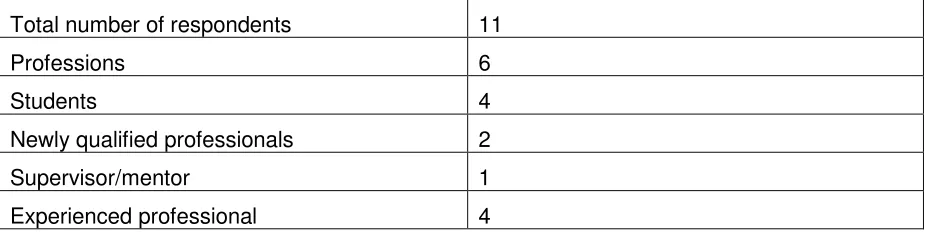
Figure two lists the professions and roles of those who responded to the tool. Whilst we were
disappointed to only receive 11 responses within the time period, we were pleased that it
represented a range of students and qualified professional from 6 different disciplines. One
respondent was mentoring a newly qualified person.
All the results were generally
favourable; all but one responded agreed or strongly agreed against all of the questions, this
would suggest that the tool does have interprofessional application, and can work as a
starting point for discussion and supervision, as well as individual reflection and
6
Figure 2: Evaluation results – professions and roles.
Total number of respondents
11
Professions
6
Students
4
Newly qualified professionals
2
Supervisor/mentor
1
Experienced professional
4
More detailed feedback identified a number of points, including relevance to practice,
different styles of communication and reflection.
The evaluation also highlighted some of the more challenging aspects of developing the
professional role, such as dealing with cultural issues, which students often state that they
feel ill prepared for once they are no longer under supervision.
Asked if there were any ‘surprises’ most respondents said no. One, however, picked up on
the emphasis on service users as a separate and important group. Service user engagement
had been an important feature of the ALPS programme, so it was good to see this reflected
here:
‘It gave opportunity to separate communication between service users and
colleagues which was useful, they are often thought of or reflected on together.’
Respondents were asked if it offered anything new or different that they could use. Most said
yes regarding the structure it could give:
‘Suggested some useful strategies in the feedback. This is different to clinical
reflections done in the past. Good to have some guidance on where you can go or
activities to help develop’.
This particular result indicates that the student involvement in developing the feedback and
signposting to support and guidance may have positively influenced the quality of the tool.
Whilst these are only limited initial results, the team feel that they offer justification for the
strategy of student collaboration.
Conclusion:
Working collaboratively did have a number of advantages for the project team: Student
insights and ideas for the generation of feedback offered a perspective that would not have
been reached by academics working in isolation. The involvement of student technologists
allowed for a flexibility of approach and the input of fresh ideas. In addition there were clear
advantages for the students, all of whom enjoyed the involvement and gained personal
confidence and employment skills, mirroring the aspirations we had for users of the CiPA
tool. The learning and skills displayed by the students were similar to those identified by
Osman et al (2011). More structured evaluation of the student experience is being built in to
subsequent projects.
7
Firstly, the interaction with the students during the development of the responses to the tool
was significant. We wanted to learn from them, and for this to be reflected in a tool that had
meaning and purpose to them, rather than us. We recommend this methodology to others:
giving students time and a free rein to think creatively led to a richer outcome. The tool
relates strongly to student and newly qualified professionals’ needs and concerns.
Secondly, facilitation was important – from our perspective we learned that more short
sessions over time would have been better than one big session at the beginning, as it
would have given students more time to understand the project and get to know us and the
other students
Whilst there are gains in student collaboration, there is also possible dilution of purpose.
Having given the students the framework, we had to go with their direction and could not
predict or fully control the outcome. The project team therefore need the confidence, and
flexibility of design to allow for this type of variation.
Finally, we have created what we believe is a robust and very useful tool. However, wide
ranging implementation has proved challenging, which we recognise by the small number of
responses to the evaluation so far. We have strong anecdotal feedback that the tool is fit for
purpose and value, which motivated us to create the evaluation. A limitation of this study is
that we still do not know the full extent of its use.
References
Baxter P. & Norman G
.
(2011) Self-assessment or self deception? A lack of association
between nursing students’ self-assessment and performance.
Journal of Advanced Nursing
.
67 (11)
2406-2413. DOI: 10.1111/j.1365-2648.2011.05658.x
Conway-Gòmez, K & Palacios, FA (2011): Discussing the Geography of Sustainable
Development through an International Online Collaboration with Students in Chile and the
USA.
Journal of Geography in Higher Education,
35:2, 265-279
Flying Start Programme; NHS SCOTLAND http://www.flyingstart.scot.nhs.uk accessed
13
THAugust 2012
Harpin S, Gilmore-Bykovoskyi AL (2012) Bringing students to the table: the value of student
involvement in Midwest nursing research society.
Western Journal of Nursing Research.
34
(3):287-8
Higher Education Authority (2012) What works? Student retention and success programme
http://www.heacademy.ac.uk/what-works-retention accessed 7th January 2013
Hmelo-Silver Cindy E (2004) Problem-based learning; What and How do students learn?
Educational Psychology Review Volume 16, Number 3 235-266, DOI:
10.1023/B:EDPR.0000034022.16470.f3
8
Kramer K (2005). Medical student involvement in research in the pre-clinical years.
Hawaii
Medical Journal.
64 (7): 190-1
Kruger J & Mueller RA (2002) Unskilled, Unaware, or Both? The Better-Than-Average
Heuristic and Statistical Regression Predict Errors in estimates of Own Performance.
Journal
of Personality and Social Psychology
.
82 (2)
180–188
Millard , L. and Hargreaves , J. (2013) ‘Creatively employing funding to support innovation’
Innovations in Education and Teaching International
(in press)
Osman G, Duffy TM, Chang Ju-Yu, Lee, j (2011): Learning through collaboration: student
perspectives
Asia Pacific Educ. Rev
. 12:547–558
Student Learning and Teaching network.
http://www.northumbria.ac.uk/sd/academic/sches/programmes/lt/afl/cetl_afl/engagement/net
work/studentnetwork accessed 13th August 2012.