The London School of Economics and Political Science
The development of the ASEAN Charter: Origins and norm codification
Kasira Cheeppensook
Declaration
I certify that the thesis I have presented for examination for the MPhil/PhD degree of the London School of Economics and Political Science is solely my own work other than where I have clearly indicated that it is the work of others (in which case the extent of any work carried out jointly by me and any other person is clearly identified in it).
The copyright of this thesis rests with the author. Quotation from it is permitted, provided that full acknowledgement is made. This thesis may not be reproduced without my prior written consent.
I warrant that this authorization does not, to the best of my belief, infringe the rights of any third party.
Abstract
Acknowledgements
First and foremost, I am deeply grateful to Dr. Jürgen Haacke whose supervision, continuous support and insightful feedback have been vital for the completion of this thesis. He meticulously read my work yet always encouraged and allowed me to grow intellectually, for which I am forever thankful.
I would like to thank my colleagues at Faculty of Political Science, Chulalongkorn University for their kind support as well as Chulalongkorn University for providing financial funding towards the 4-year program. In particular, the support extended from my departmental cohort (International Relations), is greatly appreciated. I am thankful to each and every one of them. To name but a few, Professor Chaiwat Khamchoo, Associate Professor Dr. Thitinan Pongsudhirak, Associate Professor Dr. Vira Somboon, Assistant Professor Dr. Natthanan Kunnamas, Assistant Professor Dr. Pranee Thiparat, Assistant Professor Dr. Puangthong Pawakapan, Assistant Professor Dr. Supamit Pitipat, and Assistant Professor Surat Horachaikul have offered words of encouragement, practical advice regarding the interviews and paper presentation.
The LSE fieldwork funding for PhD students made my trips to a number of countries in Southeast Asia possible. Pichaya Sonjai and Salakjit Manthamraksa helped facilitate some of the near-impossible interviews. I am indebted to Ambassador Rudolfo Severino, Dr. Pavin Chachavalpongpun, Dr. Ralf Emmers, Dr. Pornchai Danvivathana, Ambassador Manassawee Srisodapol, Dr. Makarim Wibisono, Dr. Surin Pitsuwan, and Dr. Termsak Chalermpalanupap for the work I was allowed to do at the Institute of Southeast Asian Studies (ISEAS), the S. Rajaratnam School of International Studies (RSIS) in Singapore, the Department of ASEAN Affairs, Ministry of Foreign Affairs in Thailand, the Permanent Mission of Thailand to ASEAN, the ASEAN Foundation and the ASEAN Secretariat in Jakarta, respectively. I would also like to thank the helpful staff at the ISEAS library.
Dr. Pontep Tanakoses, Dr. Thanthira Porntaveetus, Dr. Yajai Bunnag, Akareeya Ngamwongpaiboon, Chalongkwan Tavarayuth, Jiraporn Laocharoenwong, Narumon Thanomsingh, Natthapol Na Songkla and his wife Wichawan, Pawat Satayanurug, Phacharaphorn Phanomvan na Ayuttaya, and Piyapong Boosabong provided emotional and intellectual support, among other help. My thanks go to Chaiyawit Terawitchanun, Chaturawit Thongmueng, and Narongdech Phantapoommee for friendship. I would also like to thank Gritiya Ace Rattanakantadilok for reminding me that a PhD student also needs a laugh every once in a while with her best friend.
Last but not least, my mom, dad, and sister are always there for me. I am truly thankful for their unwavering belief in me throughout this journey and the weekly telephone calls which could brighten even the darkest of London days. They are with me every step of the way.
Table of Contents
List of Acronyms……….….11
List of Tables………..………….13
Chapter 1 Overview of the research project 1.1 Introduction……….………14
1.2 Research Question………16
1.3 Context of the study and its significance……….………..16
1.4 Overview of theoretical framework and methodology……….………19
1.5 Structure of thesis………26
Chapter 2 Arguing, Bargaining, and norm codification 2.1 Introduction……….………30
2.2 Norms and law-making: the rationalist VS constructivist account………….………..33
2.21 The rationalists……….33
2.22 The constructivists………37
2.3 Constructivism in Southeast Asian Studies………40
2.4 Role identity……….…..53
2.5 Norms, rules, and institutions………56
2.51 Norm definition………56
2.52 Norm robustness………..60
2.53 Tacit and explicit rules………..62
2.54 Norms in the first-, second-, and third-party contexts……….65
2.55 Norm diffusion………..67
2.56 Institutional institution as social setting and norm entrepreneurs…….70
2.61 Arguing and communicative action………..76 2.62 Bargaining and strategic action……….………94 2.63 Conceptual operationalisation: norm codification and legitimization in multilateral negotiations……….96 2.7 Conclusion……….………102
Chapter 3 ASEAN’s lifeworld: Exploring core norms in the ASEAN Way
3.1 Introduction……….105 3.2 ASEAN as a social setting……….106 3.21 The Great Power brainchild: SEATO and its demise, 1954-1977……...107 3.22 The ASEAN ‘in-betweens’: ASA and MAPHILINDO, 1961-1967……..….113 3.23 Lessons learned?: ASEAN, 1967-present……….115 3.3 The ASEAN Way as a shared ‘lifeworld’………..……….119 3.31 Sovereign equality………..………125 3.32 Non-recourse to the use of force and peaceful settlement of conflict……….126
3.33 Non-interference and non-intervention…….………126 3.34 Non-involvement of ASEAN to address unresolved bilateral conflict between members……….……….127
3.35 Quiet diplomacy………127 3.36 Mutual respect and tolerance……….128 3.4 Contestations over the core norms prior to the drafting of the ASEAN Charter……….129 3.5 Conclusion……….134
Chapter 4 Formulating the ASEAN Charter: Setting up ‘rules of the game’
4.2 The need for explicit rules: The origin of the ASEAN Charter………..136
4.21 Key documents leading to the drafting of the ASEAN Charter…………136
4.22 The necessity for explicit rules codification in the ASEAN Charter……139
4.3 Setting up rules of the game: On establishing the EPG and the HLTF……….143
4.31 Mandates to establish the EPG and the HLTF………….………143
4.32 Rules of the game for the negotiators: How the HLTF operated………146
4.4 The role of non-state actors: constructing an artificial lifeworld? ...161
4.5 Conclusion………166
Chapter 5 Dispute Settlement Mechanisms in the ASEAN Charter 5.1 Introduction……….168
5.2 Peaceful settlement of conflict in ASEAN……….169
5.3 Dispute settlement mechanisms in ASEAN……….176
5.31 Dispute settlement mechanisms in economic area……….178
5.32 Dispute settlement mechanisms in political area………..181
5.4 Formulating Chapter VIII Settlement of Disputes in the ASEAN Charter………..185
5.41 Enshrining peaceful settlement of disputes: ‘ruling out’ the mechanisms………...185
5.42 Enshrining peaceful settlement of disputes: ‘ruling in’ on the mechanisms……….……….199
5.43 Final result in the ASEAN Charter: The institutionalized dispute settlement mechanism and the way forward………..……….208
5.44 Testing the setting that arguments will prevail: Chapter VIII in retrospect………..217
5.5 The Cambodian-Thai border dispute: Testing ASEAN’s limits………219
5.51 Background………219
5.6 Conclusion……….225
Chapter 6 Human Rights and its mechanism in the ASEAN Charter 6.1 Introduction………..………229
6.2 Human Rights in ASEAN………..…….230
6.21 Human rights development in post-Cold War Southeast Asia………….230
6.22 The role and impact of NGOs and CSOs………..……….237
6.23 The effects of the 1997 economic crisis on human-centric norm: Increased acceptance and codification……….……….245
6.3 The development of human rights mechanism in ASEAN……….…………..249
6.4 Codifying human rights and other human-centric norms in the ASEAN Charter………..252
6.41 Human rights in Preamble, Article 1 Purposes and Article 2 Principles………....252
6.42 ASEAN Human Rights Body in Article 14………..………254
6.43 Testing the setting that arguments will prevail: Article 14 in retrospect……….………...……….266
6.5 Conclusion……….………268
Chapter 7 Final Remarks 7.1 Summaries of findings and research question revisited………269
7.2 The contribution………..……….277
7.3 Possible avenues of future research………283
7.4 Final remarks………285
APPENDICES……….……….319
A. The ASEAN Declaration……….………..319
B. Terms of Reference of the Eminent Persons Group (EPG) on the ASEAN Charter………..323
C. Terms of Reference of the High Level Task Force on the drafting of the ASEAN Charter (HLTF)………..………327
D. Charter of the Association of Southeast Asian Nations………..…….329
Annex I ASEAN Sectoral Ministerial Bodies………..………..356
Annex II Entities Associated with ASEAN……….……….360
Annex III ASEAN Flag………364
List of Acronyms
ACC ASEAN Coordinating Council AEM ASEAN Economic Ministers AHRB ASEAN Human Rights Body
AICHR ASEAN Intergovernmental Commission on Human Rights AICOHR ASEAN-ISIS Colloquium on Human Rights
AIPA ASEAN Inter-Parliamentary Assembly AIPO ASEAN Inter-Parliamentary Organization AMCC ASEAN Ministerial Coordinating Council AMM ASEAN Ministerial Meetings
ASC ASEAN Standing Committee
ASCCO ASEAN Political-Security Community ASEAN Association of Southeast Asian Nations
ASEAN-ISIS ASEAN Institute of Strategic and International Studies ASEC ASEAN Secretariat
ASEM Asia-Europe Meeting
CLMV Cambodia, Laos, Myanmar, Vietnam CPR Committee of Permanent Representatives EPG Eminent Persons Group on the ASEAN Charter HLP High Level Panel
HLTF/HLTF-AC High Level Task Force on the Drafting of the ASEAN Charter
ICJ International Court of Justice NGO Non-Governmental Organization NHRI National Human Rights Institution PMC Post-Ministerial Conference
SEATO Southeast Asia Treaty Organization SEOM Senior Economic Officials Meeting SOM Senior Official Meeting
TAC Treaty of Amity and Cooperation TOR Terms of Reference
UN United Nations
List of Tables
Table 1 Types of arguing and bargaining………..95
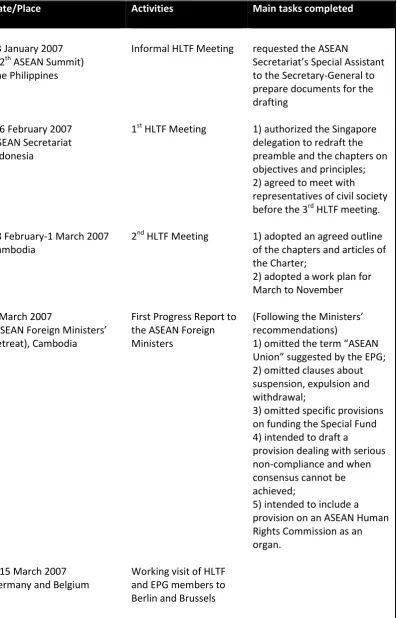
Table 2 Members of the HLTF on the ASEAN Charter, January to November 2007………145
Chapter 1
Overview of the research project
1.1 Introduction
The purpose of the thesis is to explore the development of the ASEAN
Charter which introduces a departure from some of the former norms and
practices ASEAN (the Association of Southeast Asian Nations) used to stand
by. It aims to understand how the codification of norms in the Charter
reflects upon the core norms in the ASEAN Way and set different standards
of behaviour for ASEAN members in the future. The thesis thus posits that
the core norms in the ASEAN Way (as instrumental parts in a shared lifeworld
of ASEAN) undergo the process of norm contestation in the form of arguing
and bargaining during the development of the ASEAN Charter which must be
tested against a social setting, and may result in change of norms and/or
practices prescribed by the Charter.
After discussing in detail the conceptual framework, background of
ASEAN as a social setting and rules of the game in drafting the text, the thesis
examines two very distinctive propositions in the ASEAN Charter which are
the increased authority of ASEAN officials in settlement of disputes and the
establishment of ASEAN Human Rights Body. Both are unprecedented in the
sense that ASEAN generally prefers non-involvement in unresolved bilateral
minimal institutionalism. ASEAN is governed by a set of core norms
embedded in its diplomatic and security culture, sometimes known as the
ASEAN Way. However, some core norms matter more than others. Some can
be watered down, became weaker, less essential. Some are stronger when
facing contestations, and therefore still remain. The drafting process of the
ASEAN Charter also involves norm contestation where actors argue or
bargain their way through.
According to Finnemore (1996), norms are shared expectations about
behaviour held by a community of actors. Kratochwill (1989) sees norms as
standards of behaviour defined in terms of rights and obligations. ASEAN
norms refer to both shared expectations and standards of appropriateness
about ASEAN members’ behaviour. The norms of interference,
non-intervention, and pacific settlement of disputes are formally embedded in a
number of ASEAN documents, i.e. the ASEAN Declaration, the Treaty of
Amity and Cooperation in Southeast Asia, and the Declaration of ASEAN
Concord. Some of the norms are unwritten but equally essential to interstate
relations among member countries such as adherence to informal, quiet
diplomacy and mutual respect and tolerance.
While state-centric concept of security (by the strict adherence to the
concept of non-intervention and state sovereignty) is uphold, the Charter
community enhanced by more concrete mechanism in pacific settlement of
disputes and human rights promotion and protection. Before the Charter and
a few Declarations leading towards the drafting of the Charter, no ASEAN
documents have challenged the core norms of non-involvement of ASEAN to
address unresolved bilateral conflict between members or explicitly codified
human rights. The Charter is therefore an important source to study recent
norms development, contestation, and codification in ASEAN.
1.2 Research Questions
The central research question will include:
- How have the ASEAN core norms manifested in the ASEAN Way been
affected through the process of norm contestation in the development of the
ASEAN Charter?
- Does the social setting of ASEAN allow for the use of arguments?
1.3 Context of the study and its significance
During the creation of several short-lived regional architectures and
the birth of ASEAN in the 60s, there was a lack of scholarly interest from
framework. The works were not “theoretically self-conscious” (Huxley 1996,
207) although they largely adopted realist assumptions in their arguments.
For example, Michael Leifer’s (2005) valuable contributions on the region. In
the 80s, the focus of the study shifted towards intra-regional cooperation
and how to manage conflicts within the region (Jorgensen-Dahl 1982). This
was in part due to ASEAN’s success in opposing Vietnam’s occupation of
Cambodia in international arena such as the United Nations.
The realist tradition was apparent at least until the Cold War ended
where we saw more theoretical pluralism in the study of Southeast Asia. The
works of the past two decades are also more theoretically informed,
attempting to test various international relations theories – constructivism
being the most popular – on Southeast Asia and its regional organization
(Busse 1999; Eaton and Stubbs 2006; Narine 2006; Peou 2002; Tan 2006).
The development of the region in general and ASEAN in particular as a
theoretical testing ground demonstrated the scholars’ preoccupations with
security in the study of Southeast Asia. Several concepts related to security
were applied to and tested against the region’s affairs. These include
“security complex” (Buzan 1988), “security community” (Acharya 1991;
2009b; Simon 1988), “security regime” (Wiseman 1992), cooperative security
and balance of power (Emmers 2003; Leifer 1999). However, this exercise
was not entirely confined to the realist realm of dominance. Taking the
attention as means to a more complete explanation of Southeast Asian
affairs (Acharya 2006). Social communication in the form of negotiation is the
valuable source for constructivist studies since it supplies the foundation
where intersubjective reality exists. This is where actors reach consensus of
constructing meaning for a contested norm. Constructivism is, after all, the
view that the manner in which the material world shapes and is shaped by
human action and interaction depends on dynamic normative and epistemic
interpretations of the material world (Adler 1997, 322). While the thesis
benefits from the literature of norm studies and social constructivism, it
constitutes a distinct contribution to the area of regional norm building as
well as Southeast Asian Studies through a detailed analysis of an important
development in the region, attempting to study it systematically. Moreover,
the thesis benefits from primary source of records of all the Meetings of the
drafters throughout the process. The records were kept at the ASEAN
Secretariat and the access was not granted prior to this study.
Since the ASEAN Charter was ratified fully in December 2008, there
have been few attempts to study the development and contribution of the
Charter, not to mention its normative value. Studies relevant to the
formulation of the ASEAN Charter are limited. ‘The Making of the ASEAN
Charter’ (Koh, Manalo & Woon, 2009) is a useful source, but is “a record of
the impressions of the drafting process by members of the High Level Task
academic void of theoretically-informed work on the development of the
ASEAN Charter and its normative reflection on the current core norms.
The thesis intends to fill that gap. The drafting of the ASEAN Charter
from January to October 2007 was in a relatively closed space. There were
some interactions with academics, other delegations and civil society, but
their influences were limited and the text was kept confidential until after
the signing. Moreover, the Summary Recordings of the Meetings were also
classified and kept at the ASEAN Secretariat in Jakarta. Only the end result of
the negotiation was disclosed at that time. Fortunately, my request to access
the Records for the study was approved by the Head Political Officer who
used to preside over the drafting. The documents still cannot leave the
Secretariat, but I was allowed to incorporate relevant parts into the research.
The thesis therefore aims to clarify the formulation process of the Charter
with special regard to provisions dealing with increased authority of ASEAN
officials in settlement of disputes and the establishment of ASEAN Human
Rights Body through those new materials as well.
1.4 Overview of theoretical framework and methodology1
1
Dealing with norms change, the thesis is situated within social
constructivism in international relations, bearing in mind that
constructivism’s importance and its added value for the study of
International Relations lie mainly in its emphasis on the ontological reality of
intersubjective knowledge and on the epistemological and methodological
implications of this reality (Adler 1997, 322-323). The thesis leans towards
the critical strand of social constructivism, problematizing power (while the
conventional strand is more analytically neutral to the distribution of power)
in the relations as well as the role of actors regarding change. Although the
importance of norms is not ignored by rationalist approaches, constructivism
allows for a deeper understanding of norms in shaping states’ behaviours by
explaining the constitutive effect of norms or how norms create identities,
define and redefine interests (Katzenstein 1996; Finnemore 1996). When the
constructivist analysis starts, some reality has already been made and is
taken as given (Zehfuss 2002). It then proceeds to examine the change in that
‘social reality’. Constructivists also stress the importance of shared practice
deriving from social interaction. The international system is seen as socially
constructed through practices, in particular diplomatic practices (Guzzini
2000, 169), which constitute an important element of our subject of interest.
The social environment does not only shape actors’ identities and interests,
but it is also shaped by actors within that environment (Wendt 1994; 1998).
they assume interests as a given. This could prevent the meaningful study of
the change deriving from the states’ interactions (Wendt 1992). The core
norms in the ASEAN Way are internalized in ASEAN member countries, but
this does not mean that it is fixed and unchangeable from the constructivist
point of view.
Although the literature concerning norms diffusion and socialization is
robust (Finnemore 1993; 1996; Finnemore and Sikkink 1998; Katzenstein
1996; Keck and Sikkink 1998; Klotz 1995; Kratockwill 1989; Risse, Ropp, and
Sikkink 1999) with different focus on external actors vis-à-vis domestic ones
and various case studies, there are few academic attempts (Acharya 2009a;
Johnston 2003; Katsumata 2003; Katzenstein 1997) to study the norm
dynamics in Southeast Asia in general and ASEAN in particular comparing to
the European continent and the European Union (Checkel 2001; 2003; 2004;
2007; Christiansen, Jørgensen, and Wiener 2001; Hopf 2002; Risse 2004). The
thesis strives to contribute to the body of knowledge of norm codification in
the ASEAN context.
Emphasizing agency, Acharya (2009a) focuses on the role of norm
takers that he regards as more important. The external norms will have to
undergo modifications by the local norm-takers who will build congruence
between the local and external norms. He terms this process “constitutive
study of norms dynamics and should not be portrayed as passive. ASEAN
members are definitely not passive norm takers since there were debates
regarding new and controversial norms such as human rights since the 90s.
Johnston (2003) also contributed to the understanding of the normative
environment that can facilitate actors’ persuasion by proposing the four
‘ideal combinations’ that should be present in the social environments. These
are
1) the actor is highly cognitively motivated to analyze
counterattitudinal information (e.g. a very novel or potentially
threatening environment);
2) the persuader is a highly authoritative member of a small, intimate,
high effect in-group to which the persuadee also belongs or wants to
belong;
3) the actor has few prior, ingrained attitudes that are inconsistent
with the counterattitudinal message;
4) the agent is relatively autonomous from principal (e.g. when issue is
technical or issue is ignored by principal).
Similar suggestions of the conditions facilitating persuasion were also
1) the target of the socialization attempt is in a novel and uncertain
environment and thus cognitively motivated to analyze new
information;
2) the target has few prior, ingrained beliefs that are inconsistent with
the socializing agency’s message;
3) the socializing agency/individuals is an authoritative member of the
in-group to which the target belongs or wants to belong;
4) the socializing agency/individual does not lecture or demand, but,
instead, acts out principles of serious deliberative argument; and
5) the agency/target interaction occurs in less politicized and more
insulated, in-camera settings. (Checkel 2007a)
The literature on ASEAN negotiation cultures (Antolik 1990; Ba 2009a;
Koh, Manolo, and Woon 2009; Severino 2006; Thambipillai and
Saravanamuttu 1985) are also useful for exploring the negotiating style which
fosters and preserves the core norms in the ASEAN Way. ASEAN is more
familiar with the “high context” negotiating style. Cohen (1991) suggests that
in non-Western cultures, group interests define individual needs. “Face” or
one’s standing in the eyes of the group must be preserved. Personal
relationships are key to the negotiation and must be cultivated before there
principles, preferring to work on details later, once personal relationships are
solidified. In the case of ASEAN Charter formulation, personal relationships
are highly important. They even nicknamed one another; for example, “the
King of Footnotes”, or “the King of Questions” (Pibulsonggram 2009, 90). This
is opposite to “low context” cultures in Western countries where
individualism is strong. Straight talk is admired. Face does not carry the same
importance as in a high-context culture. The provision or articles formalized
will also be more detailed than those negotiated in the high context cultures.
The thesis bears in mind that ASEAN’s negotiating style informs the drafting
process of the ASEAN Charter. The conceptual framework regarding mode of
communication (arguing and bargaining) as well as the norm robustness will
be discussed more in Chapter 2 when we turn to explore in detail the
theoretical framework underpinning the thesis.
There have been attempts to propose constructivist methodology by
combining a number of social methodologies such as process tracing,
discourse analysis, and counterfactuals as well as contextualizing the
phenomenon. (Klotz and Lynch 2007; Lupovici 2009; Pouliot 2007)
Recognizing the intrinsic interpretative and historical nature of
constructivism, the thesis looks at numerous sources of primary data such as
ASEAN official documents, declarations, agreements, reports from summits
and ministerial meetings. It benefits in particular from difficult-to-access
the ASEAN Charter and multiple versions of its drafts, including the minutes
of the drafting panel’s meetings and issues tabled by the panels’ assistants.
Relevant memoirs, interviews, speeches, and news articles are also used.
Elite interviewing is given importance as crucial to constructivist studies
(Tansey 2007). Defining elite members as those who decide on or influence
policy making process, I managed to secure interviews of some HLTF
members, their alternates, and an ASEAN Secretariat official who
represented Secretary-General Ong Keng Yong at the Meeting. I also
interviewed the officials relevant to the ASEAN Charter provision on
authority of ASEAN in mediation such as Secretary-General Surin Pitsuwan
and a high level government official. The questions asked are mostly
open-ended to enable comfortability in answering some sensitive issues. Most
interviews took the form of (guided) conversations. I took great pleasure
interviewing them bearing in mind that there was only one occasion for each
interview considering their busy schedules – one interview even occurred at
the back of the car while the interviewee was rushing to another meeting.
Some of the elite interviewees asked to remain anonymous but granted
permission to be quoted in the examination thesis. The interviews are off the
record, meaning there was no taping allowed, (although notes were
permitted). I would omit their names in the version deposited in the public
domain as per their requests. I would also include the nationality of the
1.5 Structure of thesis
The contents of the thesis are divided into seven chapters – an
introduction, a conceptual framework, a background chapter setting up the
organization as a social context, an analysis of the drafting process and its
‘rule of the game’, in-depth examination of the two provisions that are
virtually unprecedented in ASEAN interstate conduct and how they reflect
upon the core norms of ASEAN, and the conclusion.
Chapter 2 deals with the conceptual framework for the study in detail.
It draws on social constructivism and Habermasian concept of lifeworld in
order to constitute understanding for shared concepts among the
negotiators. It begins by outlining how rationalist accounts treat norms with
a special reference to legalization to demonstrate its inadequacy in
explaining the outcome of the Charter negotiation. It will then contextualize
the thesis in social constructivism with brief accounts of constructivist
scholarship concerning the region with special reference to the critical strand
of social constructivism. Varying degree of norm robustness which
contributes to the need to formulate tacit rules into explicit ones will be
addressed. The chapter then proceeds to explore arguing and bargaining,
showing that the concepts are not mutually exclusive before further
from Habermasian insights, the concept of lifeworld will be employed to
enrich the conceptual analysis of arguing and bargaining.
Chapter 3 will provide the background on ASEAN as a social and
normative context in which the ASEAN Charter was negotiated. It explores
regional cooperation in Southeast Asia prior to ASEAN in detail, starting from
the 1950s during the Cold War. This will also shed light to how the governing
core norms that came to be embedded in ASEAN have been developed and
tested through time. Through the creation and demise of regional
organizations prior to ASEAN, a set of norms also evolved. It will then
examine the core norms constituting the ASEAN Way in detail as well as trace
some contestations over the core norms prior to the drafting of the ASEAN
Charter. The chapter establishes the ASEAN Way as the most manifested part
of a shared lifeworld in ASEAN.
Chapter 4 answers why ASEAN leaders agree to transform what used
to be implicit principles into explicit rules. It deals with the need to codify
governing core norms in ASEAN in written form. The ‘rules of the game’, how
the drafters went about drafting the Charter under common understanding
of expected behaviour, is then laid out. Last but not least, the role of
non-state actors as norm entrepreneurs interacting with the existing lifeworld,
creating an artificial lifeworld as a way to provide and extend the normative
Chapter 5 examines Chapter VIII Settlement of Disputes of the ASEAN
Charter. It begins by exploring peaceful settlement of conflict in ASEAN then
proceeds to dispute settlement mechanisms in ASEAN. Both existing dispute
settlement mechanisms in economic area and political area are analyzed. The
formulation of Chapter VIII of the ASEAN Charter is then examined and the
setting that arguments will prevail tested. The case of Cambodian-Thai
dispute is analysed in order to demonstrate increased authority of ASEAN in
dispute settlement, which was different from before.
Chapter 6 focuses on the codification of human rights as a norm in the
ASEAN Charter and the controversy around establishing an ASEAN Human
Rights Body. It starts by exploring human rights development in Post-Cold
War Southeast Asia in order to provide a backdrop for the analysis.
Interactions with international norm are also examined. It then explains the
1997 economic crisis as a window of opportunity for human centric values to
gain a firmer ground in the region. The development of human rights
mechanism in ASEAN is traced and the formulation of Article 14 analysed.
The social setting that arguments will prevail is also tested.
Chapter 7 summarises key findings throughout the work referring back
to the research questions set at the beginning of this project. It emphasizes
Southeast Asian and in particular ASEAN studies. Further avenues for future
Chapter 2
Arguing, bargaining, and norm codification
2.1 Introduction
This chapter aims to establish an analytical framework to study how
ASEAN’s diplomatic and security norms have been contested through the
drafting process until they were finally codified (and therefore legitimized) in
the ASEAN Charter. In order to account for the process by which particular
outcomes – the reinforcement of norms that ASEAN members consensually
deemed essential to an effective and successful operation of the organization
– occur, it is important to look at how contested norms were dealt with
during the negotiation of key provisions. The final Charter stands as a
milestone in ASEAN’s cooperation, the most concrete attempt to formally
codify diplomatic norms in ASEAN so that all members must follow them ‘as a
rule’. However, little is known of how norms and principles were included in
or dismissed from the text.
The normative contestation process is mainly associated with arguing
and bargaining about what should be included in the Charter during the
drafting process. Clearly conceptualizing arguing and bargaining can provide
insights to how the two main provisions in the Charter come to look like they
do now. Norms that have undergone exhaustive debates characterized by
in the Charter were normally more robust. They should be able to weather
further contestations in the future better than those imposed (or omitted) by
power where bargaining was the preferred mode of communication. Robust
norms put in place through reason-based argumentation usually signify ‘true’
internalization rather than adaptive behaviour.
In negotiating a particular provision, actors aim at changing others’
position while seeking to protect their own or reaching mutual
understanding while preparing to also change their former position. It can be
said roughly that they bargain in the former cases and argue in the latter;
however, these two types of social decision-making procedures are not
mutually exclusive in real-world political negotiations. Actors engaged in
bargaining often argue to justify their position. We need to pay attention to
not only whether actors justify their positions, but also for what reasons.
Therefore, conceptualizing arguing and bargaining does not only entail the
difference between the two but also the difference between arguing for
one’s own interests (which is only rhetorical) and arguing for better
understanding of the ‘right’ course of action. Bargaining must also be
distinguished further as this chapter will later clarify.
Formulating the ASEAN Charter can be seen as transforming some of
the formerly tacit rules and norms in ASEAN into explicit ones. In other words,
into written documents is the starting point of the ASEAN Charter and must
be analysed in order to provide a complete picture of the development of the
Charter. Thus, the framework that would be useful to the study must deal
with 1) why actors choose to resolve commonly perceived problems in the
way they do (in this case, creating a legally binding instrument which goes
against former practices) and 2) why actors choose to justify their arguments
in particular ways during the creation of said instrument (when do they see
that they should opt for different types of arguing and/or bargaining?)
Since creating the ASEAN Charter is, after all, law-making with high
costs for all actors involved, rationalist accounts are relatively insufficient in
explaining the negotiating outcome. In particular, neoliberal institutionalists
argue that the most difficult area to achieve cooperation is when actors
prefer cooperation but are still reluctant to sacrifice unilateral gain (in this
case, to be free from binding legal obligations). When states enter
agreements despite its costliness from a rationalist’s viewpoint, they may
perceive other gains in terms of increased reputation as norm-subscribers.
Their cumulative action could emerge out of a long process of norm
socialization. To the extent that rationalism often downplays independent
explanatory power of norms and their influence on state actions,
constructivism provides a more satisfactory approach in explaining norms
evolution in ASEAN through the ASEAN Charter formulation. Problematizing
constructivism thus provides a guiding theoretical framework for the study.
The thesis still benefits from the foundation of social constructivism, but
leans towards the critical strand in the analysis of the ASEAN Charter
development.
The thesis takes ASEAN as a social setting where the negotiation
leading towards the Charter took place. The negotiators shared collective
norms and experiences in ASEAN diplomacy which provided common
background for them. In explaining this backdrop or shared normative
understandings, the dissertation benefits from Habermasian concept of
lifeworld. The analytical framework thus takes that arguing and bargaining
existing against culturally transmitted stock background knowledge
conceptualized in Habermasian ‘lifeworld’ provides an insight into the
process of norms and rules legitimization and codification in the critical
constructivist framework which holds that norms are inherently contested. It
will then proceed to test whether arguments prevail in a particular setting.
2.2 Norms and law-making: the rationalist VS constructivist account
2.21 The rationalists
Rationalist perspectives which emphasize utility-maximization are
preferences can be influenced, the actors’ interests remain fixed. Structural
realists, including neorealist institutionalists, often see that norms have very
little impact on states on their own: they possess no independent
explanatory power. Based on the self-interested calculation of great powers,
they are only a reflection of the distribution of power in the international
system or the hegemons’ national interests/values. The norms are usually
positioned as the intervening variables or intermediate variables between
the interests and outcomes in world politics (Mearsheimer 1994-5, 7; Krasner
1983; 1985; 1993). The norms are seen to reflect, rather than shape, a
strategic reality determined by the great powers’ decisions (Desch 1998).
Norms are not constitutive of the interests during the process of interaction.
March and Olsen (1998, 949) terms this the “logic of expected
consequences”. Based on a model of utility maximization, actors choose
options that best serve their (material) objectives and interests. Only
obligations that are created through consent and contracts based calculated
consequential advantage are recognized. Therefore, norms play very little
role in influencing those decision-makings.
Neoliberal institutionalists give more weight to the role of norms on
state behaviour albeit in the regulatory, and not constitutive, sense
(Goldstein and Keohane 1993; Keohane 1984; 1989). The state will be willing
to follow a norm if its interests are furthered or there are sanctions involved.
and benefits are weighed. Hard law reduces transaction costs of subsequent
interactions, strengthens the credibility of commitments, reduces the
possibility of cheating and resolves problems of incomplete contracting
(Abbott and Snidal 2000). At the same time, hard law constrains sovereignty
and autonomy as a result of legal obligations of rules. Therefore, in creating
hard law, the benefits must outweigh the cost in neoliberal views. It cannot
really explain the case where it seems that costs outweigh benefits, and fails
to capture legalization and norm codification as a social process whereby
actors attempt to coordinate their actions while realizing that their interests
are fluctuant in order to reach mutual understanding.
In a rationalist account, a norm change might as well result from the
changes in great powers’ interests or the costs and benefits calculation.
Rationalists see that communication - the exchange of information - can be in
an actor’s interest, depending on his/her bargaining position. It can lead to
the restructuring of the preference order. However, communication is not
used to build trust about the authenticity or honesty of the speaker. To
signify that the speaker really means what he/she says, it must be
accompanied by signs like promises or threats (Fearon 1997). This leaves a
void when the audience is convinced of the speaker’s arguments despite the
lack of tangible signals. Rationalists are particularly lacking when it comes to
the case where a state still chooses to follow a norm even if it cannot gain
entrepreneurs”, such as non-governmental organizations in proposing,
sustaining, and circulating certain norms among state actors.
Viewing the ASEAN Charter through a rationalist lens, it can be argued
that the Charter either originated from the members’ desire to constrain and
control one another, or that the benefits of having a hard law in place must
enormously outweigh the costs. However, that might not be the case given
that ASEAN member countries have always guarded their sovereignty,
avoiding binding legal agreements and resisting the involvement of the
regional organization in members’ affairs. Nonetheless, the Charter was
created despite the cost.
Moreover, in a rationalist tenet, state preferences are formed
domestically prior to the international negotiation and are quite fixed
(Moravcsik 1998). After the interstate bargaining where all preferences are
brought to the table returns results, the institutional choices are then made
to seal the outcome. Preferences formation; therefore, is independent of the
negotiation process (Checkel 2001, 556; Risse 2000, 20). The state identity is
also relatively unaffected. Material considerations are the most salient
sources of the preferences, outweighing normative considerations. However,
preferences can actually be affected by the interactions during the
negotiation. Along the same line, the source of preferences should be
factors such as the desire to portray a good image by keeping previous
commitments. This leaves us to look elsewhere for an alternative tenet to
account for norms evolution and its effects on negotiating outcomes.
2.22 The constructivists
Social constructivists (Kratochwil 1984; Onuf 1989; Wendt 1992; 1999;
Zehfuss 2002) have criticized neorealist and neoliberalist assumptions on
norms and provided a more satisfactory approach to the study of state
behaviour by recognizing changes in state identities and interests. There are
no fixed or given preferences formed independently of the interaction or
communication process (Bozdağlıoğlu 2003; Checkel 2001; Chernoff 2008,
68; Schmidt 2010). Material structures are given meaning by the social
context through which they are interpreted (Jupille et al. 2003). The
explanatory power of norms is given more importance than in the rationalist
camp. Their status can vary from intervening variables to independent
variables in explaining state behaviour. The social constructivists, to again
employ the distinction introduced by March and Olsen (1998, 949), follow
the “logic of appropriateness”, which is different from means-ends
calculations or the logic of expected consequences employed by
rational-choice analysts. The reason for following a norm is not purely to maximize
one’s own interests, but involves the perception of others and the ideational
circumstance? Rules and norms are intersubjective and sustained through
interaction among actors. Norms are also inextricably linked with actors’
identities. They define the identities, and the resulting constitutive effects
will specify what actions will cause relevant others to recognize a particular
identity (Jepperson et al. 1996). The social structures and the agents are
mutually constitutive.
Constructivists treat law-making as a social process which cannot be
reduced to mere cost-benefits analysis. The process itself is taken into
account because law is perceived to be generated based on shared values
and normative understandings. This normative dimension is not entirely
overlooked by neoliberals, but they tend to focus more on the outcomes and
effects and not the process (Finnemore and Toope 2001).
Although it is situated in the reflectivist camp, constructivism is argued
to be occupying the middle ground between the rationalists and other
reflectivists such as postmodernists because it does not reject causal
explanation or the “science” (Björkdahl 2002; Checkel 1998). However, some
social constructivists prioritize “the logic of interpretation” over “the logic of
explanation” and abandon the search for the “real causes” (Campbell 1992).
Others still see the causal explanation as instrumental to the meaningful
constitution of social reality (Checkel 1999; Laffey and Weldes 1997).
or conventional constructivists (Hopf 1998; Ruggie 1998). They distinguish
the ideas literature from the constructivist approaches. They do not want
ideational arguments to replace structural and interest-based accounts. If
anything, the ideational arguments should only supplement them. In some
cases, i.e. when studying the domestic effects of norms, structural accounts
are still more preferable (Checkel 1997b).
Critical constructivism chides the positivist element in conventional
constructivism, seeing that it is unable to criticize the boundaries of its own
understanding. Alienation and domination exist in power relationships, and
critical constructivism seeks to unmask that. Conventional constructivism
does not take its own role in producing change or constituting social entities
that they study into account, and remain analytically neutral on the issue of
power relations (Hopf 1998, 185). Critical constructivism therefore has
reservations against the scientific methods popular with conventional
constructivists such as process tracing. Instead, it turns to focus on the role of
communication and power relations in a certain social setting.
The more conventional constructivism tries to discover the causal
mechanisms, the more it loses the possibility of maintaining the ontological
openness that its interpretivist method can afford (Hopf 1998, 197). As a
matter of fact, some who employ process tracing and see its benefits also
embrace more pluralism in their works (Checkel 2007a; 2007b). The thesis
proposes to take the interpretivist turn seriously which starts from the idea
of meaningful action, the nature of studying a set of socially constructed
reality that requires an interpretation of an already interpreted world (Schutz
1962). The intersubjectivity between several actors participating in a
communicative process is essential to understand how they finally manage to
reach a consensus.
Social communications have significant effects on social relations, and
the relationship among acting, communication, and rationality is critical for
constructivists (Adler 2006, 102). Dissatisfied with the emphasis only on
instrumental rationality, they advance the notion of practical or
communicative rationality. It is tied in with communicative action theory
where actors engage in validity proving of their claims to either pursue their
interests or to convince the other party. This is where Habermasian legacy
can contribute to a constructivist account of the development of the ASEAN
Charter.
2.3 Constructivism in Southeast Asian Studies
Up to the 1990s, academic works on the region were not
“theoretically self-conscious” (Huxley 1996, 207). They are even considered
permeated the attempts to study Southeast Asia.2 Realist accounts of the
region were dominant in the study until the end of the Cold War where other
international relations theory proliferated and challenged the realist
hegemony in the discipline. Also influenced by emerging and seemingly
sustained cooperative arrangements in the region such as the launch of the
ASEAN Regional Forum (ARF) and the Asia Pacific Economic Cooperation
(APEC) forum, the works of the past two decades are more theoretically
diverse, attempting to test various international relations theories –
constructivism being the crowd favourite – on Southeast Asia and its regional
organization (Acharya 2000, 2009a; Busse 1999; Eaton and Stubbs 2006;
Haacke 2005a; Higgott 1994; Narine 2006). Still, for some (Buzan and Segal
1994; Friedberg 1993-94), realism is the most promising candidate in the
studies.
ASEAN according to realist and neo-realist perspective is toothless
since institutions are deemed unable to overcome prevailing patterns of
anarchy in the global world system (Goldschagg 2007, 12). Outcomes within
institutions merely reflect the workings of power or threat balances (Waltz
1979; Walt 1986). In a rather pessimistic view, ASEAN is deemed a prime
example of powerless ‘imitation community’ (Jones and Smith 2001; 2002):
2
ASEAN is neither a security nor an economic community, either in being or in prospect. It is, in fact, an imitation community (comparable to a fake state whose insecure and illegitimate leaders, ensconced through bogus elections or military coups, wield unrestrained power over those whom they rule). Such insecurity translated to a regional level produces a rhetorical and institutional shell. The shell delivers declarations, holds ministerial meetings, and even supports a secretariat, but beyond the flatulent musings of aging autocrats or postmodern constructivists pontificating in Track Two fora nothing of substance eventuates (Jones and Smith 2001, 285).
ASEAN’s future was deemed bleak in its security functions according
to this tenet. ASEAN as a regional institution is perceived to play a minor role
in determining regional order (Buzan and Segal 1994; Dibb 1995).
Downplaying the role of norms in a ‘realist institutionalist’ conception, Khoo
(2004, 43) states that ‘ASEAN is best explained as an institution that has
locked its members into a vicious pattern of negative interaction. The
emergent patterns of interaction are corroding ASEAN…’. Unfortunately, it is
not clear in Khoo’s view what constitutes ‘negative interaction’ apart from
his argument that ASEAN member states tend to employ extra-regional
dispute settlement mechanism. However, this neither supports his claim that
norms do not play any role when there are disputes nor the contention that
constructivism does not recognize ‘negative’ norms. Social constructivism
especially the critical strand maintains that the actors give values to the
norms in a setting, and treats norms as more flexible than a fixed concept
Other ‘realist-based’ theory such as He’s ‘institutional realism’ (2006)
sees ASEAN in a more positive light regarding managing security affairs in the
region – unlike Khoo’s (2004) ‘realist institutionalism’. Still not fully
recognizing the importance of the role norms can play, ASEAN is neither a
facilitating mechanism for cooperation nor a constitutive means for common
identity, but a balancing tool for its member states against both internal and
external security threats (He 2006, 189). ASEAN states rely on institutions to
engage in the regional balance of power. He (2006, 191) sees that neorealism
cannot explain policy orientations of ASEAN states after the Cold War. There
was no sign of balancing against the United States, an extra-regional super
power, or China, a regional great power.
Neoliberals and neoliberal institutionalists also take more optimistic
view when it comes to cooperation in ASEAN. ASEAN has potential in
managing intra-mural conflicts and plays a part in maintaining regional
stability and order (Broinowski 1982; Jorgensen-Dahl 1982, 1990; Simon
1982). However, most liberal theories of cooperation assume background
conditions, such as a shared liberal-democratic domestic environment and a
relatively high degree of mutual economic interdependence for closer
cooperation to succeed. These conditions have never been marked features
of ASEAN (Acharya 2009a). Among scholars who are dissatisfied with
employing rationalism to explain the region, Peou (2002, 120) sees that
recognition”. This is also the case for neoliberal institutionalism because the
emergence and consolidation of ASEAN took place with fairly low levels of
intra-mural transactions and interdependence (Acharya 2000, 199). Rother
(2012, 52) sees that the Asian financial crisis of 1997 also serves as evidence
that institutionalist interpretations are lacking. Little institutional building
helped ASEAN cooperate on the problem since until the 1997 crisis ASEAN
was still operating on an ad-hoc basis. The lack of empirical evidence from
the neoliberalist side made constructivism a more prominent competitor
vis-à-vis realism. Some; nonetheless, maintain that theoretical pluralism is
desirable and “Southeast Asian Studies need not be dominated by either
realism or constructivism” (Acharya and Stubbs 2006).
To be sure, constructivism in Southeast Asian studies is not without
criticism. Tsuyoshi Kawasaki (2009) challenges the constructivist approach,
characterizing it as romantic and intellectually naïve. In his view, the ARF
which is the most institutionalized forum in ASEAN can best be seen as
serving the members states’ interests and most usefully analysed through
what he terms a ‘rationalist institutionalist’ lens. Jones and Smith (2007)
claim that the empirical facts suggest that ASEAN was ‘making process, not
progress’. Yet some scholars studying the region propose English school as
‘distinct approach to understanding IR” (Narine 2006) while others (Alagappa
1998; Roberts 2011) prefer to apply the regional security complex theory
demonstrates that Southeast Asian Studies in general and ASEAN studies in
particular are far from being dominated by any homogenized theoretical
tenet.
Lee Jones’ work (2012) attempts to explain ASEAN and intervention
within the region from the perspective of political economy, aiming to
“transcend the dominant realist-constructivist debate on ASEAN” (2) and
demonstrate that the principle of non-interference is not as sacrosanct as
one might think. Non-interference can be invoked and discarded by powerful
social groups in the state to defend their particular interests. He argues that
the principle of non-interference is applied in a much more flexible way on
the ground and cites examples such as East Timor and Cambodia pre- and
post-Cold War. ASEAN’s involvement in intra-regional conflicts was also
studied by Alagappa (1993) who highlights ASEAN’s successful intervention in
the Cambodian conflict. Jones contends that constructivists have “incentive
to minimize evidence of norm violation” (2012, 5) in order to prove that
norms matter.
However, norm deviation does not mean abandonment of the norm.
Rather, it is a test of said norm (Acharya 2009a). Certain norms might come
out weaker or stronger after the process of contestation, but it also depends
on the perception of member states in a community to determine its validity.
overlook cases where actors follow, invoke or discard norms regardless of
material interests, but from other reasons such as reputation.
Non-interference in mainly considered intra-mural norm in ASEAN’s diplomatic
and security culture (Haacke 2003), to be employed mainly among members
in the organization. When ASEAN ‘intervened’ in the case of Cambodia during
the Cold War, neither Cambodia nor Vietnam was a member of ASEAN. Alice
D. Ba (2005) also made similar arguments when she replied to Khoo (2004).
Moreover, Ba argues that there are exceptions to rules even in wider context
such as when the cases involve military aggression or self defense. ASEAN’s
response to Vietnam’s actions in Cambodia is complicated by questions
about aggression and about Vietnam as a non-ASEAN member whose
intentions were furthermore made suspect by its past statements and
actions toward ASEAN (Ba 2005, 258). It can be seen that the organization is
acting on a security issue in the region and not on a particular member. If the
power of norms is just an ‘excuse’ for constructivists to highlight its
importance, the norm that is viewed to be often violated would not be
incorporated readily when ASEAN members created a legally-binding
instrument which codifies norms they deemed salient and valid in the form
of the ASEAN Charter.
Social constructivism provides welcome value-added insights to the
explanation of various phenomena in the region by emphasizing the role of
theoretical approach in the 1990s, scholars have come to study the culture,
ideas, and values guiding Southeast Asian interstate relations among other
interests. Constructivism challenges uncritical acceptance of the balance of
power system posited by realist and neo-realist scholars as the basis of Asian
regional order by giving greater play to the possibility of change and
transformation driven by socialization (Acharya 2008, 72). The development
of the Asian values, often grouped together as the ASEAN Way when dealing
specifically with the regional organization, and the regional identity are taken
into account in the analysis (Acharya 1997, 2000, 2009a, 2009b; Haacke
2005a). Earlier in the 1980s, scholars have paid attention to the impact of
norms on states’ behaviour (Davies 2013) despite the fact that they did not
bandwagon under constructivist umbrella. Donald Weatherbee (1987, 1227)
highlights the established norms of intra-ASEAN behaviour similar to what is
known as the ASEAN Way today. Buszynski (1987, 765) analyses ASEAN’s
behaviour regarding Vietnam issue, stressing the importance of dialogue and
how ASEAN would want to instill values related to democracy such as
inclusive election in Cambodia. Constructivism then bolsters the traditional
understanding of norms, treating the power and influence of norms in a
more sophisticated manner (Davies 2013).
In studying Southeast Asian interstate norms, scholars tend to explore
the region’s history (Stubbs 2008). This reinforces Wendt’s argument that
aspect. An appropriate mode of interstate relations practiced among actors
in any normative space has usually gone through the test time and again to
see whether it still worked. If it could not properly function, then it would be
revised or replaced. ASEAN was labeled by some scholars as norm
entrepreneur, norm brewery (Katsumata 2006), norm guardian (Stubbs 2008,
455) by constructivists who emphasize the role of ASEAN in managing,
producing and reproducing regional norms.
Most constructivist accounts of the region are of the conventional
strand (Acharya 2000; 2009a; Johnston 1999; 2003). Acharya (2009a)
explores norms and socialisation in ASEAN and suggests that ASEAN is a
nascent security community. Norms are important because they are
intimately linked with the creation and maintenance of specific national, and
regional, identities (Davies 2013, 211). Social communities, ASEAN included,
rely on norms of behaviour which prescribe and proscribe legitimate and
illegitimate conduct (Acharya 2009a). Busse (1999) argues along this line
when he studies how norms influence the construction and endurance of
Southeast Asian security by providing code of conduct for the interaction of
member states as well as a set of working guidelines which set out the
procedure by which the organization would manage problems such as
Saravanamuttu (2010, 5) suggests that Acharya’s work still falls within
the broad sphere of state-centric constructivism, more or less in keeping with
Wendtian theory. He argues for dialogic interaction between civil society and
state as a way to represent competing views and missions stemming from
interests and identities of both state and non-state actors, framing the
research agenda in a more critical approach (1999). Drawing from Cox (1981),
humans are not only followers of given structures, but they also create them.
Critical constructivism also concerns with a continuing process of historical
change (Hwang 2006, 247) and recognizes that the person who studies the
subject cannot claim to be objective, standing apart from the topic. Although
the constructivist literature on the region is quite robust as outlined above,
works with critical strand are quite sparse. Tan (2006) expresses concerns
that constructivist accounts of the region might be too “essentialist” due to
its state-centrism à-la-Wendt. He sees that this is partly due to the uncritical
emulation of rationalist constructivist perspectives in International Relations
Theory. Acharya and Stubbs (2006) contend that it is not necessarily the case
that being social scientific means analysing only the role of the state and
being deterministic about norms. States (or more often, individuals acting in
the capacity of the states) are given primary focus as units of analysis, but
constructivists are also interested in the roles of other non-state actors such
as international non-governmental organizations in proposing new norms or
method in order to avoid causal determinism. To the extent that the analysis
problematizes power relations, it leans towards critical constructivism. Social
constructivist account of ASEAN in a critical strand is still not common, and
the thesis proposes to fill this intellectual and academic space in Southeast
Asian studies.
Hopf (1998) contends that the critical strand focuses more on
interrogating and unmasking power relationships unlike conventional
constructivists. Conventional constructivists have conceded that their
approach might ignore the participatory character of social science in the
construction of social reality (Wendt 2005, 211-214; Checkel 2007a, 59-61). It
might have uncritically reified allegedly fixed norms and identities (Checkel
2007a, 66-67). Simmerl (2011) thus argues that critical constructivism can be
a way out of the dilemma. According to Simmerl (2011, 5), “critical
constructivism invigorates the basic strengths of constructivism by
incorporating three aspects of post-structuralist discourse theory: focus on
language and communication; emphasis on discursive structures; and
awareness for power relations in process of construction”.
Critical constructivism understands language and discourse as
producing social reality. It departs from the logic of causal explanation of
conventional constructivism and applies interpretative methods instead
meaning. A critical constructivist research on norms thus maintains, “the
quality of norms is what actors make of it” (Wiener and Puetter 2009).
Furthermore, norm contestation in a necessary component in raising the
level of acceptance of norms (Wiener and Puetter 2009, 7). While
conventional constructivism focus on the structuring power of norms and
their influence on state behaviour (Katzenstein 1996; Risse, Ropp and Sikkink
1999), critical constructivism focus on the meaning of norms as constituted
by and constitutive of the use (Reus-Smit 2003; Weldes and Saco 1996). As
cited in Wiener and Puetter (2009, 8), Wiener (2004) sees that critical
constructivism’s “interest in relation to norms enhances the understanding of
how intersubjectivity plays out in (interactive) international relations based
on normative structures that entail meaning which is actually in use”. In an
ASEAN context, employ a conventional constructivist framework might help
us find out whether a specific norm influence policy outcome, but critical
constructivism can help us discover the change evolving from the interaction
and the power structure within the social setting that the actors make
decisions. The venue where the interactions occur is conducive to
establishing social recognition of a contested norm and social learning
remains a process involving the participating elites within the environment of
an international organization (Wiener and Puetter 2009). This leads us to
look at the negotiation as the source to study norms codification within a
place as a means to reach the constructed consensus of the norm’s meaning.
The contestation nature of norms which is a critical constructivist assumption
implies that there is an ongoing process of norm interpretation within a
social context. Wiener and Puetter (2009, 9) also sees that “the meaning
attached to a norm is likely to differ according to respective experience with
norm-use”. This is where Jones’ criticism on how constructivism
misinterprets deviation from the norm of non-intervention also overlooks.
Norms undergo process of contestation within a framework of shared
understanding (conceptualized in Habermasian ‘lifeworld’ which will be
further elaborated below in 2.6 arguing and bargaining in multilateral
negotiations), implying new contestation which could lead to change in
meaning or implementation when the situation arises. Actors neither merely
‘follow norms’, adhering to ‘norm-governed’ behaviour as conventional
constructivist account suggests, nor do they have a fixed set of interests they
must comply to in a political economic sense since interests are also socially
constructed (Weldes 1996). Critical constructivism, by problematizing power
relations and take the quality of norms as inherently contested, could
capture the dynamism of interaction among states trying out norms validity
2.4 Role identity
One of the main contributions of constructivism is the notion that
state identity fundamentally shapes state preferences and actions
(Finnemore and Sikkink 2001, 398). Wendt (1992, 1994) emphasizes
international environment as important factor in shaping state identities. For
Wendt (1999), identities’ roots can be found in an actor’s self-understandings
as well as the recognition of other actors. Identity is constituted by views
“held by the Self and held by the Other” (1999, 224). This idea was in
accordance with Holsti’s (1970). Attempting to incorporate the concept of
role into the analysis of foreign policy, Holsti sees that “national role
conceptions are also related to, or buttressed by, the role prescriptions
coming from the external environment” (1970, 246).
Wendt (1999) discusses four kinds of identities: personal or corporate;
type; role; and collective:
1) Personal or corporate identities are constituted by “the
self-organizing, homeostatic structures that make actors distinct entities” (Wendt
1999, 224-225). The construction of this identity in personal actors involves a
sense of personal Self. Its construction in corporate actors also requires a
sense of group Self through the formation of a joint narrative of selves
intrinsic, self-organizing qualities that constitute actor individuality” (Wendt
1994, 385).
2) Type identities are social categories of states that share some
characteristics, such as regime types or forms of state (Wendt 1999, 226).
Type identities are influenced by international social structure since the
perception of the international society can change over time. For example,
colonized states and absolute monarchical states might be viewed as less
legitimate forms of state nowadays. International values might dictate
democracy as more desirable than authoritarianism. States can have multiple
type identities, be it democratic, capitalist, Asian.
3) Role identities are social – the product of dyadic relationships
among countries and exist in relation to others (Finnemore and Sikkink 2001,
399). They rest on shared expectations (Wendt 1999, 27). Wendt defines ro