Developing business students' employability skills though working in
partnership with a local business to deliver an undergraduate mentoring
programme.
Dr Denis Hyams-Ssekasi, University Campus Oldham, Oldham College
Sue Spence, Careers and Employability Service, University of Huddersfield
Structured Abstract
Developing business students' employability skills though working in partnership with a local business to deliver an undergraduate mentoring programme.
Purpose
Working collaboratively with local business is vitally important in the delivery of Higher Education in Further Education. This study aims to explore an effective way of engaging local employers to enhance the employability skills of students through a closely monitored and supported mentoring relationship. The project was developed in order to address the employability needs of final year business students at a higher education facility offered by a college situated in the North West of England.
Design/methodology/approach
Qualitative data was collected through the use of reflective journals and a series of focus groups with mentors and mentees
Findings
Overall both mentors and mentees reported positive responses to the mentoring scheme. From the mentees point of view self-confidence, employability skills and networks were enhanced. Mentors reported satisfaction in contributing to the local community. Challenges were found in matching mentors with appropriate mentees. A perceived poor match negatively affected the relationship. Mentors reported that mentees lacked career direction and seemed to have limited understanding of what was expected in the mentoring process.
Research limitations/implications
The scope of this study is one mentoring scheme in one institution and therefore has limited generalisability. However, there are implications for the development of further mentoring schemes in other institutions in the UK and beyond.
Originality
Introduction
Following the Browne (2010) review, higher education institutions (HEIs) increasingly include employability outcomes in their strategy plans and key performance indicators. Any strategy that aims to improve graduate employability outcomes is of great interest to HEIs. The challenge lies in designing initiatives that will enable students to acquire relevant skills, knowledge and experience thereby increasing their aims of gaining employment and forging more satisfying careers (Attwood, 2009).
This study focuses on a mentoring project carried out with students on a higher education programme within a Further Education (FE) institution in Oldham in the North West of England. The institution has established relationships with local businesses and industries and offers courses that deliver practical skills and knowledge alongside academic and theoretical learning. A mentoring scheme was created in collaboration with a local business, Exel Partnership. Employing more than 400 staff, the business delivers a wide range of services including highways and engineering, property, information communication and technology, and customer and accounts services.
In a challenging economic environment, graduate unemployment stands at 7.3% in the North West as compared to 6.4% in England as a whole (Office for National Statistics Labour Market Statistics, 2014). Many students at Oldham come from a widening participation background by way of their ethnic group and/ or social class. The mentoring project was developed to address the employability needs of a cohort of final year Business Management students. The final year group was identified as a specific group with the potential to benefit most from the mentoring scheme; staff had observed that many students lacked confidence and communication skills. It was anticipated that through a formal mentoring relationship with senior managers from the Exel Partnership, students would be able to gain insights into what it takes to succeed in the world of work, develop in confidence and improve their employability skills – ultimately making them more employable graduates. Models of graduate employability suggest that self-confidence and self-esteem are key facilitators of later employment (Dacre, Pool and Sewell, 2007). Mentors were working professionals who had many calls on their time and received no reward for their work other than the satisfaction of helping the Business Management students to work towards their career aim. The company gained from the scheme by providing employees with activities that contributed to the company corporate social responsibility commitment (CSR) and ethos.
Widening participation
Widening participation in HE is a stated aim of the UK government as evidenced by the Higher Education Council for England (HEFCE):
Widening access and improving participation in higher education are a crucial part of our mission. Our aim is to promote and provide the opportunity of successful participation in higher education to everyone who can benefit from it. This is vital for social justice and economic competitiveness.
HEFCE, 2014
Manchester, Oldham has the highest percentage of population with a Bangladesh background, relatively large Pakistani (10.1%) and Bangladeshi (7.3%) populations and low rates of employment (58.3%), full-time employment (36.6%) and self-employment (7.8%), compared with England (62.1%, 38.6% and 9.8% respectively). The population continues to experience social deprivation, inequality and disproportionate life chances (Cantle, 2006). Oldham borough also has the highest percentage of people with a basic level of attainment in numeracy and literacy in Greater Manchester (Oldham Partnership, 2005), 29.6% have no formal qualifications (Census Key Statistics for Oldham, 2011). The statistics indicate the demographic of students who access education at Oldhamand the importance of widening participation.
The Mentoring Literature
Mentoring as a concept is not new. It has been gaining ground progressively since its origins which are found in ancient times. References are made to the Greek bard Homer as the originator of the concept of the mentor in his narrative of Odysseus. When away fighting the Trojan War Odysseus left his offspring Telemachus to the care of his trusted friend and adviser Mentor. (Freedman, 2009; Megginson and Garvey, 2007; Woodd, 1997). Contemporary references refer to the figure of a mentor as senior, guide, dependable, instructor and an investor in the relationship (Colley, 2002).
Mentoring has evolved to become an important tool in today’s world of work. In various establishments both in private and public sector, mentoring is used as an effective means to bolster individuals’ performance (Bloch, 1993), staff development and training (Wiggans, 1994) and as an element of ‘professional development and in addressing social exclusion’ (Colley, 2002, p.245). Mentoring programmes are becoming increasingly popular worldwide and have been adopted as a way of supporting professionals, students and young people. Colley (2002, p.247) argues that mentoring is now a favoured policy initiative placed at ‘centre stage’ by both UK and US government schemes in both ‘compulsory and post-compulsory education, to address social exclusion among young people.’ References are made to the UK government’s concern for economic and social unrest, pointing out the basis for unemployment and poverty caused by technological change as having resulted in growth in mentoring (Freedman, 2009). Internationally, US programmes such as Big Brothers, Big Sisters and Geared-Up are known for using unpaid mentors (Miller, 2002) and mentoring projects have been implemented in Canada, Israel, Sweden and Australia. Sundli (2007, p.202) provides a detailed empirical picture of government programmes and states that ‘in new plans for education in Norway, mentoring is regarded as an important approach for securing and enhancing quality’.
Supporters of mentoring believe that ‘there are clearly recognisable benefits to mentoring’ (Freedman (2009, p.173) and that the mentees benefit more that the mentors (Clutterbuck, 2004; Lui, McGrath-Chammp and Fletcher, 2013) According to Freedman (2009, p. 173) mentees benefit from two categories: career development; as specific mentor behaviour supportive of a mentee’s career success; and psycho-social mentoring as the personal aspect of a relationship related to supporting a protégé’s professional identity and sense of confidence. In relation to career and professional support associated with mentoring, the additional benefits include: career contentment, dividend, job satisfaction whilst the social support include assurance companionship, corroboration recognition, mental support, expanded skillsets and networks (Kram, 1985; Allen, et al., 2004; Bibbings, 2006; Jeste et al,. 2009).
Furthermore, Gibb (1999) notes the benefits of supporting mentees; building confidence and maintaining motivation including developing skills and knowledge, solving problems, determining how and where to find further information, explaining career options and developing learning and coping strategies. Freedman (2009, p.173) further notes the benefits for the mentee which include ‘the opportunity from within a safe and non-threatening relationship, to interact with or learn from someone with experience and contacts’. Mentoring is noted as having the reciprocal benefits to mentors in the form of the personal satisfaction gained from helping someone else, a renewed commitment and enthusiasm and an opportunity to stimulate thinking and develop new skills (Ehrich et al., 2002) .In addition, mentoring contributes to the mentors’ professional development through the encouragement and motivation of others (Goodyear, 2006; Moore, 1992).
Some commentators point out that mentoring programmes often lead to forming lasting relationships between a mentor and a mentee (Clutterbuck, 2004, Gannon and Maher, 2012). According to Gannon and Maher effective mentoring is built on the strength of mentee-mentor relationship and interactions. Such a relationship is beneficial for the individual, group and organisation. In relation to trust both parties should feel comfortable with and be able to confide in each other and ensure the content of their discussions remains confidential. As both parties have to meet each other at the arranged times and dates (Frankie, Wienberg and Lankau, 2011) there is an expected level of trust if the relationship is to prevail. Furthermore, the mentee must be able to trust the information which is being provided to them, for example information given about particular area of work or career path.
The positive effects of mentoring are clearly recorded, however what seems to be overlooked by many is the ‘dark side’ of mentoring for both mentee and mentor. Woodd (1997) recognises an acquiescent role played by the mentee and the provision of a father figure in a mentor, which negates collaboration and empowerment. The mentees are generally pigeonholed or labelled as inexperienced individuals who can only gain from the more experienced mentors (Gannon and Maher, 2012). In their study of mentoring Fleck and Mullins (2012) noted that pair compatibility and mental preparation were vital. This is echoed in the study of Eby et al., (2004) who point out that in their pursuit for development during the mentoring programme, the mentees encounter negatives experiences.
Research methodology and process
Qualitative data was collected through a number of media. Qualitative data collection is a way of eliciting detailed information and rich data from research participants (Silverman, 2005). Qualitative research is concerned with process rather than outcomes, with meaning – how people deal with and make sense of their life experiences. In order to elicit this information it is essential to interact with the individuals concerned. The researchers collected data from 22 mentees and 20 mentors.
i) Reflective journals. Mentees were asked to use a diary system to record their thoughts and feelings as the relationships progressed,
ii) A series of focus groups. Separate small groups (n<6) of mentors and mentees were asked to comment on aspects of the mentoring programme with a view to identifying positive and negative aspects whilst also examining the effect of the programme upon personal and employability skills. All the participants, both mentees and mentors participated in the focus groups.
The process
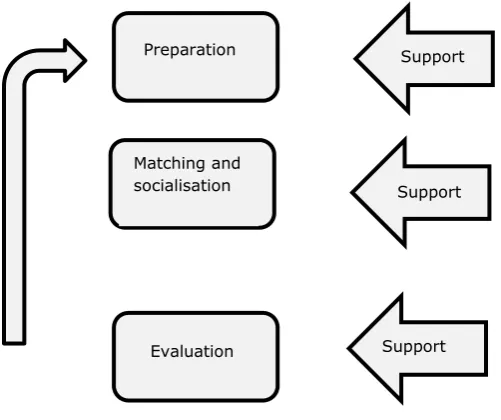
[image:5.595.153.404.349.559.2]The effectiveness of a mentoring programme requires a logical process for both the mentor and mentee to benefit. According to Gannon and Maher (2012) the mentoring programme involves four important factors: matching, preparation, interaction and evaluation. In relation to the needs and nature of the Business Management students a logical process was put in place. In this study the process comprised initial preparation, a matching process accompanied by the opportunity for socialisation between the mentoring pairs followed by a process of evaluation that would feed into future programmes. On-going support from both the course leader and careers adviser was provided at all stages. This model is represented in figure1.
Figure 1 The component elements of the mentoring scheme
Preparation, matching and socialisation
Preparation: The preparation of participants is given significant consideration in the mentoring programmes (Clutterbuck, 2004). Gannon and Maher, (2012, p.443) outline the importance of the preparatory stage of the mentoring process, stating that ‘setting expectations, outlining roles and responsibilities and interpersonal skills such as giving feedback, active listening and questioning are vital for mentors’ . In relation to the mentees and mentors, benefits of training are vital and these include aspects of individual reflection, setting realistic goals and awareness of the roles and responsibilities (Klasen and Clutterbuck, 2002).
The final year students undertaking the Business Management degree were introduced to the scheme by the course leader and careers adviser during a scheduled teaching session. The main objectives
Preparation
Evaluation Matching and socialisation
Support
Support
were made explicit, that is to participate in a mentoring scheme which would provide students with opportunities to acquire and develop employability skills.
As an insight into the real world experience of employment, the selected group of potential mentees applied for the mentoring programme in writing. They were asked to provide their CV, an outline of their current career plans and to explain how they thought they would benefit from the mentoring relationship. This is echoed by Gannon and Maher (2012) who argue that effective mentoring is built on the strength of a mentor and mentee relationship and interaction. Similarly, mentors were asked to submit a career profile outlining their areas of expertise and why they would like to engage in the mentoring process. As with any other selection process, some applicants were unsuccessful because of the poor quality of their application and their failure to address the objectives of the task set. Those students who were not initially successful were offered guidance from the careers adviser including advice on how to improve their application and were invited to re-apply. The rationale was to give the students a realistic learning experience in terms of them understanding the need to produce applications of high quality in order to be successful at graduate level in a competitive market. The careers adviser delivered training sessions to mentors and mentees regarding the nature of the mentoring relationship, expectations and boundaries and offering a proposed structure and content for mentoring meetings. Sundli (2007, p.205) confirms that ‘mentoring is about guiding, supporting the trainee (student); it is about smoothing the way, enabling, reassuring and as well as directing’.
Matching: It can be argued that the effectiveness of a mentoring programme essentially requires an element of compatibility. In relation to compatibility, matching is essential (Clutterbuck, 2004). The literature suggests that the matching process takes into account considerations such as individual traits, learning styles, beliefs and values and demographic data (Clutterbuck, 2004, Klasen and Clutterbuck, 2002). To assist with the matching and selection process of both mentors and mentees, the mentees completed a form expressing their personal and future career interests. In this study, the careers adviser and an employer representative reviewed both sets of participants, looking to identify by way of a matching process correlation between mentees’ career aspirations and mentors’ areas of expertise.
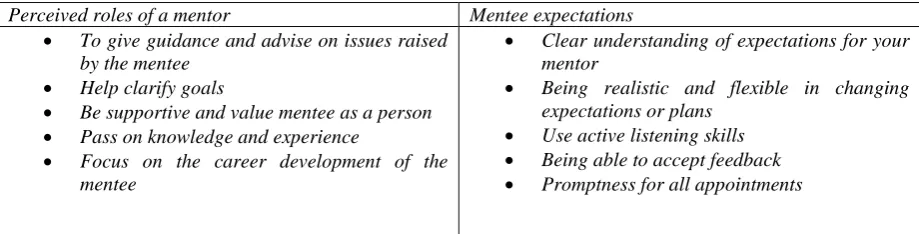
Socialisation: Specifically within the FE in HE context and the background of the students in this study, the need for the first encounter with both mentor and mentee was paramount. A launch event which lasted for an hour and half was held to allow mentees and mentors to meet in an informal setting (Frankie, Wienberg and Lankau, 2011). At the launch event, as well as having the opportunity to network and form ‘effective working relationships’ (Wilkes 2006, p.42) students were provided with a document to explain the basic premise of the scheme (Table 1). Ice-breaking activities included the student pairing up with a mentor and sharing their life story and reporting each other’s story to the wider group. Opportunities were given to share contact details and arrange a first meeting. The programme ran for twelve weeks with 3-4 further non-optional face-to-face meetings the first being agreed by mentor and mentee on the day of the launch.
Perceived roles of a mentor Mentee expectations
To give guidance and advise on issues raised
by the mentee
Help clarify goals
Be supportive and value mentee as a person
Pass on knowledge and experience
Focus on the career development of the
mentee
Clear understanding of expectations for your
mentor
Being realistic and flexible in changing
expectations or plans Use active listening skills
Being able to accept feedback
[image:6.595.68.528.579.696.2] Promptness for all appointments
On-going support
According to Gannon and Maher, (2012, p.443) ‘support mechanisms for the mentors and mentees will need to be identified in any interactions documentation (and the briefings stages) with the role of the mentoring programme coordinator crucial in this context’. Based on the initial informal questioning, it was clear that most of the student participants were unclear about both the mentoring concept and the purpose of the scheme. In order to ensure the mentees were aware of what was expected of them, mentoring guidelines were made available to them at the outset of the programme (Table 2) coupled with on-going support. These were intended to help the mentees to prepare for their first encounter with the mentor and also to gain insights into what was expected of them.
Steps Theme Instructions
1 Selection Congratulations! You have been selected to be mentored by a member of the senior
management team at Exel Partnership. Your mentor wants to help you progress and achieve your personal and business goals. It is important that you act professionally and aim to make a good impression from the outset. Here are some brief guidelines to help you get started.
2 Contact Contact your mentor / mentee to introduce yourself by email or telephone. Don’t wait
for them to get in touch with you. You might like to let them see a copy of your application form to give them a bit of background information about you and your career plans. Thank them for agreeing to mentor you and say how you think they might be able to help you. Remember to use business language. Arrange your first meeting.
3 Meeting
Place
You should aim to meet your mentor about once a month. You can arrange a place and time that is convenient to you both; for example, having a chat over a coffee might be a good way to start. Please remember that the mentors are busy managers; you may need to be flexible and fit in with their diaries. If you agree to meet it is imperative that you turn up – if you need to cancel then let the mentor know in advance and then get in touch to re-arrange.
4 First
meeting
At the first meeting you should try to get to know each other, perhaps you could ask the mentor about their role and how they have progressed through their career to where they are now. Some questions are listed below to get you started. You may also wish to discuss any career ideas you have. Together you should try to establish what you want to get out of the mentoring process – you might find it helpful to work out some brief action points to discuss at the next meeting.
Table 2 Guidance to mentees prior to first mentoring meeting
Categories Subject areas Find out some background
information about the
mentor
length of time in current position/ organisation major job responsibilities
organisational structure of their area career path that led to this position
Find out more about their job and profession
what a typical day is like personal likes/dislikes of role
frequently recurring problems in such a role
major rewards of role
skills most utilised in role
employment outlook for the profession
professional associations active in and recommended for job
general salaries and benefits of profession
aspects of his/her education or other skills that helped most in the job
how has technology changed the profession
Get some advice share your background/goals with the mentor volunteer
obtain advice regarding your job search or selection of a career path ask for literature if you would like more information about the
company/organisation
ask for a referral to another contact person, if appropriate, to continue networking
[image:8.595.68.542.73.360.2] ask for job search advice or tips
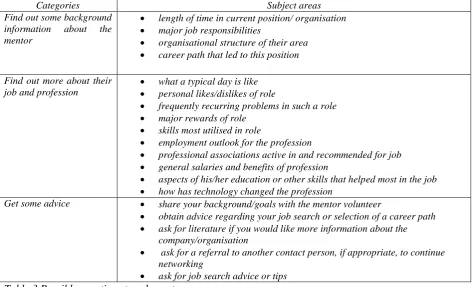
Table 3 Possible questions to ask mentors
Evaluation
Mentors Mentees Challenges
I felt as though he didn’t have much to say for himself, I really had to work hard to drag a conversation out of him. I thought, I haven’t got time to hold his hand through this. When I was that age I was so keen...I thought they would have been really eager to suck us dry.
...the scheme only helped me to decide accounting was definitely an area I would never work in, apart from that I did not receive anything else from the scheme. I think maybe if I had a mentor who appeared more willing and assertive then I would have gained a lot more from it. I really had to dig deep with lots of questions to gain any kind of information
She didn’t really have any career focus at all so I think it was difficult for her to engage with what I was talking about. She was really, really grateful for my time but certainly has no idea what she wants to do in the future which I found a little strange for a university student. She will be graduating this year and she had absolutely no idea...
...as much as I appreciated the support and guidance from my mentor, I could not fully engage with her as my career choice and aspirations were not my mentor’s career field. Therefore, we were not compatible career-wise. I feel I would have benefited more from this mentorship scheme had I been matched to a mentor with experience in the career I was interested in.
I was most concerned about expectations. I was unsure as to what was expected from me and after three meetings am still not convinced that I know what her expectations really are.
...my mentor appeared very quiet and shy when I did meet up with her and I found this to be very awkward. It almost felt like she did not want to be a mentor and despite trying to gain information it was very difficult. These guys are going to find themselves in the real
world soon and no-one is going to hold their hand. I really feel as though they expect us to spoon feed them information – but it’s up to them to ask the right questions.
The biggest improvement would be to match students to mentors more effectively. In my case with no disrespect, I don’t think the match could have been any worse. It may have helped if the mentor was a bit more interested as well because my thoughts are that she may have been pressured into being involved.
Benefits
Being a mentor to business management students has been one of the most rewarding things I have done in my career. Seeing the difference we made to the confidence, business understanding and approach taken by the students was fantastic. I’m really proud that Exel is able to offer this level of added value to the community.
I initially thought it was a fabulous idea and an amazing opportunity to gain real life knowledge from business professionals. I really wanted to be involved with the scheme because I felt it would provide first-hand experience in particular business areas that I was interested in and maybe leading me to decide if that area was something I was still interested in after completion of the scheme.
I like the fact that it’s tailored so the person I’m seeing wants to work in the field I work in so it a chance for me to give her a bit more specialised expertise.
Having a mentor gave me an opportunity to discuss my career goals with someone who was familiar with my career choice. I was privileged to learn about my mentors past work experiences that included both successes and failures. This gave me an insight to lessons that my mentor has learned through her career. Mine came with bags of enthusiasm very polite and
grateful and I was really able to work with that enthusiasm to try and get a bit of focus and direction.
Talking with the mentor was a kind of “gift” given to me. The mentor was so kind that he shared his work life story which made realise how hard working, persistence in life and openness can be a stepping stone to better life in the future.
I found it a really rewarding experience, It’s a two way process and I benefited from the experience as well. It was really great to see the positive impact on the students by the end of the programme. I really enjoyed being a sounding board for advice, helping to guide the students and advising them on plans for business ventures.
A great opportunity if you want to develop and improve your skills, CV and knowledge regarding what management is and what managers do.
Take the opportunity and meet as many times with your mentor as possible for both of you. Be honest, ask questions. They are willing to help.
Findings and Analysis
An overview of responses from the focus groups and the reflective diaries evidence that generally the mentees had a positive initial response to the mentoring project (tables 4 and 5). There is clear evidence of engagement in the programme and the responses suggest that the extent to which the mentors and mentee interacted added to the learning and the development of coping strategies. The overwhelming feeling from the mentees was that they were very appreciative of the opportunity to participate in the mentoring scheme. Having met with their mentors, however, there was concern over the accuracy of the matching process and therefore the benefits the mentor could deliver for them. In some cases there was also the perception that the mentor had been coerced to participate rather than willingly volunteering.
From the mentors point of view the data suggested that they were looking forward to the opportunity to ‘give something back’ having embraced the CSR ethos of their employer and maintain support to the community (Melling and Gurjee, 2013). However, they were decidedly underwhelmed by the lack of the focus the mentees had with regard to their career ideas. This could be due to a generational gap – mentors being on the whole more mature, experienced and knowledgeable (Colley, 2002), and the widely reported view that this generation of students have been spoon-fed throughout their education and are not capable of independent thinking and learning (Ramsden and Atwood 2011).
Despite the fact that mentees had participated in the introductory lecture, attended the launch event and had received the supporting documentation, they still appeared to have prepared insufficiently for their meetings and were perceived by the mentors to be unclear as to their expectations. The data suggests that those students with clear career ideas wanted a strong element of ‘match’. For these students if the match was perceived to be ‘wrong’ the benefits were immediately very limited. There seemed to be little attempt to find areas of congruence once this ‘mismatch’ of career was established. On the other hand, students with limited or no career ideas would have benefitted from relationships with mentors more equipped with the interpersonal and perhaps coaching skills to draw out their ideas.
Reflective journals extracts – mentees
I have always lacked self-belief and confidence but this mentoring programme has
helped me a lot. I have learnt to be positive and to embrace every opportunity presented to me in order to try and improve myself, to be a better person, to make myself more marketable.
The mentoring scheme offered me some direction and guidance, gave different but relevant ideas with regards to future career. It enabled me to gain some confidence, increase my networking opportunities and build a professional relationship.
For me the mentoring programme gave me a totally new experience; something which I initially was not prepared to embrace. But as I think now, it was an opportunity not to be missed but to be appreciated and also acknowledged that there are people out there prepared to give up some of their time to help others and I like that in other people, that is the type of person I am, I always want to help others.
Having a mentor has helped with gain information about real companies and real situations; I feel there is only so much I can learn from a textbook but having a mentor adds to my career preparation and awareness of what I will experience after finishing university. The scheme has given me the opportunity to create contacts with the real world of work. The mentor has aided me with situations I am faced with whilst at University. When I had difficulties resolving team issues, for example, my mentor shared his knowledge and experience in this matter which help me.
I am experiencing the difficulty getting in touch with John (the mentor). I have written to him and up to now he has not responded, what is the next step that I should take??? Does he want me to be my mentor or not?
I think that the Mentoring Scheme can be a very enriching experience in addition to the course. It is a great challenge in terms of exposure and interaction with professionals who possess the knowledge and experience needed to become a successful individual.
I liked the opportunity and experience my mentor offered of spending a couple of hours with me in her office and to attend some of her meetings. Observing the way she does her job, how she communicates and solves problems both internally and externally etc was really an eye-opener. I learnt to appreciate the managers’ roles and responsibilities.
Table 5 Reflective journals data extracts
Table 5 captures the reflective accounts of the mentees expressing their initial needs, such as a lack of confidence and of a social network. The evidence suggest that a many mentees’ needs were enriched through their interaction with mentors who they acknowledged as experienced, professional and with strong business management acumen. However, through the reflection some negative issues were identified. For example a mentor did not respond to a mentee’s constant reminders which left the mentee uncertain and affected the perceived professionalism of the mentor.
Highlighted in the reflective journals is the awareness of individual learning and recognition of new experiences through interaction with the mentors and participation in the mentoring programme. Interestingly some mentors offered opportunities to visit their place of work and attend business meetings in order to gain an understanding of what managers do and to experience the real work situation. Such positive experiences show that the mentees made use of the opportunities and support associated with the programme.
Discussion
Overall the outcomes of the mentoring programme indicated that there were elements of effective practice. The programme provided a fantastic opportunity for students to work with mentors who demonstrated a willingness to share their skills, knowledge and expertise. It also highlighted the positive attitude required in order to acquire employability skills relevant to the world of work (Mason, Williams, and Cranmer 2009). The general response highlights the learning and career development the mentees gained from the programme as noted by Simmonds (2009), Colley (2002) and Gibb (1999). The mentors gained greatly from the programme and particular attention is given to at least one of the mentor’s responses to overall programme:
Being a mentor to Business Management students has been one of the most rewarding things I have done in my career. Seeing the difference we made to the confidence, business
is able to offer this level of added value to the Oldham community. And the way team put the programme together and delivered it was a real example of excellence in action.
Exel Manager, mentor focus group
Interestingly, this mentoring programme was acknowledged through an award for its outstanding contribution to the local community and to widening participation in the region. A follow up mentoring programme has been in place and currently the team is recruiting mentors for the next cohort:
The ‘Into Business Mentoring Programme’ aims to improve the prospects and knowledge base of students by establishing mentoring relationships. Each member of Exel’s senior management team volunteered to take part and meets regularly with at least one student to discuss topics such as career development, business plans and interviewing and application skills. A number of students have obtained work experience as a result of the programme and feedback has been extremely positive.
Extract from awards programme ‘Excellence Awards 2013’.
One of the key aspects of mentoring emphasised in the literature is the importance of matching pairs (Klasen and Clutterbuck 2002, Clutterbuck, 2004, Gannon and Maher, 2012). The majority of the mentees found the matching of mentor-mentee a positive and enriching experience. However, there were instances where the mentors felt reluctant to respond to mentees positively in the one-to-one meetings, perhaps due to a poor initial match. Fleck and Mullins (2012) found that the matching issue can lead to either mentee or mentor dissatisfaction. It was noted that the matching process in this programme would benefit from some development. Problems were in part due to the nature of the scheme and the limited number of mentors available; it was not always possible to match exactly the careers paths and aspirations of mentors and mentees.
Despite the challenges incurred during the mentoring programme such as incompatibility, lack of self-confidence, lack of time from the mentee’s perspectives, and from the mentor perspective: lack of focus, unclear expectations, lack of engagement and lack of time it is clear that most mentees and mentors felt that the scheme was beneficial.
Our initial aims for the students were as follows: students would be able to gain insights into what it takes to succeed in the world of work; develop confidence; and improve their employability skills. Based on the responses from the mentees, we believe to an extent that they have been achieved. However, this programme could be enhanced if the mentoring was more embedded into the course rather than being optional, giving all the students the opportunity to get involved.
Other key learning points for further iterations of the programme are as follows:
1. Expectations of both mentors and mentees are key – more work needs to done prior to the commencement of the programme to ensure that students understand what is expected of them. In addition mentors would perhaps benefit from some training in elementary coaching techniques.
3. Career planning. Enhanced career development interactions both with the careers service and also with employers to give students more opportunity to consider their career plans and put together some tentative ideas prior to meeting with a mentor, for example ‘taster’ sessions and overviews from a variety of job roles and industry areas.
To capitalise on the students’ knowledge, experience and employability chances, it is important to provide students with appropriate support, guidance while still studying (Simmonds, 2009). Individual students’ potential was elevated and this is evidenced by the students’ reflective comments. Through an informal mentoring relationship with a business manager, students have had the opportunity ask questions and gain insights into the real world of business management and to acquire employability skills.
Fundamentally the complex needs of the Business Management students in Oldham in terms of widening participation have been identified and support and guidance have been accorded as a preparation for career choices. It has been noted that there are recognisable benefits to mentoring for both mentees and mentors (Clutterbuck, 2004). The assumed benefits are in line with employability skills, career development, companionship, corroboration, recognition and self-confidence (Kram, 1985, Freeman, 2009). Evidence from the reflective accounts of students suggests that they developed skills, knowledge and a level of self-confidence pertinent to employment.
Conclusion
This study has outlined the involvement of a local business in FE institution that offer HE courses. The Business Management Students in Oldham benefit greatly from the widening participation programmes which are emphasised internationally and in particular by the UK Labour government (Colley, 2002). Using local businesses to support employability skills has been always on the agenda at Oldham. This has created a purposeful relationship with Exel in which the individual managers are recruited and subsequently voluntarily give their time to support students in order to prepare them for a future career. With the support given through the mentoring programme the students’ essential employability skills have been enhanced.
The mentoring programme in business highlights key aspects in the real world work. There is a need to extend this programme to other disciplines in order to maintain the momentum. It is important to devise promotional activities that would increase interest amongst students and staff. Positive
References
Ali P.A., & Panther, W. (2008). Professional development and the role of mentorship. Nursing Standard. 22: 42, pp35-39.
Allen, T.D., Eby, L., & Lentz, E. (2006). Mentorship behaviour and mentorship quality associated with formal mentoring programs: Closing the gap between research and practice. Journal of Applied Psychology,93(3), pp567-578.
Attwood, R. (2009). The personal touch. Times Higher Education, 7 May, Available at: http://www.timeshighereducation.co.uk/story.asp?sectioncode=26&storycode=406424 (accessed 16 September, 2014)
Bibbings, L.S. (2006). Widening participation and higher education. Journal of Law and Society, 33(1), pp74-91
Bollinger, K. (2009). Mentoring: A two way street. Adult Learning 20 (1/2), pp39-40
Browne (2010). Securing a sustainable future for higher education. An Independent Review of Higher Education Funding & Student Finance. Department for Business, Innovation and Skills
Bryan, H., & Carpenter, C. (2008). Mentoring: a practice developed in community. Journal of In-Service Education, 34 (1), pp47-59.
Cantle, E. (2006). Review of community cohesion in Oldham. Report of institute of community cohesion. Coventry. Coventry University.
Caruso, R. (1992), Mentoring and the development of social capital, Bradley, K. (Ed.), Human Resource Management: People and Performance, Dartmouth Publishing, Aldershot, pp. 64‐73.
Chao, G.T. (2007). Mentoring and organisational socialisation: networks for work adjustment. In Ragins, B.R. and Kram, K.E (eds), The Handbook of Mentoring at Work Theory, Research and Practice, Sage, Los Angeles, CA, pp179-196
Clutterbuck, D. (2004). Everyone needs a mentor -Fostering Talent in Your Organisation, 4th Edition, Chartered Institute of Personnel and Development: London.
Colley, H. (2002) A ‘Rough Guide’ to the History of Mentoring from a Marxist Feminist Perspective’. Journal of Education for Teaching, 28(3), pp257-273
Crisp, G., & Cruz, I. (2009). Mentoring college students: A critical review of the literature between 1990 and 2007. Research in Higher Education, 50(6), pp525-545.
D’Abate, C.P., & Eddy, E.R. (2008). Mentoring as a learning tool, enhancing the effectiveness of an undergraduate business mentoring program. Mentoring and Tutoring: Partnership in Learning, 16(4) pp363-378
Dacre Pool, L., & Sewell, P. (2007). The Key to Employability. Developing a practical model of graduate employability. Education and Training, 49(4), pp277-289.
Department for Business Innovation and Skills (2011). Higher education: students at the heart of the system. Available at: www.bis.go.uk/news/topstories/2011/jun/he-white-paper-students-at-the-heart-of-the-system (accessed 16 September 2014)
Ehrich, L.C., Tennent, L., Hansford, B.C. (2002) A Review of Mentoring in Education: Some Lessons for Nursing. Contemporary Nurse 12(3), pp253-264
Fleck, C., & Mullins, M.E. (2012). Evaluating a psychological graduate student peer mentoring programme. Mentoring and Tutoring : Partnership in Learning, 20(2), pp271-290
Frankie, J., Weinberg, J.F., & Lankau, M.J. (2011). Formal mentoring programs. A mentor and longitudinal analysis, Journal of Management, 37(6), pp1527-1557.
Freedman, S. (2009). Effective mentoring. International Federation of Library Association and Institution.
Garavan, T.N., O’Brien, F., & O’Hanlon, D. (2006). Career advancement of hotel managers since graduation. A comparative study. Personnel Review. 35(3), pp252-280.
Gibb, S. (1999). The usefulness of theory; A case study in evaluating formal mentoring schemes.
Human Relations, 52(8), pp1055-1075.
Gibb, S. & Telfer, S (2008). Making it happen: operational, coordination and strategic concern in mentoring schemes. The International Journal of Mentoring and Coaching. 6(1), pp3-23.
Gannon, J.M., & Maher, A. (2012). Developing tomorrow’s talent: The case of an undergraduate mentoring programme. Education + Training , 54(6), pp440-455.
Goodyear, M. (2006). Mentoring: A learning collaboration. Educause Quarterly, 29(4), pp51-53. Gorard, S., & Smith, E. (2006.). Beyond the ‘learning society’: what have we learnt from widening participation research? International Journal of Lifelong Education 25(6), pp575-594.
Higher Education Funding Council for England (HEFCE ) (2014). What we do. Available at: http://www.hefce.ac.uk/whatwedo/wp/ (Accessed 17 September 2014).
Hezlett, S.A. & Gibson, S.K. (2007). Linking mentoring and social capital: implications for career and organisation development. Advances in Developing Human Resources. 9(3), pp384-412.
Holden, R. & Hamblett, J. (2007). The transition from higher education into work: tales of cohesion and fragmentation. Education + Training. 49(7), pp516-585.
Jeste, D.V., Twamley, E.W., Cardenas, V., Lebowitz, B., & Reynolds, C.F. (2009). A call for training the trainers: Focusing on mentoring to enhance diversity in mental health research. American Journal of Public Health, 99 Suppl 1(S1) S31-S37.
Jowett, V. & Stead, R. (1994), Mentoring students in Higher Education. Education and Training
36(5), pp20-26.
Klasen, N. & Clutterbuck, D. (2002). Implementing Mentoring Scheme: A practical guide to Successful Programs. Elsevier, Oxford
Kram, K.E. (1985). Mentoring at work. Developmental relationships in organisational life. Glenview, IL: Scott, Foresman.
Liu, H., McGrath-Champ, S, & Fletcher, S. (2013). Inspired by Business: A case of mentoring among disadvantaged first year students', Proceedings of the First Year in Higher Education Conference, Wellington, New Zealand, 10th July.
Mason, G., Williams, G. & Cranmer, S, (2009). Employability skills initiatives in higher education: what effects do they have on graduate labour market outcomes? Education Economics, 17(1), pp1-30. Megginson, ,D. & Garvey, B. (2007). Odysseus, Telemachus and mentor: stumblinginto, searching for and signposting the road to desire, The International Journal of Mentoring and Coaching EMCC,
11(1), 1-7.
Melling, A., & Gurjee, R. (2013) Researching the Impact of Student Mentoring in the Community,
International Journal of Social Work and Human Services Practice ,1(1), pp1-8.
Miller, A. (2002). Mentoring students: A Handbook of effective practice. Falmer Press Limited, UK. Moore, K. (1992). Benefits of mentorship. Health Services Management, 88(6) pp15-17
Office for National Statistics Labour Market Statistics, July 2014 Available at: http://www.ons.gov.uk/ons/publications/re-reference-tables.html?edition=tcm%3A77-314861
(Accessed 23 July 2014).
Oldham Partnership, (2005). Oldham in profile. Monitoring the Oldham Community strategy. Oldham: Oldham Partnership.
Ramsden, P., & Attwood, R. (2011). When I grow up, I want to be spoon-fed. The Times Higher Education Supplement, 30.
Saarnivaara, M. & Sarja, A. (2007). From university to working life: mentoring as a pedagogical challenge. Journal of Workplace Learning, 19(1), pp5-16.
Schlee, R.P. (2000). Mentoring and professional development of business students, Journal of Management Education, 24(3), pp322-337.
Silverman, D. (2005). Doing Qualitative Research, 2nd ed. London. Sage.
Simmonds, D. (2009). The evaluation of learning and development interventions. In Mankin, D. (Ed,),
Human Resource Development, Oxford University Press, Oxford, pp261-292,
Sundli, L (2007). Mentoring –A new mantra for education? Teaching and Teacher Education, 23, pp201-214
Weber, K. & Ladkin,A. (2008). Career development for tourism and hospitality academics; publish, network, study and plan, Journal of Hospitality and Tourism Research, 32(4), pp448-466.
Wiggans, J., (1994) Block One – Framework for Mentoring, Leeds Metropolitan University, Leeds, 1994.
Wilkes, Z. (2006). The student-network relationship. A review of the literature, Nursing Standard,
20(37), pp42-47.