Zinchenko, A. and Conci, M. and Muller, Hermann J. and Geyer, T. (2018)
Predictive visual search: Role of environmental regularities in the learning of
context cues. Attention, Perception, & Psychophysics 80 (5), pp. 1096-1109.
ISSN 1943-3921.
Downloaded from:
Usage Guidelines:
Please refer to usage guidelines at or alternatively
Running head: ENVIRONMENTAL REGULARITIES IN CONTEXTUAL LEARNING
1
2
Predictive visual search: role of environmental regularities in the
3
learning of context cues
4
5
Artyom Zinchenko1, Markus Conci1, Hermann J. Müller1,2 & Thomas Geyer1 6
7
1 Department Psychologie, Ludwig-Maximilians-Universität München, Munich, Germany 8
2 Department of Psychological Science, Birkbeck College, University of London, London, United Kingdom 9
10
11
12
13
14
15
16
Correspondence to: 17
Artyom Zinchenko 18
Department Psychologie 19
Lehrstuhl für Allgemeine und Experimentelle Psychologie 20
Ludwig-Maximilians-Universität München 21
Leopoldstraße 13 80802 München, Germany 22
Tel: +49-(0)89/2180-2336 23
Fax: +49(0)89/2180-5211 24
E-Mail: [email protected] 25
26
27
Word count: 9261 28
29
Abstract
1
Repeatedly searching through invariant spatial arrangements in visual search displays 2
leads to the build-up of memory about these displays (contextual-cueing effect). In the present 3
study, we investigate (1) whether contextual cueing is influenced by global statistical 4
properties of the task; and if so (2) whether these properties increase the overall strength 5
(asymptotic level) or the temporal development (speed) of learning. Experiment 1a served as 6
baseline against which we tested the effects of increased or decreased proportions of repeated 7
relative to non-repeated displays (Experiments 1b and 1c, respectively), thus manipulating the 8
global statistical properties of search environments. Importantly, probability variations were 9
achieved by manipulating the number of non-repeated (baseline) displays so as to equate the 10
total number of repeated displays across experiments. In Experiment 1d, repeated and non-11
repeated displays were presented in longer streaks of trials, thus establishing a stable 12
environment of sequences of repeated displays. Our results showed that the build-up of 13
contextual cueing was expedited in the ‘statistically-rich’ Experiments 1b and 1d, relative to 14
the baseline Experiment 1a. Further, contextual cueing was entirely absent when repeated 15
displays occurred in the minority of trials (Experiment 1c). Together, these findings suggest 16
that contextual cueing is modulated by observers’ assumptions about the reliability of search 17
environments. 18
19
Word count: 204/250 20
21
Keywords: environmental statistics, contextual cueing, predictive coding, visual search 22
Introduction
1
Natural images contain various statistical regularities (Kersten, Mamassian, & Yuille, 2
2004). For instance, objects in real life are often positioned at invariant locations (e.g., icons 3
on the desktop of an office computer, a mailbox in a front yard; Palmer, 1975), and the human 4
visual system is able to acquire these regularities from past experience to prioritize where to 5
look and to attend for efficient visual processing of the sensory environment. One such 6
mechanism, which supports the efficient guidance of attention, is contextual cueing (Chun, 7
2000). Contextual cueing refers to the expedited visual search for targets presented in 8
invariant (‘repeated’) distractor configurations. Typically, participants perform a relatively 9
difficult search for a target letter “T” embedded in a set of distractor letters “L”. Unbeknownst 10
to them, half of the trials contain repeated (‘old’) displays, while the spatial arrangement of 11
the distractors surrounding the target is compiled anew on each trial in the other half of trials 12
(‘new’ displays). The typical finding is that reaction times (RTs) are faster to old as compared 13
to new displays. This RT benefit for repeated layouts is referred to as the contextual-cueing 14
effect, which has been shown to remain effective for up to 10 days (van Asselen & Castelo-15
Branco, 2009; Zellin, von Mühlenen, Müller, & Conci, 2014). Moreover, participants’ ability 16
to discriminate repeated from non-repeated displays is typically only at chance level. Chun 17
and Jiang (1998) took these findings to suggest that learned spatial target-distractor 18
associations, stored in implicit long-term memory, come to guide search, by “cueing” 19
attention to the target location (Schankin & Schubö, 2009). 20
The ability to learn and to predict future environmental states is also a central element of 21
current theories of human information processing. At the heart of the so-called predictive-22
coding models (Friston, 2010; Gold & Shadlen, 2007; Huang & Rao, 2011) is the idea that the 23
brain is essentially an inference machine that actively tries to explain its sensations by 24
reducing surprise, or prediction errors, on the basis of learned information from prior 25
environmental interactions. Thus, in order to behave optimally in a faceted and multi-26
sensory world, it is important to build-up memory representations about the current sensory 27
environment and to use this memory for predicting important objects (events) on future 28
occasions. Applying this idea to the context-based guidance of visual search, statistical 29
knowledge in the form of target-distractor associations stored in memory would correspond to 30
some model of the world (Hohwy, 2015) that the brain can use for predicting important 31
predictive-coding models also make assumptions about the relation between sensation and 1
prediction in perceptual experience (i.e., bottom-up and top-down processing, respectively). 2
Specifically, it has been assumed that bottom-up influences vary as a function of the 3
reliability of the sensory environment (Friston, 2010; Hohwy, 2015). A prediction error is 4
likely to act as a learning signal and eventually lead to the build-up (or update) of long-term 5
memory when the environment is itself predictive and contains statistical regularities on many 6
trials. By contrast, prediction errors may be resolved (suppressed) at early stages of the 7
perceptual hierarchy in a ‘noisy’ environment, in which statistical regularities occur only on 8
few trials. Under these conditions, a sensory event, be it a reliable occurrence or unwanted 9
noise, is likely not to affect further (higher-order) processing. Note that predictive coding 10
models equate bottom-up sensation with perceptual prediction errors, so that effectively only 11
the prediction error (defined as the mismatch between sensation and expectation) is made 12
available to higher cognitive processes, including learning about repeated search displays. 13
One prediction that follows from this scheme is that the context-based guidance of visual 14
search is modulated by the relative occurrence of repeated – signal – relative to non-repeated 15
– noise – trials. The present study was designed to examine this idea. 16
Specifically, we examined whether and how learning of repeated target-distractor 17
arrangements would vary for variable proportions of repeated relative to non-repeated 18
displays. For instance, according to predictive-coding accounts, one would expect that a large 19
proportion of repeated trials would lead to particularly strong context memory about the 20
repeated displays. In line with this, several studies show that the frequency structure of the 21
visual input can modulate learning in a visual-search task. For instance, Geyer, Müller, and 22
Krummenacher (2008; see also Müller, Geyer, Zehetleitner, & Krummenacher, 2009; Töllner, 23
Müller, & Zehetleitner. 2012) found that the latency of the first eye movement (saccade) on a 24
given search trial was reduced when task-irrelevant distractors were frequent and thus 25
expected (i.e., they were effectively excluded from visual selection). Müller et al. (2009) 26
adopted a paradigm in which the most (bottom-up) salient item was not the target, but rather a 27
distracting non-target that had to be ignored (see Theeuwes, 1991). In this task variant, 28
behavioral and oculomotor response latencies to the target are typically slower in the presence 29
compared to the absence of the distractor (an effect referred to as distractor interference). 30
Müller and collaborators demonstrated that this effect is sensitive to variation in the 31
proportions of distractor to no-distractor trials. By varying the presentation frequency of 32
of distractor interference. 1
The latter finding is in general agreement with recent neuroscientific studies showing that 2
manipulations of the repetition probability lead to a substantial modulation in the neural 3
processing signatures of incoming sensory stimulation. For instance, Summerfield, Trittschuh, 4
Monti, Mesulam, and Egner (2008; see also Larsson & Smith, 2012; Kovács, Kaiser, 5
Kaliukhovich, Vidnyánszky, & Vogels, 2013) reported a reduction of blood oxygen level-6
dependent (BOLD) activity in the fusiform face area in response to repeated as compared to 7
non-repeated (face) stimuli, which was particularly pronounced when repetitions were 8
frequent and thus expected. More recently, Summerfield et al. (2011) replicated their original 9
finding using temporally precise electroencephalographic (EEG) measures: they observed 10
enhanced event-related potentials, approximately 300 milliseconds (ms) after stimulus onset 11
at central electrodes, for repeated relative to non-repeated stimuli when repetitions occurred in 12
the majority of trials (and were thus expected). 13
Taken together, these findings indicate that (bottom-up driven) visual exploration can be 14
modulated by expectations generated based on the recently experienced frequency distribution 15
patterns in the task environment; that is, recent experiences, including both short- and long-16
term memory influences, can act as ‘primes’ to subsequent visual search behavior given 17
sufficient evidence of stimulus repetitions (see Conci, Zellin, & Müller, 2012, for such a 18
view). 19
Rationale of the present study
20
The present experiments investigated whether predictive-coding models provide an 21
appropriate account for contextual cueing of visual search, that is, stimulus repetition effects 22
that manifest on a relatively long timescale (of several days; van Asselen & Castelo-Branco, 23
2009). Although contextual cueing is usually considered to reflect effortless and cognitively 24
impenetrable learning (Chun, 2000), the idea developed above on predictive coding suggests 25
that configural learning is influenced by the reliability of sensory signals, corresponding to 26
observers’ implicit assumptions about the presence versus absence of statistical regularities of 27
the current sensory environment (Friston, 2010). In this view, only highly regular 28
environments will lead to a processing focus on bottom-up perceptual input, thus increasing 29
the detection of a statistical regularity in this display and boosting the learning of associations 30
between the target position and the constant distractor context. In the present study, we tested 31
repeated relative to non-repeated displays (cf. Larsson & Smith, 2012); and repetition 1
volatility, defined as the rate of change of repeated and non-repeated displays (cf. 2
Summerfield et al., 2011). 3
A related question concerns the specific way in which environmental regularities 4
influence contextual cueing. For example, if contextual cueing takes into account event 5
probabilities, one would expect the strength of memory-based guidance to be higher in 6
environments with many repeated, as compared to many non-repeated, displays (regular vs. 7
irregular environments). This may be so because in regular environments, a higher number of 8
repeated displays is detected and subsequently stored in memory – thus increasing the mean 9
contextual-cueing effect. Of note in this regard, several contextual-cueing studies have shown 10
that only very few repeated displays are actually learned (i.e., represented in context 11
memory); in other words, many repeated displays are searched as inefficiently as non-12
repeated displays (e.g., Colagiuri & Livesey, 2016; Geyer, Müller, Assumpcao, & Gais, 2013; 13
Johnson, Woodman, Braun, & Luck, 2007; Peterson & Kramer, 2001; Schlagbauer, Müller, 14
Zehetleitner, & Geyer, 2012; Smyth & Shanks, 2008). If regular environments indeed 15
increase the number of displays producing contextual cueing, one would expect an increased 16
overall contextual-cueing effect (averaged across all repeated displays). We refer to this as the 17
‘strength’ hypothesis. Alternatively, it is possible that regular environments, rather than 18
changing the strength of contextual guidance, do increase the speed with which observers 19
acquire contextual memory representations. This ‘acceleration’ hypothesis would predict that 20
repeated contexts are learned faster in regular as compared to irregular environments; 21
however, once the acquisition is completed (after a learning phase of variable length), 22
context-based search guidance would be comparable in effect magnitude irrespective of the 23
regular or irregular search environment. 24
In Experiment 1a, observers performed a visual search task in which they encountered 25
repeated and non-repeated (i.e., randomly generated) display arrangements that were 26
presented in random order across trials within a given block. Thereafter, a recognition test 27
was administered: participants were presented with a display arrangement and had to indicate 28
whether or not they believed having seen this display in the previous search task (two-29
alternative forced-choice, 2AFC, task; cf. Chun & Jiang, 1998). Each trial of the search task 30
was equally likely to contain a repeated or a non-repeated arrangement. Thus, Experiment 1a 31
served as ‘baseline’ against which contextual-cueing effects were compared in the other two 32
whether different probabilities of repeated and non-repeated displays would influence the 1
contextual-cueing effect. Two conditions were used: in Experiment 1b, repeated displays 2
occurred with higher probability than non-repeated displays: 80% versus 20% (regular 3
condition). These probabilities were reversed in Experiment 1c, presenting only 20% repeated 4
and 80% non-repeated displays (irregular condition). Importantly, the total number of trials 5
with repeated displays was held constant in all experiments. Thus, variations of the 6
probability with which repeated displays were encountered were achieved by manipulating 7
the number of non-repeated displays. With this approach, we were able to equate the absolute 8
number of presentations of repeated displays across the regular, irregular, and baseline 9
conditions. 10
In Experiment 1d, we went on to compare contextual cueing in ‘stable’ versus ‘volatile’ 11
environments. Volatile environments are in essence identical to typical conditions in 12
contextual-cueing experiments: each block of trials presents 50% repeated and 50% non-13
repeated displays, with the probability of a repeated or non-repeated display being the same 14
on a given trial. In the volatile (default) environment, changes from repeated to non-repeated 15
displays (and vice versa) were frequent, occurring, on average, in 50% of the trials (i.e. about 16
8 times per block of 16 trials; see below for further details). By contrast, in stable 17
environments, each block was composed of two “mini-blocks” (or streaks) of 8 repeated and 8 18
non-repeated displays, respectively (the order of repeated and non-repeated streaks was 19
counterbalanced across observers). With this manipulation, in stable environments a change 20
from repeated to non-repeated displays (or vice versa) was rare, occurring in only ~ 6% of the 21
trials (once per block). One could assume that environmental regularities become evident 22
more strongly under conditions of rare changes, thus increasing the detection of repeated 23
displays as “repeated”. In such a stable environment, contextual cueing should be overall 24
stronger (strength hypothesis) and / or develop earlier (acceleration hypothesis) as compared 25
to the volatile environments. 26
General Method
27
Participants
28
The same 13 participants (6 male, mean age: 26.8 years; all reporting normal or 29
corrected-to-normal vision) took part in Experiments 1a through 1d. Sample size was 30
in relation to an invariant context of distractor elements, importantly also including M. Chun’s 1
pioneering work (e.g., Chun & Jiang, 1998; Chun & Jiang, 1999; Chun & Phelps, 1999). 2
These studies (see also Assumpção, Shi, Zang, Müller, & Geyer, 2015; Geringswald, Herbik, 3
Hofmüller, Hoffmann, & Pollmann, 2015; Geyer, Zehetleitner, & Müller, 2010; Zellin, von 4
Mühlenen, Müller, & Conci, 2013a; Zellin, von Mühlenen, Müller, & Conci, 2014) typically 5
tested between 5 and 14 participants on the visual search/ contextual-cueing task. On the basis 6
of effect size measures provided in these studies (Assumpção et al., 2015; Geringswald et al., 7
2015; Zellin et al., 2013a; Zellin et al., 2014), we determined that our sample size would be 8
appropriate to detect an f(U) effect size of 1.0 with 85% power (partial eta2 = 0.4, groups = 2, 9
number of measurements = 4), given an alpha level of .05 and a nonsphericity correction of 1. 10
To minimize transfer effects, the experiments were performed in individual sessions, which 11
were separated by at least 10 days. Further, the experimental manipulations were administered 12
in two counterbalanced orders: each participant started with Experiment 1a (to obtain an 13
unbiased baseline measure initially), followed by Experiments 1b/c (with Experiments 1b and 14
1c performed in counterbalanced order across participants) and finally, Experiment 1d. The 15
relative fixed order of experiments was necessary to first establish a baseline contextual-16
cueing effect in all participants against which the subsequent experimental variations could 17
effectively be compared. Additionally, a within-subjects design was essential for the purpose 18
of the study, as individual differences in the rate of contextual learning (i.e., in the between-19
subject design) could have obscured potential systematic effects as induced by our 20
environmental manipulations. One participant could not attend further experiments after 21
Experiment 1a (this means that the total number of initially recruited observers was 14, but all 22
analyses reported are based on the 13 observers who completed all experimental parts). All 23
participants provided written informed consent prior to the experiment and received 8 € per 24
hour or course credit for participating in this study. Before the start of each experiment, 25
participants performed one practice block of 24 trials (data not recorded). 26
Apparatus and stimuli
27
The experimental routine was programmed in Matlab with Psychtoolbox extensions 28
(Brainard, 1997; Pelli, 1997) and was run on a PC under the Windows 7 operating system. 29
Participants were seated in a dimly lit room in front of a 23-inch LCD monitor (ASUS, 30
Taiwan; refresh rate 60 Hz; display resolution: 1920 x 1080 pixels) at a viewing distance of 31
(luminance: 1.0 cd/m2; 1 “T”-shaped target and 11 “L”-shaped distractors) presented against a 1
black background (0.11 cd/m2). All stimuli extended 0.35º of visual angle in width and height. 2
The items were arranged on four (invisible) concentric circles around the display center (with 3
a radius of 1.74º, 3.48º, 5.22º, and 6.96º, for circles 1 through 4, respectively). The target was 4
always positioned on the third circle. There were overall 16 possible target locations, 8 of 5
which were used for repeated displays with constant distractor layout throughout the 6
experiment (2 in each quadrant). The other 8 target locations (also 2 in each quadrant) were 7
used for non-repeated displays with random distractor arrangements. The “T” target was 8
rotated randomly by 90° to either the left or the right. The 11 remaining items were L-shaped 9
distractors rotated randomly by 0º, 90º, 180º, or 270º. 10
Trial sequence
11
A trial started with the presentation of a fixation cross (size: 0.10° luminance: 1.0 cd/m2) 12
for 500 ms, followed by a blank interval of 200 ms before the onset of the search display. 13
Observers were instructed to respond as quickly and accurately as possible to the orientation 14
of the ‘‘T’’ (left vs. right). Each search display stayed on the screen until the observer’s 15
manual choice response was registered. Observers responded to the left/right orientation the 16
“T” target by pressing the left/right arrow button on a computer keyboard with their 17
corresponding index finger. Following an erroneous response, a red minus sign appeared on 18
the screen for 1000 ms. Each trial was followed by a blank inter-trial interval of 1000 ms. 19
Design and procedure
20
In all experiments, the repeated condition was composed of 8 randomly arranged target-21
distractor configurations, generated at the beginning of the experiment. These arrangements 22
were repeatedly presented on randomly selected trials throughout the search task, with the 23
restriction that each repeated display was shown only once per block. Displays in the non-24
repeated condition were generated at the beginning of a given trial. In Experiment 1a, 25
repeated arrangements were presented in half of the trials, and non-repeated arrangements in 26
the other half. Trial order was randomized in each block. To equate target location repetition 27
effects between the two types of displays, the target appeared equally often at each of 16 28
possible locations throughout the experiment: 8 locations were used for repeated displays and 29
the remaining 8 for non-repeated displays. Furthermore, item density was controlled for each 30
2017). The orientation of the target in a given repeated display was selected at random on 1
each trial, whereas the non-targets were held constant across repetitions (cf. Chun & Jiang, 2
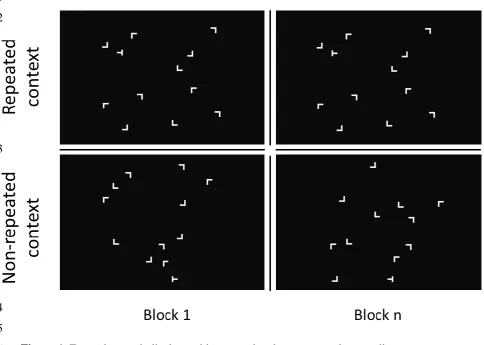
1998). Figure 1 depicts example search displays for the repeated and non-repeated conditions. 3
The experiments were divided into 16 blocks each, with a variable number of trials dependent 4
on the number of non-repeated displays (see below). Participants had the opportunity to take a 5
short break between blocks or continue directly with the next block. To acquire reliable 6
estimates of contextual cueing, we collapsed 4 consecutive blocks into one epoch for analysis. 7
In Experiment 1a, each block contained 16 trials, yielding a total of 256 trials. In each 8
block, 8 trials presented repeated target-distractor arrangements and the other 8 trials non-9
repeated layouts. Experiment 1a served as baseline against which the effects of the 10
environmental manipulations in Experiment 1b/c and 1d were compared. In Experiment 1b 11
(regular condition), each block contained 10 trials, resulting in a total of 160 trials. Each block 12
consisted of 8 repeated and 2 non-repeated trials, yielding a ratio of repeated to non-repeated 13
displays of 80:20. In Experiment 1c (irregular condition), each block contained 40 trials, that 14
is, 640 trials in total. Each block contained 8 repeated and 32 non-repeated displays, with a 15
repeated- to non-repeated-display ratio of 20:80. In other words, the crucial difference 16
between Experiments 1b and 1c was the number of non-repeated displays (32 vs. 512), while 17
the number of repeated displays was constant (always 128). Experiment 1d was similar to 18
Experiment 1a in that half of the trials in a given block contained repeated displays and the 19
other half were non-repeated displays (the total number of trials was 256 as in Experiment 20
1a). However, in contrast to Experiment 1a, Experiment 1d introduced ‘stable’ environments 21
where repeated and non-repeated displays were presented in sequences, or streaks (of 8 trials) 22
of repeated and non-repeated displays. The sequence of repeated and non-repeated displays 23
was controlled: half of the participants started the experiment with a sequence of repeated 24
displays followed by a sequence of non-repeated displays (and they continued with this order 25
throughout the experiment), while the other half started with a sequence of non-repeated 26
displays followed by repeated displays. Note that the order of individual old and new 27
configurations was randomized within the streaks. 28
29
1
2
3
4
[image:12.595.50.535.74.419.2]5
Figure 1. Example search displays with repeated and non-repeated target-distractor 6
configurations (top and bottom panels, respectively). 7
8
Recognition test
9
At the end of each experiment, observers performed a yes/no recognition test, intended to 10
examine whether they had (any) explicit memory of the repeated configurations (a standard 11
procedure in contextual-cueing experiments; cf. Chun & Jiang, 1998). To this end, 8 repeated 12
displays from the search task and 8 newly composed displays were shown and observers were 13
asked to indicate whether or not they had seen a given display previously (by pressing the left 14
or the right mouse key, respectively, without time pressure). The 8 repeated and 8 non-15
repeated displays were presented in random order for four times (i.e., in 4 separate blocks), 16
yielding a total of 72 recognition trials. Note that the 8 non-repeated displays were also 17
repeated during the 4 blocks of the recognition test in order to equate display repetitions 18
between repeated and non-repeated displays. The response was non-speeded, and no error 19
Results
1
In order to gain a coherent picture of the effects of environmental manipulations on 2
contextual cueing, it was necessary to test for the absence of effects. Since non-significant 3
results as such can only be interpreted as absence of evidence, we used Bayes factors which 4
can also be interpreted as evidence of absence given they are sufficiently small (see Dienes, 5
2013; Rouder, Speckman, Sun, Morey, & Iverson, 2009). Bayes Factors allow for an 6
assessment of the degree to which the observed data favor the alternative hypothesis (Jarosz 7
& Wiley, 2014; Jeffreys, 1961). In the present analyses, we used the Bayes Factor algorithms 8
implemented in the JASP software (Marsman & Wagenmakers, 2016), with BF10 based on a 9
directional H1 (pre > post) and a Cauchy prior width of 0.707 (default). A Bayes factor of > 3 10
is considered as substantial evidence against the absence of effects, while a factor of < 1 is 11
evidence for the null effect. Finally, Bayes factors between 1and 3 are typically taken as 12
inconclusive evidence and thus neither the null nor the alternative hypothesis is supported. 13
Individual mean error rates were calculated for each experiment and factor (epoch x 14
context) combination. The mean error rate was very low (<1%), and no main effects or 15
interactions were significant (all p’s > 0.1, BF10 < 1). 16
Next, individual mean RTs were calculated for repeated and non-repeated contexts 17
separately for each epoch (1-4). Error trials and RTs exceeding the individual’s mean RT by 18
2.5 standard deviations were excluded from analysis. This outlier criterion led to the removal 19
of < 5% of all trials. Greenhouse-Geisser corrected values are reported in case Mauchley’s 20
test of sphericity was significant (p < 0.05). 21
Experiment 1a: baseline
22
Experiment 1a was performed to acquire a baseline measure of contextual cueing, 23
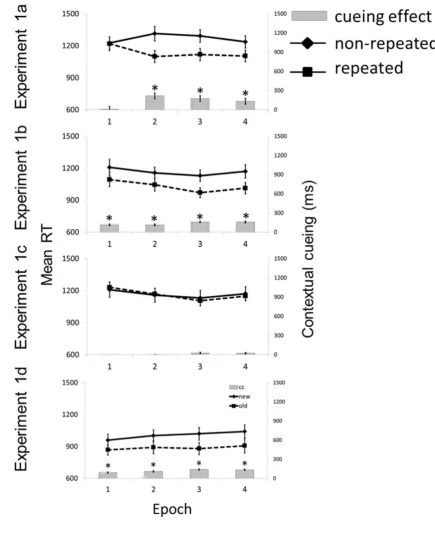
presenting 8 repeated and 8 non-repeated displays per block (ratio: 50:50). Fig. 2 shows mean 24
RTs for repeated and non-repeated contexts as a function of epoch together with the 25
corresponding contextual-cueing effects (RT[non-repeated] minus RT[repeated]). RTs were 26
subjected to a 2 (context: repeated, non-repeated) x 4 (epoch: 1-4) repeated-measures 27
ANOVA, which revealed a main effect of context: repeated displays elicited overall shorter 28
RTs compared to non-repeated displays (Figure 2; contextual-cueing effect: 131 ms; F(1,12) 29
= 17.24, p < 0.01, ηp2 = 0.590, BF10 > 1841). In addition, the context x epoch interaction was
30
significant (F(3, 36) = 7.69, p < 0.01, ηp2 = 0.391, BF10 = 14.52). As revealed by follow-up
31
effects > 130 ms; all p’s < 0.01, BF10 > 12.00), but not in epoch 1 (contextualcueing effect: -1
1.6 ms; F(1, 12) = 0.001, p > 0.9, ηp2 = 0.001, BF10 = 0.27).
2
This pattern is in line with previous investigations of contextual guidance of visual 3
search, which indicate that context information can serve as a strong cue for the detection 4
(and subsequent processing) of the target in repeated displays, also expressed in expedited 5
guidance of the eyes to the target (e.g., Geyer, Zehetleitner, & Müller, 2010; Kunar, Flusberg, 6
Horowitz, & Wolfe, 2007; Peterson & Kramer, 2001; Zellin, von Mühlenen, Müller, & Conci, 7
2013b). 8
Experiment 1b/c: effects of repetition probability
9
Experiment 1b/c was designed to examine whether the memory underlying contextual 10
cueing is sensitive to the probability with which repeated displays occur. To carry this out, we 11
kept the total number of repeated displays constant (thus equating the number of to-be-learned 12
displays across different levels of probability) and instead manipulated the number of new 13
displays: either presenting relatively few (Experiment 1b) or relatively many (Experiment 1c) 14
non-repeated displays together with (a constant number of) repeated displays. In Experiment 15
1b (henceforth referred to as ‘regular’ condition), there were 32 trials with non-repeated and 16
128 trials with repeated displays, leading to a ratio of 20:80 (non-repeated: repeated displays). 17
In Experiment 1c (‘irregular’ condition), there were 512 non-repeated and 128 repeated trials 18
[80:20 ratio]. Prior research had shown that contextual cueing is influenced by the frequency 19
with which a given repeated display appears in a given block of trials (with larger contextual-20
cueing effects for frequently repeated displays; cf. Tseng, Hsu, Tzeng, Hung, & Juan, 2011). 21
Given this, investigating the effects of expectations arising from the relative repetitions of 22
repeated and non-repeated displays on context-based guidance of search would require that 23
the effects of absolute repetitions of individual target-distractor arrangements are equated 24
across the critical learning conditions. For this reason, in Experiments 1b and 1c, we realized 25
variations of the relative occurrence of repeated displays by manipulating the number of non-26
repeated displays. According to the strength hypothesis, contextual cueing should be stronger 27
in Experiment 1b (regular condition) and weaker in Experiment 1c (irregular condition), 28
relative to the baseline Experiment 1a. The acceleration hypothesis predicts a faster 29
development of the cueing effect in Experiment 1b, as compared to an intermediate 30
development in the baseline Experiment 1a, and a slow development in Experiment 1c. Of 31
regularities increase both the onset and asymptotic strength of the cueing effect. Note that a 1
preliminary analysis comparing mean RTs (and standard deviations) of new – baseline – 2
displays in Experiments 1b and 1c revealed no differences between the experiments, F(1, 25) 3
= 1.19, p > 0.28; Levene’s test F = 0.028, p > 0.86. This suggests that any differences in 4
contextual-cueing performance between Experiment 1b and 1c are unlikely to be due to 5
differences in observers’ overall response speed. 6
Experiment 1b: high repetition probability
7
In Experiment 1b, non-repeated displays occurred only rather infrequently (in 32 trials). 8
Given this, in order to achieve a reasonably stable estimate of RTs in the non-repeated 9
condition, we combined RTs to non-repeated displays across Experiments 1b and 1c (see, 10
e.g., von Mühlenen & Conci, 2016, for a comparable procedure). 11
For the RT analysis, we first examined contextual cueing as a function of epoch in 12
Experiment 1b. A 2 (context) x 4 (epoch) repeated-measures ANOVA revealed a main effect 13
of context: repeated displays gave rise to faster RTs relative to non-repeated displays 14
(contextual-cueing effect: 138 ms; F(1, 12) = 22.24, p < 0.01, ηp2 = 0.650, BF10 > 1430). The
15
main effect of epoch was also significant: RTs decreased with increasing number of epochs 16
(epoch 1: 1154 ms, epoch 4 = 1091 ms; (F(3, 36) = 7.55, p < 0.01, ηp2 = 0.386, BF10 = 1.56).
17
Interestingly, the context x epoch interaction was not significant (F(3, 36) = 0.565, p > 0.6, 18
ηp2 = 0.045, BF10 = 0.150): Contextual cueing emerged already in epoch 1 (cueing effect: 123
19
ms) and remained strong in all subsequent epochs (cueing effect averaged across epochs 2-4: 20
143 ms; p’s < 0.05; see Fig. 2). However, a finer grained analysis comparing the first 8 blocks
21
(of the first 2 epochs) revealed a borderline-significant block x context interaction (further 22
considered below). 23
Next, we compared contextual learning in Experiment 1b with learning in Experiment 1a 24
(baseline condition) by means of a 2 (experiment) x 2 (context) x 4 (epoch) repeated-25
measures ANOVA. This analysis revealed a main effect of context: repeated displays yielded 26
faster RTs than non-repeated displays (contextual-cueing effect: 134 ms; F(1, 12) = 50.98, p < 27
0.001, ηp2 = 0.809, BF10 > 2954). The main effect of epoch was also significant: RTs became
28
faster with increasing duration of the experiment (epoch 1 = 1201 ms, epoch 4 = 1144 ms; 29
F(3, 36) = 5.56, p < 0.01, ηp2 = 0.317, BF10 = 0.09). Finally, and most importantly, the
three-30
way interaction was significant (F(3, 36) = 3.72, p < 0.05, ηp2 = 0.237, BF10 = 4.18). This
31
from epoch 2 onwards in the control Experiment 1a (-1.6 ms effect in epoch 1), cueing was 1
already (almost) fully developed in epoch 1 in the regular condition in Experiment 1b (123 ms 2
effect in epoch 1; non-significant context x epoch interaction: F(3, 36) = 0.565, p > 0.6, ηp2 =
3
0.045, BF10 = 0.150). This suggests that, unlike in Experiment 1a, repeated displays 4
facilitated visual search to an equal amount in all epochs when these displays constituted the 5
majority of trials. In other words, a high proportion of repeated displays facilitated the initial 6
build-up of the contextual-cueing effect. 7
Experiment 1c: low repetition probability
8
In Experiment 1c, repeated displays were presented together with many non-repeated 9
displays. Under these conditions, there was no evidence for a reliable contextual-cueing 10
effect. A 2 (context) x 4 (epoch) repeated-measures ANOVA revealed no significant main 11
effect or interaction (all p’s > 0.1, BF10 < 1; see Fig. 2). 12
Next, we contrasted the irregular condition (Experiment 1c) with the baseline 13
(Experiment 1a). A 2 (experiment) x 2 (context) x 4 (epoch) repeated-measures ANOVA 14
revealed a significant experiment x context interaction (F(1, 12) = 6.69, p < 0.03, ηp2 = 0.358,
15
BF10 = 6.02): repeated contexts facilitated visual search for the baseline experiment (cueing 16
effect: 132 ms), but not in the irregular condition (cueing effect: 4 ms; p’s > 0.1, BF10 < 1).
17
In addition, the experiment x context x epoch interaction was significant (F(3, 36) = 3.64, p < 18
0.03, ηp2 = 0.233, BF10 = 0.04), owing to the finding (already reported above) that contextual
19
cueing was reliable from epoch 2 onwards in the Experiment 1a, whereas there was no 20
reliable effect at all in Experiment 1c (no significant main and interaction effects: all p’s >
21
0.1, BF10 < 1). 22
Taken together, the results of Experiments 1b and 1c show that increasing the probability 23
of encountering a repeated context facilitates the acquisition of contextual information 24
(Experiment 1b). Conversely, reducing the probability completely eliminates contextual 25
learning. Importantly, these results were obtained despite a constant absolute number of 26
repeated displays across the regular, irregular, and baseline conditions – ruling out that any 27
differences in contextual cueing are attributable to differences in the total number of repeated 28
displays in these conditions. In addition, the difference in cueing performance between the 29
regular and irregular conditions is also unlikely to be due to carryover effects resulting from 30
previous training: recall that observers initially performed the baseline condition followed by 31
with repeated displays affected contextual cueing in later conditions. However, what is at 1
odds with this proposal is that context cueing was completely opposite in the regular and 2
irregular conditions, despite these conditions being preceded by an identical training schedule 3
(Experiment 1a). Accordingly, the findings from the regular Experiments 1b and irregular 4
Experiment 1c indicate that contextual cueing is highly sensitive to within-experimental 5
factors that pertain to the proportion (or distribution) of repeated and non-repeated displays. 6
Next, for Experiment 1d we continued to examine whether a manipulation of the 7
temporal distance within which observers encountered individual repeated displays would 8
exert comparable effects on the context-based guidance of visual search. It should be noted 9
that an inescapable feature of the probability manipulations used in Experiments 1b/c is that 10
they also introduce variations in the inter-trial temporal distance of presentations of individual 11
repeated displays. This inter-trial spacing is either decreased (10.4 trials; Experiment 1b) or 12
increased (41.8 trials; Experiment 1c) relative to the baseline Experiment 1a (16.7 trials). It 13
might therefore, in principle, be possible that differences in the temporal spacing of individual 14
repeated displays are responsible for differences in contextual-cueing performance. For 15
instance, findings from explicit learning studies show that memory performance is typically 16
better with distributed over massive presentation of studied material (see, e.g., Dempster, 17
1987). Applying this to (implicit) contextual cueing, it is possible that participants may also 18
learn more with spaced relative to dense presentations of repeated items, e.g., because spaced 19
presentations engage qualitatively different – and deeper – levels of processing (considered 20
further in the General Discussion section). However, more efficient learning of repeated 21
displays may also come along with the disadvantage of increasing the interference between 22
individual displays (recall that the repeated condition consists of a set of 8 repeated displays) 23
and/or led to greater difficulty in matching a given display to a representation in context 24
memory. This may lead to a situation in which the beneficial effects of item spacing are 25
outperformed by interference from other non-repeated displays. In a nutshell then, the 26
temporal spacing account predicts that as the distance between repeated displays increases, 27
learning of repeated displays becomes more efficient. At the same time, however, interference 28
from concurrent displays representations increases, which would effectively decrease 29
contextual-cueing performance. As a consequence, contextual cueing should be relatively 30
constant for conditions of identical spacing of individual repeated displays. An alternative 31
account would predict that the context-based guidance of visual search increases in regular 32
was tested in Experiment 1d by employing a volatility, instead of a probability, manipulation. 1
In the new experiment, individual repeated displays were presented across longer 2
sequences of trials (uninterrupted by non-repeated displays) and followed by another 3
sequence of novel displays (uninterrupted by repeated displays). With this manipulation, the 4
average distance between individual repeated displays was set at 16.7 trials and thus fully 5
comparable to the baseline experiment. However, and in contrast to the baseline experiment, 6
experiment 1d allowed observers more massed experience of individual repeated displays, 7
uninfluenced by temporal spacing effects. 8
Experiment 1d: low volatility
9
In Experiment 1d, repeated and non-repeated displays were presented in streaks of trials 10
(cf. Kristjansson, Wang, & Nakayama, 2002), one after the other. A given streak, of 8 trials, 11
consisted of only repeated or only non-repeated displays, and the sequence of streaks of 12
repeated and non-repeated displays was counterbalanced across observers: they either started 13
with a streak of repeated displays followed by a streak of non-repeated displays (and 14
continued with this order until the end of the search experiment), or vice versa. Importantly, 15
the number of repeated and non-repeated displays was equal in Experiment 1d (128 trials each 16
– as in Experiment 1a), and the absolute number of repeated displays was also comparable to 17
all other experiments (Experiments 1a, 1b, and 1c), which allows investigating whether 18
streaks of trials would affect contextual learning without any confounds due to a variable 19
absolute number of trials across experiments. Furthermore, since each block of trials 20
contained the same number of repeated and non-repeated displays (though these displays were 21
presented in mini-blocks of trials), the temporal distance between individual repeated displays 22
was comparable between Experiment 1d and the ‘baseline’ Experiment 1a. Thus, any 23
variations in contextual cueing between the two experiments are unlikely to result from 24
spacing effects. 25
RTs were subjected to a 2 (context) x 4 (epoch) repeated-measures ANOVA, which 26
revealed a main effect of context: RTs were faster to repeated relative to non-repeated 27
displays (contextual-cueing effect: 119 ms; F(1, 12) = 18.53, p < 0.01, ηp2 = 0.607, BF10 >
28
1446). The context x epoch interaction was non-significant: F(3, 36) = 1.91, p > 0.14, ηp2 =
29
0.137, BF10 = 0.168: contextual cueing was evident already in epoch 1 (cueing effect: 91 ms; 30
p < 0.01, BF10 = 7.76) as well as in all subsequent epochs (cueing effect averaged across 31
Given that contextual cueing was reliable already in the first epoch of both Experiments 1
1b and 1d, we further explored this early onset of the cueing effect by means of a more 2
thorough analysis, comparing reaction times to repeated and non-repeated displays across 3
individual blocks (of the first epoch). Effectively, we performed a 2 x 2 x 8 repeated-measures 4
ANOVA with the within-group factors experiment (1b, 1d), context (repeated, non-repeated) 5
and block (1-8). There was a significant main effect of context (F(1, 12) = 13.96, p = 0.003, 6
ηp2 = 0.54) in addition to a marginally significant interaction of context and block (F(7, 84) = 7
1.89, p = .082, ηp2 = 0.14). Follow-up analyses across blocks showed that the main effect of 8
context was significant in all blocks (all p’s < 0.05), except for blocks 1 (t(25) = -0.39, p > 9
0.6) and block 5 (t(25) = -1.75, p = 0.092). There was, however, no interaction of context and 10
experiment (F(1, 12) = 0.36, p = .56, ηp2 = 0.03), as well as no three-way interaction (F(7, 11
84) = 0.99, p = .447, ηp2 = 0.08). The results of this finer grained analysis suggest that 12
contextual cueing was comparable in terms of temporal development (and overall magnitude) 13
between the ‘environmentally-rich’ Experiments 1b and 1d (see Table 1). 14
In a final analysis, we compared Experiments 1a and 1d in a 2 (experiment) x 2 (context) 15
x 4 (epoch) repeated-measures ANOVA. The results revealed main effects of experiment and 16
context: RTs were overall shorter in Experiment 1d than in Experiment 1a (971 ms vs. 1228 17
ms; F(1, 12) = 9.82, p < 0.01, ηp2 = 0.450, BF10 > 16) and the repeated context facilitated
18
search performance overall in both experiments (F(1, 12) = 57.38, p < 0.001, ηp2 = 0.827,
19
BF10 = 4.82). Of theoretical importance, the experiment x context x epoch interaction turned 20
out to be significant (F(3, 36) = 5.51, p < 0.01, ηp2 = 0.315, BF10 = 46.15), reflecting the fact
21
that repeated (relative to non-repeated) displays facilitated search from epoch 1 onwards in 22
Experiment 1d (epoch 1 = 91 ms, epoch 4 = 134 ms) but only from epoch 2 onwards in 23
Experiment 1a (epoch 1 = -1.6 ms, epoch 4 = 139 ms). This pattern suggests that the 24
presentation of repeated and non-repeated displays in streaks of trials facilitates the initial 25
build-up of contextual cueing, even if temporal distances between individual repeated 26
displays are equated between the critical learning conditions. This finding supports the 27
acceleration hypothesis and further supports the results obtained in Experiment 1b. 28
Cross-session transfer
29
Despite of the counterbalanced order in which the experiments were presented, in a final 30
set of analyses, we examined the possibility that cross-experimental variations in contextual 31
individual experiments. Recall that the current study used a within-subject design, which 1
makes it possible that at least parts of the cueing effect transferred across conditions. 2
Although we used relatively large inter-session separations (of at least 10 days) and 3
counterbalancing, there remains the possibility that order effects contributed to the observed 4
results. For instance, it is possible that observers’ beliefs about the presence (or absence) of 5
statistical regularities in the current search environment are carried over from one to the other 6
session. This idea is feasible given recent investigations of contextual cueing that showed that 7
the effect can emerge on several consecutive days (e.g., Jiang, Song, & Rigas, 2005; Zellin et 8
al., 2013a). However, none of these studies reported increased contextual-cueing scores across 9
subsequent days, as one might expect for the present investigation (e.g., from the baseline 10
Experiment 1a to the regular Experiment 1b). Instead, contextual cueing in the 11
aforementioned studies was either relatively constant (Jiang et al., 2005) or even reduced 12
(Zellin et al., 2013a) across subsequent days. 13
In an attempt to directly address the transfer issue, we re-analyzed RT performance in 14
Experiments 1a-d dependent on the order in which observers experienced the respective 15
environmental manipulations. There were two counterbalanced orders (see Method section): 16
‘ascending’ (1a1b1c1d) and ‘descending’ (1a1c1b1d). Since all observers 17
started with the baseline Experiment 1a (thus contextual cueing in the baseline could not be 18
affected by a previous experiment), we then performed three separate repeated-measures 19
ANOVAs, for Experiment 1b, 1c, and 1d, in which we included order (ascending, 20
descending) as a variable, besides display type (repeated, non-repeated) and epoch (1-4). 21
However, none of these ANOVAs revealed a significant effect of order (neither main effects 22
nor interactions; all F’s < 1.87). As a second check, we computed contextual-cueing effects in 23
the ‘early’ blocks 2-8 of the initial experimental epoch and compared contextual-cueing 24
scores across Experiments 1b-1d, again dependent on whether observers performed these 25
conditions in ascending or descending order. – The idea being that any cross-session transfer 26
of environmental expectations should be particularly strong in early blocks and thus up- or 27
down-modulate learning of a new set of repeated displays already in these early blocks. 28
However, variations in contextual cueing due to different orders were only small and non-29
significant (see Table 1). The results of these analyses thus argue against any cross-session 30
transfer of contextual expectations. Instead, variations of contextual cueing seem to arise 31
almost entirely within individual sessions. 32
1
Figure 2. Mean RTs (in ms) and associated mean standard errors (SEM) for repeated and 2
non-repeated displays as a function of epoch in the ‘baseline’ Experiment 1a (50% repeated 3
and 50% repeated displays), and in the ‘regular‘ Experiment 1b (80% repeated, 20% non-4
repeated trials), the ‘irregular’ Experiment 1c (20% repeated, 80% non-repeated displays), 5
and in the ‘streak’ Experiment 1d (50% repeated, 50% non-repeated trials). In Experiments 1a 6
trial. In Experiment 1d, repeated and non-repeated displays were presented in streaks of 8 1
consecutive trials, with an alternating order of the streaks. 2
3
Table 1 4
Contextual-cueing effects (RT[non-repeated display]-RT[repeated display]) in milliseconds 5
(ms) in ‘early’ blocks 2-4 of epoch 1 for the three Experiments 1b-1d as a function of whether 6
observers participated in these experiments in ascending or descending order 7
(1a1b1c1d; 1a1c1b1d, respectively). 8
9
High-Repetition
1b
Low-repetition
1c
Low-volatility
1d
Ascending order 149 ms -22 ms 156 ms
Descending order 135 ms -52 ms 94 ms
10
Recognition test
11
As shown by Vadillo, Konstantinidis, and Shanks (2015; see also Smyth & Shanks, 12
2008), the results of (explicit) recognition tests in contextual cueing crucially depend on the 13
power of the respective tests. While standard tests of recognition in contextual-cueing studies 14
typically fail to find evidence of explicit memory (for review see Goujon, Didierjean, & 15
Thorpe, 2015), increasing the test power has been argued to be sufficient for revealing above-16
chance recognition (Smyth & Shanks, 2008). This is supported by a recent meta-analysis by 17
Vadillo et al. (2015), which showed that, even though explicit memory of repeated search 18
displays might go ‘undetected’ in individual studies, the combined evidence indicates above-19
chance recognition. For this reason, we combined the performance in the current recognition 20
test across all experiments, comparing the hit rates (repeated display correctly judged as 21
repeated in the recognition task) with the corresponding false-alarm rates (non-repeated 22
display incorrectly judged as repeated in the recognition task) by means of a 2 (type of 23
response: hit, false alarm) x 4 (experiment: 1a, 1b, 1c, 1d) repeated-measures ANOVA. On 24
average, observers correctly recognized repeated displays in 47% of the trials (hit rate), while 25
the hit rate was not significantly different from the false alarm rate (F(1, 12) = 2.118, p > 1
0.17, ηp2 = 0.150, BF10 = 0.39), and there was also no difference across the three experiments
2
(main effect of experiment: F(3, 36) = 1.228, p > 0.3, ηp2 = 0.093, BF10 = 0.164; interaction:
3
F(3, 36) = 0.938, p > 0.4, ηp2 = 0.073, BF10 = 0.062). This suggests that context memory was
4
uninfluenced by explicit knowledge of display repetitions in the present experiments. 5
General Discussion
6
The present study examined whether environmental regularities can modulate contextual 7
cueing – a form of statistical learning in visual search. In the baseline Experiment 1a, which 8
was a typical contextual-cueing experiment, half of the trials presented repeated displays and 9
the other half non-repeated displays. Experiment 1b/c then manipulated the display 10
probability, that is, the relative frequency with which repeated target-distractor configurations 11
were presented, while equating the absolute number of repeated displays across experiments. 12
In Experiment 1b, repeated displays occurred in 80% of trials and non-repeated displays in 13
20%; these probabilities were reversed in Experiment 1c. Experiment 1d then examined the 14
effects of a second environmental manipulation on context-based learning in visual search, 15
namely, the ‘volatility’ or the rate of change between repeated and non-repeated displays – by 16
presenting repeated and non-repeated displays each in longer sequences of 8 trials, with 17
alternating sequences of repeated and non-repeated displays throughout the search 18
experiment. This manipulation also served as a critical test for the effects of inter-item 19
spacing on contextual-cueing performance, which may have confounded cueing effects in 20
Experiments 1b/1c. 21
Environmental regularities and contextual cueing
22
The main findings were that increasing the probability of repeated relative to non-23
repeated displays resulted in an earlier development (onset) of the contextual-cueing effect 24
(Experiment 1b), whereas reducing the probability of repeated relative to non-repeated 25
displays completely abolished the cueing effect (Experiment 1c), as compared to the baseline 26
Experiment 1a. Moreover, presenting repeated and non-repeated displays in (separate) streaks 27
of trials expedited the development of contextual cueing, again relative to the baseline 28
condition. The difference in the time course of the cueing effect across the experimental 29
manipulations shows that configural learning is influenced by environmental regularities (or 30
acquire spatial memory about repeated search displays. On the other hand, the data also show 1
that once a cueing effect has been established, it reaches an asymptotic level – that is, the 2
magnitude of the effect cannot be further improved by statistical regularities (of encountering 3
repeated displays) in the search environment. Thus, ‘expectations’ about the occurrence of 4
invariant displays exert a very specific effect on the context-based guidance of visual search: 5
configural memory is acquired faster and guidance by repeated contexts manifests in earlier 6
epochs when repeated displays occur on the majority of trials or when they are aggregated 7
into longer sequences of trials. Importantly, these results go beyond earlier demonstrations of 8
the effects of statistical properties of the repeated displays. In particular, Tseng et al. (2011) 9
showed that increasing the frequency of the presentation of repeated displays (e.g., 1, 2, or 3 10
times per block) results in an increased magnitude of contextual cueing. In line with this, we 11
observed that regular environments have an advantageous effect on the configural learning 12
process. However, unlike Tseng and collaborators (2011), we found that the asymptotic level 13
of contextual cueing was not influenced by the probability manipulation. Instead, 14
environmental regularities were expressed only in terms of an accelerated development of the 15
contextual-cueing effect. 16
Furthermore, in the present experiment, we equated the frequency of individual repeated 17
displays (which was again different to the approach taken by Tseng et al., 2011). Thus, in 18
each experiment, the total number of to-be-learned displays was identical and differences in 19
contextual cueing across the experiments can ultimately only be attributed to observers’ 20
expectations about the occurrence of repeated displays. Of note, we conceive these 21
‘expectations’ as being implicit in nature (similar to other ‘implicit expectation’ effects in 22
visual search; see, e.g., Wolfe, Butcher, Lee, & Hyle, 2003), specifically because observers 23
were unable to explicitly tell apart repeated from non-repeated displays in the present 24
investigation - even in the case of a regular or structured environment (Experiments 1b and 25
1d). 26
We also found that a decrease of the probability of encountering repeated displays 27
substantially reduced the contextual-cueing effect. This finding may imply that the visual 28
system requires a sufficient amount of predictive information for detecting and subsequently 29
learning contextual associations. Previous studies showed that contextual cueing requires 30
some 100-150 trials (4-6 repetitions of each individual repeated display) in order to become 31
measurable (Chun & Jiang, 2003; Chun & Turk-Browne, 2008). However, our current 32
display that determines the formation of a stable contextual association, but also the relative
1
amount of evidence provided by the environment, as the number of repeated displays was 2
identical in all experiments of the present study. In other words, our data imply that when 3
repeated displays are rather infrequent, statistical learning may not operate at all. This is 4
consistent with work by Jungé, Scholl, and Chun (2007), who used a training-test design in 5
their experiment. During training, observers completed either 18 blocks of trials with only 6
repeated displays (regular condition) or 18 blocks of trials with only non-repeated displays 7
(irregular condition), with different groups of observers participating in the two training 8
conditions. In the subsequent test phase (intended for measuring the contextual-cueing 9
effects), both groups received 6 blocks of trials that contained both repeated and non-10
repeating displays. Interestingly, Jungé et al. reported that repeated contexts expedited visual 11
search (relative to non-repeated contexts) only if participants had encountered the repeated 12
displays initially (regular condition). In the other – irregular – condition, no contextual-cueing 13
effect was evident at all. Jungé et al. took these findings to mean that, in the course of the 14
visual search task, observers develop assumptions about the presence versus absence of 15
contextual regularities. If observers come to the assumption that the current search 16
environment lacks regularities (Jungé et al.’s irregular condition), they “turn off” their 17
learning efforts, even if in the subsequent test phase they are presented with repeated displays 18
on 50% of all trials. The reason for this may be that although contextual memory traces are 19
acquired incidentally (automatically), the retrieval of these traces is an effortful, attention-20
demanding process (e.g., Annac et al., 2013; Jiang & Leung, 2005). Another explanation 21
might be that configural learning is generally more robust in earlier epochs (sessions), 22
reflecting a kind of primacy effect in statistical learning (Zellin, Conci, von Mühlenen, & 23
Müller, 2013a). Whatever the explanation, the results of Jungé et al. (2007) are in line with 24
the present Experiment 1c, showing that expectations about the absence of repeated displays 25
impede, or entirely prevent, the development of contextual-cueing effects. 26
But probability manipulations inevitably come along with either a decreased (Experiment 27
1b) or increased (Experiment 1c) temporal spacing of individual repeated displays, relative to 28
the baseline Experiment 1a. Previous studies have repeatedly reported that explicit learning is 29
reliably affected by the temporal distribution of study time (Cepeda, Pashler, Vul, Wixted, & 30
Rohrer, 2006). Specifically, distributed relative to massed presentation of to-be-learned items 31
consistently shows learning benefits that increase proportionally with increased distance 32
317 experiments see Cepeda, Pashler, & Rohrer, 2006). When the distance between repeated 1
items is relatively small, the first occurrence of the target evokes a mental representation of 2
that object, while a prompt re-appearance of the target object reduces its semantic processing. 3
Since semantic priming wears off after a period of time (Kirsner, Smith, Lockhart, King, & 4
Jain, 1984), less semantic priming is expected for the second occurrence of a spaced item and 5
the learning is constrained. However, we believe that spacing effects are unlikely to explain 6
the current results. First, we observed that an increase in the distance of presentations of 7
individual repeated displays results in reduced contextual cueing. While this reduction may be 8
due to increased interference from concurrent contextual-cueing representations – which may 9
beat down the facilitatory effects arising from spaced over dense items, in Experiment 1d we 10
again found an up-modulation of contextual cueing, critically, when inter-display spacing was 11
identical between the environmental manipulation and the baseline experiment. But in 12
Experiment 1d, repeated and non-repeated displays were presented in longer streaks of trials, 13
rendering the presence of environmental regularities more salient. This makes an account of 14
(differences in the) temporal spacing of individual search displays unlikely. Instead, it 15
supports a view of contextual cueing according to which context memory takes into account 16
higher-order environmental properties, such as the proportion of repeated displays or the rate 17
of change between repeated and non-repeated displays. 18
Variations in the number of non-repeated displays unescapably come along with a 19
variable length of the individual experiments tested here. It is therefore possible that an 20
increased number of trials particularly in the low-probability Experiment 1c (N=640 trials) 21
resulted in an increased level of fatigue, which could potentially explain why contextual 22
cueing was weakened and even non-significant in this experiment. Jiang and Leung (2005; 23
see also Annac et al., 2013) have shown that the expression (i.e., retrieval) of learned context 24
cues requires selective attention. If now assuming that fatigue is accompanied by a reduction 25
of (sustained) attention, this could also reduce the contextual-cueing effect. But we believe 26
that this explanation is rather unlikely. We base this view on prior investigations of spatial 27
context learning that reported strong cueing effects when using, relative to the current 28
Experiment 1c, comparable or even higher numbers of trials (e.g., N=720 trials in Experiment 29
1 of Chun & Jiang, 1998). Further, significant contextual cueing was reported in 30
neuroscientific studies that used very high numbers of trials (N>1000 trials; e.g., Schankin & 31
Schubö, 2010). Thus, context learning seems to occur even in very long search experiments 32
in Experiment 1c is also not compatible with the idea of fatigue in context learning. This 1
experiment revealed no differences in context learning across epochs, which would have been 2
indicative of a possible effect of fatigue on search reaction times/ contextual cueing. – If 3
fatigue would have been at play in this experiment, then the cueing effect should have been 4
reduced with increasing numbers of trials. However, contrary to this prediction, contextual 5
cueing was absent right from the beginning and did not come to the fore until the end of 6
Experiment 1c (see Figure 2). This again indicates that factors related to fatigue or tiredness 7
are unlikely to explain the pattern of results in Experiment 1c. 8
Predictive coding and contextual cueing
9
Contextual cueing can be interpreted as a form of statistical learning, revealing striking 10
commonalities with current predictive-coding theories (e.g., den Ouden, Kok, & de Lange, 11
2012, for review). Predictive-coding theories (Friston, 2010) assume that (i) object 12
recognition is largely achieved by taking into account prior object knowledge; and that (ii) in 13
order to successfully, that is, statistically optimally, recognize a certain object, the sensory 14
system must represent the variability, or reliability, of (the occurrence/appearance of) this 15
object. For instance, visual object information is more reliable at day than at night, and 16
auditory signals are less ambiguous in a sound-protected environment than in a busy 17
classroom. These differences in the reliability of sensory objects have a large impact on the 18
way prediction error signals are regulated in perceptual inference and learning. In regular 19
environments, a prediction error will receive a high weight in perceptual inference; in other 20
words, in regular environments, the prediction error serves as a strong learning signal. In 21
irregular environments, by contrast, the prediction error has a relatively small weight – thus 22
less is learned about the sensory environment (in fact, under these conditions, prediction error 23
signals might be effectively suppressed at lower, sensory levels; cf. Den Ouden et al., 2012). 24
Applied to the present study, in the ‘regular’ Experiments 1b and 1d, observers will be 25
confident with the current sensory input such that they can attribute meaning (i.e., ‘signal’) to 26
the input. For this reason, the visual representation of the (invariant) target-distractor relations 27
acts as a strong learning signal for the build-up of contextual memory about this display. 28
When this display is encountered on later occasions, associated configural memory traces are 29
quickly retrieved and come to support visual search. In this scheme, the context-based 30
guidance of visual search may be conceived as an application of the Bayes rule. However, 31
non-repeated than repeated displays), less is learned about the repeated displays and visual 1
search may be predominantly driven by the featural properties of the search items. This would 2
correspond to a stimulus-based, rather than memory-based, visual search process in irregular 3
environments. 4
Conclusion
5
Current proposals in cognitive neuroscience emphasize predictive coding as a mechanism 6
by which the brain can predict events based on learned statistical environmental regularities. 7
However, less is known about the context factors that modulate statistical learning of sensory 8
environments. Here we use a visual search paradigm to unravel the mechanisms that 9
determine statistical learning of spatial target-distractor associations (the “contextual-cueing” 10
effect). We show that reaction time gains resulting from learned target-distractor layouts are 11
influenced by the relative proportion of repeated to non-repeated displays. Importantly, 12
variations in statistical context learning were achieved through manipulations of the number 13
of non-repeated trials. The results thus go beyond previous findings that showed that absolute
14
frequency with which an event occurs are important determinants in statistical learning. 15
Further, the results are unlikely to be explained by differences in the temporal spacing of 16
repeated search displays. The human perceptual system therefore seems to monitor the level 17
of noise associated with a certain sensory environment, which determines statistical learning 18
of critical task parameters, such as the location of the target in relation to the constant 19
distractor background. 20