IJPSR (2018), Volume 9, Issue 5 (Research Article)
Received on 28 July, 2017; received in revised form, 12 October, 2017; accepted, 20 October, 2017; published 01 May, 2018
PREPARATION, CHARACTERIZATION AND EVALUATION OF TABLET FOR COLONIC DELIVERY
P. M. Chavan * 1 and Swati Ughade 2
Department of Pharmaceutics 1, Shree Sainath College of Pharmacy, Dawalamethi, Nagpur - 440023, Maharashtra, India.
Department of Pharmaceutics 2, Vidyabharti College of Pharmacy, Amravati - 444602, Maharashtra, India.
ABSTRACT: The aim of the present work is to develop and evaluate colon targeted drug delivery of satranidazole for an effective and safe therapy of amoebiasis. Amoebiasis is a parasitic disease caused by E. histolytica and it causes about 34 - 50 million symptomatic infections each year. The treatment of amoebiasis is effective with satranidazole. Therefore it was planned to develop a suitable dosage form, which can deliver maximum amount of the drug in the colonic environment such that there would be effective action on amoebiasis. This investigation was planned to characterize the satranidazole for their physico-chemical properties and to evaluate rheological and compressional characteristics of the tablets. It was planned to optimize the amount of PH dependent polymer eudragit L100 and eudragit S100 carriers for colonic delivery. The coating formulation consisted of Eudragit L100: Eudragit S100 in ratio of 6:4 at 10% coating level has potential for the required lag time of 5 hours. In-vitro release study was shown after effective lag time.
INTRODUCTION: Colon drug delivery system
improves the localized action of drug. Present study will take up with following objectives drug directly available at the target site, decreased dose to be administered by controlling release rate, decreased side effect by direct treating disease site and improved drug utilization by prolonging effect of drug colon is attracting interest as a site where poorly absorbed drug molecule may have an improved bioavailability 1. This region of the colon is recognized as having a somewhat less hostile environment with less diversity and intensity of activity than the stomach and small intestine 2.
QUICK RESPONSE CODE
DOI:
10.13040/IJPSR.0975-8232.9(5).2027-33
Article can be accessed online on: www.ijpsr.com
DOI link: http://dx.doi.org/10.13040/IJPSR.0975-8232.9(5).2027-33
Oral delivery of drugs to the colon is valuable in the treatment of diseases of colon (ulcerative colitis, Crohn' disease, carcinomas and infections) whereby high local concentration can be achieved while minimizing side effects that occur because of release of drugs in the upper GIT or unnecessary systemic absorption.
The colon is rich in lymphoid tissue, uptake of antigens into the mast cells of the colonic mucosa produces rapid local production of antibodies and this helps in efficient vaccine delivery. The colon has a longer retention time and appears highly responsive to agents that enhance the absorption of poorly absorbed drugs. The simplest method for targeting of drugs to the colon is to obtain slower release rates or longer release 3, 4.
Approaches to Colon Specific Drug Delivery: The most direct route for delivery of drugs into the colon is by rectal administration. Since there are Keywords:
Colon, Amoebiasis, Satranidazole, Eudragit L100, eudragit S100, pH dependand Correspondence to Author: Mrs. Pooja Manish Chavan
Assistant Professor,
Department of Pharmaceutics, Shree Sainath College of Pharmacy, Dawalamethi, Nagpur - 440023, Maharashtra, India.
problems in both patient acceptability and accessing the proximal colon using rectally administered dosage forms, orally administered colon specific delivery systems have been developed. There are three practical mechanisms by which a delivery system can be targeted into the colon following oral administration 5.
The targeting of orally administered drugs to the colon is accomplished by:
Coating with pH dependent polymers, Time release dosage forms,
Delivery systems based on the metabolic activity of colonic bacteria.
Coating with pH Dependent Polymers: In these systems, drugs are formulated into solid dosage
forms such as tablets, capsules and pellets and coated with pH sensitive polymers as in enteric coating. Widely used polymers are methacrylic resins (Eudragits) which are available in water-soluble and water-inwater-soluble forms. It is well known that the pH value increases as it goes from stomach to the rectum 6. The slight differences in pH between the small intestine (pH 6.5 - 7) and large intestine (pH 7 - 8) gives many fold difference in their hydrogen ion concentration which can be utilized to deliver the drug to the large intestine with the help of a pH dependent polymer. The carboxyl group present in these polymers are soluble at higher pH values. The pH at which these dissolve is known as threshold pH and depends on
the number of the carboxyl groups in the molecules 7.
TABLE 1: POLYMERS USED IN THE DEVELOPMENT OF MODIFIED-RELEASE FORMULATIONS FOR COLONIC DRUG DELIVERY SYSTEMS 8
Polymers Optimum pH for dissolution of drug
Polyvinyl acetate phthalate (PVAP) 5.0
Cellulose acetate trimelitate (CAT) 5.5 Hydroxypropyl methylcellulose phthalate (HPMCP) > 5.5 Hydroxypropylmethylcellulose acetate succinate (HPMCAS) > 6.0 Methacrylie acid copolymer, Type C (Eudragit L100-55) > 6.0 Methacrylic acid copolymer dispersion (Eudragit L30D-55) > 5
Methacrylic acid copolymer, Tyep A > 6.0 (Eudragit®L-100 and Eudragi st L12,5) - Cellulose acetate phthalate (CAP) (Aquateric) 6.0
Methacrylic acid copolymer, Type B > 7.0
(Eudragist S-100 and Eudragit S12,5) -
Eudragit FS30D > 7.0
Shellac (MarCoat 125 &125N) 7.0
Satranidazole: Satranidazole is a 5- nitroimida zoles with a potent antiprotozoal activity, effective in treating intestinal amoebiasis, giardiasis trichomoniasis or bacterial vaginosis. It is of synthetic origin and belongs to Nitroimidazole. It belongs to Amebicides pharmacological group. Amebiasis and giardiasis Satranidazole is extremely effective against anaerobic bacterial infections and is also used to treat Crohn's disease, antibiotic-associated diarrhea, and rosacea.
Nitro group covalently binds to DNA, disrupt its helical structure, inhibiting bacterial nucleic acid synthesis and resulting in bacterial cell death 9. Dosage: 10 For amoebiasis 300 mg two times a day for 3 - 5 day. For trichomoniasis and giardiasis 600 mg as a: single dose.
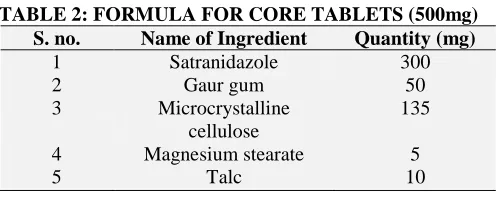
[image:2.612.44.572.317.477.2]Materials: Satranidazole gifted from Alkem laboratory, Mumbai, Gaur gum, Microcrystalline cellulose, Mg. stearate, Talc, Eudragit L100, Eudragit S 100 gifted by Evonik India Pvt. Ltd., Mumbai, Methanol, Dibutyl phthalate, Lactose. Formula for Core Tablets:
TABLE 2: FORMULA FOR CORE TABLETS (500mg) S. no. Name of Ingredient Quantity (mg)
1 Satranidazole 300
2 Gaur gum 50
3 Microcrystalline cellulose
135
4 Magnesium stearate 5
5 Talc 10
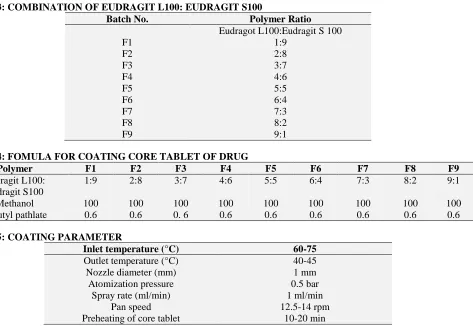
[image:2.612.315.565.577.679.2]Formula for Coating Solution: The core tablet was coated with polymer Eudragit L100 and Eudragit S100 in combination in different
[image:3.612.88.561.105.431.2]concentration, formulation developed from batch F1 to F9 give in Table 3.
TABLE 3: COMBINATION OF EUDRAGIT L100: EUDRAGIT S100
Batch No. Polymer Ratio
Eudragot L100:Eudragit S 100
F1 1:9
F2 2:8
F3 3:7
F4 4:6
F5 5:5
F6 6:4
F7 7:3
F8 8:2
F9 9:1
TABLE 4: FOMULA FOR COATING CORE TABLET OF DRUG
Polymer F1 F2 F3 F4 F5 F6 F7 F8 F9
Eudragit L100: Eudragit S100
1:9 2:8 3:7 4:6 5:5 6:4 7:3 8:2 9:1
Methanol 100 100 100 100 100 100 100 100 100
Dibutyl pathlate 0.6 0.6 0. 6 0.6 0.6 0.6 0.6 0.6 0.6
TABLE 5:COATING PARAMETER
Inlet temperature (°C) 60-75
Outlet temperature (°C) 40-45
Nozzle diameter (mm) 1 mm
Atomization pressure 0.5 bar Spray rate (ml/min) 1 ml/min
Pan speed 12.5-14 rpm
Preheating of core tablet 10-20 min
Preparation of Coating Solution: Coating solution was made using different ratios of material like Eudragit L100 and Eudragit S100. Required quantity of polymers were dissolved in solvents and stirred on magnetic stirrer to get homogeneous coating solution. Dibutyl pthalate was added in above solution as plasticizer (0.6% w/v). After getting homogeneous coating solution; coating was done on tablets.
Pre-Compression Characteristics of Powder Bed: 11 Powder used for direct compression of core tablet were evaluated for various rheological properties like bulk density, tapped density, compressibility index, flow properties (angle of repose) by using standard procedures. All studies were carried out in triplicate (n = 3) and average values were reported.
Bulk Density: Bulk density was determined (bulk density apparatus, Konark instruments, India) by taking the Powder in a measuring cylinder and
measures the volume and weight of the total Powder.
Bulk density = Total weight / Total bulk volume The results are shown in Table 20.
Tapped Density: Tapped density was determined (Tapped density apparatus, Konark instruments, India) by taking the powder in a measuring cylinder and the volume of powder after 100 tapping and weight of the total Powder.
Tapped density = Total weight / Total volume after Tapping
The results are shown in Table 20.
Compressibility Index: Compressibility index was determined by placing the powder in a measuring cylinder and the volume (V0) was noticed before tapping, after 100 tappings again volume (V) was noticed.
Angle of Repose (Ø): Angle of repose was determined by measuring the height, radius of the heap of the powder. A cut system funnel was fixed to a stand and bottom of the funnel was fixed at a height of 5 cm from the plane. Powder were placed in funnel and allowed to flow freely and measured the height and radius of the heap of powder. These studies were carried out before and after incorporating lubricants / glidants.
Tan ø = h /r h = height of heap of powder. r = radius of heap of powder.
Compression of Tablets: The core tablet were prepared by mixing 300 mg of satranidazole, 50 mg of guar gum, 135 mg of microcrystalline cellulose. After adding lubricant (talc) and anti-adherent (Magnesium stearate) to the powder bed and subsequent blending of the powder, were compressed into tablets on a pilot plant (Vidyabharti College of Pharmacy, Amravati) press machine using 10 mm diameter, convex punches at a pressure of approximately 5 kgs /cm2.
Evaluation of Post Compression Characteristics of Tablets: 12 Tablets were evaluated for their thickness, weight uniformity, hardness, friability, disintegration time and dissolution profiles by using standard procedures.
Thickness: The tablets were evaluated for their thickness using a vernier caliper (Mitutoyo, Japan) measured in terms of micrometer. Average of three readings were taken and the results were tabulated (n = 3).
Weight Uniformity: Ten tablets were taken and weighed individually. Average weight was calculated standard deviation and percent coefficient of variance was computed.
Hardness Test: Prepared tablets were evaluated for their hardness by using Pfizer hardness tester. The hardness was measured in terms of kg/cm2. Triplicate readings were taken and average was computed.
Friability Test: Roche Friabilator was used for testing the friability of the tablets. Five tablets were weighed accurately and placed in the tumbling
chamber and rotated at 25 rpm for a period of 5 min. Tablets were again weighed and the percentage weight loss was determined by using formula given below.
% Friability = Initial wt of tablets – Final wt of tablets × 100 / Initial wt of tablets
Where; W1 is the initial weight of the tablet,
W2 is the weight of the tablet after the particular swelling time interval.
Disintegration Time: Disintegration test was performed for core tablets in 0.1N HCl at 37 °C by using USP disintegration apparatus. Triplicate readings were takenand average was computed. Drug Content Uniformity: From each batch three randomly selected tablets were weighed accurately and powdered in a clean and dry glass mortar with pestle. Powder equivalent to 100 mg of drug was transferred into 100 mL volumetric flask containing distilled water; the remaining volume was made up to 100 mL with distilled water. Shaken intermittently for 24 h and the solution was filtered, make up desired dilutions and analyzed for drug content at λ max 256.5 nm, using a Distilled water as a blank. Triplicate readings were taken and average was computed.
Water Absorption Ratio and Wetting Time: A piece of tissue paper folded twice was placed in a small petridish containing 6 ml of water. A tablet of known weight was put on the paper and the time required for complete wetting of tablet was measured. The wetted tablet was then weighed, water absorption ratio R was determined using the following equation and the result is shown in table
R = 100 × Wb – Wa Wa
Where Wb is weight of tablet before water absorption and Wa is weight of tablet after water absorption.
In vitro Dissolution Studies: The core tablets were
evaluated with the aid of USPXXIV type 2 apparatus. The tablet was kept in 900 mL of dissolution medium and the medium was stirred at
100 rpm and the temperature of the medium was
jars are filled with phosphate buffer pH 6.8 for a period of 12 h. Samples of 1 mL were collected at predetermined time intervals for 12 h. All the studies were carried out in triplicate and the average was considered (n = 3).
Evaluation of Coating: 13
% Weight Gain: The tablets were evaluated for their % weight gain. The core tablet of known weight was coated and again weight was taken. The % weight gain was calculated using following formula
% Weight Gain = W2 - W1 × 100 W1
Coating Thickness: The tablets were evaluated for their coating thickness. The thickness of core tablet measured using a vernier calliper (Mitutoyo, Japan) in terms of micrometer. Again thickness of coated tablet was measured. The difference between two are calculated. Average of three readings were taken and the results were tabulated (n = 3).
In vitro Dissolution Studies: Colon targeted
tablets of saitanidazole were evaluated with the aid
of USP XXIV type 1 (basket) apparatus. The tablet
was kept in basket in the jars containing 900 mL of
dissolution medium and the medium was stirred at
100 rpm and the temperature of the medium was
maintained at 37 ± 0.5 °C.
For the first 2 hours thejars are filled with buffer of
pH 1.2. After 2 h the jar assembly was lifted and
the dissolution fluid was replaced with phosphate
buffer pH 6.4 for 1hr, 7.4 for a period of 9 h.Samples of 1 mL were collected at predetermined time intervals for 12 h. All the studies were carried out in triplicate and the average was considered (n = 3).
Stability Studies: Stability of a drug has been defined as the ability of a particular formulation, in a specific container, to remain within its physical, chemical, therapeutic and toxicological specifications 14.
[image:5.612.48.570.395.535.2]RESULT AND DISCUSSION:
TABLE 6: PHYSICAL PROPERTIES OF POWDER FOR FORMULATION BATCH Formulations Angle of repose() Loose Bulk
Density (gm/cm)
Tapped Density (gm/cm)
Compressibility (%)
Hausner’s ratio
F1 24.560 ±0.02 0.34±0.01 0.38±0.08 11.19 ± 0.12 1.15 ± 0.02 F2 23.320±0.12 0.33±0.02 0.37±0.07 10.82 ± 0.22 1.14 ± 0.07 F3 28.600±0.13 0.33±0.07 0.37±0.01 10.97 ± 0.16 1.17 ± 0.08 F4 25.300±0.12 0.35±0.09 0.39±0.13 10.75 ± 0.21 1.17 ± 0.04 F5 23.240±0.14 0.32±0.04 0.38±0.07 12.76 ± 0.17 1.14 ± 0.10 F6 24.080±0.16 0.33±0.02 0.37±0.21 11.58 ± 0.18 1.13 ± 0.10 F7 24.860±0.13 0.34±0.01 0.38±0.08 11.21 ± 0.13 1.18 ± 0.11 F8 25.290±0.14 0.41±0.03 0.46±0.07 10.68 ± 0.21 1.20 ± 0.10 F9 23.210 ±0.017 0.32±0.06 0.38±0.01 10.69 ± 0.25 1.17 ± 0.06
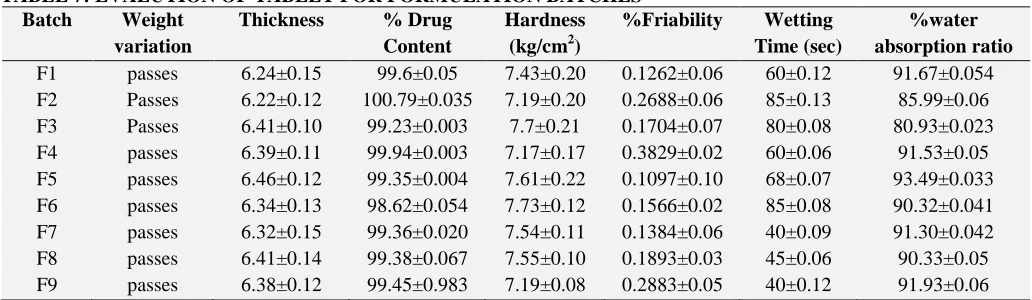
[image:5.612.48.564.576.726.2]Evaluation of Post Compression Characteristics of Tablets: TABLE 7: EVALUTION OF TABLET FOR FORMULATION BATCHES
Batch Weight variation
Thickness % Drug
Content
Hardness (kg/cm2)
%Friability Wetting Time (sec)
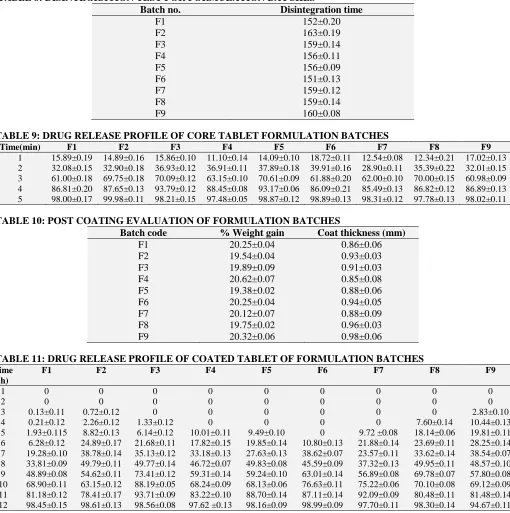
TABLE 8: DISINTEGRATION TEST FOR FORMULATION BATCHES
Batch no. Disintegration time
F1 152±0.20
F2 163±0.19
F3 159±0.14
F4 156±0.11
F5 156±0.09
F6 151±0.13
F7 159±0.12
F8 159±0.14
[image:6.612.53.563.63.576.2]F9 160±0.08
TABLE 9: DRUG RELEASE PROFILE OF CORE TABLET FORMULATION BATCHES
Time(min) F1 F2 F3 F4 F5 F6 F7 F8 F9
1 15.89±0.19 14.89±0.16 15.86±0.10 11.10±0.14 14.09±0.10 18.72±0.11 12.54±0.08 12.34±0.21 17.02±0.13
2 32.08±0.15 32.90±0.18 36.93±0.12 36.91±0.11 37.89±0.18 39.91±0.16 28.90±0.11 35.39±0.22 32.01±0.15
3 61.00±0.18 69.75±0.18 70.09±0.12 63.15±0.10 70.61±0.09 61.88±0.20 62.00±0.10 70.00±0.15 60.98±0.09
4 86.81±0.20 87.65±0.13 93.79±0.12 88.45±0.08 93.17±0.06 86.09±0.21 85.49±0.13 86.82±0.12 86.89±0.13
5 98.00±0.17 99.98±0.11 98.21±0.15 97.48±0.05 98.87±0.12 98.89±0.13 98.31±0.12 97.78±0.13 98.02±0.11
TABLE 10: POST COATING EVALUATION OF FORMULATION BATCHES
Batch code % Weight gain Coat thickness (mm)
F1 20.25±0.04 0.86±0.06
F2 19.54±0.04 0.93±0.03
F3 19.89±0.09 0.91±0.03
F4 20.62±0.07 0.85±0.08
F5 19.38±0.02 0.88±0.06
F6 20.25±0.04 0.94±0.05
F7 20.12±0.07 0.88±0.09
F8 19.75±0.02 0.96±0.03
F9 20.32±0.06 0.98±0.06
TABLE 11:DRUG RELEASE PROFILE OF COATED TABLET OF FORMULATION BATCHES
Time (h)
F1 F2 F3 F4 F5 F6 F7 F8 F9
1 0 0 0 0 0 0 0 0 0
2 0 0 0 0 0 0 0 0 0
3 0.13±0.11 0.72±0.12 0 0 0 0 0 0 2.83±0.10
4 0.21±0.12 2.26±0.12 1.33±0.12 0 0 0 0 7.60±0.14 10.44±0.13
5 1.93±0.115 8.82±0.13 6.14±0.12 10.01±0.11 9.49±0.10 0 9.72 ±0.08 18.14±0.06 19.81±0.11
6 6.28±0.12 24.89±0.17 21.68±0.11 17.82±0.15 19.85±0.14 10.80±0.13 21.88±0.14 23.69±0.11 28.25±0.14
7 19.28±0.10 38.78±0.14 35.13±0.12 33.18±0.13 27.63±0.13 38.62±0.07 23.57±0.11 33.62±0.14 38.54±0.07
8 33.81±0.09 49.79±0.11 49.77±0.14 46.72±0.07 49.83±0.08 45.59±0.09 37.32±0.13 49.95±0.11 48.57±0.10
9 48.89±0.08 54.62±0.11 73.41±0.12 59.31±0.14 59.24±0.10 63.01±0.14 56.89±0.08 69.78±0.07 57.80±0.08
10 68.90±0.11 63.15±0.12 88.19±0.05 68.24±0.09 68.13±0.06 76.63±0.11 75.22±0.06 70.10±0.08 69.12±0.09
11 81.18±0.12 78.41±0.17 93.71±0.09 83.22±0.10 88.70±0.14 87.11±0.14 92.09±0.09 80.48±0.11 81.48±0.14
12 98.45±0.15 98.61±0.13 98.56±0.08 97.62 ±0.13 98.16±0.09 98.99±0.09 97.70±0.11 98.30±0.14 94.67±0.11
TABLE 12: STABILITY STUDY FOR FORMULATION BATCH F6 Stability
(40±20, 75±5% RH)
Physical appearance % Drug content % Cumulative Drug release Lag time
0 Day No colour change 99.4±0.03 98.99±0.01 5
1 week No colour change 99.4±0.11 98.99±0.03 5
2 week No colour change 99.39±0.05 98.90±0.09 5
3 week No colour change 98.97±0.06 98.89±0.04 5
4 week No colour change 98.93±0.06 98.87±0.10 5
After getting all the physical parameter satisfactory for all the batches from F1 - F9 dissolution of these batches were tested. Dissolution study for coated tablet of satranidazole was carried out which give
tablet of satranidazole. The drug release study was done on coated batches and lag time of which were studied. From the combination study of eudragit L100: eudragit S100 of batch F6 (6:4) concentration shows satisfactory result. These formulations give 5 hrs of lag time to target tablet to the colon and also give release of drug upto 98.99 within 12 hrs.
CONCLUSION: From the results obtained of the executed experiments it can be conclude that, From the above IR Study and physical observation it can be concluded that there is no significant Drug- Excipient interaction. So we can conclude that drug and other excipients are compatible with each other. The prepared tablets were developed to a satisfactory level, in terms of hardness, thickness, weight variation, In-vitro disintegration, and content uniformity. It was shown that coating formulation consisted of Eudragit L100: Eudragit S100 in ratio of 6:4 at 10% coating level has potential for the required lag time of 5 h.
The release of drug from coated tablet was found to be proportional to the concentration of the polymer; where the % coating increases lag time increases. On the basis of in vitro release studies and effective lag time, F6 was selected as an optimized formulation for designing repturable coating device. In-vitro release study was shown after effective lag time. Accelerated stability studies, proved that the formulation is quite stable.
ACKNOWLEDGEMENT: For the completion of the research work the authors would like to show sincere gratitude to Vidyabharti College of Pharmacy, Amravati to provide with a lot of support and help whenever needed.
CONFLICT OF INTEREST: Authors have no conflict of interest.
REFERENCES:
1. Asija R, Chaudhari B and Asija S: Oral Colon Targeted Drug Delivery System: A Review on current and Novel Perspectives. Journal of pharmaceutical and scientific innovation 2012; 1(5):1-6.
2. Bhushan PK, Kalyani VT, Vinayak SM and Sandeep SL: Colon Targeted Drug Delivery System – A Novel
Perspective. Asian Journal of Biomedical and
Pharmaceutical Sciences 2012; 2(14): 21-28.
3. Gupta VK, Gnanarajan G and Kothiyal P: A review article on colonic targeted drug delivery system. The pharma innovation 2012; 1(7): 14-24.
4. Ratnaparkhi MP, Somvanshi FU, Pawar SA, Chaudhari SP, Gupta JP and Budhavant KA: Colon Targeted Drug Delivery System-A review. International Journal of Pharma Research and Review 2013; 2(8): 33-42.
5. Sreelatha D and Brahma CK: Colon Targeted Drug Delivery – A Review on Primary and Novel Approaches. Journal of Global Trends in Pharmaceutical Sciences 2013; 4(3): 1174-1183.
6. Prathap M, Gulshan M and Rao NR: Colon: Targeted Drug Delivery System – A Review. International Journal Of Research In Pharmaceutical And Nano Sciences 2014; 3(5): 429- 437.
7. Seth A, Jack EB, and Vivek SD: Colon-Targeted Oral Drug Delivery Systems: Design Trends and Approaches. AAPS Pharm Sci Tech 2015; 16(4): 731-741.
8. Patel RB, Patel R, Patel J, Patel V and Sanghvi K: A Promising Approach of Colon Targeted Drug Delivery System. International Journal of Pharmaceutical Research and Bio-Science 2014; 3(2): 814-826.
9. http://www.medindia.net/doctors/drug_information/satrani dazole
10. Sherje AP, Tawade AP and Vyas M: Simultaneous Spectrophothometric. Determination of Satranidazole and Ofloxacin in Combined Dosage Form. International Journal of Pharm Tech Research 2010; 2(1): 511-514. 11. Hadi MA, Rao NGR and Rao AS: Formulation and
evaluation of ileo-colonic targeted matrix-mini-tablets of Naproxen for chronotherapeutic treatment of rheumatoid arthritis. Saudi Pharmaceutical Journal 2016; 24: 64–73. 12. Singh R: Formulation And Evaluation of Colon Targeted
Drug Delivery System. International Journal of Pharmacy and Life Sciences 2012; 3(12): 2286-2288.
13. Yachao R, Lei J, Shuman Y, Sainan G, Hui Y, Jie H, Dandan U, Wenbin M, Haisheng P and Yulong Z: Design and preparation of a novel colon-targeted tablet of hydrocortisone. Brazilian Journal of Pharmaceutical Sciences 2017; 53(1): 1-11.
14. Lachman L, Lieberman HA and Kanig JL: Kinetic principles and stability. Theory and practice of industrial pharmacy. Varghese publishing house. 3rd ed Philadelphia 1986; 760-803.
All © 2013 are reserved by International Journal of Pharmaceutical Sciences and Research. This Journal licensed under a Creative Commons Attribution-NonCommercial-ShareAlike 3.0 Unported License.
This article can be downloaded to ANDROID OS based mobile. Scan QR Code using Code/Bar Scanner from your mobile. (Scanners are available on Google Playstore)
How to cite this article: