BIROn - Birkbeck Institutional Research Online
Press, Clare and Berlot, E. and Bird, G. and Ivry, R. and Cook, R. (2014)
Moving time: the influence of action on duration perception.
Journal of
Experimental Psychology: General 143 (5), pp. 1787-1793. ISSN
0096-3445.
Downloaded from:
Usage Guidelines:
Please refer to usage guidelines at
or alternatively
BRIEF REPORT
Moving Time: The Influence of Action on Duration Perception
Clare Press
Birkbeck, University of London
Eva Berlot
University College London
Geoffrey Bird
King’s College London
Richard Ivry
University of California, Berkeley
Richard Cook
City University London
Perceiving the sensory consequences of action accurately is essential for appropriate interaction with our physical and social environments. Prediction mechanisms are considered necessary for fine-tuned sensory control of action, yet paradoxically may distort perception. Here, we examine this paradox by addressing how movement influences the perceived duration of sensory outcomes congruent with action. Experiment 1 required participants to make judgments about the duration of vibrations applied to a moving or stationary finger. In Experiments 2 and 3, participants judged observed finger movements that were congruent or incongruent with their own actions. In all experiments, target events were perceived to be longer when congruent with movement. Interestingly, this temporal dilation did not differ as a function of stimulus perspective (1st or 3rd person) or spatial location. We propose that this bias may reflect the operation of an adaptive mechanism for sensorimotor selection and control that preactivates anticipated outcomes of action. The bias itself may have surprising implications for both action control and perception of others: we may be in contact with grasped objects for less time than we realize, and others’ reactions to us may be briefer than we believe.
Keywords: motor processes, perceptual motor coordination, time perception, social perception Supplemental materials:http://dx.doi.org/10.1037/a0037650.supp
To interact appropriately with physical and social environments, actors must predict and evaluate the sensory consequences of their actions. We select actions on the basis of their predicted outcomes (Greenwald, 1970;Hommel, Müsseler, Aschersleben, & Prinz, 2001), and when the experienced sensory information deviates from the prediction, corrective adjustments can be made to ensure successful execution. For example, when picking up a cup of tea, the motor commands generated result in both visual (e.g., sight of grasping and lifting) and tactile (e.g., pressure on the fingertips) sensory
conse-quences. If the actual feedback differs from the anticipated sensory outcomes, rapid corrective actions can be executed to avoid spillage. Similarly, when interacting with others, rapid response prediction and error correction may facilitate smooth social interactions (Wolpert, Doya, & Kawato, 2003).
Successful interaction with the environment requires perception of not only the nature of our action outcomes (e.g., somatosensa-tion on the fingertips during grasping) but also, crucially, the onset and duration of those outcomes. We are sensitive both to the
This article was published Online First August 4, 2014.
Clare Press, Department of Psychological Sciences, Birkbeck, University of London; Eva Berlot, Division of Psychology and Language Sciences, University College London; Geoffrey Bird, MRC Social, Genetic and Developmental Psy-chiatry Centre, Institute of PsyPsy-chiatry, King’s College London; Richard Ivry, Department of Psychology, University of California, Berkeley; Richard Cook, Department of Psychology, City University London.
This research was funded by a Wellcome Trust Biomedical Studentship awarded to Eva Berlot and Clare Press, a Birkbeck School of Science grant awarded to Clare Press, and ESRC Future Research Leaders Grant ES/ K008226/1 awarded to Richard Cook. We are grateful to Martin Eimer for the loan of solenoids.
This article has been published under the terms of the Creative Commons Attribution License (http://creativecommons.org/licenses/by/ 3.0/), which permits unrestricted use, distribution, and reproduction in any medium, provided the original author and source are credited. Copyright for this article is retained by the author(s). Author(s) grant(s) the American Psychological Association the exclusive right to publish the article and identify itself as the original publisher.
Correspondence concerning this article should be addressed to Clare Press, Department of Psychological Sciences, Birkbeck, University of London, Malet Street, London WC1E 7HX, United Kingdom. E-mail: [email protected]
“what” and “when” of sensory predictions (Blakemore, Frith, & Wolpert, 1999;Blakemore, Wolpert, & Frith, 1998;Christensen, Ilg, & Giese, 2011;Fagioli, Hommel, & Schubotz, 2007;Hommel, 2010;Lee, Young, Reddish, Lough, & Clayton, 1983;Schubotz, 2007). For example, lifting the teacup from a saucer requires an anticipatory response to maintain postural stability (Diedrichsen, Verstynen, Hon, Lehman, & Ivry, 2003;Dufossé, Hugon, & Mas-sion, 1985). Similarly, anticipating the duration of the lift phase is essential for coordinating hand and mouth gestures, and when shaking someone’s hand, contact must be made for an appropriate length of time—neither too long nor too short—to convey the intended social message.
While the preceding examples underscore the importance of temporal information in the generation and perception of sensory expectancies, duration perception is frequently distorted. For ex-ample, perceived motion of upright point light walkers is tempo-rally dilated relative to inverted walkers (Wang & Jiang, 2012; see alsoGavazzi, Bisio, & Pozzo, 2013). In the present experiments, we examine how movement influences the perceived duration of sensory outcomes of action. Sensory prediction mechanisms es-sential for action selection and fine-tuned control may, paradoxi-cally, distort the perceived duration of outcomes, with conse-quences for action control and perception in a variety of contexts. In Experiment 1, participants were required to perform a lifting movement with either their index finger or their middle finger. A short target vibratory tactile stimulus was presented to the moving or stationary finger, followed by a second reference vibration. Participants judged which was of longer duration, allowing us to determine how action influences duration perception. In Experi-ments 2– 4, we investigated whether action influences the per-ceived duration of visual events in a comparable manner.
Experiment 1
Sixteen right-handed, healthy adults (12 men) with a mean age of 29.3 years (standard error of the mean [SEM]⫽ 2.5) partici-pated in the experiment. Three were replacements for participants who could not perform the perceptual discrimination (psychomet-ric functions could not be modeled or their point of subjective equivalence [PSE] fell outside the range of presented stimuli). All experiments were undertaken in accordance with the 1964 Decla-ration of Helsinki.
The experiment was conducted in MATLAB using the Cogent toolbox.1
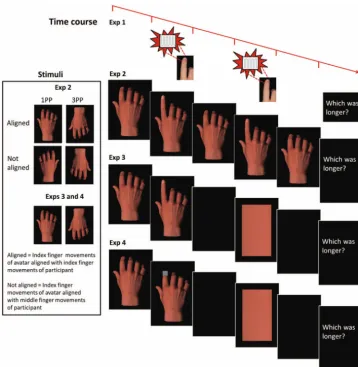
Two 5V solenoids, each driving a metal rod with a blunt conical tip (diameter⬇1.5 mm, skin indentation⬇1 mm), were attached to the distal phalange (ventral surface) of the index and middle fingers on the participant’s right hand. Participants held down two keys on the keyboard until an imperative cue instructed them to lift either their index (I) or their middle (M) finger. They were instructed to make large, rapid, single-movement lifts. Their response hand was visually occluded. Approximately 10 ms after the cued finger was lifted, a target vibration lasting for one of seven durations (104 –296 ms, 32-ms steps) was applied to the moving (congruent) or stationary (incongruent) finger (seeFigure 1). After an interstimulus interval (300 –500 ms), a 200-ms refer-ence vibration was applied to the same finger. Both vibratory stimuli were presented at 62.5 Hz.
Participants judged whether the target or reference vibration was longer, responding with a button press made with their left hand.
After this response, they returned the lifted finger to the start position. The next trial started after 2,000 ms. There were 280 trials: 140 in which stimuli were applied to the congruent finger and 140 where they were applied to the incongruent finger. Trial type was randomized, and participants completed eight practice trials.
To estimate psychometric functions, the responses for each individual were modeled by fitting cumulative Gaussians, and associated pDev statistics were calculated to establish the good-ness of fit of each function (Palamedes toolbox;Kingdom & Prins, 2010). This procedure was performed separately for congruent and incongruent response data. In each condition, bias was inferred from the PSE and precision from the difference threshold (see
Figure 2).
The participants were more precise in their judgments when the vibratory stimuli were applied to the congruent relative to incon-gruent finger, t(15)⫽2.3, p⬍.05,2
⫽.26; seeTable 1. There was also an effect on PSE: Target events were judged to be longer when the stimulus was applied to the congruent relative to the incongruent finger, t(15)⫽2.6, p⬍.02,2⫽
.32 (seeFigure 2
and the supplemental materials). In sum, tactile events presented to a moving effector are perceived to be longer and are judged more consistently than when that effector is stationary.
Experiment 2
If prediction mechanisms operate in social contexts, we may predict and evaluate sensation related to not only our own actions but also actions produced by interactants (Wolpert et al., 2003). As such, we should observe comparable action-related predictive modulation with visual action stimulus events. Ad-ditionally, such mechanisms should operate across perspectives given the range of viewpoints from which others’ actions are observed. Therefore in Experiment 2 we examined duration perception of congruent and incongruent visual events during action, across stimuli presented from first- and third-person perspectives.2
Sixteen right-handed, healthy adults (12 men) with a mean age of 25.9 years (SEM ⫽ 1.9) participated in the experiment. Five were replacements for participants who could not perform the discrimination. Unless otherwise stated, procedural information already outlined in Experiment 1 is identical in this, and all subsequent, experiments. Participants compared the duration of two finger movements simulated visually by gestures of an avatar hand. At the start of the trial, the avatar hand was presented in a neutral position on the monitor (seeFigure 1; screen refresh rate⫽ 85 Hz). An imperative cue (1 or 2) was presented between the index and middle fingers. When participants lifted the cued finger, the neutral hand image was immediately replaced (within the constraints of the refresh rate) by one depicting the avatar hand performing either an index finger or a middle finger lift for 120 – 480 ms (seven levels; 60-ms steps). This resulted in apparent
1John Romaya, Wellcome Trust Centre for Neuroimaging and Institute
of Cognitive Neuroscience development team, University College London.
2Examining congruency-induced temporal dilation in the visual
modal-ity also permits better isolation of perceptual effects from the direct effects of action performance. Visually defined congruency is eliminated when the hands are occluded. It is not possible to eliminate tactile-defined congru-ency without some form of sensory deafferentation.
motion of the avatar’s finger approximately synchronized with the participant’s action. At the offset of the target event, the avatar hand resumed the neutral position for an interstimulus interval of 300 –500 ms, followed by a second image of the same lifted finger for a reference duration of 300 ms and then the neutral image again for 300 ms. Participants judged which lift lasted longer. The range of dura-tions was chosen to match discrimination performance in Experiment 1.
There were four block types. In spatially aligned first-person perspective (1PP) blocks, participants viewed a right avatar hand with fingers aligned in the horizontal plane with their own right hand (seeFigure 1). In spatially aligned third-person perspective (3PP) blocks, the avatar hand was rotated about the horizontal axis (therefore presenting a left hand). The remaining blocks consisted of these stimuli flipped on a vertical axis, such that corresponding finger movements did not match in spatial location (necessitating a left hand for 1PP and a right hand for 3PP). These blocks thereby controlled for the spatial location of finger movement (Press, Gherri, Heyes, & Eimer, 2010). The four blocks each comprised 140 trials and were completed in a counterbalanced order.
The precision and PSE distributions were analyzed using sepa-rate three-way ANOVAs, with factors of movement congruency (avatar and participant moved the congruent or incongruent fin-ger), location (avatar and participant finger movements were made in aligned or misaligned horizontal locations), and perspective (1PP or 3PP). No precision effects were observed (all Fs⬍2.1, all ps ⬎ 0.17; see Table 1). However, as in Experiment 1, target events were perceived to be longer when the avatar and participant moved the same finger, F(1, 15)⫽5.3, p⬍.04,2⫽
.26). There were no other main effects or interactions (all Fs⬍2.5, all ps⬎ 0.14). These results indicate a bias to judge target events to be longer when observed actions are congruent with self-generated actions, regardless of whether stimuli are observed from first- or third-person perspectives. Notably, these effects reflect congru-ency between effectors (same finger) rather than spatial location.
Experiment 3
[image:4.603.118.477.75.442.2]Experiment 2 suggests that action performance influences the per-ceived duration of effector-congruent visual events. However, it is
possible that despite informing participants that the reference event was always presented for the same length of time, participants’ actions might have influenced the perceived duration of the reference rather than the target event. To control for this possibility, we modified
[image:5.603.119.478.75.573.2]the reference event in Experiment 3. Rather than define the reference duration by a second avatar movement, this interval was defined by the stimulus duration of a rectangle, a neutral stimulus selected because it exhibited no congruency relationship with the fingers.
Figure 2. Top panel: Demonstration of how the point of subjective equivalence (PSE) was calculated with psychometric functions for an example participant, with stimuli congruent and incongruent with moving fingers. The PSE describes the point where participants judge the target and reference events to have equal duration. Judgment precision was inferred from the standard deviation of the Gaussian distribution that best fits the data; it pertains to the inverse of the slope, and lower thresholds reflect more consistent categorizations, thereby indicating better performance. Other panels: Mean PSEs for stimuli congruent and incongruent with moving fingers, for all experiments and perspectives. 1PP⫽first-person perspective; 3PP⫽third-person perspective. Error bars represent the standard error of the mean.
Sixteen right-handed, healthy adults (11 men) with a mean age of 28.3 years (SEM⫽2.2) participated in the experiment. Three were replacements for participants who could not perform the discrimination. The imperative cue (I or M) was presented between the index and middle fingers of the observed hand. When partic-ipants lifted the cued finger, the neutral hand image was immedi-ately replaced by an image of a hand with a lifted index or middle finger for 150 –900 ms (seven levels; 125-ms steps). After an interstimulus interval of 300 –500 ms, a rectangle was presented for a reference interval of 525 ms. The color, luminance, and aspect ratio of the rectangle were identical to that of the avatar hand. The test stimulus range was selected on the basis of pilot testing to yield comparable performance to that observed in Ex-periments 1 and 2. Participants again judged which of the two intervals was longer. Given that spatial location had no impact on the effect in Experiment 2, only aligned blocks were included. Participants completed 1PP and 3PP blocks, each comprising 140 trials, in a counterbalanced order.
The precision analysis yielded no main effects or interactions (all Fs ⬍ 1.4, all ps⬎ 0.25; seeTable 1). However, the PSE phenomenon observed in Experiments 1 and 2 was replicated: Target events were perceived to be longer when the observed event was congruent with the participant’s action, F(1, 15)⫽6.5, p⬍ .03,2⫽
.30 (seeFigure 2). As in Experiment 2, this effect did not interact with perspective, F(1, 15)⫽0.05, p⫽.8,2
⫽.02. These findings demonstrate that action biases perception of the tempo-rally contiguous target event, rather than reference events pre-sented after a delay.
Experiment 4
It is possible that the temporal dilation effects in Experiments 2 and 3 result from attentional orienting toward the location of the congruent effector. Increased attention may influence the per-ceived duration of events at this location irrespective of action– stimulus congruency. We conducted a final experiment to test this possibility, which was identical to Experiment 3 except that target durations were defined by the presentation of a rectangle over the fingertip of the index or middle finger rather than by a finger movement (seeFigure 1). If attentional orienting generates tem-poral dilation effects irrespective of the nature of the target event, similar influences of congruency will be observed.
Sixteen right-handed, healthy adults (seven men) with a mean age of 27.7 years (SEM⫽1.7) participated in the experiment. One
was a replacement for a participant who could not perform the discrimination. The precision analysis yielded no main effects or interactions (all Fs ⬍ 0.7, all ps ⬎ 0.41; seeTable 1). Unlike Experiments 1–3, there was also no PSE effect, F(1, 15)⫽0.7, p⫽.42 (seeFigure 2). An ANOVA conducted on the PSE data from both Experiments 3 and 4 with experiment as a between-subjects factor revealed a Congruency⫻Experiment interaction, F(1, 30)⫽6.8, p⬍.02,2⫽
0.2. These results argue against this attentional orienting account of the congruency-induced temporal dilation.
Discussion
The present findings demonstrate a bias to judge sensory events to be longer when they are congruent with a concurrently per-formed action. This effect was found when participants judged the duration of tactile vibrations applied to a moving finger, as well as when assessing the duration of observed finger movements.3These results indicate that subjective action time can be subject to tem-poral dilation: Events effector congruent with performed actions are perceived to be longer than events incongruent with those actions.
These effects may be a consequence of preactivated action expectancies during selection and preparation (Greenwald, 1970;
Hommel et al., 2001), whereby congruent sensory events are perceived to begin before action onset. Imperfect distinctions between anticipated and actual sensory consequences would cause congruent sensation to be perceived as longer. In contrast, when action consequences are unexpected, preactivated outcomes differ from the actual sensory consequences and can thus be discrimi-nated. The hypothesis that duration biases result from imperfect distinctions between predicted and stimulus-driven percepts is consistent with the finding that imagined and perceived visual events activate common occipital representations (Albers, Kok, Toni, Dijkerman, & de Lange, 2013;Kosslyn et al., 1993; see also
Bueti & Macaluso, 2010) and that action preparation activates representations of the anticipated effects (Kühn, Keizer, Rom-bouts, & Hommel, 2011;Müsseler & Hommel, 1997). Further-more, the idea that the perceived onset of anticipated events is shifted in time is consistent with a number of temporal distortions in the action control literature. For example, it has long been recognized that when tapping to a metronome, movements show a phase lead to the pacing signals (Bartlett & Bartlett, 1959;Dunlap, 1910). Moreover, effects resulting from action but at delay are perceived to occur earlier than in reality (Haggard, 2005).
Temporal biases resulting from the prediction of congruent action consequences might be expected to detract from effective action control. However, illusory biases often result from the operation of adaptive mechanisms. For example, visual
afteref-3This similarity was observed across experiments despite changes in the
[image:6.603.46.287.112.214.2]range of durations presented. It is worth noting that piloting indicated these shifts in duration to be necessary for two reasons. First, the apparent motion in Experiments 2 and 3 did not appear natural with short durations. Second, the duration judgments became more difficult across experiments, moving from punctate touch to apparent motion in vision in Experiment 2 and changing the nature of the reference relative to the target in Experiment 3. Given these changes to the durations presented in Experiments 1–3, it is difficult to draw conclusions concerning the presence of a precision effect in Experiment 1 and its absence in Experiments 2 and 3.
Table 1
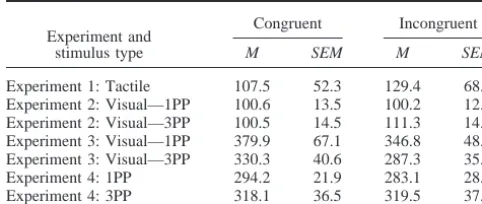
Mean Precision Estimates for Stimuli Congruent and Incongruent With Moving Fingers
Experiment and stimulus type
Congruent Incongruent
M SEM M SEM
Experiment 1: Tactile 107.5 52.3 129.4 68.5 Experiment 2: Visual—1PP 100.6 13.5 100.2 12.1 Experiment 2: Visual—3PP 100.5 14.5 111.3 14.8 Experiment 3: Visual—1PP 379.9 67.1 346.8 48.2 Experiment 3: Visual—3PP 330.3 40.6 287.3 35.2 Experiment 4: 1PP 294.2 21.9 283.1 28.6 Experiment 4: 3PP 318.1 36.5 319.5 37.7
fects, defined by significant sensory distortion, are believed to be the products of ongoing perceptual recalibration to ambient sen-sory inputs (Clifford & Rhodes, 2005;Thompson & Burr, 2009; see also Yarrow, Haggard, Heal, Brown, & Rothwell, 2001). Similarly, stimulus-general temporal dilation during action plan-ning may maximize information acquisition prior to movement (Hagura, Kanai, Orgs, & Haggard, 2012). Following this line of reasoning, we suggest that the dilation of subjective action time observed for anticipated sensory outcomes may be indicative of an adaptive mechanism optimized for online action control. Antici-pation of the sensory consequences of action is essential for action selection and subsequent error correction. Imperfect distinction between anticipated and actual sensory outcomes may reflect ex-ploitation of mechanisms adapted for perception during action planning. Although these mechanisms broadly benefit actors, there may be surprising consequences for tightly time-locked action control and social perception. For example, we may be in contact with grasped objects for less time than we realize and handshakes may be briefer than we believe.
Equivalent effects when observing sensory events from first-and third-person perspectives suggests that common mechanisms may anticipate the consequences of one’s own actions as well as the imitative reactions of others.Wolpert et al. (2003)proposed that sensory prediction mechanisms for action control may also operate when interacting with others, but this possibility has re-ceived little empirical investigation. The present study provides support for this hypothesis, suggesting that we overestimate the duration of not only our own actions but also others’ imitative reactions. Future investigations must establish whether these ef-fects are found when other individuals react in a nonimitative but predictable manner, for example, when dominant body postures result in complementary submissive postures of an interactant (Tiedens & Fragale, 2003).
Neuropsychological and neuroimaging studies have implicated motor structures in duration perception, even when action is not required. For example, the cerebellum and basal ganglia are thought to play key roles in a range of temporal judgments ( Har-rington, Haaland, & Hermanowicz, 1998; Ivry & Keele, 1989;
Ivry, Spencer, Zelaznik, & Diedrichsen, 2002;Koch et al., 2007). Additionally, greater activation has been observed in cortical mo-tor areas, including the supplementary momo-tor area and dorsal premotor cortex, when judging the duration of visual events (Coull, Nazarian, & Vidal, 2008;Ferrandez et al., 2003) than when making intensity or color judgments about the same stimuli. These duration judgments may recruit the motor system to exploit mech-anisms adapted, either phylogenetically or ontogenetically (Heyes, 2003), for action control.
References
Albers, A. M., Kok, P., Toni, I., Dijkerman, H. C., & de Lange, F. P. (2013). Shared representations for working memory and mental imagery in early visual cortex. Current Biology, 23, 1427–1431.doi:10.1016/j .cub.2013.05.065
Bartlett, N. R., & Bartlett, S. C. (1959). Synchronization of a motor response with an anticipated sensory event. Psychological Review, 66, 203–218.doi:10.1037/h0046490
Blakemore, S. J., Frith, C. D., & Wolpert, D. M. (1999). Spatio-temporal prediction modulates the perception of self-produced stimuli. Journal of
Cognitive Neuroscience, 11, 551–559.doi:10.1162/089892999563607
Blakemore, S. J., Wolpert, D. M., & Frith, C. D. (1998). Central cancel-lation of self-produced tickle sensation. Nature Neuroscience, 1, 635– 640.doi:10.1038/2870
Bueti, D., & Macaluso, E. (2010). Auditory temporal expectations modu-late activity in visual cortex. NeuroImage, 51, 1168 –1183.doi:10.1016/ j.neuroimage.2010.03.023
Christensen, A., Ilg, W., & Giese, M. A. (2011). Spatiotemporal tuning of the facilitation of biological motion perception by concurrent motor execution. Journal of Neuroscience, 31, 3493–3499. doi:10.1523/ JNEUROSCI.4277-10.2011
Clifford, C. W. G., & Rhodes, G. (2005). Fitting the mind to the world:
Adaptation and after-effects in high-level vision. Oxford, United
King-dom: Oxford University Press.
Coull, J. T., Nazarian, B., & Vidal, F. (2008). Timing, storage, and comparison of stimulus duration engage discrete anatomical components of a perceptual timing network. Journal of Cognitive Neuroscience, 20, 2185–2197.doi:10.1162/jocn.2008.20153
Diedrichsen, J., Verstynen, T., Hon, A., Lehman, S. L., & Ivry, R. B. (2003). Anticipatory adjustments in the unloading task: Is an efference copy necessary for learning? Experimental Brain Research, 148, 272– 276.doi:10.1007/s00221-002-1318-z
Dufossé, M., Hugon, M., & Massion, J. (1985). Postural forearm changes induced by predictable in time or voluntary triggered unloading in man.
Experimental Brain Research, 60, 330 –334.doi:10.1007/BF00235928 Dunlap, K. (1910). Reaction to rhythmic stimuli with attempt to
synchro-nize. Psychological Review, 17, 399 – 416.doi:10.1037/h0074736 Fagioli, S., Hommel, B., & Schubotz, R. I. (2007). Intentional control of
attention: Action planning primes action-related stimulus dimensions.
Psychological Research, 71, 22–29.doi:10.1007/s00426-005-0033-3 Ferrandez, A. M., Hugueville, L., Lehéricy, S., Poline, J., Marsault, C., &
Pouthas, V. (2003). Basal ganglia and supplementary motor area subtend duration perception: An fMRI study. NeuroImage, 19, 1532–1544.doi: 10.1016/S1053-8119(03)00159-9
Gavazzi, G., Bisio, A., & Pozzo, T. (2013). Time perception of visual motion is tuned by the motor representation of human actions. Scientific
Reports, 3, Article 1168.doi:10.1038/srep01168
Greenwald, A. G. (1970). Sensory feedback mechanisms in performance control: With special reference to the ideo-motor mechanism.
Psycho-logical Review, 77, 73–99.doi:10.1037/h0028689
Haggard, P. (2005). Conscious intention and motor cognition. Trends in
Cognitive Sciences, 9, 290 –295.doi:10.1016/j.tics.2005.04.012 Hagura, N., Kanai, R., Orgs, G., & Haggard, P. (2012). Ready steady slow:
Action preparation slows the subjective passage of time. Proceedings of
the Royal Society of London, B, 279, 4399 – 4406.doi:10.1098/rspb.2012 .1339
Harrington, D. L., Haaland, K. Y., & Hermanowicz, N. (1998). Temporal processing in the basal ganglia. Neuropsychology, 12, 3–12. doi: 10.1037/0894-4105.12.1.3
Heyes, C. (2003). Four routes of cognitive evolution. Psychological
Re-view, 110, 713–727.doi:10.1037/0033-295X.110.4.713
Hommel, B. (2010). Grounding attention in action control: The intentional control of selection. In B. J. Bruya (Ed.), Effortless attention: A new
perspective in the cognitive science of attention and action (pp. 121–
140). Boston, MA: MIT Press. doi:10.7551/mitpress/9780262013840 .003.0006
Hommel, B., Müsseler, J., Aschersleben, G., & Prinz, W. (2001). The theory of event coding (TEC): A framework for perception and action planning. Behavioral and Brain Sciences, 24, 849 – 878.doi:10.1017/ S0140525X01000103
Ivry, R. B., & Keele, S. W. (1989). Timing functions of the cerebellum.
Journal of Cognitive Neuroscience, 1, 136 –152.doi:10.1162/jocn.1989 .1.2.136
Ivry, R. B., Spencer, R. M., Zelaznik, H. N., & Diedrichsen, J. (2002). The
cerebellum and event timing. In S. M. Highstein & W. T. Thach (Eds.),
Annals of the New York Academy of Sciences: Vol. 978. The Cerebellum: Recent developments in cerebellar research (pp. 302–317). New York,
NY: New York Academy of Sciences. doi:10.1111/j.1749-6632.2002 .tb07576.x
Kingdom, F. A. A., & Prins, N. (2010). Psychophysics: A practical
introduction. London, United Kingdom: Elsevier.
Koch, G., Oliveri, M., Torriero, S., Salerno, S., Lo Gerfo, E., & Caltagi-rone, C. (2007). Repetitive TMS of cerebellum interferes with millisec-ond time processing. Experimental Brain Research, 179, 291–299.doi: 10.1007/s00221-006-0791-1
Kosslyn, S. M., Alpert, N. M., Thompson, W. L., Maljkovic, V., Weise, S. B., Chabris, C. F., . . . Buonanno, F. S. (1993). Visual mental imagery activates topographically organized visual cortex: PET investigations.
Journal of Cognitive Neuroscience, 5, 263–287.doi:10.1162/jocn.1993 .5.3.263
Kühn, S., Keizer, A., Rombouts, S. A. R. B., & Hommel, B. (2011). The functional and neural mechanism of action preparation: Roles of EBA and FFA in voluntary action control. Journal of Cognitive Neuroscience,
23, 214 –220.doi:10.1162/jocn.2010.21418
Lee, D. N., Young, D. S., Reddish, P. E., Lough, S., & Clayton, T. M. H. (1983). Visual timing in hitting an accelerating ball. Quarterly Journal
of Experimental Psychology: Human Experimental Psychology, 35(A),
333–346.doi:10.1080/14640748308402138
Müsseler, J., & Hommel, B. (1997). Blindness to response-compatible stimuli. Journal of Experimental Psychology: Human Perception and
Performance, 23, 861– 872.doi:10.1037/0096-1523.23.3.861
Press, C., Gherri, E., Heyes, C., & Eimer, M. (2010). Action preparation helps and hinders perception of action. Journal of Cognitive
Neurosci-ence, 22, 2198 –2211.doi:10.1162/jocn.2009.21409
Schubotz, R. I. (2007). Prediction of external events with our motor system: Towards a new framework. Trends in Cognitive Sciences, 11, 211–218.doi:10.1016/j.tics.2007.02.006
Thompson, P., & Burr, D. (2009). Visual aftereffects. Current Biology, 19, R11–R14.doi:10.1016/j.cub.2008.10.014
Tiedens, L. Z., & Fragale, A. R. (2003). Power moves: Complementarity in dominant and submissive nonverbal behavior. Journal of Personality
and Social Psychology, 84, 558 –568.doi:10.1037/0022-3514.84.3.558 Wang, L., & Jiang, Y. (2012). Life motion signals lengthen perceived temporal duration. PNAS: Proceedings of the National Academy of
Sciences, USA, 109, E673–E677.doi:10.1073/pnas.1115515109 Wolpert, D. M., Doya, K., & Kawato, M. (2003). A unifying computational
framework for motor control and social interaction. Philosophical
Transactions of the Royal Society of London, Series B: Biological Sciences, 358, 593– 602.doi:10.1098/rstb.2002.1238
Yarrow, K., Haggard, P., Heal, R., Brown, P., & Rothwell, J. C. (2001, November 15). Illusory perceptions of space and time preserve cross-saccadic perceptual continuity. Nature, 414, 302–305. doi:10.1038/ 35104551
Received December 10, 2013 Revision received April 17, 2014