Psychology: Learning, Memory, and Cognition , ISSN 0278-7393. (In Press)
Downloaded from:
Usage Guidelines:
Please refer to usage guidelines at or alternatively
Peter J. Collins1
Ulrike Hahn11,2
1Munich Center for Mathematical Philosophy
2Birkbeck, University of London
Author Note
Peter Collins is now at the Department of Psychology, Goldsmiths, University
of London
Corresponding Author:
Dr Peter Collins
Department of Psychology
Goldsmiths, University of London
New Cross
London
SE14 6NW
Copies of the surveys, data files and analysis scripts can be found on the Open
Abstract
We gain much of our knowledge from other people. Since people are fallible -
they lie, mislead, and are mistaken - it seems essential to monitor their claims and
their reliability as sources of information. An intuitive way to do this is to draw on our
expectations about claims and sources: to perform expectation-based updating (Hahn,
Merdes, & von Sydow, 2018). But this updating can have damaging consequences,
leading us into a kind of confirmation bias. An alternative is to keep track of outcomes
and record whether a claim proves true or false: to perform outcome-based updating
(Hahn et al., 2018). This form of updating does not have the negative repercussions
on belief accuracy. But both forms of updating might undermine the trust and
cooperation assumed to be necessary for successful communication. We explore a
potential boundary condition on these types of updating. We investigate whether
speakers can protect their reputation when they make claims with low prior
probability, with and without knowledge of the final outcome. We explore suggestions
from McCready (2015) that speakers can protect themselves by hedging with
evidential language: in particular with weaker propositional attitudes ('I suspect
that...') and so-called double hedges ('I might be wrong, but I think...'). We find that
both forms of updating are robust to hedging with this evidential language, and find
no clear evidence for a protective effect. We discuss extra ingredients that may allow
successful hedging.
Each day we receive information from other people, from the mundane
("There is heavy traffic on the motorway") to the highly consequential ("This pension
scheme will give you security in retirement"). We can use this information to form or
change our beliefs. When we update our beliefs in this way, we are engaging with
people's testimony: with their saying, telling, or asserting; their committing to the
truth of some proposition intending that a recipient (or recipients) will accept the
proposition as true (see, e.g., Adler, 2015; Coady, 1992). Testimony seems both
ubiquitous and essential1. Most of us have not experienced that the world is spherical,
witnessed the events in the news, collected evidence of historical events, or studied
the safety of medical treatments. But much of the time, we will accept other people's
testimony on such matters. Testimony allows a division of labour: we all want to
know how to treat our ailments, but we cannot all be doctors. But it also raises a
normative question: when should we trust, and when distrust, our information
sources?
Information sources can clearly be unreliable, leaving us at risk of being
misinformed, misled, or deceived. Sources can, for instance, be well-intentioned but
inaccurate: people forget, and their memories are reconstructive (for discussion, see
Hahn, Oaksford, & Harris, 2012; on reconstructive memory, see, e.g., Loftus, 1975).
Sources can also be dishonest: people routinely engage in small acts of deception,
cheating when they can do so without being caught or without challenging their
conception (see, e.g., Chance, Norton, Gino, & Ariely, 2011; Mazar, Amir, & Ariely,
2008).
Systematic unreliability seems to compel us to be "epistemically vigilant": to
monitor the source and content of messages, and to distinguish between
comprehending and accepting a message (Sperber et al., 2010). Although this
vigilance may be fragile (on this debate, see Gilbert, Krull, & Malone, 1990; Gilbert,
Tafarodi, & Malone, 1993; Hasson, Simmons, & Todorov, 2005; Mandelbaum, 2014),
we clearly can be epistemically vigilant. For instance, developmental studies show
that even 14-month-olds can distinguish between reliable and unreliable informants
(Poulin-Dubois, Brooker, & Polonia, 2011; Poulin-Dubois & Chow, 2009); that
3-year-olds are sensitive to verbal uncertainty (Sabbagh & Baldwin, 2001), expertise
(Robinson, Champion, & Mitchell, 1999), and accuracy (Ganea, Koenig, & Millett,
2011); and that older children (between 6 and 8 years' old) are sensitive to deception
(Mascaro & Sperber, 2009), self-interest (Mills & Keil, 2005), and partiality (Mills &
Keil, 2008). Such vigilance continues into adulthood, as shown in experimental
studies of persuasion (for recent reviews, see Briñol & Petty, 2009; Petty & Briñol,
2008).
One form of vigilance is to monitor a source's claims and the actual outcomes:
whether the claims prove true or false. The recipient can use the outcomes to revise
their judgments about a source's reliability. When a source's claim (hypothesis, belief)
proves to be true, the source's reliability increases; when a source's claim proves to be
false, the source's reliability decreases. Following Hahn, Merdes, and von Sydow
(2018) we call this form of vigilance "outcome-based updating". Outcome-based
outcomes, the recipient will converge on a true belief about the reliability of the
source (Hahn, Merdes, & von Sydow, 2018). But outcome-based updating does not
apply when outcomes are unknown or when reasoning about a singular event, such as
an individual piece of witness testimony in court (Hahn et al., 2018).
Epistemic vigilance is also embodied in a form of updating seen in putatively
normative models of testimony from social epistemology: the models of Bovens and
Hartmann (2003) and Olsson and Angere (reported in Olsson, 2011; Olsson &
Vallinder, 2013). These models capture belief change from a source's assertion in
terms of subjective probability (degrees of belief). The models both assume that
source reliability and information content interact. In these models, the recipient of
some claim (proposition, assertion, statement) assigns subjective probabilities to two
key variables: the reliability of the source and the information content of the claim.
Source reliability is understood as the (subjective) probability that a particular source
will say something true. The recipient has (or can form) an initial judgment of
reliability, prior to the specific claim being made; the recipient can, further, revise that
judgment in light of the claim. With respect to the information content, the recipient
has (or can form) some subjective prior probability. We can gloss this prior as the
degree of belief in the claim before receiving any evidence, whether from observation
or someone's assertion; or as how expected it is that the claim will prove true, again
before receiving any such evidence. We will use the terms "high expectedness" and
"low expectedness"2 to indicate the degree to which the claim is expected to prove
true. The recipient updates the prior in light of the claim and the source's reliability.
2 In this paper we deal exclusively with binary hypotheses, for which "low prior" (low
On these models, reliable sources should tend to increase belief3; high prior
(high expectedness) information should tend to increase perceived reliability; and
low-prior (low expectendness) information should tend to decrease perceived
reliability. Following Hahn et al. (2018) we call this form of vigilance
"expectation-based updating".
Expectation-based updating can apply with single events, such as witness
testimony in a courtroom, where a single underlying historic event is at issue. This
updating only requires that a recipient has - or can generate - (subjective) prior
probabilities for the source's reliability and for the claim in hand. Since these
probabilities are subjective, they do not need to refer to relative frequencies of events.
However, expectation-based updating can have problematic effects. Through time,
sources may display a kind of confirmation bias, amplifying (subjectively) plausible
evidence and down-weighting (subjectively) implausible evidence (Hahn et al., 2018).
Given that people seem to perform expectation-based updating (see, e.g.,
Collins, Hahn, von Gerber, & Olsson, 2018), perhaps we should worry about
testimony: perhaps our natural, intuitively rational tendencies lead us astray. But
expectation-based updating has been evidenced so far with claims that are bold
assertions: assertions that admit no possibility of error (Collins et al., 2018). Claims
do not, of course, have to be so strong. Their sources can draw on language for
scale (.5). The midpoint reflects agnosticism: the hypothesis is as likely to be true as false. For multivalued hypotheses - for instance, that a person has a specific telephone number - the relevant midpoint separating low/high prior (expectedness) is 1/N, where N is the number of rival hypotheses considered.
3 The models differ in their approach to unreliable sources: the Bovens and Hartmann
making weaker, less certain claims. Perhaps, then, such language establishes
boundary conditions on expectation-based updating. We will consider one boundary
condition in the experiments reported below.
Expectation-based updating and outcome-based updating share a potential
disadvantage for speakers, in that they may undermine the basis of successful
communication. It is widely assumed that communication is, in some sense,
cooperative (Grice, 1975; McCready, 2015). This assumption can be fleshed out in
various ways. As Sperber et al. (2010) put it, speakers and hearers cooperate by
investing effort: speakers invest effort to communicate something, and hearers invest
effort to attend to and interpret it. This cooperative effort is sustained by the
expectation of benefit for each party. The benefit for the speaker is to produce some
desired effect; the benefit for the hearer is to acquire true, relevant information
(Sperber et al., 2010).
Fulfilling the hearer's expectations of benefit is no mean feat. In particular,
truth and relevance can be conflicting goals. Imagine a speaker who prioritizes
truthfulness. That speaker might decide only to communicate information they are
certain about. When that speaker has information that is relevant but uncertain, they
would withhold that information. If the withholding comes to light, would the speaker
not suffer reputational damage? There is no guarantee that speakers possess
information that is both relevant and certain. But we expect speakers to be
informative, and an uninformative speaker may damage their reputation (McCready,
2015). Conversely, if a speaker decides to communicate relevant but uncertain
false (McCready, 2015) or merely has a low prior probability (Collins, Hahn, von
Gerber, & Olsson, 2015; Collins et al., 2018).
Cooperation is integral to recent formal models of communication: models
that use the tools of game theory (e.g. Goodman & Frank, 2016; McCready, 2015).
One such model is the Rational Speech Act Model (RSA), which has had considerable
success in explaining phenomena such as scalar implicatures, hyperbole, and
vagueness (for discussion, see, e.g., Goodman & Frank, 2016). This model is
premised on cooperation. Simplifying somewhat, hearer and speaker reason about
each other4, and hearers assume that the speaker chooses an utterance proportionately
to its expected utility, which is determined by the "social benefit of providing
epistemic help to the listener" (Goodman & Frank, 2016, p. 820).
But what happens to cooperation when a hearer downgrades their belief in a
speaker's reputation? McCready (2015) points out a fundamental dilemma raised by
game-theoretic accounts. Cooperation requires speakers to communicate relevant
information, but when that information turns out to be false, it threatens the mere
possibility of subsequent communication. When a speaker's reputation drops enough,
that speaker may struggle to establish enough cooperation for communication to
proceed (McCready, 2015). A speaker with a bad reputation will presumably seem
unlikely to offer truthful, relevant information5 - information that motivates hearers to
attend and interpret (Sperber et al., 2010). So speakers must balance two, often
conflicting goals, cooperation and reputation management. This means that speakers
4 In fact, in this model the speaker reasons about an imagined literal hearer to avoid
an infinite regress.
5 We will focus in this paper on truth, rather than relevance, and on hedging of truth.
must possess a strategy for trying to "ensure that honest mistakes don't destroy the
possibility of future trust and cooperation"(McCready, 2015, p.3) - and for
"signal[ing] that they do not wish to take responsibility for the signals they use"
(McCready, 2015, p.39). One such strategy, McCready notes, is the use of hedges:
evidential language (“I suspect X is the case...”) that may serve as "grammatical
mechanisms for protecting reputations" (McCready, 2015, p. 3).
Hedging
The term "hedging" has a number of difference senses. Hedging is said to
occur when speakers qualify their assertions to lessen the impact in some way: for
instance, to soften bad news, to make an utterance more polite, or to avoid a firm
commitment to the truth or to an action (see, e.g., Holtgraves, 2002). We restrict our
attention, here, to hedging which qualifies assertions to allow for exceptions or
possible falsehood (McCready, 2015). This hedging can be likened to disclaimers in
advertising (McCready, 2015). Take, for instance, the following examples (the hedges
are italicized):
(a) John is sort of stupid
(b) I suspect that it is cold outside
(c) I might be wrong, but Palin is not going to be elected.
(d) This might not be true, but she doesn’t really care about you.
(McCready, 2015, p. 39)
McCready (2015) argues that hedging with evidential language allows
speakers to maintain cooperation without having to be perfectly reliable sources.
Hedging does so by allowing sources to protect their reputations. Reputations and
the Bayesian models of testimony above. McCready takes hearers to remember their
interactions with particular sources; to record whether sources' claims proved true,
false, or indeterminate; and to judge the proportion of claims that proved true. This
proportion is then the reliability of the source (McCready, 2015, p. 9). Reliability, in
this sense, can easily be understood as the prior probability, or base rate, that a
particular source will say something true. When hearers interact with a new source,
they have no history of interactions to draw on; but they can presumably use
background information, such as stereotypes6, to form a rapid judgment of reliability.
A wide range of evidential language could, in principle, function as hedges,
but we focus on two types of evidential hedge distinguished by McCready (2015)
which can be seen in examples (a) to (d) above. On McCready's account, while all the
hedges act as disclaimers, hedges (a) and (b) work differently from (c) and (d).
Hedges (a) and (b), McCready argues, modify the assertions directly: they soften the
embedded proposition to the point at which it is assertable. Hedges (c) and (d), in
contrast, modify the assertions more indirectly: a bold assertion is made, but a 'shield
hedge', or disclaimer, is added (McCready, 2015). Hedges (c) and (d) do not, however,
strike all hearers as acceptable (McCready, 2015). For such hearers - the present
authors included - a second hedge is needed. Hence:
(e) I might be wrong, but I think that Palin is not going to be elected.
(f) This might not be true, but I think that she doesn't really care about you.
McCready terms these 'double hedges'. While McCready (2015) focuses on shielding,
6 We are not implying that stereotypes provide accurate information (though see, e.g.,
we consider both types of evidential hedge, since both offer a way to defuse the
reputational hit and its potential damage to cooperation.
What, we might ask, is the semantic content of these hedges? We will assume
that these hedges express considerably less than full certainty, which we will
understand as a probability considerably below 1. It is a widespread assumption in
psychology that expressions of uncertainty can be modelled with probabilities, as
shown in the large literature on verbal probability expressions ("It is virtually
impossible/possible/likely/virtually certain")(see, e.g., Budescu & Wallsten, 1985;
Karelitz & Budescu, 2004; Wallsten & Budescu, 1995). Similarly, probabilities
feature in a recent account of epistemic modality (Lassiter, 2010, 2017). We do not
have conceptual grounds for fixing an exact point value for this probability. Indeed,
we take research on verbal probabilities to show how difficult it is to associate such
words with a fixed point value or range. But a loose point estimate of (somewhere
around) a "60% chance" seems reasonable7.
This account of hedging as reputation management is intuitively appealing and
compatible with existing research. Theories of argumentation, for instance, hold that it
is a key argumentative skill to calibrate claims to the strength of evidence or certainty
using appropriate evidential language (Kuhn, 1991; Toulmin, Rieke, & Janik, 1979).
It seems to follow that a speaker using such language should be given credit for doing
so and should not be treated as though they are making an absolute claim. The
account of hedging is also compatible with evidence that hedging can improve
7 Intuitively, example (a) - "sort of stupid" - appears to work differently, by adjusting
perceptions of a source's credibility (Jensen, 2008; though see Longman, Turner,
King, & McCaffery, 2012), and that using some kinds of probabilistic language can
protect a speaker's reputation (Teigen, 1988). To the best of our knowledge, however,
no study has directly tested whether evidential hedging protects reputations.
Overview of the Experiments
In this paper we report six novel experiments that treat the following question:
does hedging allow speakers to make low expectedness (low prior) claims without
damaging their reputation? We try to answer this question for cases of pure
expectation and cases when the outcome is known. Throughout we operationalize a
speaker's reputation as their perceived reliability as measured on a ratings scale. The
first four experiments are variations on the same fundamental design; we report these
as a mini meta-analysis. These experiments explored hedging using a propositional
attitude ("I suspect") or a double hedge ("I might be wrong, but I think..."). We then
report two further experiments that extend the results of the meta-analysis.
As a whole, the experiments test between two contrasting sets of predictions,
termed, here, the Vigilance Position and the Hedging Position. The Vigilance Position
is inspired by expectation-based updating; the Hedging Position is inspired by
McCready's (2015) account of hedging:
Vigilance Position: Reputation updating is robust to hedging.
Weak Form: Low expectedness claims cause perceived reliability to
decrease even in the presence of hedges.
Strong Form: Hedging offers no protection; there are no differences
Hedging Position: Hedging protects against reputation updating
Weak Form: Hedged low expectedness claims give rise to better
ratings of perceived reliability than unhedged low expectedness claims.
Strong Form: Hedging offers complete protection; hedged low
expectedness claims cause no decrease in perceived reliability.
The weak forms of the Vigilance and Hedging Positions are compatible (in as much as
vigilance may decrease perceived reliability, but hedging cushions that blow to
speaker reputation); otherwise, the positions conflict. Strong Vigilance implies the
negation of Weak Hedging: it is equivalent to a null hypothesis for hedging. Strong
Hedging implies the negation of Weak Vigilance: it is equivalent to a null hypothesis
for vigilance. In this paper, then, we focus on Weak Vigilance and Weak Hedging.
Later, in Experiments 5 and 6, we also test for a difference between hedging
with propositional attitudes and double hedging. On a plausible reading of McCready
(2015), hedging with propositional attitudes may offer some protection against a
reputational hit by weakening the assertion. But double hedging should be more
effective because of the disclaimer "I might be wrong, but..." Hence, double hedging
should lead to higher ratings of perceived reliability than propositional attitudes.
To preview the results, across the experiments there was no clear evidence for a
reliable effect of hedging. Perceived reliability was lower in the presence of low
expectedness (low prior) claims, whether hedged or unhedged; and there were no
reliable differences between hedged and unhedged claims or between hedging with
propositional attitudes and double hedging.
We begin our test of the Vigilance and Hedging Positions with a mini
meta-analysis of four experiments8. These experiments followed the same basic design, and
were simple belief-change tasks based on Collins, Hahn, von Gerber, and Olsson
(2015, 2018), who set out to test predictions from two Bayesian models of testimony:
the models of Bovens and Hartmann (2003) and Olsson and Angere (reported in
Olsson, 2011; Olsson & Vallinder, 2013). Most relevant for present purposes is that,
as the models predicted, low expectedness (low prior) information decreased the
perceived reliability of its source (in Experiment 2 in Collins et al., 2015, which is
Experiment 1b in Collins et al., 2018). In other words, low expectedness information
damaged its source's reputation.
To introduce the present experiments, we consider, first, the basic method used
by Collins et al. (2015, 2018): a pre-test/post-design design. Participants read an
initial description of a source9, whose reliability they then rated on a scale from 0 (not
at all reliable) to 10 (completely reliable). For instance, participants saw the following
item:
Michael is a clinical nurse specialist.
How reliable do you think he is, from 0 (not at all reliable) to 10 (completely
reliable)?
8 For brevity's sake we compress some details. We note, also, that Experiments 1 to 3
also included a condition in which claims were embedded under the phrase "I am certain that" so that we could explore the effect of propositional attitudes more generally. For fuller details and data on these additional conditions, see the unpublished PhD dissertation of Collins (2017).
9 In other experiments, Collins et al. (2015, 2018) measured belief change instead of
They then read the source making a claim, after which they rated the source’s
reliability again on the same scale. Some participants saw a high expectedness claim,
that is, a claim with intuitively high prior probability:
Now imagine that Michael told you the following: ‘One of the best remedies
against a severe cough is lots to drink, hot or cold.’
Other participants saw a low expectedness claim, that is, a claim with intuitively low
prior probability:
Now imagine that Michael told you the following: ‘One of the best remedies
against a severe cough is valium.’
In each case, participants answered the following question10:
Now how reliable do you think he is, from 0 (not at all reliable) to 10
(completely reliable)?
Participants' prior ratings were subtracted from their posterior ratings to create change
scores. Positive change scores meant an increase in perceived reliability; negative
change scores, a decrease in perceived reliability. In an initial data set, high
expectedness claims lead to a statistically reliable increase in perceived reliability
(reliably positive change scores); low expectedness claims lead to a statistically
reliable decrease in perceived reliability (reliably negative change scores). A
replication yielded the same pattern for high expectedness claims, but the pattern was
different for low expectedness claims. There was a trend in the anticipated direction,
but this proved statistically inconclusive.
10 We note that this question is somewhat vague: reliable about what topic and on
With some adaptations - and some replication - the paradigm above offers a
potential method for testing between the Vigilance and Hedging Positions. The same
basic adaptations feature in Experiments 1 to 4. The experiments used only the low
expectedness claims. Since, in Collins et al. (2015, 2018), participants gave these
claims low initial ratings of convincingness11 - in other words, low prior probabilities
- these claims are an appropriate test case. The experiments modified these claims
with (a) hedge(s), and used only reliable sources to avoid any floor effects. The
experiments still followed a pre-test/post-test format, with participants rating sources'
reliability before and after seeing the source make the low expectedness claim. The
key manipulation was hedging: whether the claim was unhedged - a bold assertion -
or hedged. This manipulation was between-participants.
Experiments 1 to 4 had a number of aims, including exploring the effects of
propositional attitudes more generally. For present purposes we focus on hedging with
the weak propositional attitude 'suspect' (see Methods for justification of that choice),
as in Experiments 1 to 3, and the double hedge 'I might be wrong, but I think...'), as in
Experiment 4.
Now that the design is clear, we can address some assumptions we made to
generate predictions for Experiments 1 to 4, which were necessary because there is an
imperfect fit between expectation-based updating and McCready's (2015) hedging.
Firstly, McCready takes reliability to be induced from a history of interactions. In this
11 The relevant data are from Experiments 1a and 2a in Collins et al. (2018). Pooling
and all other experiments, we instead used background knowledge or context to
suggest sources' reliability, based on previous research (e.g. Collins et al., 2018). We
assumed that this is a reasonable simplification. Secondly, McCready focuses on the
case where "hedges shield the speaker from blame [reputational damage] if it turns
out that her assertion fails to represent the facts correctly"(McCready, 2015, p. 3). In
Experiments 1 to 4 (and, later, in Experiment 5) we, instead, focussed on
expectations: participants never learnt the truth of the matter. We took expectations to
set the bar lower. However different outcomes and expectations might be from a
rational point of view (see the distinction about accuracy in the General Introduction),
from the recipient's point of view there seems to be a continuum between things they
know to be false and things they expect to be false. If a recipient finds a claim
implausible, they presumably assign it a low probability; if a recipient learns that
claim is false, they presumably assign it zero probability12. It is unclear why hedging
should work in the more extreme, zero-probability case, and not the low-probability
case. The less extreme case seems, to us, an easier target. We will return to this point,
though, in Experiment 6 and the General Discussion.
These assumptions having been made, the predictions were as follows. This was
a single-factor between-participants design, with the variable Hedging with levels
'Unhedged' and 'Hedged-Suspect' (Experiments 1 to 3) or 'Hedged-Double' (i.e. 'I
might be wrong, but I think...'; Experiment 4). The pre-test/post-test structure allowed
various comparisons: one-sample comparisons (versus zero) for each condition, and
comparisons between hedged and unhedged conditions. We predicted the following.
Basic Reputational Hit: in the unhedged condition, perceived reliability should
reliably decrease (one-sample comparison).
Weak Vigilance: perceived reliability should reliably decrease in the unhedged,
hedged-suspect and hedged-double conditions (one-sample comparison).
Weak Hedging: in Experiments 1 to 4 change scores should differ reliably
between the unhedged and suspect and the unhedged and
hedged-double conditions, with the unhedged condition reliably lower than both of the
hedged conditions, indicating a bigger decrease in perceived reliability
(between-groups comparison)
Methods
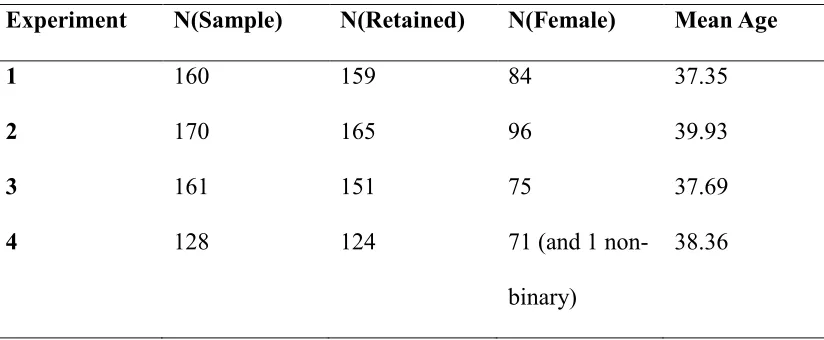
Participants. Table 1 summarizes the number of participants for each
experiment. The numbers reported are for the experiment as a whole, including the
conditions not reported in this paper. Sample sizes were selected to give high power
(.8) for a medium effect size in frequentist analyses (the original analyses were
frequentist). Numbers are reported for the original samples and for the samples
retained after exclusions. For all experiments, participants were excluded if they
stated that their first language was not English; for Experiments 2 to 4, they were also
excluded if they failed a memory check or indicated that they did not participate
seriously (see Procedure). Gender and mean age are reported for the participants
Table 1. Participants for Experiments 1 to 4
Experiment N(Sample) N(Retained) N(Female) Mean Age
1 160 159 84 37.35
2 170 165 96 39.93
3 161 151 75 37.69
4 128 124 71 (and 1
non-binary)
38.36
Materials. There were five items, which took the following form:
Initial source information: Michael is a clinical nurse specialist.
Claim: Now imagine that Michael told you the following: ‘One of the best
remedies for a severe cough is valium.’
The item above corresponds to the unhedged condition. In the hedged condition,
participants read the claim embedded under "I suspect that..."
We adopted the items from Collins et al. (2018), selecting reliable sources
making low expectedness claims. A clinical nurse specialist claimed that valium was
one of the best remedies for a severe cough. A baker claimed that the varying
temperatures of a particular oven made it perfect for fluffy and crispy bread. A
journalist with a good track record predicted that a horse would beat a competitor
despite losing to that horse in the majority of races. A retired meteorologist claimed
And a respected DJ claimed that a club in Detroit had the reputation of one of coolest
in the world.
The hedged conditions embedded the claims underneath the propositional
attitude 'suspect' (hedged-suspect; Experiments 1 to 3) or the double hedge 'I might be
wrong, but I think...' (hedged-double; Experiment 4). Both types of hedge feature in
McCready's analysis. In the present study, Experiments 3 and 4 also included
manipulation checks in which participants clearly found hedged claims weaker than
their unhedged counterparts: in Experiment 3 "suspect" was rated on average 4.92
(SD = 2.04) on a scale from 0 (very weak) to 10 (very strong), whereas the unhedged
claims were rated on average 7.70 (SD= 2.43); in Experiment 4, "suspect" was rated
on average 5.27 (SD = 1.91) and "I might be wrong, but..." was rated on average 4.96
(SD = 1.93), whereas the unhedged claims were rated on average 8.02 (SD = 2.39).
The hedged (hedged-suspect and hedged-double) claims were rated as conveying
significantly weaker claims than unhedged claims (ps < .001; for details, see Collins,
2017).
Procedure. The experiments reported here and below were carried out
following the guidelines, and with the approval, of the ethics committee at the
Department of Psychological Sciences, Birkbeck, University of London. The
experiments were posted on Amazon Mechanical Turk via the intermediary MTurk
Data (www.mturkdata.com). We set high qualifications for the task: participants had to
be resident in the US and have an overall approval rating of 99% for 1,000 previously
completed tasks. These criteria maximized the number of first-language English
speakers. Each participant was only able to take part in a single experiment. On the
information they receive from other people. No information was given about the
specific manipulation. After giving informed consent, participants were assigned, in a
round-robin manner, to a condition. They were shown the following instructions:
Thank you for taking part in this study. You’ll be shown some descriptions of
people, and will be asked to indicate how reliable these people seem, by
selecting the appropriate number on a scale from 0 (not at all reliable) to 10
(completely reliable).
Participants then saw 5 items, comprising initial source information and then a claim.
Participants gave a prior rating after the initial source information, and a posterior
rating after the claim. The order of presentation was counterbalanced. Finally,
participants were given debriefing information, and were paid $0.75, a fee chosen to
exceed the US minimum wage for reasonable completion times.
In Experiments 2 to 4, there were the following changes to the procedure. To
ensure that participants processed the materials deeply enough, participants were
informed that they may have to perform a memory test. Participants in the hedged
conditions did, indeed, perform a memory test at the end of the experiment and in a
fixed order. The test comprised a recall test and a recognition test, in that order, details
of which can be found at osf.io/r9cna. The recall test gave an indication of how
deeply participants were processing the materials: for instance, in Experiment 2,
approximately 76% passed the test, rising to 84% if near synonyms are included. But
the recognition test was the minimum threshold for inclusion of the data. This
threshold was waived if participants passed the recall test but failed the recognition
test, since these participants may have misinterpreted the recognition question as a
based on Aust, Diedenhofen, Ullrich, and Musch (2013); for details see osf.io/r9cna.
Experiments 2 and 3 also placed the propositional attitude 'suspect' in capitals as a
simple attentional device; this device was dropped in Experiment 4. And Experiments
3 and 4 included a manipulation check between the recognition test and the sincerity
question; for the wordings, see osf.io/r9cna.
Results
Copies of the data files and analysis scripts are available on the Open Science
Framework at osf.io/r9cna. For all data, we calculated change scores by subtracting
the prior rating from the posterior rating. We then averaged change scores across
items to produce a single score per participant13. For the present meta-analysis, we
analysed the data in two ways: we first calculated meta-analytic means and
confidence intervals in R (R Core Team, 2016) using the 'meta' package (Schwarzer,
2007). Since we are only interested in summarizing the present studies, we used a
fixed-effects model. We then entered the relevant t-statistics from the experiments into
a meta-analytic Bayesian t-test in the 'Bayes Factor' package (Morey & Rouder,
2015). Bayes Factors allow us to directly assess the support for the null and
alternative hypotheses. We assess each of the predictions in turn.
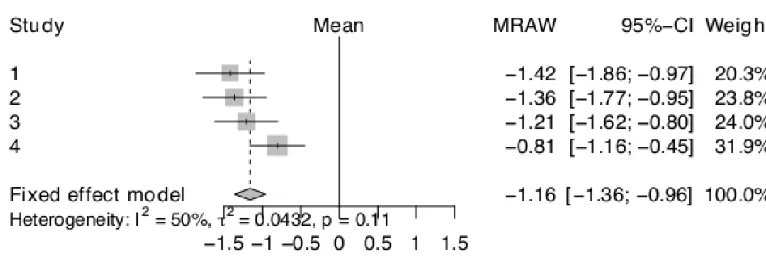
Basic Reputational Hit. Fig. 1 is a forest plot of the mean change scores and
confidence intervals for the unhedged condition across the four experiments (studies).
The figure shows reliably negative change scores: participants reliably decreased their
13 Given this averaging, we must be cautious about generalizing beyond the existing
belief in the reliability of the source when s/he made a low expectedness claim.
[image:24.595.134.517.202.332.2]Hence, the data replicate the basic reputational hit.
Figure 1. Forest plot of mean change scores and confidence intervals for the unhedged condition of Experiiments 1 to 4.
A meta-analytic Bayesian t-test confirmed this result. Table 2 reports the
one-sample t-statistics, number of participants, and degrees of freedom for the unhedged
condition in each study.
Table 2. One-sample t-statistics, degrees of freedom, and number of participants for the unhedged condition for Experiments 1 to 4.
Study t-statistic (df) N
1 -6.23 (53) 54
2 -6.53 (58) 59
3 -5.83 (51) 52
4 -4.43 (57) 58
The Bayesian analysis found strong support for a reputational hit from low
expectedness claims. To gauge sensitivity to priors, the analysis used the three
[image:24.595.90.508.507.647.2]size r: medium, wide, and ultra-wide. These each yielded strong support for a
reputational hit, BFsAlternative > 100.
Weak Vigilance. Fig. 2 is a forest plot of the mean change scores and
confidence intervals for the hedged condition across the four experiments
(hedged-suspect in Experiment (Study) 1 to 3; hedged-double in Experiment (Study) 4). The
figure shows reliably negative change scores: participants decreased their belief in the
reliability of the source when s/he made a low expectedness claim even when that
[image:25.595.131.522.343.473.2]claim was hedged.
Figure 2. Forest plot of mean change scores and confidence intervals for the hedged condition for Experiments 1 to 4.
A meta-analytic Bayesian t-test confirmed this result. Table 3 reports the t
[image:25.595.87.504.701.752.2]-statistics, number of participants, and degrees of freedom for the hedged condition.
Table 3. One-sample t-statistics, degrees of freedom, and number of participants for the hedged condition for Experiments 1 to 4.
Study t-statistic (df) N
2 -9.66 (51) 52
3 -6.64 (46) 47
4 -7.89 (66) 67
The Bayesian analysis found strong support for a reputational hit with hedged
claims, hence for Weak Vigilance. As above, the analysis used the three pre-set
Cauchy priors, which each yielded strong support for Weak Vigilance, BFsAlternative >
100.
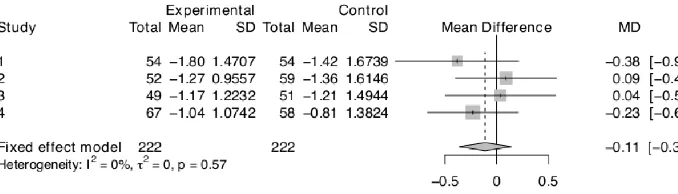
Weak Hedging. Fig. 3 is a forest plot summarizing the difference in change
scores between the unhedged and hedged conditions across the four experiments
(studies). For each study, the confidence intervals include 0; the meta-analytic
confidence interval also includes 0, and the meta-analytic mean is slightly negative,
with non-significantly lower ratings in the hedged conditions. The figure offers no
[image:26.595.137.476.508.605.2]support for the predicted effect of hedging.
Figure 3. Forest plot of differences in mean change score between hedged and unhedged conditions (and confidence intervals) for Experiments 1 to 4.
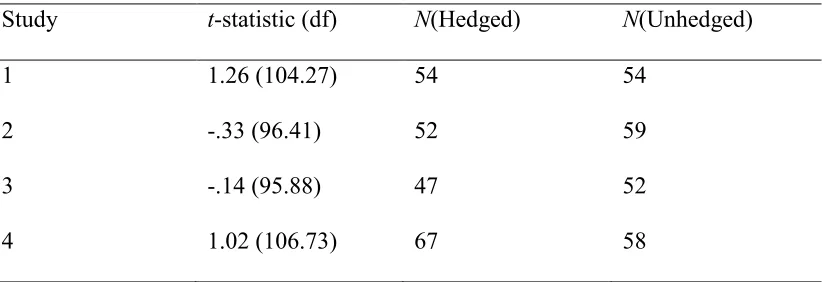
A meta-analytic Bayesian t-test confirmed this result. Table 4 reports the
independent-samples t-statistics, number of participants in hedged and unhedged
Table 4. Independent-samples t-statistics, degrees of freedom, and participant numbers for difference in mean change scores for hedged and unhedged conditions for Experiments 1 to 4.
Study t-statistic (df) N(Hedged) N(Unhedged)
1 1.26 (104.27) 54 54
2 -.33 (96.41) 52 59
3 -.14 (95.88) 47 52
4 1.02 (106.73) 67 58
The Bayesian analysis found moderate support for the null hypothesis, hence
moderate evidence against Weak Hedging. As above, the Bayesian analysis used the
three pre-set Cauchy priors for the effect size. In each case there was moderate
support for the null hypothesis, but there was some sensitivity to those priors: with the
default medium prior, BFNull = 6.23; with the wide prior, BFNull = 8.68; and with the
ultra-wide prior, BFNull = 12.18.
Discussion
The mini meta-analysis is informative on a number of points. Firstly, it
replicated the basic reputational hit from low expectedness claims which was found in
the initial study by Collins et al. (2015, 2018) but which was inconclusive in a
replication (Collins et al., 2018). This finding is consistent with Bayesian models of
testimony (Bovens & Hartmann, 2003; Olsson, 2011; Olsson & Vallinder, 2013) and
with the idea of epistemic vigilance (Sperber et al., 2010). The finding generalizes,
support at least Weak Vigilance: low expectedness claims cause a reputational hit even
when hedged. The data do not support Weak Hedging: hedging did not reliably protect
reputations. Indeed, the data suggest moderate evidence for the relevant null
hypothesis. In other words, epistemic vigilance seems robust against hedging. The
data do not sit well with the idea that a key function of hedges is the protection of
reputation, in the sense of perceived reliability (McCready, 2015).
The results above arise from experiments with slightly different procedures.
Experiments 2 to 4 sought to ensure that the hedges were not simply ignored.
Experiments 2 and 3 placed the hedge, 'suspect', in capitals; Experiments 2 to 4 all
included a memory test, which encouraged participants to process the text more
deeply; and Experiments 3 and 4 also included manipulation checks. These procedural
differences make no obvious difference to the results, and suggest that participants in
all experiments processed the items in some depth.
Nevertheless, Experiments 1 to 4 have a number of limitations. The
experiments used a design and statistical analysis that limit generalizability. While we
might expect our results to generalize to new participants, we have no grounds to
expect them to generalize to new materials (Clark, 1973). The experiments also used a
pre-test/post-test format, a method that may give rise to demand characteristics
(Levine & Parkinson, 1994). In particular, participants may have deduced that we
intended them to use the content of the claims to revise their judgments of source
reliability. Since the hedging manipulation was between-participants, participants had
no evidence to guess the manipulation itself. But the results are worth replicating with
an alternative, more natural design. Finally, the experiments did not include any
use an intuitive notion. This intuitive notion may not, however, map neatly onto the
notion of reliability that is theoretically relevant.
Experiment 5
Experiment 5 set out to address the limitations of the preceding studies. It used
a design that yields better evidence of generalizability, addresses potential demand
characteristics of the pre-test/post-test format, and tightens up the dependent measure.
The basic design was as follows. The experiment included 20 items in total,
including adapted versions of the materials from Experiments 1 to 4. To reduce task
demands and vary demand characteristics, Experiment 5 abandoned the
pre-test/post-test format, and adopted a fully between-participants design which comprised the
following 4 conditions.
Null Condition: participants read only information about 20 sources.
Unhedged Condition: participants read these 20 sources making low
expectedness claims (one claim per source).
Propositional-Attitude Condition: participants read these 20 sources making
the same low expectedness claims but hedged with a propositional attitude ('I
suspect that...').
Double-Hedged Condition: participants read these 20 sources making the
same low expectedness claims but hedged with 'I might be wrong, but I
think...'
Participants rated source reliability, this time using the (potentially) more
sensitive measure of fixing a slider on a scale from 0 to 100 (on the definition, see
In this design, the null condition provides a baseline for the reliability of a
source. It anchors the reputational hit: a reputational hit occurs in any condition where
ratings are reliably lower than the null condition. The basic effect of low expectedness
claims should be seen in the difference between null and unhedged conditions. The
effects of hedging can be seen in the difference between unhedged and hedged
(Propositional-Attitude, Double-Hedged) conditions. If hedging protects the source's
reliability, then ratings should be reliably higher in hedged conditions than in the
unhedged condition. This design also permits direct comparison between hedging
with a propositional attitude and double hedging.
The new design has certain advantages over the preceding studies but prompts
further changes. First, consider some advantages. Since the design is fully
between-participants, it reduces (or at least varies) the potential demand characteristics. In the
between-participants design, participants give a single rating after reading the items,
and only a control group (the Null Condition) rates the source when s/he has not made
a claim. The design also includes more items, allowing us to be more confident about
generalizing our findings.
The fully between-participants design might, however, alter how people
understand the task. Accordingly we introduced new features to protect construct
validity. These features largely concern the dependent variable, perceived reliability.
Since different conditions present different amounts of information, participants in
these conditions might interpret reliability differently. In particular, participants in the
null condition do not see a claim at all, which risks them giving more general ratings
than participants in the other conditions. It is one thing to rate a nurse's reliability as a
matters. To aid interpretation, we made the following four changes across all
conditions. Firstly, we defined reliability as a person's "credibility, trustworthiness, or
expertise - as whether they tend to say the truth". Including this definition also
mitigates the concern that participants might understand reliability differently from
the theoretically important sense. Secondly, we added information to each item to
provide a context for the rating. So, for example, the new version of the now-familiar
Michael item was as follows, with the relevant information italicized:
You are discussing treatments for coughs and colds, which are mostly
treated with simple over-the-counter medicines. Michael is a nurse
practitioner who specializes in minor illnesses.
Thirdly, we fixed the scope of the reliability question for each item by identifying a
topic. For the Michael item (topic italicized):
How reliable is Michael about remedies for minor illnesses?
Since there is no objective measure of topic scale - Is the evolution of the domestic cat
a bigger/smaller topic than the history of the Napoleonic wars? - we relied on intuition
to keep the scale comparable. In each case, the topic was broad enough to avoid
collapsing to a simple judgment of belief in a claim in the conditions where a claim
was presented (unhedged, propositional attitudes, and double hedged). Fourthly, we
gave participants three practice items to sensitize them to the full range of the scale.
These items described a high reliability (highly trustworthy and expert) source, a
middle-reliability source (with a 50:50 hit rate), and a low reliability (highly inexpert)
source.
A final innovation concerns expectedness. In Experiments 1 to 4, the items
determined by (presumed) background beliefs: for instance, we presumed that
participants would have a sense of likely and unlikely summer temperatures. In other
items, expectedness was determined by contextual information: for instance, we told
participants about the record of a pair of horses in races against each other. In
Experiment 5, when items invoked background knowledge, they also explicitly stated
that knowledge: hence, for example, an item about summer temperatures in North
Africa explicitly stated that summers there are very hot.
For this design we make the following predictions:
Reputational Hit: the Unhedged Condition should have reliability ratings
reliably lower than the Null condition.
Weak Vigilance: reliability ratings should be reliably lower than the Null
Condition in all other conditions.
Weak Hedging: the hedged conditions (Propositional Attitude and
Double-Hedged Conditions) should have reliability ratings reliably higher than the
Unhedged Condition.
Shielding: the Double-Hedged condition should be rated reliablly higher
than the Propositional Attitude condition.
Methods
Participants. 206 participants completed a web survey; the same selection
criteria were used as for the previous experiments. We retained the data for the 203
participants (88 female; average age 35.98) who indicated that English was their first
Materials. There were 3 practice items (see Procedure) and 20 test items.
These can be seen in a copy of the Qualtrics survey on the Open Science Framework
at osf.io/r9cna. Each test item described a scenario, gave information about a source,
and set up an expectation. The Null condition comprised only this information. In the
Unhedged, Propositional-Attitude and Double-Hedged conditions the source also
made a low expectedness claim (given the context). In the hedged conditions, the
claim was modified by a propositional attitude ('I suspect that...') or a double hedge ('I
might be wrong, but I think that...'). Finally, there was a reliability question: 'How
reliable is [Source] about [Topic]?' The following is one of the items. In the Null
condition, participants saw only the context and the reliability question.
You are talking about Susie, a high-school student, and her work habits. Susie
is known for being easily distracted. Jake is Susie's brother, and they both still
live at home.
Unhedged: He tells you, 'Susie does her homework best sitting in front of the
TV.
Propositional Attitude: He tells you 'I suspect that Susie does her homework
best sitting in front of the TV.
Double-Hedged: He tells you, 'I might be wrong, but I think that Susie does
her homework based sitting in front of the TV.'
How reliable is Jake about Susie?
Procedure. The experiment comprised a Qualtrics web-survey, posted on
Mechanical Turk by the intermediary MTurkData. Participants gave informed consent
and were (pseudo-)randomly assigned to a condition. All participants received the
In this task, we would like you to rate how reliable you think certain people
are as sources of information. You can think of someone's reliability as their
credibility, trustworthiness, or expertise - as whether they tend to say the
truth.
You'll see 20 scenarios. For each one you'll be asked about someone's
reliability. We would like you to make your judgments using the sliding scale
provided. '0' means not at all reliable, '100' completely reliable. You now have
the chance to practice on the following items.
They then rated the following items using a sliding scale from 0 to 100, to
sensitize themselves to the scale.
[High Reliability] You are being told about a particular type of deep-
sea fish by a world expert on the subject. The expert has no reason to
misinform you. How reliable is the expert about this fish?
[Medium Reliability] You are being told by a high-school student
about what they learnt in class today. The student has a vivid
imagination, and makes things up about half the time. How reliable is
the student about their class?
[Low Reliability] You are visiting a foreign city. Another tourist is telling you
about the city. The tourist has only briefly looked at a guidebook in a foreign
language that they understand very poorly. How reliable is the tourist about
the city?
Participants were then reminded of the instructions using the following text:
Thank you. Let's get on with the rest of the experiment. Now you'll see 20
be asked about the reliability of some people as sources of information about a
topic. As you've just practiced, please rate their reliability using the scale
provided. '0' means not at all reliable. '100' means completely reliable.
Each participant then rated 20 items. The web survey randomized the order of
presentation. Finally, participants received debriefing information, and received a fee
of $1.50, which was chosen to exceed the US minimum wage per minute.
Results
Copies of the data files and analysis scripts can be found on the Open Science
Framework at osf.io/r9cna.The analysis comprised a Bayesian zero-one inflated beta
regression run in the 'brms' package (Bürkner, 2017). Conclusions, here, are based on
the estimated marginal means and the 95% Highest Posterior Density intervals,
calculated with the emmeans package (Lenth, 2018). A survey error led to ambiguities
in two items (Items 11 ("Eric") and 12 ("Alex") in the survey; see the Open Science
project) that may have decreased the effect of hedging. Accordingly we excluded
these items, and ran all analyses on the remaining 18 items.
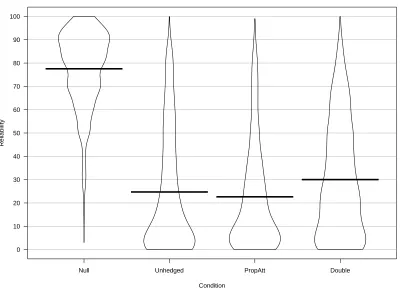
Fig. 4 shows the descriptive data and was produced using the 'pirateplot'
function of the 'yarr package' (Phillips, 2017). The descriptive data suggest a clear
drop in perceived source reliability between the Null and remaining conditions. There
Attitude (PropAtt) condition rated slightly worse than the Unhedged and
[image:36.595.118.530.185.486.2]Double-Hedged (Double) condition.
Figure 4. The figure shows the horizontally jittered raw data and smoothed density
distributions by condition. Black bars represent the mean for each condition; the white boxes represent the 95% high density interval (see Kruschke, 2013).
We analyzed the data with a zero-one-inflated beta regression with perceived
reliability (rescaled to the range 0-1) predicted by Condition (Null, Unhedged,
Propositional Attitude, Double-Hedging). The model included random slopes and
intercepts for items and random intercepts for participants: that is, in R syntax, the
model included the terms '(Condition|Item)' and '(1|ID)', where 'ID' stands for
'participant'.
We used the default uninformative, or weakly informative, priors from the
brms package. For the beta coefficients, the prior for the intercept was a 0-centered
Condition
R
e
lia
b
ili
ty
0 10 20 30 40 50 60 70 80 90 100
Student-t distribution with 3 degrees of freedom and scale of 31; the prior for the
remaining coefficients was an improper uniform prior across the real numbers. For the
standard deviations of the random effects, the prior was a 0-centered Student-t
distribution with 3 degrees of freedom and scale of 31); for the correlation between
random effects, the prior, ('lkj(1)'), set all correlation matrices to be equally likely. For
the conditional-one inflation (coi) and zero-one inflation probabilities (zoi), the priors
were uniform (Beta(α = 1, β = 1). For phi, the prior was a gamma distribution with
shape and spread of .01. We ran 3 chains for 10,000 iterations. These settings
achieved good convergence for all chains. All Rhat values were 1.00; and effective
sample sizes were above 3,800.
[image:37.595.89.436.468.720.2]Table 5 reports the parameter estimates.
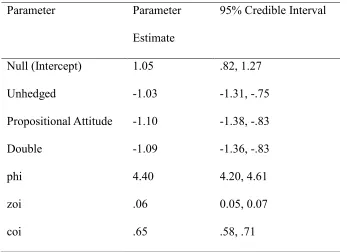
Table 5. Parameter estimates (excluding group-level parameters) and 95% Credible Intervals. Note that estimates are on the logit scale, and that the independent variable was treatment-coded.
Parameter Parameter
Estimate
95% Credible Interval
Null (Intercept) 1.05 .82, 1.27
Unhedged -1.03 -1.31, -.75
Propositional Attitude -1.10 -1.38, -.83
Double -1.09 -1.36, -.83
phi 4.40 4.20, 4.61
zoi .06 0.05, 0.07
coi .65 .58, .71
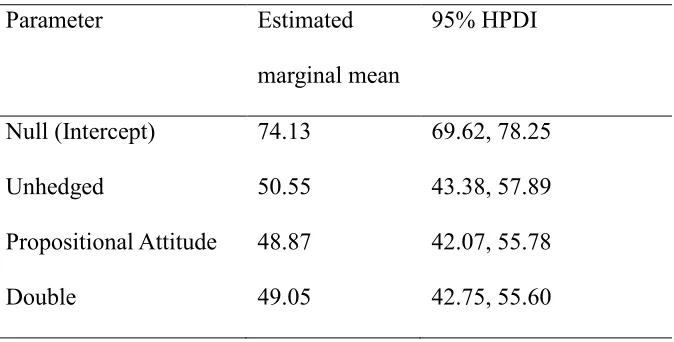
Table 6. Estimated marginal means and 95% HPDIs. Note that all estimates are on the original response scale.
Parameter Estimated
marginal mean
95% HPDI
Null (Intercept) 74.13 69.62, 78.25
Unhedged 50.55 43.38, 57.89
Propositional Attitude 48.87 42.07, 55.78
Double 49.05 42.75, 55.60
The estimated marginal means show that the experimental (non-null)
conditions are clearly reliably lower than the Null Condition, but are themselves close
together with substantial overlap in the 95% highest posterior density intervals. We
consider the evidence for each hypothesis in turn.
Reputational Hit. The data replicate the basic reputational hit seen in
Experiments 1 to 4: ratings are reliably lower in the Unhedged Condition than in the
Null Condition.
Weak Vigilance. The data also replicate the finding that ratings are reliably
lower in both the Propositional Attitude condition and the Double Hedged condition
than in the Null Condition.
Weak Hedging. The data show no clear evidence for an effect of hedging: the
hedged conditions do not have ratings reliably higher than the Unhedged Condition:
there is almost complete overlap in the HPD intervals, and the mean ratings were
Shielding. The data show no evidence of shielding: the Double-Hedged
condition did not have reliability ratings reliably higher than the Propositional
Attitude Condition. Indeed, there was almost complete overlap of 95% HPD intervals,
for the two types of hedging: the Double-Hedged Condition extended only .44 points
on the reliability scale above the Propositional Attitude Condition.
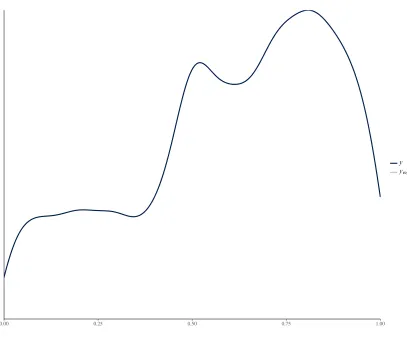
We tested model fit with posterior predictive checks, shown in Fig. 5. These
checks suggest adequate fit, though note the mismatch between approximately .25
and .50 (25 and 50 on the response scale): the model predicts too many ratings in this
[image:39.595.127.534.360.697.2]interval.
Figure 5. Posterior predictive checks for the model, showing the data (y) against 100 predictions from the model (yrep).
0.00 0.25 0.50 0.75 1.00
In summary, the data for Experiment 5 only offer support for Weak Vigilance.
They suggest, further, that ratings were highly similar for the Unhedged, Propositional
Attitude, and Double Hedged Conditions.
Discussion
A fifth experiment has now replicated the reputational hit from low
expectedness claims and shown that it can occur even when the claims are hedged.
This experiment used new items, a new design, and a more tightly defined dependent
variable. Nevertheless, the data replicate the basic pattern seen in Experiments 1 to 4:
support for Weak Vigilance and no support for Weak Hedging. Experiment 5 adds a
direct comparison between hedging with the propositional attitude 'I suspect that' and
double-hedging with 'I might be wrong, but I think...' There was no reliable difference
between these types of hedging.
At this point, however, we must reconsider our auxiliary assumptions and, in
particular, the assumption that expectations are a fair test case for reputation
management. The assumption seems reasonable: low expectedness claims seem to
provide a clear case of reputation damage and should, on McCready's (2015) account,
threaten cooperation. As we have already discussed, expectations seem to set the bar
somewhat lower. And many conversations will be about things whose truth we cannot
- at least not immediately - establish. Our approach, then, seems to treat an important
part of the picture.
Nevertheless, McCready does not treat expectations, but cases where the
outcome is known: to repeat an earlier quotation, she focuses on the case where
assertion fails to represent the facts correctly"(McCready, 2015, p. 3). It might be a
fairer test of McCready's account to include outcomes. Outcomes feature in our final
experiment, to which we now turn.
Experiment 6
This experiment used the same design as Experiment 5 with only a single
alteration. We added, to each item, the phrase 'Later you learn that what [source] told
you was wrong'. We repeat the predictions from above:
Reputational Hit: the Unhedged Condition should have reliability ratings
reliably lower than the Null condition.
Weak Vigilance: reliability ratings should be reliably lower than the Null
Condition in all other conditions.
Weak Hedging: the hedged conditions (Propositional Attitude and
Double-Hedged Conditions) should have reliability ratings reliably higher than the
Unhedged Condition.
Shielding: the Double-Hedged condition should be rated reliably higher than
the Propositional Attitude condition.
Methods
Participants. 205 participants completed a web survey; the same selection
criteria were used as in all previous experiments. We retained the data for the 204
participants (86 female; average age = 36.86) who listed English as their first
language.
Materials. The materials were the same as for Experiment 5 (the errors in
you learn that what [source] told you was wrong.' A copy of the Qualtrics survey is
available on the Open Science Framework at osf.io/r9cna.
Procedure. The procedure was identical to Experiment 5.
Results
Copies of the data files and analysis scripts are available on the Open Science
Framework at osf.io/r9cna. As with Experiment 5, the analysis comprised Bayesian
zero-one inflated beta regression run in the 'brms' package, and conclusions are based
[image:42.595.122.527.391.683.2]on the estimated marginal means and 95% HPDs.
Fig. 6 shows the descriptive data.
Figure 6. The figure shows the horizontally jittered raw data and smoothed density
distributions by condition. Black bars represent the mean for each condition; the white boxes represent the 95% high density interval (see Kruschke, 2013).
Condition
R
e
lia
b
ili
ty
0 10 20 30 40 50 60 70 80 90 100
The data suggest that, when low expectedness information proves false, there
is a large hit to reliability. The pattern differs from that seen in Experiment 5: the
Double-Hedging Condition has a noticeably higher mean than the Unhedged and
Propositional Attitude Conditions.
We analyzed the data with a zero-one-inflated beta regression with perceived
reliability (rescaled to the range 0-1) predicted by Condition (Null, Unhedged,
Propositional Attitude, Double-Hedging). The model included random slopes and
intercepts for items and random intercepts for participants: that is, in R syntax, the
model included the terms '(Condition|Item)' and '(1|ID)', where 'ID' stands for
'participant'. We used the same priors as for Experiment 5, and once again ran 3
chains for 10,000 iterations, achieving good convergence. All Rhat values were 1.00;
effective sample sizes were all above 1,100.
[image:43.595.93.428.539.755.2]Table 7 reports the parameter estimates.
Table 7. Parameter estimates (excluding group-level parameters). Note that estimates are on the logit scale, and that the independent variable was treatment-coded.
Parameter Parameter
Estimate
95% Credible Interval
Null (Intercept) 1.22 .95, 1.48
Unhedged -2.31 -2.65, -1.97
Propositional Attitude -2.49 -2.82, -2.15
Double -2.06 -2.38, -1.74
phi 7.78 7.42, 8.14
coi .10 .07, .13
[image:44.595.94.429.319.484.2]Table 8 reports the estimated marginal means, which are on the response scale.
Table 8. Estimated marginal means and 95% HPDIs. Note that all estimates are on the original response scale.
Parameter Estimated
marginal mean
95% HPD
Null (Intercept) 77.15 71.20, 81.24
Unhedged 25.13 20.73, 30.53
Propositional Attitude 21.82 17.92, 26.56
Double 29.97 25.01, 35.70
The estimated marginal means show that the experimental (non-null)
conditions are clearly reliably lower than the Null Condition. A new finding, here, is
that the Double Hedging Condition has higher ratings than either the Unhedged or
Propositional Attitude Conditions. However, there is overlap in the 95% HPD
intervals, if rather minimal between the hedged conditions. Unsurprisingly, ratings in
the non-null conditions are considerably, and reliably, lower in this experiment than in
Experiment 5.
Reputational Hit. The data replicate the basic reputational hit seen in
Experiments 1 to 4: ratings are reliably lower in the Unhedged Condition than in the
Weak Vigilance. The data also replicate the finding that ratings are reliably
lower in both the Propositional Attitude condition and the Double Hedged condition.
Weak Hedging. The data do not show clear evidence of hedging. The
Propositional-Attitude Condition once again has ratings lower than the Unhedged
Condition, though these ratings are, once again, not reliably different. The Double
Hedging Condition, this time, has higher ratings than the Unhedged Condition, but the
95% HPD intervals overlap by some 4.28 reliability points.
Shielding. The data hint at an effect of shielding. The Double-Hedged
Condition had higher ratings than the Propositional Attitude Condition, but the 95%
HPD intervals overlap by some 1.55 reliability points. There is, therefore, insufficient
evidence to conclude in favour of an effect of shielding.
We tested model fit with posterior predictive checks, shown in Fig. 7. The
to 100% on the response scale) and some under prediction in approximately the .15
[image:46.595.128.542.173.496.2]to .40 (15 to 40) range.
Figure 7. Posterior predictive checks, showing the data (y) against 100 simulations from the model (yrep).
In summary, the headline finding is that there is, once again, no clear evidence
that hedging protects reliability. This headline should not, however, obscure the
differences between the data sets. While Experiment 5 offered good evidence for the
similarity of ratings in the Unhedged, Propositional Attitude, and Double Hedged
Conditions, Experiment 6 offers tentative evidence for differences: in particular,
between the Unhedged and Double Hedged Conditions - where the overlap in 95%
0.00 0.25 0.50 0.75 1.00