Journal of Chemical and Pharmaceutical Research, 2012, 4(6):3201-3206
Research Article
ISSN : 0975-7384
CODEN(USA) : JCPRC5
Prescribing pattern in paediatric urinary tract infections at a tertiary care
centre
Sushma Muraraiah, Astha Sarda, Ayesha Romana and C R Jayanthi
Department of Pharmacology, Bangalore Medical College and Research Institute, Fort, K R Road, Bangalore
____________________________________________________________________________________________
ABSTRACT
Urinary tract infections (UTIs) are common bacterial infections in children. The present study was undertaken to evaluate the trend of Antimicrobial agents (AMAs) prescription in children with UTI and also the sensitivity patterns of the uropathogens isolated in our hospital. 100 in-patients satisfying the inclusion criteria were selected. About 38.8% of the patients were in the age group of 1-5 years and 46% of the patients received AMAs for 6-10days. E.coli mainly sensitive to Amikacin, Nitrofurantoin and resistant to Norfloxacin, Ciprofloxacin was isolated in majority of the urine samples in our study. Most commonly prescribed drugs in complicated UTI (cUTI) was Amikacin (19) in the hospital and Cotrimoxazole in simple UTI. The number of drugs per prescription was 5.2±2.4. The number of antibiotics per prescription was 3.5±1.5. The number of drugs prescribed by generic name was 35% and number of drugs prescribed from the WHO Model List of Essential Medicines was 96%. The prescription of AMAs were in accordance with guidelines from Indian paediatrics Nephrology group. In view of development of increasing resistance to fluoroquinolones, its empiric use in the treatment of UTI in children should be strongly discouraged. The number of antibiotic prescriptions and its intravenous administration could be reduced in our hospital by implementing a regional antibiotic policy.
Key words: Urinary tract infection, E.coli, Amikacin, Cotrimoxazole, Antimicrobial agents.
_____________________________________________________________________________________________
INTRODUCTION
Urinary tract infections (UTIs) are relatively common in children. By seven years of age, 8 percent of girls and 2 percent of boys will have at least one episode [1]. Common uropathogens include Escherichia coli (accounting for approximately 85 percent of UTIs in children), Klebsiella, Proteus, Enterobacter, Citrobacter, Staphylococcus saprophyticus, and Enterococcus [2].
Within one to two years of the first diagnosed UTI, renal parenchymal defects are noticed in 3 to 15 percent of children. Long-term complications of UTI associated with renal scarring include hypertension, chronic renal failure, and toxemia in pregnancy [3].
diarrhoea. But in children older than 2 years, urinary symptoms mainly, frequent voiding, dysuria and suprapubic, abdominal or lumbar pain may appear with or without fever [4].
A clinician frequently prescribes antimicrobial agents (AMAs) empirically for UTIs while waiting for the results of urine culture. Various factors are involved in antibiotic selection for outpatient treatment of UTIs, including patient age, allergies, cost, compliance and dosing frequency, and local resistance patterns [5]. Indian paediatric nephrology group has formulated the recommendations for management of patients with UTI [6].
Studies in the adult literature in India [7] have demonstrated an increase in the prescriptions of irrational AMAs in the treatment of UTI, raising the concerns that the same in children may also increase the antibiotic resistance. Hence, the present study was undertaken to evaluate the trend of AMA prescription in children with UTI and also the sensitivity patterns of the uropathogens isolated in our hospital.
EXPERIMENTAL SECTION
This prospective observational study was conducted in Vani Vilas Hospital, Bangalore from January to December 2010. Ethics committee approval was obtained before initiating the study. Detail of the study procedure was explained to the patients and informed consent was obtained from them. All the patients satisfying the following selection criteria were involved in the study.
Inclusion criteria
1.Patients with diagnosis of UTI admitted in the wards of Vani Vilas Hospital 2.Patients who voluntarily give informed consent
3.Patients aged less than 16 years
Exclusion criteria
1.Patients who do not voluntarily give informed consent 2.Patients aged more than 16 years
3.Patients attending out-patients department
The details of demographics of the patients, past medical history, details of the drugs including dose, duration of therapy, route of administration, urine culture and antimicrobial sensitivity were obtained from the case records of the patients. The prescriptions were analysed for the following WHO/INRUD indicators:
1.Number of drugs per prescription 2.Number of antibiotics per prescription 3.Number of drugs prescribed by generic name
4.Number of drugs prescribed from the WHO Model List of Essential Medicines (EML) 5.Number of injections per prescription
Definitions:
Complicated UTI (cUTI): UTI with presence of fever >38.5º C, toxicity, persistent vomiting, dehydration and renal
angle tenderness.
Simple UTI: UTI with low grade fever, dysuria, frequency, urgency, but none of the symptoms of toxicity.
Statistics
Descriptive statistics was used for the analyses of the results. Mean ± Standard deviation and percentages were used wherever appropriate.
RESULTS
About 100 in-patients were included in the study. About 18.4% of the patients were less than one year old, 38.8% were in the range of 1 to 5 years, 18.4% in 6-10 years and 24.5% in 11-15 years age group. Out of 100 patients in the study, 56% were males and 44% were females.
______________________________________________________________________________
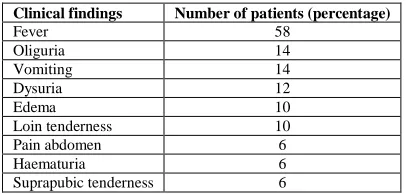
[image:3.595.197.400.156.253.2]As shown in Table 1, most common presentation to the hospital in children with UTI was fever, followed by oliguria and vomiting.
Table 1: Summary of clinical findings
Clinical findings Number of patients (percentage)
Fever 58
Oliguria 14
Vomiting 14
Dysuria 12
Edema 10
Loin tenderness 10
Pain abdomen 6
Haematuria 6
Suprapubic tenderness 6
Most commonly encountered uropathogen was E.coli (68%), followed by Klebsiella (10%), staphylococci (6% ), pseudomonas (6%) , citrobacter (6%), and proteus (4%). AMA sensitivity and resistant pattern of E.coli are as shown in Table 2 and 3 respectively.
Table 2: E.coli sensitivity pattern
AMA Number of specimens (n=68)
Amikacin 26
Nitrofurantoin 18
Gentamycin 16
Imipenem 8
Cotrimoxazole 3
Piperacillin & tazobactum 3
Cefotaxime 2
Cefuroxime 2
Amoxycillin 2
Ampicillin 2
[image:3.595.197.395.320.576.2]Ciprofloxacin 1
Table 3: E.coli resistance pattern
AMA Number of specimens (n=68)
Norfloxacin 18
Ciprofloxacin 10
Ampicillin 8
Cefotaxime 8
Cotrimoxazole 6
Cefuroxime 6
Ceftazidime 6
Nitrofurantoin 4
Cotrimoxazole 4
Gentamycin 2
About 74 patients had cUTI and 26 had simple UTI, as per the definitions mentioned above.
Table 4: Drugs used in complicated and simple UTI
Complicated UTI (no. of patients) Simple UTI (no. of patients) Amikacin (Cotrimoxazole on discharge) (38)
Amikacin + Ciprofloxacin (4) Amikacin + Ceftriaxone (2) Amikacin + Imipenem (2)
Cotrimoxazole (18) Amoxycillin (4) Cephalexin (4)
Ciprofloxacin (4)
Ciprofloxacin + Augmenten (4) Augmenten(4)
Augmenten +Gentamycin (2) Nitrofurantoin (2)
Norfloxacin (2) Crystalline Penicillin(2) Vancomycin (2) Gentamycin (4)
Cefoperazone&Sulbactum (2)
The prescriptions analyzed according to the WHO/INRUD prescribing indicators are as follows: 1.Number of drugs per prescription: 5.2±2.4
2.Number of antibiotics per prescription: 3.5±1.5 3.Number of drugs prescribed by generic name: 91(35%)
4.Number of drugs prescribed from the WHO Model List of Essential Medicines (EML): 250 (96%). 5.Number of injections per prescription: 2.12±1.27
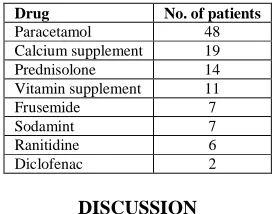
Paracetamol was the most commonly prescribed drug other than AMAs, followed by calcium supplement and prednisolone as shown in Table 5.
Table 5: Drugs prescribed other than AMAs in the study are as follows:
Drug No. of patients
Paracetamol 48
Calcium supplement 19
Prednisolone 14
Vitamin supplement 11
Frusemide 7
Sodamint 7
Ranitidine 6
Diclofenac 2
DISCUSSION
In the present study, male preponderence to UTI in children was seen with majority of the patients in the age group of 1 to 5 years. During the first year of life, the male to female ratio is 3-5:1. Beyond 1-2 years, male to female ratio becomes 1:10 [6]. The incidence of UTI is known to be highest in the first year of life for all children (1%), but decreases substantially among boys after infancy [8].
Majority of the patients received AMA therapy for 6-10 days in our study. Duration of AMA therapy should be for 10-14days in cUTI and 7-10days for simple UTI. Shorter duration treatment regimens are not recommended in children [9].
[image:4.595.229.366.403.510.2]______________________________________________________________________________
The most common bacterial pathogen identified in this study was E.coli, followed by Klebsiella. In a study conducted in Iran [12], the commonest bacterial agents were found to be E. coli (71.0%), Klebsiella (10.5%) and Proteus (9.1%). Another study by Naylor GR [13] also concluded the same result.
E.coli mainly sensitive to Amikacin, Nitrofurantoin and resistant to Norfloxacin, Ciprofloxacin was isolated in majority of the urine samples in our study. In a study conducted by Mohan J et al in chennai [14], showed that E.coli was sensitive to Amikacin, follwed by cephalosporins. The emergence of resistant bacteria is a significant problem in UTI chemotherapy. In Japan, isolation of fluoroquinolone-resistant E. coli from patients with UTI is reported as a serious therapeutic problem, similar to the present study [15]. A study conducted in South Africa, showed that E.coli in both uncomplicated and complicated UTIs, had the highest rates of resistance to Cotrimoxazole and Amoxicillin . In complicated UTI, E.coli resistant to Ciprofloxacin was also noted in 45% of cultures. Over-use of quinolones increases the incidence of methicillin-resistant S. aureus (MRSA) in hospital and community settings. It is also the most potent antibiotic in the second-line treatment of tuberculosis. Therefore, empiric use of Quinolones should be strongly discouraged [16]. A study conducted by Ghorashi et al in Iran [17], showed that E.coli isolated from children with UTI, was resistant to Ampicillin, Cotrimoxazole, and Cephalexin (71%–96%), sensitive to Ciprofloxacin (84.4%), Amikacin (83.8%), and Nitrofurantoin (82.8%).
Majority of the patients with cUTI in our study received Amikacin which is in accordance with the guidelines from Indian Pediatric Nephrology Group[6]. The other drugs suggested for parenteral administration in cUTI are combination of Ampicillin and Aminoglycoside or a third generation Cephalosporin (cefotaxime or ceftriaxone). Once the child shows clinical improvement, with resolution of fever and toxicity, AMAs should be administered orally.
In simple UTI, most commonly administered AMAs were Cotrimoxazole, followed by Amoxicillin and Cephalexin. The guidelines from Indian Pediatric Nephrology Group recommended the use of same drugs[6]. Quinolones should be avoided in children as first line therapy, unless guided by the results of urine sensitivity. Paracetamol was most commonly used in the present study as majority of the patients were admitted with fever.
A national ambulatory survey conducted in United States of America from 1998 to 2007 [5] showed that Cotrimoxazole was the most commonly prescribed oral AMA for UTI and Ceftriaxone was the most commonly prescribed parenteral AMA for cUTI in children. American Academy of Family Physicians suggested Cotrimoxazole as the first choice for treating UTI in children, followed by Amoxicillin/clavulanate (Augmentin) or Cephalosporins[18].
According to WHO/INRUD indicators, the average drug per prescription was high. The prescription of AMAs and injections were higher than the adults admitted with UTI [19]. Although, most of the drugs prescribed were from essential drug list, prescribing by generic name needs to be improved in our hospital to prevent medication errors and further adverse effects due to it. A regional antibiotic policy would further improve the presciption practices in our hospital. The policy could be established and monitored by a regional paediatric pharmacovigilance centre in our Hospital. This view was also expressed in another study conducted in the same hospital [20].
In conclusion, prescribing pattern in UTI in children was done in a paediatric tertiary care centre. 100 patients were included in the study, of which majority were in the age group of 1-5years. The incidence of UTI was seen to be more in males than females. E.coli was isolated from majority of the urine cultures, which was shown to be sensitive to Amikacin, Nitrofurantoin and resistant to Norfloxacin, Ciprofloxacin. Amikacin was most commonly prescribed in cUTI, while Cotrimoxazole in simple UTI. The prescription of AMAs were in accordance with guidelines from Indian paediatrics Nephrology group. In view of development of increasing resistance to fluoroquinolones, its empiric use in the treatment of UTI in children should be strogly discouraged. The number of AMA prescriptions and its intravenous administration could be reduced in our hospital by implementing a regional AMA policy.
REFERENCES
[1]Williams GJ; Wei L; Lee A; Craig JC. Cochrane Database Syst Rev., 2006, 3, CD001534. [2]Shaikh N; Morone NE; Lopez J et al. JAMA, 2007, 298(24), 2895-2904.
[3]Dick PT; Feldman W. J Pediatr.,1996, 128(1), 15-22.
[5]Copp HL; Shapiro DJ; Hersh LA, Pediatrics, 2011, 127, 1027-1033. [6]Bagga A. Indian Pediatrics, 2001, 38, 1106-1115.
[7]Ramanath KV; Shafiya SB. Indian Journal of Pharmacy Practice, 2011, 4 (2), 57-63. [8]Jakobsson B; Jacobson SH; Hjalmas K. Acta Paediatr, 1999, 88, 31–39.
[9]Grabe M; Bishop MC; Bjerklund-Johansen TE; Botto H; Çek M; Lobel B; Naber KG; Palou J; Tenke P; Wagenlehner F. European Association of Urology, 2009, 38-45.
[10]Saleh SI; Tuhmaz MM; Sarkhouh MY; El-Ghawabi MA. Kuwait Medical Journal, 2003, 35 (1), 31-35. [11]Ahmed SM; Swedlund SK. Am Fam Physician., 1998, 57(7), 1573-1580.
[12]Modarres S; Oskoii NN. Eastern Mediterranean Health Journal, 1997, 3(2), 290-295. [13]Naylor GR. Journal of medical microbiology, 1984, 17(1):31-6.
[14]Mohan J; MadhanaGopal K; Meganathan M; Sasikala P; Gowdhaman N; Balamurugan K; Parvathavarthni SA.
Global Journal of Pharmacology, 2011, 5(1), 01-03.
[15]Muratani T; Matsumoto T. Int J Antimicrob Agents. 2004, 24 (1):S28–S31. [16]Bosch FJ; Vuuren CV; Joubert G. S Afr Med J, 2011, 101, 328-331.
[17]Ghorashi Z; Ghorashi S; Soltani-Ahari H; Nezami N. Infection and Drug Resistance, 2011, 4, 171–176. [18]White B. American Family Physician, 2011, 83 (4), 409-415.
[19]Muraraiah S; Rajarathna K; Rahman FU; Jayanthi. J. Chem. Pharm. Res., 2012, 4(2), 1222-1230.