STRUCTURAL MODELLING OF COST OVERRUN FACTORS IN
CONSTRUCTION INDUSTRY
AFTAB HAMEED MEMON
A thesis submitted in
fulfilment of the requirements for award of the Doctor of Philosophy
Faculty of Civil and Environmental Engineering University Tun Hussein Onn Malaysia
v
ABSTRACT
ABSTRAK
vii
TABLE OF CONTENTS
DECLARATION
DEDICATION
ACKNOWLEDGEMENT
ABSTRACT
ABSTRAK
TABLE OF CONTENTS
LIST OF TABLES
LIST OF FIGURES
LIST OF APPENDICES
CHAPTER 1 INTRODUCTION
1.1 Background 1.2 Problem Statement 1.3 Aim and Objectives 1.4 Scope of the Research 1.5 Research Methodology 1.6 Thesis Layout/Organization
CHAPTER 2 LITERATURE REVIEW
2.1 Construction Industry in Malaysia 2.2 Problems in Construction Industry
2.2.1 Time Overrun 2.2.2 Cost Overrun
2.2.3 Construction Waste 2.2.4 Poor Safety
2.2.5 Poor Quality
2.2.6 Excessive Resources Consumption 2.2.7 Threat To Environment
2.3 Construction Cost Overrun 2.3.1 Concept
2.3.2 Cost Performance
2.3.2.1 Developed Countries 2.3.2.2 Developing Countries 2.4 Causative Factors of Cost Overrun 2.5 Summary
CHAPTER 3 RESEARCH METHODOLGY
3.1 Introduction 3.2 Research Plan
3.3 Questionnaire Design 3.3.1 Measurement Scale 3.4 Pilot Study Analysis 3.5 Questionnaire Survey 3.6 Analysis Methods
3.6.1 Descriptive Analysis 3.6.2 Factor Analysis
3.6.3 Structural Equation Modelling (SEM) 3.6.3.1 Why PLS-SEM?
3.7 Summary
CHAPTER 4 DESCRIPTIVE ANALYSIS
4.1 Introduction
4.2 Pilot Study Analysis 4.3 Questionnaire Survey
4.3.1 Sampling Statistics
4.3.2 Respondent’s Organization Demography 4.3.3 Respondent’s Project Handled Demography 4.3.4 Respondent’s Expertise Demography 4.4 Factor Analysis Results
4.5 Reliability Test
4.6 Ranking of Factors Causing Cost Overrun 4.6.1 Design and Documentation (DDF) 4.6.2 Contractor's Site Management (CSM)
ix
4.6.3 Financial Management (FIN)
4.6.4 Project Management and Contract Administration (PMCA)
4.6.5 Labour Management (LAB) 4.6.6 Material and Machinery (MMF) 4.6.7 Information and Communication (ICT) 4.6.8 External Factors (EXT)
4.6.9 Ranking of Overall Data 4.7 Comparison with Other Countries 4.8 Summary
CHAPTER 5 PARTIAL LEAST SQUARE SEM (PLS-SEM)
ANALYSIS
5.1 Introduction
5.2 Hypothetical Model of Causes of Cost Overrun 5.3 Mechanism for PLS Model Analysis and
Assessment 5.3.1 Data Input
5.3.2 Run PLS Algorithm
5.3.3 Evaluation of Model Output
5.3.3.1 Assessment of Measurement Model
5.3.3.2 Modify Theoretical Model 5.3.3.3 Assessment of Structural Model 5.3.4 Test Hypothesis
5.4 Sample Size
5.5 Evaluation of Hypothetical Model
5.5.1 Individual reliability and CV of measurement Model
5.5.1.1 Optimization of the Model Quality 5.5.2 Discriminant Validity of Measurement
Model
5.5.3 Structural Model Assessment 5.5.4 Test of Hypothesis
5.5.5 Assessment of Overall Model 5.6 Validation of the Results
5.6.1 Statistical Validation 5.6.2 Expert Opinion Validation 5.7 Summary
CHAPTER 6 CONCLUSION AND RECOMMENDATION
6.1 Introduction
6.2 Summary of the Findings
6.2.1 Common Factors of Cost Overrun 6.2.2 Ranking of Causes of Cost Overrun 6.2.3 Developing model to assess significance of
causative factors 6.2.4 Validating SEM Model 6.3 Contribution of this Study
6.4 Recommendations For Future Research
REFERENCES
APPENDIX A: QUESTIONNAIRE FOR PILOT STUDY
APPENDIX B: QUESTIONNAIRE FORM
APPENDIX C: INPUT DATA (*.CSV) WITH FILE FORMAT
USED IN PLS-SEM ANALYSIS
APPENDIX D: PLS ASSESSMENT RESULTS OF ITERATION 1
APPENDIX E: PLS ASSESSMENT RESULTS OF ITERATION 2
APPENDIX F: PLS ASSESSMENT RESULTS OF ITERATION 3
APPENDIX G: PLS ASSESSMENT RESULTS OF ITERATION 4
APPENDIX H: PLS ASSESSMENT RESULTS OF ITERATION 5
APPENDIX I: PLS ASSESSMENT RESULTS OF ITERATION 6
APPENDIX J: PLS ASSESSMENT RESULTS OF ITERATION 7
APPENDIX K: PLS ASSESSMENT RESULTS OF ITERATION 8
APPENDIX L: QUESTIONNAIRE FORM FOR MODEL
VALIDATION
LIST OF PUBLICATIONS
xi
LIST OF TABLES
2.1 Contractors Registered under CIDB 2.2 Cost Performance in Developed Countries 2.3 Cost Performance in Developing Countries
2.4 Mapping Previous Studies (Factors of Cost Overrun) 3.1 Criteria for Selection of SEM Approach
4.1 Respondent’s Demographics in Pilot Study 4.2 Analysis of Pilot Study
4.3 Survey Statistics
4.4 Respondent’s Organization 4.5 Factor Analysis Results
4.6 Categorization of Cost Overrun Factors
4.7 Respondent’s Demographics in Validating Factor Analysis Results
4.8 Reliability Test Results
4.9 Ranking of Design and Documentation Related Factors
4.10 Ranking of Contractor's Site Management Related Factors
4.11 Ranking of Financial Management Related Factors 4.12 Ranking of Project Management and Contract
Administration Related Factors
4.13 Ranking of Labour Management Related Factors 4.14 Ranking of Material and Machinery Related Factors 4.15 Ranking of Information and Communication Related
Factors
4.16 Ranking of External Factors Related Factors 4.17 Ranking of Overall Factors
4.18 Comparison with Factors of Cost Overrun with other Countries
5.1 Steps in PLS-SEM Process
5.2 Convergent Validity of Model (Iteration 1) 5.3(a) Convergent Validity of Model (Iteration 1 to 4) 5.3(b) Convergent Validity of Model (Iteration 5 to 8) 5.4 Analysis of Cross-Loadings of factors
5.5 Latent Variable Correlations 5.6 Path Results of the Model 5.7 GoF index and its Criteria 5.8 Estimates of Power Analysis
5.9 Estimates Q2 for Predictive Relevancy
5.10 Demographic information of respondents Involved in Validation Process of the Model Results 5.11 Results of Validation Process of the Model Results
71 79 87 90 91 92 93 95 96 98 99
xiii
LIST OF FIGURES
2.1 Construction work on an apartment complex in Kuala Lumpur
2.2 The construction of the tunnel at Bukit Berapit in Kuala Lumpur
2.3 Construction waste illegally dumped in mangrove swamp
2.4 Construction debris along roadside
3.1 The flow chart of methodology for this research 4.1 Experience of Respondents involved in Pilot Study 4.2 Type of Projects Respondents handled
4.3 Size of Projects Handled by Respondents 4.4 Academic Qualification of Respondents 4.5 Respondents Experience
5.1 Hypothetic Model of Causes of Cost Overrun 5.2 Schematic Diagram of PLS-SEM Analysis
5.3 Theoretical Model of Cost Overrun and Causative Factor
5.4 Data Input Screenshot from SmartPLS Software 5.5 PLS Model Results for Iteration 1
5.6 Result of Structural Model
6.1 Common Factors of Cost Overrun 6.2 Significant Factors of Cost Overrun
6.3 PLS-SEM Showing Causal Relations b/w Cost Overrun Factors
6.4 Power Analysis Results Obtained from GPower
6
6
11 11 31 40 46 46 47 47 74 75
76 78 87 94 109 110
LIST OF APPENDICES
APPENDIX TITLE PAGE
A Questionnaire for Pilot Study 128
B Questionnaire form for Data Collection 133 C Input Data (*.csv) with file format used in
PLS-SEM Analysis 137
CHAPTER 1
INTRODUCTION
1.1 Background
Construction industry is a very important industry that plays a vital role in the socio-economic growth of a country. Economically, it contributes significantly in the improvement to the overall GDP of a country. It also improves the quality of life by providing necessary infrastructure such as roads, hospitals, schools and other basic and enhanced facilities. Hence, it is fundamentally crucial to make the construction projects complete successfully within the time, budget and quality expected. However, being a complex, fragmented and schedule driven industry it is always facing chronic problems such as low quality, low productivity, cost overrun, time overrun, construction waste etc. Of these, cost overrun is the major problem as money is always of high importance.
Cost overrun is a global phenomenon in the construction industry and very rarely projects are finished within the budgeted cost. The issue of cost overrun in construction projects is very dominant in both developed and developing countries but this trend is very severe in developing countries where these overruns sometimes exceed 100% of the anticipated cost (Azhar, Farooqui, & Ahmed, 2008).
1.2 Problem Statement
Like other developing countries, Malaysia also facing a serious issue of cost overrun in construction industry (Ali & Kamaruzzaman, 2010, Sambasivan & Soon, 2007, Abdullah et al., 2009 and Ibrahim et al., 2010). This is confirmed with a research conducted by Endut, Akintoye, & Kelly (2009) showing that only 46.8% of public sector and 37.2% of private sector projects were completed within the stipulated budget. The issue of cost overrun has become a serious concern of the investors, which needs a serious attention and in-depth research to put forward with solution to this issue.
According to Toh, Ali, & Aliagha, (2011), Malaysia needs more research works by academia and practitioners regarding construction cost factors. Since construction cost is the most dominant component of project’s life cycle, thus it is important to evaluate it before it is too late so that poor cost performance can be prevented (Cha & Shin, 2011). The impact of poor cost performance could lead to cost overrun which is an additional burden over the budgeted cost of project and this cost overrun can never be recovered. These overruns are resulted from various factors, thus it is important to identify and to control these responsible factors.
Further, there was no study done on assessing causal relationships among factors of cost overrun (Toh et al., 2011) and this give an opportunity to the author adopting Structural Equation Modelling (SEM) approach to assess and also to model the factors. SEM is a graphical equivalent of a mathematical representation (Byrne, 2010) with features of advance multivariate tool to determine the strength of the relationships between the factors (Jackson, Dezee, Douglas, & Shimeall, 2005; Hair, Anderson, Tatham, & Black, 1998). It is becoming very popular in analyzing cause– effect relations between factors (Hair, Ringle, & Sarstedt, 2011).
3
1.3 Aim and Objectives
The aim of this study is to model the factors contributing to cost overrun in Malaysian construction industry. To achieve this aim, various objectives were set which include:
o Identifying the common factors causing cost overrun
o Assessing hieratically the causative factors of cost overrun in Malaysian construction industry
o Developing Structural Equation Model (SEM) to assess significance of causative factors to cost overrun
o Validating the results of SEM
1.4 Scope of the Research
This study adopted quantitative approach in identifying and assessing the significant factors causing overrun. The data samples are collected through questionnaire survey amongst the clients, consultants and contractors involved in construction industry. Contractors were selected from “list of approved contractors” in Construction Industry Development Board (CIDB) Malaysia registered under category from G3 to G7.
1.5 Research Methodology
involved in handling construction projects. Questionnaire survey was conducted to understand the perception of clients, consultants and contractors towards the factors causing cost overrun. Gathered data was analyzed with statistical tools in order to draw the conclusion in determining the current situation of cost overrun problem and factors contributing to this overrun.
1.6 Thesis Layout/Organization
This study focused on modelling the causative factors of cost overrun to propose the guidelines for controlling cost overrun problem in construction industry of Malaysia. The thesis for this study is divided into 6 chapters as follows:
Chapter One: This chapter discusses about the need of this study. It contains background of the study and problem statement to outline the primary objectives, scope of the study with introductory remarks.
Chapter Two: This chapter contains the review of published research works for related study on cost overrun issues and factors of cost overrun.
Chapter Three: This chapter illustrates the methodology adopted for this study. It provides details of various analyzing approaches used for data analysis together with the data collection strategy used.
Chapter Four: This chapter explains the descriptive analysis results including the hierarchal assessment of causative factors of cost overrun and comparison of findings with similar studies carried out in other countries.
Chapter Five: It discusses the structural equation modelling (SEM) analysis and achieved results of causal relationships. It also explains the course of validating the results and prosing the mitigation measure and guidelines to help the practitioners in controlling causative factors of cost overrun at source.
CHAPTER 2
LITERATURE REVIEW
2.1 Construction Industry in Malaysia
Construction industry is necessary in every country to provide physical developments which help in improving social and economic needs of country (Abedi, Mohamad, & Fathi, 2011). Hence, construction industry has been growing rapidly worldwide.
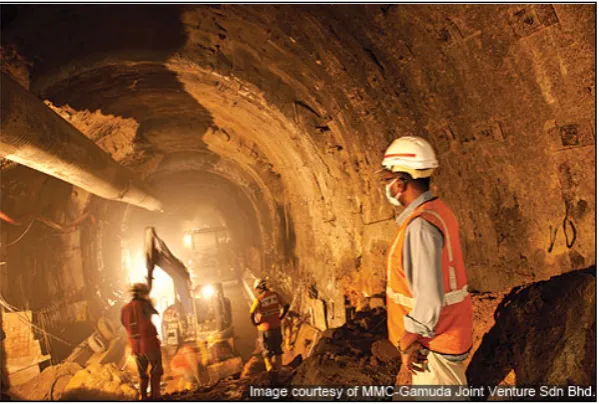
Construction industry in Malaysia developed since its independence. The industry is generally classified into two areas namely general construction and special trade works (Ibrahim et al., 2010). General construction focuses on residential and non-residential constructions and also general civil engineering works. For special trade works, the activities involved are metal works, electrical works, plumbing, sewerage and sanitary works, refrigeration and air-conditioning work, painting work, carpentry, tiling and flooring work, and glass work. Figure 2.1 and 2.2 show the example of construction work of apartment complex and tunnel construction in Kuala Lumpur.
growth subsequently increased to 8.7% in 2010 as against that overall (GDP) growth of 10.1%. Realizing the huge impact on the economy, the government had allocated huge amount of the budget for construction development in Malaysia under 10th Malaysian Plan with a total sum of RM230 billion (Mansor, 2010).
Figure 2.1: Construction work on an apartment complex in Kuala Lumpur Source: Richter & Scheid (2011)
Figure 2.2: The construction of the tunnel at Bukit Berapit in Kuala Lumpur Source: Railway-Technology.com (2011)
[image:17.595.170.470.443.645.2]7
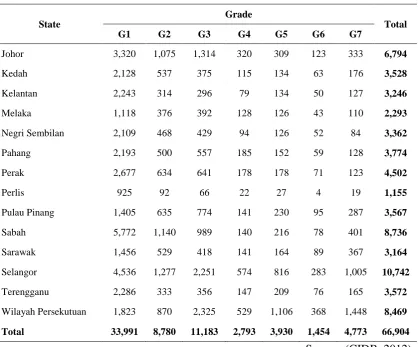
[image:18.595.112.531.177.524.2]projects. A total of 66,904 contractors are currently registered with CIDB as classified in 7 categories ranging from grade G1 to grade G7 (CIDB, 2012) as shown in table 2.1.
Table 2.1: Contractors Registered under CIDB
State
Grade
Total
G1 G2 G3 G4 G5 G6 G7
Johor 3,320 1,075 1,314 320 309 123 333 6,794
Kedah 2,128 537 375 115 134 63 176 3,528
Kelantan 2,243 314 296 79 134 50 127 3,246
Melaka 1,118 376 392 128 126 43 110 2,293
Negri Sembilan 2,109 468 429 94 126 52 84 3,362
Pahang 2,193 500 557 185 152 59 128 3,774
Perak 2,677 634 641 178 178 71 123 4,502
Perlis 925 92 66 22 27 4 19 1,155
Pulau Pinang 1,405 635 774 141 230 95 287 3,567
Sabah 5,772 1,140 989 140 216 78 401 8,736
Sarawak 1,456 529 418 141 164 89 367 3,164
Selangor 4,536 1,277 2,251 574 816 283 1,005 10,742
Terengganu 2,286 333 356 147 209 76 165 3,572
Wilayah Persekutuan 1,823 870 2,325 529 1,106 368 1,448 8,469
Total 33,991 8,780 11,183 2,793 3,930 1,454 4,773 66,904
Source: (CIDB, 2012)
take part for tendering only in small projects. While, contractors registered in G6 and G7 grades are able to tender for small and large projects. However, grade G6 contractors are limited to tender up to RM 10 million project and G7 contractors have no limitation.
2.2 Problems in Construction Industry
Construction industry is considered as a locomotive of physical developments which bring substantial and significant impacts to the country’s economy (Kumaraswamy, 2006). However, it also contributes to negative implications especially to the environment and social aspect of a country. In addition, the industry is always facing chronic problems such as time overrun, cost overrun, waste generation (Hussin, Rahman, & Memon, 2012a), poor safety (Nahmens & Ikuma, 2009), poor quality, excessive resource consumption and threat to environment (Hussin, Rahman, & Memon, 2012b).
2.2.1 Time Overrun
9
Oluwoye, & Crawford (2003) found that 33 (70%) out of 47 projects in Ghana were delayed. Whilst, in Saudi Arabia 70% of projects faced time delay with average time delay of 10% to 30% of the original duration of the project (Assaf & Al-Hejji, 2006). Likewise in Malaysia also, the construction industry is facing the same critical problem of time overrun (Alaghbari, Kadir, Salim, & Ernawati, 2007; Ibrahim et al., 2010; Sambasivan & Soon, 2007). Abdullah (2010) reported that more than 90% of large MARA construction projects experienced delay since 1984. Endut et al. (2009) studied on time performance of 359 projects (301 new constructions while 58 refurbishment projects) in Malaysia. Of these 301 were public projects and 51 private projects. The study found that only 18.2% of the public sector projects and 29.45% of private sector projects had 0% time deviation (no delays) while the average percentage of time overrun for other projects was 49.71%. Time Delay can be due to one or more reasons including problems of financing and payment for completed works. As an example, Yogeswaran, Kumaraswamy, & Miller (1998) scrutinized 67 civil engineering projects in Hong Kong and found at least 15–20% of time overrun was due to inclement weather.
2.2.2 Cost Overrun
Cost is one of the major considerations throughout the lifecycle of a project. Unfortunately, most of the projects failed to achieve project completion with the estimated cost. Besides time overrun, cost overrun is also a serious problem in the construction industry. This is a major problem both in developed and developing countries. The trend is more severe in developing countries where these overruns sometimes exceeds 100% of the anticipated cost of the project (Azhar et al. 2008).
to 100% of project cost (Flyvbjerg et al., 2003). Like other countries, Malaysian construction industry is also facing a lot of challenges in completing the construction projects within the estimated cost (Ibrahim et al., 2010; Toh et al., 2011) and more than 50% of projects face cost overrun (Endut et al., 2009).
2.2.3 Construction Waste
Waste is another serious problem in construction projects. Waste has direct impact on the productivity, material loss and completion time of project resulting in loss of a significant amount of revenue. Forsberg & Saukkoriipi, (2007) stated that the amount of waste contributed is around 30-35% of a project’s production cost. The amount of construction materials wasted on the site is relatively high and equals 9% by weight of the purchased materials (Bossink & Brouwers, 1996). They investigated material waste generated in a Dutch construction project and found that the average waste per house was 6,860 kg which consisted of 4,480 kg of construction debris and 2,380 kg of other types of solid waste.
In Malaysia also construction waste generation is becoming an important issue (Begum, Satari, & Pereira, 2010; Nagapan, Rahman, Azis, Memon, & Zin, 2012). The high quantity of construction waste generated in the country is due to the rapid development of the construction industry. Demand of houses and major infrastructure projects contributed to the increase of construction waste (Nasaruddin, Ramli, & Ravana, 2008; Siti & Noor, 2008). Begum, Siwar, Pereira, & Jaafar (2006) studied the economic feasibility of waste minimization in Malaysian construction project and concluded that by adopting waste minimization strategy like recycling and reusing materials, it can save 2.5% of the total budget.
11
Bandar Hilir, Malacca (Murali, 2011) and construction debris problem near roadside at Section 17, Petaling Jaya, Selangor (Tan, 2012) as shown in figures 2.3 and 2.4.
Figure.2.3: Construction waste illegally dumped in mangrove swamp
Source: Murali (2011)
Figure.2.4: Construction debris along roadside. Source: Tan (2012)
These illegal dumping has caused a risk to human health and environment (Faridah et al., 2004; Rahmat & Ibrahim, 2007). The issues of illegal dumping arise is due to the cost and location of the project (Seow & Mohamad, 2007). The contractors intended to maximise profit by avoiding transportation cost and payment charge to the gazetted landfill. Distance between the project location and the landfill site also hinders the contractor to dispose in legal landfill. A study conducted at 30 construction sites in Malaysia identified six types of waste materials which includes concrete (12.32%), metals (9.62%), bricks (6.54%), plastics (0.43%), timber (69.10%) and other wastes (2%) (Faridah et al., 2004). Hence, it is timely for Malaysia to adopt a systematic and efficient waste management strategy which would minimise the generation of waste at different level. Advanced techniques such as lean construction can help in reducing waste at source and can minimised the waste produced during the operation by re-using and re-cycling.
2.2.4 Poor Safety
data prepared by the Occupational Safety and Health Branch of the Labour Department, Hong Kong as summarized by (Rachel, 2006) shows that accident rates in the construction industry are much worse than all other industries for many years: for 1000 workers, the accident rates are on an average 3 times more than that of all industries, whereas the fatality rates are on an average 5 times more than other industries. Bureau of Labor Statistics USA (in Nahmens & Ikuma, 2009) reported that in USA total injury and illness incidence rates are 9.5 to 14.3 per 100 workers in prefabricated wood manufacturing while in the residential construction, incidence rate is approximately 5 per 100 workers.
Koskela (1992) mentioned that cost incurred because of poor safety practices in construction industry is approximately 6% of total project cost. In a research, Everett and Frank (1996) found that the total costs of construction accidents accounted for 7.9% to 15% of the total costs of projects. UK Health and Safety Executive reported that the total losses due to accidents in the UK were equal to about 8.5% of the tender price (Rowlinson, 2003). These accidents may be caused by different factors. Kartam (1997) stated that accidents are directly attributed to unsafe design and site practices while Baxendale & Jones (2000) stated that most of the accidents are caused due to poor management and control.
2.2.5 Poor Quality
13
2.2.6 Excessive Resources Consumption
Built environment has significant impact on resources where it accounts for one-sixth of the world’s freshwater withdrawals, one-quarter of its wood harvest and two-fifths of its material and energy flows. The structures also have impact areas beyond their immediate location, affecting the watersheds, air quality, and transportation patterns of communities (Rodman & Lenssen, 1994). Buildings built without due consideration to energy, environmental impact and natural resources conservation will result in detrimental wastage affecting our ecological integrity (Shen & Tam, 2002).
Excessive resource and energy use and a growing demand for raw materials are largely responsible for the depletion of natural resources worldwide and the acceleration of global warming. About 40% of the world's resource and energy used is linked to the construction and maintenance of buildings. This contributes to one-tenth of the global economy (Rodman & Lenssen, 1994). Other studies indicate that more than half of all resources consumed globally are used in construction, and 45 per cent of energy generated across the world is used to heat, light and ventilate our buildings, with a further 5 per cent arising from constructing those (Edwards, 2001). As an example, in the European Union, buildings are responsible for more than 40% of the total energy consumption and the construction sector is estimated to generate approximately 40% of all man-made wastes. In addition, the construction sector is the Union’s largest industrial sector, contributing approximately 11% to the GNP and having more than 25 million people directly and indirectly engaged (CIB, 1999).
2.2.7 Threat To Environment
is only a temporary setup lasting for two to three years. In fact, the industry is a major source of urban air pollutants (Chan, 2000).
The emission of CO2 by buildings contributed to the global warming and
extreme weather change all over the world. The harvest of timber leads to the loss of natural forests. Other impacts of constructing a new building include quarrying to provide aggregates, production of cement, the wasteful use of water and the widespread use of toxic chemicals in materials (Kin-sun, 2004).
2.3 Construction Cost Overrun
Among the problems faced by construction industry, one of the most critical issues is cost overrun problem. Cost overrun has become a global phenomenon and rarely projects are completed within the budgeted cost. While, achieving completion within the budgetary cost is the fundamental requirement of any construction project (Olawale & Sun, 2010). Cost overrun normally experiences in construction projects (Azhar et al., 2008). However, the magnitude of these cost overruns varies considerably from project to project which are subjected to various causes. Thus Sohail, Miles, & Cotton (2002) suggested that construction professionals should pay more attention to cost performance of projects as cited by (Olawale & Sun, 2010) and unearth the causes affecting it which can be shared amongst construction community.
2.3.1 Concept
15
Cost overrun is measured as a percentage of actual costs over the estimated costs of the project (Cantarelli, 2009; Choudhury & Phatak, 2004) as shown in expression 2.1:
Cost Overrun = Actual Cost−Estimated CostEstimated Cost
Actual costs are defined as real and accounted construction costs determined at the time of project completion. Estimated costs are defined as budgeted or forecasted construction costs determined at the start of projects (Cantarelli, 2009).
2.3.2 Cost Performance
The success of any project can be measured by various norms like time performance, cost performance, quality standards, achieving safety and health, etc. Atkinson (1999) stated that cost, time and quality serve as Iron Triangle for success of any project. Of these, cost performance is the most important indicator of project success (Frimpong et al., 2003; Olawale & Sun, 2010). It presents not only the firm’s profitability but also the productivity of organizations at any point during the construction processes. It can be seen easily in the project account and is always used to measure project performance against the estimated target.
Unfortunately, construction industry has been experiencing poor cost performance which described its inability to complete projects within budget. This chronic issue is experienced worldwide and becoming more critical as been revealed in World Bank report in 1990. The report pointed out that 63% of the 1778 financed construction projects faced poor performance with overrun in budget at an average of 40% as cited by (Ameh et al., 2010; Zujo et al., 2010). For worldwide scenario, Flyvbjerg et al. (2003) had studied 258 projects in 20 nations which approximately US$90 billion worth of project with size ranging from US$1.5 million to $8.5 billion. They found that cost escalation happened to almost 9 out of 10 projects with an average of 28% higher than forecasted costs. The study concluded that cost performance has not improved over the time and its magnitude has not changed for the past 70 years. Other study conducted by Odeck (2004) shows that average cost
overrun was rather small with approximately 7.9% of project cost. The problem of cost overrun is common issue in both developing and developed countries (Angelo & Reina, 2002) However, it is more severe in developing countries where actual cost exceeded 100% of the anticipated cost of the projects (Azhar et al., 2008).
2.3.2.1 Developed Countries
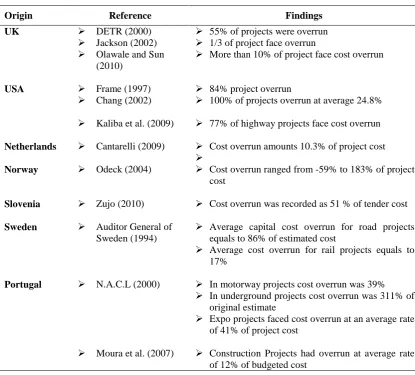
Numerous project control methods and software packages, such as Gantt Bar Chart, Program Evaluation and Review Technique (PERT), Critical Path Method (CPM), Microsoft Project, Asta Power Project, Primavera, etc. have been used to control cost overrun. Despite that, many construction projects in developed countries still suffer cost overruns (Olawale & Sun, 2010) as discussed below:
UK Scenario: A research conducted by Barrick (1995) showed that nearly one third of the clients in UK complaints that their projects generally overran budget. Further, Department of Environment, Transport and the Regions (DETR, 2000) reported that approximately 55% of projects face the problem of cost overrun with huge amount as cited by (Jackson, 2002). For example, British library faced three times over the original budget, Guy’s house at £152M doubled its original budget (NAO, 1998) parliamentary office building in London also at cost of £250M doubled its original budget (Wheeler, 1998) and Holyroad project in Glasgow took £230M against £90M of the original budget (Fairs, 2001). Olawale & Sun (2010) conducting a survey on cost overrun problems in construction projects stated that 41% of respondents experienced overrun on just less than 10% of their projects while 59% of respondents experience cost overrun on 10% or more of their projects.
17
Accountability Office also stated that 77% of highway projects in the USA experienced cost escalation (Cantarelli, Flyvbjerg, Molin, & Wee, 2010).
Netherlands Scenario: Investigation on 87 projects (29 road projects, 28 rail projects and 30 fixed link projects) revealed that cost overrun was the common problem at an average of 10.3% of project cost. The study showed that the percentage of cost overrun in road projects was the highest with the rate of 18.5% followed by rail projects with 7.6% and finally fixed link project with 4.5% (Cantarelli, 2009).
Norway Scenario: Odeck (2004) studied the performance of construction projects controlled by Norwegian Public Roads Administration. He found that that cost overrun was a severe problem and the amount of overruns ranged from -59% to 183%.
Slovenia Scenario: In a study of 92 traffic structures, it was found that contracted construction price overrun was 51 % as cited by (Zujo et al., 2010).
Sweden Scenario: The Auditor General of Sweden (1995) report showed a narrow focus on cost overruns involving transport projects. It covered 15 projects (8 road and 7 rail projects). The report showed that average capital cost overrun for road projects was 86% (ranging between 2 and 182%) and for rail projects this overrun was 17% (ranging from -14% to 74%) as cited by (Cantarelli et al., 2010).
Portugal Scenario: Auditing report of public projects published by the National Court of Audit Portugal (NACL, 2000) on the cost performance of 26 major motorway projects, underground projects launched between 1985 and 2000 and 98 Expo projects revealed that in motorway projects, average cost overrun was 39% of project cost. In underground projects, cost overrun averaged 311% while the Expo projects had cost overruns averaged as much as 41%. Further, an investigating 66 construction projects with average initial contract amount was €16.530.674. Average final costs of these projects reached €18.584.954 with an average cost overrun of €2.054.280 i.e. 12% of the initial average cost (Moura, Teixeira, & Pires, 2007).
Table 2.2: Cost Performance in Developed Countries
Origin Reference Findings
UK DETR (2000)
Jackson (2002) Olawale and Sun
(2010)
55% of projects were overrun 1/3 of project face overrun
More than 10% of project face cost overrun
USA Frame (1997)
Chang (2002)
Kaliba et al. (2009)
84% project overrun
100% of projects overrun at average 24.8%
77% of highway projects face cost overrun
Netherlands Cantarelli (2009) Cost overrun amounts 10.3% of project cost
Norway Odeck (2004) Cost overrun ranged from -59% to 183% of project cost
Slovenia Zujo (2010) Cost overrun was recorded as 51 % of tender cost
Sweden Auditor General of Sweden (1994)
Average capital cost overrun for road projects equals to 86% of estimated cost
Average cost overrun for rail projects equals to 17%
Portugal N.A.C.L (2000)
Moura et al. (2007)
In motorway projects cost overrun was 39% In underground projects cost overrun was 311% of
original estimate
Expo projects faced cost overrun at an average rate of 41% of project cost
Construction Projects had overrun at average rate of 12% of budgeted cost
2.3.2.2 Developing Countries
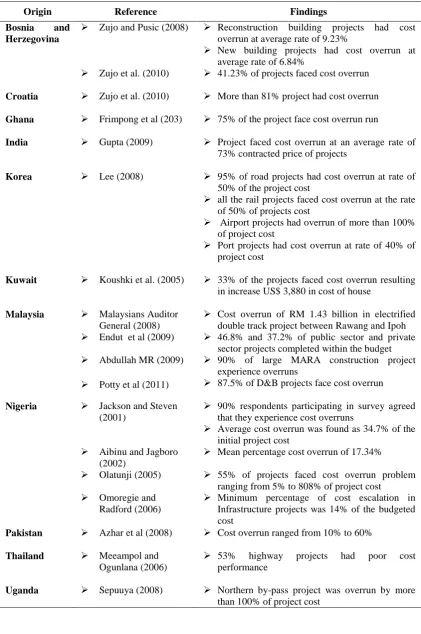
Compared to developed countries, the trend of cost overrun is more severe in developing countries as discussed below:
Bosnia and Herzegovina: In a study of 177 structures, it was found that the contracted price was not met in 41.23% of structures. Another study of 53 building projects including 29 new construction and 24 reconstruction projects showed that average cost overrun in reconstruction projects was 9.23% white it was 6.84% for new construction projects (Zujo et al., 2010; Zujo & Car, 2008).
19
pointed out that the occurrence of price overrun was in no less than 81 % projects as cited by (Zujo et al., 2010).
Ghana: Frimpong et al. (2003) studied cost performance of water drilling projects and found that 38 of total of 47 investigated projects (at a rate of 75%) were facing cost overrun whereas only 25% were completed within the budget.
India: A study of 290 projects showed a total of Rs 20,024 crore over the contract cost of projects as Rs 27,568 with an average of 73% of cost overrun as cited by (Gupta, 2009).
Korea: Lee (2008) investigated 161 projects which included 138 road projects, 16 rail projects, 2 airport and 5 port projects. Findings of study showed that 95% of road projects had cost overrun at rate of 50% of the project cost, all the rail projects faced cost overrun at the rate of 50% of projects cost while airports projects had overrun of more than 100% of project cost and port projects had approximately 40% of cost overrun.
Kuwait: In study of 450 private housing projects in 27 metropolitan districts, Koushki, Al-Rashid, & Kartam (2005) noted that 33% of the projects faced cost overrun which resulted in increasing the cost of house from US$ 381,612 to US$385,492 (with increase of US$ 3,880).
was borne by contractors as the projects were awarded on fixed price conditions.
Nigeria: Jackson & Steven (2001) studied the problem of cost overrun by investigating 15 projects in llorin and found that 73.7% project faced cost overrun at an average of 34.7% of the initial project cost. They also conducted a questionnaire survey and mentioned that only 10% respondents have not experience cost overruns at all while 75% of the respondents mentioned that cost overruns have sometimes occurred in building projects, 15% said it always occurred. Through 61 cases studies Aibinu & Jagboro (2002) found that the projects had a mean percentage cost overrun of 17.34%. Later on an investigation of 137 construction projects showed that 55% of projects were facing cost overrun problem. These overrun ranged from 5% to a maximum amount of 808% of project cost (Olatunji, 2008). A research of cost escalation on infrastructure projects conducted by Omoregie & Radford (2006) showed that a minimum percentage of cost escalation was found as 14% of the budgeted cost.
Pakistan: Azhar et al. (2008) stated that cost overrun was a common problem in construction projects. The minimum range of cost overrun experienced was found as near around the 10% of the total cost of the project. In large construction firms these overrun ranged up to about 40% while in medium size firms this percentage increased up to nearly about 60% of the project cost.
Thailand: Meeampol & Ogunlana (2006) studied cost performance on 99 highway construction projects and found that only 46 projects only were satisfied with cost performance while the others faced poor cost performance.
Uganda: Northern by-pass project in Kampala was overrun by more than 100% and a study of a total of 30 projects showed that 53% of the projects had cost overruns (Apolot, Alinaitwe, & Tindiwensi, 2011).
Vietnam: Government has acknowledged the construction cost overruns problem as the big headache, especially with government-related funded projects (Le-Hoai et al., 2008).
21
[image:32.595.108.530.159.794.2]Cost performance of construction projects in developing countries is summarized in table 2.3.
Table 2.3: Cost Performance in Developing Countries
Origin Reference Findings
Bosnia and Herzegovina
Zujo and Pusic (2008)
Zujo et al. (2010)
Reconstruction building projects had cost overrun at average rate of 9.23%
New building projects had cost overrun at average rate of 6.84%
41.23% of projects faced cost overrun
Croatia Zujo et al. (2010) More than 81% project had cost overrun
Ghana Frimpong et al (203) 75% of the project face cost overrun run
India Gupta (2009) Project faced cost overrun at an average rate of 73% contracted price of projects
Korea Lee (2008) 95% of road projects had cost overrun at rate of 50% of the project cost
all the rail projects faced cost overrun at the rate of 50% of projects cost
Airport projects had overrun of more than 100% of project cost
Port projects had cost overrun at rate of 40% of project cost
Kuwait Koushki et al. (2005) 33% of the projects faced cost overrun resulting in increase US$ 3,880 in cost of house
Malaysia Malaysians Auditor General (2008) Endut et al (2009)
Abdullah MR (2009)
Potty et al (2011)
Cost overrun of RM 1.43 billion in electrified double track project between Rawang and Ipoh 46.8% and 37.2% of public sector and private
sector projects completed within the budget
90% of large MARA construction project
experience overruns
87.5% of D&B projects face cost overrun
Nigeria Jackson and Steven (2001)
Aibinu and Jagboro (2002)
Olatunji (2005)
Omoregie and Radford (2006)
90% respondents participating in survey agreed that they experience cost overruns
Average cost overrun was found as 34.7% of the initial project cost
Mean percentage cost overrun of 17.34%
55% of projects faced cost overrun problem ranging from 5% to 808% of project cost
Minimum percentage of cost escalation in Infrastructure projects was 14% of the budgeted cost
Pakistan Azhar et al (2008) Cost overrun ranged from 10% to 60%
Thailand Meeampol and Ogunlana (2006)
53% highway projects had poor cost
performance
Apolot et al (2011) 53% of the projects had cost overruns
Vietnam Le-Hoai et al (2008) Most of projects face cost overrun which has become headache.
Zambia Kaliba (2009) more than 50% road construction project faced cost overrun
2.4 Causative Factors of Cost Overrun
Cost overrun in construction projects can occur due to many factors. It is very crucial to determine these factors in improving cost performance. Since, many research works had been carried out in determining these factors, hence a comprehensive literature review was carried out to uncover these factors affecting cost overrun for further investigation in construction industry of Malaysia.
Kaming, Olomolaiye, Holt, & Harris (1997) identified factors influencing construction cost overruns on high-rise building projects in Indonesia through a questionnaire survey administered on 31 project managers. The results showed that major factors affecting project cost were materials cost increased by inflation, inaccurate quantity take-off, labour cost increased due to environment restriction, lack of experience of project location, lack of experience of project type, unpredictable weather conditions and lack of experience of local regulation.
Jackson & Steven (2001) examined the causes of cost overrun in building projects of Ilorin through questionnaire survey and found that major factors of cost overruns were fluctuation in the prices of materials/Labour, variation orders, delay in honouring certificates, lack of proper analysis of tenders, selection of incompetent contractors, lack of proper appraisal of projects and unrealistic representation of clients needs.
Jackson (2002) studied reasons of budget overrun in UK through questionnaire survey and found that major reasons of overrun were design changes, design development factors, information availability, method of estimation, performance of design team and project management.
23
study showed that the major reason for cost increase was owner request of changes in scope and additional works.
Frimpong et al. (2003) conducted a questionnaire survey consisting of 26 factors to study major contributors of cost overrun in groundwater drilling projects in Ghana. Out of 26 factors considered, top 10 factors are monthly payment difficulties, poor contract management, material procurement, inflation, contractor’s financial difficulties, escalation of material prices, cash flow during construction, planning and scheduling deficiencies, bad weather and deficiencies in cost estimates prepared.
Koushki et al. (2005) studying problem of cost increase in the private residential projects of Kuwait mentioned that three main contributors to cost overruns were contractor-related problems, material-related problems and owners’ financial constraints.
Omoregie & Radford (2006) study found out the major factors causing cost overrun in infrastructure projects of Nigeria were price fluctuations, financing & payments of completed works, poor contract management, schedule delay, changes in site conditions, inaccurate estimates, shortage of material, imported materials & plant items, additional works, design changes, subcontractors & nominated suppliers, weather, non-adherence to contract conditions, mistakes & discrepancies in contract conditions and fraudulent practices.
Azhar et al. (2008) investigated cost overrun causes in construction industry of Pakistan. A survey using questionnaire containing forty two (42) factors showed that the top ten cost overrun factors found were fluctuation in prices of raw materials, unstable cost of manufactured materials, high cost of machineries, lowest bidding procurement procedures, poor project (site) management/ poor cost control, delays between design and procurement phases, incorrect/ inappropriate methods of cost estimation, additional work, improper planning, and unsupportive government policies.
Enshassi et al. (2009) conducted questionnaire survey to identify major causes of cost overrun in construction projects of Gaza by investigating 42 factors amongst contractors, consultants and owners. Results indicated that top ten factors that cause cost overruns as perceived by the three parties include increment of materials prices due to continuous border closures, delay in construction, supply of raw materials and equipment by contractors, fluctuations in the cost of building materials, unsettlement of the local currency in relation to dollar value, project materials monopoly by some suppliers, resources constraint: funds and associated auxiliaries not ready, lack of cost planning/monitoring during pre-and post contract stages, improvements to standard drawings during construction stage, design changes, and inaccurate quantity take-off.
Kaliba et al. (2009) carried out a study to determine the contributors of cost escalation in road construction projects of Zambia. The finding of study showed that the main causes of cost escalation included bad or inclement weather due to heavy rain and flooding, scope changes, environmental protection and mitigation costs, schedule delay, strikes, technical challenges, inflation and local government pressure.
Ameh et al. (2010) investigated the causes of cost overrun in 53 telecommunication projects of Nigeria through structured questionnaire survey containing 42 factors. Survey results showed that top seven factors were lack of experience of contractors, cost of material, fluctuation in the prices of materials, frequent design changes, economic stability, high interest rates charged by banks on loans received by contractors, mode of financing, bonds & payments as well as fraudulent practices & kickbacks.
REFERENCES
Abdullah, M. R. (2010). Significant causes and effects of construction delay. Master thesis, University Tun Hussein Onn Malaysia.
Abdullah, M. R., Aziz, A. A. A., & Rahman, I. A. (2009). Causes of delay and its effects in large MARA construction project. International Journal of Integrated Engineering (Issue on Mechanical, Materials and Manufacturing Engineering).
Abedi, M., Mohamad, M. F., & Fathi, M. S. (2011). Major Causes of Construction Delays Under Client Category and Contractor Category. Paper presented at the The Proceeding of the First Iranian Student Scientific Conference in Malaysia.
Aibinu, A. A., & Al-Lawati, A. M. (2010). Using PLS-SEM technique to model construction organizations' willingness to participate in e-bidding. Automation in Construction, 19, 714–724.
Aibinu, A. A., & Jagboro, G. O. (2002). The effects of construction delays on project delivery in Nigerian construction industry International Journal of Project Management 20, 593–599.
Aibinu, A. A., Ling, F. Y. Y., & Ofori, G. (2011). Structural equation modeling of organizational justice and cooperative behaviour in the construction project claims process: contractors' perspectives. Construction Management and Economics, 29(5), 463-481.
Akter, S., Ambra, J. D., & Ray, P. (2011a). Trustworthiness in mHealth Information Services: An Assessment of a Hierarchical Model with Mediating and Moderating Effects Using Partial Least Squares (PLS). Journal Of The American Society For Information Science And Technology, 62(1), 100–116 Akter, S., Ambra, J. D., & Ray, R. (2011b, 4th -7th August ). An evaluation of PLS
GoF index. Paper presented at the Proceedings of the Seventeenth Americas Conference on Information Systems (AMCIS 2011), Detroit Michigan.
Al-Momani, A. (2000). Construction delay: a quantitative analysis. International Journal of Project Management, 18(1), 51–59.
Al-Najjar, J. M. (2008). Factors Influencing Time and Cost Overruns on Construction Projects in the Gaza Strip. Master of Science in Civil Engineering, Faculty of Engineering, The Islamic University – Gaza.
Alaghbari, W., Kadir, M. R. A., Salim, A., & Ernawati. (2007). The significant factors causing delay of building construction projects in Malaysia. Engineering, Construction and Architectural Management, 14(2), 192-206. Ali, A. S., & Kamaruzzaman, S. N. (2010). Cost performance for building
construction projects in Klang valley. Journal of Building Performance, 1(1), 110-118.
Alwi, S., & Hampson, K. (2003). Identifying the importan causes of delays in building construction projects. Paper presented at the Proceedings The 9th East Asia-Pacific Conference on Structural Engineering and Construction, Bali, Indonesia, Retrived from
https://eprints.qut.edu.au/secure/00004156/01/Bali_Conference_2003.doc. Ameh, O. J., Soyingbe, A. A., & Odusami, K. T. (2010). Significant factors causing
cost overruns in telecommunication projects in Nigeria. Journal of Construction in Developing Countries, 15.
Amu, O. O., & Adesanya, D. A. (2011). Mathematical Expressions for Explaining Project Delays in Southwestern Nigeria. Singapore Journal of Scientific Research, 1(1), 59-67.
Angelo, W. J., & Reina, P. (2002). Megaprojects need more study up front to avoid cost overruns. Retrieved May 29, 2011, from
http://flyvbjerg.plan.aau.dk/News%20in%20English/ENR%20Costlies%2015 0702.pdf
115
Assaf, S. A., & Al-Hejji, S. (2006). Causes of delay in large construction projects. International Journal of Project Management, 24(4), 349-357.
Atkinson, R. (1999). Project management: cost, time and quality, two best guesses and a phenomenon, its time to accept other success criteria. International Journal of Project Management, 17(6), 337-342.
Avots, I. (1983). Cost-relevance analysis for overrun control. International Journal of Project Management, 1, 142-148.
Azhar, N., Farooqui, R. U., & Ahmed, S. M. (2008). Cost Overrun Factors In Construction Industry of Pakistan. Paper presented at the First International Conference on Construction In Developing Countries (ICCIDC–I) “Advancing and Integrating Construction Education, Research & Practice”. Barclay, D., Thompson, R., & Higgins, C. (1995). The Partial Least Squares (PLS)
approach to causal modeling: personal computer adoption and use as an illustration. Technology Studies, 2(2), 285–309.
Barclay, D. W., Thompson, R., & Higgins, C. (1995). The Partial Least Squares (PLS) Approach to Causal Modeling: Personal Computer Adoption and Use an Illustration. Technology Studies, 2(2), 285-309.
Barrick, A. (1995). Poll reveals one in three jobs late. Building, 28 July, 10.
Baxendale, T., & Jones, O. (2000). Construction design and construction management safety regulations in practice - Progress and implementation. International Journal of Project Management, 18(1), 33–40.
Begum, R. A., Satari, S. K., & Pereira, J. J. (2010). Waste Generation and Recycling: Comparison of Conventional and Industrialized Building Systems. American Journal of Environmental Sciences, 6(4), 383-388.
Begum, R. A., Siwar, C., Pereira, J. J., & Jaafar, A. H. (2006). A benefit–cost analysis on the economic feasibility of construction waste minimisation: The case of Malaysia. Resources, Conservation and Recycling, 48, 86–98.
Bossink, A. G., & Brouwers, H. J. H. (1996). Construction waste: quantification and source evaluation. Journal of Construction Engineering and Management, 122(1), 55–60.
Burati, J., Farrington, J., & Ledbetter, W. (1992). Causes of quality deviations in design and construction. Construction Engineering and Management, 118(1). Byrne, B. M. (1994). Structural equation modeling with EQS and EQS/Windows:
basic concepts, applications and programming: Sage Publications, Thousand Oaks, Calif.
Byrne, B. M. (2010). Structural Equation Modeling with AMOS Basic Concepts, Applications, and Programming (2nd ed.): Taylor and Francis Group, LLC. Cantarelli, C. C. (2009). Cost overruns in Dutch transportation infrastructure projects.
Bijdrage aan het Colloquium Vervoersplanologisch Speurwerk (Contribution to the Transport Planning Research Colloquium).
Cantarelli, C. C., Flyvbjerg, B., Molin, E. J. E., & Wee, B. v. (2010). Cost Overruns in Large-scale Transportation Infrastructure Projects: Explanations and Their Theoretical Embeddedness. European Journal of Transport and Infrastructure Research (EJTIR), 10(1), 5-18.
Cha, H. S., & Shin, K. Y. (2011). Predicting Project Cost Performance Level by Assessing Risk Factors of Building Construction in South Korea. Journal of Asian Architecture and Building Engineering, 437-444.
Chan, D. W. M., & Kumaraswamy, M. M. (1997). A comparative study of causes of time overruns in Hong Kong construction projects. International Journal of Project Management, 15(1), 55-63.
Chan, K. L. (2000). Environmental Awareness: Communicating Needs and Requirements for the Construction Sector. In Building Journal Hong Kong (Paper presented at The 9th Annual Business & Industry Environment Conference).
Chan, S., & Park, M. (2005). Project cost estimation using principal component regression. Construction Management and Economics, 23, 295-304.
117
Chimwaso, D. K. (2001). An evaluation of cost performance of public projects: Case of Botswana. Paper presented at the Proceedings of the 2nd International Conference of the CIB
http://buildnet.csir.co.za/cdcproc/docs/2nd/chimwaso_dk.pdf.
Chin, W. W. (1998). The partial least squares approach to structural equation modelling. In G. A. Marcoulides (Ed.), Modern Methods for Business Research (pp. 295–336): Erlbaum, Mahwah, NJ.
Chin, W. W. (2010). How to Write Up and Report PLS Analyses. In V. Esposito Vinzi et al. (eds.) (Ed.), Handbook of Partial Least Squares, Springer Handbooks of Computational Statistics: Springer-Verlag Berlin Heidelberg. Chin, W. W., Marcolin, B. L., & Newsted, P. R. (1996, December 16-18, 1996).
Partial Least Squares Latent Variable Modeling Approach for Measuring Interaction Effects: Results From A Monte Carlo Simulation Study And Voice Mail Emotion/Adoption Study. Paper presented at the Proceedings of the Seventeenth International Conference on Information Systems, Cleveland, Ohio.
Chin, W. W., & Newsted, P. R. (1999). Structural equation modeling analysis with small samples using partial least squares. In R. Hoyle (ed.), Statistical strategies for small sample research, , Thousand Oaks, CA: Sage Publications, 307–341.
Choudhury, I., & Phatak, O. (2004, April 8 - 10, 2004). Correlates of Time Overrun in Commercial Construction. Paper presented at the ASC Proceedings of the 40th Annual Conference, Brigham Young University - Provo, Utah.
Churchill, G. A. (1979). A Paradigm for Developing Better Measures of Marketing Constructs. Journal of Marketing Research, 16, 64–73.
CIB. (1999). CIB Agenda 21 on sustainable construction, CIB Report Publication 237, International Council for Building Research Studies and Documentation. Rotterdam, the Netherlands.
CIDB. (2012). Construction Statistics Quarterly Bulletin, Retrived from ( http://www.cidb.gov.my/cidbweb/index.php?option=com_content&view=ar ticle&id=218&Itemid=314&lang=en) on 20 September 2012.
Cohen, J., Cohen, P., West, S. G., & Aiken, L. S. (2003). Applied Multiple Regression/Correlation Analysis for the Behavioral Sciences (Third ed.): Lawrence Erlbaum Associates, Publishers, Mahwah, New Jersey, London. Compeau, D. R., Higgins, C. A., & Huff, S. (1999). Social cognitive theory and
individual reactions to computing technology: a longitudinal study. MIS Quarterly, 23(2), 145–158.
Davison, A. C., & Hinkley, D. V. (1997). Bootstrap methods and their application: Cambridge University Press.
DETR. (2000). Performance indicators show improvement, Construction Monitor. Edwards, B. (2001). Rough Guide to Sustainability: RIBA Publications, London. Efron, B., & Tibshirani, R. J. (1993). An Introduction to the Bootstrap (Monographs
on Statistics and Applied Probability, # 57): Chapman and Hall, New York. Elinwa, A. U., & Buba, S. A. (1993). Construction Cost Factors in Nigeria. Journal
of Construction Engineering and Management, 119(4), 698-713.
Endut, I. R., Akintoye, A., & Kelly, J. (2009). Cost and time overruns of projects in Malaysia. retrieved on August 21, 2009, from http://www.irbnet.de/daten/iconda/CIB10633.pdf, 243-252.
Enshassi, A., Al-Najjar, J., & Kumaraswamy, M. (2009). Delays and cost overruns in the construction projects in the Gaza Strip. Journal of Financial Management of Property and Construction, 14(2), 126-151.
Enshassi, A., Lisk, R., Sawalhi, I., & Radwan, I. (2003). Contributors to construction delays in Palestine. The Journal of American Institute of Constructors, 27(2), 45-53.
Fairs, M. (2001, 28 September). Scottish parliament: The true story. Building and Environment, 38-43.
Falk, R. F., & Miller, N. B. (1992). A primer for soft modeling: The University of Akron Press.
119
Faul, F., Erdfelder, E., Buchner, A., & Lang, A.-G. (2009). Statistical power analyses using G*Power 3.1: Tests for correlation and regression analyses. Behavior Research Methods, 41(4), 1149-1160.
Faul, F., Erdfelder, E., Lang, A. G., & Buchner, A. (2007). G*Power 3: A flexible statistical power analysis program for the social, behavioral, and biomedical sciences. Behavior Research Methods, 39(2), 175-191.
Fellows, R., & Liu, A. (1997). Research methods for construction: 2nd ed.: Blackwell publication.
Flyvbjerg, B., Holm, M. K. S., & Buhl, S. L. (2003). How common and how large are cost overruns in transport infrastructure projects? Transport Reviews, 23(1), 71-88.
Fong, N. K., Wong, L. Y., & Wong, L. T. (2006). Fire services installation related contributors of construction delays. Building and Environment, 41, 211–222. Fornell, C., & Bookstein, F. L. (1982). Two structural equation models: Lisrel and
PLS applied to customer exit-voice theory. Journal of Marketing Research, 19, 440–452.
Fornell, C., & Cha, J. (1994). Partial least squares. In R. P. Bagozzi (Ed.), Advanced methods of marketing research (pp. 52–78): Cambridge: Blackwell.
Fornell, C., & Larcker, D. F. (1981). Evaluating structural equation models with unobservable variables and measurement error. Journal of Marketing Research, 18, 39–50.
Forsberg, A., & Saukkoriipi, L. (2007, July 2007). Measurement of waste and productivity in relation to lean thinking. Paper presented at the Proceedings IGLC-15, Michigan, USA.
Frame, J. D. (1997). Establishing project risk assessment teams. In K. Kahkonen & K. A. Artto (Eds.), Managing risks in projects: E & FN Spon, London.
Frary, B. R. (1996). Hints for Designing Effective Questionnaires. Assessment Research and Evaluation, Virginia Polytechnic Institute Retrieved from (http://Pareonline.Net/Getvn.Asp?V=S&N=3), 5(3).
Gefen, D., Straub, D. W., & Boudreau, M. C. (2000). Structural equation modelling and regression: Guidelines for research practice. Communications of the Association for Information Systems, 4(5), 1–78.
Gotz, O., Liehr-Gobbers, K., & Krafft, M. (2010). Evaluation of Structural Equation Models Using the Partial Least Squares (PLS) Approach. In V. Esposito Vinzi et al. (eds.) (Ed.), Handbook of Partial Least Squares, Springer Handbooks of Computational Statistics: Springer-Verlag Berlin Heidelberg Gupta, N. (2009). Avoiding Time and Cost Overruns in the Construction of Rohtang
Tunnel. Institute for Defence Studies and Analyses, December 14.
Haenlein, M., & Kaplan, A. M. (2004). A beginner's guide to partial least squares (PLS) analysis. Understanding statistics, 3(4), 283–297.
Hair, J. F., Anderson, R. E., Tatham, R. L., & Black, W. C. (1998). Multivariate data analysis: 5th ed. Prentice-Hall, Upper Saddle River, N.J.
Hair, J. F., Ringle, C. M., & Sarstedt, M. (2011). PLS-SEM: Indeed a Silver Bullet. Journal of Marketing Theory and Practice, 19(2), 139–151.
Hair, J. F., William, C. B., Barry, J. B., & Anderson, R. E. (2010). Multivariate Data Analysis: Englewood Cliffs, NJ: Prentice Hall.
Harisweni. (2007). The Framework for Minimizing Construction time and Cost Overruns in Padding and Pekanbaru, Indonesia. Unpublished Unpublished, Universiti Teknologi Malaysia.
Henseler, J., Ringle, C. M., & Sinkovics, R. R. (2009). The Use of partial least Squares Path modeling in International Marketing. Advances in International Marketing, 20, 277–319.
Hill, T., & P. Lewicki. (2006). Statistics Methods and Application: StatSoft.
Hulland, J. (1999). Use of partial least squares (PLS) in strategic management research: a review of four recent studies. Strategic Management Journal, 20, 195–204.
Hussin, J. M., Rahman, I. A., & Memon, A. H. (2012a). The Way Forward in Sustainable Construction: Issues and Challenges. International Journal of Advances in Applied Sciences (IJAAS), 1(3).
121
International Conference on civil and Environmental Engineering for Sustainability (IConCEES2012).
Ibrahim, A. R., Roy, M. H., Ahmed, Z., & Imtiaz, G. (2010). An investigation of the status of the Malaysian construction industry. Benchmarking: An International Journal, 17(2), 294-308.
Islam, M. D. M., & Faniran, O. O. (2005). Structural equation model of project planning effectiveness. Construction Management and Economics, 23(2), 215 - 223.
Jack, P. C. K., Russell, C. H. C., & Bert, B. (2001). Validation of trace-driven simulation models: bootstrap tests. Management Science, 47(11), 1533–1538. Jackson, J. L., Dezee, K., Douglas, K., & Shimeall, W. (2005). Introduction to
structural equation modeling (path analysis) [Electronic Version]. Precourse PA08. Society of General Internal Medicine (SGIM), Washington, D.C. Available from
http://www.sgim.org/userfiles/file/AMHandouts/AM05/handouts/PA08.pdf. Jackson, O., & Steven, O. (2001). Management of cost overrun in selected building
construction project in Ilorin. Review of Business and Finance, 3(1).
Jackson, S. (2002, 2-4 September). Project cost overruns and risk management. Paper presented at the Greenwood, D. (Ed.) Proceedings of Association of Researchers in Construction Management 18th Annual ARCOM Conference, Newcastle.
Kaliba, C., Muya, M., & Mumba, K. (2009). Cost escalation and schedule delays in road construction projects in Zambia. International Journal of Project Management, 27, 522–531.
Kaming, P. F., Olomolaiye, P. O., Holt, G. D., & Harris, F. C. (1997). Factors influencing construction time and cost overruns on high-rise projects in Indonesia. Construction Management and Economics, 15, 83-94.
Kartam, N. (1997). Integrating safety and health performance into construction CPM. Journal of Construction Engineering and Management, 123(2), 121–126. Khamidi, M. F., Khan, W. A., & Idrus, A. (2011). The Cost Monitoring of
Kline, R. B. (2005). Principles and practice of structural equation modeling, 2nd Edition: Guilford Press, New York.
Kometa, T. S., & Olomolaiye, P. O. (1997). Factors influencing construction client's decisions to build. Journal of Management in Engineering, 13(2), 77-86.
Koskela, L. (1992). The application of the new production philosophy to construction'. Technical Report No. 72, Stanford University, Stanford, CA. Koushki, P. A., Al-Rashid, K., & Kartam, N. (2005). Delays and cost increases in the
construction of private residential projects in Kuwait. Construction Management and Economics, 23(3), 285–294.
Kumar, R. (2005). Research methodology: a step-by-step guide for beginners: SAGE Publication.
Kumaraswamy, M. M. (2006). Accelerating construction industry development. Journal of Construction in Developing Countries, 11(1), 73-96.
Le-Hoai, L., Lee, Y. D., & Lee, J. Y. (2008). Delay and Cost Overruns in Vietnam Large Construction Projects: A Comparison with Other Selected Countries. KSCE Journal of Civil Engineering, 12(6), 367-377.
Ledbetter, W. B. (1994). Quality performance on successful projects. Journal of Construction Engineering and Management, 120(1).
Lee, J.-K. (2008). Cost Overrun and Cause in Korean Social Overhead Capital Projects: Roads, Rails, Airports, and Ports. Journal of Urban Planning and Development, 134(2), 59–62.
Leung, W. T., & Tam, C. M. (2004). Scheduling For High-Rise Building Construction Using Simulation Techniques. Paper presented at the Proceeding of 20th International Conference CIB-W78.
Litwin, M. S. (1995). How to Measure Survey Reliability and Validity: Sage, Thousand Oaks, CA.
Long, N. D., Ogunlana, S., Quang, T., & Lam, K. C. (2004). Large construction projects in developing countries: a case study from Vietnam. International Journal of Project Management, 22, 553–561.
123
Mansor, S. A. (2010). The 7th Malaysia Construction Sector Review and Outlook Seminar. Retrieved. from.
Marcoulides, G. A., & Saunders, C. (2006). PLS: A silver bullet? A commentary on sample size issues in PLS modeling. MIS Quarterly, 30(2), 3-10.
Marosszeky, M., Thomas, R., Karim, K., Davis, S., & McGeorge, D. (2002). Quality management tools for lean production - moving from enforcement to empowerment. Paper presented at the Proceedings IGLC-10, Gramado, Brazil. Meeampol, S., & Ogunlana, S. O. (2006). Factors affecting cost and time
performance on highway construction projects: evidence from Thailand. Journal of Financial Management of Property and Construction, 11(1), 3 - 20. Mohamed, S. (2002). Safety climate in construction site environments. Journal of
Construction Engineering and Management, 128(5), 375–384.
Molenaar, K., Washington, S., & Diekmann, J. (2000). Structural equation model of construction contract dispute potential. Journal of Construction Engineering and Management 126(4), 268–277.
Moura, H. P., Teixeira, J. C., & Pires, B. (2007). Dealing With Cost and Time in the Portuguese Construction Industry. Paper presented at the CIB World Building Congress.
Murali, R. S. N. (2011). An Irresponsable Act: Tropical Mangrove Swamp has Become a Construction Dumpsite. The Star, Newspaper, 22 September 2011, Page 3.
NACL. (2000). National Accounting Court of Law Auditory Reports no 20/2001-2, seccao. Volume III, no 43/2000-2.
Nagapan, S., Rahman, I. A., Azis, A. A. A., Memon, A. H., & Zin, R. M. (2012). Identifying Causes of Construction Waste – Case of Central Region of Peninsula Malaysia. International Journal of Integrated Engineering, Issue on Civil and Environmental Engineering, 4(2), 22-28.
Nahmens, I., & Ikuma, L. H. (2009). An Empirical Examination of the Relationship between Lean Construction and Safety in the Industrialized Housing Industry, . Lean Construction Journal, 1-12.
Nasaruddin, F. H., Ramli, N. H. M., & S. D. Ravana. (2008). E-Construction Waste Exchange in Malaysia: A Preliminary Study. Paper presented at the Proceedings of Information Technology International Symposium, Kuala Lumpur, Malaysia.
Nega, F. (2008). Causes and effects of cost overrun on public building construction projects in Ethiopia.
Ng, T. S., Wong, Y. M. W., & Wong, J. M. W. (2010). A structural equation model of feasibility evaluation and project success for public private partnerships in Hong Kong. I E E E Transactions on Engineering Management, 57(2), 310-322.
Norman, G. R., & Streiner, D. L. (2003). PDQ Statistics, 3rd edition: B C Decker Inc. Nunnally, J. C. (1976). Psychometric theory: McGraw-Hill, New York.
Odeck, J. (2004). Cost overruns in road construction—what are their sizes and determinants? Transport Policy, 11(1), 43-53.
Odeh, A. M., & Battaineh, H. T. (2002). Causes of construction delay: traditional contracts. International Journal of Project Management, 20(1), 67-73.
Ogunlana, S. O., & Promkuntong, K. (1996). Construction delays in a fast-growing economy: Comparing Thailland with other economies. International Journal of Project Management, 14(1), 37–45.
Okpala, D. C., & Aniekwu, A. N. (1988). Causes of high costs of construction in Nigeria. Journal of Construction Engineering and Management Accounting Research, 114(2), 233-244.
Olatunji, O. A. (2008). A comparative analysis of tender sums and final costs of public construction and supply projects in Nigeria. Journal of Financial Management of Property and Construction, 13(1).
Olawale, Y. A., & Sun, M. (2010). Cost and time control of construction projects: inhibiting factors and mitigating measures in practice. Construction Management and Economics, 28(5), 509–526.
Omoregie, A., & Radford, D. (2006). Infrastructure delays and cost escalation: Causes and effects in Nigeria. Paper presented at the Proceeding of sixth international postgraduate research conference.