Journal of Chemical and Pharmaceutical Research, 2013, 5(12):714-720
Research Article
ISSN : 0975-7384
CODEN(USA) : JCPRC5
The application of value engineering in project decision-making
Hongping Wang and Xuwei Li
Henan University of Urban Construction, Pingdingshan, China
_____________________________________________________________________________________________
ABSTRACT
Value engineering is an organized creative activity, and the ultimate goal getting the maximization value can achieve through the reasonable use of value engineering with promote technical and economic organically. The paper expounds the concepts and principles of value engineering and then analyses how to use value engineering method to make scientific and sound decisions to achieve better benefits in the construction project investment decision. At the end of the paper, some problems which we should pay attention to are proposed in the construction project decision-making in the process of applying the value engineering. And then there will be a new way to discusses the investment decision about a project, and this method can be applied in the future projects of decision-making.
Key words: Value engineering, Construction project, Decision-making, Application
_____________________________________________________________________________________________
INTRODUCTION
Value Engineering (VE), also known as value analysis (VA), originated from the United States in late 1940s, and was introduced into China after 1978. Value engineering is a kind of ways of thinking and management techniques aiming to improve the value of research object on the basis of systematic analysis and continuous innovation of the function and cost through cooperation of the various related areas.
Value engineering is a product or job function analysis as the core, it is an organized creative activity for the purpose of improving the value of the product or homework, and striving to achieve the lowest life cycle cost product or work required to use the necessary function.
As a technical and economic analysis method, value engineering focuses on function analysis and comprehensive evaluation of various design plans of a particular product or system by using the collective wisdom, calculated the total costs and screens out lower total cost scheme, whose necessary functions can be achieved reliably. Its purpose is to reliably achieve necessary functions required to the users and get the best comprehensive benefits based on the lowest life cycle cost study. it is commonly used in the new product design analysis stage.
The objects of value engineering We have researched can be understood as, all the things which will take the expenses to obtain the function, such as products, technology, engineering and service or their part, and so on, can be used as the sessions of value engineering. The purpose of the value engineering which is based on the minimum life cycle cost of the objects to achieve the user required functions, is to get the best comprehensive benefit. In other words, it will take the lowest cost to get enough applicable function.
The root meaning of value engineering include:
The purpose of value engineering is to improve the research object of value, the value is bound up with function and cost which may each can rise or fall, the purpose of value engineering can achieve so long as the value increase. The cost refersed in the value engineering research is the whole life cost, which including the disposable production and the regular use things, the purpose of which is the lowest cost in the whole life.
Value engineering is a kind of system, organized research methods and activities, which can be achieved by relying on the collective wisdom.
For this reason, the value of value engineering is “comparable value", in which the value can be understood as the best combination of “the cost performance”, and it is the comprehensive evaluation of the function and cost. The function evaluation figures of engineering value (also known as the value coefficient), can be expressed by the following formula (1):
)
(
)
(
t(V)
coefficien
C
Cost
P
Function
(1)Function (F) is a kind of properties for the study object to meet certain needs, i.e. the specific use of products. Functions can be divided into necessary functions and unnecessary functions, and necessary functions refer to the functions required by the users or some relevant functions users need. Value Engineering functions generally refers to the necessary functions.
Cost (C) is the life-cycle cost, i.e. the full cost of a product in its lifetime, including production cost and use cost. Increasing the product value is to obtain the maximum economic effects at the cost of the minimum consumption of resources; therefore, the purpose of value engineering is to improve the value, which is to achieve the best value coefficient V through the combination of cost and function.
Approach to improve the product value
Generally speaking, following are five ways to increase the value of the finished product:
Improve the function, reduce the cost, which is the most ideal way; Keep the same function, and reduce the cost;
Keep the same cost, and improve the function level;
Cost increases slightly, but the function level increased significantly; Function level decreases a slight, but the cost dropped substantially.
It can achieve the biggest economic benefits through the best combination of value, function and cost obviously. It tries to get some good economic effectiveness in the key link of the project cost control (construction project decision stage) in this paper, and then obtain the final goal of value maximization.
THE CRUCIAL PHASE OF THE PROJECT COST CONTROL The overview of the construction project investment decision
The construction project investment decision is to choose and decide investment action plan process, it means that, in order to make the use of the construction funds reasonable, improve the benefit of investment, and proof the necessity and feasibility of the proposed project technical in a certain constraint conditions, it is the process which analysis the different construction schemes of technical and economic, compare and make judgment and decision.
The construction project investment decision is the premise of the investment action and criterion. The correct project investment is from the right project investment decision, once the project decision is determined, so does the project investment scale and construction scheme. Whether the project decision-making is correct or not, it is the premise to determine and control the project cost reasonable, which is related to the discretion of the engineering cost and investment effect, and directly affects the success of the project construction. If the project decision was right, it means that the judgment of the project construction is scientific, as well as the premise of construction, the best investment plan can be optimized, the rational allocation of resources will be achieved. Therefore, it is meaningful to strengthen the construction project decision-making phase of the project cost control[1].
The key phase of comprehensive engineering cost control is the construction project investment decision
comprehensive Cost Management (Total Cost Management, abbreviation TCM) refers to the effective use of professional knowledge and technology, the resource, cost, profit and risk for planning and control. The comprehensive cost management of construction project includes the whole life cost management, overall process cost management, and total factor cost management and comprehensive cost management.
The overall process cost management is a kind of cost management. Which can cover all the construction project planning and implementation and also relation each phase of the construction, it includes: the decision-making phase of the project planning, investment estimation, project economic evaluation, project financing scheme analysis; The design phase of the quota design, scheme comparison, The bidding phase of the section division, contracting contract model and the choice of the form of contract, bidding control price or base price establishment; The construction phase of the project measurement and settlement, engineering change control, claim management; The completion inspection and acceptance stage of completion settlement and final accounts, etc.
Practices show that pre-control is the key to the cost control, according to the control theory and practice has proved. Therefore, it is the decision-making and design phase instead of the construction phase that takes up crucial influence on the project cost control.
As we all know, the construction decision-making plays a central role. Premier Zhou Enlai has said "Decision-making error is the biggest mistake." The design control is the critical control after the investment decision is made. Figure 1 shows a cost influence in all stages of project, from which we can know that we should focus on the early stage of construction, especially the construction decision-making stage in order to effectively control the project cost.
Fig.1. The affected extent of project cost in various stages of construction
THE APPLICATION OF VALUE ENGINEERING IN THE DECISION-MAKING STAGE
The investment decision-making of construction project investment is the choices and decision investment action plan process, which refers to the economic argumentation of the necessity and feasibility of the proposed project, the economic analysis of different construction schemes, the process of comparing and making judgment and decision. Project investment decision is the premise of the investment action and criterion. The project decision-making is correct or wrong will decide the premise of the reasonable and control engineering cost. It related to the discretion of the engineering cost and investment effect and directly affects the success or failure of the project construction [2].
The key point of the construction project decision stage is to determine the construction scheme, that’s to say to determine the construction scale of construction projects. How to make an organic combination of the index and achieve the greatest value of the program is the focus in decision-making phase of the project. The following example will demonstrate the application of value engineering.
A factory building completed in June 1990, which is the concrete structure, four layer and building area of 1360 M2. With the enlarging of the production scale, after the comprehensive research in May 2010, the owner decided to take office building reconstruction. After the argumentation the experts puts toward to three following alternatives:
Program two: making full use of the current open space and constructing a new 8-meter long building connected to the existing office building with the same height to meet the needs.
Program three: adding two layers on the original building to meet the needs.
The value engineering team which consists of nine experts: five from the construction unit, two from the design unit and two from the construction companies, decide to compare the principle of value engineering about the three schemes, the above three programs are compared under the principles of value engineering.
Figuring out each program’s total cost and cost coefficient
Solution 1: To dismantle the original building need $ 150000, the new office building area is 2000M2, the construction cost, equipment fixing cost and decoration construction cost need $ 20.5 million.
Solution 2: additional west building area is 600 M2. New west building need construction cost, equipment fixing cost and decoration construction cost are $790 million.
Solution 3: The scheme will add layer to the original building, totally increase layer 2, the adding layers construction area are 700M2. After the review of the engineering design consulting company, it will need to strengthen to the original building foundation and main wall component. Expenses respectively need for $300000 and $100000. The original building reinforcement totally cost of $400000. The new adding layers need the construction cost, equipment fixing cost and decoration construction cost are $8300000, the total cost of the scheme is $8.7 million.
The data are calculated after the cost engineers. As is shown in table 1:
Table 1. The total cost and cost coefficient of each program
No Construction Area(
M2) Demolition Costs Construction Costs Equipment Costs Decoration Costs Maintenance Costs Total Cost Cost Coefficient
1 2000 15 1500 35 500 2050 0.5526
2 600 680 10 100 790 0.2129
3 700 780 10 40 40 870 0.2345
The calculation of the cost coefficient of each program is shown in formula (2).
programs
all
the
of
cost
total
The
program
each
of
cost
The
(C)
t
coefficien
(2)5526
.
0
870
790
2050
2050
1
C
2129
.
0
870
790
2050
790
2
C
2345
.
0
870
790
2050
870
1
C
Quantifying and analysing the function of each program.
Defining the function of each program: Building function refers to the building products meet the social needs of the various performance combined. Different building products have different functions, which can reflect the requirements of the building through a series of construction factors . The functions of the building products generally are divided into five categories: social function, suitable function, technical sexual, physical function and aesthetic function. Above all, it should make clear that what are the kinds of specific function, what are the main functions during the functional analysis and then define and systemize the function[3].
molecule (F) is difficult to qualify and can merely be described qualitatively. Therefore, how to get the function quantified as data is the core of value engineering.
Value engineering team will definite and evaluate of the function about the building as a complete and independent product. And after repeated argument by the experts, the office building can be defined as eight major functions, such as floor area, time, difficulty of construction, lighting and ventilation, three proofing facilities, office equipments, maintenance and use life, which are respectively numbered with letters ABCDEFGH.
Determining the importance of each function:The above function definition basically expressed the office building function. But the eight functions play different roles in the whole functions. Therefore it needs to determine the relative important degree among them, that is to say the important factor of each scheme.
Usually use 0 ~ 1 VAS, 0 ~ 4 VAS, link rating method, the calculation of the various functions of coefficient of function evaluation as the function of the importance weight[4].
Considering the important degree difference about the eight functions are not very big. After the discussing of the value engineering group, they determine to use the 0-1 method to calculate the important function factor of each scheme. O-1 method is one of the methods of the forced scoring method. It was a methods of marking which uses a certain score rules and a forced contrast to assess the importance of the function about the evaluation object.
[image:5.595.121.492.376.486.2]The value engineering team uses 0-1 method to mark the above eight functions according to its importance. 1 point is set to the relatively important functions and 0 to the unimportant ones. When using 0-1 method, if a total score of 0 point happens, all functions must be revised and 1 point should be increased to the total score of each program. Table 2 shows the score of each function[5].
Table 2. The score of each function importance
No Indicators A B C D E F G H Score Fixed score Function
Coefficient
A Building Area × 0 1 0 0 0 1 0 2 3 0.083
B Time 1 × 1 0 0 0 1 0 3 4 0.111
C Difficulty of Construction 0 0 × 0 0 0 0 0 0 1 0.028
D Lighting and Ventilation 1 1 1 × 0 0 1 1 5 6 0.167
E Three Proofing Facilities 1 1 1 1 × 1 1 1 7 8 0.222
F Office Equipments 1 1 1 1 0 × 0 0 4 5 0.139
G Maintenance 0 0 1 0 0 1 × 0 2 3 0.083
H Use Life 1 1 1 0 0 1 1 × 5 6 0.167
Total score of functions: 36 1.000
Calculating the function coefficient of each program
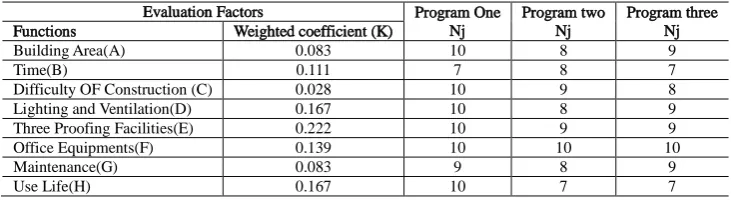
[image:5.595.123.489.607.707.2]Three solutions to the above eight functions of satisfaction are not the same, so the experts of the value engineering team evaluate the above three programs according to their functions such as floor space, time, difficulty construction, lighting and ventilation, the three proofing facilities, office equipments, maintenance and use life. A 10-point principle is cited, the full score is 10 points and the score will be given out between 0-10.The top score and the lowest score are removed from the 9 experts’ scores and the left seven ones are calculated to get a weighted average score for function satisfaction degree of each program, the data as shown in Table 3.
Table 3. The total function score of the three programs
Evaluation Factors Program One
Nj
Program two Nj
Program three Nj
Functions Weighted coefficient (K)
Building Area(A) 0.083 10 8 9
Time(B) 0.111 7 8 7
Difficulty OF Construction (C) 0.028 10 9 8
Lighting and Ventilation(D) 0.167 10 8 9
Three Proofing Facilities(E) 0.222 10 9 9
Office Equipments(F) 0.139 10 10 10
Maintenance(G) 0.083 9 8 9
Use Life(H) 0.167 10 7 7
The calculation of the total score of the function satisfaction degree of each program is shown in formula (3).
jj
K
N
Nj——the function score of program J
Mj——the total score of function satisfaction level of program J
M1=10×0.083+7×0.111+10×0.028+10×0.167+10×0.222+10×0.139+9×0.083+10×0.167=9.584 M2=8×0.083+8×0.111+9×0.028+8×0.167+9×0.222+10×0.139+8×0.083+7×0.167=8.361 M3=9×0.083+7×0.111+8×0.028+9×0.167+9×0.222+10×0.139+9×0.083+7×0.167=8.555
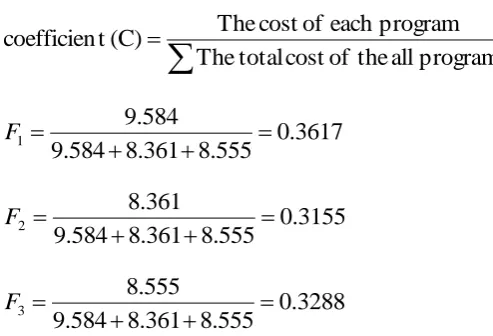
The calculation of the function coefficient of each program is show in formula (4).
programs
all
the
of
cost
total
The
program
each
of
cost
The
(C)
t
coefficien
(4)3617
.
0
555
.
8
361
.
8
584
.
9
584
.
9
1
F
3155
.
0
555
.
8
361
.
8
584
.
9
361
.
8
2
F
3288
.
0
555
.
8
361
.
8
584
.
9
555
.
8
3
F
Then calculate the function value coefficient of other programs.
Working out the value coefficient of each program
[image:6.595.72.319.183.351.2]Value coefficient (V) can be calculated based on function coefficient (F) and cost coefficient (C), and the program with the largest value coefficient of all the programs is the optimal one, as shown in Table 4.
Table 4. The value coefficient of each program
No Coefficient of function evaluation Cost coefficient Value Coefficient
Program One 0.5526 0.3617 0.6545
Program two 0.2129 0.3155 1.4819
Program three 0.2345 0.3228 1.3765
From the results, we can find that program two is the best program, which has the largest value coefficient, that is to say, constructing a new 8-meter long building connected to the existing office building with the same height can maximize the needs of uses . According to the principles of value engineering, the unit cost of the program two has brought about the largest amount of value, which has achieved a good combination of cost and function.
CONCLUSION
In the construction project decision-making stage implement value engineering is of great significance, it can make the function of the building products more reasonable. Value engineering is the core of functional analysis, through the implementation of value engineering, can make the decision personnel more accurate understanding of customer need, and building products between each function of the specific gravity, and at the same time, also can consider all aspects the advice of experts, so as to make the decision more reasonable.
The value engineering can effectively control the project cost and save social resources. Value engineering needs to analys the relationship between function and cost system. Decision makers can avoid only paying attention to function while ignoring the tendency of cost in the process of decision-making, it can give full play to the decision makers of the spirit of creation, put forward various functions of the scheme, and select the most reasonable solution in the premise of clear function[6].
purpose of value engineering is to achieve the users’ required function by the minimum life cycle cost, and can make the cost of the project, the use cost and building products function match reasonable, save the consumption of social resource.
The following are some problems should be paied attention to the application of value engineering , or else it will lose its proper role if inappropriate[7].
1.Differences between value engineering and the general theory of investment decisions
The above discussion indicates that value engineering and the general theory of investment decisions are different. General theory of investment decisions mainly study the results of project investments and emphasize the feasibility of the project, while the value engineering is to study how to obtain the necessary functions by means of technical and economic analysis at the cost of the least resources of human, materials, funds and time, whose emphasis is the product's function analyses and function improvements, and it seeks the best combination of the cost and function.
2. Function analysis is the core of value engineering
The core of value engineering is function analysis, which includes function definition, function assignment and function quantification. Through the above arguments, we can find that human factors account for a large proportion in the function analysis. Therefore, majority of value engineering staff is required to extensively collect all related information, which includes information of users, technology and economy, and strive to gain accurate and reliable function analyses through sifting the true from the false in dealing with the information.
3. Value engineering should take full advantage of collective wisdom
Value engineering is an activity with organization and leadership. Various value engineering has a diversity of working group members, who should be familiar with the study objects. In the implementation of value engineering, team members should draw on collective wisdom and absorb all useful ideas to make an evaluation and innovation of the alternative programs.
REFERENCES
[1] Dongmei Yu. Journal of Architectural Design Management. 2010(10): 23-25.
[2] Yutao Zhu, Junran Chen , Jianliang Shen. Journal of Building Management Modernization. 2008(01): 49-51. [3] Wu Jin. Journal of Building Economics. 2004(01): 33-35.
[4] Xianrong Ji, Fenghua Lu, Journal of the application in western China science and technology. 2010(09): 47-50.
[5] Jishou Niu, Ping He. Journal of Building Economics. 2007(09): 82-84.
[6] Yanliang Zhang, Qingyun Wei, Yadong Li, JinFeng Wang. Journal of Advances in Information Sciences and Service Sciences. 2012(04): 404 - 410.