Recursive Construction of
n
-gonal Codes on the
Basis of Block Design
Tkachenco V.G.
1,*, Sinyavsky O.V.
21Odessa National Academy of Telecommunications named after O.S.Popov, 65029, Odessa, str. Kovalska 1, Ukraine 2Military Academy (Odessa), 65009, Odessa, str. Fontansky road, 10, Ukraine
Copyright © 2014 Horizon Research Publishing All rights reserved.
Abstract
In the article are defined nonlinear n-gonal block codes. The methods of constructing n-gonal codes are considered. Suggest efficient universal recursive methods of constructing codes great length on the basis of block design for error-correcting code. On the basis of these methods can be constructed error-correcting codes for any predetermined number of errors. Among the codes with a predetermined length codeword and a predetermined number of units in the word, these codes will have a maximum number of codewords. Dignity of these codes is speed of encoding and decoding. Also possibility of fast change of a code without change of tables of encoding and decoding. This makes it possible to use these in cryptosystems.Keywords
Error-correcting Code, Nonlinear N-gonal Codes, Steiner System, Affine Plane, Projective Plane, Projective-affine BIB Expansion1. Introduction
In the progress of transmitting information on telecommunication networks there is a problem of error correction. Control of integrity of data and error correction — important tasks at many levels of work with information. One means of solving these problems is the use of error-correcting codes.
To date, developed many different error-correcting codes, which differ from each other by structure, redundancy, encoding and decoding algorithms ([1] … [4]). On the basis of monotone Boolean functions constructed a number of cryptosystems [5 - 8] with error correction. In particular, in the system based on triangular codes for construction codes great lengths used a recursive method [6].
However the recursive method used in [6] does not allow to build codes, if number of units in a code word more than 3. The aim of this work is to develop a recursive method for constructing of error-correcting code great length, which has a maximum power and corrects any predetermined number of errors and has a high speed encoding and decoding.
2. Theoretical Foundations of
n
-gonal
Codes
In this article as codewords we will consider vectors of length n
p
=
(
p
1,..., ,...,
p
ip
n)
, which components accept values from a set{ }
0,1 , and the number unit a component is equal in a vector to k. Such codewords have Hamming weight (number of units in a codeword) equal k. In Hamming distance (code distance) between two codewordsp and s the number is called
ρ
( )
p s , equal to number a component in which they differ [1]. Length of a code we will call length of a codeword. In total such codewords with weight of k can beC
nk. Code distances between differentwords in this case can be 2, 4, 6, …, 2k. For correcting codes only codewords with distance 4, 6, …, 2k are applicable. The number of codewords is called as code power. Such codes with code distance 2k are uninviting, as their power is small and is always equal n
k
. In any such pair of codewords
there are no conterminous single bits. Let's consider further the maximum codes with
ρ
( )
p s , ≥2k−2, as they correctthe maximum number of errors. From determination of Hamming distance follows that in such codes for each pair of codewords of the general there can be only one unit. It is easy to present such codes in the form of monotonous Boolean functions of a rank n, weight 1 and power m, where m
equally to code power. [6-8]]
For research of such codes it is possible to use block designs.
In [9-11] the following definitions of the block design,
BIB of the block design, the affine and projective planes are given.
blocks.
Example 1. For v=7,b=7,r=3,k=3,
λ
=1 we have such blocks:b0: (0, 1, 3)
b1: (1, 2, 4)
b2: (2, 3, 5)
b3: (3, 4, 6)
b4: (4, 5, 0)
b5: (5, 6, 1)
b6: (6, 0, 2)
Definition. The block design balanced with respect to pairs (elements) of BIB
(
v b
, ,...,
(
1b
m) (
, ,...,
k
1k
m)
,
λ
)
iscalled such placement of v of elements on b= 1
m i
b
∑
to blocks that: 1) bi blocks contains on ki < v of different elements at some i = l..., m; 2) each pair of elements appears together precisely in λ blocks.Any block design or ВІВ the block design is a code. In this case numbers of single bits of codewords correspond to block elements, and codewords correspond to blocks in this block design. Thus, since.
ρ
( )
a b
,
≥
2
k
−
2
, that no 2 blocks in the constructed count have the general pairs of elements. It is obvious that number λ corresponds to Hamming distance, namely: ρ( )
a b, =2(
k−λ)
.Definition. Correcting ability – the characteristic of a code which is equal to the maximum number of corrected errors in codewords.
Is defined as 1
2 d−
, where d – the minimum distance
between codewords.
As number of codewords, at which ρ
( )
a b, =2kit is notenough, the greatest correcting ability of a code is reached, when λ =1 also it is equal 2
(
1 1)
2 32 2
k− − k
= −
What follows we consider only the block designs with
1
λ = , i.e. Steiner systems.
In the offered method creation of correcting codes the projective and affine planes will be used.
Definition. System PG
( )
2,n , having finite number of points is called as the projective plane of an order n, if satisfies to the following axioms:Through two different points of P and Q of the plane there passes a straight line, and, only one.
Any two straight lines have the general point.
There are three points which are not lying on one straight line.
Each straight line contains not less than three points Generally projective plane of an order n has n n2+ +1
points and as much straight lines. Each line contains n+1
points, and each point belongs n+1 straight line.
Definition. System EG
( )
2,n , having finite number of points is called as the affine plane of an order n, if satisfies to the following axioms:For any two different points there is only one straight line containing these points.
Crossing of two different straight lines contains exactly one point.
There is a set from four points, any three of which do not belong to one straight line.
Generally projective plane of an order n has n2 points
and n n2+ straight lines. Each line contains n points, and
each point belongs n+1 straight line.
The affine and projective planes are block designs in which each block consists of numbers of points being on some straight line.
Let's make definition n-gonal code.
Definition 1. n-gonal code is called the Steiner system in which each block contains n elements.
n-gonal codes are block and nonlinear as a difference of any codewords are not a code.
Before describing a recursive method of creation of codes on the basis of block designs we will enter the following definitions.
Definition 2. Projective expansion of Steiner system A0(v,
b, r, k) is called the Steiner system C0 obtained by combining blocks b of the projective planes B0(k (k – 1) + 1, k (k – 1) + 1,
k, k) = PG (2, k – 1), constructed for each block of Steiner system A0.
Definition 3. Affine expansion of Steiner system A0(v, b, r, k) is called the Steiner system C0 obtained by combining blocks b of the affine planes B0((k – 1) (k – 1), k (k – 1), k, k – 1) = EG (2, k – 1), constructed for each block of Steiner system A0.
Definition 4. The projective-affine expansion BIB of Steiner system A0(v, (b1, b2), (k, k+1)) is called the Steiner system C0 obtained by combining b1 blocks of the projective planes B0(k (k – 1) + 1, k (k – 1) + 1, k, k) = PG (2, k – 1), constructed for each block from k of elements, and b2 of the affine planes B0(k·k, k (k + 1), k + 1, k) = EG (2, k), constructed for each block from k + 1 element of Steiner system A0.
3. Recursive Methods of Constructing
n
-gonal Codes
Let's describe a recursive method of creation of block designs on an example of creation of a code in length 64 of a code in length 21.
Example 2. As the block design of A0 of length 21 we will take the projective plane of the 4th order of PG (2,4) v = 21, b
2) (2,3,8,10,20) 3) (0,3,4,9,11) 4) (0,1,6,8,18) 5) (1,4,5,10,12) 6) (2,5,6,11,13) 7) (3,6,7,12,14) 8) (4,7,8,13,15) 9) (5,8,9,14,16) 10) (6,9,10,15,17) 11) (7,10,11,16,18) 12) (8,11,12,17,19) 13) (9,12,13,18,20) 14) (0,10,13,14,19) 15) (1,11,14,15,20) 16) (0,2,12,15,16) 17) (1,3,13,16,17) 18) (2,4,14,17,18) 19) (3,5,15,18,19) 20) (4,6,16,19,20) 21) (0,5,7,17,20)
Let set Е, consists 0 and pairs (x,y), where
0≤ ≤x 20, 0≤ ≤y 2. Let's construct the blocks containing 0, as follows:
(
0, ,0 , ,1 , ,2( ) ( ) ( )
x x x)
. Such blocks we will call the allocated blocks. In pairs (x, y) as elements x we will take elements of the block of 1 block design of A0: (1,2,7,9). As a result we will receive 16-element set Е1. Let's renumber all pairs (x, y) as follows( )
0,0 1= ,( )
1,0 =2 , …,( )
0,1 22= , ... ,(
20,2)
=63. As a result we will receive such set of E1 = {0,1,2,7,9,19,22,23,28,30,40,43,44,49,51,6 1}. On this set we will construct B1 block design – the affine plane of the 4th order of EG (2,4) v = 16, b = 20, r=5, k = 4,1 λ = .
1.1) (0,1,22,43) 1.2) (0,2,23,44) 1.3) (0,7,28,49) 1.4) (0,9,30,51) 1.5) (0,19,40,61) 1.6) (1,2,9,28) 1.7) (2,7,40,43) 1.8) (7,9,23,61) 1.9)(1,23,30,40) 1.10) (2,22,51,61) 1.11) (7,22,30,44) 1.12) (23,43,49,51) 1.13) (9,19,43,44) 1.14) (9,22,40,49) 1.15) (28,30,43,61) 1.16) (28,40,44,51) 1.17) (1,44,49,61) 1.18) (2,19,30,49) 1.19) (1,7,19,51) 1.20) (19,22,23,28)
The allocated blocks in the block design of B1 are the blocks containing 0, i.e. with numbers 1.1-1.5
Similarly on the block of 2 block designs of A0 PG (2,4) we build a set of E2 = {0,2,3,8,10,20,23,24,29,31,41,44,45,
50,52,62}. On this set we will construct B2 block design – the affine plane of the 4th order of EG (2,4) v = 16, b = 20,
r=5, k = 4, λ =1 by means of such replacement of elements of the block design of B1 (according to a lemma 3):
1->>> 2->>> 3, 7---> 8, 9---> 10, 19---> 20, 22---> 23---> 24, 28---> 29, 30---> 31, 40---> 41, 43---> 44---> 45, 49---> 50, 51---> 52, 61---> 62
2.1) (0,2,23,44) 2.2) (0,3,24,45) 2.3) (0,8,29,50) 2.4) (0,10,31,52) 2.5) (0,20,41,62) 2.6) (2,3,10,29) 2.7) (2,8,20,52) 2.8) (2,24,31,41) 2.9) (2,45,50,62) 2.10) (3,8,41,44) 2.11) (3,20,31,50) 2.12) (3,23,52,62) 2.13) (8,10,24,62) 2.14) (8,23,31,45) 2.15) (10,20,44,45) 2.16) (10,23,41,50) 2.17) (20,23,24,29) 2.18) (24,44,50,52) 2.19) (29,31,44,62) 2.20) (29,41,45,52)
The allocated blocks in the block design of B2 are blocks 2.1-2.5
Having used thus everything 21 blocks of block design А0, we will receive 21 affine plane into which 420 blocks will enter. Thus not allocated blocks will not have repeating pairs of such blocks will be 15 21 315⋅ = . Now, we will add blocks on which there are crossings of block designs Вi and
Вj, 1 ,≤i j≤21,i j≠ . Such crossings will occur only on the allocated blocks (a lemma 1). Such blocks in all Вj will be
21 5 105⋅ = . But on a lemma of such blocks will be 21. Therefore we will have in the sum 315 + 21 = 336 not being crossed blocks. Thus, we have received all blocks of Steiner system C0 with parameters v = 64, b = 336, r = 21, k= 4.
For construction distribution from an example 1 on any Steiner systems previously we will prove 3 lemmas.
Lemma 1. Any not allocated block can enter only into one of Steiner systems Bi.
Proof. As as A0 the system, any 2 ai and aj blocks from A0 is considered Steiner either are not crossed, or have one general element. In the first case of a set of Ei and Ej have one general element equal to 0, so Steiner of system Bi and
and Вj. It proves that Вi and Вj have no general not allocated blocks.
Lemma 2. Any two distinct blocks of Steiner systems Bi
and Вj do not contain the general pair of elements.
Proof. On construction the allocated blocks have no general pair and no pair from the allocated block can enter into not allocated block. Let's allow 2 not allocated blocks from Вi and Вj contain the general pair of elements. Then this pair is the general for sets of Ei and Ej, so according to a lemma 1 the general enters into the allocated block, for Вi
and Вj. Then Вi contains the allocated and not allocated blocks with the general pair of elements. It contradicts that Вi
is Steiner system. The lemma is proved.
Lemma 3. Any Steiner system Bi obtained by renumbering the elements of Steiner systems B1.
Proof. Steiner systems B1 and Вi are under construction of
a1 and ai blocks of Steiner system A0. Let's unequivocally display a1 block elements on ai block elements. Thus the general element of 2 blocks (if it is) is mapping on itself. To elements of a1 and ai blocks there correspond components x in pairs (x,y), belonging to sets to E1 and Ei. In such a mapping obtained uniquely renumbering of the elements of
E1 to the elements of Ei. Thus from Steiner system B1
obtained the Steinersystem Bi.
In the proof of lemmas 1-3 that in an example 1 in quality
Вi and Вj the affine planes undertake is not used. Therefore lemmas 1-3 are fair, when Вi and Вj is Steiner systems
Let's extend construction from an example 2 to a case of the any v and k.
Theorem 1. If there is Steiner system A0(v, b, r, k) and there is an affine plane k-1st order B0((k – 1)2, k (k – 1), k, k –
1) = EG (2, k – 1), exists the affine expansion C0(v (k – 2) +1,
b · k (k – 2) + v, v, k – 1) of Steiner system A0. The affine planes Bi exist for k – 1 look pi, where p – simple number.
Proof. According to a lemma 1 at b the affine planes Bi there are b · k (k – 1) – b · k of not allocated blocks. Adding to them v of the allocated blocks we will receive that the affine expansion C0 of Steiner system A0 contains b·k (k – 2) + v of blocks. Into all these blocks on construction enter v(k – 2) +1 elements, as x in pairs (x,y) changes generally from 0 to v – 1, and y from 0 to k – 3. Each pair (x,y) is included into r·(k–1) not allocated blocks and in one allocated block. 0 enters into
v of the allocated blocks. As in any Steiner system is carried out r·(k–1)+1= v, each element of the affine expansion C0 enters into v of blocks, and pair of elements ((х1,у1), (х2,у2))
according to a lemma 2 is included only into one block. b·k (k
– 2) + v blocks contains in all b·k(k – 2)·(k – 1)·(k – 2)/2 +
v ·(k – 1)·(k – 2)/2 pairs. As for block designs b · k= v · r, number of pairs equally v·(v – 1)·(k – 2)2/2+ v ·(k – 1)·(k –
2)/2= v2·(k – 2)2/2+v·(k – 2)/2, i.e. to number of pairs, which
form v(k – 2) + 1 elements. It proves that C0 Steiner system. In a case when v=40, this theorem it is impossible to apply that. From the block design with v=13 to construct the block design v=40 it is possible by means of the projective plane.
Theorem 2. If there is Steiner system A0(v, b, r, k) and there is a projective plane k-1st order B0(k(k – 1) + 1, k(k – 1) + 1, k, k) = PG(2,k – 1), exists the projective expansion
C0(v(k – 1) + 1, b(k – 1)·(k – 1) + v, v, k) of Steiner system A0. The projective plane B0 exists for k – 1 look pi, where p –
simple number. Steiner system B0 is symmetric.
Proof. According to a lemma 1 at b the projective planes Bi there are b · (k (k – 1) + 1) – b · k of not allocated blocks. Adding to them v of the allocated blocks we will receive that the projective extension C0 of the block design of A0 contains b (k – 1) 2 + v of blocks. In all of these blocks by construction includes (k – 1) + 1 elements, as x in pairs (x,y) changes generally from 0 to v-1, and y from 0 to k – 3. Each pair (x,y) is included into r · (k – 1) not allocated blocks and in one allocated block. 0 enters into v of the allocated blocks. As in any Steiner system is carried out r · (k–1) + 1 = v, each element of the projective C0 expansion enters into v of blocks, and pair of elements ((х1,у1), (х2,у2)) according to a
lemma 2 is included only into one block. In all b (k – 1) 2 + v
blocks contains b (k – 1)2 · k · (k–1)/2 + v · k · (k–1)/2 pairs.
As for block designs b· k= v · r, number of pairs equally v·(v – 1)·(k – 1)2/2+ v·k·(k – 1)/2= v·(k – 1)(v·(k – 1)+1)/2, i.e. to
number of pairs, which form v (k – 1) + 1 elements. It proves that C0 Steiner system.
Example 3. From block design A0(13, 13, 4, 4) and the same block design В0(13, 13, 4, 4) we will receive block design С0(40, 130, 13, 4). Let block designs of A0 and В0 the such:
1) (1, 2, 3, 4) 8) (3, 6, 10, 11)
2) (1, 5, 6, 7) 9) (3, 5, 9, 13)
3) (1, 8, 9, 10) 10) (3, 7, 8, 12)
4) (1, 11, 12, 13) 11) (4, 5, 10, 12)
5) (2, 5, 8, 11) 12) (4, 6, 8, 13)
6) (2, 6, 9, 12) 13) (4, 7, 9, 11)
7) (2, 7, 10, 13)
From the block 1 we will receive just as in an example the 2nd block design В1(13, 13, 4, 4). From it renumbering of elements we will receive block designs В2 – В13. As a result we will receive 117 not allocated and 13 allocated blocks of block design С0.
Repeatedly applying the theorem 2 to С0(40,130,13,4) =
А1 we will receive infinite sequence of Steiner systems:
(
)
(
)
(
)
0 13,13,4,4 1 40,130,13,4 ... 3 364,11011,121,4
A A
A
⇒ ⇒
⇒ ⇒
(
)
... Ai 9841,8069620,3280,4 ...
⇒ ⇒ ⇒
In a case, when v=52 1 and 2 it is impossible to apply the theorem. But it is possible to construct Steiner system with v=52, using Steiner A0 system
(k – 1) (k – 1) +b2 (k · k–1) + v, v, k) BIB of Steiner system A0. Both planes exist for k – 1 look
p
1i1 · i1 and look kp
2i2 , where p1 and p2 – simple numbers.Proof. According to a lemma 1 in b1 projective and b2 the affine planes Bi are present at b1·(k(k – 1) + 1) – b1·k + b2·k(k
+ 1) – b2·(k + 1) not allocated blocks. Adding to them v of the allocated blocks we will receive that the projective and affine C0 extension of the block design of A0 contains b1(k – 1)2 + b2(k2 – 1) + v of blocks. Enter into all these blocks on
construction v(k – 1) + 1 elements, as x in pairs (x,y) changes generally from 0 to v-1, and y from 0 to k – 2. Each pair (x,y) enters in r k
(
− +1)
k not allocated blocks and in one allocated block. 0 enters into v of the allocated blocks. As in any Steiner system is carried out r · (k–1) + 1 = v, each element of the projective C0 expansion enters into v of blocks, and pair of elements ((х1,у1), (х2,у2)) according to alemma 2 is included only into one block. In all b1(k – 1)2 + b2(k2 – 1) + v blocks contains b1(k – 1)2·k·(k – 1)/2+ b2(k2 –
1)·k·(k – 1)/2 + v·k·(k – 1)/2 pairs. As for block designs (b1 +
b2) · k = v · r, number of pairs equally v·(v – 1)·(k – 1)2/2+ v·k·(k – 1)/2= v·(k – 1)(v·(k – 1)+1)/2, i.e. to number of pairs, which form v (k – 1) + 1 elements. It proves that C0 Steiner system.
Example 4. Let BIB block design A0(v=17, (b1=16, b2=4), (k=4, k+1=5)) is set:
а1) (0, 1, 2, 3, 4)
а2) (0, 5, 6, 7, 8)
а3) (0, 9, 10, 11, 12)
а4) (0, 13, 14, 15, 16)
а5) (1, 5, 9, 13)
а6) (1, 6, 10, 14)
а7) (1, 7, 11, 15)
а8) (1, 8, 12, 16)
а9) (2, 5, 10, 15)
а10) (2, 6, 9, 16)
а11) (2, 7, 12, 13)
а12) (2, 8, 11, 14)
а13) (3, 5, 11, 16)
а14) (3, 6, 12, 15)
а15) (3, 7, 9, 14)
а16) (3, 8, 10, 13)
а17) (4, 5, 12, 14)
а18) (4, 6, 11, 13)
а19) (4, 7, 10, 16)
а20) (4, 8, 9, 15)
projective plane of the 3rd order B0(13, 13, 4, 4) and affine plane of the 4th order D0(16, 20, 5, 4). From А0, В0 and D0 it is possible to construct the projective and affine expansion
C0(52, 221, 17, 4). Namely, from blocks а1 – а4 block
designs А0 we will receive 4 affine planes D1 – D4(13, 13, 4, 4) (as in an example 2) which will give 144 not allocated blocks, and from other blocks of scheme А0 we will receive 16 projective planes B5 – В20(16, 20, 5, 4) (as in an example 3) which will give 60 not allocated and 17 allocated blocks (on construction) the projective-affine expansion C0(52, 221, 17, 4).
For specific cases k can exist and other recurrent ways of creation of codes. In particular, for a case k=3 in [7] are proved the theorem A and the theorem B, and also Moore's theorem is provided.
Theorem A. Exists a triangular code with words of code length k ( k is odd and k≡/5 mod 6
(
)
) power(
1)
6 k k
m= − . Then there is a triangular code with words of
code length n=2k power 4
(
2)
6 n n m= − .Theorem B. There are systems of triples of Steiner of orders of v1 and v2: S1(v1, b1, r1,3) and S2(v2, b2, r2,3). Then
there is Steiner a system 1 2
(
1 2)
1 2 1 21 1
, , ,3
6 2
v v v v v v S v v − −
.
Moore's theorem. Let there are systems of triples of Steiner of orders v1 and v2: S1(v1, b1, r1,3) and S2(v2, b2, r2,3).
Let also either v3=1, or v3 is order of system of triples of
Steiner S3(v3, b3, r3,3) which is a subsystem in S2. Then it is
possible to construct system of triples of Steiner S(v, b, r, 3) with v = v3 + v1 (v2 – v3), containing v1 of subsystems of an
order of v2 and at least on one subsystem of orders v1 and v3
(if v3 is not equal 1).
For a case k=4 it is possible to prove the theorem similar to the theorem B:
Theorem 4. Let there are systems of fours Steiner’s of orders v1 and v2: S1(v1, b1, r1,4) and S2(v2, b2, r2,4). Then there
is Steiner a system
(
)
1 2(
1 2)
1 21 2
1 1
, , ,4 , , ,4
12 3
v v v v v v S v b r = S v v − −
.
Proof. We form of the elements S1 and S2 v v v= 1 2 pairs.
Of these pairs we will build the four of Steiner system S. At the first stage we take any element аi from S1 and any block
(
b c d e, , ,)
from S2. We form the four of pairs( ) ( ) (
) ( )
(
a b a c a d, , , , , , ,a e)
, such the fours exists v b1 2. Alsoat the second stage we take any block
(
a b c e, , ,)
from S1and any element d from S2. We form the four of pairs
(
) (
) ( ) ( )
(
a d, , , , , , ,b d c d e d)
. Such the fours exists v b2 1. Atthe third stage we take any block from
(
a b c d, , ,)
S1 andany block
(
e f g h, , ,)
from S2. It is possible to form 24 fourfour
(
e f g h, , ,)
. 24 it is possible to choose from these only 12 which have no general pairs. For this purpose it is necessary to take only even shifts(
e f g h, , ,)
. Let's list these 12 fours:(
( ) (
a e b f, , ,) ( ) (
, , , ,c g d h)
)
,( ) (
) ( ) (
)
(
a e b g c h d f, , , , , , ,)
,(
( ) ( ) (
a e b h c f, , , , ,) (
, ,d g)
)
,(
) ( ) ( ) (
)
(
a f, , , , , , ,b e c h d g)
,(
(
a f,) (
, , , , , ,b g c e d h) ( ) (
)
)
,(
) ( ) ( ) ( )
(
a f, , , , , , ,b h c g d e)
,(
(
a g b e c f, , , , ,) ( ) (
) (
, ,d h)
)
,(
) (
) ( ) ( )
(
a g b f, , , , , , ,c h d e)
,(
(
a g b h c e d f, , , , , , ,) ( ) ( ) (
)
)
,( ) ( ) ( ) (
)
(
a h b e c g, , , , , , ,d f)
,(
( ) (
a h b f, , ,) ( ) (
, , , ,c e d g)
)
,( ) (
) (
) ( )
(
a h b g c f, , , , , , ,d e)
. In total for Steiner systems S1and S2 it is possible to receive 12b b1 2 such fours.
Let's show that it Steiner system. As no 2 four from S1 or S2 have the general pairs, cannot have the general pairs any 2
four from these constructed 12b b1 2 fours.
Uniting the fours, the constructed on 1, 2 and 3 stages, we receive that in Steiner system S is available
1 2 2 1 12 1 2
b v b v b= + + b b blocks. For any block designs formulas are carried out: bk vr= , ( ? 1)
? 1
v r
k
λ
= . For
Steiner systems with k = 4 these formulas look like: 4b vr= , 1
3
v
r= − . From here follows
(
1)
12v v
b= − . Substituting this
expression instead of 1
(
1)
11 12
v v
b = − and 2
(
2)
2
1 12
v v b = −
we receive 1 2
(
1 2)
1 2 2 1 1 2
1 12
12
v v v v
b v b v b= + + b b = − , that is equal to number a fours in Steiner system S. The number of repetitions of each element is equal in these four
. The theorem is proved.
As the Hamming distance between any codewords is not less 2
(
k−1)
, such quadrangular code can correct that2 3 2 k−
symbols of a transferred codeword. Codewords in
the table of coding are ordered on increase.
4. Algorithms of Encoding and Decoding
of
n
-gonal Codes
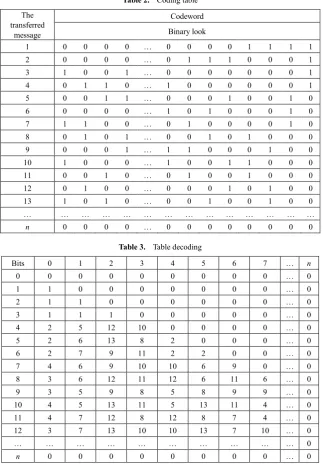
Decoding is carried out by means of the table (the two-dimensional massif) where in headings of lines and columns numbers of single bits, and in the table of number of codewords will be written down. We determine the
transferred information message by numbers of two bits of a codeword. Thus numbers of columns correspond lsb, and numbers of lines to the msb of the transferred message.
EXAMPLE 5. Detection of one error. Let's consider a code with k=4 and length n , on the channel cryptosystem two messages 2 and 1 are transferred. These messages are coded by two codewords (according to table 2): 0000 … 01110001 and 0000 … 00001111, i.e. all it is transferred 2n bat. Let two codewords 0000 … 0110001 and 000 … 10001111 have been accepted. At reception numbers of bits of codewords for the 1st codeword are defined these are bits: 0, 4, 5, for the 2nd – 0, 1, 2, 3, 7. Let's apply the decoding table (table 3) to definition of the devoted message corresponding to the first codeword. Number of lowest single bit of the transferred word is equal 0, and number of the highest is 5. On crossing of the corresponding line and a column is 2. It means that the message 2 is transferred. The error of transfer for the 1st codeword is corrected.
Let's consider, how there is a decoding in case instead of four single bits 5 single bits were accepted, on an example of the second codeword. It is possible to form 10 pairs of single bits of the 2nd codeword: (0; 1), (0; 2), (0; 3), (1; 2), (1; 3), (2; 3), (0; 7), (1; 7), (2; 7), (3; 7). To these pairs in the table of decoding there correspond the transferred messages: 1, 1, 1, 1, 1, 1, 4, 6, 9, 10. Six of the messages found in the table are identical and equal 1. It means that 6 first pairs of bits form the second codeword, i.e. the codeword 0000 … 00001111 has been transferred. The error of transfer for the 2nd codeword is corrected. It is possible to show that in case of reception of 5 bits instead of 4 it is enough to find in tables for the received pairs two conterminous messages, i.e. in the given example instead of 6 pairs was enough to check only pairs (0; 1) and (0; 2). At worst it is enough to check 6 pairs that demands 6 readings from table 2.
It is simple to count up, how many on the average it is necessary to check pairs in this case. Let's designate through
x a random variable – number of checked pairs, p – probabilities of values x. Values pi we will find on a formula
1 2 6 4
1 10
5
10
1
i
i i
C C
p
i
C
−
−
⋅
=
⋅
− +
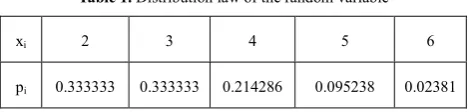
. We have the probability [image:6.595.315.550.613.669.2]distribution of this random variable:
Table 1. Distribution law of the random variable
xi 2 3 4 5 6
pi 0.333333 0.333333 0.214286 0.095238 0.02381
Mathematical expectation mх = 3.14. Therefore, in this case on the average it is necessary to check 3 pairs of bits.
1 2 2 1 1 2 1 2 1 2 1 2 1 2 1 2 1 2
12 1
4 4 4 4 48
3
v b v b b b b b b b v v b
r
v v v v v v v
+ + −
Table 2. Coding table The
transferred message
Codeword Binary look
1 0 0 0 0 … 0 0 0 0 1 1 1 1
2 0 0 0 0 … 0 1 1 1 0 0 0 1
3 1 0 0 1 … 0 0 0 0 0 0 0 1
4 0 1 1 0 … 1 0 0 0 0 0 0 1
5 0 0 1 1 … 0 0 0 1 0 0 1 0
6 0 0 0 0 … 1 0 1 0 0 0 1 0
7 1 1 0 0 … 0 1 0 0 0 0 1 0
8 0 1 0 1 … 0 0 1 0 1 0 0 0
9 0 0 0 1 … 1 1 0 0 0 1 0 0
10 1 0 0 0 … 1 0 0 1 1 0 0 0
11 0 0 1 0 … 0 1 0 0 1 0 0 0
12 0 1 0 0 … 0 0 0 1 0 1 0 0
13 1 0 1 0 … 0 0 1 0 0 1 0 0
… … … …
n 0 0 0 0 … 0 0 0 0 0 0 0 0
Table 3. Table decoding
Bits 0 1 2 3 4 5 6 7 … n
0 0 0 0 0 0 0 0 0 … 0
1 1 0 0 0 0 0 0 0 … 0
2 1 1 0 0 0 0 0 0 … 0
3 1 1 1 0 0 0 0 0 … 0
4 2 5 12 10 0 0 0 0 … 0
5 2 6 13 8 2 0 0 0 … 0
6 2 7 9 11 2 2 0 0 … 0
7 4 6 9 10 10 6 9 0 … 0
8 3 6 12 11 12 6 11 6 … 0
9 3 5 9 8 5 8 9 9 … 0
10 4 5 13 11 5 13 11 4 … 0
11 4 7 12 8 12 8 7 4 … 0
12 3 7 13 10 10 13 7 10 … 0
… … … 0
n 0 0 0 0 0 0 0 0 … 0
Example 6. Detection of two errors. In a considered example chances when:
1. Two units, other zero are accepted.
2. Four units one of which is not on the place are accepted. 3. Six units are accepted.
In the first case at once by two units we determine a transferred codeword.
In the second case we have 3 true (correspond to one transferred message) and 3 incorrect pairs (correspond to different transferred messages). Then it is enough to find to two pair one transferred message. For finding of two pairs from one transferred message it is necessary to check at least 2 and at most 5 pairs. Let's count up, how many on the average it is necessary to check pairs of bits. Let x a random variable – number of checked pairs, p – probabilities of values x. Values pi we will find on a formula
1 2 3 3
1 6
2
6 1
i
i i
C C p
i C
− −
⋅
= ⋅
− + . We have the probability distribution
of this random variable:
Table 4. Distribution law of the random variable
xi 2 3 4 5
pi 0.2 0.3 0.3 0.2
Mathematical expectation mх = 3.5. Therefore, in this case on the average it is necessary to check 3-4 pairs of bits. In the third case we have 6 true (correspond to one transferred message) and 9 incorrect pairs (correspond to different transferred messages). For finding of two pairs from one transferred message it is necessary to check at least 2 and at most 11 pairs.
[image:7.595.144.468.80.554.2]this case it is necessary to check. Similarly previous, the distribution law for this random variable:
Table 5. Distribution law of the random variable
xi 2 3 4 5 6
pi 0.142857 0.197802 0.197802 0.167832 0.125874
xi 7 8 9 10 11
pi 0.083916 0.048951 0.023976 0.008991 0.001998
Mathematical expectation mх = 4.57. Therefore, in the third case on the average it is necessary to check 4-5 pairs of bits.
5. Conclusions
In conclusion, we note the following. The main result is the development of a universal recursive method of constructing codes great length on the basis of Steiner systems. These codes have a maximum power and maximum correcting ability among the codes with a given number of units in the codeword. Is proved a number of properties of such codes, not previously described in the literature. Constructed error-correcting code with simple encoding and decoding algorithms and the ability to change the code for one permutation.
REFERENCES
[1] F.J. MacWilliams, N.J.A. Sloane. The theory of error-correcting codes, North-Holland Publishing Company, Amsterdam, 1977, 744.
[2] R.E. Blahut. Theory and practice of error control codes, Addision-Wesley Publishing Company, London, 1983, 576. [3] E.R. Berlekamp. Algebraic coding theory, McGraw-Hill
Book Company 1968, 480.
[4] David J.C. MacKay. Information Theory, Inference, and Learning Algorithms, Cambridge University Press, 2003. [5] ТкаченкоВ.Г.Перечислениетиповмонотонныхбулевых
функций при синтезе цифровых схем, Наукові праці ОНАЗім.О.С.Попова,Одеса,№2, 54 – 69, 2008 [6] Ткаченко В.Г. Синявский О.В., Построение
корректирующего кода для криптосистем на основе типов монотонных булевых функций, Наукові праці ОНАЗім.О.С.Попова,№ 1, 85 – 92, 2010.
[7] Tkachenco V.G. , Sinyavsky O.V. (2014). Construction of Cryptosystem on the Basis of Triangular Codes. Computer Science and Information Technology, 2, 300 - 307. doi: 10.13189/csit.2014.020703.
[8] Tkachenсo V.G., Sinyavsky O.V. Construction of cryptosystem оn the basis quadrangular codes, Nauka i Studia.
Przemyśl, 35 (103), 18–28, 2013.
[9] Marshall Hall, Jr. Combinatorial theory, Blaisdell Publishing Company, Waltham (Massachusetts), 1967, 424.
[10] P.J. Cameron, J.H. van Lint. Graph Theory and Block Designs, Cambridge University Press, 1975, 144.