Enhancing Labour Productivity within Construction
Industry through Analytical Hierarchy Process, the Case
of Gaza Strip
Hasan Hamouda, Nadine Abu-Shaaban
*Construction Management Group, Faculty of Applied Engineering and Urban Planning, University of Palestine, Palestine
Copyright © 2015 by authors, all rights reserved. Authors agree that this article remains permanently open access under the terms of the Creative Commons Attribution License 4.0 International License
Abstract
Construction sector plays a leading role in economic growth for countries all around the world. Since construction is a labour intensive industry, productivity is considered a primary driving force for economic development. In the Gaza Strip, the economy is severely challenged by the combined effects of rapid population growth and the closure policy imposed on the area since 2007. Owing to this situation, construction projects are characterized by low profit margin, time and cost overrun making labour productivity a key component of company’s success and competitiveness. Although, labour productivity has been subject of study by many researchers, a deeper understanding is still required to improve labour productivity. The main aim of this study is to identify key factors affecting labour productivity in the Gaza Strip. It also aims at formulating a labour productivity baseline model using the Analytical Hierarchy Process (AHP). By reviewing the literature and conducting depth interviews with experienced engineers, thirty critical factors related to labour productivity were identified and categorized into six groups: psychological, experience, supervision and leadership, physical, time and workload, and external factors. Based on the Analytical Hierarchy Process approach, a questionnaire was designed and delivered to sixty contractors to elicit the view on how labour productivity might be affected. A total of 56 feedbacks were analyzed through the AHP. The results indicated that Job satisfaction& security, lack of incentive scheme, skill& experience, drug use, overtime and weather changes have a significant impact on labour productivity in GS. In addition, the developed AHP model provides a framework that can assist managers in evaluating multiple factors and hence effectively improve labour productivity.Keywords
Analytical Hierarchy Process, Gaza Strip, Labour, Productivity, Introduction1. Introduction
The construction sector plays a key role in boosting the economy, largely through the lens of generating the potential for employment. In this respect, the construction industry utilizes various types of resources that include; labour, equipment and materials. Particularly, in Palestine, Labour accounts for 30-50 percent of the project’s cost [1]. Such a statement would point to scoring effective planning and how to manage individuals in a team. These are not only necessary to deliver a successful project but also to realizing a healthy profit.
The construction sector is one of the main driving forces to mobilizing economic growth. The statistics illustrates that the share of the labour force in the Palestinian construction industry increased from 13.2% to 15.6% for the years 2010-2013 [2]. Associated to labour, labour productivity is an issue of major concern in the Gaza Strip (GS). This is due to common phenomenon of project’s time delays and cost overrun tied to poor labour productivity [3]. Hence, improving labour productivity is vital to successful project management.
2. A Literature Review
The literature is rich in providing several contributions related to construction labour productivity within the construction industry. Categories in previous studies can be classified into either identification factors associated with labour productivity or developing the methods and techniques necessary for estimating labour productivity [4]. In doing so, a first step is to understand and evaluate how different factors influence labour productivity. This step is a preliminary step as it assists project managers in outlining the deficiencies and therefore establishing an overall optimization strategy. A significant body of research emerges which despite differences in many countries addresses different parameters affecting labour productivity [5]. For example, [6] suggest factors that affect labour productivity in Turkey from the perspective of consultants, contractors and subcontractors. Lack of local experienced labour, schedule pressure caused by the Government and working overtime have been, amongst others, the most distinguished parameters. Differently, but related, [7] have explored the de-motivating factors in Hong Kong within labour employed in civil engineering works and followed by suggesting the consequences on labour productivity. This study reveals that extensive reworks, overcrowded work areas, problems occurred in crew interfacing, availability of tools, delays in inspection, availability of materials and incompetence of site foremen have caused 5.1–13.6 lost in man-hours per week. Furthermore, [8] go further and identify ten main factors that negatively affect labour productivity within building projects constructed in Palestinian. These include materials shortages, a lack of labour experience and surveillance, in addition to drawings and altering specification occurred during execution and payment delays. Similarly, [9] classifies the key groups influencing labour productivity using a survey of the construction companies registered in Indonesia. These groups are supervision, material, execution plan and design. Another study has been conducted on Uganda construction industry [10]. Its findings indicates that incompetent supervision, lack of skills, rework, lack/breakdown of tools, poor construction methods, poor communications, inaccurate drawings, stoppages due to rejected work, political insecurity and weather conditions largely influence labour productivity. Collectively, it can be argued that there is a lack of universal set of factors affecting labour productivity due to varying country conditions. A second step is estimating the construction labour productivity in an effort to both improve labour productivity prediction and monitoring on-site performance. In this aspect, several models have been developed in the literature which their basis departs from the relationship between various factors. For example, methods such as regression analysis [11], Artificial Neural Network [12], and Fuzzy Set Theory [13], have been reported in several studies accounting for various factors affecting labour productivity. The two steps discussed above suggest a framework in this study which is adopted in the section that follows to examine the overlap
occurred within different factors, thereby arriving at basis for a labour productivity model.
3. Analytical Hierarchy Process
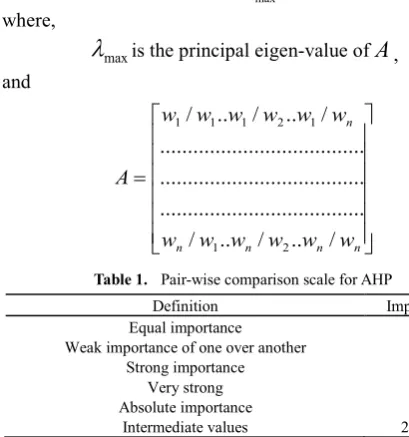
The Analytical Hierarchy Process (AHP) developed by Dr. Thomas Saaty in the 1980s, is a multi-criteria decision making tool [14]. It assists in structuring complex problems into a system by capturing both qualitative and quantitative factors. The first step of the AHP consists of building a hierarchy of elements describing the problem under consideration. The objective or goal from the decision-makers viewpoint is represented at the top level of the hierarchy. This is followed by the intermediate levels that demonstrate the criteria and sub-criteria contributing to the decision. Once the hierarchies have been established, the next step is finding out the weight of each criterion with respect to others within the same level. This is accomplished via pair wise comparisons using a nine-point scale (shown in Table (1)). Pair-wise weighting among n elements in each level leads to an approximation aij = wi / wj which is the ratio of the weight of element i to element j. The estimated weight vector w is found by solving the following eigenvector problem:
w Aw=
λ
max where,max
λ
is the principal eigen-value ofA
,and
Table 1. Pair-wise comparison scale for AHP Definition Importance Equal importance 1 Weak importance of one over another 3 Strong importance 5 Very strong 7 Absolute importance 9
Intermediate values 2,4,6,8
The AHP has a unique feature in that it measures the reliability of the input data by means of a Consistency Index (CI), which enables decision-makers to determine judgments that need reassessment. The CI is a function of the maximum eigen-value (
λ
max) and the size of the square matrix (n). Saaty identified CI as:CI =
(
(
)
)
1
max−
−
n
n
λ
If the decision maker is completely consistent
λ
max should be equal to n (CI = zero). In the case of inconsistency,max
λ
will be greater than n. The more inconsistent the [image:2.595.310.515.374.593.2]decision maker is, the greater the value of
λ
max.The AHP has been applied to a variety of areas since its development. The benefits of this approach in managing complex decisions has been discussed extensively in literature[15,16,17,18,19,20,21,22 and 23]..
4. Methodology
Thirty main factors affecting labour productivity were identified through an intensive literature and consultation of eight local contractors. Initially, a review of professional journals, publications, text books and previous research papers was conducted. A powerful Scopus search engine was selected to identify journals that have published articles related to construction labour productivity. The search was carried out under the “title/abstract/ keyword” field using ‘labour productivity’, ‘workforce productivity’, ‘construction productivity and labour improvement’. Then, eight local contractors with an experience of more than 10 years in the GS construction industry were consulted to give relatively accurate judgment on different factors affecting labour productivity. These factors were grouped into six categories: psychological, experience, supervision and leadership, physical, time & workload and finally external factors. Primary data for this study were collected through a questionnaire survey developed using the Analytical Hierarchy Process. The target population of the survey includes contractors holding a valid registration from the contractors union within the Gaza Strip; where the total number found to be 72 companies. The respondents were selected based on random sampling and a representative population size of sixty contracting companies was derived from the following formulas [24]:
2 * *
2
(1 )
1
1 ( )
Z p p
m and
m
n m
N
× × − =
∈ =
− +
Where: n, m and N are sample size for limited, unlimited available population.
Z: value (1.96 for 95% confidence level), ∈: maximum error of the point estimate
P*: degree of variance between the elements of population (0.5)
2
2
(1.96) 0.5 (1 0.5) 384.16 385 (0.05)
385 60
385 1
1 ( )
72
m and
n
× × −
= = =
= − =
+
5. Results & Discussion
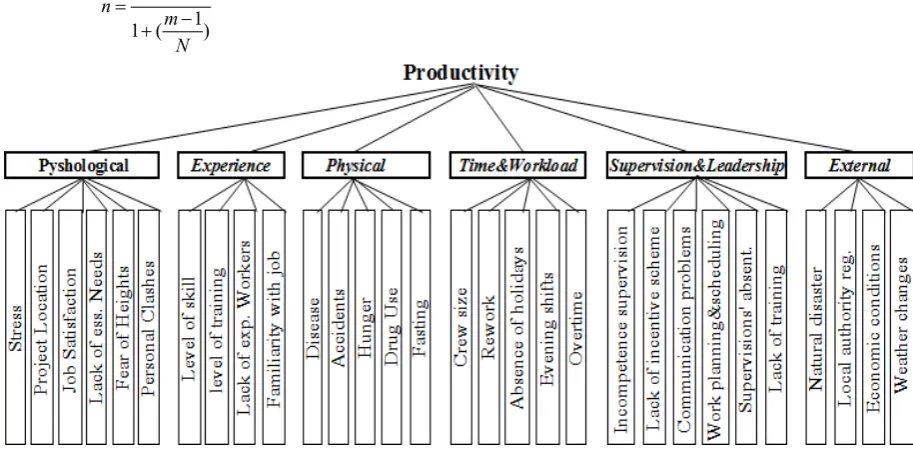
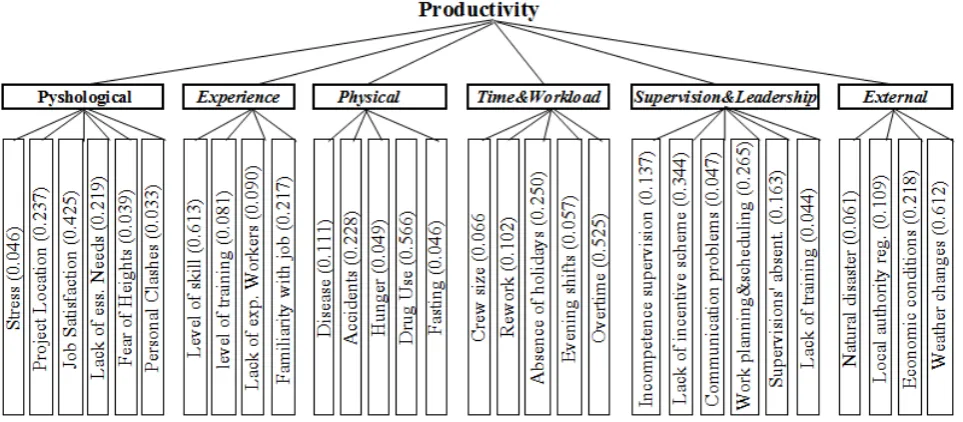
[image:3.595.77.534.520.748.2]A hierarchical model for factors affecting labour productivity was developed consisting of three levels: the goal, the critical factors and sub-factors. This model was used as a basis for designing the questionnaire survey where relative importance of each factor in the hierarchy is determined (Figure 2). Experts have been asked to make pair-wise comparisons between two factors at a time, decide which factor is more important to labour productivity, and then specify the degree of importance on a scale between 1 (equal importance) and 9 (absolutely more important) to the more important factor. A total of 56 questionnaires were completed by contractors and engineers, representing a response rate 93.3 percent. The main characteristics of the populations being sampled were experts’ contractors with more than 14 years of experience in the GS construction industry having a direct and daily interaction with labour; as 50% of participants held a site engineer position. Therefore, the responses considered to be a good representation of the target survey population.
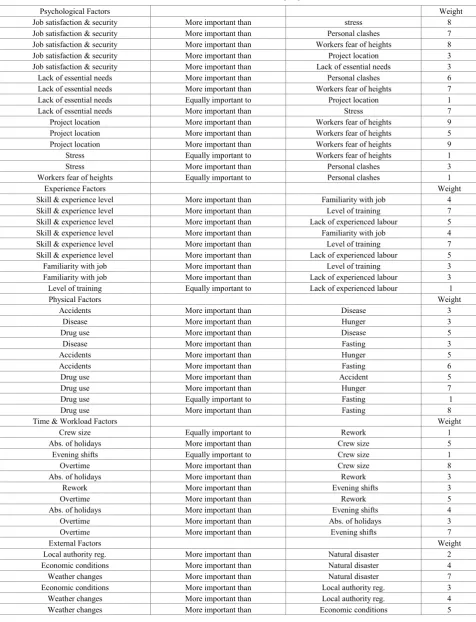
The geometric mean approach was then used to combine the individual judgments to resolve the lack of consensus on values. The geometric means of the judgments obtained for each group of factors are presented as the weight in Tables (2).
Table 2. The Geometric means of different groups of factors
Psychological Factors Weight
Job satisfaction & security More important than stress 8 Job satisfaction & security More important than Personal clashes 7 Job satisfaction & security More important than Workers fear of heights 8 Job satisfaction & security More important than Project location 3 Job satisfaction & security More important than Lack of essential needs 3 Lack of essential needs More important than Personal clashes 6 Lack of essential needs More important than Workers fear of heights 7 Lack of essential needs Equally important to Project location 1 Lack of essential needs More important than Stress 7 Project location More important than Workers fear of heights 9 Project location More important than Workers fear of heights 5 Project location More important than Workers fear of heights 9 Stress Equally important to Workers fear of heights 1 Stress More important than Personal clashes 3 Workers fear of heights Equally important to Personal clashes 1
Experience Factors Weight
Skill & experience level More important than Familiarity with job 4 Skill & experience level More important than Level of training 7 Skill & experience level More important than Lack of experienced labour 5 Skill & experience level More important than Familiarity with job 4 Skill & experience level More important than Level of training 7 Skill & experience level More important than Lack of experienced labour 5 Familiarity with job More important than Level of training 3 Familiarity with job More important than Lack of experienced labour 3 Level of training Equally important to Lack of experienced labour 1
Physical Factors Weight
Accidents More important than Disease 3 Disease More important than Hunger 3 Drug use More important than Disease 5 Disease More important than Fasting 3 Accidents More important than Hunger 5 Accidents More important than Fasting 6 Drug use More important than Accident 5 Drug use More important than Hunger 7 Drug use Equally important to Fasting 1 Drug use More important than Fasting 8
Time & Workload Factors Weight
Crew size Equally important to Rework 1 Abs. of holidays More important than Crew size 5 Evening shifts Equally important to Crew size 1 Overtime More important than Crew size 8 Abs. of holidays More important than Rework 3 Rework More important than Evening shifts 3 Overtime More important than Rework 5 Abs. of holidays More important than Evening shifts 4 Overtime More important than Abs. of holidays 3 Overtime More important than Evening shifts 7
External Factors Weight
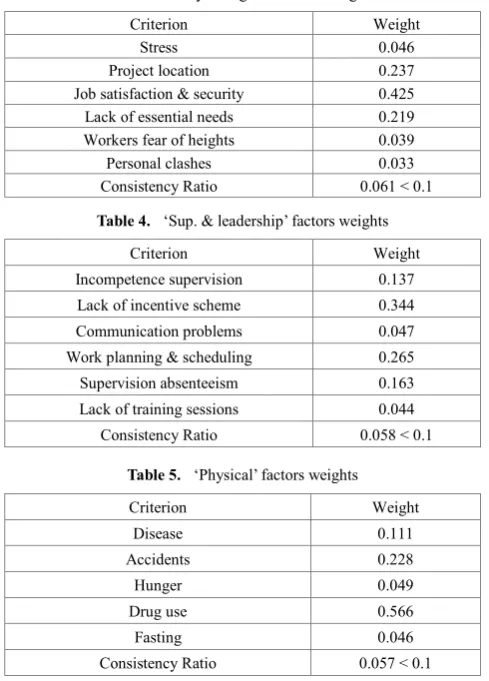
After determining weights, the analysis was carried out with the application of the AHP using the ‘Criterium Decision Plus’ support software. The importance of each factor with respect to classified group was first developed (Tables 3-8). Then, an overall assessment was carried out. The consistency of responses is considered satisfactory; as the value of Consistency Ratio (CR) is less than 0.1 across different groups of factors.
Table 3. ‘Psychological’ factors weights Criterion Weight
Stress 0.046 Project location 0.237 Job satisfaction & security 0.425 Lack of essential needs 0.219 Workers fear of heights 0.039 Personal clashes 0.033 Consistency Ratio 0.061 < 0.1
Table 4. ‘Sup. & leadership’ factors weights Criterion Weight Incompetence supervision 0.137 Lack of incentive scheme 0.344 Communication problems 0.047 Work planning & scheduling 0.265 Supervision absenteeism 0.163 Lack of training sessions 0.044
Consistency Ratio 0.058 < 0.1
Table 5. ‘Physical’ factors weights Criterion Weight
Disease 0.111 Accidents 0.228 Hunger 0.049 Drug use 0.566 Fasting 0.046 Consistency Ratio 0.057 < 0.1
Table 6. ‘Time & Workload’ factors weights
Criterion Weight Crew size 0.066
Rework 0.102 Absence of holidays 0.250 Evening shifts 0.057 Overtime 0.525 Consistency Ratio 0.037 < 0.1
Table 7. ‘Experience’ factors weights
Criterion Weight Skill and experience 0.613
Level of training 0.081 Lack of experienced labour 0.090 Familiarity with job 0.217
Consistency Ratio 0.027 < 0.1
Table 8. ‘External’ factors weights Criterion Weight Natural disaster 0.061 Local authority regulations 0.109 Weather changes 0.612 Economic conditions 0.218
Consistency Ratio 0.072 < 0.1
‘Skill & experience’ and ‘familiarity with job’ are considered the most significant factors affecting labour productivity among the experience group (Table 7). Both factors were documented in literature [10 and 6] as constraints in attaining a full performance potential. This result reflects the skilled labour gap in the GS construction industry despite relatively high levels of unemployment. Also, based on the results of the external factor group (Table 8), weather changes obtained the highest weight, followed by economic conditions. Performing work in hot or cold weather can impact labour visibility, safety as well as comfort leading to productivity loss. With GS located on the Mediterranean Sea, the weather can be classified as hot and humid in the summer, meanwhile, rainy during the winter. In addition, economic conditions governed by unstable political situation, national inflation rates and construction employment can be classified as a main driver to productivity loss in GS construction industry.
Finally, an overall assessment for the main groups with respect to productivity was then carried out to establish the AHP model (Fig. 2). It can be seen that physical and experience groups have the most significant role in labour
[image:6.595.67.549.360.571.2]productivity (Table 9).
Table 9. ‘Productivity’ groups weights
Criterion Weight ‘Psychological’ factors 0.087
‘Experience’ factors 0.261 ‘Physical’ factors 0.304 ‘Time & workload factors 0.174 ‘Supervision & leadership factors 0.130 ‘External’ factors 0.043
The model shown in Figure (2) pinpointed thirty factors related to construction labour productivity and mapped out their relationships in an AHP hierarchy. Deriving the priorities of these factors in the form of pair-wise comparisons yields reliable results, where the reliability of the pair-wise subjective judgments was verified using the consistency check. This model can be used as a reference for determination of areas to increase the value of construction productivity, by better planning and eliminating the impact on labour productivity.
6. Conclusions
This study aimed at identifying factors influencing labour productivity in the Gaza Strip construction industry. Furthermore, it aimed at establishing the foundation of further study of labour productivity improvement by establishing a baseline model. In formulating this model, thirty factors closely associated with labour productivity were considered using the Analytical Hierarchy Process.
The Analytical Hierarchy Process has proven to be useful in quantitatively analyzing the interrelation between various factors. Results from different sub-groups demonstrated that Job satisfaction& security, lack of incentive scheme, skill& experience, drug use, overtime and weather changes have a significant impact on labour productivity. Meanwhile, with regard to main groups, physical factors group contributed the most to the onsite labour productivity.
This work provide a clear indication of the effectiveness of the established AHP model to offer construction companies in Gaza Strip an insight to critical areas for labour productivity improvement, thereby saving time and money. In addition, the AHP model is easy to apply and it also offers the flexibility to add more factors and continually refine the group’s preferences among concerned criteria and sub-criteria.
REFERENCES
[1] Mahamid, I (2013) Principal factors impacting labour productivity of public construction projects in Palestine: contractors' perspective. “International Journal of Architecture, Engineering and Construction”, 2(3), 194-202. [2] PCBS (the Palestinian central Bureau of statistics) (2013)
“Percentage Distribution of Employed Person in the Palestinian Territory by Sector and Region”, (2007-2013). [3] Enshassi, A, Kochendoerfer, B and Abed, K (2013) Trends in
productivity improvement in construction projects in Palestine. “Revista ingeniería de construcción”, 28(2), 173-206.
[4] Yi, W. and Chan, A. ( 2014). Critical review of labour productivity research in construction journals. “Journal of Management in Engineering”, 30(2), 214-225.
[5] Karimi, S and Gidado, K (2012) Factors influencing construction productivity in Afghanistan. “EPPM 2012, Brighton, UK, 10-11 September 2012.
[6] Durdyev, S, Ismail, S and Abu Baker, N (2012) Factors constraining labour productivity: case study of Turkmenistan. “International Proceedings of Economics Development and Research”, 55(1), 1-5.
[7] Ng, S, Skitmore, R, Lam, K and Poon, A (2004) Demotivation factor influencing the productivity of civil engineering projects. “International Journal of Project Management”,22(2), 139-146.
[8] Enshassi, A, Sherif, M, Abu Mustafa, Z and Mayer, P (2007) Factors affecting labour productivity in building projects in
the Gaza Strip. “Journal of Civil Engineering and Management”, XIII(4), 245-254.
[9] Soekiman, A, Pribadi, K, Soemardi, B and Wirahadikusumah, R (2011) Factors relating to labor productivity affecting the project schedule performance in Indonesia. “Journal of Civil Engineering and Management”,14, 865-873.
[10] Alinaitwe, H, Mwakali, J and Hasson, B (2007) Factors affecting the productivity of building craftsmen-studies of Uganda. “Journal of Civil Engineering and Management”, 13(3), 169-176.
[11] Thomas, A and Sudhakumar, T (2013) Labour productivity variability among labour force-a case study. “The International Journal of Engineering and Science”. 2(5), 57-65.
[12] Moselhi, O, Khan, Z (2010) Analysis of labour productivity of formwork operations in building construction. “Construction Innovation”, 10(3), 286-303.
[13] Fayek, A R and Tsehayae, A A (2012) Modeling construction labour productivity using fuzzy logic and exploring the use of fuzzy hybrid techniques. “Annual Meeting of the North American”, 6-8 August 2012, Berkeley, CA. Institute of Electrical and Electronics Engineers.
[14] Saaty, T (1980) “The Analytic Hierarchy Process”. New York: McGraw-Hill.
[15] Lee, D, McCool, J and Napieralski, L (2000) Assessing adult learning preferences using the analytic hierarchy process. “Journal of Lifelong Education”, 19(6), 548-560.
[16] Cheung, S and Wan, Y (2001) An analytical hierarchy process based procurement selection method. “Journal of Construction Management and Economics”, 19(4), 427-437. [17] Khalil, M (2002) Selecting the appropriate project delivery
method using AHP. “International Journal of Project Management”, 20(6), 469-474.
[18] Abdi, M and Labib, A (2003) A design strategy for reconfigurable manufacturing systems (RMSs) using analytical hierarchical process (AHP): a case study. “International Journal of Production Research”, 41(10), 2273-2299.
[19] Marinon, O and Hoppe, A (2006) Using the analytical hierarchy process to support sustainable use of geo-resources in Metropolitan areas. “Journal of Systems Engineering Society of China”, 15(2), 154-164.
[20] Seyhan, S and Mehpare, T (2010) The analytic hierarchy process and analytic network process: an overview of applications. “Management Decision”, 48(5), 775-808. [21] Moazami, D, Muniandy, R, Hamid, H and Yusoff, Z (2011)
The use of analytical hierarchy process in priority rating of pavement maintenance. “Scientific Research and Essays”, 6(12), 2447-2456.
[22] Alam, M, Jebran, J and Hossain, M (2012) Analytical hierarchy process (AHP) approach on consumers’ preferences for selecting telecom operators in Bangladesh. “Information and Knowledge Management”, 2(4), 7-17.
[24] Hogg, R V and Tannis, E A (1997) “Probability and statistics inferences”. Prentice Hall.
[25] Kazaz, A.; Manisali, E.; Ulubeyli, S. 2008. Effect of basic motivational factors on construction workforce productivity in Turkey, Journal of Civil Engineering and Management 14(2): 95-106.
[26] Ailabouni, N, Painting, N and Ashton, P (2009). Factors affecting employee productivity in the UAE construction industry. Proceedings 25th Annual ARCOM Conference, 7-9 September 2009, Nottingham, UK. Association of Researchers in Construction Management, Vol. 1, 555–64. [27] Hinze J. W., 1999. Construction planning and scheduling.