Georgia State University
ScholarWorks @ Georgia State University
Public Health Theses School of Public Health
Summer 8-11-2015
A Comparison of Health Information Seeking
Behaviors and Attitudes of Immigrant US
Residents and Native Born US Residents: Adults
with Personal or Familial Experience with Cancer.
Melany Chambers
Follow this and additional works at:https://scholarworks.gsu.edu/iph_theses
This Thesis is brought to you for free and open access by the School of Public Health at ScholarWorks @ Georgia State University. It has been accepted for inclusion in Public Health Theses by an authorized administrator of ScholarWorks @ Georgia State University. For more information, please contact
Recommended Citation
Chambers, Melany, "A Comparison of Health Information Seeking Behaviors and Attitudes of Immigrant US Residents and Native Born US Residents: Adults with Personal or Familial Experience with Cancer.." Thesis, Georgia State University, 2015.
Page 1 of 52 Abstract
Background: There is insufficient research about the health information seeking, access, and usage among immigrants to the United States, who, face health disparities associated with their immigrant status. Health-information seeking behaviors and attitudes, unique to immigrants, need to be considered as one set of factors contributing to health disparities.
Objective: This thesis focused on identifying differences in information seeking behaviors and attitudes between natal and immigrant US residents and the subset who had either themselves had been diagnosed with cancer or who had a family member diagnosed with cancer.
Methods/Analyses: Nationally representative Health Information National Trends Survey (HINTS) data (HINTS4Cycle 3), collected from a sample of respondents (N=3185) by mail between September and December 2013, was used for these analyses. Sample weights were applied during SAS data analysis to account for the complex survey design. Analyses assessed the frequencies of health information seeking behaviors and attitudes of natal versus
immigrant US residents.
Results: Both natal and immigrant US residents indicated that the Internet was the most popular choice for seeking health or medical information (69.9% and 69.8%, respectively), with the next highest being doctor, healthcare provider, or cancer organization combined (14.3% and 17.1%, respectively). These differences in use of information sources were not significant. Both natal and immigrant US residents “strongly agreed” or “agreed” that they were frustrated (68.1% and 65.8%, respectively) and were concerned about the quality of the information (52.9% and 54.8%, respectively) during the last time they searched for health information. Again, these differences in attitudes toward information were not significant.
On the other hand, compared to natal US residents, immigrant US residents were more likely to state that their most recent search took a lot of effort (35.2% and 46.1%, respectively, p=.01). There were also moderate and significant differences between natal and immigrant
respondents’ trust toward information from government health agencies (69.3% and 81.3%, respectively, p<.01), charities (45.6% & 53.1%, respectively, p=0.01), and religious organizations (30.9% & 44.1%, respectively, p<.01). Compared to natal US residents, higher percentages of immigrant US residents trusted health or medical information from national television (60.6% and 43.2%, p<.01), local television (48.8% and 39.0%, p=.02), and radio (39.1% and 24.8%, <.01).
Page 2 of 52
same for both groups “doctor (66.4% and 52.2%, p=0.8),” “government health agency (37.9 and 29.5, p=0.4),” and “medical magazines and newsletters (27.0% and 22.3%, p= 0.6). Although stated as the second most common choice for both groups, healthcare provider or cancer organization was approximately three times as common among those who spoke less English (32.9% and 12.1%, p<.01) compared to those who were more fluent in speaking English.
Page 3 of 52 TABLE OF CONTENTS
Abstract ... 1
LIST OF TABLES ... 5
1 INTRODUCTION... 6
1.1 Background ... 6
1.2. This study ... 8
2. LITERATURE REVIEW ... 12
2.1 Immigrant US population ... 12
2.2 Acculturation and immigrant health ... 13
2.3 Health Information seeking behaviors (HISB) ... 15
2.4 The Internet – benefits and barriers to use... 16
2.5 Digital Divide, health, and Internet use... 20
2.6 Implications for policy and practice ... 22
3. METHODOLOGY ... 23
3.1 Sampling ... 23
3.2 Data description and measures ... 24
3.3 Data analyses ... 25
4. RESULTS ... 27
4.1 Sample characteristics ... 27
Page 4 of 52
4.2.1 Where seek information ... 29
4.2.2 Information search challenges ... 31
4.2.3 Trust of health and medical information sources... 33
5. DISCUSSION ... 38
5.1 How findings are consistent with literature ... 40
5.2 Implications for policy and practice ... 43
Page 5 of 52
LIST OF TABLES
Table 4.1 Weighted estimates and sample frequencies for socio-demographic
characteristics and nativity ... 27
Table 4.2 Where respondents looked initially during most recent search for health or
medical information ... 29
Table 4.3 Where looked for health or medical information by English fluence ... 30
Table 4.4 Challenges in seeking health and medical information during most recent search…… 31
Table 4.5 Challenges in seeking health information during most recent search by English
fluency……….33
Table 4.6 Trust of health and medical information sources ………34
Page 6 of 52
1
INTRODUCTION
1.1 Background
Chronic diseases, now a leading health concern in the United States, affect people of all
ages, and are more prevalent and costly than any other health issue (Centers for Disease
Control and Prevention [CDC], 2009). Evidence suggests that a comprehensive approach is
needed to address chronic diseases in the US (CDC, 2009). This type of approach is
recommended in the World Health Organization’s Integrated Chronic Disease Prevention and
Control Program (ICP) and in the public health approach of the CDC. These programs include,
among others, strategies to raise community awareness, implement community-based
programs, and encourage the dissemination of knowledge, experiences, and best practices
(WHO, 2015; CDC, 2013).
A key tenet of the Principles of the Ethical Practice of Public Health states, “Public health
should advocate and work for the empowerment of disenfranchised community members,
aiming to ensure that the basic resources and conditions necessary for health are accessible to
all” (Public Health Leadership Society, 2002, p. 4). Public health practitioners should consider its
tacit work to identify specific disenfranchised groups, and seek to understand and address, at
the most fundamental level, the factors that contribute to disparities. To understand some
aspects of disenfranchisement, some practitioners have focused on health information-seeking
behavior (HISB)—how individuals acquire health-related information (Lambert & Loiselle,
2007). HISB has been important in studying coping mechanisms, health decision making,
Page 7 of 52
goal of understanding HISB is to optimize the design and effectiveness of health intervention
programs.
Information sources (channels) used by individuals is one domain highlighted within the
HISB literature. Over time, an increasing number of people have been seeking health
information by way of the Internet (Cline & Haynes, 2001). The Internet provides the benefits of
convenience, anonymity, and interactivity, and is generally accepted as a source offering access
to, and a medium for sharing, a wide variety of health-related information. Furthermore, prior
research has shown a positive correlation between the use of the Internet for health
information and change in health-related behaviors of chronically ill persons (e.g. Ayers &
Kronenfeld, 2007). Also, compared to younger adults, there is higher than expected use of the
Internet among older adult; this level of Internet usage is attributed to the need for
information, due to the prevalence of chronic disease among older adults (Roblin, Houston,
Allison, Joski, & Becker, 2009).
This increasing importance of the Internet in health information seeking is a topic that
should be of great significance to public health practitioners dealing with chronic disease.
Understanding the details of who uses the Internet, under what conditions, why, and how this
and other information sources are used, provides insight that can inform the design of
interventions and health promotion programs. Despite the increased use of the Internet,
however, some population groups, because of their demographic makeup, remain
disadvantaged in terms of access to, and usage of, information and communication
technologies (Lorence, Park, & Fox, 2006). This phenomenon—the Digital Divide—affects
Page 8 of 52
the Digital Divide include people within the lower socio-economic strata, unemployed, women,
the elderly, ethnic minorities, persons with limited formal education, and immigrants
(Changrani & Gany, 2005; Kreps, 2005; Watt, Henwood, Hart, & Smith, 2005). This inequity is
addressed in the health communication and health information technology goal of Healthy
People 2020 as: to “use health communication strategies and health information technologies
(IT) to improve population health outcomes and health care quality, and to achieve health
equity” (US Department of Health and Human Services, 2015). Some objectives that have been
set toward achieving this goal include (a) “increasing internet and mobile access,” (b) “providing
new opportunities to connect with culturally diverse and hard to reach populations,” and (c)
“delivering accurate, accessible, and actionable health information that is targeted or tailored”
(US Department of Health and Human Services, 2015).
1.2. This study
In general, there is insufficient evidence about health information access and usage
within disenfranchised groups (Kreps, 2005). These groups are usually characterized by low
income, less education, and being a member of ethnic minorities (Kreps, 2005). This thesis
focuses on one group affected by disparities associated with the Digital Divide—immigrant US
residents. In 2013, immigrants constituted 13% of the total US population, up from 6% in 1980.
(Migration Policy Institute [MPI] / U. S. Census Bureau, 2012, 2011, 2010 / American
Community Survey [ACS] 1970, 1990, 2000 Decennial Census Data). This increase underscores
the importance of focusing on immigrants to help address relevant health disparities. Although
their health tends to be better than that of their US counterparts when they immigrate here,
Page 9 of 52
in the US increases (Fennelly, 2006). Further, their health declines to the point of being poorer
than those with whom they compared favorably when they first arrived in the US. This is, in
part, because they seem to be more likely to develop chronic diseases such as cancer (Kreps &
Sparks, 2008). One way to help reduce this disparity is to provide access to culturally relevant
health-related information via the Internet for immigrant US residents. However, there is also a
Digital Divide—a scarcity of culturally relevant content on the Internet (Changrani & Gany,
2005). This Digital Divide can be addressed by ascertaining which groups are using the Internet
(compared to other sources of health-information), the usage patterns, and possible barriers to
Internet use. A better understanding of the Digital Divide between immigrants and native-born
residents can provide valuable information that can allow public health practitioners to produce
health information that is meaningful to immigrant sub-groups.
A search for work in this area was conducted via Medline, Pubmed, and PsycInfo using
the search words “health information seeking” AND “immigrants” AND “Internet.” This search
yielded five studies, three of which were specific to Hispanic/Latino immigrants. This study is
designed to fill the gap of a lack of research on health information seeking behaviors of
immigrants in the United States. Data for this thesis was obtained from the Health Information
National Trends Survey (HINTS), a nationally representative data set about the use of
cancer-related information in the US. The survey provides data to compare immigrants (immigrant US
residents) and US born residents in terms of cancer diagnosis and use of the Internet and other
sources of health-related information. Given the growth in the immigrant population in the US,
the higher likelihood that, compared to natal residents, immigrant residents live with chronic
Page 10 of 52
of health-related information, it is crucial for public health practitioners to garner information
that helps in understanding the HISB of immigrants.
In this thesis, I review the literature on: (a) Immigrant US population; (b) Acculturation
and immigrant health; (c) Health information seeking behaviors (HISB); (d) Internet – benefits
and barriers to use; (e) Digital Divide, health, and Internet use; (f) Implications for policy and
practice. Following the literature review, is a description of the methodology, including the
design of the HINTS from which data were drawn for this study, and the data analyses used to
facilitate comparisons, between natal and immigrant US residents and, with other relevant
studies within extant literature. The results and discussion are then presented.
Information from a comparison of health information behaviors and attitudes between
immigrant and natal US residents can be used for improving health policy and practice
management. One use is to inform channel decisions to maximize ”reach”. Reach is a marketing
term used to quantify the number of people exposed to the messages sent by the marketer
(Assael, 2004). Reach, therefore, ultimately affects the dissemination of health information.
Another use is to promote access to, and understanding of health-related information from,
and about, immigrants. Having a better understanding of how the Internet and other sources
are used, and the experiences and challenges immigrants face in relation to health information
seeking can help in the design and placement of more relevant health messages. These two
factors have obvious implications for (a) the effectiveness and efficiency of health programs
designed to address chronic illness, (b) costs associated with healthcare delivery, (c) morbidity,
Page 11 of 52
effects on the communities in which immigrants reside, and, to a lesser extent, the general
Page 12 of 52
2.
LITERATURE REVIEW
2.1 Immigrant US population
There has been consistent growth in the number of immigrant residents within the US in
the last three decades. In 1980, there were approximately 14 million immigrants resident in the
US, but by 2013, there were approximately 40 million (MPI / U. S. Census Bureau, 2012, 2011,
2010/ ACS 1970, 1990, 2000 Decennial Census Data). One immigrant (net) is added to the US
population every 33 seconds (US Census Bureau, 2015). Projections indicate that the number of
immigrant residents will increase by 26% within the next decade (by 2025), and more than 67%
[image:13.612.107.522.345.563.2]by 2050 (US Census Bureau, 2014).
Figure 2-1 Projections of Foreign-Born Population for the United States: 2015 to 2060; Source: US Census Bureau, Population Division, 2014.
The current immigrant segment of the population is significant, not only in terms of size,
but it also compares unfavorably with natal US residents on characteristics that are important
to public health. In 2010, members of the immigrant group were less likely to have health
Page 13 of 52
in poverty, to have given birth in the previous 12 months, and to live in larger multigenerational
households with more children under 18 (Grieco et al., 2012). Many of these characteristics are
directly or indirectly attributable to acculturation.
2.2 Acculturation and immigrant health
Acculturation is the process by which cultural behaviors change because of consistent
interaction between groups of people from different cultures; this is usually found in
minority/ethnic groups, which adopt beliefs, language, and behaviors of the host group
(Redfield, Linton, & Herskovits, 1936; Satia-Abouta, Patterson, Neuhouser, & Elder, 2002).
Understanding acculturation is important because it provides explanations of how and why the
health of immigrant US residents tends to deteriorate over time, despite evidence that when
they arrive in the host country they tend to be in better health than their natal US counterparts
in that country. This phenomenon—the healthy migrant phenomenon—refers to the finding
that the individuals who immigrate are usually those that are in good health (Fennelly, 2006).
They are usually found to fare initially better than their US-born counterparts on measures of
chronic health, mortality, and health risk factors (Fennelly, 2006). Afterwards, however, factors
intervene to create a gap between immigrant and natal residents.
A number of factors may help to explain a decline in immigrants’ health. These include
higher educational attainment (they are likely to be among the more highly educated in their
country of origin), employment outside the home, language fluency, disparities in access to
health care, and health-risks associated with poverty (Fennelly, 2006; Satia-Abouta et al., 2002).
High education, employment outside the home, and language fluency result in greater
Page 14 of 52
fluency also enables immigrants to interact with other residents and thus to be assimilated into
the culture and environment more easily than others who may have a language barrier.
Immigrants gain increased exposure to the host culture via friends, acquaintances, and the
media. Invariably, immigrants work outside the home, thus gaining additional exposure to the
local culture via interaction with natal and other US residents. Working outside the home also
reduces the amount of time for preparing food at home and maintaining an active lifestyle.
Access to fast foods and other convenient food alternatives contribute to increased health risks.
Greater acculturation has been associated with chronic illness in the US. For example, in
their systematic review of acculturation literature, Delevari, Sonderlund, Swinburn, Mellor, and
Renzaho (2013) found that greater acculturation was often associated with higher than lower
body mass index (BMI). Specifically, the association with prevalence of obesity starts after 10
years of living in the US, and begins to approach the levels of natal residents (Goel, McCarthy,
Phillips, & Wee, 2004) This was attributed to diminished “Healthy Immigrant Effect” caused by
unhealthy nutritional changes resulting from being exposed more and more to promotions in
the host country (Delevari et al., 2013). Higher BMI is of importance because obesity has been
found to be associated with increased risk of various chronic diseases and cancers, such as
esophageal, pancreatic, colorectal, breast, kidney, thyroid, and gallbladder (National Cancer
Institute [NCI], 2012).
Duration of stay in the US also affects the prevalence of cancers in general among
immigrants. Studies that utilized data from Surveillance, Epidemiology, and End Results (SEER),
and cancer registries from the US and other countries between 1975 and 2003 have been
Page 15 of 52
incidence patterns of cancer among first generation immigrants were very similar to those of
their country of origin but for subsequent generations these patterns were similar to those in
the host country. This was particularly so for cancers related to hormones and diet, such as
breast and colorectal malignancies (SEER, 2003). There is also an association between BMI and
cancer (National Cancer Institute (NCI), 2012). Other factors, such as perceived medical
discrimination, have also been associated with screening behaviors, which, in turn are
associated with cancer incidence and mortality rates (Crawley, Ahn, & Ainkleby, 2008).
These adverse health-related associations with acculturation and immigrant status
underscore the importance of understanding health information seeking behaviors and
attitudes of immigrant US residents. Doing so can help strategize channel decisions for
dissemination and retrieval of health-related information thus, potentially ameliorating the
acculturation-related natural progression toward poorer health status.
2.3 Health Information seeking behaviors (HISB)
Health information seeking behavior can be classified according to why seekers are
motivated to find health information. These reasons include interest in behavior change and
prevention, medical decision making involvement, and coping (Lambert & Loiselle, 2007). The
study of health information seeking has been applied mostly to the concept of coping with
illness but is applied to many other areas of health (Lambert & Louiselle, 2007).
The Internet is often used for seeking health information, and may be used to improve
health-related decision-making (Warren, Kvansey, Hecht, Ahluwalia, & Okuyemi, 2010).
Health-related information accessed through the Internet can also bridge language and financial
Page 16 of 52
Yoon, 2011). For example, the internet can provide (a) information in the natal language of
immigrants, (b) translation help, and (c) recommendations for finding health service providers
who speak the desired language (Kim & Yoon, 2012). Pursuing knowledge about health
information seeking behaviors, including the sources of choice, enhance one’s understanding of
these behaviors (Lambert & Loiselle, 2007).
2.4 The Internet – benefits and barriers to use
Television and other media sources play important roles in the dissemination of health
information but the Internet offers an alternative to these other sources (Cotten & Gupta,
2004). Advent of the Internet and subsequent advances in technology have significantly
impacted the way the average person communicates. Health information can be accessed
online via websites, email, listservs, instant messaging (IM), online support groups, and chat
rooms (Cotton & Gupta, 2004). Focusing on the Internet as a channel of communication is
important to public health professionals because of the implications associated with the
multiplicity of users and usages (Cline & Haynes, 2001). A 2013 Pew study indicated that 59% of
US adults had looked online for information in the past year (Pew Research Center, 2015).
Internet Advantages. There are many advantages to communicating through Internet
connectivity, now commonly referred to as computer-mediated communication (CMC). Many
of these advantages differentiate the Internet from other sources, such as television, radio, and
newspapers (Cotton & Gupta, 2004). Some of the advantages provided by this mode of
communication include anonymity (not having to disclose one’s identity when seeking sensitive
health related information), convenience (being able to access information at any time and
Page 17 of 52
synchronous and asynchronous communication, and physical space from the other party, when
desired. In addition to these advantages, communication can also be tailored to the cultural
preferences of a user by adapting text, sound, color, movement, diagrams, etc. (Pearson, 2010).
Some of these and other advantageous CMC features, such as interactivity and aiding
widespread access to information, form the bases for recommendations for public health
practitioners to use the Internet. The Internet can be used to provide information to members
of the public, to access information from the public, and for administering interventions. The
interactivity feature of the Internet enhances the potential for tailoring messages (Cline &
Haynes, 2001). Furthermore, because the Internet can be used for interpersonal interaction it
can be helpful in encouraging behavior change (Cline & Haynes, 2001). Seeking information
from Internet users and then using that information for programming customized audiovisual
responses is a means of replicating interpersonal communication, thus facilitating persuasion
through these customized messages (Cassell, Jackson, & Cheuvront, 1998).
Many of the attributes of Internet-facilitated communication are advantageous for
managing health-related interventions. Some reasons that have been noted for use of the
Internet in intervention delivery include convenience for users, cost, timeliness in disseminating
information, stigma reduction (attributable to the anonymity feature), better control of
interventions, providing access to hard-to-reach groups, and immediacy of feedback (Cassell et
al., 1998; Griffith et al., 2006). Convenience-related benefits include effort-reduction on the
part of users and reduction of transportation-related time and costs (Griffith, 2006). Groups
may be hard-to-reach, not just because of geographic reasons, but also because of other
Page 18 of 52
lack of access to child care, which can make it difficult for caregivers or mothers to attend
in-person intervention sessions (Griffiths, Lindenmeyer, Powell, Lowe, & Thorogood, 2006).
The Internet is a viable option for preserving anonymity and is a quick source of
information when time is of the essence (Griffith et al., 2006). The anonymity that accompanies
Internet usage enables stigmatized individuals to search for information without having
face-to-face contact with others by whom they feel they may be judged (Cline & Haynes, 2001),
provides confidentiality, and permits users to ask sensitive questions without fear of scrutiny
(Cotton & Gupta, 2004). These advantages position the Internet as an attractive health
information channel for both the general public—seeking support and health information—and
for health professionals—gathering information (e.g. from postings) and intervention delivery.
Barriers to Internet use. The Internet is important in providing information and
encouragement to help individuals take an active role in their own health care. For this reason,
it is important that public health practitioners be aware of, not just the advantages of Internet
use, but also the barriers that may preclude access to helpful health-related resources. These
barriers should be taken into consideration when making decisions regarding the design of
health message (Clayman, Manganello, Viswanath, Hesse, & Arora, 2010). Despite the
advantages associated with privacy, confidentiality, and other features of the Internet, some of
these characteristics also present concerns for online health information seekers, in general
(Bernhardt, Lariscy, Parrott, Silk, & Felter, 2002). Barriers to accessing health information via
the Internet can be attributed to factors that limit access to the Internet or factors that limit the
usability of Internet-information. Factors that limit access include socio-economic status and
Page 19 of 52
minorities, compared to other members of population (Warren at al., 2010). As noted above,
compared to the general population, members of minority populations (such as immigrants)
are disproportionately affected by factors that lead to poorer health status.
On the other hand, usability is affected by factors such as culture and language fluency
(Cline, 2001; Peña-Purcell, 2008). Culture and language issues can lead to other barriers related
to previous experience of the source, the relevance of the information, and credibility of the
source (Calnan & Williams, 1996; Schneider & Laurion, 1993; Gore & Madhavan, 1993, as per
Gray, Klein, Noyce, Sesselberg, & Cantrill, 2005). Culture affects the interpretation and use of
information (Peña-Purcell, 2008). Previous studies have also indicated that there is a high level
of uncertainty relative to the trustworthiness of health information accessed via the Internet
(Bernhardt et al., 2002). As an example, assessments regarding privacy and confidentiality can
pose barriers to Internet use when users become concerned that their information may not be
secure from hackers or the government (Bernhardt et al, 2002). Even for those who do have
access to the Internet, there are disparities related to its use by minority populations (Warren,
Kvasny, Burgess, Ahluwalia, & Okuyemi, 2010). For example, culture and socioeconomic status
can affect can affect the usefulness of available health information.
Whereas culture can affect attitude toward health information, language fluency affects
the ability to read, comprehend, and appropriately use available health information (Cline,
2001). Also, there is an association between socioeconomic status (e.g. education, income) and
eHealth literacy—understanding how and where to seek, evaluate, and utilize health
Page 20 of 52
ultimately, this association limits the use of Internet resources by low eHealth individuals
(Neter & Brainin, 2012).
2.5 Digital Divide, health, and Internet use
The Digital Divide—gap in access to digital information due to demographic
characteristics or socioeconomic circumstances—is well documented (e.g. Hsu, 2005; Lorence,
Park, & Fox, 2006; Wyatt, 2005). The phenomenon persists, despite programs (e.g. the Racial
and Ethnic Approaches to Community Health 2010—REACH 2010; The Universal Program) to
address the disparities associated with lack of access to digital information (Lorence, Park, &
Fox, 2006). The Race and Recession Survey, conducted through the Washington
Post/Kaiser/Harvard University Survey Project partnership found that, compared to persons
who earned $40,000 or more annually, fewer persons (74% versus 97%) who earned less than
$40,000 per year had a computer at home. The same study found that 86% of those who
earned at least $40,000 per year and 56% who earned less per year had high-speed Internet
connection. Furthermore, 73% of those in the higher income bracket, compared to 45% of
those in the lower income bracket (earning less than $40,000/annum) said they ever used the
Internet to access health information (Henry J. Kaiser Family Foundation, 2011).
Demographic characteristics and socioeconomic circumstances of persons adversely
affected by the Digital Divide are similar to those of persons adversely affected by other factors
associated with health disparities (Kreps, 2005). These characteristics, which include low
income, less education, and being a member of ethnic minorities preclude segments of the
population from access to, and use of, online health information (Kreps, 2005). This preclusion
Page 21 of 52
Members of low income, less education, and minority segments of the population are
often vulnerable to, among other illnesses, higher rates of cancer incidence and poorer survival
rates, due to lack of information and late diagnosis (Haynes & Smedley, 1999). Compared to
natal US residents, immigrants globally (and specifically in the US), are more at risk for
cancer-related morbidities and mortality (Kreps & Sparks, 2008). In general, immigrants are among the
least financially secure and least educated within the population of the United States (Kreps,
2008).
The different age distributions of immigrant and natal US residents have implications for
differing rates and types of Internet use. In general, younger adults, compared to older adults,
are more likely to use the Internet. Since immigrant populations tend to be younger, this could
serve to reduce the current divide. In this regard, there seems to be a diminishing Divide
between social media natal and immigrant US residents (Pew Research Center, 2015).
Immigrant US residents’ level of trust also affects the Digital Divide. Hispanics, the fastest
growing minority segment in the US, serves as an example here. This segment represents more
than half of the growth in the US population since 2000 (Pew Research Center, 2008). Hispanics
indicate fear regarding the quality of health information that is available on the Internet (Pew
Research Center, 2008).
In summary, immigrants tend to be younger and therefore more tech savvy, thus
conceptually contributing to a reduction in the Digital Divide between immigrant and natal
residents. However, research indicates that other factors associated with immigrant
populations in general, such as lower, socioeconomic status, and negative assessments of
Page 22 of 52
Digital Divide, and ultimately, the disparities regarding access to, and utility of, health
information for minorities will require addressing these factors, including the negative
assessments such as trust (Peña-Purcell, 2008).
2.6 Implications for policy and practice
Understanding CMC, the Digital Divide, and the effect of acculturation on HISB can
inform public health practitioners in the design of differentiated and helpful health-related
programs. Acknowledging that target group characteristics differ across contexts and usage
patterns can further clarify behaviors and provide information for designing strategic health
messaging. This thesis explores behaviors of immigrants to identify how they are different from
those of US born residents and discusses the implications of these differences in public health.
One of the implications of the lower socioeconomic status is access to health care through the
newly implemented Affordable Care Act (ACA). Information related to finding coverage options
are available through a website—healthcare.gov. Lower income families without Internet
access, or those who, because of their educational levels or other factors, may not be able to
understand the information presented are therefore at a disadvantage, despite the new
options for coverage among the uninsured (Henry J. Kaiser Family Foundation, 2011).
Page 23 of 52
3.
METHODOLOGY
This chapter provides details about the data and analytical methods used for this study.
This study is based on the Health Information National Trends Survey (HINTS), developed by the
Health Communication and Informatics Research Branch (HCIRB) of the Division of Cancer
Control and Population Sciences (DCCPS). HINTS is comprised of data that is nationally
representative of the use of cancer related information in the United States. For this thesis, I
utilized HINTS, 4 Cycle 3.
3.1 Sampling
Sampling was carried out through a two-stage design, which utilized a sampling frame of
residential addresses, from which a stratified sample was selected. Stratification included
minority sub-populations. Detailed descriptions of the sampling and data management
methods are described elsewhere (HINTS4Cycle3 Methodology Report at
http://hints.cancer.gov/hints4.aspx).
Data were collected between September 6, 2013 and December 30, 2013. One
respondent, pre-determined as the adult with the next upcoming birthday, was selected per
household to complete the questionnaire. Spanish-speaking households were over-sampled.
Of the 12,010 questionnaires that were mailed out, 3,231 were received, and 3,185 were coded
as eligible. Of the 46 ineligible questionnaires, 40 were incomplete and 6 were duplicates.
Each respondent was assigned a full-sample weight—used to calculate population and
subpopulation estimates from the HINTS data—and a set of 50 replicate weights—calculated
Page 24 of 52
unbiased estimates of sampling variance. The sampling weight variable and the 50 replicate
weight variables were used in analyzing the data for this thesis.
3.2 Data description and measures
The HINTS study provided data on demographic and other variables such as nativity (US
and non-US born immigrant status), and level of fluency in speaking English. The survey also
provided data on health communication seeking behaviors and attitudes, experiences in
searching for health information from various media (e.g., radio, newspaper, Internet), and
cancer history.
Health information seeking.
Respondents were given yes/no answer options for the question about whether they
had ever looked for health or medical information from a number of sources such as family,
friends, coworkers, Internet, newspapers, books, healthcare worker, and cancer organization.
Those who responded in the affirmative were asked questions about the last time they sought
health information. For example, they were asked to give verbatim responses to indicate where
they looked initially on the most recent occasion that they sought information about health or
medical topics.
Challenges.
Respondents were also asked to rate the level of challenges they experienced in
attempting to get health information. Respondents were asked to rate, on a 4-point Likert scale
(from “strongly agree” to “strongly disagree”), statements about effort, frustration, quality
Page 25 of 52
Trust
Respondents rated trust in the health and medical information that they received from
various sources. A 4-point Likert scale (“a lot” to “not at all”) was also used to capture
respondents’ level of trust. Sources included doctor, family, radio, newspapers, Internet, etc.
Cancer Diagnosis
To identify respondents who had been exposed to dealing with cancer, HINTS included
two questions about diagnosis history. Respondents were asked whether they had been
diagnosed and whether a family member had received a cancer diagnosis. The binary response
options to both questions were “yes” and “no.”
Sociodemographic characteristics
Some of the groupings provided by HINTS for sociodemographic characteristics were
used as presented, while others were recoded. Those used in this present analyses included:
education (up to high school completion, vocational and some college, college graduate or
post-grad); household income (US$0-34,999, 35,000-49,999, 50,000-74,999, 75,000-99,999,
100,000 and above); occupational status (employed, unemployed, homemaker/student/retired,
other); age group (18-25, 26-35, 36-45, 46-65, >65); marital status (married/ living as married,
divorced/ widowed/ separated, single/never married).
3.3 Data analyses
Sampling and replicate weights were used in all analyses. Missing data were excluded
from analyses. A series of frequencies were run to compare natal and immigrant residents.
Tables report the actual sample size, while percentages are based on weighted data. Chi square
Page 26 of 52
terms of (a) demographic characteristics, (b) health information seeking behaviors, (c) health
information seeking challenges, (b) trust of various health information sources, and (e) cancer
diagnosis for self or family member. Chi square statistics were also used to identify group
differences based on English fluency within immigrant residents. Data analyses were done using
Page 27 of 52
4. RESULTS
[image:28.612.73.541.157.572.2]4.1 Sample characteristics
Table 4.0.1 Weighted estimates and sample frequencies for socio-demographic characteristics and nativity
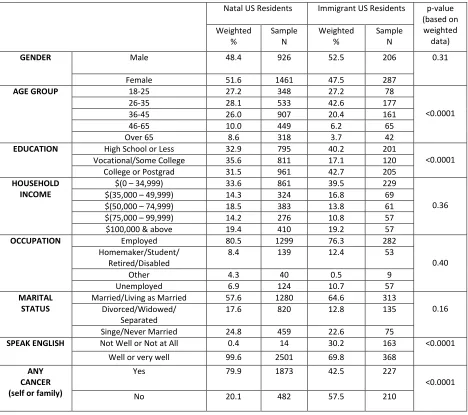
Table 4.1 shows the demographic characteristics of natal and immigrant sample
subgroups. There were significant differences between the groups in terms of age distribution,
education, how well they spoke English, and cancer diagnosis. Whereas the natal sample was
Natal US Residents Immigrant US Residents p-value
(based on weighted data) Weighted % Sample N Weighted % Sample N
GENDER Male 48.4 926 52.5 206 0.31
Female 51.6 1461 47.5 287
AGE GROUP 18-25 27.2 348 27.2 78
<0.0001
26-35 28.1 533 42.6 177
36-45 26.0 907 20.4 161
46-65 10.0 449 6.2 65
Over 65 8.6 318 3.7 42
EDUCATION High School or Less 32.9 795 40.2 201
<0.0001
Vocational/Some College 35.6 811 17.1 120
College or Postgrad 31.5 961 42.7 205
HOUSEHOLD INCOME
$(0 – 34,999) 33.6 861 39.5 229
0.36
$(35,000 – 49,999) 14.3 324 16.8 69
$(50,000 – 74,999) 18.5 383 13.8 61
$(75,000 – 99,999) 14.2 276 10.8 57
$100,000 & above 19.4 410 19.2 57
OCCUPATION Employed 80.5 1299 76.3 282
0.40 Homemaker/Student/
Retired/Disabled
8.4 139 12.4 53
Other 4.3 40 0.5 9
Unemployed 6.9 124 10.7 57
MARITAL STATUS
Married/Living as Married 57.6 1280 64.6 313
0.16 Divorced/Widowed/
Separated
17.6 820 12.8 135
Singe/Never Married 24.8 459 22.6 75
SPEAK ENGLISH Not Well or Not at All 0.4 14 30.2 163 <0.0001
Well or very well 99.6 2501 69.8 368
ANY CANCER (self or family)
Yes 79.9 1873 42.5 227
<0.0001
Page 28 of 52
more evenly distributed among the age groups, approximately 43% of the immigrant group was
in the 26-35 age group (p<.01). For education, approximately 36% of natal residents, compared
to approximately 17% (weighted percentage) of immigrant reported that they had completed
vocational of some college. However, a higher proportion of immigrant (42.7% versus 31.5%;
p<.01) reported having completed college or postgraduate school. As expected, almost all natal
stated that they spoke English “very well,” or “well,” compared to approximately 70% of
immigrant residents (P<.01). The remaining 30% of immigrant residents reported that they
spoke English “not well” or “not well at all.” Residents were asked whether they had ever been
diagnosed as having cancer and whether any family members had been diagnosed with cancer.
Approximately 80% of natal US residents indicated in the affirmative to either or both of these
questions, compared to approximately 43% of immigrant US residents (P<.01).
4.2 Health information seeking
This remaining section of this chapter outlines results related to health-information
seeking behaviors, challenges experienced, and trust of information by source. To get a clearer
picture of factors that may have influenced the differences between natal and immigrant US
residents, data were analyzed among all respondents, and since HINTS focuses on
cancer-related information behaviors, among respondents with a cancer diagnosis personally or within
their “family”. Within the immigrant group, data were analyzed by fluency in the English
language—how well they spoke English. Fluency was recoded to represent two groups: spoke
Page 29 of 52 4.2.1 Where seek information
Respondents were asked whether they had ever looked for health or medical
information and where they went initially the most recent time they looked for such
information. There was a moderate and significant difference (p=.01) between natal and
immigrant residents in terms of whether they had ever looked for health or medical
information from any source. Approximately 80% of natal, compared to approximately 68% of
immigrant US residents, stated that they had searched for health information.
[image:30.612.69.547.307.457.2]
Table 4.0.2 Where respondents looked initially during most recent search for health or medical information
All respondents Respondents with Cancer Experience p-value
(based on weighted data) Native US-Residents Immigrant US-Residents
Native US-Residents Immigrant
US-Residents
% N % N % N % N
Books, Brochures,
Library 8.8 191 8.2 31 8.8 141 9.0 17 0.54
(All) 0.9 (cancer) Healthcare/
Cancer Org 14.3 327 17.1 76 14.4 243 15.6 34
Family, Friend,
Coworker 4.1 78 4.3 16 3.7 56 3.8 7
Internet 70.0 1144 69.3 178 73.4 862 71.5 78
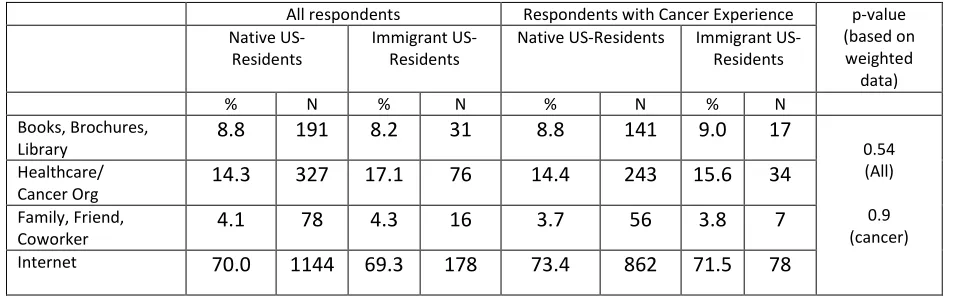
All Respondents.Table 4.2 displays frequencies of information sources by nativity. There
was no difference in the proportions of either group regarding where they first sought health or
medical information on the most recent occasioned that they looked. Both groups indicated
that the Internet was the most popular choice (70.0% and 69.3%, p=0.54), with the next highest
being healthcare provider or cancer organization (14.3% & 17.1%, natal and immigrant
residents, respectively, p=0.54). Additionally, equal proportions of both groups indicated that,
Page 30 of 52
Respondents with Experience of Cancer. Table 4.2 displays frequencies of information
sources by nativity for the subset of survey respondents who had either themselves or their
family received a cancer diagnosis. There was no significant difference between natal and
immigrant residents, in terms of where they first looked for health information during their
most recent search (p=0.9). Among respondents who had a cancer diagnosis in their families),
the Internet was reported by most people (both natal and immigrant US residents) as the initial
source they utilized for seeking health or medical information during their most recent search
[image:31.612.120.492.327.433.2](73.4%, 71.5%, natal vs. immigrant US residents, respectively, p=0.9).
Table 4.0.3 Where looked for health or medical information by English fluency
Speak English very well or well
Speak English not well p-value
(based on weighted data) Weighted % Sample N
Weighted % Sample
N Books, Brochures,
Library
6.1 20 15.0 11
<.01
Healthcare/Cancer Org 12.1 44 32.9 32
Family, Friend, Coworker 3.7 11 6.4 5
Internet 78.1 146 45.8 31
Immigrants’ English Fluency. Table 4.3 displays frequencies of information sources
among immigrant US residents, classified by level of English fluency (speak English “very well”
or “well” and speak English “not well” or “not at all”). Results were similar to those obtained for
all respondents and those with experience of cancer. The Internet was the source both groups
of immigrant US residents classified by English fluency went to initially during their most recent
search for health or medical information (78.1% and 45.8%, respectively, p<.01). Although
stated as the second most common choice for both groups, “healthcare provider or cancer
organization” was three times as common among those who spoke less English (32.9% and
Page 31 of 52 4.2.2 Information search challenges
This section outlines the results of participants’ responses regarding their experience
[image:32.612.71.549.180.447.2]the most recent time they looked for health or medical topics.
Table 4.4 Challenges in seeking health and medical information during most recent search
All respondents Respondents with Cancer
Experience p-value (based on weighte d data) Native US-Residents Immigrant US-Residents Native US-Residents Immigrant US-Residents
% N % N % N % N
LOT OR EFFORT (to get info needed)
Strongly agree,
agree 35.2 710 46.1 177 34.1 526 44.5 76
0.01 (All) 0.1 (Can) Somewhat,
strongly disagree 64.8 1321 53.9 181 65.9 984 55.5 85
FRUSTRATED (during search)
Strongly agree,
agree 31.9 666 34.2 118 32.0 500 34.3 53
0.6 (All)
0.7 (Can) Somewhat
disagree, dis 68.1 1357 65.8 221 68.0 1009 65.7 99
QUALITY CONCERN
Strongly agree,
agree 52.9 1022 54.8 201 51.8 756 56.4 92
0.7 (All)
0.4 (Can) Somewhat
disagree, dis 47.1 997 45.2 147 48.2 749 43.6 65
HARD TO UNDERSTAND
Strongly agree,
agree 25.8 520 34.4 130 25.2 374 37.3 60
0.1 (All) 0.01 (Can) Somewhat
disagree, dis 72.4 1496 65.6 212 74.8 1127 62.7 92
All Respondents. Table 4.4 displays frequencies of challenges in seeking information by
nativity. There were significant differences between both groups regarding effort needed to get
the information and difficulty in understanding the information. Compared to natal US
residents, a higher percentage of immigrant US residents (35.2% & 46.1%, respectively, p=.01)
“strongly agreed” or “agreed” that the most recent search required a “lot of effort.” Likewise, a
greater proportion of immigrant US residents (34.4% versus 25.8%, p=0.1) “strongly agreed” or
“agreed” that the information was “hard to understand.” Most immigrant and natal US
Page 32 of 52
“frustrated” (68.1% and 65.8%, p=0.6) or were concerned with the quality of the information
(47.1% & 45.2%, p=0.7).
Respondents with Experience of Cancer. Table 4.4 displays frequencies of challenges in
seeking information by nativity for the subset of survey respondents who had either themselves
or their family received a cancer diagnosis. As was revealed in the analyses for the general natal
and immigrant subgroups, above, there were significant differences between the natal US
residents who had experienced a cancer diagnosis for themselves or their family and immigrant
US residents who had experienced a cancer diagnosis for themselves or their family. Both of
these natal and immigrant groups “strongly agreed” or “agreed” that the most recent search
took “a lot of effort” (34.1% and 44.5%, respectively, p=0.1), and was “hard to understand”
25.2% and 37.3%, respectively, p= 0.01). Unlike the results obtained in analyzing data on the
general population, however, among those that had dealt with a cancer diagnosis, both the
natal and immigrant US residents “strongly agreed” or “agreed” that “quality concern” was
their biggest challenge (51.8% and 56.4% respectively, p=0.04). “Lot of effort” during search
was the second biggest challenge (34.1% and 44.5, US and immigrant US residents, respectively,
Page 33 of 52 Table 4.5 Challenges in seeking health or medical information during most recent search by English fluency
Speak English very well or well
Speak English not well p-value
(based on weighted data) Weighted % Sample N
Weighted % Sample
N
LOT OR EFFORT (to get info needed)
Strongly agree, agree 44.6 121 50.8 55
0.5
Somewhat, strongly disagree 55.4 143 49.2 38
FRUSTRATED (during search)
Strongly agree, agree 33.8 88 35.8 30
0.8
Somewhat disagree, dis 66.2 170 64.2 50
QUALITY CONCERN
Strongly agree, agree 55.1 152 54.0 49 0.9
Somewhat disagree, dis 44.9 113 46.0 33
HARD TO UNDERSTAND
Strongly agree, agree 33.6 90 36.9 39 0.7
Somewhat disagree, dis 66.4 169 63.1 43
Immigrant English Fluency. Table 4.5 displays frequencies of information sources among
immigrant US residents, classified by level of English fluency (speak English “very well” or “well”
and speak English “not well” or “not at all”). There were no significant differences between the
English fluency groups in terms of their responses to the challenges—level of effort, frustration,
quality concern, and difficulty in understanding—associated with the most recent time they
looked for health or medical information. However, most of the respondents in both groups
“strongly agreed” or “agreed” that “concern for quality” was a challenge (55.1% and 54%,
p=0.9), followed by “lot of effort to get information needed” (44.6% and 50.8%, p= 0.5).
4.2.3 Trust of health and medical information sources
Respondents were also asked how much, in general, they trusted health and medical
information that they got from various sources.
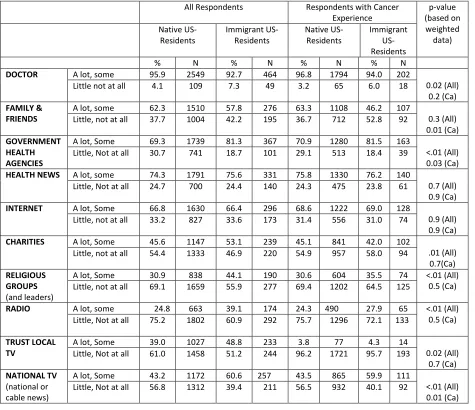
All Respondents. Table 4.6 displays frequencies of trust of medical and health information
sources by nativity. Although there was little difference between the proportion of each group
that trusted the Internet “a lot” or “some” (66.8% & 66.4%, p=0.9), there were group
Page 34 of 52
highest level of support for trust “a lot” or “some” (behind doctor, 92.7%, and government
health agency, 81.3%, and health news from special health or medical magazines or
newsletters, 75.6%) for immigrant residents, but fifth highest (behind doctor, 95.9%, health
news, 74.3%, government, 69.3%, religious organizations, 69.1%) for natal residents. Comparing
both groups, there was a small but significant difference in the level of trust (“a lot” or “some”)
[image:35.612.72.547.268.678.2]toward health or medical information from a doctor (92.7% vs. 95.9%, p=.02).
Table 4.6 Trust of health and medical information sources
All Respondents Respondents with Cancer
Experience p-value (based on weighted data) Native US-Residents Immigrant US-Residents Native US-Residents Immigrant US-Residents
% N % N % N % N
DOCTOR A lot, some 95.9 2549 92.7 464 96.8 1794 94.0 202
0.02 (All) 0.2 (Ca)
Little not at all 4.1 109 7.3 49 3.2 65 6.0 18
FAMILY & FRIENDS
A lot, some 62.3 1510 57.8 276 63.3 1108 46.2 107
0.3 (All) 0.01 (Ca)
Little, not at all 37.7 1004 42.2 195 36.7 712 52.8 92
GOVERNMENT HEALTH AGENCIES
A lot, Some 69.3 1739 81.3 367 70.9 1280 81.5 163
<.01 (All) 0.03 (Ca)
Little, Not at all 30.7 741 18.7 101 29.1 513 18.4 39
HEALTH NEWS A lot, some 74.3 1791 75.6 331 75.8 1330 76.2 140
0.7 (All) 0.9 (Ca)
Little, Not at all 24.7 700 24.4 140 24.3 475 23.8 61
INTERNET A lot, Some 66.8 1630 66.4 296 68.6 1222 69.0 128
0.9 (All) 0.9 (Ca)
Little, not at all 33.2 827 33.6 173 31.4 556 31.0 74
CHARITIES A lot, Some 45.6 1147 53.1 239 45.1 841 42.0 102
.01 (All) 0.7(Ca)
Little, not at all 54.4 1333 46.9 220 54.9 957 58.0 94
RELIGIOUS GROUPS
(and leaders)
A lot, Some 30.9 838 44.1 190 30.6 604 35.5 74 <.01 (All)
0.5 (Ca)
Little, not at all 69.1 1659 55.9 277 69.4 1202 64.5 125
RADIO A lot, some 24.8 663 39.1 174 24.3 490 27.9 65 <.01 (All)
0.5 (Ca)
Little, Not at all 75.2 1802 60.9 292 75.7 1296 72.1 133
TRUST LOCAL TV
A lot, Some 39.0 1027 48.8 233 3.8 77 4.3 14
0.02 (All) 0.7 (Ca)
Little, Not at all 61.0 1458 51.2 244 96.2 1721 95.7 193
NATIONAL TV
(national or cable news)
A lot, Some 43.2 1172 60.6 257 43.5 865 59.9 111
<.01 (All) 0.01 (Ca)
Page 35 of 52
There were also moderate and significant differences between natal and immigrant
residents’ trust toward information from government health agencies (69.3% and 81.3%,
respectively, p<.01), charities (45.6% & 53.1%, respectively, p=0.01), and religious organizations
(30.9% & 44.1%, respectively, p<.01). There were even larger differences between the two
groups. Compared to natal residents, immigrant residents more frequently trusted health or
medical information from national television (60.6% and 43.2%, respectively, p<.01), local
television (48.8% and 39.0%, respectively, p=.02), and radio (39.1% and 24.8%, respectively,
<.01).
Respondents with Experience of Cancer. Table 4.6 displays frequencies of trust of
medical and information sources by nativity for the subset of survey respondents who had
either themselves or their family received a cancer diagnosis. Among those who had dealt with
cancer, there was no significance between the proportion of natal US residents and immigrant
US residents who trusted the Internet “a lot” or “some” (68.6% and 69.0%, respectively, p=
0.9). The Internet was fourth most-trusted by both groups. Both of these results were
consistent with the results obtained for the general population (above). “Doctor” was the
number one choice trusted “a lot” or “some,” for both groups. There were differences in the
next two top choices trusted “a lot” or “some.” For natal residents, “health news” was second
choice (78.8%), followed by “government health” agency sources (70.9%). For immigrant
residents, the second most popular choice for trust “a lot” or “some” was “government health
agencies,” followed by “health news” from special health or medical magazines or newsletters
(76.2%). Compared to the general population there were much fewer trust differences within
Page 36 of 52
trusted “national television,” compared to 59.9% of those that were immigrant residents
(p=0.01). There were also significant differences between the proportion of natal and
immigrant US residents who reported “a lot” or “some” trust in government sources (70.9%
and 81.5%, respectively, p=0.03), and family and friends (63.3% and 46.2%, respectively,
[image:37.612.73.545.239.435.2]p=0.01).
Table 4.7 Trust of health and medical information sources by English fluency
Speak English well or very well
Speak English Not well p-value
(based on weighted data) Weighted % Sample N
Weighted % Sample
N
DOCTOR A lot, Some 94.9 335 87.5 127 0.01
Little not at all 5.1 21 12.5 28
GOVERNMENT HEALTH AGENCIES
A lot, Some 85.4 276 70.5 91
.004
Little not at all 14.6 63 29.5 37
HEALTH NEWS A lot, Some 81.4 254 60.7 76 .004
Little not at all 18.6 84 39.3 55
INTERNET A lot, Some 71.3 233 52.9 61 0.01
Little not at all 28.7 107 47.1 66
NATIONAL TV A lot, Some 62.0 192 56.7 64 .05
Little not at all 38.0 148 43.3 62
FAMILY & FRIENDS A lot, Some 58.6 210 55.8 65 0.7
Little not at all 41.4 127 44.2 67
Immigrants’ English fluency. Table 4.7 displays frequencies of trust of medical and
health information sources among immigrant US residents, classified by English fluency (speak
English “very well” or “well” and speak English “not well” or “not at all”). There were several
differences between the two fluency groups in terms of the level of trust for health and medical
information sources. First, there were significant differences in the trust levels between the
respondents of the more fluent and less fluent English-speaking groups with respect to health
and medical information from multiple sources. These included: “a doctor” (94.9% and 87.5%,
respectively, p=.01), “government health agencies” (85.4% and 70.5%, respectively, p=.004),
Page 37 of 52
the “Internet” (71.3% and 52.9%, respectively, p=.01), and “national or cable television news
programs” (62.0% and 57.6%, respectively, p=.05).
The Internet was reported as the fourth most trusted source (71.3%) for health and
medical information for immigrant residents who but sixth most trusted 52.9%) among those
who indicated less English fluency (p=0.01). The three most trusted sources were the same for
both those who reported that they spoke English “very well” or “well” and those who reported
less English fluency. They were “doctor” (94.9% and 87.5%, respectively, p=.001), “government
health agency” (85.4% and 70.5%, respectively, p=.004), and “special health or medical news
Page 38 of 52
5.
DISCUSSION
This thesis focused on the health information seeking behaviors and attitudes of natal
US residents and immigrant US residents in terms of sources searched, challenges associated
with health information seeking, and trust of various sources. The primary objective was to
compare sources of health information by nativity among all respondents and among those
with cancer experience (either personal or familial). The first main difference was that a lower
percentage (68% vs 80%, p<.01) of immigrant residents indicated that they had searched for
health information. Another main finding of this thesis was that, for most (70.0% and 69.3%)
respondents in both the natal US residents and immigrant US residents groups, the Internet
was the initial source of choice during their most recent search for health or medical
information.
The second objective was to compare information search challenges by nativity among
all respondents and among those with cancer experience (either personal or familial). Among
all respondents that had searched for health or medical information, a higher percentage of
immigrant residents “strongly agreed” or “agreed” that during their most recent search, a lot of
effort was needed to get health info (46.1% vs. 35.2%, p=.01) and was hard to understand
(34.4% vs. 25.8%, p=0.1). Also, among those who had, themselves, or their family, received a
cancer diagnosis, there was a significant difference between the natal group and the immigrant
group regarding the degree to which they “strongly agreed” or “agreed” that the information
Page 39 of 52
The third objective was to compare trust for various sources of health and medical
information among all respondents and among those who experienced cancer (either
personally of through family). The main finding in this respect was that immigrant residents
were more trusting of government health agencies (81.3 vs. 69.3, p<0.01), charities (53.1 vs.
45.6, p=0.01) and religious organizations (44.1 vs. 30.9, p<.01) but less trusting of national and
local television and radio. However, immigrant residents that had experienced cancer were
more trusting of national television (59.9 vs. 43.5, p=0.01) than natal residents.
A fourth objective of the study was to compare immigrant US residents by level of
English fluency in terms of where they initially searched, and the challenges they experienced,
during their most recent search for health or medical information, and trust of various sources
of health or medical information. Thirty percent (30%) of immigrant US-residents indicated
limited fluency in the English language. The internet was the initial source chosen by most
respondents of both the group that indicated that they spoke English “very well” or “well” and
those who indicated that they spoke English “not well” or “not at all.” There was a significant
difference between the more English-fluent and less English-fluent groups in terms of where
they initially searched for health information (78.1 and 45.8 respectively; p<.01). There was no
difference between the two groups in respect of the challenge regarding “level of effort,”
“frustration,” “quality concern,” and “difficulty in understanding." Compared to the less
English-fluent immigrant US-residents, the immigrant US-residents who were more fluent in the
English language reported greater trust of doctor, government health agencies, special health
or medical magazines or newsletters, the Internet, and national or cable television news
Page 40 of 52
There were also other (secondary) findings related to nativity differences and within
group differences for the immigrant US population (English-fluency). The Internet was rated
fourth highest in terms of trust for the immigrant group, compared to fifth for natal residents,
but was trusted by approximately the same proportion of respondents within both nativity
groups (66.8% and 66.4%, p=.09). For cancer incidence, a much lower percentage of immigrant
US residents indicated that they, or anyone in their family, had received a cancer diagnosis.
There was also a difference in the age distribution - there was a higher percentage of immigrant
residents in the younger age categories, compared to natal residents.
5.1 How findings are consistent with literature
The finding that compared to natal US residents, a lower proportion (67.6% vs. 79.5%)
of immigrant US residents had ever looked for health information may be partially explained by
factors that are consistent with the concept of a “Digital Divide”. Higher proportions of the
immigrant group “strongly agreed” or ”agreed” that their most recent health information
seeking experience required a lot of effort and the information was hard to understand.
Literature indicates that limited fluency, socioeconomic characteristics, such as low income and
less education, and membership in minority groups that contribute to the Digital Divide can
affect health information seeking (Cline 2001, Kreps, 2005; Warren et al., 2010).
Also, whereas the age distribution of the natal respondents was approximately evenly
spread, for the immigrant group, close to half (43%) were between 26 and 35 years old. In fact,
the proportion of this group that reported being in the younger age groups 18-25 and 26-35
Page 41 of 52
need of more health information because of the prevalence of chronic illness within that age
group (Roblin et al., 2009).
Since cancer is related to age, and the immigrant group was younger, this may explain
the fact that, compared to natal US respondents, a smaller percentage of immigrant residents
(42.5% vs. 79.9%) reported that they, themselves, or a family member had received a cancer
diagnosis. Although cancer is not the only reason one may need to seek health information, this
difference could affect information seeking behaviors and the level of challenges one may face.
For, example, since a cancer diagnosis is such a significant and stressful event in life, seeking
information could become more challenging than during other less stressful times and thus,
could affect the reported level of challenges in this study. Additionally, previous studies note a
paradox between acculturation and immigrant health—despite better initial health status,
immigrants’ health tend to decline with length of stay in the US (Delevari, 2013). Access to, and
use of, helpful health information via the Internet or other sources could offset some of the risk
of this decline in health. Furthermore, increasing life expectancy is accompanied by increasing
levels of chronic diseases associated with older ages. Thus, as immigrants age, their
health-related information needs will increase. Some of the “Digital Divide” between immigrant and
natal residents is spurious and may diminish with time as an increase in medical conditions such
as cancer motivate health information seeking behavior. This does not mean, however, that
challenges related to difficulty, trust, etc., will be resolved. In fact, these challenges could be
exacerbated.
According to the Migration Policy Institute, about half of the immigrant population is