Georgia State University
ScholarWorks @ Georgia State University
Public Health Theses School of Public Health
Summer 8-11-2015
The Association of Participant Characteristics and
Service Delivery with Program Completion Rates
for SafeCare in Georgia
Malinda Bolt
Follow this and additional works at:https://scholarworks.gsu.edu/iph_theses
This Thesis is brought to you for free and open access by the School of Public Health at ScholarWorks @ Georgia State University. It has been accepted for inclusion in Public Health Theses by an authorized administrator of ScholarWorks @ Georgia State University. For more information, please contact
Recommended Citation
Bolt, Malinda, "The Association of Participant Characteristics and Service Delivery with Program Completion Rates for SafeCare in Georgia." Thesis, Georgia State University, 2015.
Bolt 1
ABSTRACT
THE ASSOCIATION OF PARTICIPANT CHARACTERISTICS AND SERVICE DELIVERY WITH PROGRAM COMPLETION RATES FOR SAFECARE® IN GEORGIA
By
MALINDA SUZANNE BOLT
JULY 28, 2015
Child maltreatment affects millions of children annually, and evidence-based home visiting
programs, such as SafeCare®, help increase parenting skills and, ultimately, the well-being of
children. Although effective at reducing maltreatment when participants complete services,
high attrition rates in home visiting services may reduce this effectiveness. Using a sample of all
clients receiving SafeCare services in Georgia (n=93) from October 2013 to February 2015, we
evaluated individual characteristics, information seeking behaviors, and programmatic factors
in order to understand the relationships, if any, with participant program completion. During
this evaluation cycle, SafeCare reports a completion rate of 43%. The race of the primary
guardian significantly relates to program completion (p=0.02). This evaluation can assist those
Bolt 2
THE ASSOCIATION OF PARTICIPANT CHARACTERISTICS AND SERVICE DELIVERY WITH PROGRAM COMPLETION RATES FOR SAFECARE® IN GEORGIA
by
MALINDA S. BOLT
B.S., THE UNIVERSITY OF GEORGIA
A Thesis Submitted to the Graduate Faculty of Georgia State University in Partial Fulfillment
of the
Requirements for the Degree
MASTER OF PUBLIC HEALTH
Bolt 3
APPROVAL PAGE
THE ASSOCIATION OF PARTICIPANT CHARACTERISTICS AND SERVICE DELIVERY WITH PROGRAM COMPLETION RATES FOR SAFECARE® IN GEORGIA
by
MALINDA S. BOLT
Approved:
___Dr. Daniel J. Whitaker______ Committee Chair
__Dr. Shannon Self-Brown_____ Committee Member
Bolt 4
Acknowledgments
I would like to share my gratitude for Dr. Daniel Whitaker’s patience and encouragement, and for Dr. Shannon Self-Brown’s insightful feedback. Thank you both for being such a wonderful
Bolt 5
Author’s Statement Page
In presenting this thesis as a partial fulfillment of the requirements for an advanced degree from Georgia State University, I agree that the Library of the University shall make it available for inspection and circulation in accordance with its regulations governing materials of this type. I agree that permission to quote from, to copy from, or to publish this thesis may be granted by the author or, in his/her absence, by the professor under whose direction it was written, or in his/her absence, by the Associate Dean, School of Public Health. Such quoting, copying, or publishing must be solely for scholarly purposes and will not involve potential financial gain. It is understood that any copying from or publication of this dissertation which involves potential financial gain will not be allowed without written permission of the author.
Bolt 6
Table of Contents
Introduction ... 10
Child Maltreatment Overview ... 10
Physical Consequences. ... 11
Psychological Consequences. ... 11
Behavioral Consequences. ... 12
Evidence-Based Practices and Policies ... 13
The SafeCare® Model ... 14
The Health Module. ... 14
The Home Safety Module. ... 15
The Parent-Infant/Child Interaction Module. ... 15
SafeCare Research ... 15
Engagement and Attrition ... 16
Integrated Theory of Parent Involvement. ... 19
The Current Project ... 21
Methods and Procedures ... 21
Project Overview and Data Sources ... 21
Sample ... 22
Data Collection Procedure ... 22
Bolt 7
Individual Characteristics... 23
Information Seeking and Main Concerns. ... 24
Program Factors. ... 25
Program Completion. ... 25
Data Analysis Plan ... 26
Results ... 26
Sample description ... 26
Table 1 ... 26
Chi-Square Analyses ... 26
Table 2 ... 26
T-Test of Means Analyses ... 27
Table 1 ... 28
Table 2 ... 31
Table 3 ... 33
Discussion... 34
Overview ... 34
Family Characteristics ... 34
PG race. ... 34
Information Seeking ... 36
Bolt 8
Limitations ... 37
Conclusion ... 38
References ... 39
Appendix A: Initial Referral Form ... 46
Bolt 9 List of Tables
Bolt 10
Introduction
Child Maltreatment Overview
Although current child health policies aim to reduce the negative impact of child
maltreatment, the sexual, physical, and psychological abuse and neglect of children create a
massive burden in the United States. In 2008, the CDC released a report that defines child
maltreatment to be “Any act or series of acts of commission or omission by a parent or other
caregiver that results in harm, potential for harm, or threat of harm to a child ” in an effort to
create a uniform definition. Of the 74 million children in the US, 3.5 million were referred to
Child Protective Services (CPS) for potential maltreatment in 2013, and 17.5% (612,500) of
those cases were substantiated as maltreatment (United States Department of Health and
Human Services, 2015). Estimates indicate that the actual number of maltreated children is
much higher, due to underreporting of child maltreatment (Finkelhor, D. et al., 2015). In FFY
2013, an estimated 1,520 children died due to child maltreatment, and 73.9% of child fatalities
were victims under the age of three (USDHHS, 2015). In 2008, the estimated total lifetime
burden of fatal and non-fatal child maltreatment equaled $124 billion (Fang, Brown, Florence,
& Mercy, 2012). Factors such as short-term health care costs, long-term health care costs,
productivity losses, child welfare costs, criminal justice costs, and special education costs
impact the overall cost of CM across the lifespan (Fang, Brown, Florence, & Mercy, 2012). At a
conservative estimate, non-fatal cases in 2008 produced lifetime costs of $210,012 per case and
fatal incidences totaled $1,272,900 per individual (Fang, Brown, Florence, & Mercy, 2012). In
2006, states disbursed over $25.7 billion in federal, state, and local funds to the child welfare
Bolt 11
Additionally, Medicaid expenditures for children suspected of or identified as being victims of
child abuse average $2,600 per year higher than the Medicaid expenditures of non-victims
(Florence et al., 2013).
Physical Consequences.
While the financial burden is heavy, the physical, psychological, and behavioral effects
of child maltreatment create adverse health outcomes that can span the lifetime for victims (US
HHS, 2015). Of these impacts, the physical consequences of maltreatment may be the most
visible, ranging from death, stunted growth, untreated infections and illnesses, and obesity (The
Institute of Medicine & the National Research Council, 2014). Research indicates that adults
who self-report experiences of maltreatment as a child face significantly lower levels of
health-related quality of life in adulthood (Corso et al., 2008). Furthermore, a 2001 study of pediatric
emergency room admissions by Dominguez, Chalom, and Costarino shows that of the 1,376
child (ER) admissions 17 were reported as cases of child abuse. And 6 of the 85 child deaths
were the direct result of abuse (Dominguez, Chalom, & Costarino, 2001). Brown and colleagues’
2010 study suggests that a relationship between adverse childhood experiences such as
maltreatment may play a significant role in an increased risk of development of and death from
lung cancer.
Psychological Consequences.
CM clusters with various mental illnesses for those who experience maltreatment
(Norman et al., 2012). A 2012 meta-analysis by Norman and colleagues indicated that CM
doubles the likelihood of developing an adverse mental health condition throughout the
Bolt 12
psychological health outcomes such as depressive disorders, anxiety disorders, suicide
attempts, and risky sexual behaviors are linked to experience of CM (Norman et al., 2012).
Childhood maltreatment increases the likelihood of problems in socialization as well,
such as disconnectedness, which can result in difficulty transitioning in a stable adulthood
(Casanueva, Dolan, & Smith, 2014). In a nationally representative sample, the National Survey
of Child and Adolescent Well-Being (NSCAW) indicates that 15% of youths who experience
maltreatment face issues with disconnectedness during a three period after reported
maltreatment. Disconnected youth are defined as neither in school nor employed and are not
being prepared for life as an adult. Issues resulting from disconnection include early pregnancy,
poverty, social and familial disruption, and alienation. There were no significant differences by
race, gender, poverty level, or home placement setting at baseline, however, the likelihood of
disconnectedness increases with age of victim at reported maltreatment (Casanueva, Dolan, &
Smith, 2014). Approximately, 47% of youths with disconnectedness were found to have low
cognitive skills or behavioral issues (Casanueva, Dolan, & Smith, 2014).
Behavioral Consequences.
Adults who have experienced childhood maltreatment are at an increased risk for
perpetrating or being the victim of violence, smoking, obesity, high-risk sexual behaviors,
unintended pregnancy, and substance abuse (IOM & NRC, 2014). These negative behaviors
have deleterious health effects, which inflate health-related costs (World Health Organization,
2014). For children who experience maltreatment with a caregiver as the perpetrator, issues of
Bolt 13
others throughout life further exacerbating psychological and social impacts of maltreatment
(IOM & NRC, 2014).
Evidence-Based Practices and Policies
In 1993, the National Research Center released a report encouraging empirical research
of CM interventions as a main objective for the future of child policy (IOM & NRC, 1993). Since
that time, several behaviorally-based parenting programs have been shown to impact child
maltreatment reports and recidivism, including Parent-Child Interaction Therapy (Thomas &
Zimmer-Gembeck, 2012), Triple P (Prinz et al., 2009), and SafeCare (Chaffin et al., 2012).
As the movement toward evidence-based practices (EBPs) continues, the child policy
sector shifts its focus to interventions that are effective in reducing rates of CM and preventing
future cases (Chaffin & Friedrich, 2004). Determinations of what programs to implement are
made from research evidence relying primarily on randomized trials or a quasi-experimental
designs that can indicate whether an intervention is effective and thus warrants widespread
implementation (Chaffin & Friedrich, 2004). EBPs are typically manualized and many have
quality assurance procedures built in to implementation methods that allow for accountability
and fidelity to the model.
Many home visiting models have been noted to have strong research evidence for
preventing or reducing child maltreatment (Avellar, S. et al., 2014). Home visiting as an
approach to treatment can reduce barriers to access for participants such as transportation and
child care (Damashek, Doughty, Ware, & Silovsky, 2011). Additionally, EBPs can lessen the
economic burden of child maltreatment (Covington, 2013). Many EBPs have been shown to be
Bolt 14
The SafeCare® Model
SafeCare® is a behaviorally based, in-home parenting model designed to prevent child
maltreatment among parents of children ages 0-5. SafeCare focuses on teaching parenting
skills in three key areas (or modules) related to child maltreatment: Child health, Home Safety,
and Parent-Child/Infant Interaction. The teaching portion of each module follows a general
seven step outline. Home visitors describe target behaviors, explain the importance for each
behavior, model the behavior, request parental demonstration of behavior, provide positive
feedback, indicate areas for improvement, and provide goals for the next training meeting.
Each module typically requires five training sessions, an assessment, and a social validation or
satisfaction questionnaire. However, if a parent does not meet the requisite criteria for module
advancement, the provider will revisit problem areas and conduct additional training. During
the modules, home visitors provide parents with required materials to continue the program
and improve child well-being such a thermometer to check the child’s temperature, child safety
latches for cabinets to improve home safety, and a child health manual to encourage healthy
behaviors.
The Health Module.
During the Health Module, parents learn to use child health reference materials,
prevent childhood illnesses, identify symptoms, and determine the course of action for child
illness. Child health knowledge is assessed through role-play health scenarios where parents
determine the course of action in various child health scenarios. Along with skill building
medically-Bolt 15
validated health manual. Parents complete this module by indicating that they can properly
meet the health needs of their child or children.
The Home Safety Module.
The Home Safety Module focuses on ensuring that home safety risks are identified and
eliminated, so that the child is no longer exposed to home hazards. Home visitors assess rooms
in the home using the validated and reliable Home Accident Prevention Inventory (HAPI), which
identifies five types of home hazards: fire and electrical, mechanical-suffocation, ingested
object suffocation, firearms, and solid/liquid poisons. Decreases in hazards indicates that the
Home Safety Module effectively trains parents in home injury prevention.
The Parent-Infant/Child Interaction Module.
The Parent-Infant/Child Interaction Module uses the Planned Activity Training (PAT)
Checklist during play and routine activities to ensure parents understand how to engage in
positive activities and prevent negative child behaviors. During in-home assessments, home
visitors help parents identify areas for improvement and modify interaction behaviors in order
to increase positive interactions.
SafeCare Research
The largest randomized control trial of SafeCare followed over 2100 families after a
state-wide implementation in Oklahoma to determine the effectiveness of the model. SafeCare
reduced child maltreatment recidivism by approximately 26% in comparison to services as usual
for families with children within the age range of 0-5 years (Chaffin, Hecht, Bard, Silovsky, &
Beasley, 2012). In regards to specific skills improvements, single-case studies of SafeCare have
Bolt 16
Bigelow, & Doctor, 1998), use of the HAPI and training reduces home hazards, and the health
module improves the health skills of parents (Bigelow & Lutzker, 2000). A recent randomized
trial has demonstrated improved parent and child outcomes following receipt of SafeCare
relative to a control (Carta et al., 2013).
Because research indicates that SafeCare successfully decreases child welfare recidivism
and improves parenting behaviors, the model has been broadly implemented in 20 states
across the US as well as internationally. International implementation with cultural
modifications includes sites in Australia, Belarus, Canada, Israel, Spain, and the United Kingdom.
Agencies implementing SafeCare – or any evidence-based practice – must focus on delivering
the program correctly and engaging families in services. The latter has proved to be a
substantial challenge in child welfare-related services.
Engagement and Attrition
Engagement is one of the most important constructs of programmatic interventions as
participants must receive services in order for those services to impact behavior. Though home
visiting interventions report higher levels of engagement versus non-home visiting services,
attrition still greatly affects implementation (Olds, 2003). Researchers recommend using a
multidimensional approach to address the socio-ecological issues affecting participation (Olds,
2003). While attrition rates vary by program’s target demographics, on average between
20%-50% of participants drop out of home visiting programs (Gomby, 2007). One large program,
Parents as Teachers, which focuses primarily on young at-risk mothers, experiences almost a
60% drop out rate on average before the target child reaches two years of age (Wagner,
Nurse-Bolt 17
Family Partnership (NFP) program and attrition occurred more commonly among younger
mothers (Brand and Jungmann, 2014). Other findings suggest that young mothers, unmarried
mothers, and African-American mothers were more likely to drop out, and that home visitors’
turnover was related to premature dropout (O’Brien et al., 2012). Hispanic mothers, those
living with a co-parent, and those employed at enrollment remained in the program longer.
Provider qualities such as flexibility correlated with higher retention rates as well (O’Brien et al,
2012).
A 2003 program evaluation by Wagner and colleagues identifies the five dimensions of
home visiting engagement: (1) “say yes” engagement (participant agrees to enroll); (2) “be
there” engagement (attends scheduled visits); (3) “be involved” (participant actively
participates in session) engagement; (4) “do the homework” engagement (participant uses
learned skills outside of sessions); and, (5) “look for more” engagement (participant ventures
outside of home visiting services for more information regarding parenting techniques).
Wagner argues that in order to effect behavior change, it is necessary to focus on each form of
participant engagement as parents can function well in one area of engagement, but not others
(Wagner, Spiker, Linn, Gerlach-Downie, & Hernandez, 2003).
Parental characteristics have been found to significantly affect the strength of various
dimensions of engagement for the PAT home visiting intervention (Wagner, Spiker, Linn,
Gerlach-Downie, & Hernandez, 2003). Participants who remained in the program were
significantly older than other participants, of higher education status, and more likely to earn a
household income of $40,000 or greater and own their own home. African Americans were
Bolt 18
characteristics of the completion group rather than the drop out group. Older adult, Caucasian
mothers were most likely to be rated highly on overall engagement as were participants who
owned their own homes. Teen and Latina mothers were the only participant groups found with
significantly high “look for more” engagement, which means these mothers joined groups and
sought community support outside of program services and family members. (Wagner, Spiker,
Linn, Gerlach-Downie, & Hernandez, 2003).
Though most child maltreatment home visiting interventions are aimed toward the
mother, research indicates that the role and engagement of the direct co-parent, such as the
father, must not be underestimated (Duggan et al., 2004). A 2004 study by Duggan et al.
describes paternal engagement as low for home visiting services, even when the father resided
in the home. Fathers with a history of domestic abuse and heavy drinking were reported to
interact very little with home visitors leading the evaluation team to question whether the
program was having the intended effects; in order to reduce child maltreatment, an
intervention must address behavior modification for the high risk parent—in these cases, the
violent father. Overall, paternal engagement levels for all family types, living together,
separated, and separated with seldom visits, saw a decrease in paternal engagement overtime.
With decreasing paternal engagement, maternal relationship satisfaction decreased (Duggan et
al., 2004). Given the complex nature of child maltreatment and family dynamics, evaluations
attempting to understand engagement and attrition must also include information regarding
Bolt 19
Integrated Theory of Parent Involvement.
Information regarding demographic characteristics and parenting program completion
rates are readily available, and in fact, the abundancy of these data have led to mixed results
(Josten, Mullett, Savik, Campbell, & Vincent, 1995; Olds & Kitzman, 1993). For instance, the
National Committee to Prevent Child Abuse (1995) reported high attrition rates for first-time
mothers, while Olds and Kitzman’s 1993 meta-analysis indicated much lower rates.
Intervention scientists have begun to focusing research on determining whether specific factors
can be identified to predict engagement in home visiting child maltreatment program
participants (McCurdy et al., 2006). McCurdy and Daro’s Integrated Theory of Parent
Involvement (ITPI) posits that four domains influence engagement and attrition: individual
factors such as objective program experience, provider factors such as caseload, neighborhood
factors such as social cohesion, and program factors such as participant incentives. Other
service-based factors such as funding, provider competence, and service delivery mode are
considered primary influencers. ITPI attempts to establish a causal link between the four
domains and intent to enroll, enrollment, and program retention (McCurdy & Daro, 2001).
Damashek et al. uses the ITPI framework in the 2011 evaluation of SafeCare attrition
rates compared to Services as Usual (SAU). In this case, SAU was also a home visiting program,
but it had programmatic differences from SafeCare. While providers offering SAU were paid by
hours worked, SafeCare home visitors received a base pay allowing for more flexibility with
scheduling and drop-by visits with parents. This version of SafeCare was augmented to use
Motivational Interviewing, an approach to engage those with substance abuse issues and can
Bolt 20
examined the characteristics of the caregiver, their environment, the home visitor’s
characteristics, and programmatic factors to determine if these variables affect both enrollment
and retention in services. SafeCare was found to have a much higher enrollment rate (i.e.,
parents entering the program), and completion rate (i.e., parents completing the program) than
SAU possibly due in part by the manualized-program approach. Mothers with depressive
symptoms were more likely to enroll in services than non-depressed mothers, a result also
found in a review of the literature by McFarlane, Shea Crowne, Burrell, and Duggan in 2014.
Victims of domestic violence were more likely to complete services than non-victims. Mothers
with substance abuse issues were less likely to complete services than mothers without.
Maternal age was the strongest demographic predictor of program completion (Damashek et
al., 2011).
Another evaluation of home visiting programs indicates that matching participants and
home visitor characteristics such as race, parenting style, and culture has been found to
significantly increase sustained enrollment in home visiting services (Daro et al., 2003).
Research reflects that home visitation services attempt to match home visitors and participants
ethnicity regularly as well (McCurdy et al., 2003). Participants who enrolled in home visiting
programs earlier in pregnancy were much more likely to continue enrollment than those who
did not. African Americans and Latino participants remained in services significantly longer than
Caucasian participants, and African American home visitors’ participant retention rates were
significantly higher than those of Caucasian home visitors. Programs with the lowest caseloads
Bolt 21
The Current Project
While evidence indicates that the SafeCare model is effective in reducing child
maltreatment, evaluation of program completion rates would inform key decisions (Segal, Sara
Opie, & Dalziel, 2012) as policymakers shape implementation processes and funding (Willging
et al., 2014). Program evaluation is a matter of public value and the effects of child
maltreatment can be seen across all strata of society (Segal, Sara Opie, & Dalziel, 2012). Many
home visiting programs are currently being disseminated, but more information regarding the
applicability of each model for particular targeted groups is necessary for policymakers and
funders to properly choose the correct program for their target and goals (Segal, Sara Opie, &
Dalziel, 2012).
Using data from Georgia’s statewide implementation of the SafeCare model, this study
examines program completion rates, demographic characteristics, and program factors that
may relate to program completion. The two questions addressed are: What proportion of
families complete SafeCare in Georgia during the October 2013-February 2015 evaluation
cycle? Do family characteristics and program factors significantly relate to program
completion/attrition?
Methods and Procedures
Project Overview and Data Sources
In 2008, the state of Georgia began providing funding through the Department of Family
and Child Services (DFCS) for state-wide implementation of SafeCare. Agencies conducting
family preservation services were offered training from the National SafeCare Research and
Bolt 22
families. As part of implementing SafeCare in Georgia, providers collect and provide to the
state data on each family served. Data from the current contract year (2012-2014) was
de-identified and sent to NSTRC for evaluation. In this evaluation data from several sources were
used: the Initial Referral form (Appendix A), a Family Needs Assessment (Appendix B) collected
at the first visit (prior to any SafeCare sessions), and Case Closure form.
During this evaluation cycle, from October 2013 to February 2015, 93 families with 201
children enrolled in one of the two versions of SafeCare. Families who are considered low risk
for child maltreatment are offered Family Fusion, a version of SafeCare in which families receive
the parenting module and either health or safety if needed. Families in need of more intensive
services are asked to complete all three modules of SafeCare.
Sample
The sample consists of all families who received SafeCare or Family Fusion services
between October 2013 and February 2015. In all, 93 families were served, including 23 that
received SafeCare and 69 that received Family Fusion. Families were referred from a variety of
sources including Horizons, Lutheran Services of Georgia, and other agencies across the state.
Data Collection Procedure
Data for this evaluation come from several forms that were either part of the referral
for services or were completed by the home visitors as part of SafeCare delivery. An initial
referral form contained family information and reasons for referrals. Providers conducted a
needs assessment prior to initiating SafeCare sessions, and a case closure form when the case
Bolt 23
of Family and Children’s Services, and de-identified data was provided to Georgia State
University for coding and analysis.
Measures
Individual Characteristics.
Families in the evaluation completed demographics information questionnaires for DFCS
during the referral process. For purposes of this analyses, the relevant demographics were
extracted.
Primary Guardian’s (PG) age.
The age of the primary guardian is grouped by years and will be presented in the results.
Number of children. Number of childrenwas reported by caregivers, and has been
grouped for analyses as one, two, or three or more children in the household.
PG Race. For analyses, race has been re-categorized as ‘1’ or ‘0’ for white or non-white,
respectively.
Co-parent. A co-parent in this evaluation includes anyone who the PG listed as a
secondary guardian of the child or children. Responses are coded as ‘Yes’ (1) or ‘No’ (0) for the
presence of a co-parent.
PG marital status.PG marital status responses are coded as ‘0’ or ‘1’ for non-married or
married, respectively.
DFCS history. Families were screened for DFCS history and this data will be reported as
‘0’ or ‘1’ for no history with DFCS versus prior/current history.
Referral reason. Service providers were provided a list of 9 options for indicating why a
Bolt 24
commonly checked referral sources that would allow for chi-square analyses. Those were (1)
parentalcapacity building, (2) prevention, (3) neglect, and (4) safety. Each was coded ‘Yes’ or
‘No’ (1/0).
Total adults in the household. Total adults in the household was reported and for
purposes of analyses, number of adults was categorized as one, two, or three or more.
Information Seeking and Main Concerns.
Participants completed a Needs Assessment form on which they reported whether they
needed assistance or information on several areas of need. For each item, parents indicated
‘Yes,’ ‘No,’ or ‘Not Sure’ as to whether they needed assistance in that area. The individual items
were collapsed into four conceptual domains: parenting information, social issues, social
support, and health, community, and social services.
Seeking parenting information (9 items).Items in the parenting domain including
discipline tips, bonding with their child, handling child behavior, child development, interacting
with their child, child nutrition, helping their child learn, and how to help their child when it is
sick. We tallied the number of yes responses to create the index of parenting information
seeking.
Seeking social issues information (4 items). Participants indicted whether they needed
information regarding four social issues (e.g., how to be more assertive, how to have healthy
relationships). All ‘yes’ selections were coded as ‘1,’ tallied via SAS 9.4, and labeled seeking
social issues information.
Seeking social support information (3 items).Participants could also select social support
Bolt 25
problems. All answers of ‘Yes’ were tallied and coded under the variable seeking social support
information.
Seeking health, community, and social services information (7 items).If participants
requested help obtaining health, community, and social services such as transportation, child
care, health or dental care, or other needs, this response was coded as ‘Yes’ (0/1)for seeking
health, community, and social services information.
Main concerns for the family. Similarly to information seeking, main concerns is used as
a measure of initial engagement and also as a qualitative assessment of the participant’s
self-identified concerns. Respondents answered an open-ended question, “What are your main
concerns for your family?” Three themes were identified: (a) family stability and wellbeing, (b)
health and safety, and (c) self-improvement and education. Participants’ responses were coded
for a single main theme, thus a categorical variable was created representing main concern.
Program Factors.
Family Fusion or SafeCare. Participants enrolled in services were assigned to either
Family Fusion (one or two modules of SafeCare), or SafeCare, all three SafeCare modules.
Time to first contact. The time to first contact is the number of days between the
participant’s referral date and the first time that a home visitor was able to contact a
participant via telephone.
Program Completion.
Program Completion. The dependent variable of this evaluation is program completion a
Bolt 26
Data Analysis Plan
We first report the descriptive statistics for the sample for all variables. Then, bivariate
analysis, namely, chi-square and t-tests were conducted to analyze the relationship of each
variable to program completion. There were too few data to conduct multivariate analyses.
Results
Sample description
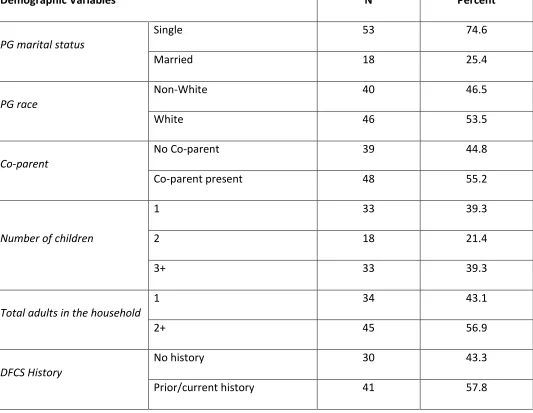
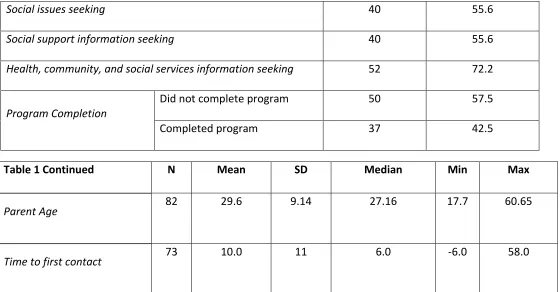
Table 1 contains descriptive information on the sample. Themedian age of PG at the
time of referral was 27 years old with a range of 17 to 60. Seventy-fourparticipants (79.6%)
were single and 19 (26%) were married. About half the sample white and half was non-white
(primarily, African American), and about half reported the presence of a co-parent. Forty
percent of the sample had one child, twenty percent had two, and forty percent had three or
more. About half the sample lived as the only adult in the household and half lived with one or
more other adults. About two-thirds of the sample had a prior history with DFCS, and one third
did not. Regarding referral reasons, 31 cases were referred for parental capacity building
(33.3%), 15 cases for neglect (16.1%), 25 cases for prevention (26.9%), and 18 cases for safety
(19.4%).
Chi-Square Analyses
Table 2 describes the chi-square analyses of categorical data in this evaluation. Race of
the primary guardian was significantly related to program completion with white participants
(54.3%) being more likely to complete SafeCare services than non-white participants (30%), p =
0.02. Though the rest of variables did not statistically significantly relate to program
Bolt 27
presence of a co-parent, number of children in the home number of adults in the home, DFCS
history referral reason identified concerns, or program (SafeCare vs. Family Fusion) – none were
statistically significantly related to program completion.
T-Test of Means Analyses
A t-test of means was performed in order to determine between program completers
and non-completers for continuous variables. Results and means are presented in Table 3.
Though no variables were found to be statistically significant, health, community, and social
services information seeking approached statistical significance (p = .085), with parents that did
not complete services expressing greater needs (M = 2.2) than those who did complete (M =
Bolt 28
Table 1
Demographic Variables N Percent
PG marital status
Single 53 74.6
Married 18 25.4
PG race
Non-White 40 46.5
White 46 53.5
Co-parent
No Co-parent 39 44.8
Co-parent present 48 55.2
Number of children
1 33 39.3
2 18 21.4
3+ 33 39.3
Total adults in the household
1 34 43.1
2+ 45 56.9
DFCS History
No history 30 43.3
Bolt 29 Referral Reason
Capacity building No 62 66.7
Yes 31 33.3
Neglect No 78 83.9
Yes 15 16.1
Safety No 75 80.7
Yes 18 19.4
Prevention No 68 73.1
Yes 25 26.9
FF or SC
FF 69 75.0
SC 23 25.0
Main Concerns
No identified concerns 36 38.7
Family stability & well-being 43 46.2
Safety 4 4.3
Education & training 10 10.8
Bolt 30
Social issues seeking 40 55.6
Social support information seeking 40 55.6
Health, community, and social services information seeking 52 72.2
Program Completion
Did not complete program 50 57.5
[image:31.792.50.610.71.363.2]Completed program 37 42.5
Table 1 Continued N Mean SD Median Min Max
Parent Age 82 29.6 9.14 27.16 17.7 60.65
Bolt 31
Table 2 Program Completion Chi-Squared (by Program Completion)
Demographic Variables % N X2 Probability
PG marital status Single (0) 39.6 53 1.387 0.239
Married (1) 55.6 18
PG race* Non-White (0) 30.0 40 5.17 0.022*
White (1) 54.3 46
Co-parent No Co-parent (0) 33.3 39 2.45 0.118
Co-parent present (1) 50.0 48
Number of children 1 36.4 33 1.881 0.391
2 55.6 18
3+ 39.4 33
Total adults in the
household
1 43.8 34 0.0162 0.899
2+ 45.2 45
DFCS History No history 38.5 26 0.242 0.623
Bolt 32
Referral Reason Capacity building No 37.5 56 1.626 0.202
Yes 18.4 31
Neglect No 43.1 72 0.047 0.828
Yes 40.0 15
Safety No 40.6 69 0.518 0.472
Yes 50.0 18
Prevention No 41.3 63 0.148 0.700
Yes 45.8 24
FF or SC FF 38.1 63 2.334 0.127
SC 56.5 23
Main Concerns No identified concerns 46.7 30 0.7470 0.8621
Family stability & well-being 41.9 43
Safety 25 4
Bolt 33
Table 3 Completed Did Not Complete T-test Probability
Parent age 31.0 (9.8) 28.5 (8.7) -1.18 0.24
Parenting information seeking 2.9 (2.3) 3.4 (2.1) 0.99 0.32
Social issues seeking 0.81 (0.9) 1.0 (1.02) 0.82 0.42
Social support information seeking 0.87 (0.9) 0.85 (0.9) -0.08 0.94
Health, community, and social services
information seeking
1.5 (1.6) 2.2 (1.7) 1.74 0.085
Bolt 34
Discussion
Overview
The purpose of this evaluation was to determine whether significant differences in rates
of program completion relate to family demographics, information seeking behaviors, or
program characteristics. This information can assist each stage of implementation of SafeCare,
from the decision to fund implementation by policymakers, the focus of trainers at the NSTRC
as the model is disseminated, and the method of service delivery by home visitors. It is
noteworthy that overall program completion rates were low with 37 of 87 participants or 42.5%
completing the program.
Family Characteristics
PG race.
Race of the primary guardian was found to be the only significant family demographic
characteristic, which may be an indication that continued focus on home visitor and participant
race may reduce attrition in SafeCare’s home visiting program. Information on home visitor
characteristics and whether there was a match between home visitors and participants’ race
was not available, but would be of interest to examine. Previous research suggests that
participants remain in home visiting services longer if the service provider closely matches the
parenting style, race, and culture of the participant (Daro et al., 2003). In Georgia, over half of
the non-white participants dropped out of services indicating that there is a need for a new
approach to this population.
In order to better understand this retention gap, examining demographic and
Bolt 35
Georgia is a densely populated urban center with diverse racial and cultural spread, rural areas,
which make up the majority of the state, exhibit a more homogenous distribution of race, with
the majority being white. Future research should focus on retention rates between the urban
and rural areas of the state due to the large differences of populations.
Due to the low power of this evaluation, other interactions differentially affecting
program completion rates by race could not be explored. Any discussion of race which
disregards the importance of health disparities as they currently exist in the United States for
minorities overlooks the complex interactions affecting behavior. So, while PG race was found
to be statistically significant in this evaluation, nuanced interactions affect attrition rates
overall. More research regarding these factors must continue in the future in order to
understand the issues creating barriers to maintaining enrollment for minorities (Gopalan et al.,
2010; McKay et al., 1998).
Motivational Interviewing
Cultural matching is not the only way to mitigate low engagement rates. Motivational
Interviewing utilizes a client-centered focus to increase participant engagement for programs
dealing with behavior changes (Miller, 1996). Motivational Interviewing is a therapeutic
approach to engaging participants where counselors focus on four important domains affecting
overall engagement. These domains are the expression of empathy by the counselor,
highlighting inconsistencies in participants’ priorities and current behaviors, accepting
participant resistance, and promoting self-efficacy. This form of counseling was first developed
by Miller in 1983 to help increase engagement in treatments for those with substance abuse
Bolt 36
such as oral health, depression, obesity, and smoking cessation (Lundahl, Kunz, Brownell,
Tollefson, and Burke, 2010). Dameshek and colleagues’ 2011 evaluation of SafeCare services
reported higher sustained enrollment versus Services as Usual and this is thought to be related
in part to the home visitors’ use of Motivational Interviewing. A 2010 meta-analysis of 119
research studies by Lundahl, Kunz, Brownell, Tollefson, and Burke indicated that overall MI
increases engagement. Moreover, in regards to effects on race, MI might be more effective on
minorities; the empathy-based approach may appeal individuals who have experienced social
rejection (Lundahl, Kunz, Brownell, Tollefson, and Burke, 2010).
Information Seeking
No significant differences were found between types of information seeking and
program completion. One effect approached statistical significant, information seeking about
social/community services. Interestingly, parents who dropped out expressed greater need
than parents who completed. Dropout may be related to the level of need in that families with
greater needs are unable to complete the program. Many parents were comfortable
requesting information on more than parenting (although it was the largest group of
information seeking cases, due in part because of the increased number of topics for parenting
versus other groups).
Program Characteristics
No observable difference was found between program completion and program
characteristics. Though few statistically significant differences were found relating specific
variables to program completion, this evaluation does provide a snapshot of the participants
Bolt 37
independence, stability, and their family’s well-being, and over half of SafeCare families are two
or more adult households. On average (median), families are staying in services for 94 days
before case closure due to either attrition or program completion, so perhaps, some skills
acquisition occurs before dropout.
In this evaluation, program completion is used as an indicator of parental uptake of
skills. We assumed that program completion is necessary for both parenting skills acquisition
and behavior change. Realistically, this might not be the case, but examining the relationship
between skill uptake and program completion was not possible in this data.
Limitations
A first limitation of this evaluation is the limited number of families that received
SafeCare or Family Fusion services. Only 93 cases were included in the analyses from families
served over a 17-month period. The challenges of recruiting families into SafeCare services in
Georgia were noted by Whitaker and colleagues (2012). The small sample size limited the types
of analyses that could be conducted; analyses were restricted to bivariate analyses and no
multivariate analyses were conducted as only one variable was found to be significant.
Moreover, the small sample limited to the extent to which statistical significance may be found.
Seemingly large differences in completion rates for some variables did not emerge as
statistically significant. For example, completion rates for SafeCare were almost 50% higher
than for Family Fusion (56% to 38%), but this difference was not statistically significant due to
the small sample size. A second limitation is that the data utilized were collected in the field by
the services providers. Such data collection necessitates the use of very brief data collection
Bolt 38
missing or incorrectly filled out. For instance, 22 cases have no information regarding the needs
assessment, and it is unclear whether this information was never collected, whether the client
refused, or whether paperwork may have been lost. Likewise, 22 participants had no
information on DFCS history, thus determinations regarding the relationship of the population
and DFCS investigations cannot be applied to the entirety of the sample.
Data collectors and coders may introduce bias into the data collection process. For
example, participants answered an opened ended question about their main concerns, and this
was hand coded by the author, which naturally lends itself to bias.
Conclusion
Though the current evaluation failed to find a large number of differences between
program completers and non-completers, the importance of understanding engagement and
program completion in real-world implementations of practices remains strong. The problems
associated with this evaluation – small sample size, limited data collection, and
non-independence of data collectors can be addressed with more rigorous methods, and by
Bolt 39
References
Avellar, S. A., & Supplee, L. H. (2013). Effectiveness of Home Visiting in Improving Child Health and
Reducing Child Maltreatment. Pediatrics, S90-S99. doi:10.1542/peds.2013-1021G
Bigelow, K. M., & Lutzker, J. R. (2000). Training Parents Reported for or at Risk for Child Abuse and
Neglect to Identify and Treat Their Children’s Illnesses. Journal of Family Violence, 15(4), 311–
330. http://doi.org/10.1023/A:1007550028684
Brand, T., & Jungmann, T. (2014). Participant characteristics and process variables predict attrition
from a home-based early intervention program. Early Childhood Research Quarterly, 29(2),
155–167. http://doi.org/10.1016/j.ecresq.2013.12.001
Brown, D. W., Anda, R. F., Felitti, V. J., Edwards, V. J., Malarcher, A. M., Croft, J. B., & Giles, W. H.
(2010). Adverse childhood experiences are associated with the risk of lung cancer: a prospective
cohort study. BMC Public Health, 10, 1–12. http://doi.org/10.1186/1471-2458-10-20
Carta, J. J., Lefever, J. B., Bigelow, K., Borkowski, J., & Warren, S. F. (2013). Randomized Trial of a
Cellular Phone-Enhanced Home Visitation Parenting Intervention. Pediatrics, S167–S173.
Casanueva, C., Dolan, M., & Smith, K. R. (2014). Disconnected Youth involved in Child Welfare. OPRE
Report #2014-63.
Chaffin, M., & Friedrich, B. (2004). Evidence-based treatments in child abuse and neglect. Children
and Youth Services Review, 26(11), 1097–1113.
http://doi.org/10.1016/j.childyouth.2004.08.008
Chaffin, M., Hecht, D., Bard, D., Silovsky, J. F., & Beasley, W. H. (2012). A Statewide Trial of the
SafeCare Home-based Services Model With Parents in Child Protective Services. Pediatrics,
Bolt 40
Cordon, I. M., Lutzker, J. R., Bigelow, K. M., & Doctor, R. M. (1998). Evaluating Spanish protocols for
teaching bonding, home safety, and health care skills to a mother reported for child abuse.
Journal of Behavior Therapy and Experimental Psychiatry, 29(1), 41–54.
Covington, T. (2013). The Public Health Approach for Understanding and Preventing Child
Maltreatment: A Brief Review of the Literature and a Call to Action. Child Welfare, 92(2), 21–39.
Damashek, A., Bard, D., & Hecht, D. (2012). Provider Cultural Competency, Client Satisfaction, and
Engagement in Home-Based Programs to Treat Child Abuse and Neglect. Child Maltreatment,
17(1), 56–66. http://doi.org/10.1177/1077559511423570
Damashek, A., Doughty, D., Ware, L., & Silovsky, J. (2011). Predictors of Client Engagement and
Attrition in Home-Based Child Maltreatment Prevention Services. Child Maltreatment, 16(1), 9–
20. http://doi.org/10.1177/1077559510388507
Daro, D., McCurdy, K., Falconnier, L., & Stojanovic, D. (2003). Sustaining new parents in home
visitation services: key participant and program factors. Child Abuse & Neglect, 27(10), 1101.
http://doi.org/10.1016/j.chiabu.2003.09.007
Dominguez, T. E., Chalom, R., & Costarino, A. T. (2001). The Severity and Cost of Child Abuse in the
Pediatric Intensive Care Unit. Journal of Intensive Care Medicine, 16(1), 35–41.
http://doi.org/10.1046/j.1525-1489.2001.00035.x
Duggan, A., Fuddy, L., McFarlane, E., Burrell, L., Windham, A., Higman, S., & Sia, C. (2004). Evaluating
a Statewide Home Visiting Program to Prevent Child Abuse in at-Risk Families of Newborns:
Fathers’ Participation and Outcomes. Child Maltreatment, 9(1), 3–17.
Bolt 41
Fang, X., Brown, D. S., Florence, C. S., & Mercy, J. A. (2012). The economic burden of child
maltreatment in the United States and implications for prevention. Child Abuse & Neglect,
36(2), 156–165. http://doi.org/10.1016/j.chiabu.2011.10.006
Finkelhor D, Turner HA, Shattuck A, & Hamby SL. (2015). Prevalence of childhood exposure to
violence, crime, and abuse: Results from the national survey of children’s exposure to violence.
JAMA Pediatrics. http://doi.org/10.1001/jamapediatrics.2015.0676
Florence, C., Brown, D. S., Fang, X., & Thompson, H. F. (2013). Health Care Costs Associated With
Child Maltreatment: Impact on Medicaid. Pediatrics, 132(2), 312–318.
http://doi.org/10.1542/peds.2012-2212
Gershater-Molko, R. M., Lutzker, J. R., & Wesch, D. (2003). Project SafeCare: Improving Health,
Safety, and Parenting Skills in Families Reported for, and At-Risk for Child Maltreatment. Journal
of Family Violence, 18(6), 377–386.
Gomby, D. S. (2007). The promise and limitations of home visiting: Implementing effective programs.
Child Abuse & Neglect, 31(8), 793–799. http://doi.org/10.1016/j.chiabu.2007.07.001
Gopalan, G., Goldstein, L., Klingenstein, K., Sicher, C., & McKay, M. (2010). Engaging vulnerable
youth and their families. Journal of Canadian Child Psychiatry, 19, 182–196.
IOM (Institute of Medicine) and NRC (National Research Council). 2014. New directions in child
abuse and neglect research. Washington, DC: The National Academies Press. Retrieved from
http://books.nap.edu/openbook.php?record_id=18331&page=5
Josten, L. E., Mullett, S. E., Savik, K., Campbell, R. and Vincent, P. (1995), Client Characteristics
Associated with Not Keeping Appointments for Public Health Nursing Home Visits. Public Health
Bolt 42
Leeb T, Paulozzi L, Melanson C, Simon T, Arias I. Child Maltreatment Surveillance: Uniform
Definitions for Public Health and Recommended Data Elements, Version 1.0. Atlanta (GA):
Centers for Disease Control and Prevention, National Center for Injury Prevention and Control;
2008.
Lee, S., Aos, S., Drake, E., Pennucci, A., Miller, M., & Anderson, L. (2012). Return on investment:
Evidence-based options to improve statewide outcomes, April 2012 (Document No.
12-04-1201). Olympia: Washington State Institute for Public Policy.
Lutzker, J. R., Bigelow, K. M., Doctor, R. M., & Kessler, M. L. (1998). Safety, Health Care, and Bonding
Within an Ecobehavioral Approach to Treating and Preventing Child Abuse and Neglect. Journal
of Family Violence, 13(2), 163–185.
McCurdy, K., & Daro, D. (2001). Parent Involvement in Family Support Programs: An Integrated
Theory. Family Relations, 50(2), 113–121.
McCurdy, K., Gannon, R. A., & Daro, D. (2003). Participation Patterns in Home-Based Family Support
programs: Ethnic Variations. Family Relations, 52(1), 3.
McCurdy, K., Daro, D., Anisfeld, E., Katzev, A., Keim, A., LeCroy, C., … Winje, C. (2006). Understanding
maternal intentions to engage in home visiting programs. Children & Youth Services Review,
28(10), 1195–1212. http://doi.org/10.1016/j.childyouth.2005.11.010
McFarlane, E., Shea Crowne, S., Burrell, L., & Duggan, A. (2014). Home Visiting Service Delivery and
Outcomes for Depressed Mothers. Zero to Three, 34(5), 53–60.
McKay, M., Stoewe, J., McCadam, K., & Gonzales, J. (1998). Increasing Access to Child Mental Health
Bolt 43
Miller, W. R. (1996). Motivational interviewing: Research, practice, and puzzles. Addictive Behaviors,
21(6), 835–842. http://doi.org/10.1016/0306-4603(96)00044-5
Miller, W. R., & Rose, G. S. (2009). Toward a theory of motivational interviewing. American
Psychologist, 64(6), 527–537. http://doi.org/10.1037/a0016830
Norman, R. E., Byambaa, M., De, R., Butchart, A., Scott, J., & Vos, T. (2012). The Long-Term Health
Consequences of Child Physical Abuse, Emotional Abuse, and Neglect: A Systematic Review and
Meta-Analysis. PLoS Medicine, 9(11), 1–31. http://doi.org/10.1371/journal.pmed.1001349
O’Brien, R. A., Moritz, P., Luckey, D. W., McClatchey, M. W., Ingoldsby, E. M., & Olds, D. L. (2012).
Mixed Methods Analysis of Participant Attrition in the Nurse-Family Partnership. Prevention
Science, 13(3), 219–228. http://doi.org/10.1007/s11121-012-0287-0
Olds, D. (2003). Reducing program attrition in home visiting: what do we need to know? Child Abuse
& Neglect, 27(4), 359–361. http://doi.org/10.1016/S0145-2134(03)00022-X
Olds, D. L., & Kitzman, H. (1993). Review of Research on Home Visiting for Pregnant Women and
Parents of Young Children. The Future of Children, 3(3), 1–40.
Prinz, R., Sanders, M., Shapiro, C., Whitaker, D., & Lutzker, J. (2009). Population-Based Prevention of
Child Maltreatment: The U.S. Triple P System Population Trial. Prevention Science, 10(1), 1–12.
http://doi.org/10.1007/s11121-009-0123-3
Segal, L., Sara Opie, R., & Dalziel, K. (2012). Theory! The Missing Link in Understanding the
Performance of Neonate/Infant Home visiting Programs to Prevent Child Maltreatment: A
Systematic Review. Milbank Quarterly, 90(1), 47–106.
Bolt 44
Thomas, R., & Zimmer-Gembeck, M. J. (2012). Parent–Child Interaction Therapy An Evidence-Based
Treatment for. Child Maltreatment, 17(3), 253–266.
http://doi.org/10.1177/1077559512459555
Understanding Child Abuse and Neglect. Washington, DC: The National Academies Press, 1993.
(1993). Understanding Child Abuse and Neglect. Retrieved July 10, 2015, from
http://www.nap.edu/openbook.php?record_id=2117&page=R1
U.S. Department of Health and Human Services, Administration for Children and Families,
Administration, on Children, Youth and Families, Children’s Bureau. (2015). Child maltreatment
2013. Available from, &
http://www.acf.hhs.gov/programs/cb/research-data-technology/statistics-research/child-maltreatment.
Wagner, M., Cameto, R., & Gerlach-Downie, S. (1996). Intervention in support of adolescent parents
and their children: A final report on the Teen Parents as Teachers Demonstration. Menlo Park,
CA: SRI International.
Wagner, M., Spiker, D., Linn, M. I., Gerlach-Downie, S., & Hernandez, F. (2003). Dimensions of
Parental Engagement in Home Visiting Programs: Exploratory Study. Topics in Early Childhood
Special Education, 23(4), 171–187.
Whitaker, D. J., Ryan, K. A., Wild, R. C., Self-Brown, S., Lutzker, J. R., Shanley, J. R., … Hodges, A. E.
(2012). Initial Implementation Indicators from a Statewide Rollout of SafeCare within a Child
Welfare System. Child Maltreatment, 17(1), 96–101.
http://doi.org/10.1177/1077559511430722
The World Health Organization. Child maltreatment. (2015). Retrieved July 9, 2015, from
Bolt 45
The World Health Organization. Global status report on violence prevention. (2014). Retrieved July 9,
2015, from http://www.who.int/violence_injury_prevention/violence/status_report/2014/en/
Willging, C. E., Green, A. E., Gunderson, L., Chaffin, M., & Aarons, G. A. (2014). From a “Perfect
Storm” to “Smooth Sailing” Policymaker Perspectives on Implementation and Sustainment of
an Evidence-Based Practice in Two States. Child Maltreatment, 1077559514547384.
Bolt 46
Bolt 48