https://doi.org/10.5194/hess-23-2939-2019 © Author(s) 2019. This work is distributed under the Creative Commons Attribution 4.0 License.
Using R in hydrology: a review of recent developments
and future directions
Louise J. Slater1, Guillaume Thirel2, Shaun Harrigan3, Olivier Delaigue2, Alexander Hurley4, Abdou Khouakhi5, Ilaria Prosdocimi6, Claudia Vitolo3, and Katie Smith7
1School of Geography and the Environment, University of Oxford, Oxford, OX1 3QY, UK 2HYCAR Research Unit, IRSTEA, 1 Rue Pierre-Gilles de Gennes, 92160 Antony, France 3Forecast Department, European Centre for Medium-Range Weather Forecasts (ECMWF), Shinfield Park, Reading, RG2 9AX, UK
4School of Geography, Earth and Environmental Sciences, University of Birmingham, Birmingham, B15 2TT, UK 5School of Architecture, Building and Civil Engineering, Loughborough University, Loughborough, LE11 3TU, UK 6Department of Environmental Sciences, Informatics and Statistics, Ca’ Foscari University of Venice, 30172 Venice, Italy 7Centre for Ecology & Hydrology, Maclean Building, Crowmarsh Gifford, Wallingford, OX10 8BB, UK
Correspondence:Louise J. Slater ([email protected]) Received: 31 January 2019 – Discussion started: 18 February 2019 Revised: 4 June 2019 – Accepted: 14 June 2019 – Published: 12 July 2019
Abstract. The open-source programming language R has gained a central place in the hydrological sciences over the last decade, driven by the availability of diverse hydro-meteorological data archives and the development of open-source computational tools. The growth of R’s usage in drology is reflected in the number of newly published hy-drological packages, the strengthening of online user com-munities, and the popularity of training courses and events. In this paper, we explore the benefits and advantages of R’s usage in hydrology, such as the democratization of data science and numerical literacy, the enhancement of repro-ducible research and open science, the access to statistical tools, the ease of connecting R to and from other languages, and the support provided by a growing community. This pa-per provides an overview of a typical hydrological work-flow based on reproducible principles and packages for re-trieval of meteorological data, spatial analysis, hydro-logical modelling, statistics, and the design of static and dy-namic visualizations and documents. We discuss some of the challenges that arise when using R in hydrology and use-ful tools to overcome them, including the use of hydrologi-cal libraries, documentation, and vignettes (long-form guides that illustrate how to use packages); the role of integrated de-velopment environments (IDEs); and the challenges of big data and parallel computing in hydrology. Lastly, this paper provides a roadmap for R’s future within hydrology, with R packages as a driver of progress in the hydrological
sci-ences, application programming interfaces (APIs) providing new avenues for data acquisition and provision, enhanced teaching of hydrology in R, and the continued growth of the community via short courses and events.
(Addor et al., 2017). Together, these datasets have facilitated the investigation of many catchments as well as interdisci-plinary research linking meteorology, climatology, hydrol-ogy, and the earth sciences.
In addition to the availability of large-scale data archives, the increase in computational power and uptake of program-ming languages have also been a major driver of change in the discipline. Increasingly, hydrologists are using data sci-ence approaches to derive process insights from large and complex datasets (e.g. Guo, 2017). The ability to explore and mine these datasets has facilitated a move from in-depth ex-periments in single catchments towards large-sample studies (e.g. Villarini et al., 2009; Berghuijs et al., 2014; Slater et al., 2015; Archfield et al., 2016; Blöschl et al., 2017; Blum et al., 2017; Harrigan et al., 2018). By applying an analysis to many catchments, or grouping those with similar characteristics, hydrologists have been able to test the broad applicability of hydrological theories and draw systematic insights about hydrological processes (e.g. Blöschl et al., 2013). Large-sample studies are increasingly being employed to develop novel (conceptual and/or physical) models that are applica-ble across diverse catchment conditions, thereby improving process understanding and leading to more robust predictions (e.g. Gupta et al., 2014). At the same time, a broad range of well-established lumped (e.g. GR4J; Perrin et al., 2003) and semi-distributed (e.g. TOPMODEL, Beven, 1997) mod-els of the hydrological cycle – many of which were initially developed in older languages such as Fortran – have now been incorporated into R packages. Some of them have been translated into R, and others remain in their initial languages, e.g. SWAT (Neistsch et al., 2005). The uptake of empirical, conceptual, and physically based computational hydrologi-cal models as well as the growth of large-sample studies have driven the emergence of a field that can be described ascomputational hydrology(e.g. Hutton et al., 2016; Melsen et al., 2017): a scientific paradigm that allows hydrologists to explore hydrological questions with a computational ap-proach. Computational hydrology aims to develop repro-ducible hydrological analyses that can be applied to many catchments, with the aim of generating novel and system-atic process insights that improve our physical understanding of the hydrological cycle. The field differs somewhat from bothhydroinformatics(e.g. Abbott et al., 1991), which has a greater focus on information and communication technolo-gies and/or black-box approaches to address water-related issues, and geocomputation, (e.g. Openshaw and Abrahart, 2000; Lovelace et al., 2019), which uses similar computa-tional techniques for spatial data analysis.
The growth of computational hydrology has been en-hanced by the development of the open-source program-ming language R, originally developed for statistical com-puting by Ross Ihaka and Robert Gentleman in the 1990s (Ihaka and Gentleman, 1996; R Core Team, 2018) and sup-ported by an enthusiastic and rapidly growing online com-munity. As a free multiplatform language, R is highly
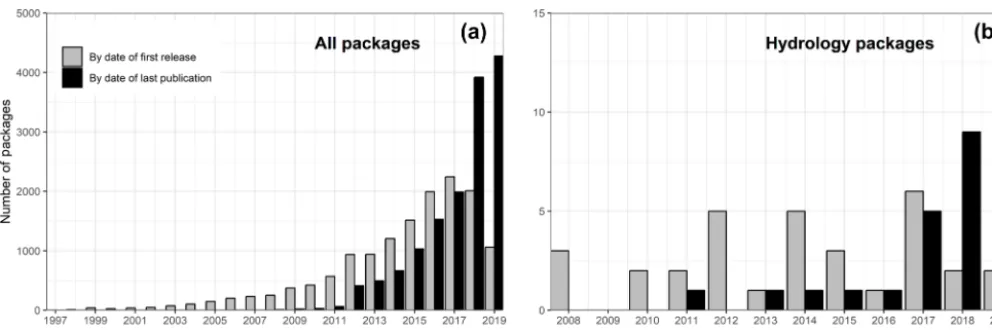
ver-satile and has a wide range of uses, including data acqui-sition and provisioning, manipulation, analysis, modelling, statistics, visualization, and even well-developed geospatial and geographic information system (GIS) applications. R can be used for generating reports, making interactive pre-sentations for teaching or conferences, or even prototyp-ing dashboards and web applications. One of the greatest strengths of R is its extremely active community of users, who, in the past 25 years, have developed and released in the public domain more than 14 000 packages spanning many scientific disciplines. The Comprehensive R Archive Net-work (CRAN; https://cran.r-project.org) is the main repos-itory for these packages, hosted by a network of FTP and web servers around the world. The abrupt increase in the number of hydrological package updates in 2018–2019 ex-emplifies the growing importance of the language in hydrol-ogy and strengthening of the community (Fig. 1). These de-velopments have allowed the R language to fit comfortably in production-ready ecosystems (e.g. web applications) and take advantage of cutting-edge technologies and tools for im-proving reproducibility, testing, and continuous integration.
This paper aims to provide a broad overview of the utility of R in the hydrological sciences and of important develop-ments in recent years. In Sect. 2 we provide a summary of the many benefits and advantages of using R in hydrology. In Sect. 3 we describe some of the key hydrological packages that have been developed by the community as well as gen-eral packages of broad application in the sciences. In Sect. 4 we discuss some of the challenges that the hydrologic R users (R-Hydro) community faces, including tools and solutions to overcome these challenges. Finally, in Sect. 5 we list some of the future directions to strengthen the computational hydrol-ogy community.
Figure 1.The number of R packages available on CRAN (1997–2019). All packages are shown in(a), and hydrology packages only (defined as those that include the string “hydro” within the package metadata; erroneous packages containing terms like hydrocarbon were removed) are shown in(b). Bar colours indicate number of packages published based on (1) date of first release (grey bars; https://cran.r-project.org/ src/contrib/Archive/) and (2) date of last publication – i.e. most recent publication date of packages that are currently available on CRAN (black bars; https://cran.r-project.org/web/packages/available_packages_by_date.html). In both cases each package is counted only once; for example the packagehydroTSMwas first released in 2010 (grey), but its most recent update was in 2017 (black). The script to produce this figure is provided in the Supplement. Data were downloaded from CRAN on 23 June 2019; thus the year 2019 is incomplete.
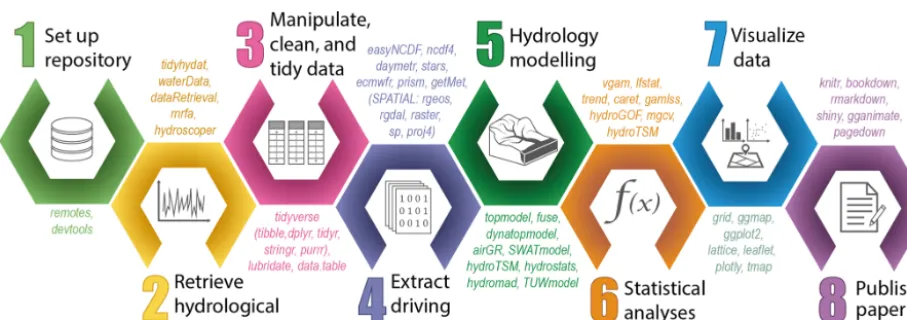
collated in an R Script; together, multiple scripts may con-stitute a hydrological workflow (see Fig. 3). A high level of documentation and support exists for each of the tasks within a hydrological workflow, including a diverse range of pack-ages (see Sect. 3). R users may search for R-relevant con-tent (such as expressions, packages, and functions) using the dedicated Internet search engine, RSeek (https://rseek.org), as well as generalist search engines. For many R newcomers, the initial hurdle is finding the time required to gain a basic understanding of R itself; but these efforts pay off rapidly as one learns how to find solutions on the Internet (see Sect. 2.5) and to navigate help files provided within R.
One of the advantages of writing a script is that it can be reused and improved incrementally over time so that the author never has to repeat a task manually (in contrast to point-and-click software that lacks a programmatic inter-face). Moreover, the same script can be reused repeatedly by different people to reproduce a given result (avoiding dupli-cation of efforts) or to analyse different data, e.g. different catchments, different types of gridded data, or the same data at different points in time. Thus, scripts written in R (or other languages) have wide-ranging benefits, as they facilitate the testing and quality control of the scientific workflow, can be shared and improved by a team of users, lessen the risk of making manual mistakes, and significantly enhance the speed with which analyses can be conducted and updated.
Recent developments in R have contributed to enhancing open science and numerical literacy in the hydrological sci-ences. R’s ease of access and use has improved what might be termed “scientific computing literacy” within the hydro-logical community. Volunteer projects such as the Software Carpentry (Wilson, 2006, 2014) have been teaching basic
Figure 2.The EGU short course Using R in Hydrology, 11 April 2018.
Figure 3.A typical hydrological workflow in R, containing eight steps. A selection of relevant R packages used within each script is indicated in coloured text; these packages are described in further detail in Sect. 3.1 to Sect. 3.8.
graphs, tables, and maps (e.g. Fig. 6). They can be fixed (e.g. a non-interactive web page) or dynamic (e.g. allow-ing users to alter input values and see how outputs change virtually in real time). Hydrologists have increasingly em-ployed dashboards to display their analyses in an interac-tive, user-friendly manner, using packages such asplotly, a graphing library that makes publication-quality graphs online (Sievert, 2018), the shiny web application frame-work (Chang et al., 2015),shinydashboard(Chang and Borges Ribeiro, 2018), or the flexdashboard package (Iannone et al., 2018). Additionally, free services such as RPubs (a free web-publishing platform; https://rpubs.com) and the aforementioned plotlyenable the publishing of these static or interactive documents and visualizations on-line. In doing so, these publishing services facilitate immedi-ate interaction and knowledge transfer.
2.2 Enhancing reproducible hydrological research and open science
Reproducibility is a key feature of the scientific method and can be broadly defined as the ability for the community to
reproduce and verify previous findings. Encouraging repro-ducible practices helps reduce the likelihood of errors (meth-ods can be tested by other researchers) while increasing the uptake of any positive developments within a discipline (Hut-ton et al., 2016). However, scientific research is increasingly under fire for its lack of reproducibility due to an inadequate methodology description (Ceola et al., 2015) and model and data availability. True reproducibility requires more than the mere repeatability of results with the same computer code and data: one must also be able to reproduce a study’s con-clusions when testing the theory with different data or a dif-ferent model set-up (Melsen et al., 2017).
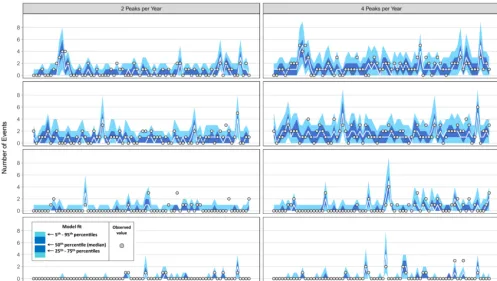
[image:4.612.73.527.247.407.2]“trace-Figure 4.An example of a figure in a paper produced in R with the packageggplot2using the facet_grid function, which allows the user to split a dataset by categories (rows and columns). Here, a probabilistic time-seriesGAMLSSmodel of flood frequency at one gauging station in Ohio, USA, is shown for four different seasons (rows) and two peak-over-threshold quantities (columns: two to four peaks per year). The probabilistic model is plotted in the background as colour ribbons (using geom_ribbon), and the observed values are plotted in the foreground as grey circles (geom_point). Source: Neri et al. (2019).
able” on the CRAN via their ORCID (Open Research and Contributor ID) number, which provides an indication of whether they also authored any corresponding scientific pa-pers. The CRAN Task Views provide guides to the pack-ages and tools that exist on CRAN for the different dis-ciplines. Note that many packages are submitted to online repositories such as GitHub that never make it to CRAN for a range of reasons, but this does not necessarily make them less reliable. The Task Views provide a list of tools which can enhance reproducibility in R (see https://cran. r-project.org/web/views/ReproducibleResearch.html). Rely-ing on well-established publishRely-ing platforms such as CRAN and GitHub has promoted the use of best practice in writ-ing R code. Packages such as rhub (Csárdi, 2017) pro-vide code checks for packages on certain operating systems, whileroxygen2helps users create documentation for their R packages (Wickham et al., 2018a). Other initiatives, such as rOpenSci (carefully vetted scientific R software tools; see https://ropensci.org) and their code peer review, have facili-tated the implementation of best practice whilst holding au-thors to scientific scrutiny.
Journals in the field of hydrology such asHydrology and Earth System Sciences,Water Resources Research, and the American Society of Civil Engineers (ASCE) journals
Jour-nal of Water Resources Planning and Managementand Jour-nal of Hydrologic Engineeringnow actively encourage au-thors to publish the data and computer codes underlying the results presented in their papers. The journalNature states that a manuscript can be rejected if the code used to generate new analyses cannot be provided to the editors and review-ers. Despite the advantages of sharing hydrological code, few computational hydrologists do this because cleaning and an-notating the code places an additional burden on the pub-lishing time frame. However, it is reasonable to assume that as more journals require submission of codes with papers, the community of computational hydrologists (and associ-ated fields) will continue to grow and strengthen the field. In addition to the sharing of open-source code, reproducibility experts also advocate the use of software tool sets such as version control, scripting, container technology, and compu-tational notebooks to enhance the reproducibility of scien-tific results (Perkel, 2018). Hydrological tutorials, vignettes, or teaching documents increasingly implement literate pro-gramming (Sect. 2.1), where the code and results are de-scribed in plain English within the same document or web page.
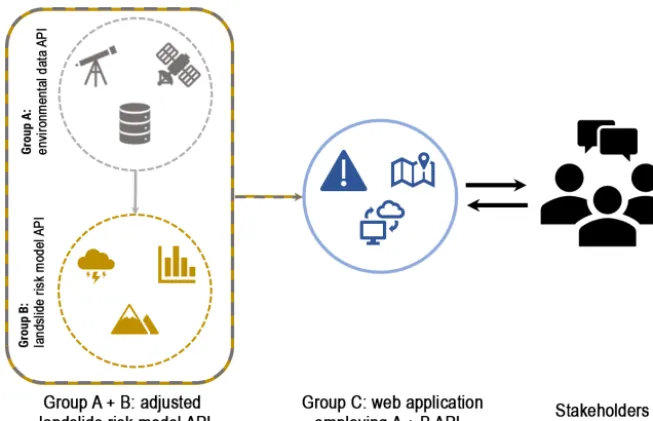
[image:5.612.50.547.66.346.2]Figure 5.Use-case scenario for implementation of APIs developed within hydrological sciences. Group A collates the most recent earth-and ground-based observations of learth-and cover, topography, earth-and climate data for an in-house project yet allows an API to interact with an analysis-ready, spatially explicit dataset for their region of interest. Group B is interested in geomorphological processes and has developed a model to predict likely occurrence of mass movements, which they also provide access to via an API. During a period of extreme rainfall over a scientifically unrelated region, both groups decide to adjust their methods and API to provide pertinent data (group A), which feed into predictions of landslide risk (group B). Finally, a disaster relief organization (group C) can swiftly act and use the outputs from the adapted API (A+B) to develop a simple web application with maps and warnings for use by the general public in the affected area.
are discussed in Sect. 3. These initiatives include the Hy-droShare web-based system for sharing hydrologic data and models, which allows hydrologists to visualize, analyse, and work with data and models on the HydroShare website (e.g. creating and publishing a web app resource; Essawy et al., 2018). Additionally, the Sharing Water-related Information to Tackle Changes in the Hydrosphere for Operational Needs (SWITCH-ON) virtual laboratory aims to explore the poten-tial of open data for water security and management (Ceola et al., 2015). The reproducibility agenda has benefited from strong political and financial support, with European Union projects like FOSTER Plus (Fostering the practical imple-mentation of Open Science in Horizon 2020 and beyond) that aim to encourage open science. The European Commission’s Science with and for Society programme, implemented as part of Horizon 2020 (European Commission, 2015, p. 17), similarly noted that the reuse of research data generated with public funding should have beneficial impacts for science, the economy, and society. As such, open science is expected to encourage interdisciplinary research and is considered a key approach to tackle the grand challenges of our time.
2.3 Providing statistical tools for hydrology
There are many different types of software for statistical analysis, but R is still considered the most powerful and pop-ular language and environment for statistical computing. For example, a search for the word “statistics” on Stack
Over-flow, the question and answer website for programmers, on 18 May 2019 generated 12 339 results with the tag “R”, 9582 results with Python, 4916 with Java, 2623 with C#, and 48 with Fortran. R is GNU S, a language which can be described as the modern implementation of the S lan-guage (Becker and Chambers, 1984; Chambers, 1998), and is specifically optimized for statistical computing. In addi-tion to the standard statistical techniques within base-R (i.e. the inbuilt basic functions that define R as a language), R also provides access to a large variety of advanced and re-cent statistical packages, which have been developed by its user community of statisticians and statistically minded sci-entists working in a range of research fields. When compar-ing R with other similar open-source languages, users often describe R’s unique selling point as the vast number of sta-tistical packages which liken it to a free, community-driven statistical software.
The statistical and graphical packages provided in R are particularly useful for the hydrological sciences and include techniques such as linear and non-linear modelling, statisti-cal tests, time-series analysis, classification, or clustering. A description of specific statistical packages relevant to hydrol-ogy is provided in Sect. 3.6.
2.4 Connecting R to and from other languages
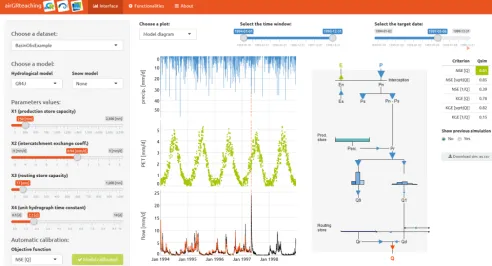
Figure 6.TheairGRteachinginterface that is used for teaching hydrological modelling. Students can choose a catchment dataset and a hydrological model and activate a snow model on the top left panel of the interface. Modifying the parameters values (on the left) by using the sliding bars will automatically update the graphs and scores displayed (on the right). This interface highlights in an interactive manner the basic principle of the rainfall–runoff relationship and its description in hydrological models. At the bottom left of the interface, an objective function can be chosen and an automatic calibration procedure can be launched within the interface.
the 1950s (e.g. Backus, 1978), and C in 1972 (e.g. Ritchie, 1993); proprietary commercial languages, e.g. MATLAB®, initially released in 1984 (MathWorks, 2018); and more re-cent open-source languages like Python, which appeared in 1990 (e.g. Sanner et al., 1999; Guttag, 2013), R in 1993 (e.g. R Core Team, 2018; Ihaka, 1998), and Julia in 2012 (Bezan-son et al., 2012).
S and R were both built using algorithms implemented mostly in Fortran and sometimes in C (Chambers, 2016, p. 55), which is why R can be connected natively to both languages. Interconnections between R and other languages can be very useful for taking advantage of each language’s strengths or using pre-existing scripts that were originally written in other languages. For example, C and Fortran are both efficient in performing loop tasks. This is the reason why the apply function loops are coded in C. TheairGR hy-drological models (Coron et al., 2017, 2018) also make use of Fortran in order to take advantage of its CPU efficiency.
R can also be connected to different languages using a range of packages, e.g. C++ (package Rcpp; Eddel-buettel and Balamuta, 2017) and Java (package rJava; Urbanek, 2018). Connections to Python can be achieved with the packages reticulate (Allaire et al., 2018b),
rPython (Bellosta, 2015), rJython (Grothendieck and
Bellosta, 2012), and XRPython(Chambers, 2017). Addi-tionally, R can also be connected to JavaScript (e.g. pack-ageV8; Ooms, 2017), MATLAB (e.g. packageR.matlab; Bengtsson, 2018), or Julia (packages JuliaCall and
XRJulia; Chambers, 2018; Li, 2018). Conversely, connect-ing other languages to R is also possible. For example,rpy2
(Gautier, 2018) is the Python interface to the R language and runs an embedded R, providing access from Python using R’s own C application programming interface (API). The Python library pyRserve (Heinkel, 2017) also connects Python with R using Rserve (a TCP/IP server which allows other programs to use facilities of R). TheRCallpackage allows users to call R from Julia (Bates et al., 2015).
2.5 Interacting with the R-Hydro community: scientific resources and courses
(https://stackoverflow.com) is the go-to online discussion fo-rum for any user, from beginners to expert developers, and provides code snippets to solve a wide range of common problems. In addition, the R Project also offers thematic mailing lists (https://www.r-project.org/mail.html), relating to usage (R-help), package development (R-package-devel), and language development (R-devel), in order to help oth-ers, report bugs, or propose solutions. More recent but al-ready extremely active is the RStudio Community forum (https://community.rstudio.com), which includes users inter-ested in RStudio-developed applications and packages.
A wide range of scientific resources, including online manuals and tutorials in several languages, have been de-veloped by the community. The rOpenSci project (https: //ropensci.org) brings together a community of volunteers who promote the open development of packages in a non-profit initiative by reviewing scientific R packages before they are uploaded to CRAN. rOpenSci has contributed no-tably to the development of best practice through free code reviews and targeted or invited blog posts. Resources can be found in many places online, such as the Journal of Open Source Software(JOSS), which hosts a wealth of short pa-pers documenting R packages.
Short courses, i.e. voluntary training sessions for R users run during conferences like the European Geosciences Union (EGU) General Assembly, have also grown in popularity in the hydrological community in recent years (Fig. 2). Since the 2017 EGU General Assembly, the Using R in Hydrol-ogy short course has been organized in conjunction with the Young Hydrologic Society (YHS; https://younghs.com) as part of the annual Hydrological Sciences division pro-gramme. The core aim of the short course is to bring to-gether the R-Hydro community, including both users who are learning to program and advanced users who are either teaching computational hydrology or developing packages for hydrological analysis. Recent advances in R for hydrol-ogy applications are demonstrated during the short course, and a platform for open discussion between guest speak-ers and course participants is provided. By rotating topics each year, a valuable repository of slides, code examples, and follow-up material is provided to the community on GitHub (https://github.com/hydrosoc; see Sect. 5.6 for further infor-mation). It is also worth noting that a regular short course is also run at the EGU on R package development. In addi-tion to the EGU, other regular conferences and meetings such as those run by the International Association of Hydrologi-cal Sciences (IAHS) and the Prediction in Ungauged Basins (PUB; PUB Summer School) also organize R courses during their meetings. The IAHS Statistical Hydrology (STAHY) commission regularly organizes workshops and short courses on various statistical topics, which typically come with a computer-based component in R.
Finally, it is worth mentioning that the continued growth of the R community is supported by the R Consortium (https: //www.r-consortium.org/about), a group with an open-source
governance and foundation model that supports the world-wide community of users, maintainers, and developers of R software. The R Consortium provides support to the com-munity in multiple ways. One example of such support is the grant programme run by the R Consortium’s Infrastruc-ture Steering Committee (ISC), which funds development of projects seeking to promote improvement of the R infrastruc-ture and to achieve long-term stability of the R community.
3 R packages in a typical hydrological workflow R is an ever-growing environment, as can be seen in the num-ber of R packages that are developed every year (Fig. 1). There are now hydrological packages for every step of a standard hydrological workflow (Fig. 3); we describe each of these steps in subsequent sections.
3.1 Setting up a repository and finding the right packages
Setting up a repository with version control (i.e. a review-able and restorreview-able history) at the start of a research project has many advantages. A repository is a structured set of files that will track edits any team member makes to the project, similar to the track-changes function in common word pro-cessors. In R, version control can be implemented quite sim-ply by connecting RStudio with Git or Subversion through hosting services like Bitbucket, GitHub, GitLab (which are like Dropbox for code). There are just a few initial steps to set up a repository. These include (1) creating a local directory (folder) to host your (RStudio) project, (2) creat-ing a Git or a Subversion repository online, and (3) link-ing the two. Beyond those three steps, all the user needs to do is regularly commit (i.e. save) their code together with a very brief summary of the changes made. These changes can then be uploaded, updating and synchronizing the online repository with labelled annotations (username and times-tamp). The repository can be public or private, with differ-ent levels of administrator access for users. Many tutorials on how to set up a repository in R can be found online. One example is the Software Carpentry course on R for Re-producible Scientific Analysis (https://swcarpentry.github.io/ r-novice-gapminder/), which also provides valuable sugges-tions on how to structure a project repository (e.g. with read-only source data, disposable generated data, and folders such as “scr” for scripts and “doc” for documentation).
the CRAN in January 2019 and lists over a hundred pack-ages under the following categories:
– Data retrieval. This includes hydrological data sources (surface or groundwater, both quantity and quality) and meteorological data (e.g. precipitation, radiation, and temperature, both measurements and reanalysis). – Data analysis. This includes data tidying (e.g. gap
fill-ing, data organization, and quality control), hydrograph analysis (functions for working with streamflow data, including flow statistics, trends, and biological indices), meteorology (functions for working with meteorologi-cal and climate data), and spatial data processing. – Modelling. This includes process-based modelling
(scripts for preparing inputs and outputs and run-ning process-based models) and statistical modelling (hydrology-related statistical models).
Additionally, many of the other 38 Task Views that were available in January 2019 were relevant to hydrology (https: //cran.r-project.org/web/views). For example, the Environ-metrics Task View contains a Hydrology and Oceanography section, and the High-Performance and Parallel Computing with R Task View can also be useful for hydrologists us-ing large amounts of data. Other relevant Task Views cover a range of topics such as time-series analysis, machine learn-ing, or spatial analysis.
One last way of discovering relevant and useful hydrolog-ical packages is social media, such as Twitter, where many hydrologists share their most recent publications as well as links to useful resources and packages. Some of the Twitter handles that highlight relevant packages for computational hydrology include the USGS group supporting R scientific programming (https://twitter.com/USGS_R) or the rOpenSci page (https://twitter.com/ropensci).
3.2 Packages for retrieving hydro-meteorological data One of the most useful computational advances in recent years has been the development of packages designed specif-ically to retrieve data from online hydrological archives. Dif-ferent packages have been designed for importing hydro-metric data from repositories such as dataRetrieval
for the US Geological Survey (USGS) National Water In-formation System (Hirsch and De Cicco, 2015) or rnrfa
for the UK’s National River Flow Archive (Vitolo et al., 2016a). Many of these packages provide vignettes that il-lustrate how to use the functions. For example, the USGS’s
waterDatapackage allows the user to import USGS daily hydrological data from the USGS web services, plot time-series data, fill in missing values, or visualize anomalies over a range of timescales (e.g. 1 year, 30 d, or 1 d) in just a few lines of code (see thewaterDatapackage vignette on the CRAN; Ryberg and Vecchia, 2017). Other relevant packages are listed in Table 1.
Additionally, many data retrieval packages that are rele-vant to hydrological analyses have been developed by related scientific disciplines, such as meteorology and climatology. In the future it seems likely that most water and meteoro-logical agencies around the world will facilitate access to these data via APIs and open-source packages (see Sect. 5.4 for further information on APIs and the possible future of hydro-meteorological data provision). Table 1 is far from ex-haustive, and there are many other relevant packages that are available on CRAN. For example, the newecmwfrpackage provides a straightforward interface to the public ECMWF Web API Services and the Copernicus Climate Data Store (CDS), where open datasets such as the ERA5 reanalysis are openly available (Hufkens, 2018).
3.3 Packages for reading, manipulating, and cleaning the data
Once data have been retrieved or downloaded, a broad range of packages are available for reading different types of data and their associated metadata. However, these packages are not specifically hydrological and so will be discussed here with brevity. Note that in many cases, for example with the
dataRetrievalpackage, the data are imported directly into the R workspace. Basic data formats such as csv and txt can be read with base-R (read.table function) or with ad-ditional packages that form part of thetidyverse pack-age suite (Wickham, 2017), which facilitate reading a range of formats including XLS(x), TSV, and FWF (e.g. package
readr; Wickham et al., 2018b). Therio package facili-tates data import and export by making assumptions about data structure from the file extension (Chan et al., 2018).
For reading or writing netCDF files, a number of pack-ages likencdf4(Pierce, 2017),easyNCDF(BSC-CNS and Manubens, 2017), stars (Pebesma, 2018b), or raster
(Hijmans, 2017) can be used. GRIB files can also be handled with packages such asraster orgribr (Wendt, 2018). There is still relatively minimal support for Open Geospatial Consortium (OGC) services in R, although there are some packages such assos4R(of which a new version is expected to be released on CRAN soon),ows4R(Blondel, 2018b), or
geometa(Blondel, 2018a).
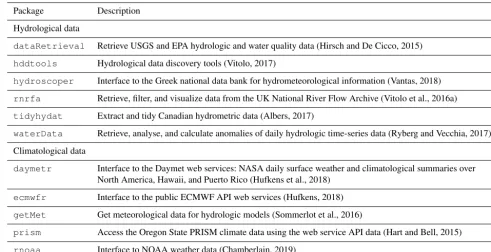
Table 1.Examples of packages for hydrological and/or meteorological data retrieval. See the Hydrology Task View for latest additions (https://cran.r-project.org/web/views/Hydrology.html).
Package Description
Hydrological data
dataRetrieval Retrieve USGS and EPA hydrologic and water quality data (Hirsch and De Cicco, 2015)
hddtools Hydrological data discovery tools (Vitolo, 2017)
hydroscoper Interface to the Greek national data bank for hydrometeorological information (Vantas, 2018)
rnrfa Retrieve, filter, and visualize data from the UK National River Flow Archive (Vitolo et al., 2016a)
tidyhydat Extract and tidy Canadian hydrometric data (Albers, 2017)
waterData Retrieve, analyse, and calculate anomalies of daily hydrologic time-series data (Ryberg and Vecchia, 2017)
Climatological data
daymetr Interface to the Daymet web services: NASA daily surface weather and climatological summaries over North America, Hawaii, and Puerto Rico (Hufkens et al., 2018)
ecmwfr Interface to the public ECMWF API web services (Hufkens, 2018)
getMet Get meteorological data for hydrologic models (Sommerlot et al., 2016)
prism Access the Oregon State PRISM climate data using the web service API data (Hart and Bell, 2015)
rnoaa Interface to NOAA weather data (Chamberlain, 2019)
3.4 Packages for extracting driving data, spatial analysis, and cartography
In the past, R may have been a less powerful alternative to the more established spatial software for processing large datasets and extracting information. Now, however, R can be parallelized more easily than other software (harnessing the power of multiple processor cores to handle large datasets) and can integrate GIS analyses within a complete, automated hydrological workflow, which includes data processing steps (before or after any GIS analyses) and any subsequent statis-tical analyses. It is this integration of GIS as one step within the hydrological workflow that makes R extremely attractive. As a result, in recent years, R has become the go-to method for geocomputation and geostatistics and can now be used as a GIS in its own right. Multiple books have been published on the topic of spatial analysis and mapping with R (Bruns-don and Comber, 2015) or, more broadly, geocomputation with R (Lovelace et al., 2019), which includes topics such as reading and writing geographic data and making maps in R.
Many methods are now implemented within R for han-dling vectorial data, with packages such assp(Pebesma and Bivand, 2005; Bivand et al., 2013) for plotting data as maps or, for spatial selection, the packagergdal(Pebesma and Bivand, 2005; Bivand et al., 2013), which provides bindings to the Geospatial Data Abstraction Library (GDAL) for read-ing and writread-ing data and access to projection and transfor-mation operations from the PROJ.4 (Urbanek, 2012) library, packagergeos(Bivand and Rundel, 2018), which provides
an interface to the Geometry Engine Open Source (GEOS) library for geometrical operations, or packagesf(Pebesma, 2018a), which provides support for simple features to encode spatial vector data. Version 3.0 ofggplot2offers support for visualizingsfobjects directly with a specific geometric object (geom_sf), which allows users to visualize spatial data (raster and shape files) easily. There is also a range of pack-ages for handling raster data, likeraster(Hijmans, 2017), which can be used to read, write, manipulate, analyse, and model gridded spatial data, andstars(Pebesma, 2018b) for reading, manipulating, writing, and plotting spatio-temporal arrays. With all these packages, R now has full cartogra-phy and mapping functionality and can produce sophisticated maps that are either static or interactive. Packages such as
cartography(Giraud and Lambert, 2016) ortmap (Ten-nekes, 2018) can both be used for creating symbols, choro-pleth, or other types of maps and for facilitating the visual-ization of spatial data distributions in thematic maps. These two packages are quite similar in content but not in form:
cartographyuses the painter’s model, whiletmapuses The Grammar of Graphicsand allows users to draw static and dynamic maps with the same code. Additionally,ggmap
(Kahle and Wickham, 2013) is commonly used for visual-izing, geolocating, and routing spatial data on top of static maps such as Google Maps;RgoogleMapsis used to in-teract with Google Maps, while the JavaScript leaflet
capa-bilities. R can access ArcGIS geoprocessing tools (ESRI, 2018) by building an interface between R and the ArcPy Python side package using theRPyGeopackage (Brenning et al., 2018b). R can also call wrappers for GDAL–OGR util-ities (GDAL Development Team, 2018) usinggdalUtils
(Greenberg and Mattiuzzi, 2018). There are also interpreted interfaces between the GRASS GIS (GRASS Development Team, 2019) and R from within the GRASS environment or from R using the packages spgrass6 (Bivand, 2016) or rgrass7 (Bivand, 2018). R can be integrated with the QGIS software (QGIS Development Team, 2018) using
RQGIS(Muenchow et al., 2017) or with SAGA GIS (SAGA Development Team, 2008) using RSAGA (Brenning et al., 2018a).
3.5 Packages for hydrological modelling
The next step in a typical hydrological workflow is to conduct hydrological modelling by using the data inputs prepared in previous steps. Hydrological modelling often proceeds by simplifying hydrological processes to test hypotheses about the water cycle, manage water resources, reconstruct incom-plete flow time series, predict extreme events (floods or low flows), or anticipate the effects of future climatic or anthro-pogenic changes. In Table 2 we highlight some of the key packages that facilitate the implementation of certain hy-drological models in R. As R can be used for every step within the hydrological modelling process, from importing and cleaning data to exploratory analyses, data modelling, data analysis, and graphical visualization, it represents an ideal language for hydrological modellers.
Several well-known hydrological models are provided in these packages, such as the HBV model in the
TUWmodel package (Viglione and Parajka, 2019), TOP-MODEL in the packagestopmodel(Buytaert, 2018) and
dynatopmodel (Metcalfe et al., 2015, 2018), SWAT in
SWATmodel (Fuka et al., 2014), GR4J inairGR (Coron et al., 2017, 2018), andhydromad(Andrews et al., 2011; Andrews and Guillaume, 2018). Some packages also in-clude degree-day snow models (e.g. airGR, hydromad, and TUWmodel) that are used in nival basins to simulate the accumulation and melt of the snowpack, which greatly impacts the flow regimes. Many of the models included in these packages are lumped (i.e. consider the catchment as a single unit with area-averaged variables) or conceptual (i.e. provide a simplified representation of the physical processes with empirical equations describing the interactions between the processes) models. Some packages, such asTUWmodel
and topmodel, allow a spatial distribution of the hydro-logical processes.TUWmodel, for instance, allows the user to implement a semi-distributed application with differentia-tion into elevadifferentia-tion zones, whiletopmodelallows the user to make topographic index classes from a topographic index map. The FUSE model (Clark et al., 2008), originally im-plemented in Fortran, is still actively developed and also has
a dedicated R package called fuse (Vitolo et al., 2016b) that is a re-implementation of the FUSE 2011 model. The vast majority of the models in the above packages are deter-ministic; however, thefusepackage can also provide en-sembles of conceptual lumped hydrological models, and the
hydromadpackage is intended to provide a flexible frame-work for assembling different soil moisture accounting and routing schemes.
The above packages typically allow the user to run the hydrological models, and usually provide some sample in-put data, with executable examples. Some packages provide optimization algorithms, criteria calculation, and dedicated plotting functions (e.g.airGRandRHMS). Developing hy-drological modelling packages in R is relatively straightfor-ward because of the language’s flexibility; additionally, as discussed in Sect. 2.4, R can be connected to other pro-gramming languages. This property allows R users to embed model codes that already exist into R and provides a more friendly environment, as many packages ease the analysis of data and model simulations.
3.6 Packages for hydrological statistics
R was initially developed as a statistical computing language and is still the primary language in which novel statistical methods are coded and distributed. Statistical approaches are employed for an extremely wide range of tasks in hydrology, and it is virtually impossible to give complete coverage of all possible packages that might be useful to hydrologists. The
skimrpackage provides compact and flexible summaries of data; it can be used with pipes and displays nicely in the console. Many estimating procedures can be carried out using the base-Rstatspackage, which includes, for ex-ample, correlation analysis and Mann–Kendall testing, lin-ear regression, Poisson regression, and Gamma regression. There are also generalist packages for non-parametric trend tests such astrend(Pohlert, 2018), which includes a broad range of tests for trend detection, correlation, and detection of change points or non-randomness. Many general mod-elling packages have been found to be useful by hydrologists, for examplemgcv(Wood, 2017),VGAM(Yee et al., 2015), andGAMLSS(Rigby and Stasinopoulos, 2005), which im-plements generalized additive regression models for a large number of distributional families. Whilemgcvcan be useful for more complex smoothing approaches (e.g. tensor prod-uct smooths or varying coefficient models), the focus of
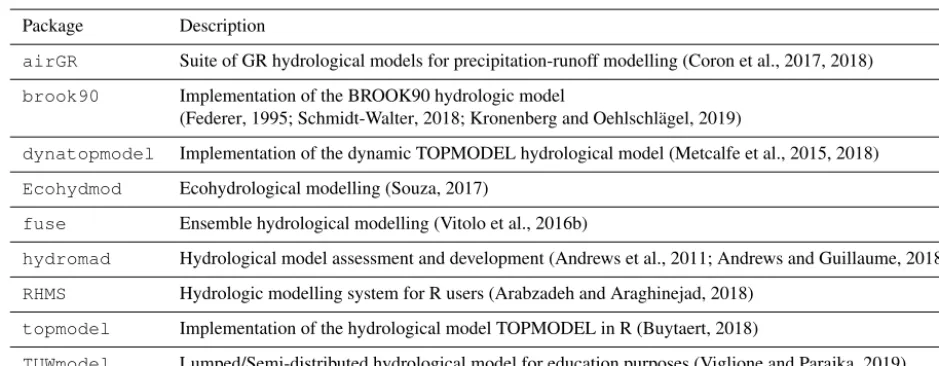
al-Table 2.Examples of packages for hydrological modelling. See the Hydrology Task View for latest additions: https://cran.r-project.org/web/ views/Hydrology.html.
Package Description
airGR Suite of GR hydrological models for precipitation-runoff modelling (Coron et al., 2017, 2018)
brook90 Implementation of the BROOK90 hydrologic model
(Federer, 1995; Schmidt-Walter, 2018; Kronenberg and Oehlschlägel, 2019)
dynatopmodel Implementation of the dynamic TOPMODEL hydrological model (Metcalfe et al., 2015, 2018)
Ecohydmod Ecohydrological modelling (Souza, 2017)
fuse Ensemble hydrological modelling (Vitolo et al., 2016b)
hydromad Hydrological model assessment and development (Andrews et al., 2011; Andrews and Guillaume, 2018)
RHMS Hydrologic modelling system for R users (Arabzadeh and Araghinejad, 2018)
topmodel Implementation of the hydrological model TOPMODEL in R (Buytaert, 2018)
TUWmodel Lumped/Semi-distributed hydrological model for education purposes (Viglione and Parajka, 2019)
lows the user to develop an impressive range of predictive models (e.g. neural networks, deep learning, and decision trees).
There are many packages available for common hydro-logical tasks. A comprehensive set of functions for carry-ing out extreme value analysis (Coles, 2001) can be found in the extRemespackage (Gilleland and Katz, 2016), and a more complete overview can be found in the CRAN Ex-treme Value Analysis Task View.nsRFAconsists of a col-lection of statistical tools for objective (unsupervised) appli-cations of the regional frequency analysis methods in hydrol-ogy (Viglione, 2018). L-moments can be implemented using the lmom Hosking (2019b) package, while the lmomRFA
package (Hosking, 2019a) enables regional frequency anal-ysis. The lfstat (Koffler et al., 2016) package provides functions to compute statistics and plots for low flows sim-ilar to those in the manual on low-flow estimation and pre-diction (WMO, 2009). Many of the standard model evalu-ation metrics are provided directly within these packages. The caretpackage, for instance, imports other packages, such as ModelMetrics(Hunt, 2018), to facilitate model evaluation directly. A range of packages have also been de-veloped specifically for model evaluation. The hydroGOF
package (Zambrano-Bigiarini, 2017a) provides goodness-of-fit functions specifically for comparison of simulated and ob-served hydrological time series. In Table 3 we present a brief overview of some other packages for hydrological statistics. For a broader overview of available packages and further ex-amples, we point the reader to the CRAN Task View on ma-chine learning and statistical learning (https://cran.r-project. org/web/views/MachineLearning.html).
3.7 Packages for static and dynamic hydrological data visualization
Data visualizations play an important role in hydrological analysis: R makes them straightforward to implement and allows considerable flexibility. R includes three main fami-lies of graphics packages: a painter model, natively present in R and based on the S language’s GR-Z model (Becker and Chambers, 1977), the trellis graphs (e.g. thelattice pack-age; Sarkar, 2008) initially implemented in S, andThe Gram-mar of Graphics(Wilkinson, 1999). The last two families are both based on thegridpackage (R Core Team, 2018), a low-level abstraction layer that allows the development of graphical packages with different philosophies, which means that the created graphics can be stored in objects to be up-dated and plotted again later.
[image:12.612.63.533.95.278.2]Table 3.Examples of packages for hydrological statistics.
Package Description
berryFunctions Function collection related to plotting and hydrology (Boessenkool, 2018)
hydroGOF Goodness-of-fit functions for comparison of simulated and observed hydrological time series (Zambrano-Bigiarini, 2017a)
hydrolinks Hydrologic network linking data and tools (Winslow et al., 2018)
hydrostats Hydrologic indices for daily time-series data (Bond, 2018)
hydroTSM Time-series management, analysis and interpolation for hydrological modelling (Zambrano-Bigiarini, 2017b)
lfstat Calculation of Low Flow Statistics for daily stream flow data (Koffler et al., 2016)
https://www.r-graph-gallery.com). ggplot2 also contains functions like “facets” (https://plot.ly/ggplot2/facet), which allow the user to split and plot the data by categories in many different rows or columns. Figure 4 provides a hydrologi-cal example of faceting where a statistihydrologi-cal model is visu-alized for different seasons (rows) and different peak-over-threshold quantities (columns).
Dynamic charts – where the user can, for instance, hover over one or multiple points to read the associated data or metadata (e.g. a hydrometric station number or the value of a point) – have also grown in popularity in hydrological analyses in recent years. These dynamic graphics are par-ticularly useful in inspecting data, such as outliers, or ex-plaining an analysis when teaching hydrology in the class-room (e.g. by zooming in on different parts of a time se-ries). Dynamic graphics including maps can be created by using the plotly package (Sievert, 2018), a graphic li-brary that allows the user to make graphs interactive with minimal extra code. A number of JavaScript-based visual-ization libraries can also help achieve dynamic graphics. For interactive time-series data requiring axis display fea-tures such as zooming and panning and highlighting of se-ries and points, thedygraphspackage (Vanderkam et al., 2018) provides an interface to the JavaScript charting li-brary. Themanipulatepackage (Allaire, 2014) allows the user to easily add sliders and other control tools to other-wise static plots. Other JavaScript-based packages include
rbokeh (Hafen and Continuum Analytics, Inc., 2016), which provides an interface to Bokeh, allowing the user to create web-based plots with hover and dynamic functional-ities.rAmCharts(Thieurmel et al., 2018) creates interac-tive charts based on the amCharts JavaScript library, while the highcharter(Kunst, 2017) package is based on the Highcharts JavaScript library of graphics. Examples of all of these implementations (includingleaflet,dygraphs,
plotly,rbokeh,highchart, and other visualization li-braries) can be found at https://www.htmlwidgets.org. We encourage the reader to explore these HTML widgets, as they show how simple it is to implement dynamic graphics with just a line or two of R code.
Choosing the appropriate colour gradients for hydrolog-ical graphs and maps is key. It is widely accepted now that certain colour schemes, and notably the infamous rain-bow colour scale, are poor choices for data visualization (Light and Bartlein, 2004; Stauffer et al., 2015). The rain-bow scheme has been shown to distort perceptions of data and alter meaning by creating false boundaries between val-ues; additionally it is not colourblind-safe, and other alterna-tives like perceptually uniform colour maps have been sug-gested (Crameri, 2018). The R language is strong in the area of colour gradients, and there are many colourblind-friendly palettes available for hydrology that follow effective data visualization guidelines (Kelleher and Wagener, 2011). There are both manually defined and predefined palettes us-ing packages such asRColourBrewer(Neuwirth, 2014),
colorspace(Zeileis et al., 2019),colorRamps(Keitt, 2012), or viridis (Garnier, 2018). For example, the
colorspacepackage can be used for colour palettes based on hue chroma luminance (HCL colour palettes are based on how humans perceive colour, in contrast to the RGB colour space, which is based on technical demands of TV/computer screens) in meteorological visualizations (Stauffer et al., 2015).
3.8 Packages for creating presentations and documents A vast array of packages have been developed in R for creat-ing dynamic presentations and documents, which are partic-ularly useful for illustrating hydrological concepts. Dynamic interfaces and web-based applications can be created with
shiny(Chang et al., 2015), such as theairGRteaching
Additionally, various packages have been designed to produce interactive maps, such as leaflet
(Cheng et al., 2018), leafletR (Graul, 2016),
plotGoogleMaps (Kilibarda and Bajat, 2012), or
googleVis (Gesmann and de Castillo, 2011). R also offers many tools for creating websites or blog posts, with packages like rmarkdown (Allaire et al., 2018c),
blogdown(Xie et al., 2017), orpkgdown(Wickham and Hesselberth, 2018).
Presentations, books, reports, and documents can be gen-erated in LaTeX, or Markdown, natively with Sweave func-tionalities or with packages such as knitr (Xie, 2018),
markdown (Allaire et al., 2018a), rmarkdown (Allaire et al., 2018c),pagedown(to paginate the HTML output of R Markdown with CSS for printing; Xie and Lesur, 2019), orbookdown(Xie, 2016). These packages facilitate the au-tomation of such documents (e.g. monthly reports) through in-line text tokens that are dynamically linked to data in R’s workspace.
4 Challenges and solutions when using R in hydrology 4.1 Hydrological libraries, documentation, and
vignettes
For most hydrologists who are new to R, the initial hurdle is understanding how to install libraries and use packages to explore their own datasets. The bookR packages(Wickham, 2015) is freely available online and explains everything from the basic installation of packages to the role of metadata, un-derstanding documentation, the role of vignettes, and best practice on GitHub (one common collaboration and version control platform).
R packages centralized on CRAN are structured similarly, with a reference manual, source code, a license file, and other common elements. The code and documentation of all ages is verified before they are uploaded to CRAN. R pack-ages ideally provide two forms of documentation: a short form (help pages) and a long form (vignettes), which are both complementary and serve different purposes (Wickham, 2015). The help pages explain what each function does, de-scribe the required input and the produced output, and usu-ally include a section with executable examples. Vignettes, in contrast, are tutorials that illustrate how R packages and their functions are used, often with discussion of the out-puts. However, not all packages include a link to a vignette on the CRAN repository, as this is not compulsory. Develop-ing clear and useful vignettes is one of the key challenges in facilitating the uptake of new packages and methods; in fact these are key to reducing the misuse of software and ensuring that the package users understand the methods. Use cases can be written as blog posts or tutorial-style papers, with expla-nation of how to correctly interpret and implement a specific method and helping the community move forward.
4.2 Integrated development environments (IDEs): facilitating the use of R
IDEs are software applications that are used to facilitate cod-ing by providcod-ing the code editor, compiler, or interpreter and debugger within a single graphical user interface (GUI). A range of IDEs exist for R, such as Eclipse – StatET, (an Eclipse-based IDE; e.g. des Riviêres and Wiegand, 2004; Wahlbrink, 2016), Emacs Speaks Statistics (ESS; an add-on package for GNU Emacs; Rossini et al., 2004), Microsoft’s R Tools for Visual Studio (RTVS; a plug-in for the Microsoft Visual Studio IDE; e.g. Beard, 2016), RKWard (which in-tegrates with the KDE desktop environment; Rödiger et al., 2012), Tinn-R (a replacement for the basic code editor de-signed to replace Rgui; Faria et al., 2008), or Vim or Neovim (a terminal-based working environment designed to facilitate working in a pure command-line interface; e.g. Neil, 2018).
The RStudio IDE (RStudio Team, 2018) is the most popu-lar of the IDEs. RStudio facilitates the uptake of R by hydrol-ogists by providing a helpful research tool and training envi-ronment to new and experienced programmers alike. RStudio is available in two editions: an opsource edition and an en-terprise edition with a commercial license. Both can run on a desktop (RStudio Desktop) or server (RStudio Server) and can be installed on different platforms (Windows, macOS, and Linux). Most hydrologists use the free RStudio Desk-top edition, although university departments and companies increasingly offer server editions too. RStudio’s features in-clude a console; a syntax-highlighting editor that supports direct code execution; integrated R help and documentation; support for version control systems; and tools for plotting, history, debugging, and workspace management.
The RStudio environment makes it straightforward for hy-drologists to conduct a range of tasks (e.g. visualize data; create dynamic graphs or web applications withshiny; use version control; or develop and view R Markdown presenta-tions, for example in LaTeX, HTML, or presentation slides), all within the IDE. Other advantages of RStudio include the easy access to the help window, the ease of package man-agement and updating, code debugging, or even the easy de-velopment of packages in one location. All of these benefits contribute to facilitating open hydrological science. RStudio version 1.2 includes many new features to help interact with other programming platforms, such as the reticulate
4.3 Big data and parallel computing challenges in hydrology
In the early years of R, the software was unable to han-dle large data files exceeding millions of rows or complex data formats. However, both of these limitations have since been overcome. Some of the early packages for handling large data files include bigmemory(Kane et al., 2013) or
biganalytics (Emerson and Kane, 2016), where ma-trices are allocated to shared memory and use memory-mapped files. More recently, the package data.table
(Dowle and Srinivasan, 2018) has gained increasing popu-larity for enhanced data frames, allowing fast aggregation of large data (e.g. 100 GB in RAM) or fast ordered joins. In hydrology, some of the spatial data handling packages are particularly relevant, such as thesfpackage (Pebesma, 2018a) for large shape files or the feather (Wickham, 2016a) package for feather files, a lightweight binary colum-nar data store designed for maximum speed. Database con-nections can be established using a range of packages such as
RPostgreSQL(Conway et al., 2017) orRSQLite(Müller et al., 2018). Distributed data frames can be implemented us-ing packages such assparklyr(Luraschi et al., 2018).
As the volume of available data increases and hydrologists use a greater number of models and ensembles, parallel com-puting – where many calculations are carried out simultane-ously instead of sequentially – has become an essential tool in computational hydrology and has sped up analyses. For instance, instead of using traditional for-loops (an approach where one action is carried out over a dataset iteratively), the data may be broken down into groups (e.g. by year or by sea-son), and functions can be applied to each group in parallel. The performance boosts that can be achieved by parallelizing the code (i.e. using more than one core at a time) are consid-erable. Even without access to a high-performance computer or cluster, it is possible to perform hydrological tasks faster, since most local machines now have between 4 to 16 cores. R has multiple facilities and packages for enabling the paral-lelization of code execution. At the most simple level, base-R functions like lapply and sapply can be used to apply a spe-cific function to a vector or list input, which can speed up analyses considerably. For instance, the base-Rparallel
package for distributed computing provides methods to ac-cess additional computational power by allocating available processing cores into a cluster. The foreach (Microsoft and Weston, 2017) anddoParallel(Microsoft Corpora-tion and Weston, 2018) packages can also be used together to execute “for-each” loops in parallel.
Other packages that are widely used for parallel computing in hydrology and other areas include thesnowfall(Knaus, 2015) package, which facilitates the development of parallel R programs, e.g. by including extended error checks. Addi-tionally, some packages have parallel functionalities that are integrated directly within the package, such as theh2o pack-age (LeDell et al., 2018) that provides an interface to H2O,
a scalable platform offering parallelized implementations of supervised and unsupervised machine learning algorithms.
5 A roadmap for the future of R in hydrology
As we have shown above, the development of R fosters progress in hydrology. In this section we discuss what we perceive as some of the future avenues for enhancing hydro-logical research or operational hydrohydro-logical practice with R and how we can achieve these as a community.
5.1 Sharing R code with the community
Open research practices bring significant benefits to re-searchers (McKiernan et al., 2016), such as increases in ci-tations, media attention, potential collaborators, job oppor-tunities, and funding opportunities. Most importantly, shar-ing code increases the likelihood that an approach will be used by other scientists in their research and saves new users the trouble of “reinventing the wheel” and writing codes that have already been developed by others. There are many dif-ferent platforms for sharing and publishing R code such as GitHub, Figshare, and RPubs or Plotly (also for dashboards and interactive plots). To obtain a DOI, users may wish to use repositories such as Zenodo, a general purpose open-access repository which allows researchers in the sciences and hu-manities to deposit datasets, research software, and create re-ports. The data publisher PANGAEA, additionally, is specif-ically tailored to archiving, publishing, and reuse of data in earth and environmental sciences. For further guidance, some of these platforms are discussed in the code and data policy section of the open-access journalGeoscientific Model De-velopment.
avail-able via the CRAN archive, ensuring that a certain standard and best practice are met. Although CRAN itself does not have any mechanism to check the quality or cleanness of the code, there is a suite of packages that are used to (i) ensure clean code and documentation that follow a widely accepted style guide, such as the lintr (Hester, 2018),
goodpractice(Csardi and Frick, 2018), andhunspell
(Ooms, 2018) packages and to (ii) rigorously test the func-tions against predefined outcomes, using for example the
testthatpackage (Wickham, 2011). In comparison with GitHub, CRAN is an organized repository which provides executables for several platforms, whereas finding an hydro-logical R package on GitHub can be difficult. The compar-ison between the two is somewhat like visiting a curated art auction versus an antique store. Additionally, CRAN has more thorough checks and gives visibility and/or searchabil-ity to a package, also signalling that the author intends to maintain the package over the long term.
Developing an R package requires a structured approach, just like writing a scientific paper. There are many generalist resources for writing R packages, such as the R package book (see http://r-pkgs.had.co.nz; Wickham, 2015) or a suite of video tutorials on YouTube. The main requirements for pub-lishing a package are listed on the CRAN website. Provid-ing documentation and tutorials, e.g. via blog posts or good README files, is essential. Package authors can also pro-vide user-friendly and modular functions to aid maintenance and future development (e.g. through external contributions or suggested changes on online platforms). The RHub ser-vice also provides a “build and check” serser-vice for R packages (Csárdi, 2017).
Authoring hydrology-based R packages that can stand up to scientific scrutiny and ensure user-friendliness is not a mi-nor task, and such investment should be recognized within the community. Fuelling the development and dissemination of new R-based methods is therefore the joint responsibil-ity of developers, authors, and journal editors. If developers include digital object identifiers (DOIs) as well as instruc-tions for citation within their software, then authors can sub-sequently cite these packages. The adequate reference or ref-erences can be obtained with the citation function for every package. The references generally comprise a reference to the package (with CRAN link and package version, which is key for encouraging reproducibility) and sometimes also include an additional journal paper reference. If both are available, then ideally both must be cited to provide recog-nition of computational scientists’ contribution to the hydro-logical community and to enhance the reproducibility of the research. Editors might also support reproducibility via spe-cial issues or sections for technical notes. Dedicated software journals such as the Journal of Open Source Software can be used to publish brief, technical descriptions of R pack-ages. Any potential apprehensions for publishing such meth-ods (e.g. due to a lack of scientific scrutiny) can be alleviated through software peer review initiatives such as those
pro-vided by rOpenSci. It is worth noting that when writing new packages, the open-source approach has both pitfalls (risk of errors in new packages) and strengths (community review and range of tests that can be implemented via the above-mentioned packages).
5.3 Harmonizing hydrological workflows
One of the main challenges today for hydrological work-flow harmonization is to standardize calls for data which are structured in different ways by data providers around the world. While the number of packages for hydrological data retrieval has grown considerably (see Table 1), the packages are structured differently because they were set up indepen-dently and because the underlying hydrological and hydro-metric datasets differ from country to country. As more na-tions develop similar hydrological data acquisition packages, we believe it would be worth implementing a common syn-tax and data output form. For example, it would be ideal to use consistent APIs and output objects across packages. Sug-gesting the “ideal” format is beyond the scope of this paper, but a potential task force might be set up to help draft a way forward for the community. There is currently no effort to combine data retrieval packages from different regions, but it might be worth implementing a meta-package with func-tions that convert hydrometric data from other packages to a standard format or one for hydrological models to be run within the same framework. Additionally, the growing ten-dency towards data standardization at the global level may facilitate the development of consistent data retrieval pack-ages. Examples of global data standards include WaterML, the Open Geospatial Consortium standards for hydrological time series, or TimeseriesML, a more generic candidate stan-dard currently under discussion. As more water agencies and data providers adopt such standards, it will become much easier to develop consistent data retrieval packages, and in theory we may no longer require different packages for data retrieval because the only component that should change is the server endpoint.
5.4 APIs: hydrological data acquisition and provision APIs play a key role in hydrological data acquisition and provision and are likely to become increasingly important in the future. An API is a set of code which usually includes subroutine definitions, communication protocols, and tools for building software and interacting with different datasets. APIs are specific to the use case by definition, but the inter-face is often provided in HTTP (i.e. web protocol) so that requests and responses can be made and received by a wide range of languages or systems. For R users, hydrological in-teraction with HTTP APIs usually comes in the form of data acquisition packages such as the aforementioned packages
means of posting requests via the R command line and then return an R object for subsequent manipulation. Internally, the source code translates all inputs and outputs to and from HTTP. Programmatically accessing a variety of vast online resources (i.e. data) in this way has considerably advanced our understanding of the earth sciences.
Recent developments, however, have opened up a new, and arguably under-utilized, approach to APIs for the R commu-nity: rather than exploiting an existing interface, R users can now increasingly rely on a set of tools to develop and make their own APIs accessible for use by third parties via HTTP. Noteworthy projects here are OpenCPU (client and scalable cloud implementation; Ooms, 2014) and RStudio’splumbr
package (Lawrence and Wickham, 2018). API development is likely to become a major avenue of future advances in sci-entific computing within the hydrological community as well as interaction beyond the scientific realm. Such APIs can pro-vide access to the latest raw or analysis-ready data, methods, or even entire (statistical) models written in R.
The simplicity and ubiquitous implementation of HTTP have vast implications, of which we highlight four. (1) Com-mon issues with interoperability between languages can be overcome, and more attention can be afforded to gaining insights rather than developing (often convoluted) language bridges (termed a “separation of concerns”; Heineman and Council, 2001). This means, for the first time, that fully seamless interaction between research groups working in dif-ferent languages is possible (e.g. between R, Python, and MATLAB). (2) Computational infrastructure can be scaled with comparatively little technical knowledge, increasing R’s aptitude to a wider range of applications. (3) Outputs can be made accessible to third parties with or without a deeper understanding of the underlying science. (4) Empirical data are rarely “clean”, and scientific computing hence has to be adaptable: R source code can be altered to account for chang-ing data, while maintainchang-ing a standardized, public-facchang-ing API. To highlight potential strengths of such APIs, we pro-vide a brief, interdisciplinary use-case scenario rooted in nat-ural hazard management and hydrological sciences in Fig. 5.
5.5 Teaching hydrology in R
Due to its relative ease of use and open-source nature, R is increasingly being used as an interactive tool for teaching in the hydrological sciences. Many examples of typical hy-drological analyses can be found online as tutorials (see for example, Hurley, 2018). The USGS also publish relevant ex-amples as a hydrological blog at https://owi.usgs.gov/blog, which may be of interest to the community.
R packages such as airGRteaching or TUWmodel
have also recently been developed to facilitate teach-ing of hydrological modellteach-ing. The TUWmodel package (Viglione and Parajka, 2019) provides a lumped concep-tual rainfall–runoff model based on the well-known HBV model (Bergström and Forsman, 1973) and is designed
for educational purposes. The airGRteachingpackage (Delaigue et al., 2018a, b) provides access to a suite of GR rainfall–runoff models such as GR4J for use by students with limited programming skills: only three basic functions are needed to prepare the data, calibrate a model, and run or eval-uate a simulation, and a single function can produce plots directly using objects from the three previously mentioned functions. In addition, a graphicalshinyweb application is included to explore data and model results with automatic updating of the plots and scores when the model parameters are modified by students; the app allows users to explore the internal fluxes and state variables of the models (Fig. 6). Such tools can be used for understanding and illustrating the main hydrological processes and concepts and for relating them to hydrological models’ components and parameters.
There is now an increasing number of online applica-tions that allow beginners to learn R in a sandbox, i.e. a virtual space for testing coding online. Sandboxes are par-ticularly useful for introducing basic methods in computa-tional hydrology without having to master the technicalities of R. Examples of R sandboxes include the RStudio Cloud (https://rstudio.cloud), which can be used to learn, teach, or test R code. Another sandbox, initially called R-Fiddle, is now called datacamp-light (https://github.com/datacamp/ datacamp-light). Many other R sandboxes can be found on-line. Thus, rather than installing R on multiple PCs, sand-boxes can be used by educators or lecturers by asking stu-dents to connect directly to the web.
5.6 Developing the community: short courses, help desks, and meet-up events
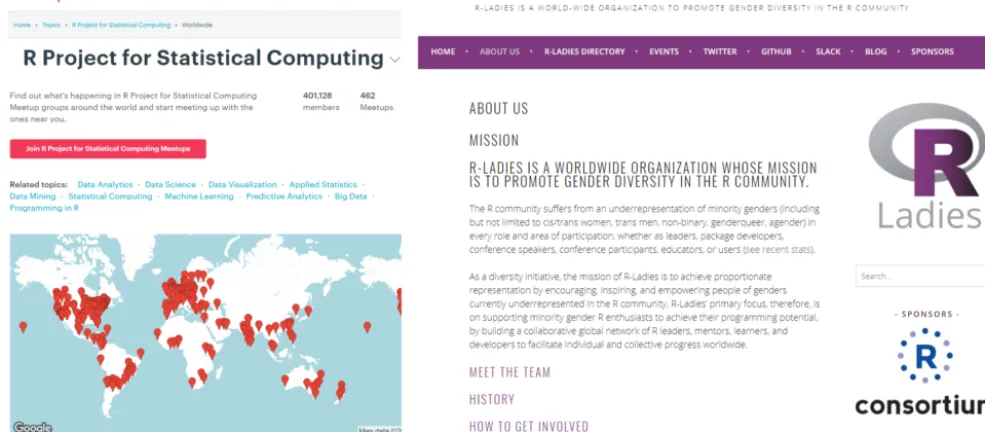
Figure 7.The R community. Left: the R meet-up groups (https://www.meetup.com/topics/r-project-for-statistical-computing). Right: the R-Ladies global organization (https://rladies.org/about-us).
Many other R conferences will be of relevance to the read-ers, including the useR! conference, RStudio, satuRdays, or eRum. These conferences are not specific to hydrology and earth sciences but usually have some discipline-specific ses-sions as well as sesses-sions and short courses of general interest for learning R, including best practice, spatial analysis, and statistical methods. Many of these conferences also stream the talks and/or make resources available after the event.
The global reach of R meet-up groups has also grown rapidly, such as the official R user group meet-up (http: //r-users-group.meetup.com). Many local initiatives for R users have regular meet-ups and seminar series and can be found either on the meet-up website or on social media web pages, such as Twitter (e.g. https://twitter.com/rusersoxford). There is also an ongoing push for greater inclusivity of under-represented groups in programming, as exemplified by the rapid growth of the global R-Ladies movement (Fig. 7).
In addition, the computational community has been try-ing to provide support to other programmers by runntry-ing cod-ing help desks such as at the American Geophysical Union (AGU) 2018 fall meeting in the career centre. Geoscientist volunteers ran the desk in 2018 to provide perspective and advice to other coders, with a range of short, 10 min tuto-rials on topics such as keeping track of code versions with GitHub, making high-quality plots, or using a new package or library. We anticipate that such help desks, short courses, and meet-up sessions will continue to help grow the compu-tational hydrology community in future years.
6 Conclusions
Over the last decade, the open-source programming language R has acquired a central role in hydrological research as well as in the operational practice of hydrology. With the rapidly increasing number of packages that are now available for ev-ery step of the hydrological workflow, R facilitates a broad range of hydrological analyses from start to finish. This paper provides an overview of the use of the open-source program-ming language R in hydrology by describing these packages as well as the influence of R on the discipline. Both the flexi-ble nature of the language and the diverse range of computa-tional, visualization, and modelling tools (physically based and statistical) have facilitated the testing of hydrological theories over a range of spatial and temporal scales as well as interactive teaching of hydrology within the classroom.