5
IX
September 2017
Mathematical Modelling and Optimization of Solar
Air Heater Using CFD
Kumar Kundan1, Vardan Singh Nayak2 1
M. Tech Scholar, 2Asst. Professor, Mechanical Engg. Dept. VIST Bhopal
Abstract: Flat plate solar air heaters are widely used as collection device for solar energy utilization as they are simple and economical. Flat plate solar air heaters are extensively utilized to deliver heated air at low to moderate temperature for crop drying, space heating and industrial application usage. Efficiency of solar air heater is low convective heat transfer coefficient between absorber plate and air. Low heat transfer from absorber plate increases its temperature and results in higher heat losses to the environment. Main thermal resistance to convective heat transfer is formation of boundary layer on heat transferring surface. Artificially destroying or disturbing this laminar sub-layer can enhance heat transfer. Artificial roughness in form of ribs of various arrangements has been used to break the laminar sub-layer or to create turbulence near the heat -transferring surface. Thus, artificial roughness can be used for enhancement of heat transfer coefficient between absorber plate and air for improving thermal performance of soar air heater. In present study different kind of rib arrangement we found optimum result from simulation in case of rib angle 90 degrees with no rib gap at higher Reynolds numbers (15000).
Keywords: Solar air heater, Numerical Modelling, Radiation model, CFD, Ansys (Fluent), solar collector etc.
I. INTRODUCTION
[image:2.612.195.419.571.718.2]Augmentation of convective heat transfer of a rectangular duct with the help of baffles/ribs has been a common practice in the past few years. This concept is widely applied in enhancing the thermo-hydrodynamic efficiency of various industrial applications such as thermal power plants, heat exchangers, air conditioning components, refrigerators, chemical processing plants, automobile radiators and solar air heaters [1]. Solar air heater is a device used to augment the temperature of air with the help of heat extracted from solar energy. These are cheap, have simple design, require less maintenance and are eco-friendly. As a result, they have major applications in seasoning of timber, drying of agricultural products, space heating, curing of clay/concrete building components and curing of industrial products [2, 3]. The shape of a solar air heater of conventional application is that of rectangular duct encapsulating an absorber plate at the top, a rear plate, insulated wall under the rear plate, a glass cover over the sun-radiation exposed surface, and a passage between the bottom plate and absorber for air to flow in [4, 5]. The detailed constructional details of a solar air heater are shown in fig. 1.1. Solar air heaters have higher thermal efficiency when the Reynolds number of air flow through their passage is 3000-21000 [3]. In this range, the duct flow is generally turbulent. Hence, all the research work pertaining to the design of an effective solar air heater involves turbulent flow. Conventional solar air heaters with all the internal walls being smooth usually have low efficiency. The solar air heater’s internal surface can be artificially roughened by mounting certain ribs/obstacles of different shapes such as circular wires, thin rectangular bars, etc. periodically on the lower side of collector plate. This results in a considerable augmentation in the heat transfer rate, but at the same time leads to increase in friction factor thereby enhancing the pumping power requirements.
It is a well-known fact that the friction factor and convective heat transfer coefficient of turbulent flow are highly dependent on the surface roughness of the duct through which they pass [6]. Hence, artificially roughened solar air heaters must be designed in such a manner that their performance yields higher convective heat transfer rates from absorber plate to air low roughness to air flow. Extensive research is being conducted in this field by many authors, whose work generally involves performing experiments or carrying out numerical simulations with different types, sizes and patterns of ribs/ baffles and finding the right parameters at which the heater gives optimal performance (minimum friction loss and maximum heat transfer). Some scientists, after performing research work on solar air heaters, develop a set of correlations for calculating Darcy’s friction factor and Nusselt number in terms of operating and roughness parameters. The mechanism by which heat transfer, between air and roughened absorber plate, increases is breakage of laminar sub-layer. The introduction of ribs leads to local wall turbulence and breakage of laminar sub-layers leading to periodic flow reattachment and separation. Vortices are formed near these baffles, which leads to a significant rise in Nusselt number.
Fig. 1.2 Mechanism of augmentation of convective heat transfer by the introduction of ribs.
As compared to experimental activities being carried on solar air heaters, very less numerical work has been done in this field. Numerical study of solar air heaters using CFD software is an excellent method to understand in detail how flow behaves under the presence of obstacles in solar air heaters. CFD results are more accurate as compared to experimental results. Other benefits of using CFD software’s are saving of time and less costs required completing the work. Presently Energy crisis is a very big problem for whole world. Most of the part of economy is spent on energy. With every passing day there is an increasing worldwide demand of energy for household, industrial and transportation purpose, much of which depends on fossil fuels and oil. Fossil fuel resources and fast depending fuels are depleting very fast and are gradually coming to an end. Rapid increase in energy usage makes necessary action to look for alternative energy resources for meeting energy demands of the future.Various forms of Energy have played an important role in worldwide progress and industrialization. In all alternative energy resources, solar energy is the most promising renewable energy sources. This energy is most abundant, pollution free and inexhaustible from of energy also needs with minimum adverse environmental risks. Vast potential of solar energy has made scientists to opt for technologies to tap this vast inexhaustible energy resource. Easy availability of development of technology for the use of solar energy, now a day most of the areas uses solar energy and save fossil fuel. Areas lying between 30°N to 30° S Latitudes receives maximum solar radiation. Thus India (8°N to32°N) is blessed with abundant solar radiation. On an average India’s annual solar energy potential is about 7000 / 2.
II. LITERATURE
in the friction factor of the roughened duct is observed as 3.4 times of that of the smooth duct. Shashikant2 Artificial roughness applied on the absorber plate is the most efficient method to improve thermal performance of solar air heaters .Experimental investigations appropriate to distinct roughness geometries shows that the enhancement in heat transfer is accompanied by considerable rise in pumping power Several studies have been carried out to determine the effect of different roughness element geometries on heat transfer and friction in solar air heaters. The objective of this paper is to review various studies, in which different artificial roughness elements are used to enhance the heat transfer rate with little penalty of friction. Heat transfer coefficient and friction factor correlations developed by various investigators for artificially roughened ducts of solar air heaters have also been reported in the present article. The effects of various rib parameters on heat transfer and fluid flow processes are also discussed. B. K. Gandhi3 Artificial roughness has been used as a convenient passive method for enhancing the heat transfer from a heated surface. Experiments on rib-groove roughened surface indicate higher heat transfer rate as well as increase in pumping power requirement due to higher friction losses. It is, thus, mandatory to select a trade-off between these two reacting effects to achieve optimum thermal efficiency at the minimum pumping power penalty. The present work aims at numerical investigation on a solar air heater duct having artificially rib-groove roughened absorber plate to study the thermal and fluid flow fields. Investigations have been carried out to determine the combined effect of the roughness parameters namely relative roughness pitch (p/e), relative roughness height (e/D) and relative groove position (g/p) at various flow Reynolds number (Re) on the heat transfer and fluid friction. This study comprehends the Reynolds number range from 6000 to 21000; relative roughness pitch 4.5-15; relative roughness height 0.0165-0.0385 and relative groove position 0.3-0.7. The predictions by different turbulence models of Computational Fluid Dynamics (CFD) was compared with the experimental results available in the literature and the realizable k-epsilon model with enhanced wall treatment was, finally, selected which showed reasonably good agreement with the experimental results reported in the literature. The heat transfer characterized by Nusselt number and friction losses characterized by friction factor for rib-grooved roughness and transverse ribbed roughness were compared. It was found that former produced higher turbulence near viscous sub-layer. It gave appreciably higher Nusselt number than latter, whereas its friction factor was slightly higher. It is observed that there is a formation of extra vortices inside the groove. This may be the reason for the higher turbulence in the ribbed-grooved region and consequently, rise in heat transfer rate across the hot rib-grooved wall in comparison to only ribbed wall. Fluid flow and heat transfer study at various possible combinations of roughness parameters is, then, carried out to achieve the optimal performance. It is found that the maximum heat transfer occurred at relative roughness pitch of 8.0 when relative roughness height is 0.0275 and relative groove position is around 0.5. As compared to a smooth duct, it yields Nusselt number of about 2.3 times and resulted in friction factor of about 4.6 times. The present research work is not only a step to address a scientific way to enhance thermal efficiency but also, it highlights the growing utility of the mathematical techniques with regards to thermal characterization. Sharad Kumar 4 In the present work the performance of a solar air heater duct provided with artificial roughness in the form of thin circular wire in arc shaped geometry has been analysed using Computation a model based results have been found in good agreement and accordingly this model is used to predict heat transfer and friction factor in the duct. The overall enhancement ratio has been calculated in order to discuss the overall effect of the roughness and working parameters. A maximum value of overall enhancement ratio has been found to be as 1.7 for the range of parameters investigated. Anil Singh Yadav 5 The objective of this article is to present a detailed review of the literature that deals with the application of CFD in the design of solar air heater. Solar air heater is one of the basic equipment through which solar energy is converted into thermal energy. CFD is a simulation tool which uses powerful computer and applied mathematics, to model fluid flow situations for the prediction of heat, mass and momentum transfer and optimal design in various heat transfer and fluid flow processes. The quality of the solutions obtained from CFD simulations are largely within the acceptable range proving that CFD is an effective tool for predicting the behaviour and performance of a solar air heater. One of the great challenges in the design of a solar air heater using CFD approach is the selection of appropriate turbulence model. The decision about a suitable turbulence model chosen in a CFD computation is not easy. In this article a CFD investigation is also carried out to select best turbulence model for the design of a solar air heater. A modern CFD code ANSYS FLUENT v12. Is used to simulate fluid flow through a conventional solar air heater. A two-dimensional flow is assumed. The influences of the five different turbulence models on the quality of the obtained results are tested .
III. OBJECTIVE OF THE STUDY
In present setup the Duct Dimension is 1000×180×30(in mm) with thermal heat flux 1000 w/m2 in one duct surface taken. Heat flux consist duct surface having different type of rib arrangement. Rib having with and without gap orientation is at the angle of 30 degree 60 degree and 90 degree. Rib dimension is 2x2 mm and pitch is taken 20 mm. The relative roughness pitch {p/e=10} and relative gap position {d/w} 0.25 has taken. Different rib arrangement is analyzed and compare with Reynolds Number (6000-15000).
IV. METHODOLOGY
A. Basic Steps to Perform CFD Analysis
1) Pre-Processing: CAD Modelling: Creation of CAD Model by using CAD modelling tools for creating the geometry of the part/assembly of which we want to perform FEA. CAD model may be 2D or 3d.
a) Meshing: Meshing is a critical operation in CFD. In this operation, the CAD geometry is discretized into large numbers of small Element and nodes. The arrangement of nodes and element in space in a proper manner is called mesh. The analysis accuracy and duration depends on the mesh size and orientations. With the increase in mesh size (increasing no. of element), the CFD analysis speed decrease but the accuracy increase.
b) Type of Solver: Choose the solver for the problem from Pressure Based and density based solver. Physical model: Choose the required physical model for the problem i.e. laminar, turbulent, energy, multiphase, etc.
c) Material Property: Choose the Material property of flowing fluid.
d) Boundary Condition: Define the desired boundary condition for the problem i.e. velocity, mass flow rate, temperature, heat flux etc.
2) Solution:
a) Solution Method : Choose the Solution method to solve the problem i.e. First order, second order
b) Solution Initialization: Initialized the solution to get the initial solution for the problem.
3) Post Processing:
a) Post Processing: For viewing and interpretation of Result. The result can be viewed in various formats: graph, value, animation etc.
B. CFD Analysis of Solar Air Heater Model using Ansys Fluent 14.5 1) Pre-processing:
a) CAD Model: Generation of 3d CAD d geometry in fluent.
b) Mesh: Generate mesh .
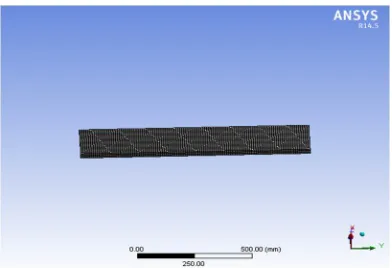
Figure 2. Mesh model without rib
Figure 3 CAD Model _without gap_angle 90
[image:6.612.201.416.578.717.2]Figure 4 Mesh Model _without gap_angle 90
c) Fluent Setup: After mesh generation define the following setup in the Ansys fluent 14.5.
d) Problem Type : 3D
e) Type of Solver: Pressure-based solver, Absolute and Steady.
f) Physical Model: Viscous: K-epsilon two equation turbulence model , Standard wall functions.
g) Material Property: Working fluid is Air
h) Absorber Plate: Aluminium
2) Boundary Condition:
a) Mass Flow Inlet: Model is solved for different mass flow rate (0.0115) and Turbulent kinetic energy and heat dissipation rate is taken unity
b) Operating Conditions: 101325 Pascal Pressure and Ambient Temperature. c) Stationary wall and No slip condition.
d) Heat Flux: 1000 w/m2
e) Out Flow outlet for the system is taken.
3) Solution:
a) Pressure: velocity coupling – Scheme -SIMPLE
b) Pressure: Standard
c) Momentum: Second order
d) Turbulent Kinetic Energy (k) Second order
e) Turbulent Dissipation Rate (e) Second order
4) Solution Initialization: Standard initialization for the system.
5) Run Solution: Run the solution by giving 20000 no of iteration for solution to converge.
6) Post Processing: For viewing and interpretation of Result. The result can be viewed in various formats: graph, contour, value, animation etc.
[image:7.612.213.400.580.722.2]V. RESULTS AND CONCLUSION
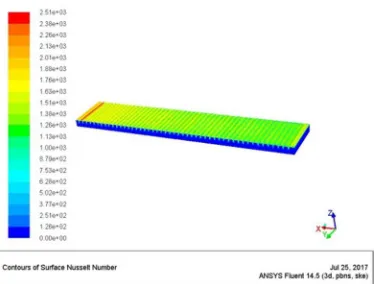
Figure 6 Temperature contour in without gap _ rib angle 90 (Reynolds no.15000)
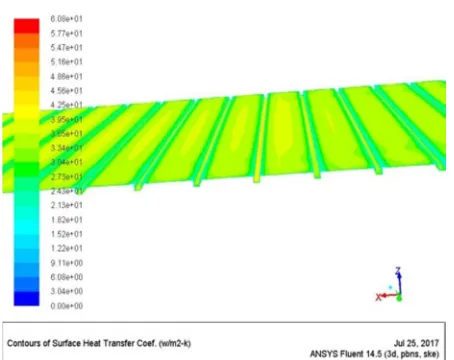
Figure 8 Surface heat transfer coefficient contour in without gap_ rib angle90 (Reynolds no.15000)
[image:8.612.194.421.76.256.2]Figure 9 Surface heat transfer coefficient contour in without gap_ rib angle90 (Reynolds no.15000)
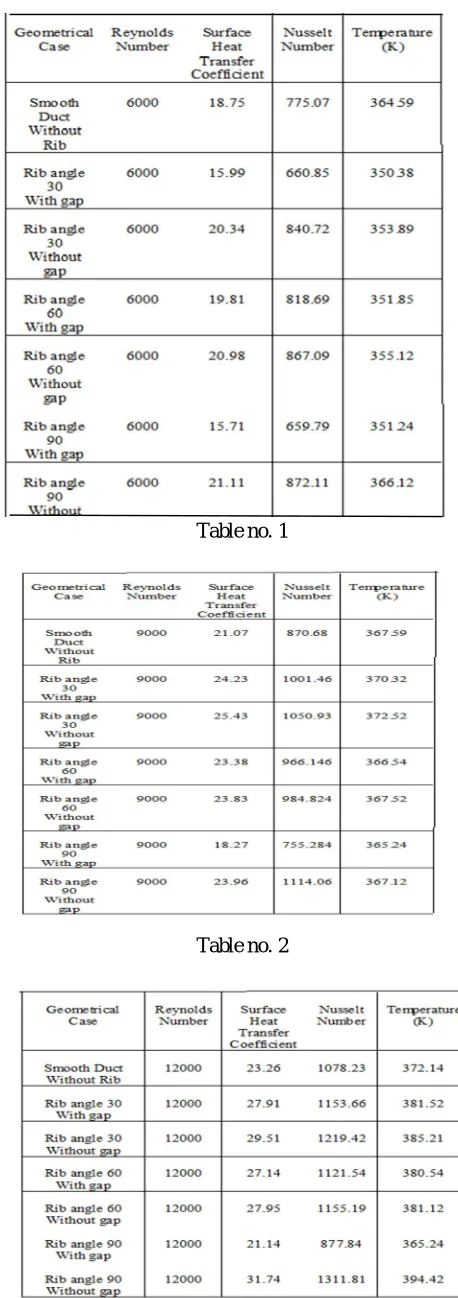
Table no. 1
Table no. 2
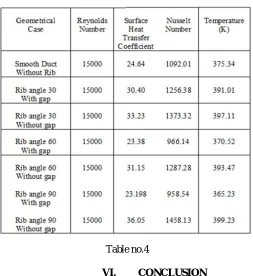
Table no.4
VI. CONCLUSION
From table no. 1 we found that in smooth surface without rib have a large heat transfer rate then using angle in rib arrangement, but when we compare the results in with and without gap using rib angle at constant Reynolds number (6000) heat transfer coefficient, Nusselt Number and temperature on top surface is greater in case of without taken gap between rib. By increasing the Reynolds number for different arrangement we have found form the CFD Simulative results that rib with angle of 90 degrees and without gap with higher Reynolds number is giving a excellent heat transfer over flat surface which is required in whole solar system , this will become the optimum results as compare to others. Parametric Runs are made for Reynolds number ranging from 6000 to 15000. The k - e turbulence model provide better arrangement with available measurement than other. In this analysis heat thermal coefficient, Skin friction coefficient and Nu number are also examined. After the CFD analysis, it is found that the Rib provides a considerable increase in heat transfer over the without rib surface. In present study different kind of rib arrangement we found optimum result from simulation in case of rib angle 90 degrees with no rib gap at higher Reynolds numbers (15000).
REFERENCES
[1] Bhupendra K. Gandhi EXPERIMENTAL AND NUMERICAL INVESTIGATIONS ON FLOW THROUGH WEDGE SHAPE RIB ROUGHENED DUCT Associate Professor, Department of Mechanical and Industrial Engineering, Indian Institute of Technology Roorkee, Roorkee 247667
[2] Shashikant Nagpure Effect of Artificial Roughness in Solar Air Heater- A Review (IJETT) – Volume 20 Number 2 – Feb 2015
[3] B. K. Gandhi Numerical Investigations on artificially roughened rib-grooved air heater duct Department of Mechanical & Industrial Engineering, IIT Roorkee, INDIA 247 667
[4] Sharad Kuma rCFD based performance analysis of a solar air heater duct provided with artificial roughness Renewable Energy 34 (2009) 1285–1291
[5] Anil Singh Yadav Heat transfer and fluid flow analysis of solar air heater: A review of CFD approach Renewable and Sustainable Energy Reviews 23 (2013) 60–79
[6] Sanket Khamitkar Performance Analysis of Solar Air Heater Using CFD (IJERT) Vol. 2 Issue 8, August – 2013
[7] Sukrut Surendra Prabhu Numerical and Experimental Analysis of a Solar Air Heater for Improved Performance -ISSN: 2278-067X, p-ISSN: 2278-800X, www.ijerd.comVolume 12, Issue 3 (March 2016), PP.22-38
[8] Mr. Juneyd Dadi A Review on Analysis of solar air heaters having Artificial Roughness Imperial Journal of Interdisciplinary Research (IJIR)Vol-3, Issue-4, 2017ISSN: 2454-1362
[9] Suman Saurav Heat transfer and thermal efficiency of solar air heater having artificial roughness International Journal of Renewable and Sustainable Energy2013; 2 (3) : 99-109Published online May 30, 2013 (http://www.sciencepublishinggroup.com/j/ijrse)doi: 10.11648/j.ijrse.20130203.14
[10] Harish Kumar Pate thermal Performance of Solar Air Heater by with artificial roughness SRG International Journal of Mechanical Engineering (SSRG-IJME) – volume 2 Issue 4–April 2015
[11] Pankaj Sharma Enhancing Thermal Performance of a Solar Air Heater through Artificial Roughness on Absorber Plate International Journal on Emerging Technologies 6(2): 105-111(2015)
[13] Santosh Vyas THERMAL PERFORMANCE TESTING OF A FLATPLATE SOLAR AIR HEATER USING OPTICALMEASUREMENT TECHNIQUE International Journal of Recent advances in Mechanical Engineering (IJMECH) Vol.3, No.4, November 2014
[14] Anand Patel Thermal Performance Evaluation of Spiral Solar Air Heater International Journal of Scientific and Research Publications, Volume 5, Issue 9, September 2015 1 ISSN 2250-3153
[15] Amey P Marathe Mathematical Modelling of Solar Air Heater(IJERA) ISSN: 2248-9622 www.ijera.com Vol. 3, Issue 3, May-Jun 2013, pp.1000-1010 [16] M. Mahesh Mathematical modelling and analysis of corrugated black coated solar flat plate collector International Conference on Explorations and Innovations
in Engineering & Technology (ICEIET – 2016
[17] Shalini Rai Thermal and Thermo hydraulic Performance Analysis on Offset Finned Absorber Solar Air Heater International Journal of Mechanical & Mechatronics Engineering IJMME-IJENS Vol:16 No:05
[18] Arun Kumar Behura Thermal analysis of three sides artificially roughened solar air Heaters Energy Procedia 109 ( 2017 ) 279 – 285
![Fig. 1.1 Solar air heater constructional details [3]](https://thumb-us.123doks.com/thumbv2/123dok_us/8306438.856267/2.612.195.419.571.718/fig-solar-air-heater-constructional-details.webp)