Fuzzy Logic Augmented Observer and Stability
Analysis for Image - Centroid Tracking
Parimala P1, Raol J. R. 2
1
Asst. Prof, Dept. of Telecommunication, MSRIT, MSR Nagar, and JU research scholar, Bangalore
2
Raol, J. R. Prof. Emeritus, MSRIT, Bangalore.
Abstract: An observer for linear continuous time dynamic system with fuzzy logic modulated residuals is presented. This modulation is done by using fuzzy logic membership function that operates on the residuals. The Lyapunov energy (LE) functional is used to derive stability condition for the local asymptotic convergence for the state error of the presented observer. The performance of this observer with fuzzy nonlinear function of residuals is evaluated by simulations implemented in MATLAB using synthetic images. Basically the image-centroid tracking is carried out using the new observer. The results validate the theoretical asymptotic behaviour of the proposed fuzzy logic based observer.
Keyword: Fuzzy logic, Fuzzy membership function, nonlinear function of residuals, Lyapunov energy functional
I. INTRODUCTION
In many image-based air traffic control, avionics, and robotics systems, an automatic target or object acquisition, identification and tracking are very essential. This is accomplished by processing a sequence of real images of the moving object. These applications require a procedure and an algorithm for image detection/segmentation, feature computation/classification and tracking. In tracking a moving target using acquired images, at each time instant, the estimates of the target’s current position and velocity are to be obtained. In such cases there would be some uncertainty regarding the origin of the received images, which may/may not include measurements from the target of interest; the latter situation could be due to a random clutter/false alarm leading to the requirement of data association (DA). The main focus is on the implementation and validation of the filtering algorithm for tracking. The main features of the image, in centroid tracking application, are the intensity and size of the cluster; the pixel intensity is graded and discretized into a few layers of gray level intensities. The centroid tracking algorithm (CTA) involves: a) conversion of the data (from the original image) into a binary image by applying upper/lower bounds for the target layers, b) the binary target image is converted into clusters using nearest neighbor (NN) criterion for DA, and then c) the centroid of the clusters is computed and this information is used for tracking the target image.
There has been some work in the area of centroid tacking [1-6]: a) in ref. [1] by analyzing the molten pool infrared images, the keyhole was extracted by using the fixed threshold method; by using the keyhole images and computing the keyhole centroid, the deviations between the keyhole (centroid) and the welding seam was analyzed; b) the method of ref. [2] is highly statistical; c) in ref. [3] a Kalman filter (KF) based centroid tracking algorithm was proposed; d) in ref. [4] the weld pool image centroid algorithm for seam tracking in an arc welding process was proposed; e) in ref. [5], the tracking problem was studied using deformable models, and the experimental results with traffic data were given; and f) in ref. [6] a fuzzy system was designed for the purpose of tracking and predicting the motion of light-colored objects on dark background.
An application of the observer theory to image-centroid tracking is considered, and especially the fuzzy membership function (FMF) is used as a nonlinear operator on the observer residuals, the latter is, perhaps, a new aspect in the domain of centroid tracking. In estimation/filtering theory, the objective of an observer is to reconstruct the state of a dynamic system using the knowledge of the system’s data/signals. For linear systems, the system’s states are usually estimated using the Luenberger observer (LO) or KF. Also the asymptotic result for the observer error dynamics which are influenced with (any) FMF is derived. The performance of the proposed observer is illustrated with implementation in MATAB.
II. LINEAR SYSTEM AND OBSERVER ERROR DYNAMICS
Let a linear system be given as
̇( ) = ( ) + ( )
( ) = ( ) (1)
( ) = ( ) + ( ) + ( )( ( )− ( )
( ) = ( ) (2)
However, now it is proposed to use fuzzy logic in the observer design, by way of using FMF of the residuals:
( )̇ = ( ) + ( ) + ( ) ( ( )) = ( ) + ( ) + ( ) ( )
( ) = ( ) (3)
In (3), the residuals and the state errors are
( ) = ( )− ( ); ( ) = ( )− ( ) (4)
L(t) is an observer gain matrix given as
( ) = ( ) (5)
From (5), it is seen that the observer gain is obtained from the KF/EKF theory [7, 8]. This is done because, the KF and the linear observer belong to the same class of the state estimators and both can be easily applied to the same or similar dynamic systems. In the case of the observer of (3), R in (5) is some positive definite matrix, and is regarded as the weighting matrix.
In (3), fm is an FMF that operates on input residuals r(t), (in turn on e(t)) and obtains the output that is used in the observer structure;
this provides a nonlinear function of residuals effect [9, Chapter 9], because any FMF is inherently nonlinear. In (5) P(t) is obtained as the solution of the observer Riccati differential (ORD) equation
̇ ( ) = ( ) ( ) + ( ) ( )−
( ) ( ) + (6)
In (6), Q is considered as some weighting matrix, whereas in KF/EKF theory it is an intensity or a covariance matrix of the process noise. By subtracting (3) from (1) the following observer error dynamics are obtained
̇ ( ) = ( ) ( )− ( ) ( )
= ( ) ( )− ( ) ( ) (7)
III. ASYMPTOTIC STABILITY OF OBSERVER ERROR DYNAMICS
The following conditions for the local asymptotic behaviour of the observer error dynamics of (7) are considered: 1) The solution of the ORD equation (6) is bounded [7,8]
plI ≤P(t)≤pu I (8)
with pl, pu > 0 as positive constants (P(t) is theoretically positive definite matrix), and are the lower and upper bounds respectively; I
is the identity matrix.
2)The nonlinearity fm(.) is bounded
‖ (. )‖ ≤ ‖ ( )− ( )‖ (9)
With the bounding constant equal to or greater than zero. Since in the present case the nonlinear function is an FMF, the overall bound on the nonlinearity is:0≤ ‖ (. )‖ ≤1
Then, the nonlinear observer error dynamics in (7) are locally asymptotically stable, if the conditions 1 and 2 are satisfied, and the time derivative of the LE functional is negative definite.
First, consider the normalized LE functional to establish the asymptotic stability of the error dynamics (7):
( ) = ( ) ( ) ( ) (10)
The matrix Y(t) is the normalizing matrix and is recognized as an information matrix {Y(t)=P-1(t)}; in case of KF, P(t) is considered as covariance matrix of the state errors. Here, also it can be considered so, however, since the stochastic noise processes are not considered; then the matrix P(t) is called as the Gramian matrix [9, Chapter 3]. However, the name ‘information matrix’ for the matrix Y can be retained; in such a case the variables x(.), and y(.) are considered as the generalized ‘random’ variables. Then, the matrix Y(t) is called the information Gramian. The LE functional, (10) is positive definite because it is governed by the condition 1, the inequality of (8):
‖ ( )‖ ≤ ( ) ( ) ( )≤ ‖ ( )‖ (11)
The point in obtaining the asymptotic result is that the time derivative of the LE functional, (10), under the constraints governed by error dynamics (7), and (5) & (6) {gain/covariance dynamics} should be negative definite. This would ensure the local asymptotic stability of the error dynamics, and hence the convergence of the observer (3). Next, this time derivative of V(t) is obtained as
̇( ) = ̇ + ̇+ .
Substitute for ( )̇ =-Y(t) ̇( ) ( ) (since Y(t)P(t)=I), and (5) and (6) in (12) to obtain
̇( ) =− ( ) ( ) ( ) ( ) + ( ) ( ) −2 ( ) ( ( ) (13)
In obtaining (13), because of the substitution of (5), and (6), several common terms cancel out. In (13), assume that ‖ ‖ ≤ ; ‖ ‖ ≤ , (Rr and h being positive constants);‖ ( )‖ ≤ and since, these are known and pre-specified quantities,
or should be finite, the following condition is obtained
̇( )≤ ( ) ( ) ( ) ( ) + −2 ( ) ( ( )) (14)
Using the inequality from (8), one obtains
̇( )≤ − ‖ ( )‖ + ‖ ( )‖ −2 ( ) ( ( )) (15)
In (15), the bound of (11) is used, and qs is the smallest (positive) eigen value of the matrix Q(t), that is positive definite. Using
bound from (9) for the FMF, one obtains
̇( )≤ − − ‖ ( )‖ −2 ( ) ‖ ( )‖ (16)
For ‖ ( )‖ ≤ , one has the following condition from (16)
̇( )≤ − − + 2 ‖ ( )‖ (17)
̇( )≤ −( )‖ ( )‖ (18)
One needs to ensure that the factor appearing in (18) is positive,{ pu2h2>qsRr} since all the other individual coefficients are anyway
positive. Since, the LE functional is positive definite as in (10) by (11), and its time derivative is locally negative definite as in (18), the observer error dynamics of the newly proposed nonlinear observer for system with FMF as the nonlinear function (of the residuals) is locally asymptotically stable. The derived result is quite general, since it is applicable even when any FMF is used to modulate the observer residuals, because the magnitude of all the FMFs are bounded between 0 and 1, as in (9).
IV. EVALUATION OF THE FUZZY LOGIC BASED OBSERVER
The performance of the observer is validated using numerical simulations carried out in MATLAB.
A. Centroid Tracking
In FL/FMF-CTA (centroid tracking algorithm), the particle segmentation wherein, an image is partitioned into object regions and background regions is used to separate the target from the background (image) when target is not fully visible. The pixel intensities are graded and discretized into 256 gray levels, and the segmentation is carried out as:
1) The gray level image is converted into binary image (using lower/upper bounds of the target); the gray image Im(i,j)is converted
into binary image with intensity β(i,j) [3]:
β(i, j) = 1 I ≤Im(i, j)≤I
0 otherwise (19)
In (19) IL and IU are the lower/upper bounds of the target intensity.
2) The detected pixels are then grouped into clusters: the binary image can be grouped into clusters using the nearest neighbor data association (NNDA), a pixel belongs to the cluster only if the distance between this pixel and at least one other pixel of the cluster is less than certain distance dp. The centroid of the cluster is determined using the formula from [3]:
( , ) =∑ ∑ ( , )(∑ ∑ ( , ) ,∑ ∑ ( , )) (20)
In (20),[xc,yc]coordinates give the centroid of the cluster; Iij is the intensity of the (I,j)th pixel; n, and m are the dimensions of the
cluster. The CT algorithm that is based on FL and the observer is evaluated, the latter is used in the NNDA mode.
B. Fuzzy Logic Modulated Observer For Centroid Tracking
The tracking dynamics are represented as in (1). The centroid coordinates are represented as a state x in the observer dynamics. FL can be used for tuning observer dynamics, and in the present application FMF is used for modulating the observer residuals, that means for the purpose of centroid tracking, FL is combined with the observer at the measurement level:
⏞
.
( ) = ( ) + ( ) ( ( ))
In (21), fm(r(t)) is regarded as an output of the FL based process and is a nonlinear function of inputs as the residuals ‘r’ (and often derivative of ‘r’) of the observer. It is assumed that position in x-y axes-measurements of the target are available. The f-vector consists of the modified residuals’ sequence for x and y axes, expressed in the discrete time domain, for the sake of clarity as
( + 1) = [ ( + 1) ( + 1)] (22)
To determine (22), the residual vector ‘r’ is first separated into its x and y components, rx and ry , with the target motion in each axis
assumed to be independent. The f-vector for the x direction can be developed and then it is generalized to include y direction. This vector consists of two inputs, rx and ̇ , and single output ( + 1), where ̇ is computed by
̇ ={ ( ) ( )} (23)
Here, T is the sampling interval in sec., and the expression (23) can be easily extended to y-direction. Appropriate FMF/FIS (fuzzy inference system) has been used and the technique is evaluated using MATLAB based fuzzy logic tool box, where necessary (evalfis: Type=sugeno;NumInputs=2;NumOutputs =1;NumRules=4;AndMethod='prod'; Or Method='max';ImpMethod='prod'; Agg Method ='max').
It is ascertained here, that the asymptotic result derived using FMF applied only to residual term r(t), (18) is also equally applicable when it is also applied to the derivative of r(t), (23). The value of R (or ‘Rr’) appearing in (5) is used as a tuning parameter. In order to implement the algorithm, one has to solve the matrix ORD equation (6), and for this one can use the following transformation [9]
a=P(t) d (24)
to obtain the differential equations, appropriately from (4), as follows
̇ =− + (25)
̇= + (26)
Equations (25) and (26) are solved by using the transition matrix method [9], then using (24) one gets P(t). Model of FLIR (forward looking infrared sensor) for generation of synthetic image is considered. To simulate the motion of the target in a frame, kinematic model of target motion is used for which a continuous time target motion model is used. The state vector is given as
( ) = [̇ ̇] . The measurement model is given as
( ) = 1 0 0 0
0 0 1 0 ( ) (27)
For the background image, two-dimensional (2D) array of 64x64 pixels is considered, which is modeled (generated) as white Gaussian random field as ( , 2 )
with standard deviation (STD) of the background image as 50. Another 2D array of pixels, modelled as white Gaussian random field as ( , 2 )
is used to generate a target of size 9x9. The total number of scans is 50 and image frame rate, sampling, (T) is 1 frame/sec. The initial state vector of the target in the image frame is: = [ ̇ ̇ ] = [10 1 10 1] . The synthetic image/s with these parameters is converted into binary image (with the upper, IU=110 and lower, IL =90
limits of a target layer) and grouped into clusters by the NNDA method using the optimal proximity distance dp=2. The centroids of
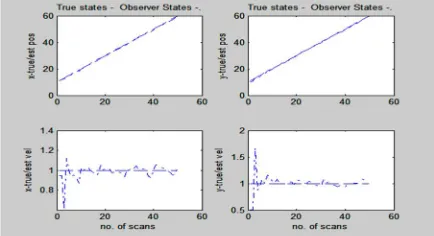
[image:5.612.204.421.587.705.2]the clusters are computed. If the background is very noisy, the cluster algorithm would produces more clusters and more centroids. This would require observer based NNDA to associate the true measurement to the target. The performance metrics: percentage fit errors (for the measurements and states), and rms (root mean square) values of position and velocity errors are evaluated. The time histories of the state errors and the observer residuals are evaluated to ascertain the performance of this centroid tracking algorithm. The CTA based on the proposed observer with FMF incorporated is coded in MATLAB by the authors. The performance of the FMF based observer is illustrated in Figures 1 to 4. Table 1 gives the numerical values of the performance metrics; PFE= 100*norm(error)/norm(true signal).
Figure 2: Position & velocity RSS errors; residual (-), bound (--),(bounds from the Gramian, R).
[image:6.612.187.442.247.377.2]Figure 3: State errors with bounds: errors (-), bounds (--) {obtained from Gramian, P of the solution of the Observer Riccati equation}.
Figure 4: Eigen values of the Gramian matrix P.{related to state x1, x2 (--), & state x3 & x4 (.)}
Table 1: Metrics from FMF based observer Standard
deviation of target noise
Std=1 Std=3 Std=5
[image:6.612.186.440.423.584.2]The root-mean square errors are evaluated and given in Table 1; rsspe= sqrt (xperr.^2 + yperr.^2) ; and Rmspe =sqrt(mean(xperr.^2 + yperr.^2)). It is seen from Table 1 that the metrics show some trend when the std of the target image noise is increased, however, in overall sense the values are quite small and hence, a good centroid tracking has been obtained. Figure 1 depicts the true states and the observer states. Figure 2 depicts the RSS state errors and the observer residuals. Figure 3 shows the observer state errors with their theoretical bounds. Since, all the errors’ time histories are within their theoretical bounds, the performance of the proposed FMF based observer for target image-centroid tracking is considered very satisfactory. Figure 4 shows the plot of the eigenvalues of the Gramian matrix P, showing convergence/satisfaction of the condition of (18), related to state x1, x2 (--), & state x3 & x4 (.).
V. CONCLUDING REMARKS
Some new results on linear observer for continuous time system with fuzzy logic based modulation of the observer residuals are presented. The FMF operates on the residuals and the time derivatives of the residuals, and then this output enters the observer state dynamics. For the proposed observer the asymptotic stability result is obtained using the LE functional, and is validated by the behavior of the Eigen values of the observer Gramian matrix. The performance of the proposed FMF based-observer is found to be very satisfactory and the results corroborate the theoretical result presented in Section 3. These results can be extended for measurement/state vector level image fusion, in comparison with conventional filtering algorithms used for data fusion [10,11,12]. For such extensions the same
REFERENCES
[1] Y-Q. Chen, Gao, X-D, Huang, J-Y, and Wen Q. Numerical study of keyhole centroid infrared image based on fixed threshold method during high power fiber laser welding .Conference on Electronic, 2012. https://scholar.google.co.in/scholar, Accessed July 2016.
[2] J-S. Cho, Kim, D-J., and Park, D-J. Robust centroid target tracker based on new distance features in cluttered image sequences. (IEICE Trans. Inf. & Syst. Dec. 2000), Vol. E83-D, No. 12.
[3] V. P. S. Naidu, Girija G., and J. R. Raol. Data fusion for identity estimation and tracking of centroid using imaging sensor data. (Defence Science Journal Sept. 2007), Vol. 57, No. 5, pp. 639-652.
[4] X. Gao, Ding, D., Bai, T., and Katayama, S. Weld Pool Image Centroid algorithm for seam tracking in arc welding process. (IEEE paper, published Proc. of International Workshop on Imaging Systems and Techniques, Shenzhen, China, 2009), May 11-12.
[5] J. C. Nascimento, Abrantes, A. J., and Marques, J.S. An algorithm for centroid-based tracking of moving objects. (IEEE International Conference on Acoustic, Speech, and Signal Processing, Phoenix, AZ., USA, March 1999.), Vol. 6, pp. 3305-3308, 15-19.
[6] P. Rodjito. Position tracking and motion prediction using fuzzy logic. Dept. of Computer Science, Honours Theses. Paper 520. http://digitalcommons.colby.edu/honorstheses/520. Accessed Dec. 2016.
[7] T. Raff, and Allgower, F. An EKF-based observer for nonlinear time-delay systems. (In Proc. of the American Control Conference, Minneapolis, MN, USA, July 2006) :4, pp.3130-3133. http://bibbase.org/network/publication/raff-allgwer-anekfbasedobserverfornonlineartimedelay-systems-2006; accessed January 2016.
[8] K. Reif, Sonnemann, F. and Unbehauen, R. An EKF-based nonlinear observer with a prescribed degree of stability. (Automatica, Vol. 34, pp. 1119-1123, Sept. 1998)https://www .researchgate. net/publication/ 220157426, accessed January 2017.
[9] J. R. Raol, G. Gopalratnam, and B. Twala. Nonlinear Filtering: Concepts and Engineering Applications. (CRC Press/Taylor & Francis, Florida, USA, 2017). [10] J. R. Raol. Multi-sensor Data Fusion with MATLAB. (CRC Press/Taylor & Francis, Florida, USA, 2010).
[11] J. R. Raol. Data Fusion Mathematics-Theory and Practice. (CRC Press/ Taylor & Francis, Florida, USA, 2015).
[12] J. Wang, M. P. Stewart, M. Tsakiri Adaptive Kalman filtering for integration of GPS with GLONASS and INS, IAG SYMPOSIA, 2000,volume 121, pp 325-330
AUTHORPROFILE
Parimala.P has done her B.E in Telecommunication engineering (1996) and M.E degree in Digital Communication engineering(1999) from BMS College of engineering, Bangalore. She is pursuing PhD Degree from Jain University, Bangalore under the guidance of Dr.J.R.Raol and currently working as Assistant Professor (1999-till date) in the Department of Telecommunication engineering, Ramaiah Institute of Engineering, Bangalore. Published papers in the field of Digital Image Processing and control theory.