Elliptic Curve Cryptography Based Algorithm for
Privacy Preserving in Data Mining
Krishna Pratap Rao
1, Adesh chaudhary
1, Prashant johri
1School of Computing Science and Engineering, Galgotias University, India
Abstract: - Data mining is used to
extract or “mine” knowledge from large
amounts of data base. However, data is often
distributed among different locations. In terms of privacy and security issues data mining techniques are recently investigated
with the conclusion that they reveal data or information to other parties involved to find global results. Recently many
cryptographic techniques have been found to address privacy problem in data mining. However the methods are too far too
inefficient and impractical for computing large databases. In this paper, we propose efficient algorithm to mine association rule
using elliptic curve cryptography technique over horizontally partitioned data. Here we consider unsecured environment. Our
proposed algorithm provides security against involving parties and intruder who can read the unsecured channel and algorithm
provides authentication between involving parties. We discussed the privacy and security provided by our proposed algorithm.
Keywords: - Data mining, privacy, cryptography, Elliptic Curve, Association Rule Mining
I. INTRODUCTION
Most of the organizations today have multiple data sources distributed at different locations, which need to be analyzed to generate interesting patterns and rules. A very effective way to deal with multiple data sources (where data to be mined is distributed among several relations on different database management systems (DBMSs) is to mine the association rules at different sources and forward the rules to a centralized system rather than sending the data to be mined which is likely to be very large.
Data mining promises to discover unknown data. If those data are personal or corporate data, it offers the potential to reveal what others regard as private. This problem is called Privacy Preserving Data Mining (PPDM). In order to perform privacy preserving data mining these techniques such (1) as kanonymity classification, clustering and association rule mining have been suggested in recent years. As data mining become more pervasive, privacy concerns are increasing. Organizations obtain information about individuals for their own specific needs. Different units within an organization themselves may find it necessary to share information. Each organization must be sure that the privacy of the individual is not violated or that sensitive business information is not revealed. In this paper a model which is exactly that of multi-party computation. So
,
there exists a secure protocol for any probabilistic polynomial-time functionality. These solutions are very inefficient, when large inputs and complex algorithms are involved. We assume that there is
unsecured environment. In any multi-party computation setting, malicious adversary can always alter its input. For the data- mining setting, this fact can be very damaging since the adversary can define its input to be the empty database.
II
.
LITERATURE SURVEY
Research has addressed classification using Bayesian Networks in vertically partitioned data [2], and situations where the distribution is itself interesting with respect to what is learned [3]. Shenoy et al. proposed an efficient algorithm for vertically mining association rules [4]. Finally, data mining algorithms that partition the data into subsets have been developed [5]. However, none of this work has directly addressed privacy issues and concerns.
PRIVACY PRESERVING ALGORITHM:
-
A lot ofimplementations of the confidentiality of data and knowledge are applied in association rule mining process. Basically privacy preserving association rule mining algorithms commonly can be divided into three categories.
(A) HEURIS TIC-BASED TECHNIQUES: -
Heuristic-based techniques are used to resolve how to select the appropriate data sets for data modification. Optimal selective data modification or sanitization is an NP-Hard problem , heuristics can be used to address the complexity issues.RULE:
-
Agrawal et al. in [6] first proposed the method of distribution reconstruction on numeric data which is disturbed by Bayesian algorithm in 2000. Then, Dakshi and Charu in [7] improve the work over the Bayesian-based reconstruction procedure by using an Expectation Maximization (EM) algorithm for distribution reconstruction.(C) CRYPTOGRAPHY-BASED TECHNIQUES:-
ManyCryptography-based approaches have been proposed in the context of privacy preserving data mining algorithms. Cryptography-based approaches like Secure Multi-party Computation (SMC) are secure at the end of the computations.
(D)
SECURE
MULTI-PARTY
COMPUTATION
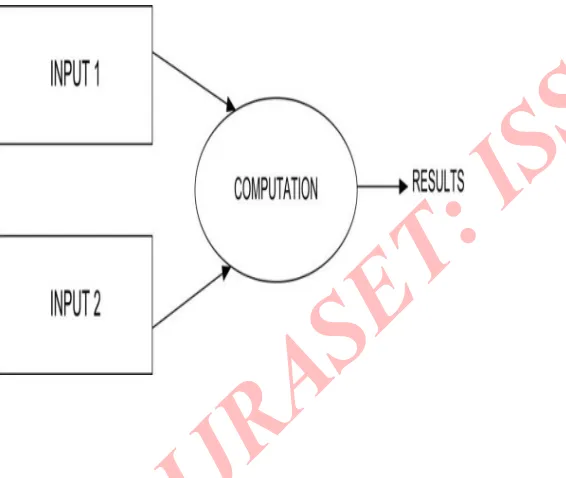
:-Goldwasser defined the SMC problem as a problem that deals with computing any function on any input, in a distributed network where each participant holds one of the inputs, while ensuring that no more information is revealed to a participant in the computation than the information that can be inferred from that participant’s input and output [8].
Figure 1. Transformation of a multi-input computation model to a secure
[image:3.612.23.306.345.584.2]multiparty computation model
.
Figure 2 . Transformation of a single-input computation
Model to a homogeneous secure multi-party computation model.
III. MOTIVATION
Computers have promised us a fountain of wisdom but delivered a flood of information. This huge amount of information is distributed among the different parties and distributed data makes it crucial to develop tools to discover hidden knowledge (association rule). These tools are called data mining tools and promise to discover hidden knowledge, but if that hidden knowledge is sensitive and then owners would not be happy if this knowledge were exposed to the public, involving parties or to adversaries. This problem motivates research to develop techniques, algorithms and protocols to assure data owners that privacy is protected while satisfying their need to share data among involving parties in distributed environment.
IV. PROBLEM DESCRIPTION
We consider scenario where more than two parties want to corporate for computing association rule on union on their databases. Although databases are private to party and they don’t want to reveal their private information to other parties or to the intruder.
We show how involved parties find global association rule efficiently without revealing personal information to other involving parties or intruder. Involving parties cannot learn anything other than global association rule.
In proposed approach, we used Apriori algorithm to generator frequent item set and for authentication and security we used ECDSA (Elliptic Curve based Digital Signature Algorithm) and ECIES (Elliptic Curve Integrated Encryption Scheme) under elliptic curve cryptography.
V. PROPOSED APPROACH
below.
Objective
Privacy and Security: Proposed algorithm provides privacy against involving parties in distributed environment and also provides security and privacy against adversary who is be part of mining process in distributed environment.
Efficiency: Finding association rule with less iteration and less time consuming.
Communication and Computation Cost: The communication and computation cost are reasonable for small database.ALGORITHM
In this section we describe our proposed elliptic curve cryptography based parallel algorithm for privacy preserving mining of association rule in distributed environment. However we consider only horizontally partitioned data. First we will discuss the basic concepts which are used in our proposed algorithm. Then we describe proposed communication protocol and privacy preserving association rule mining algorithm in detail.
[image:4.612.20.302.433.601.2](A).
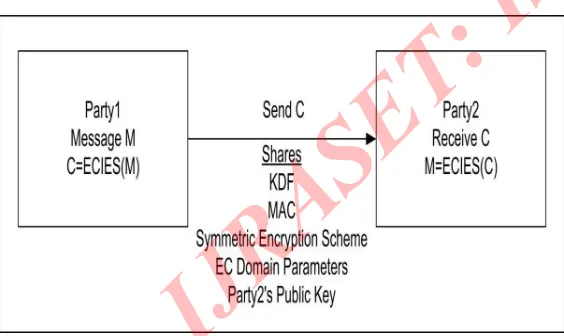
Elliptic Curve Integrated Encryption Scheme (ECIES)
for encryption:
Figure 3. Use of ECIES algorithm between two parties
.
(B). Elliptic curve based digital signature algorithm (ECDSA) for authentication and verification:
Figure 4. Use of ECDSA algorithm between two parties.
(C). Use of ECIES and ECDSA in our protocol
:
Figure5 .Use of ECIES-ECDSA in our algorithm
VI. RESULTS AND SIMULATION
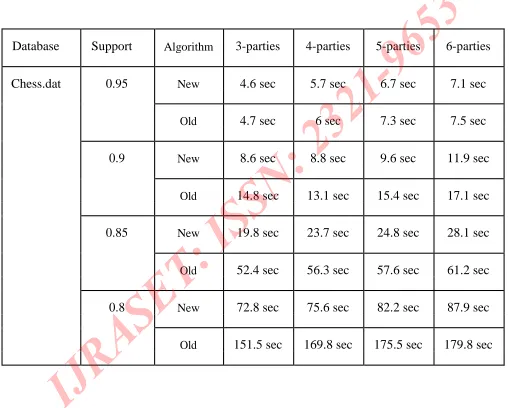
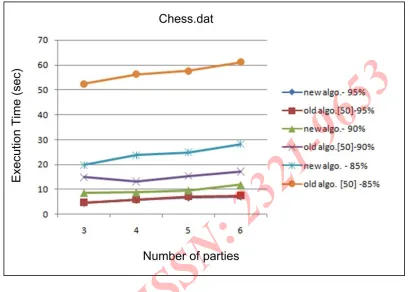
We tested our protocol on different datasets and recorded results. Here we are comparing our results with the old method [9] with respect to different database [10][11][12]. Analysis of our proposed method is shown in next subsection.
Table 1: Experimental results of chess.dat database
Database
Support
Algorithm
3-parties
4-parties
5-parties
6-parties
Chess.dat
0.95
New
4.6 sec
5.7 sec
6.7 sec
7.1 sec
Old
4.7 sec
6 sec
7.3 sec
7.5 sec
0.9
New
8.6 sec
8.8 sec
9.6 sec
11.9 sec
Old
14.8 sec
13.1 sec
15.4 sec
17.1 sec
0.85
New
19.8 sec
23.7 sec
24.8 sec
28.1 sec
Old
52.4 sec
56.3 sec
57.6 sec
61.2 sec
0.8
New
72.8 sec
75.6 sec
82.2 sec
87.9 sec
Figure 6. Comparison between old and new algorithm on chess.dat database for different parties and different support
VII. CONCLUSION
Here we proposed a novel approach for mining association rules on horizontally partitioned data in unsecured environment using elliptic curve cryptography. We also show that the global association rule can be generated without loss of privacy to the involving parties or intruder. The communication cost and computational cost also be reasonable for small amount of databases.