0095-1137/00/$04.00⫹0
Copyright © 2000, American Society for Microbiology. All Rights Reserved.
Genetic and Serologic Evaluation of Capsule Production by
Bovine Mammary Isolates of
Staphylococcus aureus
and Other
Staphylococcus
spp. from Europe and the United States
T. TOLLERSRUD,1* K. KENNY,2A. J. REITZ, JR.,3ANDJ. C. LEE3
Section of Immunoprophylaxis, National Veterinary Institute, Oslo, Norway1; Key Laboratories Ltd., Dublin, Ireland2;
and Channing Laboratory, Department of Medicine, Brigham and Women’s Hospital, Harvard Medical School,
Boston, Massachusetts3
Received 16 December 1999/Returned for modification 29 March 2000/Accepted 29 May 2000
Bovine mastitis caused by Staphylococcus aureus is responsible for major economic losses to the dairy industry, and more-effective therapeutic or preventive approaches are sorely needed. The predominance of staphylococcal capsular polysaccharide types 5 and 8 among human isolates from many sources is well documented, but there seems to be a greater variation in the distribution of capsular serotypes among isolates from cows. A total of 636 isolates ofS. aureusfrom cases of bovine mastitis in Sweden, Denmark, Finland, Iceland, Ireland, and the United States were investigated for production of capsular polysaccharide types 5 and 8. Approximately half of all the European isolates tested were of serotype 8, although variation among countries and among isolates of clinical and subclinical origin was observed. Sweden had the highest frequency (87%) of serotypeable isolates, and Finland had the lowest (48%). Capsule types 5 and 8 accounted for only 42% of the U.S. isolates tested. A few isolates showed weak reactivity with CP5 antiserum in a colony blot assay, and an enzyme-linked immunosorbent assay inhibition method confirmed that the levels of capsule produced by these strains were <10% of those produced by control strains. Fifty isolates that failed to react with capsular antisera all possessed the genes for production of capsular polysaccharide type 5 or 8. These results underscore the variability in capsule production by bovine isolates ofS. aureusfrom different geographic regions. This information is important for the rational design of a capsule-based vaccine to preventS. aureusbovine mastitis.
Mastitis is the most significant cause of economic loss to the dairy industry. Although several bacterial pathogens can cause mastitis,Staphylococcus aureus is a prime etiologic agent in most parts of the world. S. aureus strains produce capsular polysaccharide (CP) in vivo or under defined culture condi-tions (20, 36). EncapsulatedS. aureusstrains are more resistant to phagocytic uptake than are nonencapsulated strains, and antibodies to CP opsonize encapsulated strains for phagocytic killing (15, 38). In rodent models of staphylococcal infection (8, 19), capsular antibodies protected animals against death, bacteremia, endocarditis, and metastasis to the spleen, liver, and kidneys.
Eleven CP serotypes have been proposed on the basis of agglutinating reactivity with adsorbed rabbit antiserum and precipitation in double immunodiffusion (16, 34). Whereas there is general agreement that CP5 and CP8 are the predom-inant serotypes in humanS. aureus infections, evaluation of capsule production amongS. aureus strains from ruminants shows varying results. In France, 69% of 212 isolates recovered from cows’ milk were of serotype 5 (51%) or 8 (18%) (31). In contrast, only 17% of 18 isolates from bovine mastitis in Israel produced either the serotype 5 or the serotype 8 capsule (34). A recent report (35) indicated that only 14% of 195 bovine isolates from Argentina reacted with antibodies to CP5 or CP8. Guidry et al. (10, 11) evaluated the prevalence of serotype 5 and 8 capsules amongS. aureusstrains from mastitic cows in the United States and in four European countries. They showed that 41 and 70% of the U.S. and European isolates, respectively, were typeable with antibodies to CP5 or CP8.
Strains ofS. aureusthat do not react with antibodies to CP5 or CP8 are referred to as nontypeable (NT). These NT strains also fail to react with specific antibodies to serotype 1 or 2 CP (14, 18). Whether NT strains lack a capsule or produce a heterologous capsule type is unknown, since specific antibodies to proposed serotypes 3, 6, 7, 9, 10, and 11 are not available. Antibodies to serotype 5 react with the only serotype 4 strain that has been identified (14). Moreover, only CPs from sero-types 1, 2, 5, and 8 have been purified and chemically charac-terized (9, 22, 26, 27). The question of whether NT strains carry genes involved in capsule expression has only recently been addressed (35).
The genes involved in serotype 5 and 8 capsule biosynthesis are chromosomal and allelic (33). Each gene cluster contains 16 open reading frames (ORFs), designated cap5A through
cap5Pfor type 5 CP andcap8Athroughcap8Pfor type 8 CP.
The predicted amino acid sequences of 12 of the 16 ORFs of thecap5andcap8gene clusters are almost identical. However, four ORFs located in the central region (cap5Hthroughcap5K
orcap8Hthroughcap8K) bear little homology to each other
and are type specific.
The aim of this study was to evaluate the prevalence of serotypes 5 and 8 among bovine mammary isolates ofS. aureus
from four Nordic countries, Ireland, and the United States. Staphylococcal CPs may play a role in the pathogenesis of bovine mastitis because of their virulence-enhancing, anti-phagocytic properties. Information concerning the geographi-cal distribution of capsular serotypes is important for the ra-tional design and use of vaccines against S. aureus mastitis based on capsular antigens. We also sought to investigate the genotype of NTS. aureusstrains by hybridization studies and thus to determine whether they carry genes similar to those
* Corresponding author. Mailing address: National Veterinary In-stitute, P.B. 8156, 0033 Oslo Dep., Norway. Phone: 47 2296 4648. Fax: 47 2246 8890. E-mail: [email protected].
2998
on May 15, 2020 by guest
http://jcm.asm.org/
that encode the enzymes for the synthesis and polymerization of CP5 and CP8.
MATERIALS AND METHODS
Bacteria.Six hundred thirty-six isolates ofS. aureuswere obtained from the milk of cows with clinical or subclinical mastitis. The milk samples were collected from dairy herds in the United States, Sweden, Denmark, Finland, Iceland, and Ireland. Most of the isolates were from separate dairy herds within each region. TheS. aureusisolates were initially selected on the basis of colony appearance and a positive tube coagulase test and their identity was verified by API-Staph (bioMe´rieux Vitek, Inc., Hazelwood, Mo.) or Rapidec-Staph (bioMe´rieux, Marcy l’Etoile, France) or by amplification of a 108-bpS. aureus-specific DNA fragment by PCR (24). Coagulase-negative staphylococci isolated from clinical cases of bovine mastitis were identified to the species level by standard biochem-ical methods, API- and Rapidec-Staph, and by their failure to yield anS. aureus -specific amplicon by PCR. The bacteria were stored at⫺70°C in 10% skim milk or heart infusion broth (Difco Laboratories, Detroit, Mich.) with 15% glycerol. On the basis of clinical data, the isolates from Denmark, Finland, Iceland, Ireland, and Sweden were designated as originating from clinical or subclinical mastitis as defined by the National Mastitis Council (3). In brief, subclinical mastitis was defined as a form of the disease with no detectable change in the udder and no grossly observable abnormalities in the milk. Acute or clinical mastitis was defined as a condition of sudden onset with grossly abnormal milk and redness, swelling, and pain in the udder, with or without systemic symptoms.
Antibodies.Polyclonal antisera were raised in rabbits to heat- or formalin-killed suspensions of prototypeS. aureusstrains Reynolds (serotype 5), Becker (serotype 8), and PS80 (serotype 8). Sera were adsorbed withS. aureusWood 46 and trypsinized cells of acapsular mutants JL243 (2) and JL252 (5) to remove antibodies to noncapsular cell wall determinants. CP5-specific monoclonal anti-body S831 and CP8-specific monoclonal antianti-body S828 were kindly provided by H. K. Hochkeppel.
Capsule serotyping.Our serotyping experiments were performed only with antibodies to CP5 and CP8, since strains expressing CP1 and CP2 possess mucoid colony morphology and are extremely rare (4, 34). Colony immunoblots were performed as described previously (18) with CP5- or CP8-specific antibodies. Reactivity of the bovine isolates was evaluated by comparison with that of the control strains (types 1, 2, 5, and 8 and NT) included on each filter. Each isolate was tested at least twice. Reactions scored as 2⫹to 4⫹were recorded as positive, and isolates that reacted weakly (0 to 1⫹) were recorded as NT with the given antisera. Isolates consistently giving weak reactions with antibodies to CP5 or CP8 were further evaluated by immunodiffusion and/or enzyme-linked immu-nosorbent assay (ELISA) inhibition.
For preparation of crude capsular extracts,S. aureuswas cultivated for 24 h at 37°C on either tryptic soy agar (Difco Laboratories) or Columbia agar (Difco Laboratories) supplemented with 2% NaCl. The colonies from one 9-cm-diam-eter plate were harvested in 1 ml of 10 mM phosphate-buffered saline (0.15 M NaCl, pH 7.2), and the bacterial suspension was autoclaved for 1 h at 121°C. The bacteria were sedimented by centrifugation, and the supernatant was passed through a filter (pore size, 0.45m) and stored at⫺20°C. The quality of the capsular extract was verified by its reactivity with teichoic acid antiserum. Reac-tivity of the capsular extracts with antisera to CP5 and CP8 was evaluated by double immunodiffusion.
An ELISA inhibition method was used to quantitate CP5 produced by 16 bovineS. aureusisolates from four countries. This assay, described previously (2, 20), is based on the ability of purified CP5 or whole bacteria (trypsinized to remove protein A) to adsorb capsular antibodies from immune sera.
DNA hybridization experiments.To determine whether NTS. aureusisolates carry the genes involved in CP5 or CP8 expression, we performed DNA hybrid-ization studies. Genomic DNA was extracted from 50 NT bovine isolates ofS. aureusand 14 isolates of coagulase-negativeStaphylococcusspp. from cases of bovine mastitis. Strains Newman (serotype 5) and Becker (serotype 8), in addi-tion to bovine isolates of serotypes 5 and 8, were included in the hybridizaaddi-tion studies as positive controls. DNA from each isolate was digested withHindIII (Life Technologies, Gaithersburg, Md.) and electrophoresed in a 0.8% agarose gel. The DNA was transferred to a nylon membrane (Gene Screen; NEN Re-search Products, Boston, Mass.) and probed sequentially with cloned DNA fragments (cap5ABCD,cap5IJK,cap8HIJK, orcap5MNOP) that were enzyme labeled with AlkPhos Direct (Amersham Life Science, Inc., Arlington Heights, Ill.). Membrane hybridization and washing steps were performed as directed by the manufacturer at 60°C. Membrane stripping and autoradiography were car-ried out in accordance with the manufacturer’s recommendations.
RESULTS
The results of capsular serotyping of 274 bovine mastitis isolates of S. aureus from Europe are shown in Table 1. Marked differences in the distribution of isolates expressing CP5 or CP8 among the various countries were observed. When
European isolates from all cases of mastitis (clinical and sub-clinical) were considered, the majority of isolates from Den-mark, Sweden, and Ireland were of serotype 8. Isolates from Iceland showed an equal distribution of serotype 5, serotype 8, and NT isolates, whereas in Finland half of the isolates tested were NT. The typeable Finnish isolates were equally distrib-uted between serotypes 5 and 8. Among the Danish, Swedish, and FinnishS. aureusisolates, there was no significant differ-ence between the serotype distributions of clinical and subclin-ical staphylococcal isolates (Table 1). For Icelandic and Irish isolates, a higher proportion of clinical than of subclinical isolates was of serotype 8 (P⬍0.05 by chi-square analysis).
[image:2.612.311.550.93.369.2]Serotyping of the U.S. isolates revealed that only 42% of 362 isolates from seven different states were typeable with the available antisera (Table 2). Serotype 8 strains were recovered
TABLE 1. Results of capsular serotyping of isolates ofS. aureus
from cases of bovine mastitis in Europe
Country and
mastitis cases No. ofstrains
No. (%) with capsule
type: No. (%) NTa
5 8
Denmark
All 39 2 (5) 23 (59) 14 (36)
Clinical 20 1 (5) 12 (60) 7 (35)
Subclinical 19 1 (5) 11 (58) 7 (37)
Sweden
All 38 4 (11) 29 (76) 5 (13)
Clinical 11 1 (9) 8 (73) 2 (18)
Subclinical 27 3 (11) 21 (78) 3 (11)
Finland
All 62 17 (27) 13 (21) 32 (52)
Clinical 19 9 (47) 2 (11) 8 (42)
Subclinical 43 8 (19) 11 (25) 24 (56)
Iceland
All 34 10 (29) 13 (38) 11 (33)
Clinical 11 2 (18) 8 (73) 1 (9)
Subclinical 23 8 (35) 5 (22) 10 (43)
Ireland
All 101 1 (1) 62 (61) 38 (38)
Clinical 13 0 (0) 12 (92) 1 (8)
Subclinical 88 1 (1) 50 (57) 37 (42)
Total 274 33 (12) 140 (51) 101 (37)
aNT, isolates that do not react with antibodies to CP5 or CP8.
TABLE 2. Results of capsular serotyping of isolates ofS. aureus
from cases of bovine mastitis in the United States
State No. ofstrains
No. (%) with capsule
type: No. (%) NT
5 8
California 32 4 (12.5) 4 (12.5) 24 (75)
Pennsylvania 11 2 (18) 3 (27) 6 (55)
Washington 25 7 (28) 5 (20) 13 (52)
Vermont 20 5 (25) 6 (30) 11 (45)
Kentucky 20 7 (35) 3 (15) 10 (50)
Louisiana 21 6 (29) 2 (9) 13 (62)
New York 233 26 (11) 72 (31) 135 (58)
Total 362 54 (15) 98 (27) 210 (58)
on May 15, 2020 by guest
http://jcm.asm.org/
[image:2.612.312.551.603.728.2]almost twice as often as serotype 5 strains, but the majority (58%) of U.S. isolates were NT. As shown in Table 2, there was little difference in serotype distribution among strains from cows in different states. Data on the clinical status of infection were not obtained for isolates from the United States.
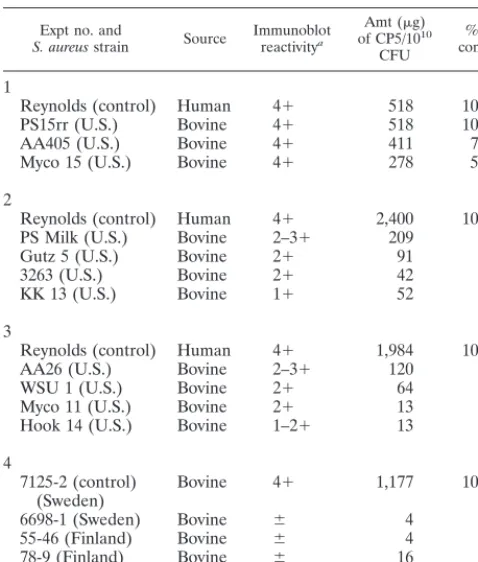
Quantitation of CP5 production.We identified a subset ofS.
aureusisolates that consistently reacted weakly with CP5
anti-serum in the colony immunoblot assay. Production of cell sur-face-associated CP5 was quantitated for 12 of these weakly reactive isolates and for five control strains (one of human origin, four of bovine origin) that reacted strongly (4⫹ reac-tions) in the colony immunoblot assay with CP5-specific anti-serum. A positive control strain was included in each experi-ment, since there is day-to-day variability in capsule expression by control strain Reynolds. As shown in Table 3, a positive
correlation existed between the strength of the reaction in the immunoblot and the quantitative ELISA results. ThreeS. au-reusisolates that reacted strongly in the colony immunoblot assays showed⬎50% of the capsule expression of strain Reyn-olds, whereas the weakly reactive isolates showed⬍10% of the cell surface-associated CP5 expression of the positive control strain.
Hybridization of genomic DNA from NTS. aureuswith the
cap5 and cap8 genes. To determine whether NT S. aureus
strains carry the genes involved in CP5 or CP8 expression, DNA hybridization studies were performed. Southern blots of genomic DNA digests from each isolate were probed consec-utively with cloned DNA fragments representing either the regions of the capsule gene clusters that are shared by type 5 and 8 strains or the regions that are unique to thecap5orcap8
gene cluster. The results, shown in Table 4, indicate that 48 of the 50 NT isolates tested carry thecap5genes, although they did not express detectable levels of CP5. Only two of the NT isolates, one each from Sweden and Iceland, carried thecap8
genes. The size of the hybridizing bands of the NT strains did not differ from those of the control serotype 5 and 8 strains (not shown), a result suggesting that each NT isolate carries an intact capsule gene cluster. As expected, none of the DNA samples hybridized to bothcap5- andcap8-specific fragments, since thecap5andcap8loci are allelic.
Hybridization of genomic DNAs from Staphylococcus spp. with thecap5andcap8genes.Poutrel et al. (32) reported that 16 of 74 coagulase-negative staphylococci of bovine origin re-acted with monoclonal antibodies to S. aureus CP5 or CP8. Thirteen of the 16 reactive strains were S. haemolyticus iso-lates. To examine this phenomenon further, 14 isolates of staphylococcal species other than S. aureus were tested for capsule production by serologic methods and for the presence of thecap5orcap8genes by Southern blot hybridization. The isolates tested, all of which were recovered from bovine milk, included seven isolates ofS. haemolyticus, three ofS. interme-dius, two ofS. chromogenes, and one each ofS. xylosusandS.
simulans. Except for theS. haemolyticusisolates, none of the
isolates reacted with the capsular antibodies or carried genes that hybridized with the capsule gene probes (Table 5). In contrast, all sevenS. haemolyticusisolates reacted with both polyclonal and monoclonal antibodies specific for CP5. Under our standard conditions for hybridization (high stringency, 60°C), genomic DNA prepared from theS. haemolyticus iso-lates did not hybridize to either acap5or acap8gene probe. However, under low-stringency (50°C) conditions, a mixture of
cap5 probes hybridized weakly to chromosomal DNAs from
[image:3.612.54.293.93.374.2]theS. haemolyticusisolates.
TABLE 3. Correlation between reactivity in the immunoblot and quantitative CP5 expression measured by ELISA inhibition
Expt no. and
S. aureusstrain Source Immunoblotreactivitya
Amt (g) of CP5/1010
CFU
% of control
1
Reynolds (control) Human 4⫹ 518 100
PS15rr (U.S.) Bovine 4⫹ 518 100
AA405 (U.S.) Bovine 4⫹ 411 79
Myco 15 (U.S.) Bovine 4⫹ 278 54
2
Reynolds (control) Human 4⫹ 2,400 100
PS Milk (U.S.) Bovine 2–3⫹ 209 8.7
Gutz 5 (U.S.) Bovine 2⫹ 91 3.8
3263 (U.S.) Bovine 2⫹ 42 1.8
KK 13 (U.S.) Bovine 1⫹ 52 2.2
3
Reynolds (control) Human 4⫹ 1,984 100
AA26 (U.S.) Bovine 2–3⫹ 120 6.0
WSU 1 (U.S.) Bovine 2⫹ 64 3.2
Myco 11 (U.S.) Bovine 2⫹ 13 0.7
Hook 14 (U.S.) Bovine 1–2⫹ 13 0.7
4
7125-2 (control)
(Sweden) Bovine 4⫹ 1,177 100
6698-1 (Sweden) Bovine ⫾ 4 0.3
55-46 (Finland) Bovine ⫾ 4 0.3
78-9 (Finland) Bovine ⫾ 16 1.4
2076 (Iceland) Bovine ⫾ 6 0.5
a1⫹, very weak; 2⫹, medium; 3⫹, strong; 4⫹, very strong;⫾, little to none.
TABLE 4. Results of hybridization experimentsa
Source (strain) No. of strains Serotype cap5ABCD cap5IJK cap8HIJK cap5LMNO
Human, U.S. (Becker) 1 8 ⫹ ⫺ ⫹ ⫹
Human, U.S. (Newman) 1 5 ⫹ ⫹ ⫺ ⫹
Bovine, Iceland (2317) 1 8 ⫹ ⫺ ⫹ ⫹
Bovine, Sweden (6622-4) 1 5 ⫹ ⫹ ⫺ ⫹
Bovine, U.S. (NY19) 1 5 ⫹ ⫹ ⫺ ⫹
Bovine, U.S. 41 NT ⫹ ⫹ ⫺ ⫹
Bovine, Sweden 4 NT ⫹ ⫹ ⫺ ⫹
Bovine, Sweden 1 NT ⫹ ⫺ ⫹ ⫹
Bovine, Iceland 3 NT ⫹ ⫹ ⫺ ⫹
Bovine, Iceland 1 NT ⫹ ⫺ ⫹ ⫹
aGenomic DNAs fromS. aureusisolates were digested withHindIII, and Southern blots were probed with cloned DNA fragments common to thecap5andcap8
gene clusters (cap5ABCDandcap5LMNOP), a DNA fragment specific to thecap5gene cluster (cap5IJK), or a DNA fragment specific to thecap8gene cluster (cap8HIJK).
on May 15, 2020 by guest
http://jcm.asm.org/
[image:3.612.52.550.591.702.2]DISCUSSION
The results of this study underscore the considerable vari-ability that exists in the prevalence of serotype 5 and 8 capsules among bovine mammary isolates ofS. aureus from different countries. CP8 expression predominated among staphylococ-cal isolates from Denmark, Sweden, and Ireland. In contrast, Poutrel et al. reported that serotype 5 strains accounted for half of 212 isolates from France while only 18% of the strains were of serotype 8 (31). Our data indicate that 63% of 274 bovine mammary isolates ofS. aureustested from five Euro-pean countries (Denmark, Sweden, Finland, Iceland, and Ire-land) expressed either serotype 5 or 8 CPs. At the other ex-treme are bovine mammary isolates from Argentina, of which 86% are NT (35). In the United Kingdom, Germany, and The Netherlands, there appears to be an equal distribution of se-rotype 5, sese-rotype 8, and NT isolates (11). We found that only 42% of 369 bovine isolates from the United States expressed CP5 or CP8, consistent with results from a previous study (10). Our data also suggest a correlation between capsule produc-tion and the clinical severity of mastitis in Iceland and Ireland, where⬎90% of isolates from cows with clinical mastitis were encapsulated. The subclinical isolates from Iceland and Ireland were only 57 and 58% positive, respectively, for capsule pro-duction. No such correlation was found for isolates from three other countries (Denmark, Sweden, and Finland), however. The clustering of typeable isolates among the clinical mastitis strains may be influenced by the occurrence of local clones of
S. aureus that become widely disseminated within a single
region. With the use of ribotyping and phage typing, Aarestrup et al. found regional clones ofS. aureusisolates from bovine mastitis distributed within the Nordic countries (1). Unlike bovine isolates,S. aureusisolates cultured from humans resid-ing in diverse geographic regions show only subtle differences in the prevalence of capsule expression. Approximately 75% of all human S. aureus isolates (both commensal and disease isolates) are positive for either CP5 or CP8 (4, 13, 34). This difference in capsule production between bovine and human isolates probably reflects limited diversity among the bovine isolates within a particular geographic region.
All 50 of the NT S. aureus isolates tested in this study possessed the capgenes required for the synthesis of either CP5 or CP8. The fact that 48 of the 50 NT isolates possessed
cap5genes is noteworthy and merits further investigation. It is possible that these NT isolates have point mutations in one or more of the 16 genes involved in capsule expression, as has been shown for the NT strainS. aureus NCTC 8325-4 (6, 21, 39). This strain carries an intact copy of thecap5gene cluster, but a mutation incap5Erenders it capsule negative. Alterna-tively, these NT isolates may produce undetectable levels of CP due to poor promoter activity or regulatory effects. Although
capsule production is known to be influenced by a number of environmental factors, such as energy availability and source, oxygen supply, and the amino acid content of the growth me-dium (12, 20, 36, 37), the genetic mechanisms regulating CP expression inS. aureusare largely unknown.
We detected a subset of bovine S. aureusisolates that ex-pressed⬍10% of the cell surface-associated CP5 produced by prototype strain Reynolds. These strains were only weakly re-active by the colony immunoblot method. The expression of scant amounts of CP5 by this subset may reflect a defect in the capsule gene cluster or regulatory control mechanisms. Alter-natively, production of CP by an individualS. aureus isolate may vary under different laboratory growth conditions or dur-ing growth in the mammary gland. The clinical significance of
S. aureus CP production in the pathogenesis of mastitis is
unknown, and the biological significance of scant CP produc-tion in this disease has not been evaluated. Strain Reynolds was significantly more virulent in a mouse bacteremia model than was either an acapsular mutant (JL243) or a mutant that expressed 9% of the wild-type level of CP5 (JL236). While both mutants were opsonized for phagocytic killing by nonim-mune serum with complement activity, strain Reynolds re-sisted phagocytosis and required capsule-specific antibodies and complement for opsonization (38). In a murine model, septic arthritis was of intermediate frequency and severity in mice inoculated with the CP-deficient mutant JL236, as op-posed to the parental strain or the acapsular mutant (29).
Of particular interest in our study was the observation that all seven of theS. haemolyticusstrains tested showed serologic evidence of CP5 expression, but that genomic DNA prepared from these seven isolates failed to hybridize to thecap5genes under high-stringency conditions. Hybridization was observed under low-stringency conditions to genomic, but not plasmid, DNA from these strains, a result suggesting thatS. haemolyti-cusdoes carrycapgenes with limited homology to those from
S. aureus. Poutrel et al. showed that 13 of 19S. haemolyticus
isolates of bovine origin reacted with monoclonal antibodies to CP5 (32). Nelles et al. (28) showed thatS. epidermidisclinical isolates did not react with CP5- or CP8-specific monoclonal antibodies. Similar findings were reported by Boutonnier et al. (7), who observed no reactions between capsule-specific mono-clonal antibodies and members of 25Staphylococcus species other thanS. aureus, including one strain ofS. haemolyticus
(ATCC 29970T). Moreover, of 678 blood culture isolates of
coagulase-negative staphylococcal species (primarilyS.
epider-midis), none reacted by ELISA with capsular antibodies.
[image:4.612.51.555.83.167.2]It is plausible that NT bovine isolates ofS. aureusmake a capsule unrelated to CP5 or CP8 that is not detected by our capsular antibodies or by hybridization with thecapgene re-gion-specific DNA probes. Several authors have described the
TABLE 5. Results of hybridization experimentsa
Species Capsule serotype No. of strains cap5ABCD cap5IJK cap8HIJK cap5LMNOP
S. aureus 5 3 ⫹ ⫹ ⫺ ⫹
S. aureus 8 2 ⫹ ⫺ ⫹ ⫹
S. intermedius NT 3 ⫺ ⫺ ⫺ ⫺
S. xylosus NT 1 ⫺ ⫺ ⫺ ⫺
S. chromogenes NT 2 ⫺ ⫺ ⫺ ⫺
S. simulans NT 1 ⫺ ⫺ ⫺ ⫺
S. haemolyticusb 5 7 ⫺ ⫺ ⫺ ⫺
aGenomic DNAs from bovine mastitis isolates ofStaphylococcusspp. were digested withHindIII, and Southern blots were probed with cloned DNA fragments
common to thecap5andcap8gene clusters (cap5ABCDandcap5LMNOP), a DNA fragment specific to thecap5gene cluster (cap5IJK), or a DNA fragment specific to the cap8 gene cluster (cap8HIJK).
bIsolates of this species showed weak hybridization to thecap5probes under low-stringency conditions.
on May 15, 2020 by guest
http://jcm.asm.org/
existence of other, less-defined capsular or surface antigens among bovine mastitis isolates ofS. aureus(23, 30, 40). Guidry et al. (11) reported that a new antigen called 336 was present on bovine isolates ofS. aureus that did not produce CP5 or CP8. However, the authors did not distinguish this antigen from teichoic acid (17). A recent study revealed that 29 (35%) of 82 NTS. aureusisolates from cases of bovine mastitis in the United States were reactive with antibodies to a newly de-scribed staphylococcal surface polysaccharide composed of poly-N-succinylglucosamine (PNSG) (25). The relationship of PNSG and CP to previously described bovine staphylococcal surface antigens is largely unknown. PNSG expression was independent of CP5 or CP8 expression; i.e., it was produced by NT strains, as well as by strains positive for CP5 or CP8.
The results of capsule serotyping studies of isolates from different countries are important for the rational design of mastitis vaccines containing staphylococcal capsular antigens. If improved vaccines against bovine mastitis are to be gener-ated, more studies must elucidate the role of these polysaccha-rides in the pathogenesis of bovine mastitis. The creation and use of isogenic, capsule-negativeS. aureusmutants of bovine origin in infection models of mastitis would add to the current knowledge. Ongoing studies will determine whether immuni-zation with CP5 or CP8 will be protective against experimental bovine mastitis.
ACKNOWLEDGMENTS
We thank Torsteinn Olafsson (Iceland), Anna Huda (Denmark), Lolita Nilsson (Sweden), Tuula Honkanen-Buzalski (Finland), and Ross Fitzgerald (Ireland) for providingS. aureusisolates from Europe. We are grateful for the coagulase-negative staphylococci supplied by Steinar Waage and Tormod Mørk. We thank the following individuals for providing bovine isolates from the United States: James Cullor, Larry Fox, R. J. Harmon, Steve Nickerson, J. W. Pankey, Richard A. Wilson, and William E. Owens. We gratefully acknowledge the gift of monoclonal antibodies from H. K. Hochkeppel. We thank Jessica Lam for her assistance in the DNA hybridization studies.
This work was supported by VESO AS and National Institutes of Health grant AI29040 (to Jean Lee).
REFERENCES
1.Aarestrup, F. M., H. C. Wegener, N. E. Jensen, O. Jonsson, V. Myllys, B. M. Thorberg, S. Waage, and V. T. Rosdahl.1997. A study of phage- and ribotype patterns ofStaphylococcus aureusisolated from bovine mastitis in the Nordic countries. Acta Vet. Scand.38:243–252.
2.Albus, A., R. D. Arbeit, and J. C. Lee.1991. Virulence ofStaphylococcus aureusmutants altered in type 5 capsule production. Infect. Immun.59:
1008–1014.
3.Anonymous.1996. Mastitis can take on several different forms. Natl. Mastitis Counc. Newsl.19:1.
4.Arbeit, R. D., W. W. Karakawa, W. F. Vann, and J. B. Robbins.1984. Predominance of two newly described capsular polysaccharide types among clinical isolates ofStaphylococcus aureus. Diagn. Microbiol. Infect. Dis.2:85–91. 5.Baddour, L. M., C. Lowrance, A. Albus, J. H. Lowrance, S. K. Anderson, and J. C. Lee.1992.Staphylococcus aureusmicrocapsule expression attenuates bacterial virulence in a rat model of experimental endocarditis. J. Infect. Dis.
165:749–753.
6.Bhasin, N., A. Albus, F. Michon, P. J. Livolsi, J. S. Park, and J. C. Lee.1998. Identification of a gene essential for O-acetylation of theStaphylococcus aureustype 5 capsular polysaccharide. Mol. Microbiol.27:9–21.
7.Boutonnier, A., F. Nato, A. Bouvet, L. Lebrun, A. Audurier, J. C. Mazie, and J. M. Fournier.1989. Direct testing of blood culture for detection of the serotype 5 and 8 capsular polysaccharides ofStaphylococcus aureus. J. Clin. Microbiol.27:989–993.
8.Fattom, A., J. Sarwar, A. Ortiz, and R. Naso.1996. AStaphylococcus aureus
capsular polysaccharide (CP) vaccine and CP-specific antibodies protect mice against bacterial challenge. Infect. Immun.64:1659–1665.
9.Fournier, J. M., W. F. Vann, and W. W. Karakawa.1984. Purification and characterization ofStaphylococcus aureustype 8 capsular polysaccharide. Infect. Immun.45:87–93.
10. Guidry, A. J., A. Fattom, A. Patel, and C. O’Brien.1997. Prevalence of capsular serotypes amongStaphylococcus aureusisolates from cows with mastitis in the United States. Vet. Microbiol.59:53–58.
11. Guidry, A. J., A. Fattom, A. Patel, C. O’Brien, S. Shepherd, and J. Lohuis.
1998. Serotyping scheme forStaphylococcus aureusisolated from cows with mastitis. Am. J. Vet. Res.59:1537–1539.
12. Herbert, S., D. Worlitzsch, B. Dassy, A. Boutonnier, J. M. Fournier, G. Bellon, A. Dalhoff, and G. Doring.1997. Regulation ofStaphylococcus aureus
capsular polysaccharide type 5: CO2inhibition in vitro and in vivo. J. Infect.
Dis.176:431–438.
13. Hochkeppel, H. K., D. G. Braun, W. Vischer, A. Imm, S. Sutter, U. Staeubli, R. Guggenheim, E. L. Kaplan, A. Boutonnier, and J. M. Fournier.1987. Serotyping and electron microscopy studies ofStaphylococcus aureusclinical isolates with monoclonal antibodies to capsular polysaccharide types 5 and 8. J. Clin. Microbiol.25:526–530.
14. Karakawa, W. W., J. M. Fournier, W. F. Vann, R. D. Arbeit, R. Schneerson, and J. B. Robbins.1985. Method for the serological typing of the capsular polysaccharides ofStaphylococcus aureus. J. Clin. Microbiol.22:445–447. 15. Karakawa, W. W., A. Sutton, R. Schneerson, A. Karpas, and W. F. Vann.
1988. Capsular antibodies induce type-specific phagocytosis of capsulated
Staphylococcus aureusby human polymorphonuclear leukocytes. Infect. Im-mun.56:1090–1095.
16. Karakawa, W. W., and W. F. Vann.1982. Capsular polysaccharides of Staph-ylococcus aureus. Semin. Infect. Dis.4:285–293.
17. Kenny, K., and T. Tollersrud.1999. Questions uniqueness of surface poly-saccharide. Am. J. Vet. Res.60:530.
18. Lee, J. C., M. J. Liu, J. Parsonnet, and R. D. Arbeit.1990. Expression of type 8 capsular polysaccharide and production of toxic shock syndrome toxin 1 are associated among vaginal isolates ofStaphylococcus aureus. J. Clin. Mi-crobiol.28:2612–2615.
19. Lee, J. C., J. S. Park, S. E. Shepherd, V. Carey, and A. Fattom.1997. Protective efficacy of antibodies to theStaphylococcus aureustype 5 capsular polysaccharide in a modified model of endocarditis in rats. Infect. Immun.
65:4146–4151.
20. Lee, J. C., S. Takeda, P. J. Livolsi, and L. C. Paoletti.1993. Effects of in vitro and in vivo growth conditions on expression of type 8 capsular polysaccha-ride byStaphylococcus aureus. Infect. Immun.61:1853–1858.
21. Lee, J. C., S. Xu, A. Albus, and P. J. Livolsi.1994. Genetic analysis of type 5 capsular polysaccharide expression byStaphylococcus aureus. J. Bacteriol.
176:4883–4889.
22. Liau, D. F., and J. H. Hash.1977. Structural analysis of the surface polysac-charide ofStaphylococcus aureusM. J. Bacteriol.131:194–200.
23. Mamo, W., and G. Froman.1994. In vivo-like antigenic surface properties of
Staphylococcus aureusfrom bovine mastitis induced upon growth in milk whey. Microbiol. Immunol.38:801–804.
24. Martineau, F., F. J. Picard, P. H. Roy, M. Ouellette, and M. G. Bergeron.
1998. Species-specific and ubiquitous-DNA-based assays for rapid identifi-cation ofStaphylococcus aureus. J. Clin. Microbiol.36:618–623.
25. McKenney, D., K. L. Pouliot, Y. Wang, V. Murthy, M. Ulrich, G. Doring, J. C. Lee, D. A. Goldmann, and G. B. Pier.1999. Broadly protective vaccine forStaphylococcus aureusbased on an in vivo-expressed antigen. Science
284:1523–1527.
26. Moreau, M., J. C. Richards, J. M. Fournier, R. A. Byrd, W. W. Karakawa, and W. F. Vann.1990. Structure of the type 5 capsular polysaccharide of
Staphylococcus aureus. Carbohydr. Res.201:285–297.
27. Murthy, S. V., M. A. Melly, T. M. Harris, C. G. Hellerqvist, and J. H. Hash.
1983. The repeating sequence of the capsular polysaccharide of Staphylococ-cus aureusM. Carbohydr. Res.117:113–123.
28. Nelles, M. J., C. A. Niswander, W. W. Karakawa, W. F. Vann, and R. D. Arbeit.1985. Reactivity of type-specific monoclonal antibodies with Staphy-lococcus aureusclinical isolates and purified capsular polysaccharide. Infect. Immun.49:14–18.
29. Nilsson, I. M., J. C. Lee, T. Bremell, C. Ryden, and A. Tarkowski.1997. The role of staphylococcal polysaccharide microcapsule expression in septicemia and septic arthritis. Infect. Immun.65:4216–4221.
30. Opdebeeck, J. P., A. J. Frost, D. O’Boyle, and N. L. Norcross.1987. The expression of capsule in serum-soft agar byStaphylococcus aureusisolated from bovine mastitis. Vet. Microbiol.13:225–234.
31. Poutrel, B., A. Boutonnier, L. Sutra, and J. M. Fournier.1988. Prevalence of capsular polysaccharide types 5 and 8 amongStaphylococcus aureusisolates from cow, goat, and ewe milk. J. Clin. Microbiol.26:38–40.
32. Poutrel, B., C. Mendolia, and J. M. Fournier.1990. Reactivity of coagulase-negative staphylococci isolated from cow and goat milk with monoclonal antibodies toStaphylococcus aureuscapsular polysaccharide types 5 and 8. J. Clin. Microbiol.28:358–360.
33. Sau, S., N. Bhasin, E. R. Wann, J. C. Lee, T. J. Foster, and C. Y. Lee.1997. TheStaphylococcus aureusallelic genetic loci for serotype 5 and 8 capsule expression contain the type-specific genes flanked by common genes. Micro-biology143:2395–2405.
34. Sompolinsky, D., Z. Samra, W. W. Karakawa, W. F. Vann, R. Schneerson, and Z. Malik.1985. Encapsulation and capsular types in isolates of Staphy-lococcus aureus from different sources and relationship to phage types. J. Clin. Microbiol.22:828–834.
35. Sordelli, D. O., F. R. Buzzola, M. I. Gomez, L. Steele-Moore, D. Berg, E. Gentilini, M. Catalano, A. J. Reitz, T. Tollersrud, G. Denamiel, P. Jeric, and J. C. Lee.2000. Capsule expression by bovine isolates ofStaphylococcus
on May 15, 2020 by guest
http://jcm.asm.org/
aureusfrom Argentina: genetic and epidemiological analyses. J. Clin. Mi-crobiol.38:846–850.
36. Stringfellow, W. T., B. Dassy, M. Lieb, and J. M. Fournier.1991. Staphylo-coccus aureusgrowth and type 5 capsular polysaccharide production in syn-thetic media. Appl. Environ. Microbiol.57:618–621.
37. Sutra, L., P. Rainard, and B. Poutrel.1990. Phagocytosis of mastitis isolates ofStaphylococcus aureusand expression of type 5 capsular polysaccharide are influenced by growth in the presence of milk. J. Clin. Microbiol.28:2253– 2258.
38. Thakker, M., J. S. Park, V. Carey, and J. C. Lee.1998.Staphylococcus aureus
serotype 5 capsular polysaccharide is antiphagocytic and enhances bacterial virulence in a murine bacteremia model. Infect. Immun.66:5183–5189. 39. Wann, E. R., B. Dassy, J. M. Fournier, and T. J. Foster.1999. Genetic
analysis of thecap5locus of Staphylococcus aureus. FEMS Microbiol. Lett.
170:97–103.
40. Watson, D. L., and N. A. Watson.1989. Expression of a pseudocapsule by
Staphylococcus aureus: influence of cultural conditions and relevance to mastitis. Res. Vet. Sci.47:152–157.