2018 International Conference on Computer, Electronic Information and Communications (CEIC 2018) ISBN: 978-1-60595-557-5
The Influences of Varied Processing Techniques on the Performance of
Polyvinyl Butyral and High Reliability of Polyvinyl Butyral-Based
Glass-Glass Modules
Hua-bin CAO
1, Xian-fang GOU
2, Qing-song HUANG
2, Lei ZHAO
2, Zhen-xia
SHI
2, Jing TAO
2, Jia ZHU
2, Hao ZHUANG
2,*and Zhong-yi CHEN
11
CECEP Solar Energy Co. Ltd, Beijing, China
2
CECEP Solar Energy Technology (Zhenjiang) Co. Ltd, Zhenjiang, China
*Corresponding author
Keywords: Mechanical strength, Transmittance, PVB, Damp heat, UV radiation.
Abstract. Three different techniques, i.e. one-step lamination, lamination+autoclave and
rolling+autoclave, were comparatively studied for the processing of polyvinyl butyral (PVB) film. The influences of different processing techniques on the mechanical performance, the transmittance and the adhesion strength between glass and PVB were investigated. Further, the transmittance of PVB with three different processes before and after damp heat test and UV radiation was measured. The obtained results demonstrate that the employment of the autoclave process is beneficial for the mechanical performance of PVB as well as its adhesion with glass. The on-based modules exhibited high reliability during damp heat and thermal cycle test.
Introduction
With the large consumption of nonrenewable fossil energy in the past years, the energy crisis has become one of the main problems the world is facing today. To solve this problem, new techniques and devices are developed for the utilization of new energy sources, such as wind power, solar energy and geothermal heat. Among these, solar energy has become a hot area of competitive development in many countries. Crystalline silicon photovoltaic modules, which convert sunlight into electricity, are usually encapsulated with glass frontsheet, encapsulant film and polymeric backsheet and are supposed to have a lifetime up to 25 years regardless of the various outdoor conditions. Many outdoor factors [1-5] may lead to reduction of the module efficiency, such as temperature, moisture, wind or snow load and thermomechanical stress.
Recently, the adoption of glass in replacement of polymeric material as the backsheet of a module has been widely investigated [6,7]. Glass–glass modules are initially the common selection for building integrated photovoltaics (BIPV), in which polyvinyl butyral (PVB) is used as the interlayer for safety and security purposes [8]. Currently, the glass-glass module has also been applied in a noticeable scale in PV power plant due to its high reliability [9,10]. For the power plant use, several encapsulant materials, including polyethyl acetate (EVA), polyolefin (POE) and PVB can be applied for the glass-glass module encapsulation. Each material has its own advantages and PVB shows superior performance in mechanical, secure and weather-resistant performance. However, the ultimate performance of the material and product are often affected by the processing technology [11,12].
insight into the relationship between the performance of PVB/PVB-based module and the processing techniques.
Experimental
PVB samples with three different processes (i.e., one-step lamination, lamination+autoclave and rolling+autoclave) were fabricated. The thickness of PVB used in the experiment is 0.76mm. Glass-glass modules were produced according to the industrial process at CECEP solar (Zhenjiang) with a standard composition of glass/PVB/cell/PVB/glass. The materials used for module encapsulation were all obtained from commercial source. The maximum power output measurements were performed for each module product before and after each environmental test under STC (25oC, 1000 W/m2, AM 1.5).
Results and Discussion
Properties of PVB after Different Processes
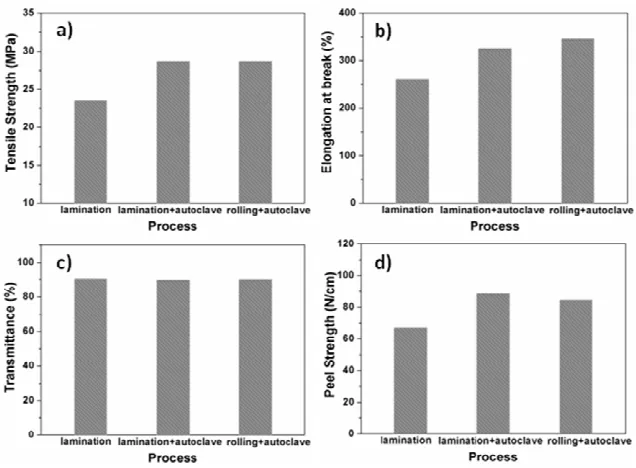
[image:2.612.147.465.416.650.2]The properties of the transparent PVB film, including the tensile strength, elongation at break, peel strength from glass are all tested after different processing techniques. Figure 1 shows the mechanical performance of PVB film after three different processes: one-step lamination (P1), lamination+autoclave (P2) or rolling+autoclave (P3). It can be seen from Figure. 1a and 1b that PVB films after the autoclave process both show superior mechanical performance than that without undergoing this autoclave process. The tensile strength of PVB films with this autoclave process is ~22% higher than that with the one-step lamination process only. The elongation at break for the films undergoing the lamination+autoclave or rolling+autoclave process is 25% and 32% better. These results suggest that the autoclave process can help improve the mechanical performance of the PVB film.
Figure 1. The (a) tensile strength, (b) elongation at break, (c) transmittance and (d) peel strength of PVB film after three different processes: lamination, lamination+autoclave, rolling+autoclave.
be seen from Figure. 1c that the transmittances are all around 90% and no obvious difference in transmittance can be observed for the three different processes. The obtained data are all summarized and listed in Table 1.
Table 1. Properties of PVB after different processes.
Item P1 P2 P3
Transmittance [%] 90.5 89.93 90.34
Tensile strength [Mpa] 23.6 28.7 28.7
Elongation at break [%] 261.7 326.7 346.6
Peel strength [N/cm] 67.3 88.6 84.7
[image:3.612.104.512.364.456.2]As high amount of hydroxyl groups exist in PVB chains, the observed improvement in the mechanical performance after the autoclave process can be attributed to the hydrogen bond formation between PVB macromolecular chains in the bulk [8]. Due to the high-pressure strengthened contact between PVB macromolecules and glass inner surface as well as the high temperature provided in the autoclave, hydroxyl groups in PVB molecular chains are easy to form hydrogen bonds between adjacent chain segments, which improve both the tensile strength and elongation of the film. Figure. 2 shows the scheme of the hydrogen bonding formation after the lamination and autoclave process. After the lamination process, only part of the hydroxyl groups close to the PVB/glass interface form hydrogen bonds with the oxygen atom in the glass. However, after the autoclave process, PVB molecular chains have more time to relax and rotate so as to form more hydrogen bonds at the PVB/glass interface, thus exhibiting higher peel strength from glass.
Figure 2. Scheme of the hydrogen bonding formation after the lamination and autoclave process.
Properties of PVB after Aging
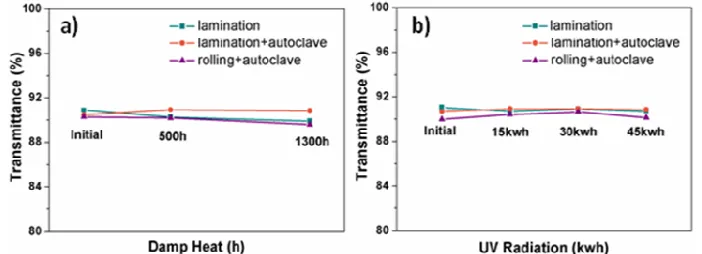
To evaluate the performance of PVB during its outdoor use in glass-glass modules, both damp heat and UV radiation test were performed on PVB prepared using different processing techiniques. Figure. 3a shows the transmittance before and after damp heat test for 500h and 1300h. Figure. 3b shows the transmittance change before and after UV radiation for 15kwh, 30kwh and 45kwh. The obtained data all demonstrate that PVB films prepared by the three different processes show no obvious change in transmittance, indicating the intrinsic superior resistance of PVB against UV and thermoxidative aging.
[image:3.612.130.481.587.714.2]To evaluate the performance of PVB-based modules fabricated with this autoclave process. PVB-based glass-glass modules were prepared with the lamination+autoclave or rolling+autoclave process. The power of the module before and after the DH1000h and TC200 were measured under standard test condition. The degradation of the modules is drived from the power loss of modules after environmental tests. Figure. 4 shows the difference in module power degradation for the two processes. The power degradation for modules fabricated with lamination+autoclave and rolling+autoclave process after DH1000h is 1.8% and 1.4%, respectively. After TC200 test, the module power degradation for lamination+autoclave and rolling+autoclave process is 2.3% and 1.9%, respectively. Modules fabricated with the rolling+autoclave process exhibited better performance in both damp heat and thermal cycle tests, suggesting better reliability for the modules with this process.
Figure 4. Degradation of PVB-based modules fabricated with the lamination+autoclave and rolling+autoclave processes after DH1000h and TC200 test.
Summary
The effects of different process techniques on the mechanical performance, the adhesion strength between glass and PVB as well as the transmittance are revealed. No obvious difference in the transmittance of PVB with three different processes before and after damp heat test and UV radiation. The obtained results demonstrate that the employment of the autoclave process is beneficial for the mechanical performance of PVB as well as its adhesion with glass. The on-based modules exhibited high reliability during damp heat and thermal cycle test.
Acknowledgement
This research was financially supported by the Key R&D Program of Zhenjiang (Industry Prospects and Common Key Technologies, CY2015002-3) and CECEP Technological Innovation Project (cecep-kj-2015-002).
References
[1] G. Mon, L. Wen, R. Sugimura, Jr., Reliability studies of photovoltaic module insulation systems, in: Proceedings of the 19th Electrical Electronics Insulation Conference, 1989, Chicago '89 EEIC/ICWA Exposition, 1989.
[3] J. Zhu, M. Koehl, S. Hoffmann et al., Changes of solar cell parameters during damp-heat exposure, Prog. Photovolt: Res. Appl. 24 (2016) 1346-1358.
[4] T. Ishii, A. Masuda, Annual degradation rates of recent crystalline silicon photovoltaic modules, Prog. Photovolt: Res. Appl. 25 (2017) 953-967.
[5] R. Dubey, S. Chattopadhyay, V. Kuthanazhi et al., Comprehensive study of performance degradation of field-mounted photovoltaic modules in India, Energy Science and Engineering, 5 (2017) 51-64.
[6] R. Couderc, M. Amara, J. Degoulange, et al., Encapsulant for glass-glass PV modules for minimum optical losses: gas or EVA, Energy Procedia, 124 (2017) 470-477.
[7] Q. Z. Wei, C. Y. Wu, X. R. Liu et al., The glass-glass module using n-type bifacial solar cell with PERT structure and its performance, Energy Procedia, 92 (2016) 750-754.
[8] R. Meitzner, S.H. Schulze, Method for determination of parameters for moisture simulations in photovoltaic modules and laminated glass, Solar Energy Materials & Solar Cells, 144 (2016) 23-28.
[9] F. Kraemer, S. Wiese, Assessment of long term reliability of photovoltaic glass–glass modules vs. glass-back sheet modules, Microelectronics Reliability, 55 (2015) 716-721.
[10] J. Tang, C. H. Ju, R. R. et al., The performance of double glass photovoltaic modules under composite test conditions, Energy Procedia, 130 (2017) 87-93.
[11] F. J. Pern, A.W. Czanderna, Characterization of ethylene vinyl acetate (EVA) encapsulant: Effects of thermal processing and weathering degradation on its discoloration, Solar Energy Materials and Solar Cells, 25 (1992) 3-23.