R E S E A R C H
Open Access
Complete moment convergence of
double-indexed randomly weighted sums of
mixing sequences
Jian Han
1*and Yu Xiang
2*Correspondence:
[email protected] 1School of Finance, Chongqing
Technology and Business University, Chongqing, China
Full list of author information is available at the end of the article
Abstract
In this paper, we study the complete moment convergence of the sums of
ρ-mixing
˜ sequences which are double-indexed randomly weighted and stochasticallydominated by a random variableX. Under the different moment conditions onXand weights, many complete moment convergence and complete convergence results are obtained. Moreover, some simulations are given for illustration.
MSC: 60F15
Keywords: complete convergence; double-indexed randomly weighted sums; ˜
ρ-mixing sequences
1 Introduction
Let {Xn,n≥ } be a random variable sequence defined on a fixed probability space
(,F,P). DenoteFS=σ(Xi,i∈S⊂N). For given sub-σ-algebrasB,RofF, let
ρ(B,R) = sup
X∈L(B),Y∈L(R)
|EXY–EXEY|
(VarX·VarY)/.
Define
˜
ρ(k) =supρ(FS,FT),
where the supremum is taken over all finite subsetsS,T⊂Nsuch that
dist(S,T) = min
j∈S,h∈T|j–h| ≥k, k≥.
Obviously, one has ≤ ˜ρ(k+ )≤ ˜ρ(k)≤ andρ˜() = .
Definition A sequence of random variables{Xn,n≥}is said to be aρ˜-mixing sequence
if there existsk∈Nsuch thatρ˜(k) < .
The concept ofρ˜-mixing random variables dates back to Stein []. Bradley [] studied the properties ofρ˜-mixing random variables and obtained the central limit theorem. There
are many examples of the structure of ρ˜-mixing random variables. Let{en,n≥} be a
sequence of independent identically distributed (i.i.d.) random variables with zero mean and finite variance. Forn≥, letXn=
p
i=cien–i, wherepis a positive integer andciare
constants,i= , , , . . . ,p. It is known that{Xn}is a moving average process with orderp.
It can be checked that{Xn}is aρ˜-mixing process. Moreover, if{Xn}is a strictly stationary,
finite-state, irreducible, and aperiodic Markov chain, then it is aρ˜-mixing sequence (see Bradley []). There are many results forρ˜-mixing sequences; see Peligrad and Gut [] and Utev and Peligrad [] for the moment inequalities, Sung [] and Huet al.[] for the inverse moments, Yanget al.[] for the nonlinear regression model, Wanget al.[] for the Bahadur representation, etc.
On the one hand, since Hsu and Robbins [] gave the concept of complete convergence, it has been an important basic tool to study the convergence in probability and statistics. Baum and Katz [] extended the complete convergence of Hsu and Robbins [], Chow [] first investigated the complete moment convergence. Many authors extend the results of complete convergence from the independent case to the dependent cases. For the strong convergence, complete convergence and the applications for NOD sequences, we can refer to Sung [, ], Wu [], Chenet al.[] among others. Similarly, for NSD sequences, they are referenced by Shenet al.[], Wanget al.[], Denget al.[], Shenet al.[], Wang
et al.[] among others. For END sequences, we can refer to Wanget al.[], Huet al.
[], Wanget al.[], etc. For more results of strong convergence, complete convergence and the applications, one can refer to Huet al.[], Rosalsky and Volodin [], Wanget al.[], Wuet al.[], Yanget al.[], Yang and Hu [], Wanget al.[] and so on. In addition, forρ˜-mixing sequences, we can refer to Kuczmaszewska [], An and Yuan [], Wanget al.[], Sung [], Wuet al.[] for the study of convergence and applications.
On the other hand, there are many authors who study the convergence of random vari-ables which are randomly weighted. For example, Thanh and Yin [] established the al-most sure and complete convergence of randomly weighted sums of independent random elements in Banach spaces; Thanhet al.[] investigated complete convergence of the randomly weighted sums ofρ˜-mixing sequences and gave the application to linear-time-invariant systems; Cabreraet al.[] investigated the conditional mean convergence and conditional almost sure convergence for randomly weighted sums of dependent random variables; Shenet al.[] obtained the conditional convergence for randomly weighted sums of random variables based on conditional residual h-integrability. For randomly weighted sums of martingales differences, Yanget al.[] and Yao and Lin [] obtained some results of complete convergence and the moment of the maximum normed sums. For the tail behavior and ruin theory of randomly weighted sums of random variables, we can refer to Gao and Wanget al.[], Tang and Yuan [], Leng and Hu [], Yanget al.
[], Mao and Ng [] and the references therein. For n≥, letSn=
n
i=AniXi, where {Xi} is aρ˜-mixing sequence and{Ani} are the
double-indexed randomly weights. Inspired by the papers above, we study the com-plete moment convergence of the sumsSnofρ˜-mixing sequences{Xi}which are
-mixing sequence of random variables{Xn,n≥}, denote the dependence coefficientρ˜(k)
byρ˜(X,k). In addition, for convenience, letC,C,C, . . . be some positive constants, which are independent ofnand may have different values in different expressions,x+=max(x, ) andx–=max(–x, ).
2 Some lemmas
Lemma .(Utev and Peligrad []) Let≤r< ,p≥,and k be a positive integer.Assume that{Xn,n≥}is a mean zero sequence ofρ˜-mixing random variables satisfyingρ˜(X,k)≤
r.Let E|Xn|p<∞for all n≥.Then there exists a positive constant C not depending on n
such that
E
max ≤j≤n
j
i=
Xi
p
≤C
n
i=
E|Xi|p+
n
i= Var(Xi)
p/ .
Lemma .(Thanhet al.[]) Let≤r< and k be a positive integer.Let X={Xn,n≥}
and Y ={Yn,n≥}be two sequences ofρ˜-mixing random variables satisfyingρ˜(X,k)≤r
andρ˜(Y,k)≤r,respectively.Suppose that f :R×R→Ris a Borel function.Assume that X is independent of Y.Then the sequence f(X,Y) ={f(Xn,Yn),n≥}is also aρ˜-mixing
sequence of random variables satisfyingρ˜(f(X,Y),k)≤r.
Lemma .(Sung []) Let{Xi, ≤i≤n}and{Yi, ≤i≤n}be the sequences of random
variables.Then,for any q> ,ε> ,and a> ,
E
max ≤k≤n
k
i=
(Xi+Yi)
–εa
+
≤
εq +
q–
aq–E
max ≤k≤n
k
i=
Xi
q
+E
max ≤k≤n
k
i=
Yi
.
Lemma .(Adler and Rosalsky [] and Adler et al. []) Let{Xn,n≥}be a sequence
of random variables,which is stochastically dominated by a random variable X,i.e.
sup
n≥
P|Xn|>x
≤CP|X|>x, ∀x≥.
Then,for anyα> and b> ,the following two statements hold:
E|Xn|αI
|Xn| ≤b
≤C
E|X|αI|X| ≤b+bαP|X|>b,
E|Xn|αI
|Xn|>b
≤CE
|X|αI|X|>b.
Consequently,E[|Xn|α]≤CE|X|αfor all n≥.
3 Main results and simulations
Theorem . Letα> /, <p< , ≤r< ,and k be a positive integer.Assume that {Xn,n≥}is a mean zero sequence ofρ˜-mixing random variables withρ˜(X,k)≤r,which is
stochastically dominated by a random variable X with E|X|p<∞.Let{A
be a triangular array of random variables.Suppose that,for all n≥,the sequence An=
{Ani, ≤i≤n}is independent of the sequence{Xn,n≥}and satisfiesρ˜(An,k)≤r and n
i=
EAni=O(n). (.)
Then,for allε> ,
∞
n=
nαp––αE
max ≤j≤n
j
i=
AniXi
–εnα
+
<∞ (.)
and so
∞
n=
nαp–P
max ≤j≤n
j
i=
AniXi
>εnα
<∞. (.)
Theorem . Let α> /, p≥, ≤r< , and k be a positive integer. Assume that {Xn,n≥}is a mean zero sequence ofρ˜-mixing random variables withρ˜(X,k)≤r,which is
stochastically dominated by a random variable X with E|X|p<∞.Let{Ani, ≤i≤n,n≥}
be a triangular array of random variables.Suppose that,for all n≥,the sequence An=
{Ani, ≤i≤n}is independent of the sequence{Xn,n≥}and satisfiesρ˜(An,k)≤r and n
i=
E|Ani|q=O(n), for some q>
(αp– )
α– . (.)
Then,for allε> , (.)holds and so(.)also holds.
For the case ≤l< , we takep= landα= /pin Theorem . and obtain following result.
Theorem . Let≤l< , ≤r< ,and k be a positive integer.Assume that{Xn,n≥}
is a mean zero sequence ofρ˜-mixing random variables withρ˜(X,k)≤r,which is stochasti-cally dominated by a random variable X with E|X|l<∞.Let{A
ni, ≤i≤n,n≥}be a
tri-angular array of random variables.Suppose that,for all n≥,the sequence An={Ani, ≤
i≤n}is independent of the sequence{Xn,n≥}and satisfiesρ˜(An,k)≤r and n
i=
E|Ani|q=O(n), for some q>
l
–l. (.)
Then,for allε> ,
∞
n=
n–/lE
max ≤j≤n
j
i=
AniXi
–εn/l
+
<∞ (.)
and
∞
n=
P
max ≤j≤n
j
i=
AniXi
>εn/l
which implies the Marcinkiewicz-Zygmund-type strong law of large numbers
lim
n→∞
n/l n
i=
AniXi= , a.s. (.)
Whenα≥ andE|X|<∞, we have the following result.
Theorem . Letα≥, ≤r< ,and k be a positive integer.Assume that{Xn,n≥}is a
sequence ofρ˜-mixing random variables withρ˜(X,k)≤r,which is stochastically dominated by a random variable X with E|X|<∞.Suppose that EXn= for all n≥ifα= .Let
{Ani, ≤i≤n,n≥}be a triangular array of random variables.Suppose that,for all n≥,
the sequence An={Ani, ≤i≤n}is independent of the sequence{Xn,n≥}and satisfies
˜
ρ(An,k)≤r and(.)holds.Then,for allε> ,we have
∞
n=
nα–P
max ≤j≤n
j
i=
AniXi
>εnα
<∞. (.)
Remark . In Theorem . of Thanh et al.[], the authors obtained the complete
convergence results of (.) in Theorems . and ., and (.) and (.) in Theorem .. But we also obtain the complete moment convergence results of (.) in Theorems . and ., and (.) in Theorem .. Meanwhile, we have the complete convergence result (.) in Theorem . under the first moment condition on X, so we extend the results of Thanhet al.[]. In addition, ifAni≡, then Wanget al.[] established (.) and
(.) forϕ-mixing sequences (see Corollaries . and . of Wanget al.[]). Similarly, if Ani=ani are constant weights in (.) and (.), then Yang et al.[] obtained (.),
(.), and (.) for martingale differences (see Theorem and Corollary of Yanget al.
[]). Therefore, we extend the results of Wanget al.[] and Yanget al.[] toρ˜-mixing sequences which are double-indexed randomly weighted. Moreover, some simulations are presented to illustrate (.).
Simulation . On the one hand, with alln≥, defineXn=
p
i=cien–ifor some positive
integerpand positive constantsci,i= , , , . . . ,p,{εi}are independent random variables.
So{Xn}is am-dependent sequence, which is also aρ˜-mixing sequence. For example with
n≥, let
Xn= .en+ .en–+ .en–+ .en–+ .en–, (.)
where{ei}arei.i.d. random variables such ase∼N(,σ) withσ> ore∼U(–a,a) witha> . On the other hand, there are two cases of assumptions on{Ani, ≤i≤n,n≥}:
() For alln≥, let{Ani, ≤i≤n}bei.i.d. random variables satisfyingA∼t(m) with
Figure 1 The Box plots for normal distribution andtdistribution.
Figure 2 The Box plots for normal distribution andtdistribution.
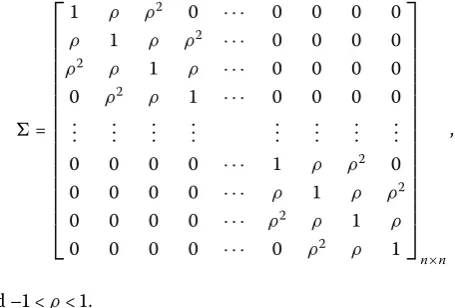
() For alln≥, letAn,An, . . . ,Ann are independent of{ei}and (An,An, . . . ,Ann)∼
Nn(,), where is the zero vector,
=
⎡ ⎢ ⎢ ⎢ ⎢ ⎢ ⎢ ⎢ ⎢ ⎢ ⎢ ⎢ ⎢ ⎢ ⎢ ⎢ ⎢ ⎣
ρ ρ · · ·
ρ ρ ρ · · ·
ρ ρ ρ · · ·
ρ ρ · · ·
..
. ... ... ... ... ... ... ...
· · · ρ ρ
· · · ρ ρ ρ
· · · ρ ρ ρ
· · · ρ ρ
⎤ ⎥ ⎥ ⎥ ⎥ ⎥ ⎥ ⎥ ⎥ ⎥ ⎥ ⎥ ⎥ ⎥ ⎥ ⎥ ⎥ ⎦
n×n
,
and – <ρ< .
Using MATLAB software, we make the Box plots to illustrate
n/l n
i=
AniXi→, n→ ∞. (.)
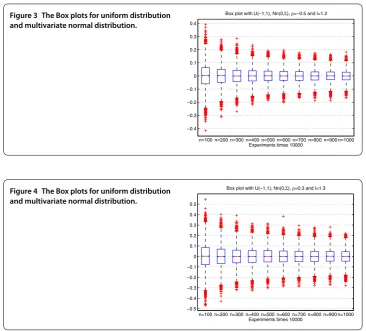
[image:6.595.130.358.465.619.2]Figure 3 The Box plots for uniform distribution and multivariate normal distribution.
Figure 4 The Box plots for uniform distribution and multivariate normal distribution.
the label of the x-axis is the sample sizen, by repeating the experiments , times. By Figures and , for the cases ofl= .,e∼N(, ),A∼t(), and A∼t(), it can be found that the medians are close to and their variation ranges become smaller as the sample sizenincreases. Comparing Figure with , the variation range of Figure is smaller than that of Figure , which can be explained by the variance oft() being smaller than that oft().
Similarly, for l= ., l= .,e∼U(–, ), A∼Nn(,) withρ = –. and A∼
Nn(,) withρ= ., we establish the Figures and . By Figures and , it is also seen
that the medians are close to and their variation range becomes smaller as the sample sizenincreases.
4 The proofs of main results
Proof of Theorem. For alln≥, letXni=XiI(|Xi| ≤nα),X˜ni=XiI(|Xi|>nα), ≤i≤n.
Obviously, for ≤i≤n,AniXidecomposes as
AniXi=AniXni+AniX˜ni
=AniXni–E(AniXni)
+E(AniXni) +AniX˜ni. (.)
∞
n=
nαp––αE
max ≤j≤n
j i=
AniXi
–εnα
+
≤C ∞
n=
nαp––αE
max ≤j≤n
j
i=
AniXni–E(AniXni)
+ ∞
n=
nαp––αE
max ≤j≤n
j i=
AniX˜ni
+ ∞ n=
nαp––α
max ≤j≤n
j i=
E(AniXni)
:=I+I+I. (.)
By (.) and Hölder’s inequality, it is easy to establish that
n
i=
E|Ani|=O(n). (.)
Since for alln≥,{Ani, ≤i≤n}is independent of the sequence {Xn,n≥}, then by
Markov’s inequality, (.), Lemma .,E|X|p<∞, andp> , we obtain
I≤ ∞
n=
nαp––α
n
i=
E|Ani|E|Xi|I
|Xi|>nα
≤C ∞
n=
nαp––αE|X|I|X|>nα
=C ∞
n=
nαp––α
∞
m=n
E|X|Im<|X|/α≤m+
=C ∞
m=
E|X|Im<|X|/α≤m+
m
n=
nα(p–)–
≤C ∞
m=
mαp–αE|X|Im<|X|/α≤m+ ≤C
E|X|p<∞. (.)
By the independence andEXi= , we haveE(AniXi) =EAniEXi= , which implies
E(AniXni) =EAniE(Xi–X˜ni) = –EAniE
XiI
|Xi|>nα
, ≤i≤n.
Therefore, by Lemma . and the proof of (.), it follows that
I = ∞
n=
nαp––α n i=
–EAniE
XiI
|Xi|>nα
≤ ∞ n=
nαp––α
n
i=
E|Ani|E
|Xi|I
|Xi|>nα
≤CE|X|p<∞. (.)
By Lemma ., we find thatAX={[AniXni–E(AniXni)], ≤i≤n}is also a mean sequence of
˜
and (.), we establish that
I≤C ∞
n=
nαp––α
n
i=
E(AniXni)=C ∞
n=
nαp––α
n
i=
EAniEXni
≤C ∞
n=
nαp––αE|X|I|X| ≤nα+C ∞
n=
nαp–P|X|>nα
:=CI+CI. (.)
Byp< ,α> / andE|X|p<∞, it can be checked that
I= ∞
n=
nαp––α
n
i=
EXI(i– )α<|X| ≤iα
= ∞
i=
EXI(i– )α<|X| ≤iα
∞
n=i
nα(p–)–
≤C ∞
i=
E|X|p|X|–pI(i– )α<|X| ≤iαiαp–α
≤CE|X|p<∞. (.)
In addition, by the proof of (.), we have
I≤ ∞
n=
nαp––αE|X|I|X|>nα≤C
E|X|p<∞. (.)
Consequently, combining (.) with (.)-(.), we get (.) immediately. Moreover, by Remark . of Sung [], (.) also holds true.
Proof of Theorem. We use the same notation as in the proof of Theorem .. Obvi-ously, byp≥, it is easy to see thatq> (αp– )/(α– )≥. Consequently, by Hölder’s inequality and (.), it follows that
n
i=
E|Ani|=O(n) and n
i=
EAni=O(n). (.)
From (.), (.), (.), and (.), we haveI<∞andI<∞. So we have to proveI<∞ under the conditions of Theorem .. Sinceq> , by an argument similar to the proof of (.), by Lemma ., we have
I≤C ∞
n=
nαp––qα
n
i=
EAniXni–E(AniXni) q
+C ∞
n=
nαp––qα
n
i=
EAniXni–E(AniXni)
q/
Forp≥,E|X|p<∞impliesEX<∞. Thus, by (.) and Lemma ., we have
I≤C ∞
n=
nαp––qα
n
i=
EAniEX q/
≤C ∞
n=
nαp––qα+q/<∞, (.)
by the factq> (αp– )/(α– ). Moreover, by Lemma . and (.),
I≤C ∞
n=
nαp––qαE|X|qI|X| ≤nα+C ∞
n=
nαp–P|X|>nα
≤C ∞
n=
nαp––qαE|X|qI|X| ≤nα+C ∞
n=
nαp––αE|X|I|X|>nα
:=CI+CI. (.)
Byp≥ andα> /, it follows that (αp– )/(α– ) –p≥, which yieldsq>p. So, by
E|X|p<∞,
I= ∞
n=
nαp––qα
n
i=
E|X|qI(i– )α<|X| ≤iα
= ∞
i=
E|X|qI(i– )α<|X| ≤iα
∞
n=i
nα(p–q)–
≤C ∞
i=
E|X|p|X|q–pI(i– )α<|X| ≤iαiαp–qα
≤CE|X|p<∞. (.)
It follows from (.) that
I= ∞
n=
nαp––αE|X|I|X|>nα≤CE|X|p<∞. (.)
Consequently, by (.) and (.)-(.), we obtainI<∞. So we have (.). Similarly, combining Remark . of Sung [] with (.), we obtain (.).
Proof of Theorem. On the one hand, byp= l,α= /p, we haveαp= . On the other hand, by the fact ≤l< , we have that (.) is the same as (.). Then, as an application of Theorem ., we obtain (.) immediately. Moreover, by (.) withαp= , we establish (.). Finally, by the Borel-Cantelli lemma, (.) holds true.
Proof of Theorem. It is easy to see that
P
max ≤j≤n
j
i=
AniXi
>εnα
≤
n
i=
P|Xi|>nα
+P
max ≤j≤n
j
i=
AniXni
>εnα
whereXni=XiI(|Xi| ≤nα). Ifα> , then by Lemma .,E|X|<∞, and (.), we obtain
nαmax≤j≤n j i=
E(AniXni)
=
nαmax≤j≤n j i= EAniEI
|Xi| ≤nα
≤ C
nα
n
i=
E|Ani|
E|X|I|X| ≤nα+nαEI|X|>nα
≤Cn–αE|X| →, asn→ ∞. (.)
Ifα= , then byEXi= , ≤i≤n, Lemma ., andE|X|<∞, we obtain
nαmax≤j≤n j i=
E[AniXni]
=
nmax≤j≤n
j i=
–E(Ani)E
XiI
|Xi|>n
≤ C
n
n
i=
E|Ani|E
|X|I|X|>n
≤CE
|X|I|X|>n→, asn→ ∞. (.)
Moreover,
∞
n=
nα–
n
i=
P|Xi|>nα
≤C ∞
n=
nα–P|X|>nα≤CE|X|<∞. (.)
So, by (.)-(.), to prove (.), it suffices to show that
I∗:= ∞
n=
nα–P
max ≤j≤n
j i=
AniXni–E(AniXni)
>
εnα
<∞.
Obviously, by Markov’s inequality and the proofs of (.), (.), and (.), we establish that
I∗≤
ε ∞
n=
n––αE
max ≤j≤n
j i=
AniXni–E(AniXni)
≤C ∞
n=
n––αEXI|X| ≤nα+C ∞
n=
nα–P|X|>nα≤CE|X|<∞.
Hence, the proof of the theorem is concluded.
Competing interests
The authors declare that they have no competing interests.
Authors’ contributions
All authors contributed equally to the writing of this paper. All authors read and approved the final manuscript.
Author details
1School of Finance, Chongqing Technology and Business University, Chongqing, China.2International Business School,
Acknowledgements
The authors are deeply grateful to editors and anonymous referee for their careful reading and insightful comments, which helped in improving the earlier version of this paper.
Received: 6 August 2016 Accepted: 22 November 2016 References
1. Stein, S: A bound for the error in the normal approximation to the distribution of a sum of dependent random variables. In: Proceedings of the Sixth Berkeley Symposium on Mathematical Statistics and Probability. Vol. II, pp. 583-602 (1972)
2. Bradley, RC: On the spectral density and asymptotic normality of weakly dependent random fields. J. Theor. Probab.
5(2), 355-373 (1992)
3. Bradley, RC: Every ‘lower psi-mixing’ Markov chain is ‘interlaced rho-mixing’. Stoch. Process. Appl.72(2), 221-239 (1997)
4. Peligrad, M, Gut, A: Almost-sure results for a class of dependent random variables. J. Theor. Probab.12(1), 87-104 (1999)
5. Utev, V, Peligrad, M: Maximal inequalities and an invariance principle for a class of weakly dependent random variables. J. Theor. Probab.16(1), 101-115 (2003)
6. Sung, SH: On inverse moments for a class of nonnegative random variables. J. Inequal. Appl.2010, Article ID 823767 (2010)
7. Hu, SH, Wang, XH, Yang, WZ, Wang, XJ: A note on the inverse moment for the nonnegative random variables. Commun. Stat., Theory Methods43(8), 1750-1757 (2014)
8. Yang, WZ, Hu, SH: Large deviation for a least squares estimator in a nonlinear regression model. Stat. Probab. Lett.91, 135-144 (2014)
9. Wang, YW, Yang, WZ, Hu, SH: The Bahadur representation of sample quantiles for weakly dependent sequences. Stochastics88(3), 428-436 (2016)
10. Hsu, PL, Robbins, H: Complete convergence and the law of large numbers. Proc. Natl. Acad. Sci. USA33(2), 25-31 (1947)
11. Baum, LE, Katz, M: Convergence rates in the law of large numbers. Trans. Am. Math. Soc.120(1), 108-123 (1965) 12. Chow, Y: On the rate of moment convergence of sample sums and extremes. Bull. Inst. Math. Acad. Sin.16, 177-201
(1988)
13. Sung, SH: On the strong convergence for weighted sums of random variables. Stat. Pap.52(2), 447-454 (2011) 14. Sung, SH: A note on the complete convergence for weighted sums of negatively dependent random variables.
J. Inequal. Appl.2012, Article ID 158 (2012)
15. Wu, QY: A complete convergence theorem for weighted sums of arrays of rowwise negatively dependent random variables. J. Inequal. Appl.2012, Article ID 50 (2012)
16. Chen, P, Sung, SH: Complete convergence and strong laws of large numbers for weighted sums of negatively orthant dependent random variables. Acta Math. Hung.148(1), 83-95 (2016)
17. Shen, Y, Wang, XJ, Yang, WZ, Hu, SH: Almost sure convergence theorem and strong stability for weighted sums of NSD random variables. Acta Math. Sin. Engl. Ser.29(4), 743-756 (2013)
18. Wang, XJ, Chen, ZY, Hu, SH: Complete convergence for weighted sums of NSD random variables and its application in the EV regression model. Test24(1), 166-184 (2015)
19. Deng, X, Wang, XJ, Wu, Y, Ding, Y: Complete moment convergence and complete convergence for weighted sums of NSD random variables. Rev. R. Acad. Cienc. Exactas Fís. Nat., Ser. a Mat.110(1), 97-120 (2016)
20. Shen, AT, Xue, MX, Volodin, A: Complete moment convergence for arrays of rowwise NSD random variables. Stochastics88(4), 606-621 (2016)
21. Wang, XH, Li, XQ, Hu, SH: On the complete convergence of weighted sums for an array of rowwise negatively superadditive dependent random variables. ScienceAsia42(1), 66-74 (2016)
22. Wang, XJ, Hu, TC, Volodin, A, Hu, SH: Complete convergence for weighted sums and arrays of rowwise extended negatively dependent random variables. Commun. Stat., Theory Methods42(13), 2391-2401 (2013)
23. Hu, TC, Rosalsky, A, Wang, KL: Complete convergence theorems for extended negatively dependent random variables. Sankhya A77(1), 1-29 (2015)
24. Wang, XJ, Zheng, LL, Xu, C, Hu, SH: Complete consistency for the estimator of nonparametric regression models based on extended negatively dependent errors. Statistics49(2), 396-407 (2015)
25. Hu, TC, Rosalsky, A, Volodin, A: A complete convergence theorem for row sums from arrays of rowwise independent random elements in Rademacher typepBanach spaces. Stoch. Anal. Appl.30(2), 343-353 (2012)
26. Rosalsky, A, Volodin, A: On almost sure convergence of series of random variables irrespective of their joint distributions. Stoch. Anal. Appl.32(4), 575-590 (2014)
27. Wang, XH, Li, XQ, Hu, SH: Complete convergence of weighted sums for arrays of rowwiseφ-mixing random variables. Appl. Math.59(5), 589-607 (2014)
28. Wu, YF, Hu, TC, Volodin, A: Complete convergence and complete moment convergence for weighted sums ofm-NA random variables. J. Inequal. Appl.2015, Article ID 200 (2015)
29. Yang, WZ, Wang, XH, Li, XQ, Hu, SH: The convergence of double-indexed weighted sums of martingale differences and its application. Abstr. Appl. Anal.2014, Article ID 893906 (2014)
30. Yang, WZ, Hu, SH: Complete moment convergence of pairwise NQD random variables. Stochastics87(2), 199-208 (2015)
31. Wang, XJ, Hu, SH, Volodin, A: General results of complete convergence and complete moment convergence for weighted sums of some class of random variables. Commun. Stat., Theory Methods45(15), 4494-4508 (2016) 32. Kuczmaszewska, A: On complete convergence for arrays of rowwise dependent random variables. Stat. Probab. Lett.
77(11), 1050-1060 (2007)
34. Wang, XJ, Li, XQ, Yang, WZ, Hu, SH: On complete convergence for arrays of rowwise weakly dependent random variables. Appl. Math. Lett.25(11), 1916-1920 (2012)
35. Sung, SH: On the strong convergence for weighted sums ofρ∗-mixing random variables. Stat. Pap.54(3), 773-781 (2013)
36. Wu, YF, Sung, SH, Volodin, A: A note on the rates of convergence for weighted sums ofρ-mixing random variables.˜ Lith. Math. J.54(2), 220-228 (2014)
37. Thanh, LV, Yin, G: Almost sure and complete convergence of randomly weighted sums of independent random elements in Banach spaces. Taiwan. J. Math.15(4), 1759-1781 (2011)
38. Thanh, LV, Yin, G, Wang, LY: State observers with random sampling times and convergence analysis of double-indexed and randomly weighted sums of mixing processes. SIAM J. Control Optim.49(1), 106-124 (2011) 39. Cabrera, MO, Rosalsky, A, Volodin, A: Some theorems on conditional mean convergence and conditional almost sure
convergence for randomly weighted sums of dependent random variables. Test21(2), 369-385 (2012)
40. Shen, AT, Wu, RC, Chen, Y, Zhou, Y: Conditional convergence for randomly weighted sums of random variables based on conditional residualh-integrability. J. Inequal. Appl.2013, Article ID 122 (2013)
41. Yang, WZ, Wang, YW, Wang, XH, Hu, SH: Complete moment convergence for randomly weighted sums of martingale differences. J. Inequal. Appl.2013, Article ID 396 (2013)
42. Yao, M, Lin, L: The moment of maximum normed randomly weighted sums of martingale differences. J. Inequal. Appl.2015, Article ID 264 (2015)
43. Gao, QW, Wang, YB: Randomly weighted sums with dominated varying-tailed increments and application to risk theory. J. Korean Stat. Soc.39(3), 305-314 (2010)
44. Tang, QH, Yuan, ZY: Randomly weighted sums of subexponential random variables with application to capital allocation. Extremes17(3), 467-493 (2014)
45. Leng, X, Hu, TZ: The tail behavior of randomly weighted sums of dependent random variables. Stat. Interface7(3), 331-338 (2014)
46. Yang, Y, Ignataviciute, E, Siaulys, J: Conditional tail expectation of randomly weighted sums with heavy-tailed distributions. Stat. Probab. Lett.105, 20-28 (2015)
47. Mao, TT, Ng, KW: Second-order properties of tail probabilities of sums and randomly weighted sums. Extremes18(3), 403-435 (2015)
48. Sung, SH: Moment inequalities and complete moment convergence. J. Inequal. Appl.2009, Article ID 271265 (2009) 49. Adler, A, Rosalsky, A: Some general strong laws for weighted sums of stochastically dominated random variables.
Stoch. Anal. Appl.5(1), 1-16 (1987)