
2019 2nd International Conference on Informatics, Control and Automation (ICA 2019) ISBN: 978-1-60595-637-4
Simple and Efficient Smoke Segmentation
Based on Fully Convolutional Network
Mao-shen LIU
1,2, Xiao-tian XIE
1,2, Ke GU
1,2and Jun-fei QIAO
1,2,*1Faculty of Information Technology, Beijing University of Technology, Beijing 100124, China
2Beijing Key Laboratory of Computational Intelligence and Intelligent System
*Corresponding author
Keywords: Fully convolutional network, Smoke segmentation, Flare stack smoke.
Abstract. In this paper, a shallow fully convolutional network for image smoke segmentation is designed to solve the real-time monitoring of smoke emitted by the flare stack. This algorithm can quickly and effectively distinguish the smoke area in the image, which can determine the actions of the flare stack control system to improve combustion efficiency. The main difficulty in segmenting the smoke in the flare stack image is the variegated texture and shape of the smoke and the varying brightness, color and other disturbances of the background. According to the above problems, we only use one layer of convolution to extract large numbers of low level features such as texture and color, and further utilize two special convolutional layers, separable convolution and 1×1 convolution, to map the final segmentation result. Through experiments on different data sets, our algorithm has the best accuracy and efficiency.
Introduction
The flare stack is an important facility in the petrochemical plant to ensure the safe production of the plant and reduce environmental pollution [1]. Real-time and accurate monitoring of the flared flare stack can effectively provide reliable feedback information of the flare stack control system. Efficient combustion of the flare stack is not only an important technical benchmark in the industry, but also a requirement for energy conservation and environmental protection. Therefore, monitoring the combustion state of the flare stack is of great significance.
Identifying smoke by pixel is often referred to as smoke segmentation. The difficulty of smoke segmentation compared to other targets is that the smoke shape, texture and color are variable and easily confused with the background. The traditional method of smoke segmentation is designed for the characteristics of smoke under certain circumstances, such as shape [2], color [3] and motion [4], so that the accuracy is greatly affected by environmental changes. In the past few years, deep learning methods have achieved excellent results in the field of computer vision. Almost the traditional algorithm has been withdrawn from the historical arena. Image semantic segmentation based on convolutional neural networks is a hotspot research. The fully convolutional network (FCN) was first applied in semantic segmentation tasks in [5], and the accuracy of semantic segmentation has been greatly improved. Subsequently, a semantic segmentation network based on encoder-decoder network structure uses a symmetric network structure to learn detailed segmentation results [6]. At present, most of the segmentation network feature extraction parts are based on VGG16 [7] or ResNet [8] structures, such as [9] and [10], which have unprecedented advantages in multi-category semantic segmentation tasks.
extracted by shallow convolution. Therefore, we design an extremely shallow network with only three layers of convolution. A large number of low-level feature maps are extracted through the first layer, which is equivalent to mapping each pixel point of the original image to a high-dimensional space. Further, the classification result of the input image pixel points is obtained by two-layer pointwise convolution, which is equivalent to the two-layer full connection between the first layer feature map channels. According to the image having local structural information, the first pointwise convolution layer is replaced by separable convolution [11]. Compared with other deep learning methods, the proposed algorithm has advantages in speed and accuracy in the smoky image segmentation problem of the flare stack. The rest of the article mainly introduces the preparation of training data, model design and comparative experiments, and finally summarizes.
Figure 1. Image set, image enhancement and segmentation benchmark. In the red box, A is an image deformation, and B and C are respectively smoke and smokeless image segmentation benchmarks.
Proposed Algorithm
As mentioned above, the main difficulty in the segmentation of smoke in the flare stack image is the variegated texture and shape features of the smoke and the varying brightness, color and other disturbances of the background sky. These low-level features are confused with each other, making the segmentation of smoke different from the traditional semantic segmentation task. To this end, we have designed a special network to solve the problem of fast smoke segmentation, referred to as ‘FSSN’. The details of the preparation of the data set and the algorithm design principles and the training are described in detail below.
Data Preparation
The image sample we prepared is the real picture obtained by the flare stack test field. The sample is mainly divided into two parts under the influence of two major factors, sunny and cloudy. In order to facilitate the manual segmentation of the smoke area to make benchmark labels, the smoke image only intercepts the area containing the smoke. Due to the lack of smoke data, the image deformation [12] is used to expand the number of smoke images, as shown in A of Fig. 1. The image segmentation benchmark is produced by splitting the smoke images by manual adjustment of the threshold value, and the result is that the smokeless area are zero and the smoke area are one, as shown in B of Fig. 1. Further, the benchmark of the smokeless image is an all-zero matrix, as shown in C of Fig. 1. In order to uniform images sizes during training, we cropped all images into 128*128 sizes. Finally, by the method of image rotation, the number of smoke images is increased to balance the smoked and smokeless pixel regions. In the end, the training image was about 36000, the validation image was about 3400, and the test image was about 3400.
Network Structure and Principle
Our network is very shallow compared to existing image segmentation networks and works well in our missions. The network successfully uses only three layers to segment smoke areas from different sky backgrounds. It is mainly due to the specially designed structure for objects and background features in this task. The proposed FSSN is described in detail below.
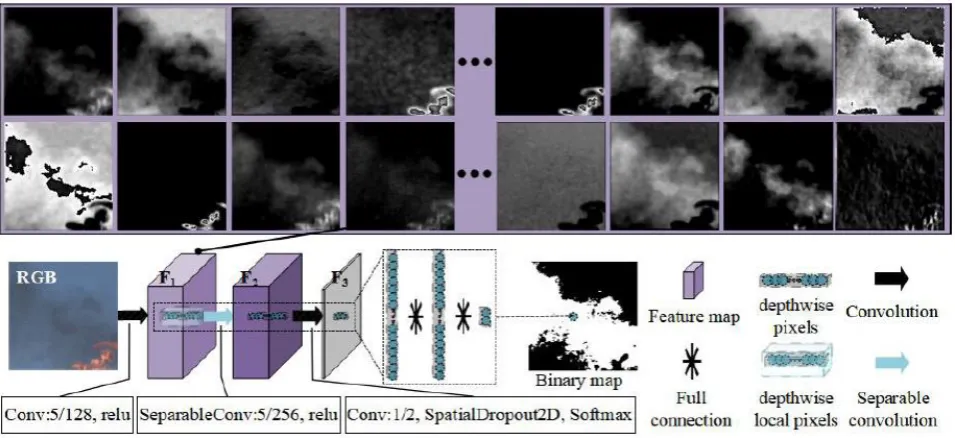
high accuracy requirements. Therefore, we can learn a large number of feature extractors to complete the feature extraction task in a data-driven manner. The convolution operation can effectively extract features from RGB images and complete simple feature extraction such as texture and edges. It is also possible to synthesize various grayscale images for segment smoke under different backgrounds by combining RGB three channels. As shown in Fig. 2, the first two lines show the 128 feature maps extracted from the RGB image by the first layer of convolution, each providing different important information for image segmentation. It is difficult to manually design 256 feature extraction methods to complete the image segmentation task.
Network Structure. All hyperparameters in the network are obtained by trial-and-error. The network structure is shown in the Fig. 2. The first layer consists of 128 5*5 size convolution kernels. Since the image has local characteristics, the category of each pixel is more easily distinguished by local pixels. Therefore, the second layer uses a separate convolution which consists of a depthwise convolution and a pointwise convolution. The depthwise convolution, kernel size is 5*5, obtains local information of the feature maps of the pixel to be classified. And the pointwise convolution operation and the third layer form a channel-wise fully-connected classifier. As shown in Fig. 2, the F1
[image:3.595.59.537.367.586.2]expresses 128 kinds of image information. Then, by inputting the local information of each pixel point of the 128 feature maps, depthwise local pixels, into the channel-wise classifier, then the classification of each pixel of the input image is obtained. The activation function of the first two layers is Relu and Softmax is used in the last layer to output the class probability of each pixel. During training, the last layer uses the SpatialDropout [13] to randomly discard 20% of the feature maps to improve the generalization of the network and enhance the robustness of the network.
Figure 2. A schematic diagram of the proposed network structure. The dashed box indicates the equivalence of the pointwise convolution with the full connection. The bottom box indicates each layer parameter, such as [Conv: 1/2, SpatialDropout2D, softmax] means that this layer is two 1*1 convolution kernels with softmax and the SpatialDropout
operation. The top two rows are the visualization of the feature map F1 obtained by the first layer of convolution.
Experiments
Training Details. In this task, the segmentation task is considered to be a binary classification task for each pixel, so the loss function of the network is selected as categorical crossentropy. The network uses the adadalt optimization method [14], where the initial learning rate is set to 1, and the adadelta decay factor is set to 0.95. The input of the network needs to be normalized by subtracting the mean value and dividing the variance for each pixel. It is necessary to disturb the training sample sequence and set the batch to 4. Finally, the number of training epochs of the network is set to 50 in total.
Table 1. Test results on the patch images set. Evaluation indicators used pixel accuracy, mean accuracy, mean intersection over union (IU), and frequency weighted IU [5]. Mean time is the average time of all patch images in the CPU
environment. Parameters is the learnable parameters of the network. The bold part is the best result.
Methods pixel acc. [%] mean acc. [%] mean IU [%] f. w. IU [%] mean time [ms] parameters
FCN-32s 96.95 92.90 90.45 95.03 159 134.28 Million
FCN-8s 97.58 94.68 93.05 96.44 176 134.27 Million
SegNet 96.68 93.72 90.98 94.59 147 5.46 Million
FSSN 98.07 97.89 96.28 97.20 43 0.046 Million
Comparative Analysis. The indicator results on the patch images set are given in the Table 1. It is obvious that our algorithm performs best on the smoke image segmentation test set compared to other algorithms. In the results, the performance of the FCN-8s algorithm is optimal in the comparison algorithm, where the mean IU is 93.05%. Our proposed FSSN yields a high result of 96.28% on mean IU. At the same time, our algorithm averages 43ms per patch, which is only 24.4% of FCN-8s. Our network parameters are almost ignorable compared to other methods. Accuracy, efficiency and network complexity indicate that our proposed algorithm is more suitable for practical projects. Fig. 3 shows the results of the entire image in the flare stack. The FCN32 effectively identified some of the smoke areas in the image, while the smoke in (2) and (3) was not recognized. FCN8 has improved performance compared to FCN32, but it also ignores some areas of smoke. The SegNet network recognizes a richer smoke area, but it does not effectively resist the interference of complex backgrounds, such as (3) results. The results of our FSSN shows us a better effect. In the (1) and (2), it is effective to segment all the smoke areas visible to the naked eye on the sunny. At the same time, the effect is also evident in the (3) (4) cloudy image. Moreover, the anti-interference of the algorithm is very strong, as in (3), the smoke area is accurately identified in a complex background.
[image:4.595.126.470.494.781.2]Summary
This paper designs a fully convolutional neural network for smoke segmentation of flare stack images. Since smoke is mainly present in images with low-level features, the proposed is designed to extract a large number of low-level features to classify each pixel. A classifier for each pixel is formed by a layer of separate convolution and a pointwise convolution. The separation convolution can extract the local information of the pixel to be identified, so that the network is more robust to background interference. Compared with the classical image semantic segmentation network, the proposed algorithm has an extraordinary effect on accuracy and efficiency. It effectively illustrates the effectiveness of the proposed network in the flare stack image smoke segmentation. It is further explained that the smoke segmentation does not require a deep network to extract the semantic features, and only the low level features can effectively complete the smoke segmentation task.
References
[1] S. David, A proposed comprehensive model for elevated flare flames and plumes, Flaregas Corporation, AIChE 40th Loss Prevention Symposium, Apr. 2006.
[2] F. Alexander, C. H. Danilo, and J. Kanghyun, Fast smoke detection for video surveillance using CUDA, IEEE Transactions on Industrial Informatics, Volume 14, Issue 2, pp. 725-733, 2018.
[3] A. G. Sagar, N. Shashank, and N. Preeti, Smoke Detection in Digital Frames. International Research Journal of Engineering and Technology, Volume 5, Issue 4, pp. 3843-3846, 2018.
[4] J. Yang, L. Gaohua, W. Jinjun, F. Jun, and Z. Yongming, Early video smoke segmentation algorithm based on saliency detection and gaussian mixture model, Computer Engineering, Volume 42, Issue 2, pp. 206-209, 2016.
[5] E. Shelhamer, J. Long, T. Darrell, Fully Convolutional Networks for Semantic Segmentation. IEEE Transactions on Pattern Analysis & Machine Intelligence, 39(4):640-651, 2014.
[6] B. Vijay, K. Alex, and C. Roberto, Segnet: A deep convolutional encoder-decoder architecture for image segmentation, IEEE transactions on pattern analysis and machine intelligence, Volume 39, Issue 12, pp. 2481-2495, 2017.
[7] S. Karen, and A. Zisserman, Very deep convolutional networks for large-scale image recognition, International Conference on Learning Representation, 2015.
[8] K. He, X. Zhang, S. Ren, and J. Sun, Deep residual learning for image recognition, IEEE Conference on Computer Vision and Pattern Recognition, pp. 770-778, 2016.
[9] C. Liangchieh, P. George, K. Iasonas, P. Kevin, and L. Y. Alan, Deeplab: Semantic image segmentation with deep convolutional nets, atrous convolution, and fully connected crfs, IEEE transactions on pattern analysis and machine intelligence, Volume 40, Issue 4, pp. 834-848, 2018.
[10] G. Lin, A. Milan, C. Shen, and I. D Reid, Refinenet: Multi-path refinement networks for high-resolution semantic segmentation, CVPR, pp. 5168-5177, 2017.
[11] M. Wang, B. Liu, and H. Foroosh, Design of Efficient Convolutional Layers using Single Intra-channel Convolution, Topological Subdivisioning and Spatial "Bottleneck" Structure, arXiv preprint arXiv:1608.04337, 2016.
[12] S. Schaefer, T. McPhail, and J. Warren. Image deformation using moving least squares. ACM Trans. Graph. 25, 3, 533-540, Jul. 2006.
[13] J. Tompson, R. Goroshin, A. J., Y. LeCun, C. Bregler, Efficient object localization using convolutional networks. CVPR. 2015.

![Table 1. Test results on the patch images set. Evaluation indicators used pixel accuracy, mean accuracy, mean intersection over union (IU), and frequency weighted IU [5]](https://thumb-us.123doks.com/thumbv2/123dok_us/245905.1024450/4.595.126.470.494.781/results-evaluation-indicators-accuracy-accuracy-intersection-frequency-weighted.webp)