R E S E A R C H A R T I C L E
Open Access
Psychiatric comorbidity as predictor of costs in
back pain patients undergoing disc surgery: a
longitudinal observational study
Alexander Konnopka
1*, Margrit Löbner
2, Melanie Luppa
2, Dirk Heider
1,2, Sven Heinrich
1, Steffi Riedel-Heller
2,
Hans Jörg Meisel
3, Lutz Günther
4, Jürgen Meixensberger
5and Hans-Helmut König
1Abstract
Background:Psychiatric comorbidity is common in back pain patients undergoing disc surgery and increases economic costs in many areas of health. The objective of this study was to analyse psychiatric comorbidity as predictor of direct and indirect costs in back pain patients undergoing disc surgery in a longitudinal study design. Methods:A sample of 531 back pain patients was interviewed after an initial disc surgery (T0), 3 months (T1) and 15 months (T2) using the Composite International Diagnostic Interview to assess psychiatric comorbidity and a modified version of the Client Sociodemographic and Service Receipt Inventory to assess resource utilization and lost productivity for a 3-month period prior interview. Health care utilization was monetarily valued by unit costs and productivity by labour costs. Costs were analysed using random coefficient models and bootstrap techniques. Results:Psychiatric comorbidity was associated with significantly (p < 0.05) increased direct (+664 Euro) and indirect costs (+808 Euro) at T0. The direct cost difference predominantly resulted from medical health care utilization and was nearly unchanged at T2. Further important cost predictors were clinical variables like the presence of chronic medical disease, the number of previous disc surgeries, and time and gender.
Conclusion:Psychiatric comorbidity presents an important predictor of direct and indirect costs in back pain patients undergoing disc surgery, even if patients do not utilize mental health care. This effect seems to be stable over time. More attention should be given to psychiatric comorbidity and cost-effective treatments should be applied to treat psychiatric comorbidity in back pain patients undergoing disc surgery to reduce health care utilization and costs associated with psychiatric comorbidity.
Keywords:Back pain, Disc surgery, Psychiatric comorbidity, Cost, Economic
Background
In industrialized societies, back pain presents a common health problem, which is often associated with disc niation [1]. While most back pain patients with disc her-niation profit from a conservative treatment surgical interventions are performed in the most severe cases, when pain and sensory or motor deficits persist under conservative treatment [2]. It is well known that back pain and back pain treatment outcome are strongly influenced by psychological factors including psychiatric
comorbidity [3-5]. Common psychiatric comorbidities in back pain patients with prevalence rates exceeding preva-lence rates in the general population are affective disorders, anxiety disorders and substance abuse/dependency disor-ders [6,7]. Not only treatment outcome is associated with psychiatric comorbidity, but also health care costs. Several studies have found associations between psychiatric comor-bidity and increased health care costs for different diseases, like dementia, substance abuse, heart failure or internal diseases [8-11]. In a recent study, Holmberg and Thelin [12] found that psychiatric comorbidity is associated with increased health care utilization in back pain patients. How-ever, so far no study has analysed the effect of psychiatric * Correspondence:[email protected]
1
Department of Medical Sociology and Health Economics, University Medical Centre Hamburg-Eppendorf, Hamburg, Germany
Full list of author information is available at the end of the article
comorbidity on health care costs in patients undergoing disc surgery in a prospective study design.
Estimating the costs of an illness is useful to inform decision makers about the economic relevance of a health problem and feasible objectives for interventions. Additionally, cost-of-illness studies provide input data for further research, in particular for studies modelling cost-effectiveness of interventions. In general, costs of illness can be distinguished into direct costs and indirect costs. Whereas direct costs refer to the monetary value of utilized resources (e.g. for hospital stays, physician visits or drugs), indirect costs refer to productivity lost due to morbidity or premature mortality.
The aim of our study was to analyse predictors for dir-ect and indirdir-ect costs in back pain patients undergoing disc surgery, and in particular the effect of psychiatric comorbidity in a prospective study design. Thereby, we hypothesised that psychiatric comorbidity is connected to increased direct as well as indirect costs.
Methods
Study design and sample
Our study referred to 620 consecutive back pain patients who underwent an index treatment of surgery for her-niated disc between April 2007 and October 2008. The study received ethics committee approval by the ethics committee of the University of Leipzig. We included patients who provided informed consent, were between the age of 18 and 55 years, spoke German sufficiently and had a radiological determined herniated disc of the lumbal or cervical spine. Study participation was declined by 86 (14%) of the 620 patients and 3 patients were excluded due to missing data on psychiatric comorbidity, resulting in a final sample of 531 patients. Disc surgery was either conducted at the Department of Neurosurgery at the University Hospital of Leipzig (N = 149, 28%), the Department of Neurosurgery at the Hospital St. Georg, Leipzig (N = 153, 29%) or the Department of Neurosurgery at the Hospital “Bergmannstrost”, Halle (N = 229, 43%). After disc surgery, all patients were offered a rehabilitation to prepare return to work which was rejected by 33 patients (7%) of 485 non-drop-out patients available at T1. Included patients were interviewed face-to-face by experi-enced and trained psychologists about psychiatric comor-bidity and health care utilization approximately 3.63 (SD 2.83) days after disc surgery (T0). Follow up interviews were conducted 3 months (T1) and 15 months (T2) post treatment via telephone.
Instruments
Socio-demographic and illness-related variables
As sociodemographic variables, age, gender, education, living situation, marital and employment status were assessed. Patients were classified according to the type
of disc herniation (cervical or lumbar) and were asked about the number of previous disc herniations as well as previous disc surgeries in their case history. Further-more, presence and nature of other chronic medical dis-eases were assessed.
Psychiatric comorbidity
We assessed psychiatric comorbidity with a German ver-sion of the Composite International Diagnostic Interview (CIDI) [13]. The CIDI is a standardized, fully structured diagnostic interview for the assessment of mental disor-ders that provides current and lifetime diagnoses accord-ing to the definitions of ICD-10 and DSM-IV. For the purpose of our study retrospective 6-month prevalence data were assessed at baseline. We assessed the CIDI sections for affective, anxiety and substance related dis-orders as the most common comorbid conditions in backpain patients, as described by Härter et al. [14]. Patients were asked probe questions on core symptoms of these psychiatric disorder groups. If such a symptom required medical attention or was sufficiently severe to affect daily life, it was scored as present, and a more detailed investigation was conducted. Finally, informa-tion on the onset and the recent nature of the particular cluster of symptoms were assessed to generate preva-lence data.
Resource utilization and loss of productivity
At every measurement, resource utilization and loss of productivity were retrospectively measured for the pre-ceding three months using a standardized questionnaire that was adapted from questionnaires used in earlier studies [15-23]. Hence T0 covered a 3 month period prior the surgical intervention, T1 covered the 3 months following the surgical intervention and T2 covered a 3 month period starting 1 year after the surgical inter-vention. We assessed utilization of inpatient treatment, rehabilitation, outpatient physician and non-physician services, medical goods and dentures, drugs, transports to medical treatment and informal care by relatives and/ or friends. We further assessed loss of productivity due to sickness absence days, early retirement, time spent for treatments and productivity reduction at work. Patients were asked to indicate their disease related productivity reduction at work on a scale ranging from“no reduction of productivity”to“unable to work”.
Cost calculation
Costs were calculated from a societal perspective by valuing resource utilization by corresponding unit costs and productivity losses by age and gender specific labour costs. For index treatment individual hospital billing in-formation were available and used to calculate rates for diagnoses related groups (DRG) [24,25]. Other hospital
Konnopkaet al. BMC Musculoskeletal Disorders2012,13:165 Page 2 of 10
treatments and the post-surgery rehabilitation were valued by hospital-type specific mean rates per diem [26,27]. Out-patient physician and non-physician visits were valued by type specific costs per contact [26,28]. Drug costs were calculated using prices from the German catalogue of drugs“red list”[29]. For drugs not listed in the red list, as well as medical goods and dentures we used market prices. Informal care was valued by average German net earnings [26] representing the opportunity costs of leisure time. Costs for transportation were asked from the patients, except for car use which was valued by 0.30 Euro per kilometre according to the German income tax act [30]. Lost productivity was valued by age and gender specific gross earnings [31] plus additional employer pay-ments for social insurances [32]. Except for medical goods, dentures and pharmaceuticals not listed in the red list, all costs refer to the year 2007 (year of measurement). For medical goods, dentures and pharmaceuticals not listed in the red list, prices were obtained from an internet based research for actual market prices. These prices refer to 2008 and 2009, corresponding to the specific time point of the searches. Unit costs originally estimated before 2007 were inflated to 2007 values using the German consumer price index [33] for direct costs and the growth rate of earnings in Germany [34] for indirect costs.
Lost to follow up analyses
From the 531 patients included at T0, 485 (91%) were available for interviews at T1 and 286 at T2 (54%). All patients lost at T1 and 88 of the patients lost at T2 were drop outs, whereas 157 of the patients lost at T2 were not interviewed because of study end. There were no significant differences between complete follow up parti-cipants (N = 286) and patients lost to follow up (N = 245) regarding disc location, gender, age, psychiatric comor-bidity, presence of chronic medical disease, the number of previous disc herniations or surgeries, number of chil-dren, education, marital status, living status or employ-ment status at baseline. The only significant (p < .05) difference was for type of health care insurance with patients lost to follow up being more often members of the statutory health insurance.
Missing values
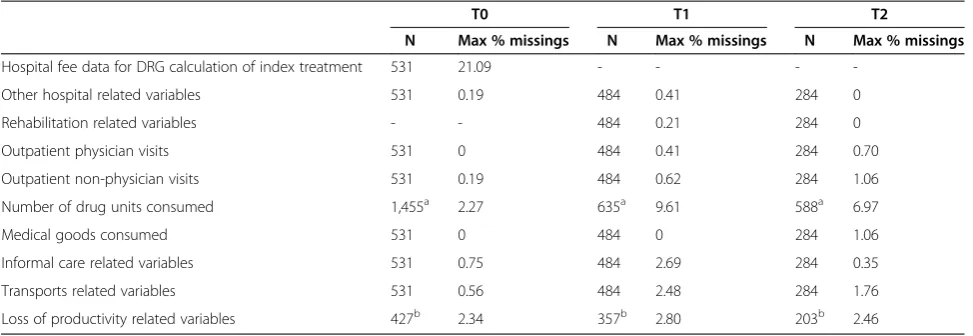
To be able to calculate overall direct and indirect costs for a sufficient sample size, we were forced to replace missing values for single variables. Table 1 shows max-imum percentages of missing values for single cost cat-egories. For most variables a maximum of three percent of values was missed, except for the DRG rates of index treatment (21% missings) and the number of drug packages used (9.6% missings at T1, 7.0% missings at T2). Missed DRG rates were replaced by the diagnosis-specific (lumbal or cervical) mean. Due to the very large
heterogeneity of drugs consumed, we decided to stay conservative and replaced missing numbers of drug packages by a value of one. For all other variables, miss-ing values of an indicated utilization were replaced by the mean utilization of respective users. If, for example, a patient indicated outpatient physician visits but not the number of visits, we replaced this missing value by the average number of visits of physician visitors.
Statistical analysis
Differences in sociodemographic variables between
patients with/without psychiatric comorbidity were ana-lysed via t-test and chi-square test as appropriate. We used random coefficient models to test our hypothesis and to identify explanatory variables of direct, indirect and total costs. Since cost data are often characterized by non-normality and right-skewness, we used bootstrap techni-ques (4,000 replications) to estimate standard errors [35]. Explanatory variables used were type of disc herniation, psychiatric comorbidity, time of measurement, the inter-action effect of psychiatric comorbidity and time, presence of other chronic medical diseases, the number of previous disc surgeries, age, gender, education, marital status, living situation, employment status, type of health insurance (statutory health insurance or private health insurance) and the number of children. In a base case scenario, we analysed direct costs without informal care (due to the hypothetic nature of informal care costs) and indirect costs without reduction of productivity in work (due to limited validity of our assessment method). Analyses in-cluding informal care costs and reduced productivity were conducted as alternative scenario. Significance level was set at p < 0.05. Cost were calculated using PASW (PASW Statistics 18), statistical analyses were performed using STATA (STATA, Release 10.0).
Results
Sample characteristics
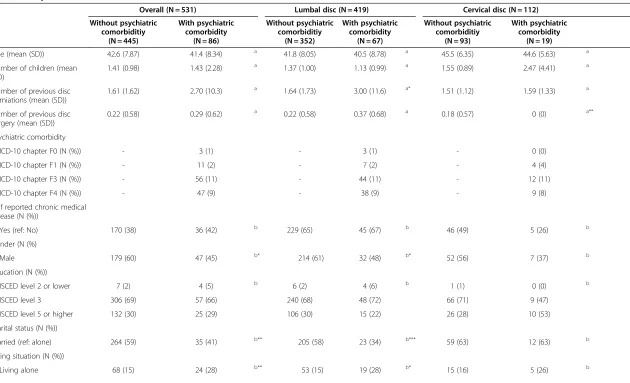
Sample characteristics are shown in Table 2. Overall, mean age was 42.4 years, 57% of patients were male, 16.2% had psychiatric comorbidity and 38.8% had comor-bid chronic medical diseases. On average, every fifth pa-tient had received a former disc surgery in the past.
The most prevelant comorbidity was depression (11%) followed by anxiety disorders (9%) and substance abuse disorders (2%). There were no relevant differences in comorbidity between patients with lumbal and patients with cervical disc herniation.
comorbidity had statistically significant more previous disc herniation than patients without psychiatric comorbidity.
Costs
Overall, mean 3-month direct costs were 5,403 Euro (SD: 2,238 Euro) at T0, 2,862 Euro (SD: 1,932 Euro) at T1 and 811 Euro (SD: 2,191 Euro) at T2, whereas mean 3-month indirect costs were 4,130 Euro (SD: 4,083 Euro) at T0, 6,629 Euro (SD: 4,861 Euro) at T1 and 1,623 Euro (SD: 3,673 Euro) at T2.
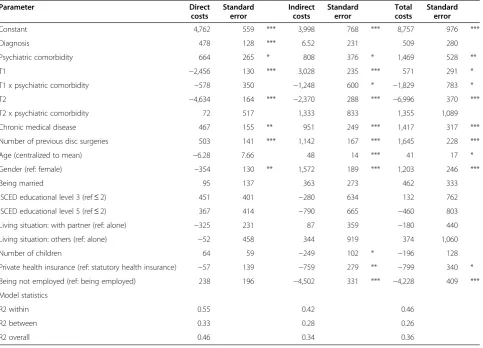
The results of our base case regression analysis are shown in Table 3. Direct costs were strongly predicted by time and “clinical” variables (disc location, psychiatric comorbidity, chronic medical disease, number of previous disc surgeries). Time was the most prominent cost pre-dictor due to changes in therapy over time (T1: -2,456 Euro; T2: -4,634 Euro). Psychiatric comorbidity at T0 was the second strongest predictor of direct costs (+664 Euro), even stronger than the presence of chronic medical dis-ease (+467 Euro). Interaction effects of time and psychi-atric comorbidity at T0 were not statistically significant for direct costs.
Also with indirect costs, clinical variables like psychi-atric comorbidity at T0 (+808 Euro), chronic medical disease (+951 Euro) and the number of previous disc surgeries (+1,142 Euro) were important cost predictors. However, the most important cost predictors were
em-ployment status (−4,502 Euro if unemployed) and time
(T1: +3,028 Euro; T2: -2,370 Euro). At T1, the inter-action of time and psychiatric comorbidity at T0 reached significance level for indirect costs. Here psychiatric comorbidity at T0 was associated with a reduction in in-direct costs (−1,248 Euro). Further significant predictors
of indirect costs were the number of children (−249
Euro), private health insurance (−759 Euro) and gender (+1,572 Euro). For total costs psychiatric comorbidity at T0 (+1,469 euro), chronic medical disease (+1,417 Euro),
the number of previous disc surgery (+1,645 Euro) and male gender (+1,203 Euro) were almost equally strong explanatory variables.
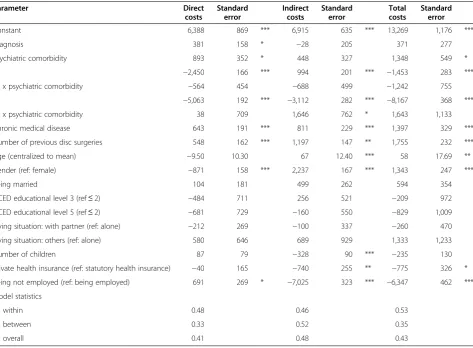
In the alternative scenario with informal care included in direct costs and reduction of productivity in work included in indirect costs, only few changes occurred (Table 4). There were no changes in signs of any statis-tical significant explanatory variable, but psychiatric comorbidity was not a significant predictor of indirect costs any more. For both direct as well as indirect costs, inclusion of the two additional cost categories resulted in a larger constant, and in partially larger effects in par-ticular of employment status and gender.
Discussion
The aim of this study was to investigate whether psychi-atric comorbidity predicts direct and indirect cost in back pain patients undergoing disc surgery and to estimate other predictors for direct and indirect costs, in a pro-spective study design. Summarized, we found that direct as well as indirect costs were strongly predicted by time and clinical variables including psychiatric comorbidity.
We found that psychiatric comorbidity is associated with increased direct costs, though we found almost no mental health care utilization at all measurements, i.e. psychiatric comorbidity increased non-mental health care utilization, which has also been found in other dis-eases [8-11]. There are several possible explanations for this finding. One may be, that psychiatric comorbidity is often either not diagnosed or not treated with psychi-atric services, as shown in other studies [36,37]. Another possible explanation may be underreporting of this spe-cific type of health care due to fear of stigma. Finally, stigma may also be a reason why patients do not utilize psychiatric treatment.
[image:4.595.56.543.100.268.2]As a result of the therapeutic pathway, time was a very strong predictor of costs. At T0 direct costs were strongly
Table 1 Missing values of resource utilization
T0 T1 T2
N Max % missings N Max % missings N Max % missings
Hospital fee data for DRG calculation of index treatment 531 21.09 - - -
-Other hospital related variables 531 0.19 484 0.41 284 0
Rehabilitation related variables - - 484 0.21 284 0
Outpatient physician visits 531 0 484 0.41 284 0.70
Outpatient non-physician visits 531 0.19 484 0.62 284 1.06
Number of drug units consumed 1,455a 2.27 635a 9.61 588a 6.97
Medical goods consumed 531 0 484 0 284 1.06
Informal care related variables 531 0.75 484 2.69 284 0.35
Transports related variables 531 0.56 484 2.48 284 1.76
Loss of productivity related variables 427b 2.34 357b 2.80 203b 2.46
a
number and percentage refer to the overall number of drug labels reported;b
percentage refers to the number of employed.
Konnopkaet al. BMC Musculoskeletal Disorders2012,13:165 Page 4 of 10
Table 2 Sample characteristics at T0
Overall (N = 531) Lumbal disc (N = 419) Cervical disc (N = 112)
Without psychiatric comorbiditiy
(N = 445)
With psychiatric comorbidity
(N = 86)
Without psychiatric comorbiditiy
(N = 352)
With psychiatric comorbidity
(N = 67)
Without psychiatric comorbiditiy
(N = 93)
With psychiatric comorbidity
(N = 19)
Age (mean (SD)) 42.6 (7.87) 41.4 (8.34) a 41.8 (8.05) 40.5 (8.78) a 45.5 (6.35) 44.6 (5.63) a
Number of children (mean (SD)
1.41 (0.98) 1.43 (2.28) a 1.37 (1.00) 1.13 (0.99) a 1.55 (0.89) 2.47 (4.41) a
Number of previous disc herniations (mean (SD))
1.61 (1.62) 2.70 (10.3) a 1.64 (1.73) 3.00 (11.6) a* 1.51 (1.12) 1.59 (1.33) a
Number of previous disc surgery (mean (SD))
0.22 (0.58) 0.29 (0.62) a 0.22 (0.58) 0.37 (0.68) a 0.18 (0.57) 0 (0) a**
Psychiatric comorbidity
—ICD-10 chapter F0 (N (%)) - 3 (1) - 3 (1) - 0 (0)
—ICD-10 chapter F1 (N (%)) - 11 (2) - 7 (2) - 4 (4)
—ICD-10 chapter F3 (N (%)) - 56 (11) - 44 (11) - 12 (11)
—ICD-10 chapter F4 (N (%)) - 47 (9) - 38 (9) - 9 (8)
Self reported chronic medical disease (N (%))
—Yes (ref: No) 170 (38) 36 (42) b 229 (65) 45 (67) b 46 (49) 5 (26) b
Gender (N (%)
—Male 179 (60) 47 (45) b* 214 (61) 32 (48) b* 52 (56) 7 (37) b
Education (N (%))
—ISCED level 2 or lower 7 (2) 4 (5) b 6 (2) 4 (6) b 1 (1) 0 (0) b
—ISCED level 3 306 (69) 57 (66) 240 (68) 48 (72) 66 (71) 9 (47)
—ISCED level 5 or higher 132 (30) 25 (29) 106 (30) 15 (22) 26 (28) 10 (53) Marital status (N (%))
Married (ref: alone) 264 (59) 35 (41) b** 205 (58) 23 (34) b*** 59 (63) 12 (63) b
Living situation (N (%))
—Living alone 68 (15) 24 (28) b** 53 (15) 19 (28) b* 15 (16) 5 (26) b
et
al.
BMC
Musculosk
eletal
Disorders
2012,
13
:165
Page
5
o
f
1
0
ntral.com/1
Table 2 Sample characteristics at T0(Continued)
—Living with partner/ parents
364 (82) 58 (67) 290 (82) 45 (67) 74 (80) 13 (68)
—Other living situation 13 (3) 4 (5) 9 (3) 3 (4) 4 (4) 1 (%)
Employment status (N (%))
—Employed (ref: unemployed)
371 (83) 54 (63) b*** 296 (84) 40 (59) b*** 75 (81) 14 (74) b
Type of health insurance (N (%))
—Statutory health insurance
381 (86) 81 (94) b* 308 (87) 62 (93) b 73 (78) 19 (100) b*
—Private health insurance 64 (14) 5 (6) 44 (13) 5 (7) 20 22) 0 (0)
a
T-test;bChi-square test; ISCED: international standard classification of education; SD: standard deviation; * p < .05; ** p < .01; *** p < .001.
Konnopka
et
al.
BMC
Musculosk
eletal
Disorders
2012,
13
:165
Page
6
o
f
1
0
http://ww
w.biomedce
ntral.com/1
influenced by acute disease and in particular by disc sur-gery resulting in the highest three month health care costs of all measurements. Acute disease and disc surgery were both also associated with sickness absence causing high indirect costs at T0. At T1 direct costs primarily resulted from inpatient rehabilitation and subsequent outpatient treatments, resulting in considerably lower direct costs compared to T0. Indirect costs strongly increased at T1 due to more sickness absence days resulting from post-operative sick leave and inpatient rehabilitation which lasted several weeks. At T2 acute treatment and rehabilita-tion had been completed and direct costs preliminary con-sisted of outpatient treatment costs, resulting in the lowest three month health care costs of all periods analysed. Ac-cordingly, most patients were back to work again and sick-ness absence (and indirect costs) declined considerably.
Though mostly not significant, the interaction term of time and psychiatric comorbidity showed an identical interesting course over time for direct and indirect costs: at T0 patients with psychiatric comorbidity showed higher costs than patients without; at T1 this difference diminished, but was found again at T2. In our opinion,
this course could be seen as an artefact resulting from the rather strictly organised therapy flow during the 3-month interval preceding the T1 assessment. This interval was characterized by the postoperative therapy and an inpatient rehabilitation lasting mostly three to four weeks, which both are highly standardized. On the one hand this limited patient’s choice of health care utilization and thus equalized direct costs of patients with and without psychiatric comor-bidity. On the other hand, relative standardized durations of postoperative sick leave and rehabilitation, may also have equalized indirect costs of patients with and without psy-chiatric comorbidity. However, at T2 this“effect”of therapy was not present anymore; hence the impact of psychiatric comorbidity on direct as well as indirect costs was observ-able again. In conclusion the impact of psychiatric comor-bidity on cost seems to have persisted after disc surgery and rehabilitation.
[image:7.595.58.542.100.448.2]Besides time and psychiatric comorbidity, direct and indirect costs were also significantly associated with the number of previous disc surgeries: the more disc surger-ies patients received in the past, the higher costs oc-curred. Having multiple disc surgeries indicates a worse
Table 3 Predictors of direct, indirect and total costs; base case scenario
Parameter Direct
costs
Standard error
Indirect costs
Standard error
Total costs
Standard error
Constant 4,762 559 *** 3,998 768 *** 8,757 976 ***
Diagnosis 478 128 *** 6.52 231 509 280
Psychiatric comorbidity 664 265 * 808 376 * 1,469 528 **
T1 −2,456 130 *** 3,028 235 *** 571 291 *
T1 x psychiatric comorbidity −578 350 −1,248 600 * −1,829 783 *
T2 −4,634 164 *** −2,370 288 *** −6,996 370 ***
T2 x psychiatric comorbidity 72 517 1,333 833 1,355 1,089
Chronic medical disease 467 155 ** 951 249 *** 1,417 317 ***
Number of previous disc surgeries 503 141 *** 1,142 167 *** 1,645 228 ***
Age (centralized to mean) −6.28 7.66 48 14 *** 41 17 *
Gender (ref: female) −354 130 ** 1,572 189 *** 1,203 246 ***
Being married 95 137 363 273 462 333
ISCED educational level 3 (ref≤2) 451 401 −280 634 132 762
ISCED educational level 5 (ref≤2) 367 414 −790 665 −460 803
Living situation: with partner (ref: alone) −325 231 87 359 −180 440
Living situation: others (ref: alone) −52 458 344 919 374 1,060
Number of children 64 59 −249 102 * −196 128
Private health insurance (ref: statutory health insurance) −57 139 −759 279 ** −799 340 *
Being not employed (ref: being employed) 238 196 −4,502 331 *** −4,228 409 ***
Model statistics
R2 within 0.55 0.42 0.46
R2 between 0.33 0.28 0.26
R2 overall 0.46 0.34 0.36
health state, e.g. due to a chronic back pain disease with more severe spine involvement or more complicated surgery conditions. This may result in higher direct costs due to more treatments and higher indirect costs due to more sickness absence.
Our regression analysis showed significant associations of direct and indirect costs with gender. Female gender was associated with higher direct but lower indirect costs. A deeper view into direct costs showed that women had higher costs in almost all cost categories for lumbal and cervical disc herniations regardless of psychiatric comor-bidity being present or not. One possible explanation for this finding may be that women in our sample were in worse health states. Women had more often comorbid chronic medical conditions (44% vs. 35%) and received on average more previous disc surgeries (0.29 vs. 0.19). Both variables were associated with higher direct costs in the regression analysis which may partially explain the gender effect. For indirect costs, we interpret the finding of lower costs in women - at least in part - as an artefact resulting
from lower productivities applied for the monetary valu-ation of lost productivity time.
Interestingly, indirect costs were significantly (p < 0.05) negatively associated with the number of children and pri-vate health insurance. We interpret these two findings as results of selection bias. On the one hand, one could as-sume that patients with children have more pressure to return to work, which may result in reduced indirect costs. On the other hand members of private health insur-ance tend to be healthier due to risk selection of private insurers. Further, members of private health insurance in Germany often earn higher income or are self-employed which both may be incentives to return to work fast.
In our base case analysis we excluded direct informal care costs and indirect costs resulting from reduced prod-uctivity at work. Costs of informal care were excluded because they are somewhat hypothetic: informal care costs present monetarily valued care time of relatives or friends [38]. Thus – in contrast to all other direct costs – no
[image:8.595.64.538.110.458.2]“real”money is paid. Instead, informal care costs represent
Table 4 Predictors of direct, indirect and total costs including monetarily valued informal care and reduced productivity at work
Parameter Direct
costs
Standard error
Indirect costs
Standard error
Total costs
Standard error
Constant 6,388 869 *** 6,915 635 *** 13,269 1,176 ***
Diagnosis 381 158 * −28 205 371 277
Psychiatric comorbidity 893 352 * 448 327 1,348 549 *
T1 −2,450 166 *** 994 201 *** −1,453 283 ***
T1 x psychiatric comorbidity −564 454 −688 499 −1,242 755
T2 −5,063 192 *** −3,112 282 *** −8,167 368 ***
T2 x psychiatric comorbidity 38 709 1,646 762 * 1,643 1,133
Chronic medical disease 643 191 *** 811 229 *** 1,397 329 ***
Number of previous disc surgeries 548 162 *** 1,197 147 ** 1,755 232 ***
Age (centralized to mean) −9.50 10.30 67 12.40 *** 58 17.69 **
Gender (ref: female) −871 158 *** 2,237 167 *** 1,343 247 ***
Being married 104 181 499 262 594 354
ISCED educational level 3 (ref≤2) −484 711 256 521 −209 972
ISCED educational level 5 (ref≤2) −681 729 −160 550 −829 1,009
Living situation: with partner (ref: alone) −212 269 −100 337 −260 470
Living situation: others (ref: alone) 580 646 689 929 1,333 1,233
Number of children 87 79 −328 90 *** −235 130
Private health insurance (ref: statutory health insurance) −40 165 −740 255 ** −775 326 *
Being not employed (ref: being employed) 691 269 * −7,025 323 *** −6,347 462 ***
Model statistics
R2 within 0.48 0.46 0.53
R2 between 0.33 0.52 0.35
R2 overall 0.41 0.48 0.43
* p < .05; ** p < .01; *** p < .001.
Konnopkaet al. BMC Musculoskeletal Disorders2012,13:165 Page 8 of 10
the opportunity costs of leisure time lost by relatives or friends. Productivity reduction at work was assessed by a ten step Likert scale ranging from“no reduction of prod-uctivity”to“unable to work”on which patients were asked to rate themselves. This scale has not been validated yet, therefore we excluded productivity reduction at work from our base case analysis too. Including these two cost categories in alternative analyses primarily resulted in clearly larger constants and larger effects of employment status and gender but no fundamental differences in results like sign changes.
Our statistical models explained a great share of the overall variance in costs, with coefficients of delimina-tion (R2) ranging from 0.34 to 0.48. One must note that these high values of R2 are in part a result of pseudo-variance generated by the variables disc location and employment status. Whereas average costs of disc sur-gery were 3,572 Euro for lumbal disc herniation, they were 5,618 Euro for cervical disc herniation. Indirect costs predominantly occurred in employed patients resulting in average 3-month indirect costs of 5,338 Euro for those employed compared to 1,907 Euro for those unemployed. Thus the relative high values of R2 gener-ated by our models should be seen with caution.
Our study has some limitations. We found relative high portions of missing values in DRG rates and the number of drug packages used. DRG coding required a complete set of variables, including hospital record data which were often not available, whereas the high portion of missings for drug packages may be due to memory effects. Our sample contained patients with cervical and lumbal disc herniations, which may bias our results. However, disease specific and sociodemographic charac-teristics were similar in both patient groups; furthermore we controlled for disc location in our regression analysis. Our assessment of psychiatric comorbidity was restricted to the most important CIDI sections (affective, anxiety and substance use disorders) that represent the most prevalent and costly psychiatric disorders. Further, the assessment of psychiatric comorbidity took place after the surgical intervention and may be influenced by this acute event, resulting in an overestimation of prevalence rates. Finally, some prices were not from our base year 2007, because no prices for this year were available. In-stead we were forced to use prices of 2008 and 2009 for some goods. However, the portion of costs affected by this bias was very low und should not have a significant effect on the results.
Implications for clinical practice
Our findings imply that more attention should be given to psychiatric comorbidity in the back pain patients undergoing disc surgery. Clinicians should be aware of the high prevalence rates of psychiatric comorbidity in
back pain patients, in particular in the most severe cases which are treated via surgery. If applicable, they should consider the assessment of psychiatric distress and support of mental health professionals [39]. Multimodal diagnostic and therapy approaches that pay attention to psychiatric comorbidity may help to improve the outcomes of surgical therapy and to reduce the costs connected to psychiatric comorbidity.
Conclusion
We found a strong effect of psychiatric comorbidity on direct as well as indirect costs in back pain patients undergoing disc surgery. Yet utilization of psychiatric treatments was negligible. The cost effect of psychiatric comorbidity decreased during the rehabilitation period but was present again at follow up. More attention should be given to psychiatric comorbidity in disc sur-gery patients and mental health care services should be offered to these patients.
Competing interest
The authors declare that they have no competing interests.
Authors’contributions
AK calculated and analysed the cost data, participated in the interpretation of results and prepared the manuscript. MZ and ML prepared clinical questionnaires, collected data and participated in the interpretation of results. DH was the primary statistician and conducted all final statistical analyses. SH contributed to the health economic study design and designed the health economic questionnaire. HJM, LG and JM contributed to the study design and recruited study patients. SRH contributed to the clinical study design and management, and contributed to the interpretation of results. HHK contributed to the health economic study design and management, and interpretation of results. All authors read and approved the final manuscript.
Acknowledgement
This study has been supported by the Department of Neurosurgery at the University Hospital Leipzig, the Division of Neurosurgery Hospital St. Georg Leipzig and the Department of Neurosurgery at the Hospital
“Bergmannstrost”Halle (Saale) and received financial support by the Deutsche Rentenversicherung Bund (reference number 8011-116-31/31.81).
Author details
1Department of Medical Sociology and Health Economics, University Medical Centre Hamburg-Eppendorf, Hamburg, Germany.2Institute of Social Medicine, Occupational Health and Public Health, University of Leipzig, Leipzig, Germany.3Department of Neurosurgery, Berufsgenossenschaftliche Kliniken Bergmannstrost, Halle (Saale), Germany.4Department of
Neurosurgery, Hospital St. Georg gGmbH, Leipzig, Germany.5Department of Neurosurgery, University of Leipzig, Leipzig, Germany.
Received: 12 September 2011 Accepted: 21 August 2012 Published: 3 September 2012
References
1. van Dieen JH, Weinans H, Toussaint HM:Fractures of the lumbar vertebral endplate in the etiology of low back pain: a hypothesis on the causative role of spinal compression in aspecific low back pain.Medical Hypothesis 1999,53:246–252.
2. Krämer J:Bandscheibenbedingte Erkrankungen. Stuttgart: Thieme; 2004. 3. Pincus T, Burton AK, Vogel S, Field AP:A systematic review of
4. Linton SJ:A review of psychological risk factors in back and neck pain. Spine (Phila Pa 1976)2000,25:1148–1156.
5. van der Hulst M, Vollenbroek-Hutten MM, Ijzerman MJ:A systematic review of sociodemographic, physical, and psychological predictors of multidisciplinary rehabilitation-or, back school treatment outcome in patients with chronic low back pain.Spine (Phila Pa 1976)2005,
30:813–825.
6. Zieger M, Schwarz R, König HH, Harter M, Riedel-Heller SG:Depression and anxiety in patients undergoing herniated disc surgery: relevant but underresearched - a systematic review.Cent Eur Neurosurg2010,71:26–34. 7. Demyttenaere K, Bruffaerts R, Lee S, Posada-Villa J, Kovess V,
Angermeyer MC, Levinson D, de Girolamo G, Nakane H, Mneimneh Z, Lara C, de Graaf R, Scott KM, Gureje O, Stein DJ, Haro JM, Bromet EJ, Kessler RC, Alonso J, Von Korff M:Mental disorders among persons with chronic back or neck pain: results from the World Mental Health Surveys.Pain2007,129:332–342.
8. Hochlehnert A, Niehoff D, Herzog W, Lowe B:Elevated costs of treatment in medical inpatients with psychiatric comorbidity are not reflected in the German DRG-system.Psychother Psychosom Med Psychol2007, 57:70–75.
9. Curran GM, Sullivan G, Williams K, Han X, Allee E, Kotrla KJ:The association of psychiatric comorbidity and use of the emergency department among persons with substance use disorders: an observational cohort study.BMC Emerg Med2008,8:17.
10. Kunik ME, Snow AL, Molinari VA, Menke TJ, Souchek J, Sullivan G, Ashton CM: Health care utilization in dementia patients with psychiatric comorbidity. Gerontologist2003,43:86–91.
11. Sayers SL, Hanrahan N, Kutney A, Clarke SP, Reis BF, Riegel B:Psychiatric comorbidity and greater hospitalization risk, longer length of stay, and higher hospitalization costs in older adults with heart failure.J Am Geriatr Soc2007,55:1585–1591.
12. Holmberg SA, Thelin AG:Primary care consultation, hospital admission, sick leave and disability pension owing to neck and low back pain: a 12-year prospective cohort study in a rural population.BMC Musculoskelet Disord2006,7:66.
13. Wittchen HU, Pfister E:Instruktionsmanual zur Durchführung von DIA-X Interviews. Swets Test Services, Frankfurt: Swets & Zeitlinger B.V; 1997. 14. Harter M, Reuter K, Weisser B, Schretzmann B, Aschenbrenner A, Bengel J:
A descriptive study of psychiatric disorders and psychosocial burden in rehabilitation patients with musculoskeletal diseases.Arch Phys Med Rehabil2002,83:461–468.
15. Stark R, König HH, Leidl R:Costs of inflammatory bowel disease in Germany.PharmacoEconomics2006,24:797–814.
16. Neubauer S, Holle R, Menn P, Grassel E:A valid instrument for measuring informal care time for people with dementia.Int J Geriatr Psychiatry2009, 24:275–282.
17. Luppa M, Heinrich S, Angermeyer MC, König HH, Riedel-Heller SG: Healthcare costs associated with recognized and unrecognized depression in old age.Int Psychogeriatr2008,20:1219–1229. 18. Luppa M, Heinrich S, Matschinger H, Hensel A, Luck T, Riedel-Heller SG,
König HH:Direct costs associated with mild cognitive impairment in primary care.Int J Geriatr Psychiatry2008,23:963–971.
19. Heinrich S, Luppa M, Matschinger H, Angermeyer MC, Riedel-Heller SG, König HH:Service utilization and health-care costs in the advanced elderly.Value Health2008,11:611–620.
20. Luppa M, Heinrich S, Matschinger H, Sandholzer H, Angermeyer MC, König HH, Riedel-Heller SG:Direct costs associated with depression in old age in Germany.J Affect Disord2008,105:195–204.
21. Becker A, Seitz R, Jacobi E, Leidl R:Cost evaluation by a patient questionnaire: pilot study of a weekly cost diary.Rehabilitation (Stuttg) 2001,40:12–20.
22. Rosch M, Leidl R, Tirpitz C, Reinshagen M, Adler G, König HH:Cost measurement based on a cost diary in patients with inflammatory bowel disease.Z Gastroenterol2002,40:217–228.
23. Roick C, Kilian R, Matschinger H, Bernert S, Mory C, Angermeyer MC: German adaptation of the client sociodemographic and service receipt inventory - an instrument for the cost of mental health care.Psychiatr Prax2001,28(Suppl 2):S84–S90.
24. AOK Bundesverband:Krankenhausbezogene Zusammenstellung der vereinbarten Basisfallwerte, Stand 10. September 2008. Berlin: AOK Bundesverband; 2008.
25. Medizincontrolling/DRG Research Group UM:DRG-Webgrouper. University of Münster: 2009. http://Drg.Uni-Muenster.De/De/Webgroup/m.Webgroup.Php (Access Several Times During 2009).
26. Krauth C, Hessel F, Hansmeier T, Wasem J, Seitz R, Schweikert B:Empirical standard costs for health economic evaluation in Germany - a proposal by the working group methods in health economic evaluation. Gesundheitswesen2005,67:736–746.
27. Verband deutscher Rentenversicherungsträger VDR:Statistik der Deutschen Rentenversicherung, Rehabilitation 2007 - Band 169. Würzburg: Verband Deutscher Rentenversicherungsträger; 2008.
28. Verband der Angestelltenkrankenkassen e.V:VDAK: Vergütungslisten für ambulante Leistungen, Anlage zum Vertrag über die Erbringung ambulanter Leistungen. InVerband Deutscher Angestelltenkrankenkassen E.V. http://www.Kvhb.De/Verordnungen/Heilmittel.Php (Access May 11, 2009). 29. Rote Liste 2007 Arzneimittelverzeichnis für Deutschland:Rote Liste Service
GmbH. Frankfurt am Main: ECV Editic Cantor Verlag; 2009. 30. Einkommensteuergesetzbuch (EStG):Bundesgesetzblatt Teil 1. Berlin:
Bundesministerium der Justiz; 2006.
31. Bundesamt S:Verdienste und Arbeitskosten 2006. Wiesbaden: Statistisches Bundesamt; 2009.
32. Bundesamt S:Arbeitskostenerhebungen - Arbeitskosten im Produzierenden Gewerbe und im Dienstleistungsbereich, Ergebnisse für Deutschland 2004. Wiesbaden: Statistisches Bundesamt; 2007.
33. Bundesamt S:Statistisches Jahrbuch 2008 für die Bundesrepublik Deutschland. Wiesbaden: Statistisches Bundesamt; 2009.
34. Bundesamt S:Verdienste und Arbeitskosten, Indizes der Arbeitnehmerverdienste 2007. Wiesbaden: Statistisches Bundesamt; 2009.
35. Efron B, Tibshirani R:Bootstrap Methods for Standard Errors, Confidence Intervals, and Other Measures of Statistical Accuracy.Stat Sci1986, 1:54–77.
36. Harter M, Woll S, Reuter K, Wunsch A, Bengel J:Recognition of psychiatric disorders in musculoskeletal and cardiovascular rehabilitation patients. Arch Phys Med Rehabil2004,85:1192–7.
37. Tiemens BG, Ormel J, Simon GE:Occurrence, recognition, and outcome of psychological disorders in primary care.Am J Psychiatry1996,153:636–44. 38. Koopmanschap MA, van Exel JN, van den Berg B, Brouwer WB:An overview
of methods and applications to value informal care in economic evaluations of healthcare.PharmacoEconomics2008,26:269–80. 39. Zieger M, Luppa M, Matschinger H, Meisel HJ, Günther L, Meixensberger J,
Toussaint R, Angermeyer MC, König HH, Riedel-Heller SG:Affective, anxiety, and substance-related disorders in patients undergoing herniated disc surgery.Soc Psychiatry Psychiatr Epidemiol2010, doi:10.1007/s00127-010-0283-2.
doi:10.1186/1471-2474-13-165
Cite this article as:Konnopkaet al.:Psychiatric comorbidity as predictor of costs in back pain patients undergoing disc surgery: a longitudinal observational study.BMC Musculoskeletal Disorders201213:165.
Submit your next manuscript to BioMed Central and take full advantage of:
• Convenient online submission
• Thorough peer review
• No space constraints or color figure charges
• Immediate publication on acceptance
• Inclusion in PubMed, CAS, Scopus and Google Scholar
• Research which is freely available for redistribution
Submit your manuscript at www.biomedcentral.com/submit
Konnopkaet al. BMC Musculoskeletal Disorders2012,13:165 Page 10 of 10