2018 International Conference on Computer, Communications and Mechatronics Engineering (CCME 2018) ISBN: 978-1-60595-611-4
Optimization of Clock Synchronization System Architecture in Nuclear
Power Plant
Zhen-Xu FU, Fu-Min ZHANG
*and Li XU
Centre of Information Technology, CGN Power Co., Ltd., Shenzhen City, China
*Corresponding author
Keywords: Clock synchronization system, Power plant, Global positioning system, BeiDou positioning system.
Abstract. Clock Synchronization System (CSS) can generate standard time, time and frequency
signals, and provide various high-precision time reference signals for systems and equipment requiring standard time scale in nuclear power plants. With the rapid development of power system, the requirement of time synchronization is becoming more and more urgent, which requires accurate, safe and reliable clock sources. The structure of nuclear power plant clock synchronization system is constantly optimized to meet the requirements of time synchronization of various systems and equipment, to ensure the time consistency of real-time data acquisition, to improve reliability and to adapt to the interconnection of large power grids in China. At the same time, the interconnection between time synchronization system and time-service equipment or system, and the interconnection of first-level time synchronization system network and operation mode of time synchronization devices from different manufacturers are standard
Introduction
Clock synchronization system (CSS) is an important subsystem of communication system in nuclear power plant. The system plays an increasingly important role in nuclear power plant. At the same time, the security and reliability requirements of clock synchronization system in nuclear power plant are becoming higher and higher. The clock synchronization system receives the global positioning system (GPS)/Beidou satellite signal. The system is composed of high-precision satellite timing reference source, well-functioned master/sub clock system, remote system for nuclear power plant clock system application requirements, time signal distribution network, perfect equipment monitoring system and so on. It has many advantages, such as strong disturbance, high reliability, easy to use, easy to expand and easy to maintain. With the rapid development of power system, the requirement of time synchronization is becoming more and more urgent, which requires accurate, safe and reliable clock sources. The structure of nuclear power plant clock synchronization system is constantly optimized to meet the requirements of various systems and equipment for time synchronization. This paper mainly describes the structure optimization of the clock synchronization system of nuclear power plants.
Composition of Time Synchronization System
There are three typical forms of clock synchronization system: basic mode, master slave mode and main standby mode.
Basic Time Synchronization System
Master Clock
Time service equipment/sysytem
Time service
equipment/sysytem Other clocks
……
Wired time reference signal
[image:2.595.129.470.71.223.2]Wireless time reference signal
Figure 1. Composition of basic time synchronization system.
Master Slave Time Synchronization System
[image:2.595.157.439.318.494.2]The master-slave time synchronization system consists of a master clock, multiple slave clocks and signal transmission media, which is used to synchronize the time-receiving equipment or system.See Figure 2.
Master Clock
Slave Clock Slave Clock Other clocks
……
Wired time reference signal
Time service equipment/ sysytem
Time service equipment/ sysytem
Wireless time reference signal
Figure 2. Composition of master slave time synchronization system.
Main Standby Time Synchronization System
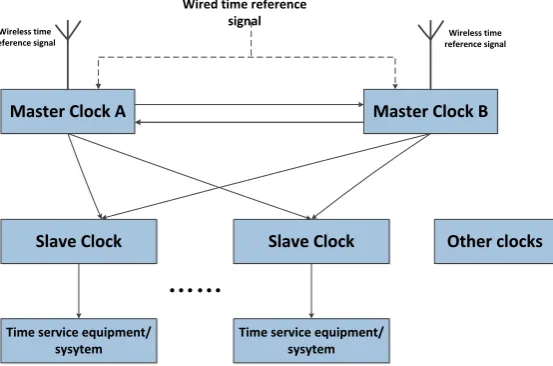
The main and standby time synchronization system is composed of two master clocks, several slave clocks and signal transmission media, which are timed by the given equipment or system. See Figure 3.
Master Clock B
Slave Clock Slave Clock Other clocks
……
Wired time reference signal
Time service equipment/ sysytem
Time service equipment/ sysytem
Master Clock A
Wireless time reference signal
[image:2.595.163.440.591.774.2]All levels of dispatching structure and dispatching agencies should configure a set of time synchronization system, and the time synchronization system should adopt the main and standby mode.
Power plants or substations should be equipped with a set of time synchronization system. Large power plants, 500 kV substations and other occasions should adopt the main and standby time synchronization system to improve the reliability of the time synchronization system. If two wireless time reference signals are used, different timing sources should be selected. For example, using GPS and Beidou system. The time synchronization system is connected to the time synchronization network. In addition to receiving the wireless time reference signal, it also receives the wired time reference signal from the upper time synchronization system. When both types of time reference signal input are valid, wireless time reference signal is the priority time source of the system. When the wireless time reference signal is abnormal, the wired time reference signal is used as the time source of the system.
Optimization of Clock Synchronization System for Nuclear Power Station
Early Clock System Architecture for Nuclear Power Station Clock
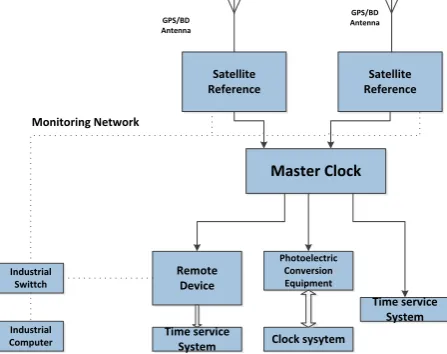
The architecture of clock synchronization system in early nuclear power plant is shown in Figure 4. The system consists of satellite reference source, master clock, remote equipment, sub-clock system and monitoring system. The satellite reference source receives GPS and BD signals, and the monitoring system monitors the main equipment.
Satellite Reference
Satellite Reference
Master Clock
Remote Device
Photoelectric Conversion Equipment
Clock sysytem Time service
System
Time service System GPS/BD
Antenna
GPS/BD Antenna
Industrial Computer Industrial Swittch
[image:3.595.185.409.378.555.2]Monitoring Network
Figure 4. Early clock system architecture.
Problems in the Clock System Architecture of Early Nuclear Power Plants
1) Although the secondary structure of the master-slave clock is adopted in the architecture, the master clock acts as both the reference source and the downstream load. A service card fault on the master clock may cause the signal source interruption or system paralysis of the downstream second clock.
2) Business cards of master r clock and remote module have multiple units or multiple downstream systems at the same time. When a business card fails, it affects multiple systems or different units.
3) The remote module receives only one time reference signal from the master clock, so it can not achieve dual or multi-source backup function.
Optimization of Clock Synchronization System for 3 Nuclear Power Station
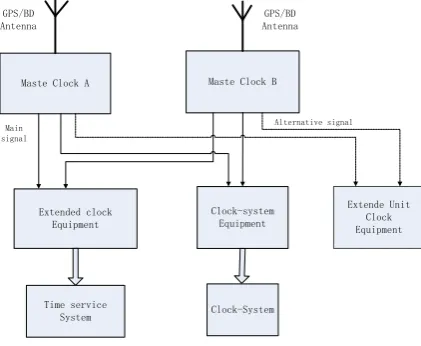
The optimized clock structure of the nuclear power plant is mainly in standby mode, and the architecture is shown in Figure 5. The system consists of five subsystems: the main clock system, the remote system, the sub-clock system, the monitoring management system and the power supply system. The optimized clock system has the following characteristics:
Maste Clock A GPS/BD Antenna
Clock-system Equipment
Clock-System Maste Clock B
GPS/BD Antenna
Extended clock Equipment
Main signal
Alternative signal
Time service System
[image:4.595.188.399.151.324.2]Extende Unit Clock Equipment
Figure 5. Clock system optimization framework for nuclear power station.
The Time Transfer Mode of Safety. The clock system adopts a tree-like time information
transmission mode, which transfers step by step from the front end to the back end. The back stage synchronizes with the front stage, and the same level is independent of each other, so as to ensure the high reliability and stability of the system.
Satellite Time Reference Source and Extension Clock Separation. The clock source is
separated from the expansion device. Under the satellite time reference source, the main equipment of the extended clock and sub-clock system only hangs without service, and all downstream loads are connected to the extended clock equipment. The system structure adopts three-tier architecture, the first tier is clock source, and a set of standard clock source is installed in the main communication room; the second tier is expansion equipment, which is placed in different unit rooms, and downstream services are accessed from expansion equipment; and the third tier is business layer.
Unit and Business Separation. Different units are connected to different expansion devices, and
different systems of the same unit are connected to independent boards to realize the separation of units and services. For example, the 1#, 2# and 1/2# shared units are individually equipped with one expansion clock, and the units are independent of each other. 1 # Unit uses the same time format system to configure the board separately, without affecting each other, to achieve business separation.
Redundancy of Satellite Reference Sources. The same extended clock device receives satellite
reference source signals from different locations, and when the main signal is switched, it will automatically switch to the standby signal. At the same time, the satellite time reference source is installed in different computer rooms. Because of the different environment, the possibility of losing two signals is reduced, thus improving the reliability of the system.
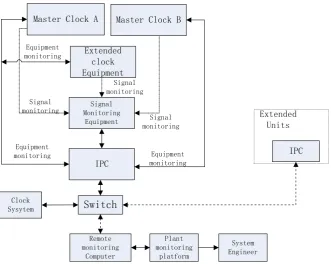
Equipment and Signal Detection. The output signal is monitored at signal level to find faults in
real time. When the clock source and expansion equipment detect the faults of the equipment, the output of the signal is automatically cut off and the wrong signal is not detected.
Perfect Monitoring and Management System. The system has a perfect monitoring and
short message platform in time, thus improving the response speed of handling the fault, as shown in Figure 6.
Master Clock A Master Clock B
Extended clock Equipment
Remote monitoring
Computer Signal Monitoring
Equipment
IPC
Signal monitoring Signal
monitoring
Signal monitoring
Equipment
monitoring Equipment
monitoring
Switch
Equipment monitoring
IPC Extended
Units
Clock Sysytem
Plant monitoring
platform
System Engineer
Figure 6. Optimized clock system monitoring system.
Concluding Remarks
The synchronous clock system provides standard time for nuclear power plant systems and equipment to ensure reliable operation of the system. It plays an important role in analyzing and tracing all kinds of time. Provide strong technical support for nuclear power plants and power grids. In order to meet the operation requirements of the power system, the clock system is constantly optimized in the construction process to make the system more stable and reliable.
Reference
[1] Yan Peili. 500kV time synchronization system for substations [J]. electric power Journal. 2005 (03)
[2] Zhou Ping An. Research on power grid synchronous clock system [J]. computer and digital engineering.1996 (05)
[3] Wang Shengqi, Yang Fan, sun soo. Unified clock system for power grid [J]. power system automation.1991 (Z1)
[4] Week safety. Unified clock system of power grid [J]. China Rural Water Conservancy and Hydropower.1997 (06)