2018 2nd International Conference on Modeling, Simulation and Optimization Technologies and Applications (MSOTA 2018) ISBN: 978-1-60595-594-0
Numerical Study on the Vapor Bubble Growth in a Pool Boiling through
Lattice Boltzmann Method
Xiao-peng SHAN and De-ming NIE
*Institute of Fluid Mechanics, China Jiliang University, Hangzhou, China
*Corresponding author
Keywords: Pool boiling, Vapor bubble, Lattice Boltzmann method.
Abstract. In this work the bubble growth and departure on a heated plate in pool boiling is realized through a pseudo-potential based two-phase lattice Boltzmann method. This method is able to account for the liquid-vapor phase transition. The computational code is validated by comparing the present liquid-vapor coexistence curve with the literature result. Then the effect of the gravity force on the bubble diameter and release frequency is studied. In particular, the effect of the surface wettability is examined by varying the solid-fluid interaction strength which exhibits different contact angles between the liquid-vapor interface and the solid wall.
Introduction
Two-phase flows are very common in many natural processes such as the weather as well as in industrial applications such as combustion engines, heat exchangers, boilers, dryers. The phase transition may occur under certain conditions in numerous industrial process involving two-phase flows, which is known as boiling heat transfer. The phase change has a significant influence on the liquid-vapor flows in terms of heat transfer rate as well as flow characteristics. As a consequence, it is important to pay much attention to the phenomena and mechanism of phase transition between liquid and vapor, which helps to provide a better understanding of the behavior of heat transfer in two-phase flows.
The lattice Boltzmann method (LBM), which is based on the well-known Boltzmann equation, has emerged as a powerful numerical scheme for the simulation of particle suspensions, multiphase flow, microfluidics, and turbulence due to its several remarkable advantages since it was originated. In particular, the LBM is proved to be a promising method for dealing with interfacial flows such as solid-liquid and liquid-vapor flows. So far several lattice Boltzmann models have been proposed to simulate the liquid-vapor flows, including the color-gradient model [1], the pseudo-potential model [2–4] and the free-energy model [5]. The pseudo-potential model which was first proposed by Shan and Chen [2], has become the most popular model due to its conceptual simplicity and computational efficiency. Based on the pseudo-potential scheme [2], Gong and Cheng [3, 4] proposed an improved lattice Boltzmann model for liquid-vapor phase change. In their model, a new form of the source term in the energy equation was derived, which was demonstrated to improve the numerical stability. Overall, the mechanism of liquid-vapor phase change is not well-understood even though tremendous efforts [6-8] have been devoted to it, owing to highly nonlinear effect in the two-phase flows. Much more attention should be paid to the effect of the boiling on the heat transfer. The objective of this work is to present a preliminary understanding of the fluid dynamics and heat transfer of the liquid-vapor phase transition. The improved LB model proposed by Gong and Cheng [3, 4] is used here.
Lattice Boltzmann Method
( )
1
( , ) ( ) ( , ) eq( , )
i i i i i i
f
f t t t f t f t f t f
x e x, x x (1)
where fi(x, t) is the density distribution function corresponding to the microscopic velocity ei, ∆t is
the time step of the simulation, τf is the relaxation time. fi(eq)(x, t) is the equilibrium distribution
function which is given by,
2 2 ( )
2 4 2
( )
1
2 2
eq i i
i i
s s s
f w
c c c
e u e u u (2)
where cs is the speed of sound, and wi are weights related to the lattice model. ∆fi is the discrete
form of the body force F, which accounts for the inter-particle interaction force Fint, the
gravitational force Fgand the interaction force between solid surface and fluid Fs. The fluid density
and velocity are obtained through,
i i i i i ff u e
, (3)
Due to the forcing term, the real fluid velocity of fluid U is modified by,
2 i i i
t f
U
e F (4)Similarly, the lattice Boltzmann equations are proposed [3, 4] to solve the fluid temperature T,
( )
1
( , ) ( , ) ( , ) eq( , )
i i i i i i
g
g t t t g t g t g t tw
x e x x x (5)
where τg is the relaxation time for the fluid temperature and gi(eq)(x, t) is the corresponding
equilibrium distribution function,
2 2 ( )
2 4 2
( )
1
2 2
eq i i
i i
s s s
g w T
c c c
e U e U U (6)
The source term is responsible for the phase change, determined by,
U
1 1 ( )
T p c T v (7)
where p is the pressure and cvis the heat capacity. Then the temperature is obtained through,
i i
g
T (8)
Validation
The equation of state (EOS) relates the pressure p, volume V and temperature T of a physically homogeneous system in the state of thermodynamic equilibrium. So far, the Peng-Robinson (P-R) equation of state has become the most popular EOS for natural gas systems in the petroleum industry, which is adopted in the present work. However, for the purpose of comparison, the Shan-Chen EOS is used here to validate the present computational code, instead. The liquid-vapor coexistence curve is then computed and compared with the result reported in the literature [4], which is illustrated Fig. 1. In thermodynamics, the coexistence curve, also known as binodal curve, denotes the condition at which two distinct phases may coexist. Accordingly, it is the boundary between the set of conditions in which it is thermodynamically favorable for the system to be fully mixed and the set of conditions in which it is thermodynamically favorable for it to phase separate.
Note that /c < 1 and /c > 1 (c is the critical density) represent the vapor phase and liquid
G o n g a n d C h e n g ( 2 0 1 2 )
/C
T
/T
C
0 1 2 3 4 5
0 . 5 0 . 6 0 . 7 0 . 8 0 . 9 1
P r e s e n t r e s u lts
[image:3.595.182.418.70.215.2]liq u id p h a s e b r a n c h g a s p h a s e b r a n c h
Figure 1. Comparison of the coexistence curve between the present study and the literature result [4] based on the Shan-Chen EOS.
Results and Discussion
The problem of pool boiling is numerically studied in the present work by simulating a single bubble generated from a heated plate due to the liquid-vapor phase change. The length of the heated plate is 30 (in lattice unit, the same as below) which is placed at the bottom wall of a pool fill with liquid. The computational domain is 3301200. The saturation temperature of the liquid is fixed at
Ts=0.9Tc and the temperature of the heat plate is chosen as Tw=0.98Tc (unless otherwise specified).
For the following simulations, the P-R EOS is used to determine the pressure.
Figure 2 presents the instantaneous flow field at different times for contact angle equivalent to 90 degree (gs=0, gs is the solid-fluid interaction force strength), which illustrates the process of a single
vapor bubble departure from the heated wall. Once a nucleus is developed at the heated plate, the bubble starts to grow rapidly, as shown in Figure 2(a)-(c). Two recirculation zones, rotating in opposite rotations, are observed on both sides of the nucleus, which leads to the transition of the heat transfer from natural convection to forced convection. A bubble neck is then seen when the buoyant effect becomes significant [Figure 2 (d) and (e)]. Eventually, the neck breaks and the bubble departure occurs, as seen from Figure 2(f)-(h). Then this process is repeated, which enhances the rate of heat transfer in the way that the flow is notably disturbed by motion of bubbles.
(a) (b) (c) (d)
(e) (f) (g) (h)
Figure 2. Instantaneous flow field (velocity vector and density distribution) at different times for gs=0 (contact angle equivalent to 90).
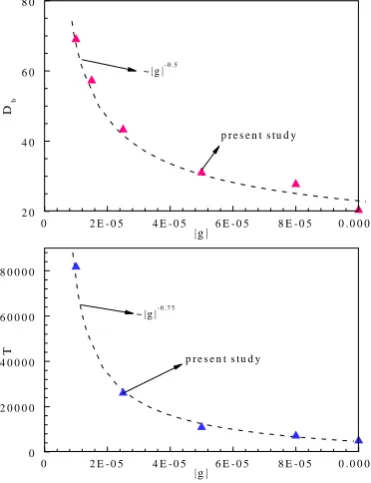
In the case of pool boiling, the departure diameter (Db) as well as the release frequency (f) of
bubbles plays a key role in the process of heat transfer, which has been an everlasting topic from both numerical and theoretical points of view. According to the balance between adhesive force and buoyant force experienced by a vapor bubble, Fritz [9] obtained a formulation for the departure diameter which is related to the magnitude of gravity force (|g|),
~ b
L G
D g
(9)
[image:3.595.186.414.504.627.2]indicates a power-law relationship between Db and g, i.e. Db~|g|-0.5. Similarly, Zuber [10] developed
a formulation for the release frequency of bubbles,
0.25
2
1
~ b L G
L
g
T D
f
(10)
From (9) and (10), it is easy to reach the following relationship: T~|g|-0.75.
According to the present LBM simulations, Figure 3 shows the departure diameter and release period of a single vapor bubble in the case of pool boiling. It can be clearly seen that the dependence of Db or T on the gravity force is realized.
|g |
D
b
0 2 E - 0 5 4 E - 0 5 6 E - 0 5 8 E - 0 5 0 . 0 0 0 1 2 0
4 0 6 0 8 0
p r e s e n t s tu d y ~ |g |- 0 . 5
|g |
T
0 2 E - 0 5 4 E - 0 5 6 E - 0 5 8 E - 0 5 0 . 0 0 0 1 0
2 0 0 0 0 4 0 0 0 0 6 0 0 0 0 8 0 0 0 0
[image:4.595.204.390.200.442.2]p r e s e n t s tu d y ~ |g |- 0 . 7 5
Figure 3. Departure diameter (Db) and release period (T) for a single bubble releasing from the heated wall as a function of gravity force (|g|).
Figure 4 presents the instantaneous flow field at different times for gs=0.2 and gs=-0.4,
respectively, which shows the wettability effect on the bubble departure. For gs>0, the contact
angle, form by a solid-vapor interface when meeting a solid plate, is seen to be greater than 90 degree, which, however, is lower than 90 degree for gs<0. It is found that the value of gsgreatly
affects the process of bubble departure as well as the heat transfer between the heated plate and the liquid. For the case of high wettability (gs>0), an extra rewetting process (the contact line moving
inward) is observed which leads to a smaller release frequency of bubbles. This can be better illustrated by showing the resulting time-periodic heat flux of the heated plate in Figure 5. Three kinds of wettability, i.e. gs=-0.2, 0 and 0.2, are taken into account. The heat flux is averaged over
the length of the heated plate. It is clearly seen that the surface wettability considerably affects the heat transfer in terms of the magnitude as well as the frequency of bubble departure.
(a)
(b)
[image:4.595.190.408.635.758.2]gs= - 0 . 2
t
q
0 2 0 0 0 0 4 0 0 0 0 6 0 0 0 0 8 0 0 0 0 1 0 0 0 0 0 0
0 . 0 1 0 . 0 2 0 . 0 3 0 . 0 4
[image:5.595.191.405.70.189.2]gs= 0 gs= 0 . 2
Figure 5. Time history of averaged heat flux for three kinds of surface wettability.
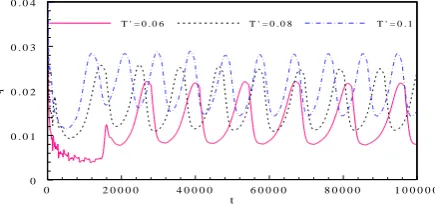
The temperature of the heated plate has a similar effect on the heat transfer in the case of pool boiling. This is indicated by Figure 6, which shows the time history of the averaged heat flux for different values of Tw. The normalized temperature T' is defined through T'=(Tw-Ts)/Tc. The
magnitude of heat flux as well as the frequency of its oscillation is seen to increase as the value of
T' increases. This is consistent with the fact that the higher the temperature of heated wall is, the more intense the boiling of liquid is.
T ' = 0 . 0 6 T ' = 0 . 0 8
t
q
0 2 0 0 0 0 4 0 0 0 0 6 0 0 0 0 8 0 0 0 0 1 0 0 0 0 0 0
0 . 0 1 0 . 0 2 0 . 0 3 0 . 0 4
T ' = 0 . 1
Figure 6. Time history of averaged heat flux for three kinds of heated plate temperature. The normalized temperature is defined as T'=(Tw-Ts)/Tc.
Conclusion
A two-phase lattice Boltzmann method, which is based on the pseudo-potential scheme, is used to numerically study the liquid-vapor transition in the case of pool boiling in this work. The generation of a vapor bubble at a nucleus on the heated wall as well as its departure is realized through the present simulations. The effect of the gravity force (|g|) on the bubble diameter and release frequency is presented, which shows a ~|g|-0.5 and ~|g|-0.75 power-law relationship, respectively. The effect of the surface wettability is also examined by simulating the bubble departure at different contact angles. Results show that the low wettability enhances the heat transfer of pool boiling in two respects, i.e. the magnitude and the frequency of heat flux on the heated wall.
Acknowledgment
This work was supported by the National Key Research and Development Program of China (2017YFB0603700) and the Zhejiang Provincial Natural Science Foundation of China (LY15A020004).
References
[1] A.K. Gunstensen, D.H. Rothman, S. Zaleski and G. Zanetti, “Lattice Boltzmann model of immiscible fluids,” Phys. Rev. A, Vol. 43, pp. 4320–4327, 1991.
[image:5.595.189.407.301.403.2][3] S. Gong and P. Cheng, “A lattice Boltzmann method for simulation of liquid-vapor phase-change heat transfer,” Int. J. Heat Mass Trans., Vol. 55, pp. 4923–4927, 2012.
[4] S. Gong and P. Cheng, “Numerical investigation of droplet motion and coalescence by an improved lattice Boltzmann model for phase transitions and multiphase flows,” Comput. Fluids, Vol. 53, pp. 93–104, 2012.
[5] M.R. Swift, E. Orlandini E, W.R. Osborn and J.M. Yeomans, “Lattice Boltzmann simulations of liquid-gas and binary fluid systems,” Phys. Rev. E, Vol. 54, pp. 5041–5052, 1996.
[6] G. Hazi and A. Markus, “On the bubble departure diameter and release frequency based on numerical simulation results,” Int. J. Heat Mass Trans., Vol. 52, pp. 1472–1480, 2009.
[7] S. Ryu and S. Ko, “Direct numerical simulation of nucleate pool boiling using a two-dimensional lattice Boltzmann method,” Nucl. Eng. Des., Vol. 248, pp. 248–262, 2012.
[8] T. Sun and W. Li, “Three-dimensional numerical simulation of nucleate boiling bubble by lattice Boltzmann method,” Comput. Fluids, Vol. 88, pp. 400–409, 2013.
[9] W. Fritz, “Maximum volume of vapour bubbles,” Physik Zeitschr, Vol. 36, pp. 379–384, 1935.
![Figure 1. Comparison of the coexistence curve between the present study and the literature result [4] based on the Shan-Chen EOS](https://thumb-us.123doks.com/thumbv2/123dok_us/258200.1025923/3.595.186.414.504.627/figure-comparison-coexistence-curve-present-study-literature-result.webp)