R E S E A R C H
Open Access
On nonlinear matrix equations
X
±
m
i
=
A
∗
i
X
–
n
i
A
i
=
I
Asmaa M Al-Dubiban
**Correspondence:
[email protected] Faculty of Science and Arts, Qassim University, Buraydah, Kingdom of Saudi Arabia
Abstract
We study the nonlinear matrix equationsX+mi=1A∗iX–niA
i=Iand X–mi=1A∗iX–niA
i=I, whereniare positive integers fori= 1, 2,. . .,m. The iterative
algorithms for obtaining positive definite solutions for these equations are proposed. The necessary and sufficient conditions for the existence of positive definite solutions of these equations are derived. Moreover, the rate of convergence of the sequences generated from the algorithms is studied. The efficiency of proposed algorithms is illustrated by numerical examples.
Keywords: matrix equation; positive definite solution; iterative algorithm
1 Introduction
Consider the nonlinear matrix equations:
X+
m
i=
A∗iX–niA
i=I (.)
and
X–
m
i=
A∗iX–niA
i=I, (.)
whereXis an unknown square matrix,I is the identity matrix,Aiare square complex
matrices andniare positive integers fori= , , . . . ,m.
Nonlinear matrix equations of type (.) and (.) have many applications in engineer-ing, control theory, dynamic programmengineer-ing, stochastic filterengineer-ing, ladder networks, statis-tics,etc.; see [–] and the references therein. Whenm= andn= , (.) arises in the analysis of stationary Gaussian reciprocal processes over a finite interval []. Whenm> andni= fori= , , . . . ,m, (.) arises in solving a large-scale system of linear equations
in many physical calculations [] and (.) is recognized as playing an important role in modeling certain optimal interpolation problems [, ].
In the last few years, many authors have been greatly interested in developing the theory and numerical approaches for positive definite solutions to the nonlinear matrix equations of the form (.) and (.). Similar types of (.) and (.) have been investigated [–]. The matrix equationsX±A∗X–A=Qhave been studied by several authors [–, , ] and
different iterative algorithms for computing the positive definite solutions with linear and quadratic rate of convergence are proposed. Ivanovet al.[] derived sufficient conditions for the existence of positive definite solutions for the matrix equationsX±A∗X–A=Iand they proposed iterative algorithms for obtaining positive definite solutions of these equa-tions. El-Sayed [] presented two iterative methods for calculating the positive definite solutions of the matrix equationX–A∗X–nA=Q, for the integern≥, the first method is
derived for a normal matrixAand for the second method a sufficient condition for
con-vergence is given forn= k. El-Sayed and Ran [] studied the general matrix equation
X+A∗F(X)A=QwhereFmaps positive definite matrices either into positive definite
ma-trices or into negative definite mama-trices and satisfies some monotonicity property. Hasanov and Ivanov [] considered the matrix equationsX±A∗X–nA=Q, they studied the
solu-tions and perturbation analysis of these solusolu-tions. They also derived a sufficient condition for the existence of a unique positive definite solution of the equationX–A∗X–nA=Q.
Hasanov [] established and proved theorems for the necessary and sufficient conditions of the existence of positive definite solutions for the matrix equationsX±A∗X–qA=Q
with <q≤, he showed that the equationX–A∗X–qA=Qhas a unique positive definite solution by using the properties of matrix sequence in Banach space. Also, in [] some con-ditions for the existence of positive definite solution of the equationX+mi=A∗iX–A
i=I
have been obtained and two iterative algorithms to find the maximal positive definite solu-tion of this equasolu-tion have been presented. Duanet al.[] gave two perturbation estimates for the positive definite solution of the equationX–mi=A∗iXδiA
i=Qwith <|δi|< .
Duanet al.[] studied the equationX–mi=Ni∗X–Ni=I, they used the Thompson
met-ric to prove that the matrix equation always has a unique positive definite solution and they derived a precise perturbation bound for the unique positive definite solution. In ad-dition, other nonlinear matrix equations such asXs±ATX–tA=In[],AX+BX+C=
[], andX=Q+AH(I⊗X–C)–δA∗[] have been investigated.
In this paper, we study the positive definite solutions of (.) and (.). We derive the nec-essary and sufficient conditions for the existence of positive definite solutions. We suggest iterative algorithms for obtaining positive definite solutions of these equations. Moreover, under some conditions we obtain the rates of convergence of the iterative sequences of ap-proximate solutions and the stopping criterions. Finally, we give some numerical examples to ensure the performance and the effectiveness of the suggested iterative algorithms.
The following notations will be used in this paper.A denotes the complex conjugate
transpose ofA. We writeA> (A≥), if matrixAis positive definite (positive semidef-inite). IfA–Bis positive definite (positive semidefinite), then we writeA>B(A≥B). Moreover, we denoteρ(A) by the spectral radius ofA. We useλmax(A) andλmin(A) to
de-note the maximal and minimal eigenvalues ofA. · and · ∞denote the spectral and
infinity norm, respectively.
Lemma .[] If A≥B> ,then A–≤B–.
Lemma .[] If A and B are positive definite matrices for which A–B> and AB=BA are satisfied,then An–Bn> .
Lemma .[] If A>B> (or A≥B> ),then Aα>Bα> (or Aα≥Bα> ),for all
2 The matrix equationX+mi=1A∗iX–niA
i=I
In this section, we give some necessary and sufficient conditions for the existence of posi-tive definite solutions of (.). We present the following iteraposi-tive algorithm to compute the positive definite solution of (.).
Algorithm .
X=I, Xs+=I–
m
i=A∗iX
–ni
s Ai, fors= , , , . . . .
Remark . Lettingm= in Algorithm ., we get Algorithm (.) in [] which is pro-posed for obtaining the positive definite solutions of the matrix equationX+A∗X–nA=I. Also, lettingni= ,∀i= , , . . . ,m, in Algorithm ., we get Algorithm . in [], which
is proposed for obtaining the positive definite solutions of the matrix equation X+
m
i=A∗iX–Ai=I.
The following theorem provides the necessary condition for the existence of positive definite solutions of (.).
Theorem . If(.)has a positive definite solution X,then
AiA∗i
ni <X≤I–
m
i=
A∗iAi, i= , , . . . ,m. (.)
Proof SinceXis a positive definite solution of (.), thenX≤I andim=A∗iX–niA
i<I.
Using the inequalityX≤Iand Lemmas ., ., we have
X=I–
m
i=
A∗iX–niA
i≤I– m
i= A∗iAi.
Also, from the inequalitymi=A∗iX–niA
i<I, we haveA∗iX–niAi<I. Then
A∗iX–ni/X–ni/A
i<I,
which implies that
X–ni/A
iA∗iX–ni/<I.
Using Lemma ., we obtain
AiA∗i
/ni
<X.
This completes the proof.
Remark . Lettingni= ,∀i= , , . . . ,m, in (.) we get the conditionAiA∗i <X≤I–
m
i=A∗iAi, which is necessary for the existence of positive definite solutions of the matrix
equationX+mi=A∗iX–A
Lemma . If Ai, i= , , . . . ,m, are hermitian matrices and AiAj=AjAi, for all i,j=
, , . . . ,m,then
AjXs=XsAj, j= , , , . . . ,m, (.)
where the sequence{Xs},s= , , , . . . ,is determined by Algorithm..
Proof SinceX=I,AjX=XAj. By using the conditionAiAj=AjAi, we have
AjX=Aj
I–
m
i= Ai
=Aj–
m
i=
AjAi =Aj– m
i= AiAj=
I–
m
i= Ai
Aj=XAj.
We suppose thatAjXs=XsAj. Then forXs+, we have
AjXs+=Aj
I–
m
i=
AiXs–niAi
=Aj– m
i=
AjAiXs–niAi
=Aj– m
i=
AiAjXs–niAi
=Aj– m
i=
AiXs–niAjAi
=Aj– m
i=
AiXs–niAiAj
=
I–
m
i=
AiXs–niAi
Aj
=Xs+Aj.
Hence, the equalities (.) are true, for alls= , , , . . . .
Lemma . If Ai, i= , , . . . ,m, are hermitian matrices and AiAj=AjAi, for all i,j=
, , . . . ,m,then
XsXr=XrXs. (.)
Here the sequences{Xs},{Xr},s,r= , , , . . . ,are determined by Algorithm..
Proof SinceX=I,XXr=XrX,∀r= , , , . . . . According to Lemma ., we have
XXr=
I–
m
i= Ai
I–
m
i=
AiXr––niAi
=I–
m
i= Ai –
m
i=
AiXr––niAi+ m
j=
m
i=
=I–
m
i= Ai –
m
i=
AiXr––niAi+ m j= m i=
AiXr––niAiAj
=I–
m
i= Ai –
m
i=
AiXr––niAi+ m i= m j=
AiXr––niAiAj
= I– m i=
AiXr––niAi
I–
m
i= Ai
=XrX.
That is,XXr=XrX,∀r= , , , . . . . We suppose thatXsXr=XrXs,∀r= , , , . . . . Then
forXs+, we have
Xs+Xr=
I–
m
i=
AiXs–niAi
I–
m
i=
AiXr––niAi
=I–
m
i=
AiXs–niAi– m
i=
AiXr––niAi+ m
j= AjX
–nj
s Aj m
i=
AiX–r–niAi
=I–
m
i=
AiXs–niAi– m
i=
AiXr––niAi+ m j= m i= AjX
–nj
s AjAiX–r–niAi
=I–
m
i=
AiXs–niAi– m
i=
AiXr––niAi+ m j= m i= AiX
–nj
s AiAjXr––niAj
=I–
m
i=
AiXs–niAi– m
i=
AiXr––niAi+ m j= m i= AiAiX
–nj
s Xr––niAjAj
=I–
m
i=
AiXs–niAi– m
i=
AiXr––niAi+ m j= m i=
AiAiXr––niX –nj
s AjAj
=I–
m
i=
AiXs–niAi– m
i=
AiXr––niAi+ m j= m i=
AiX–r–niAiAjX
–nj
s Aj
=I–
m
i=
AiXs–niAi– m
i=
AiXr––niAi+ m
i=
AiXr––niAi m
j= AjX
–nj
s Aj
= I– m i=
AiXr––niAi
I–
m
i=
AiXs–niAi
=XrXs+.
Therefore, the equality (.) is true, for alls,r= , , , . . . .
Remark . When we compare Lemmas . and . by Lemmas and in [], we note that the sequence{Xs},s= , , , . . . (which is defined by Algorithm .) satisfies the same
properties of the sequence{Xs},s= , , , . . . (which is defined by Algorithm (.) in []).
Theorem . Let Ai,i= , , . . . ,m,be hermitian matrices and AiAj=AjAi,for all i,j=
, , . . . ,m.If A
i ≤
(α–)
nmα(ni+)I,whereα> and n=max≤i≤m{ni},then(.)has a positive definite solution.
Proof We consider the sequence{Xs}generated from Algorithm .. ForX, we haveX=
I>αI. ForX, we have
X=I–
m
i=
Ai ≥I–
m
i=
(α– ) nmα(ni+)I>I–
m
i= (α– )
nmα I≥I–
(α– )
α I=
αI,
X=I–
m
i=
Ai ≤I=X.
That is,
X≥X>
αI.
We suppose that
Xs–≥Xs>
αI. (.)
Using the inequalities (.) and Lemmas ., ., and ., we obtain
Xs+=I–
m
i=
AiXs–niAi
≤I–
m
i=
AiXs––niAi
=Xs.
Also
Xs+=I–
m
i=
AiXs–niAi
>I–
m
i=
αniA
i
≥I–
m
i=
αni (α– )
nmα(ni+)I
=I–
m
i= m
(α– ) nα(ni+)I
>I–(α– )
α I
=
Therefore the inequalities (.) are true, for alls= , , . . . . That is, the sequence{Xs}is
monotonically decreasing and bounded below by αI. Hence, the sequence{Xs}converges
to a positive definite solutionXof (.).
Theorem . Let Ai,i= , , . . . ,m,be hermitian matrices and AiAj=AjAi,for all i,j=
, , . . . ,m.If Ai ≤ (α–)
nmα(ni+)I,then(.)has a positive definite solution X which satisfies Xs+–X<
α–
α
Xs–X, (.)
whereα> ,n=max≤i≤m{ni},and{Xs},s= , , , . . . ,is the sequence determined by
Algo-rithm..
Proof By Theorem ., we know that the sequence{Xs},s= , , , . . . , is convergent to a
positive definite solutionXof (.). We consider the spectral norm of the matrixXs+–X. We have
Xs+–X=
I–
m
i=
AiX–sniAi–I+ m
i=
AiX–niAi
=
m
i= Ai
X–ni–X–ni
s
Ai
≤
m
i=
Ai
X–ni–X–ni
s
Ai
≤
m
i=
AiX–ni
Xni
s –Xni
X–ni
s
≤
m
i=
AiX–niXs–niXnsi–Xni
=
m
i=
AiX–niXs–ni
(Xs–X)
ni
r= Xni–r
s Xr–
≤
m
i=
AiX–niXs–niXs–X
n
i
r=
Xsni–rXr–
.
From the proof of Theorem ., we obtainX–ni
s <αniI,X–ni≤αniI, andX≤Xs≤I. Then
we have
Xs+–X ≤
m
i=
AiX–niXs–niXs–X
n
i
r=
Xsni–rXr–
<
m
i=
niαniAiXs–X
≤
m
i= niαni
(α– )
≤
m
i=
n(α– )
nmα Xs–X
= (α– )
α Xs–X.
Theorem . Let Ai,i= , , . . . ,m,be hermitian matrices and AiAj=AjAi,for all i,j=
, , . . . ,m.If A
i ≤
(α–)
nmα(ni+)I,whereα> ,n=max≤i≤m{ni},and after s iterative steps of Algorithm.,we haveI–Xni
s Xs––ni<ε,then
Xs+
m
i=
AiXs–niAi–I
<
(α– )
α ε. (.)
Proof From Algorithm ., we have
Xs+ m
i=
AiX–sniAi–I=Xs+ m
i=
AiXs–niAi–Xs– m
i=
AiXs––niAi
= m i= Ai X–ni
s –X
–ni
s–
Ai.
By taking the norm on both sides of the above equation, we have
Xs+
m
i=
AiXs–niAi–I
= m i= Ai X–ni
s –X
–ni
s– Ai ≤ m i=
AiXs–ni–X
–ni
s–
≤
m
i=
AiXs–niI–XnsiX
–ni
s–.
From the proof of Theorem ., we haveX–ni
s <αniI, then
Xs+
m
i=
AiXs–niAi–I
< m i=
(α– ) nmα(ni+)α
niI–Xni
s X
–ni
s–
<
m
i= (α– )
mα I–X
ni
s X
–ni
s–
< (α– )
α ε.
3 The matrix equationX–mi=1A∗iX–niA
i=I
In this section, we give some necessary and sufficient conditions for the existence of pos-itive definite solutions of (.). We present the following iterative algorithm to compute the positive definite solution of (.).
Algorithm .
X=I, Xs+=I+
m
i=A∗iX
–ni
Remark . Lettingm= in Algorithm ., we get Algorithm (.) in [] which is pro-posed for obtaining the positive definite solutions of the matrix equationX–A∗X–nA=I.
Also, letting ni = , ∀i = , , . . . ,m, in Algorithm ., we get Algorithm (.) in []
which is proposed for obtaining the positive definite solutions of the matrix equation X–mi=A∗iX–A
i=I.
The following theorem provides the necessary condition for the existence of positive definite solutions of (.).
Theorem . If(.)has a positive definite solution X,then
I≤X≤I+
m
i=
A∗iAi. (.)
Proof SinceXis a positive definite solution of (.), thenmi=A∗iX–niA
i≥. Thus we get
X=I+
m
i=
A∗iX–niA
i≥I.
Also, from the inequalityX≥Iand Lemmas . and ., we have
X=I+
m
i=
A∗iX–niA
i≤I+ m
i= A∗iAi.
This completes the proof.
Remark . The condition (.) is the same necessary condition for the existence of pos-itive definite solutions of the matrix equation X–mi=A∗iX–A
i =I ([], Remark .).
Also, ifAis an invertible matrix andm= in condition (.), then we get the condition I<X<I+A∗A, which is necessary for the existence of positive definite solutions of the matrix equationX–A∗X–nA=I([], Corollary .).
Lemma . If Ai, i= , , . . . ,m, are hermitian matrices and AiAj=AjAi, for all i,j=
, , . . . ,m,then
AjXs=XsAj, j= , , , . . . ,m, (.)
where the sequence{Xs},s= , , , . . . ,is determined by Algorithm..
Proof The proof is similar to the proof of Lemma ..
Lemma . If Ai, i= , , . . . ,m, are hermitian matrices and AiAj=AjAi, for all i,j=
, , . . . ,m,then
XsXr=XrXs. (.)
Proof The proof is similar to the proof of Lemma ..
Remark . When we compare Lemmas . and . by Lemmas . and . in [], we note that the sequence{Xs},s= , , , . . . (which is defined by Algorithm .) satisfies the
same properties of the sequence{Xs},s= , , , . . . (which is defined by Algorithm (.) in
[]).
Theorem . Let Ai,i= , , . . . ,m,be hermitian matrices and AiAj=AjAi,for all i,j=
, , . . . ,m.If q=mi=niAi( +mi=Ai)ni–< ,then(.)has a positive definite
solu-tion X which satisfies
Xs≤X≤Xs+ (.)
and
Xs+–Xs ≤qs m
i=
Ai, (.)
where the sequence{Xs},s= , , , . . . ,is determined by Algorithm..
Proof We consider the matrix sequence{Xs}generated from Algorithm . and using
Lemmas ., . and .. SinceA
i ≥, then
X=I+
m
i=
Ai ≥I=X
and
X=I+
m
i=
AiX–niAi≤I+ m
i=
Ai =X.
Consequently
X≤X≤X.
We find the relation betweenX,X,X,X. UsingX≤X≤X, we obtain
X=I+
m
i=
AiX–niAi≤I+ m
i= Ai =X
and
X=I+
m
i=
AiX–niAi≥I+ m
i=
AiX–niAi=X.
HenceX≤X≤X. In the same way we can prove that
We suppose that
X≤Xs≤Xs+≤Xs+≤Xs+≤X. (.)
Using the inequalities (.), we have
Xs+=I+
m
i=
AiX–sn+iAi≤I+ m
i=
AiX–sn+i Ai=Xs+,
Xs+=I+
m
i=
AiX–sn+iAi≥I+ m
i=
AiX–sn+iAi=Xs+.
Similarly
Xs+=I+
m
i=
AiX–sn+i Ai≤I+ m
i=
AiX–sn+i Ai=Xs+,
Xs+=I+
m
i=
AiX–sn+i Ai≥I+ m
i=
AiX–sn+i Ai=Xs+.
Therefore, the inequalities (.) are true, for all s= , , , . . . . Consequently the subse-quences{Xs}and{Xs+}are convergent to positive definite matrices. To prove that these sequences have a common limit, we consider
Xs+–Xs=
m i= Ai X–ni
s –X
–ni
s–
Ai ≤ m i=
AiX–sni–X
–ni
s–
=
m
i=
AiX–sni
Xni
s––X
ni
s
X–ni
s–
≤
m
i=
AiX–sniX
–ni
s–X
ni
s––X
ni s = m i=
AiX–sniX
–ni
s–
(Xs––Xs) ni
r= Xni–r
s–Xr–s
≤ m i=
AiX–sniX
–ni
s–Xs––Xs
×
n
i
r=
Xs–ni–rXsr–
.
From the inequalities (.), we haveXs,Xs–≥I, andXs,Xs–≤I+
m
i=Ai, for alls=
, , , . . . . Then we have
Xs+–Xs ≤ m
i=
niAiXs––Xs
+
m
i=
Ai
ni–
Hence
Xs+–Xs ≤qXs–Xs– ≤ · · · ≤qs
m
i=
Ai,
that is,
Xs+–Xs →, ass→ ∞.
Hence, the two subsequences{Xs}and{Xs+}have the same limitX, which is a positive
definite solution of (.).
From Theorem ., we can deduce the following corollary.
Corollary . From inequality(.),we have the following upper bound:
maxXs+–X,X–Xs
≤qs
m
i=
Ai. (.)
Remark . Theorem . provides the sufficient condition q = mi=niAi( +
m
i=Ai)ni–< for the existence of positive definite solutions of (.), we note that when
m= we have the conditionA( +A)n–<
n, which is sufficient for the existence of
positive definite solutions of the matrix equationX–A∗X–nA=I([], Theorem .).
Theorem . Let Ai,i= , , . . . ,m,be hermitian matrices and AiAj=AjAi,for all i,j=
, , . . . ,m.If q=mi=niAi( +
m
i=Ai)ni–< ,and after s iterative steps of
Algo-rithm.,we haveI–Xni
s–X –ni
s <ε,then
Xs–
m
i=
AiX–sniAi–I
<ε
m
i=
Ai. (.)
Proof From Algorithm ., we have
Xs– m
i=
AiXs–niAi–I=Xs– m
i=
AiXs–niAi–Xs+ m
i=
AiXs––niAi
=
m
i= Ai
X–ni
s––Xs–ni
Ai.
By taking the norm on both sides of the above equation, we have
Xs–
m
i=
AiX–sniAi–I
=
m
i= Ai
X–ni
s––Xs–ni
Ai
≤
m
i=
AiXs––ni–Xs–ni
≤
m
i=
AiXs––niI–X
ni
From the proof of Theorem ., we haveX–ni
s–≤I, then
Xs–
m
i=
AiX–sniAi–I
≤
m
i=
AiI–Xsn–i X–sni
<ε
m
i=
Ai.
4 Numerical examples
In this section, we use the iterative Algorithms . and . to compute the positive def-inite solutions of (.) and (.), respectively. The solutions are computed for different matrices Ai, i= , , . . . ,m, with different orders. We denote X, the solution obtained
by Algorithms . and . and(Xs) =X–Xs∞,R(Xs) =Xs+
m
i=A∗iX
–ni
s Ai–I∞,
Ys=I–
m
i=A∗iAi–Xs,Zi,s=Xsni–AiA∗i (i= , , . . . ,m),R(Xs) =Xs–
m
i=A∗iX
–ni
s Ai–I∞.
Example . Consider the matrix equation
X+A∗X–A
+A∗X–A+A∗X–A=I, (.)
whereA,A, andAare given by
A=
⎛ ⎜ ⎝
. . .
. . .
–. . .
⎞ ⎟
⎠, A=
⎛ ⎜ ⎝
. . .
. . .
. . –.
⎞ ⎟ ⎠,
A=
⎛ ⎜ ⎝
. –. .
. –. .
. –. .
⎞ ⎟ ⎠.
We use Algorithm . to solve (.). After iterations, we get the positive definite solution
X≈X=
⎛ ⎜ ⎝
. . –.
. . –.
–. –. .
⎞ ⎟ ⎠
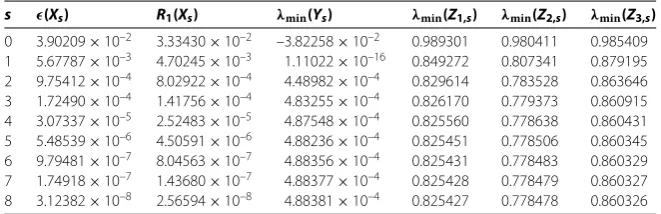
and R(X) = . × –, λmin(Y) = ., λmin(Z,) = .,
[image:13.595.132.463.624.731.2]λmin(Z,) = .,λmin(Z,) = .. The other results are listed in Table .
Table 1 Error analysis for Example 4.1
s (Xs) R1(Xs) λmin(Ys) λmin(Z1,s) λmin(Z2,s) λmin(Z3,s)
0 3.90209×10⁻² 3.33430×10⁻² –3.82258×10⁻² 0.989301 0.980411 0.985409
1 5.67787×10⁻³ 4.70245×10⁻³ 1.11022×10⁻¹⁶ 0.849272 0.807341 0.879195
2 9.75412×10⁻⁴ 8.02922×10⁻⁴ 4.48982×10⁻⁴ 0.829614 0.783528 0.863646
3 1.72490×10⁻⁴ 1.41756×10⁻⁴ 4.83255×10⁻⁴ 0.826170 0.779373 0.860915
4 3.07337×10⁻⁵ 2.52483×10⁻⁵ 4.87548×10⁻⁴ 0.825560 0.778638 0.860431
5 5.48539×10⁻⁶ 4.50591×10⁻⁶ 4.88236×10⁻⁴ 0.825451 0.778506 0.860345
6 9.79481×10⁻⁷ 8.04563×10⁻⁷ 4.88356×10⁻⁴ 0.825431 0.778483 0.860329
7 1.74918×10⁻⁷ 1.43680×10⁻⁷ 4.88377×10⁻⁴ 0.825428 0.778479 0.860327
Example . Consider the matrix equation
X+A∗X–A+A∗X–A+A∗X–A+A∗X–A=I, (.)
whereA,A,A, andAare given by
A=
⎛ ⎜ ⎜ ⎜ ⎝
. . . .
. . . .
. –. . .
. –. . .
⎞ ⎟ ⎟ ⎟ ⎠,
A=
⎛ ⎜ ⎜ ⎜ ⎝
. . . –.
. . . .
. . . –.
. . –. .
⎞ ⎟ ⎟ ⎟ ⎠,
A=
⎛ ⎜ ⎜ ⎜ ⎝
. . . .
. . . .
–. . –. .
–. –. . .
⎞ ⎟ ⎟ ⎟ ⎠,
A=
⎛ ⎜ ⎜ ⎜ ⎝
. . –. .
–. . . .
. . –. .
. –. . .
⎞ ⎟ ⎟ ⎟ ⎠.
We use Algorithm . to solve (.). After iterations, we get the positive definite solution
X≈X=
⎛ ⎜ ⎜ ⎜ ⎝
. –. –. –.
–. . . –.
–. . . –.
–. –. –. .
⎞ ⎟ ⎟ ⎟ ⎠
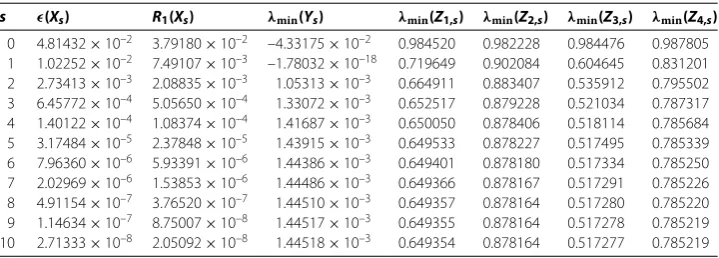
and R(X) = . × –, λmin(Y) = ., λmin(Z,) = .,
[image:14.595.118.478.603.732.2]λmin(Z,) = .,λmin(Z,) = .,λmin(Z,) = .. The other results are listed in Table .
Table 2 Error analysis for Example 4.2
s (Xs) R1(Xs) λmin(Ys) λmin(Z1,s) λmin(Z2,s) λmin(Z3,s) λmin(Z4,s)
0 4.81432×10⁻² 3.79180×10⁻² –4.33175×10⁻² 0.984520 0.982228 0.984476 0.987805
1 1.02252×10⁻² 7.49107×10⁻³ –1.78032×10⁻¹⁸ 0.719649 0.902084 0.604645 0.831201
2 2.73413×10⁻³ 2.08835×10⁻³ 1.05313×10⁻³ 0.664911 0.883407 0.535912 0.795502
3 6.45772×10⁻⁴ 5.05650×10⁻⁴ 1.33072×10⁻³ 0.652517 0.879228 0.521034 0.787317
4 1.40122×10⁻⁴ 1.08374×10⁻⁴ 1.41687×10⁻³ 0.650050 0.878406 0.518114 0.785684
5 3.17484×10⁻⁵ 2.37848×10⁻⁵ 1.43915×10⁻³ 0.649533 0.878227 0.517495 0.785339
6 7.96360×10⁻⁶ 5.93391×10⁻⁶ 1.44386×10⁻³ 0.649401 0.878180 0.517334 0.785250
7 2.02969×10⁻⁶ 1.53853×10⁻⁶ 1.44486×10⁻³ 0.649366 0.878167 0.517291 0.785226
8 4.91154×10⁻⁷ 3.76520×10⁻⁷ 1.44510×10⁻³ 0.649357 0.878164 0.517280 0.785220
9 1.14634×10⁻⁷ 8.75007×10⁻⁸ 1.44517×10⁻³ 0.649355 0.878164 0.517278 0.785219
Example . Consider the matrix equation
X+A∗X–A+A∗X–A=I, (.)
whereAandAare given as in Example . from []:
A=
⎛ ⎜ ⎝
. –. –.
. . –.
. –. .
⎞ ⎟ ⎠,
A=
⎛ ⎜ ⎝
. –. .
–. –. –.
. –. –.
⎞ ⎟ ⎠.
We use Algorithm . to solve (.). After iterations, we get the positive definite solution
X≈X=
⎛ ⎜ ⎝
. –. –.
–. . –.
–. –. .
⎞ ⎟ ⎠
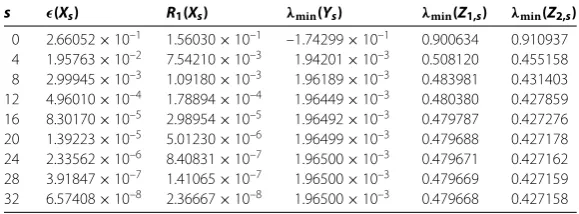
andR(X) = .×–,λmin(Y) = .,λmin(Z,) = .,λmin(Z,) = ..
The other results are listed in Table .
Example . Consider the matrix equation
X–A∗X–A–A∗X–A–A∗X–A–A∗X–A=I, (.)
whereA,A,A, andAare given by
A=
⎛ ⎜ ⎝
. –. .
–. . .
. . .
⎞ ⎟
⎠, A=
⎛ ⎜ ⎝
. –. .
. .
. –. .
⎞ ⎟ ⎠,
A=
⎛ ⎜ ⎝
–. . .
–. . .
. –. –.
⎞ ⎟
⎠, A=
⎛ ⎜ ⎝
. .
. . .
. –. –.
⎞ ⎟ ⎠.
We use Algorithm . to solve (.). After iterations, we get the positive definite solu-tion
X≈X=
⎛ ⎜ ⎝
. . –.
. . .
–. . .
⎞ ⎟ ⎠
andR(X) = .×–, λmin(I+i=A∗iAi–X) = .,λmin(X–I) = ..
Table 3 Error analysis for Example 4.3
s (Xs) R1(Xs) λmin(Ys) λmin(Z1,s) λmin(Z2,s)
0 2.66052×10⁻¹ 1.56030×10⁻¹ –1.74299×10⁻¹ 0.900634 0.910937
4 1.95763×10⁻² 7.54210×10⁻³ 1.94201×10⁻³ 0.508120 0.455158
8 2.99945×10⁻³ 1.09180×10⁻³ 1.96189×10⁻³ 0.483981 0.431403
12 4.96010×10⁻⁴ 1.78894×10⁻⁴ 1.96449×10⁻³ 0.480380 0.427859
[image:16.595.161.434.244.342.2]16 8.30170×10⁻⁵ 2.98954×10⁻⁵ 1.96492×10⁻³ 0.479787 0.427276 20 1.39223×10⁻⁵ 5.01230×10⁻⁶ 1.96499×10⁻³ 0.479688 0.427178 24 2.33562×10⁻⁶ 8.40831×10⁻⁷ 1.96500×10⁻³ 0.479671 0.427162 28 3.91847×10⁻⁷ 1.41065×10⁻⁷ 1.96500×10⁻³ 0.479669 0.427159 32 6.57408×10⁻⁸ 2.36667×10⁻⁸ 1.96500×10⁻³ 0.479668 0.427158
Table 4 Error analysis for Example 4.4
s (Xs) R2(Xs) λmin(I +4i=1A∗iAi– Xs) λmin(Xs– I)
0 8.55046×10⁻¹ 2.65 0.715946 0
10 1.83959×10⁻¹ 3.26477×10⁻¹ 0.544118 0.076489
20 1.06950×10⁻² 1.87085×10⁻² 0.493691 0.098958
30 5.94976×10⁻⁴ 1.04066×10⁻³ 0.490594 0.100375
40 3.30916×10⁻⁵ 5.78794×10⁻⁵ 0.490422 0.100455
50 1.84048×10⁻⁶ 3.21913×10⁻⁶ 0.490412 0.100459
60 1.02364×10⁻⁷ 1.79042×10⁻⁷ 0.490411 0.100459
70 5.69327×10⁻⁹ 9.95792×10⁻⁹ 0.490411 0.100459
Example . Consider the matrix equation
X–A∗X–A–A∗X–A–A∗X–A=I, (.)
whereA,A, andAare given by
A=
⎛ ⎜ ⎜ ⎜ ⎝
. –. .
. . .
. . . .
. –. . .
⎞ ⎟ ⎟ ⎟
⎠, A=
⎛ ⎜ ⎜ ⎜ ⎝
–. . .
. . .
. –. . .
. . .
⎞ ⎟ ⎟ ⎟ ⎠,
A=
⎛ ⎜ ⎜ ⎜ ⎝
–. . . .
–. . –.
–. –.
. –. . .
⎞ ⎟ ⎟ ⎟ ⎠.
We use Algorithm . to solve (.). After iterations, we get the positive definite solution
X≈X=
⎛ ⎜ ⎜ ⎜ ⎝
. . –. .
. . –. .
–. –. . .
. . . .
⎞ ⎟ ⎟ ⎟ ⎠
andR(X) = .×–,λmin(I+
i=A∗iAi–X) = .,λmin(X –I) = ..
Table 5 Error analysis for Example 4.5
s (Xs) R2(Xs) λmin(I +3i=1A∗iAi– Xs) λmin(Xs– I)
0 2.10332×10⁻¹ 2.95400×10⁻¹ 0.047059 0
3 3.11244×10⁻² 4.52684×10⁻² 0.017503 0.028153
6 5.17330×10⁻³ 8.36352×10⁻³ 0.023078 0.023109
9 1.10730×10⁻³ 1.75717×10⁻³ 0.022155 0.023907
12 2.28175×10⁻⁴ 3.63481×10⁻⁴ 0.022341 0.023751 15 4.73953×10⁻⁵ 7.54424×10⁻⁵ 0.022303 0.023783 18 9.83002×10⁻⁶ 1.56497×10⁻⁵ 0.022311 0.023776 21 2.03950×10⁻⁶ 3.24685×10⁻⁶ 0.022309 0.023778 24 4.23122×10⁻⁷ 6.73607×10⁻⁷ 0.022310 0.023777
27 8.77834×10⁻⁸ 1.39750×10⁻⁷ 0.022310 0.023777
[image:17.595.159.433.259.388.2]30 1.82120×10⁻⁸ 2.89934×10⁻⁸ 0.022310 0.023777
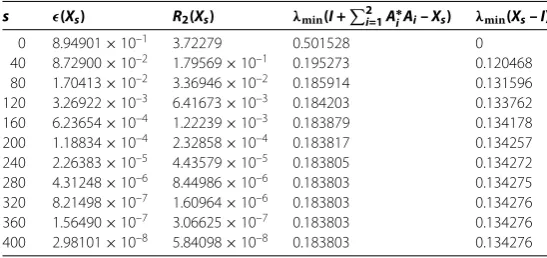
Table 6 Error analysis for Example 4.6
s (Xs) R2(Xs) λmin(I +2i=1A∗iAi– Xs) λmin(Xs– I)
0 8.94901×10⁻¹ 3.72279 0.501528 0
40 8.72900×10⁻² 1.79569×10⁻¹ 0.195273 0.120468
80 1.70413×10⁻² 3.36946×10⁻² 0.185914 0.131596
120 3.26922×10⁻³ 6.41673×10⁻³ 0.184203 0.133762
160 6.23654×10⁻⁴ 1.22239×10⁻³ 0.183879 0.134178
200 1.18834×10⁻⁴ 2.32858×10⁻⁴ 0.183817 0.134257
240 2.26383×10⁻⁵ 4.43579×10⁻⁵ 0.183805 0.134272
280 4.31248×10⁻⁶ 8.44986×10⁻⁶ 0.183803 0.134275
320 8.21498×10⁻⁷ 1.60964×10⁻⁶ 0.183803 0.134276 360 1.56490×10⁻⁷ 3.06625×10⁻⁷ 0.183803 0.134276 400 2.98101×10⁻⁸ 5.84098×10⁻⁸ 0.183803 0.134276
Example . Consider the matrix equation
X–A∗X–A–A∗X–A=I, (.)
whereAandAare given as in Example . from []:
A=
⎛ ⎜ ⎝
. . .
. . .
. . .
⎞ ⎟ ⎠,
A=
⎛ ⎜ ⎝
. . .
. . .
. . .
⎞ ⎟ ⎠.
We use Algorithm . to solve (.). After iterations, we get the positive definite so-lution
X≈X=
⎛ ⎜ ⎝
. . .
. . .
. . .
⎞ ⎟ ⎠
andR(X) = .×–,λmin(I+i=A∗iAi–X) = .,λmin(X–I) = ..
5 Conclusion
In this paper, we investigate the nonlinear matrix equationsX±mi=A∗iX–niA
i=I, where
ni,i= , , . . . ,m, are positive integers. Necessary and sufficient conditions for the existence
of positive definite solutions are derived. Iterative algorithms are proposed to compute the positive definite solutions of these equations. Moreover, some numerical examples are given to illustrate the effectiveness and rapidly convergence rate (small run time) of the proposed iterative algorithms (see values of(Xs),R(Xs), andR(Xs)). Also, the values
ofλminshow that the solutions of the matrix equations satisfy the necessary conditions.
Competing interests
The author declares to have no competing interests.
Acknowledgements
The author is grateful to the editor and the reviewer for important comments and suggestions, which improved the quality of the paper.
Received: 15 February 2015 Accepted: 15 April 2015
References
1. Anderson, WN, Morley, TD, Trapp, GE: Positive solutions toX=A–BX–1B∗. Linear Algebra Appl.134, 53-62 (1990)
2. Engwerda, JC: On the existence of a positive definite solution of the matrix equationX+ATX–1A=I. Linear Algebra
Appl.194, 91-108 (1993)
3. Ferrante, A, Levy, BC: Hermitian solutions of the equationX=Q+NX–1N∗. Linear Algebra Appl.247, 359-373 (1996)
4. Zhan, X: Computing the extremal positive definite solutions of a matrix equation. SIAM J. Sci. Comput.17, 1167-1174 (1996)
5. He, YM, Long, JH: On the Hermitian positive definite solution of the nonlinear matrix equationX+mi=1A∗iX–1A
i=I. Appl. Math. Comput.216, 3480-3485 (2010)
6. Duan, X, Wang, Q, Liao, A: On the matrix equationX–mi=1N∗iX–1N
i=Iarising in an interpolation problem. Linear Multilinear Algebra61, 1192-1205 (2013)
7. Sakhnovich, LA: Interpolation Theory and Its Applications. Mathematics and Its Applications. Kluwer Academic, Dordrecht (1997)
8. Cheng, M, Xu, S: Perturbation analysis of the Hermitian positive definite solution of the matrix equation
X–A∗X–2A=I. Linear Algebra Appl.394, 39-51 (2005)
9. Duan, X, Li, C, Liao, A: Solutions and perturbation analysis for the nonlinear matrix equationX+mi=1A∗iX–1Ai=I. Appl. Math. Comput.218, 4458-4466 (2011)
10. El-Sayed, SM, Al-Dubiban, AM: On positive definite solutions of the nonlinear matrix equationX+A∗X–nA=I. Appl. Math. Comput.151, 533-541 (2004)
11. Hasanov, VI: Notes on two perturbation estimates of the extreme solutions to the equationsX±A∗X–1A=Q. Appl.
Math. Comput.216, 1355-1362 (2010)
12. Ivanov, IG: On positive definite solutions of the family of matrix equationsX+A∗X–nA=Q. J. Comput. Appl. Math.
193, 277-301 (2006)
13. Lin, WW, Xu, SF: Convergence analysis of structure-preserving doubling algorithms for Riccati-type matrix equations. SIAM J. Matrix Anal. Appl.28, 26-39 (2006)
14. Chiang, CY, Chu, EKW, Guo, CH, Huang, TM, Lin, WW, Xu, SF: Convergence analysis of the doubling algorithm for several nonlinear matrix equations in the critical case. SIAM J. Matrix Anal. Appl.31, 227-247 (2009)
15. Ivanov, IG, Hasanov, VI, Minchev, BV: On matrix equationsX±A∗X–2A=I. Linear Algebra Appl.326, 27-44 (2001)
16. El-Sayed, SM: Two iteration processes for computing positive definite solutions of the equationX–A∗X–nA=Q. Comput. Math. Appl.41, 579-588 (2001)
17. El-Sayed, SM, Ran, ACM: On an iterative method for solving a class of nonlinear matrix equations. SIAM J. Matrix Anal. Appl.23, 632-645 (2001)
18. Hasanov, VI, Ivanov, IG: Solutions and perturbation estimates for the matrix equationsX±A∗X–nA=Q. Appl. Math. Comput.156, 513-525 (2004)
19. Hasanov, VI: Positive definite solutions of the matrix equationsX±A∗X–qA=Q. Linear Algebra Appl.404, 166-182 (2005)
20. Duan, XF, Wang, QW, Li, CM: Perturbation analysis for the positive definite solution of the nonlinear matrix equation
X–mi=1A∗iXδiAi=Q. J. Appl. Math. Inform.30, 655-663 (2012)
21. Liu, XG, Gao, H: On the positive definite solutions of the matrix equationsXs±ATX–tA=In. Linear Algebra Appl.368, 83-97 (2003)
22. Long, JH, Hu, XY, Zhang, L: Improved Newton’s method with exact linear searches to solve quadratic matrix equation. J. Comput. Appl. Math.222, 645-654 (2008)
23. Yao, G, Liao, A, Duan, X: Positive definite solution of the matrix equationX=Q+AH(I⊗X–C)–δA∗. Electron. J. Linear
Algebra21, 76-84 (2010)
24. Ivanov, IG, El-Sayed, SM: Properties of positive definite solutions of the equationX+A∗X–2A=I. Linear Algebra Appl. 279, 303-316 (1998)