R E S E A R C H A R T I C L E
Open Access
Reliability of the Multidimensional Pain Inventory
and stability of the MPI classification system in
chronic back pain
Martin L Verra
1,2,3*, Felix Angst
2, J Bart Staal
4, Roberto Brioschi
2, Susanne Lehmann
2, André Aeschlimann
2and Rob A de Bie
3Abstract
Background:This cross validation study examined the reliability of the Multidimensional Pain Inventory (MPI) and the stability of the Multidimensional Pain Inventory Classification System of the empirically derived subgroup classification obtained by cluster analysis in chronic musculoskeletal pain. Reliability of the German Multidimensional Pain Inventory was only examined once in the past in a small sample. Previous international studies mainly
involving fibromyalgia patients showed that retest resulted in 33–38% of patients being assigned to a different Multidimensional Pain Inventory subgroup classification.
Methods:Participants were 204 persons with chronic musculoskeletal pain (82% chronic non-specific back pain). Subgroup classification was conducted by cluster analysis at 4 weeks before entry (=test) and at entry into the pain management program (=retest) using Multidimensional Pain Inventory scale scores. No therapeutic interventions in this period were conducted. Reliability was quantified by intraclass correlation coefficients (ICC) and stability by kappa coefficients (κ).
Results:Reliability of the Multidimensional Pain Inventory scales was least with ICC = 0.57 for the scale life control and further ranged from ICC = 0.72 (negative mood) to 0.87 (solicitous responses) in the other scales. At retest, 82% of the patients in the Multidimensional Pain Inventory cluster interpersonally distressed (κ= 0.69), 80% of the adaptive copers (κ= 0.58), and 75% of the dysfunctional patients (κ= 0.70) did not change classification. In total, 22% of the patients changed Multidimensional Pain Inventory cluster group, mainly into the adaptive
copers subgroup.
Conclusion:Test-retest reliability of the German Multidimensional Pain Inventory was moderate to good and comparable to other language versions. Multidimensional Pain Inventory subgroup classification is substantially stable in chronic back pain patients when compared to other diagnostic groups and other examiner-based subgroup Classification Systems. The MPI Classification System can be recommended for reliable and stable specification of subgroups in observational and interventional studies in patients with chronic musculoskeletal pain.
Keywords:Reliability, Back pain, Cluster, Subgroup, MPI, Classification
* Correspondence:[email protected]
1Department of Physiotherapy, Inselspital, Bern University Hospital, 3010
Bern, Switzerland
2Rehabilitation clinic“RehaClinic”, 5330 Bad Zurzach, Switzerland
Full list of author information is available at the end of the article
Background
The search for homogeneous subgroups of patients with nonspecific low back pain who respond best to subgroup-specific pain management interventions has been on the international research agenda for over 15 years [1]. The process of developing treatment-based subgroups can be divided into 3 stages: 1) hypo-thesis generation; proposal of potential effect modifiers; 2) hypothesis testing; testing of the potential effect modi-fiers; 3) replication; assessing generalizability [2]. Sev-eral physiotherapy-based classification systems for low back pain have been developed [3,4]. So far, most sub-grouping approaches have been based on unproven theories, are poorly validated or remain, as yet, unre-plicated in other studies [5]. Besides biological factors of low back pain and spinal movement or mechanical loading strategies, especially in chronic pain syndromes psychosocial factors are also likely to modify treatment response. As such, investigation of effect modifiers from the full biopsychosocial spectrum seems the most likely way to identify clinically important sub-groups [6].
The Multidimensional Pain Inventory is a self-report instrument assessing not only pain intensity and pain interference, but also the way people cope with pain, it measures support as well as potential reinforcement of pain behaviors by the patient’s significant other, and peo-ples’ general activity level. The Multidimensional Pain Inventory has been translated into several languages and validated in various settings for several diagnostic pain groups [7,8]. The reliability of the German version of the Multidimensional Pain Inventory has been tested in a relatively small sample by only one research group for over 20 years [9]. An approach based on cluster analysis of the mean scores of the scales of the Multidimensional Pain Inventory yielded three unique profiles or sub-groups for patients with chronic pain [10]. So far, two research groups assessed test-retest stability of the MPI Classification System [11-13]. In their samples of patients with low back pain and fibromyalgia up to one third of the patients changed Multidimensional Pain In-ventory classification at retest. The authors concluded that for a sizeable number of chronic pain patients, Multidimensional Pain Inventory subgroup classifica-tions may not be stable and need to be reconsidered [11,13].
The main aim of the present study was to re-examine the test-retest stability of the MPI Taxonomy Classifica-tion in patients with persistent musculoskeletal pain. The secondary objective focussed on the elaboration of additional evidence concerning internal consistency of items within scales and test-retest reliability at scale level of the German version of the Multidimensional Pain Inventory.
Methods
Setting and participants
The study was conducted at the rehabilitation clinic
“RehaClinic” (locations Bad Zurzach and Braunwald, Switzerland), which is attended by severely disabled patients suffering from persistent musculoskeletal pain. The patients were assessed prior to participating in the
“Zurzach Interdisciplinary Pain Program” - ZISP. The program is a 4-week in-house, standardized, interdiscip-linary pain management program. All subjects were con-secutively admitted and included in the study and 1) suffered either from chronic non-specific back pain (i.e. lumbar, thoracic, or pan-vertebral pain syndrome with-out serious spinal pathology or nerve root pain) or suf-fered from fibromyalgia according to the original American College of Rheumatology criteria, 2) had pain for at least 6 months and 3) were disabled by their pain enough to warrant admission to an intensive inpatient pain management program [14,15]. Further inclusion criteria were 4) ability to complete self-assessment ques-tionnaires, 5) understand the German language, 6) no psycho-intellectual inabilities, and 7) provision of writ-ten, signed informed consent. Exclusion criteria were 1) severe somatic illness requiring specific treatment such as cancer, inflammatory rheumatic disease, neurological disease, and pain after a recent operation, 2) manifest psychiatric disorder such as dementia, psychosis, suicid-ality, and 3) failed inclusion criteria.
The study design is a cohort study with 4 weeks follow-up. The study protocol was approved by the Local Ethic Commission (Health Department in Aarau, Switzerland, no. EK AG 2008/026). All participants gave written informed consent according to the Declaration of Helsinki.
Outcome measures
as the original US version: pain severity, interference due to pain, life control, affective distress (synonymously described as negative mood), support, punishing responses, solicitous responses, distracting responses, so-cial and recreational activities, household chores, and ac-tivities away from home [18]. The last three subscales can be summarized into one subscale of general activities. Cronbach’s alpha reliability coefficients vary between α= 0.63–0.93, and test-retest reliability scores ranged from rp= 0.46–0.93 [9]. Comparing 5 assessment instruments for chronic pain, the Multidimensional Pain Inventory was most responsive in all comparable domains [19].
An approach based on cluster analysis of the mean scores of the scales of the Multidimensional Pain Inven-tory yielded three unique profiles or subgroups for patients with chronic pain. The Multidimensional Pain Inventory differentiates between three subgroups la-belled as adaptive copers, dysfunctional, and interper-sonally distressed [10]. The interperinterper-sonally distressed cluster is mainly characterized by lower levels of per-ceived solicitous and distraction responses from the patients’partners or spouses and higher levels of punish-ing responses compared to the adaptive copers and dys-functional clusters. The adaptive copers cluster, compared with the other two subgroups, is characterized by less pain severity, less interference with everyday life due to pain and less affective distress, more perception of life control and higher activity level. The persons of the dysfunctional cluster report high pain severity, high interference and activity distress, low life control, and low activity level.
Statistical analysis
The Multidimensional Pain Inventory was assessed 4 weeks before entry to the clinic and at entry to the clinic (pre-treatment). No therapeutic interventions took place in this period. This time interval is 1) sufficiently short that we can assume that the underlying process of chronic musculoskeletal pain is unlikely to have chan-ged, and 2) sufficiently long that we can assume that the patients did not memorize their item responses of the first occasion.
The internal consistency of the Multidimensional Pain Inventory was assessed by using Cronbach’s alpha, a statistic used to calculate the strength of the association between the individual items within the scale. The alpha coefficient examines inter-item corre-lations and therefore relates to its homogeneity. Be-cause a Cronbach’s alpha≥0.90 might suggest a high level of item redundancy, ideally Cronbach’s alpha should be above 0.70, but probably not higher than 0.90 [20].
Test-retest reliability of the Multidimensional Pain In-ventory scales was determined by intraclass correlation
coefficients (ICC). The intraclass correlation coefficient measures the consistency and degree of correspondence of the test and retest responses pairwise for each item and each patient for the whole sample and ranges from 0.00 (no consistency) to 1.00 (perfect consistency). Al-though the intraclass correlation coefficient is primarily designed for use with interval or ratio data, the intraclass correlation coefficient can be applied without distortion of the data on the ordinal scale of the Multidimensional Pain Inventory when intervals between such measure-ments are assumed to be equivalent [21]. For compar-ability with other studies test-retest relicompar-ability of the Multidimensional Pain Inventory scales was also deter-mined by Pearson correlation coefficients: 0.00 means no correlation and 1.00 means perfect correlation.
According to Turk and colleagues, the empirically derived subgroups were defined by confirmatory cluster analysis using a predefined three cluster solution [10]. The Multidimensional Pain Inventory score patterns of this study were depicted as graphs of the mean Multidi-mensional Pain Inventory baseline scale scores and com-pared to the patterns described by Turk and colleagues and our previous studies on this topic using the rank orders of the three subgroups within one Multidimen-sional Pain Inventory subscale [22,23].
The test-retest stability of the Multidimensional Pain Inventory clusters was determined by percent of agree-ment and kappa coefficients. The kappa statistic is a chance-corrected measure of percent agreement for or-dinal or nominal scales [24]. It is a useful method for summarizing observer consistency (inter- or intertester reliability) and provides valuable information on the stability of classification procedures used in musculo-skeletal practice, for example. The following standards for strength of agreement for the Kappa coefficient have been proposed: <0 = poor, 0.00–0.20 = slight, 0.21– 0.40 = fair, 0.41–0.60 = moderate, 0.61–0.80 = substantial and 0.81–1.00 = almost perfect [25].
All analyses were performed using the statistical software package SPSS 20.0 for WindowsW (SPSS Inc., Chicago, IL, USA).
Results
Participants at baseline
Internal consistency and test-retest reliability of the MPI scales
[image:4.595.58.291.110.364.2]Cronbach’s alpha was measured for 7 out of 9 Multidi-mensional Pain Inventory scales with scores between 0.76 and 0.86 and so reflects a good association between the individual items within their scales. The internal consistency of the items within the scales negative mood and distracting responses was smaller (0.60, and 0.69, resp.). Test-retest reliability, measured at an average 4-week time interval, for the mean Multidimensional Pain Inventory scale scores was very good with scores be-tween ICC = 0.72 and 0.87. Only the score for the MPI scale life control (ICC = 0.57) was less favourable (Table 2).
Classification and test-retest stability of patients in the Multidimensional Pain Inventory subgroups
All 204 patients could be allocated by cluster analysis into one of the three predefined chronic pain subgroups at both time points. The Multidimensional Pain Inven-tory scores differed significantly between the three clus-ters: the patients in the dysfunctional cluster showed highest scores for pain severity, interference due to pain, and negative mood and lowest scores for general activ-ities. In accordance with the predefined profile of the empirically derived MPI Classification System, the clus-ter inclus-terpersonally distressed showed lowest scores for support, solicitous and distracting responses by their partner or spouses, and the highest score for negative/ punishing responses by their partner or spouses. Com-pared to the other two subgroups, the adaptive copers showed best scores for life control, negative mood, and general activities (Table 3).
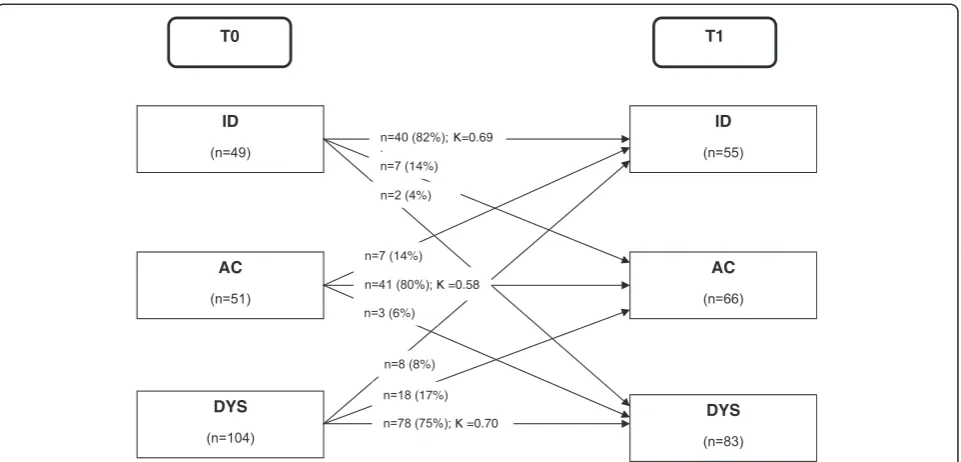
At retest after 4 weeks, 82% of the patients in the Multidimensional Pain Inventory cluster interpersonally distressed (κ= 0.69), 80% of the adaptive copers (κ= 0.58), and 75% of the dysfunctional patients (κ= 0.70) did not change classification profile (Figure 1). Over the whole sample, 159 patients (78%) had a stable MPI subgroup classification. But, 22% of the patients (n = 45) did change Multidimensional Pain In-ventory cluster group at retest. Most of the retest clas-sification changes occurred in the subgroup adaptive copers: 18 dysfunctional patients (17%) and 7 interper-sonally distressed patients (14%) were classified as adaptive copers at retest. Least retest classification changes took place in the dysfunctional subgroup (4% of interpersonally distressed patients and 6% of the adaptive copers).
Discussion
[image:4.595.57.539.577.716.2]In this study, we were able to provide additional evi-dence about the clinimetrical properties of the
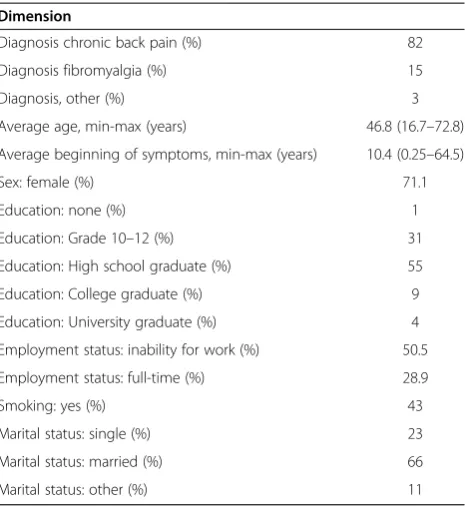
Table 1 Demographic characteristics of the sample (n = 204)
Dimension
Diagnosis chronic back pain (%) 82
Diagnosis fibromyalgia (%) 15
Diagnosis, other (%) 3
Average age, min-max (years) 46.8 (16.7–72.8)
Average beginning of symptoms, min-max (years) 10.4 (0.25–64.5)
Sex: female (%) 71.1
Education: none (%) 1
Education: Grade 10–12 (%) 31
Education: High school graduate (%) 55
Education: College graduate (%) 9
Education: University graduate (%) 4
Employment status: inability for work (%) 50.5
Employment status: full-time (%) 28.9
Smoking: yes (%) 43
Marital status: single (%) 23
Marital status: married (%) 66
Marital status: other (%) 11
Table 2 Test-retest reliability of mean MPI scale scores and Internal consistency of the items at scale level for all subjects (n = 204)
MPI subscales T0 (m,s) T1 (m,s) ICC (95% CI) CA (95% CI)
Pain severity (100 = most) 76.1 (16.5) 73.9 (16.0) 0.77 (0.70–0.82) 0.81 (0.77–0.86)
Interference (100 = worst) 74.7 (15.9) 72.5 (16.1) 0.82 (0.77–0.86) 0.83 (0.76–0.86)
Life control (100 = best) 49.4 (22.1) 50.2 (21.4) 0.57 (0.47–0.66) 0.76 (0.69–0.81)
Negative mood (100 = worst) 61.0 (19.6) 58.4 (22.1) 0.72 (0.65–0.78) 0.60 (0.49–0.69)
Support (100 = most) 69.4 (24.8) 69.0) 26.2) 0.85 (0.80–0.88) 0.82 (0.77–0.86)
Negative responses (100 = most) 25.6 (26.1) 24.3 (24.4) 0.75 (0.69–0.81) 0.86 (0.82–0.89)
Solicitous responses (100 = best) 58.3 (25.0) 58.6 (25.0) 0.87 (0.83–0.90) 0.81 (0.76–0.85)
Distracting responses (100 = best) 53.6 (25.3) 55.3 (24.8) 0.77 (0.71–0.82) 0.69 (0.61–0.76)
General activity (100 = most) 34.5 (13.7) 35.1 (13.4) 0.86 (0.82–0.90) 0.82 (0.78–0.86)
Multidimensional Pain Inventory. Testing it in 204 patients with chronic musculoskeletal pain – mainly chronic nonspecific back pain–demonstrated that test-retest reliability at scale level of the German version of the Multidimensional Pain Inventory was moderate to good and comparable to other language versions. The Multidimensional Pain Inventory Classification System – classifying patients into predefined subgroups labelled as adaptive copers, dysfunctional, and interper-sonally distressed–is substantially stable.
Reliability of scales compared to other versions
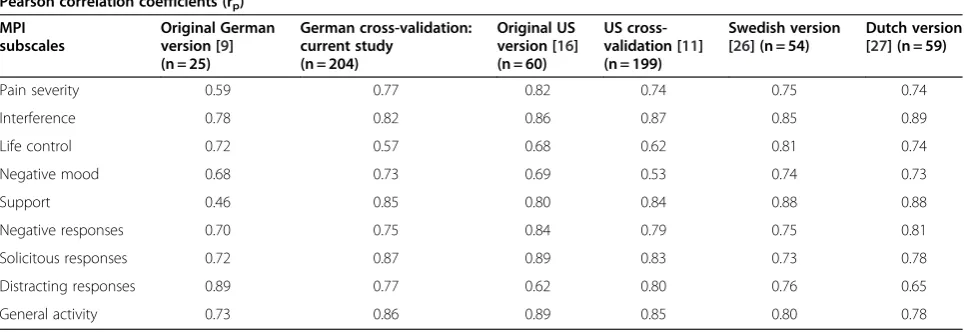
In a sample of 185 patients (60% chronic low back pain) Flor and colleagues measured an internal consistency score for the scale general activities of α= 0.63 [9]. In our sample we found for the same scale the superior score of α= 0.82. Test-retest reliability at an average 4-week time interval of the mean Multidimensional Pain Inventory scores at scale level yielded correlation
coefficients between rp= 0.73 and 0.87, making it on average better than the original German version and comparable with the original US version and several other language versions (Table 4). For this benchmark, the test-retest correlation coefficient for life control in our sample (rp= 0.57) was lower.
Interpretation of MPI classification changes
[image:5.595.57.539.112.264.2]Most of the retest classification changes occurred in the subgroup adaptive copers: 17% of the dysfunctional patients and 14% of the interpersonally distressed patients were at retest classified in the less disabled sub-group of adaptive copers (Figure 1). This change in the subjective pain experience of the patients in this sample occurred within a 4-week period, although no thera-peutic interventions took place. We hypothesize that an-ticipation of paran-ticipation in a pain management program might have a positive effect on the mental health of the patients (improvement of locus of control,
Table 3 Mean scores and standard deviations of the scales of the Multidimensional Pain Inventory clusters at 4 weeks before and at entry to a pain program
MPI scales MPI clusters at T0 (m,s) MPI clusters at T1 (m,s)
ID n = 49 AC n = 51 DYS n = 104 ID n = 55 AC n = 66 DYS n = 83
Pain severity (100 = most) 75.9 (15.1) 63.0 (17.0) 82.6 (12.7) 76.4 (12.1) 59.5 (15.2) 83.6 (9.4)
Interference (100 = worst) 77.2 (13.0) 58.9 (16.4) 81.3 (10.9) 76.6 (11.7) 57.5 (15.2) 81.7 (9.7)
Life control (100 = best) 42.2 (17.6) 65.2 18.2) 45.1 (22.2) 42.7 (19.2) 63.7 (17.0) 44.4 (20.9)
Negative mood (100 = worst) 66.3 (13.6) 39.8 (17.3) 68.9 (15.0) 67.3 (14.9) 38.0 (17.3) 68.8 (18.0)
Support (100 = most) 44.0 (23.5) 61.9 (19.7) 85.0 (13.7) 41.6 (24.0) 66.9 (18.5) 88.7 (12.0)
Negative, punishing responses (100 = most) 34.4 (29.1) 11.0 (13.8) 28.6 (26.5) 33.0 (29.2) 13.9 (15.3) 26.9 (24.1)
Solicitous responses (100 = best) 33.3 (17.1) 47.5 (20.0) 75.5 (15.2) 34.5 (16.7) 53.0 (19.0) 79.0 (15.5)
Distracting responses (100 = best) 30.5 (18.7) 43.0 (21.2) 69.7 (17.6) 33.7 (20.5) 50.5 (19.4) 73.5 (16.9)
General activity (100 = most) 34.1 (12.0) 38.1 (12.1) 33.0 (14.9) 37.5 (11.6) 38.2 (12.5) 30.9 (14.3)
MPI: Multidimensional Pain Inventory, ID: MPI cluster interpersonally distressed, AC: MPI cluster adaptive copers, DYS: MPI cluster dysfunctional, T0: 4 weeks before entry to pain management program, T1: at entry to pain management program, m: mean, s: standard deviation.
Table 4 Comparison of different versions of the Multidimensional Pain Inventory concerning test-retest reliability of scales
Pearson correlation coefficients (rp) MPI
subscales
Original German version [9] (n = 25)
German cross-validation: current study
(n = 204)
Original US version [16] (n = 60)
US cross-validation [11] (n = 199)
Swedish version [26] (n = 54)
Dutch version [27] (n = 59)
Pain severity 0.59 0.77 0.82 0.74 0.75 0.74
Interference 0.78 0.82 0.86 0.87 0.85 0.89
Life control 0.72 0.57 0.68 0.62 0.81 0.74
Negative mood 0.68 0.73 0.69 0.53 0.74 0.73
Support 0.46 0.85 0.80 0.84 0.88 0.88
Negative responses 0.70 0.75 0.84 0.79 0.75 0.81
Solicitous responses 0.72 0.87 0.89 0.83 0.73 0.78
Distracting responses 0.89 0.77 0.62 0.80 0.76 0.65
[image:5.595.57.540.568.734.2]reduction of anxiety and depression), and so explains why a substantial number of dysfunctional and interper-sonally distressed patients change at retest into the more favorable adaptive copers cluster.
Stability of MPI Classification System compared to other research samples
This study partly challenges the results of three other studies assessing the test-retest stability of the MPI Classification System [11-13]. In the two samples of fibromyalgia up to one third of the patients changed Multidimensional Pain Inventory classification at retest (Table 5). These authors concluded that for a sizeable number of chronic pain patients, Multidimensional
Pain Inventory classifications may not be stable and need to be reconsidered [11,13]. Our data on test-retest stability in patients with predominantly chronic back pain suggest that the MPI Classification System is according the definition of the kappa values of 0.58-0.70 substantially stable: only 22% of patients with pre-dominantly chronic back pain who completed the Multidimensional Pain Inventory and who had been classified into one of the empirically derived subgroups altered their responses sufficiently to be classified into a different pain coping style after a four week time interval without therapeutic interventions. Our results are in line with the score changes of 28% of the pre-dominantly low back pain patients in the study by Junghaenel & Broderick [12]. Further studies are needed to replicate these results in other musculoskel-etal pain disorders. So far, the German version of the Multidimensional Pain Inventory can be recommended for reliable and stable classification of subgroups of patients with chronic back pain in observational stud-ies and randomized controlled trials.
Comparison of MPI classification system with other back pain classification systems
The Treatment Based Classification developed by Delitto and colleagues and the O’Sullivan Classification System are validated physiotherapy movement-based classifica-tion approaches to low back pain [28,29]. In these classi-fications, analysis of mainly mechanical spinal loading strategies and modified spinal movement strategies
ID
DYS AC
DYS AC
ID
T0 T1
=0.69 )
=0.70 =0.58 14%
4%
14%
6%
8%
[image:6.595.59.540.88.319.2]17%
Figure 1Multidimensional Pain Inventory subgroup classification changes T0: 4 weeks before entry to pain management program, T1: at entry to pain management program, MPI: Multidimensional Pain Inventory, ID: MPI cluster interpersonally distressed, AC: MPI cluster adaptive copers, DYS: MPI cluster dysfunctional, K: Cohen's Kappa coefficient.
Table 5 Comparison of this sample with prior research samples investigating Multidimensional Pain Inventory subgroup stability
Authors Number of patients
Main diagnosis
Average time between test-retest
Percentage of unstable patients at retest
Current study n = 204 Chronic back pain (82%)
28 days 22%
Junghaenel & Broderick [12]
n = 99 Low back pain (84%)
14 days 28%
McKillop & Nielsen [13]
n = 376 Fibromyalgia (100%)
56 days 33%
Broderick et al [11]
n = 199 Fibromyalgia (100%)
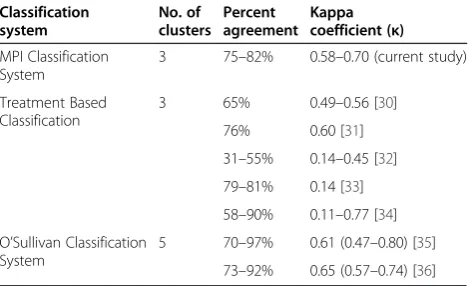
[image:6.595.57.291.601.733.2]determines subgrouping. In accordance with the MPI Classification System, both classifications also assess cer-tain psychosocial aspects (fear-avoidance behavior, and/ or maladaptive pain behavior). Comparison of percent agreement scores (75–82%) and kappa coefficients (0.58– 0.70) for test-retest stability of the MPI Classification System reveals scores that are at least as good as the cor-responding scores of the widely accepted Treatment Based Classification and the O’Sullivan Classification System (31–97% agreement,κ= 0.11–0.80) (Table 6).
Strengths and limitations of this study
The present study has several strengths: a large sample size, no missing data, and the use of a valid assessment tool implemented worldwide. On the other hand, a limi-tation of the study was that the patient sample was somewhat heterogeneous with 82% chronic nonspecific back pain, 15% fibromyalgia and 3% other medical diag-noses. This is a possible source of variance that may complicate the analysis, but the reliability and stability analyses compared scores for the same patient, a proced-ure which is not affected by the heterogeneity of the sample.
Conclusions
The reliability of the German Multidimensional Pain In-ventory was moderate to good and comparable to other language versions. Multidimensional Pain Inventory sub-group classification is substantially stable in chronic back pain patients when compared to other diagnostic groups and other examiner-based subgroup classification systems. The MPI Classification System can be recom-mended for reliable and stable specification of subgroups in observational and interventional studies.
Abbreviations
MPI: Multidimensional Pain Inventory; CA: Cronbach’s alpha reliability coefficient; 95%CI: 95% confidence interval; m: Mean scale score; s: Standard
deviation; ICC: Intraclass correlation coefficient; n: Number of patients; T0: 4 weeks before entry to pain management program; T1: At entry to pain management program; ID: Multidimensional Pain Inventory cluster interpersonally distressed; AC: Multidimensional Pain Inventory cluster adaptive copers; DYS: Multidimensional Pain Inventory cluster dysfunctional.
Competing interests
The authors declare that they have no competing interests.
Authors’contributions
MLV, FA, JBS, AA and RAB were responsible for the design of the study. AA procured funding. SL, RB and MLV collected the data. Statistical analysis was performed by FA and MLV. MLV and FA interpreted the data and made a first draft of the manuscript. All authors have read and approved the final manuscript.
Acknowledgements
We gratefully thank all patients for their participation in the study and Joy Buchanan for her English editing. We appreciate Jeff McKillop for his statistical advice and data control. This study was supported by the Zurzach Rehabilitation Foundation SPA, Bad Zurzach, Switzerland.
Author details
1Department of Physiotherapy, Inselspital, Bern University Hospital, 3010
Bern, Switzerland.2Rehabilitation clinic“RehaClinic”, 5330 Bad Zurzach,
Switzerland.3Department of Epidemiology and Caphri Research School, Maastricht University, Maastricht, The Netherlands.4Scientific Institute for
Quality of Healthcare, Radboud University Medical Centre, Nijmegen, The Netherlands.
Received: 17 May 2012 Accepted: 16 August 2012 Published: 24 August 2012
References
1. Borkan JM, Cherkin DC:An agenda for primary care research on low back pain.Spine1996,21(24):2880–2884.
2. Kamper SJ, Maher CG, Hancock MJ, Koes BW, Croft PR, Hay E: Treatment-based subgroups of low back pain: a guide to appraisal of research studies and a summary of current evidence.Best Pract Res Clin Rheumatol
2010,24:181–191.
3. Karayannis NV, Jull GA, Hodges PW:Physiotherapy movement based classification approaches to low back pain: comparison of subgroups through review and developer/expert survey.BMC Muscoskel Disord2012, 13:24.
4. Hill JC, Dunn KM, Lewis M, Mullis R, Main CJ, Foster NE, Hay EM:A primary care back pain screening tool: identifying patient subgroups for initial treatment.Arthritis Rheum2008,59(5):632–641.
5. Foster NE, Hill JC, Hay EM:Subgrouping patients with back pain in primary care: Are we getting any better at it?Man Ther2011,16:3–8. 6. Hancock MJ, Maher CG, Laslett M, Hay E, Koes B:Discussion paper: what
happened to the“bio”in the bio-psycho-social model of low back pain?
Eur Spine J2011,20:2105–2110.
7. Turk DC:The potential of treatment matching for subgroups of patients with chronic pain: lumping versus splitting.Clin J Pain2005,21(1):44–55. discussion 69–72.
8. Flor H, Turk DC:Identifying patient subgroups and matching patients with treatments. InChronic pain - an integrated biobehavioral approach. Seattle: IASP Press; 2011:289–317.
9. Flor H, Rudy T, Birbaumer N, Streit B, Schugens M:The applicability of the West Haven-Yale multidimensional pain inventory in German-speaking countries. Data on the reliability and Validity of the MPI-D.Der Schmerz
1990,4:82–87.
10. Turk DC, Rudy TE:Toward an empirically derived taxonomy of chronic pain patients: integration of psychological assessment data.J Consult Clin Psychol1988,56(2):233–238.
11. Broderick JE, Junghaenel DU, Turk DC:Stability of patient adaptation classifications on the multidimensional pain inventory.Pain2004, 109(1–2):94–102.
[image:7.595.57.292.123.266.2]12. Junghaenel DU, Broderick JE:Validation of the MPI patient profiles by partner and healthcare providers.Pain2009,144:130–138.
Table 6 Chance-corrected measures of agreement of different back pain classification systems comprising psychosocial aspects
Classification system
No. of clusters
Percent agreement
Kappa coefficient (κ)
MPI Classification System
3 75–82% 0.58–0.70 (current study)
Treatment Based Classification
3 65% 0.49–0.56 [30]
76% 0.60 [31]
31–55% 0.14–0.45 [32]
79–81% 0.14 [33]
58–90% 0.11–0.77 [34]
O’Sullivan Classification System
5 70–97% 0.61 (0.47–0.80) [35]
73–92% 0.65 (0.57–0.74) [36]
13. McKillop JM, Nielson WR:Improving the usefulness of the
Multidimensional Pain Inventory.Pain Res Manage2011,16(4):239–244. 14. Airaksinen O, Brox JI, Cedraschi C, Hildebrandt J, Klaber-Moffett J, Kovacs F,
Mannion AF, Reis S, Staal JB, Ursin H, Zanoli G, COST B13 Working Group on Guidelines for Chronic Low Back Pain:Chapter 4. European guidelines for the management of chronic nonspecific low back pain.Eur Spine J2006, 15(Suppl 2):S192–S300.
15. Wolfe F, Smythe HA, Yunus MB, Bennett RM, Bombardier C, Goldenberg DL, Tugwell P, Campbell SP, Abeles M, Clark P, Fam AG, Farber SJ, Fiechtner JJ, Franklin CM, Gatter RA, Hamaty D, Lessard J, Lichtbroun AS, Masi AT, McCain AG, Reynolds WJ, Romano TJ, Russel IJ, Sheon RP:The American College of Rheumatology 1990 Criteria for the Classification of Fibromyalgia. Report of the Multicenter Criteria Committee.Arthritis Rheum1990,33(2):160–172. 16. Kerns RD, Turk DC, Rudy TE:The West Haven-Yale Multidimensional Pain
Inventory (WHYMPI).Pain1985,23(4):345–356.
17. Dworkin RH, Turk DC, Farrar JT, Haythornthwaite JA, Jensen MP, Katz NP, Kerns RD, Stucki G, Allen RR, Bellamy N, Carr DB, Chandler J, Cowan P, Dionne R, Galer BS, Hertz S, Jadad AR, Kramer LD, Manning DC, Martin S, McCormick CG, McDermott MP, McGrath P, Quessy S, Rappaport BA, Robbins W, Robinson JP, Rothman M, Royal MA, Simon L, Stauffer JW, Stein W, Tollett J, Wernicke J, Witter J:Core outcome measures for chronic pain trials: IMMPACT recommendations.Pain2005,113:9–19.
18. Flor F:Anhang 15.1. West Haven-Yale Multidimensionaler Schmerzfragebogen (MPI-D). InPsychobiologie des Schmerzes. Bern Göttingen Toronto: Verlag Hans Huber; 1991:267–273.
19. Angst F, Verra ML, Lehmann S, Aeschlimann A:Responsiveness of four condition-specific and generic otcome assessment instruments for chronic pain.BMC Med Res Methodol2008,8(1):26.
20. Streiner DL, Norman GR:Homogeniety of the items. InHealth measurement scales. A practical guide to their development and use. Fourth editionth edition. Oxford University press; 2008:91.
21. Tinsley HE, Weiss DJ:Interrater reliability and agreement of subjective judgements.J Counsel Psychol1975,22(4):358–376.
22. Verra ML, Angst F, Brioschi R, Lehmann S, Keefe FJ, Staal JB, de Bie RA, Aeschlimann A:Does classification of persons with fibromyalgia into Multidimensional Pain Inventory (MPI) subgroups detect differences in outcome from a standard chronic pain program?Pain Res Manage2009, 14(6):445–453.
23. Verra ML, Angst F, Staal JB, Brioschi R, Lehmann S, Aeschlimann A, de Bie RA:Differences in pain, function and coping in Multidimensional Pain Inventory subgroups of chronic back pain: a one-group pretest-posttest study.BMC Musculoskeletal Disorders2011,12:145.
24. Cohen JA:A coefficient of agreement for nominal scales.Educ Psychol Meas.1960,20:37–46.
25. Landis JR, Koch GG:The measurement of observer agreement for categorical data.Biometrics1977,33:159–174.
26. Bergstrom G, Bodin L, Jensen IB, Linton SJ, Nygren AL:Long-term, non-specific spinal pain: reliable and valid subgroups of patients.
Behav Res Ther2001,39(1):75–87.
27. Lousberg R, Van Breukelen GJP, Groenman NH, Schmidt AJM, Arntz A, Winter FAM:Psychometric properties of the Multidimensional Pain Inventory, Dutch language version (MPI-DLV).Behav Res Ther1999, 37:167–182.
28. Delitto A, Erhard RE, Bowling RW, DeRosa CP, Greathouse DG:A treatment-based classification approach to low back syndrome: identifying and staging patients for conservative treatment.Phys Ther1995,75:470–489. 29. O’Sullivan:Diagnosis and classification of chronic low back pain
disorders: Maladaptive movement and motor control impairments as underlying mechanism.Man Ther2005,10:242–255.
30. Fritz JM, George S:The use of a classification approach to identify subgroups of patients with acute low back pain: interrater reliability and short-term treatment outcomes.Spine2000,25:106–114.
31. Fritz JM, Brennan GP, Clifford SN, Hunter SJ, Thackeray A:An examination of the reliability of a classification algorithm for subgrouping patients with low back pain.Spine2006,31(1):77–82.
32. Heiss DG, Fitch DS, Fritz JM, Sanchez WJ, Roberts KE, Buford JA:The interraterreliability among physical therapists newly trained in a classification system for acute low back pain.J Orthop Sports Phys Ther
2004,34:430–439.
33. Henry SM, Fritz J, Trombley AL, Bunn JY:Reliability of the treatment based classification system for subgrouping people with low back pain.
J Orthop Sports Phys Ther2009,39:A87–A88.
34. Widerstrom B, Olofsson N, Arvidsson I, Harms-Ringdahl K, Evers Larsson U: Inter-examiner reliability of a proposed decision-making treatment based classification system for low back pain patients.Man Ther2012, 17:164–171.
35. Dankaerts W, O’Sullivan PB, Straker LM, Burnett AF, Skouen JS:The inter-examiner reliability of a classification method for non-specific chronic low back pain patients with motor control impairment.Man Ther2006, 11:28–39.
36. Vibe Fersum K, O’Sullivan PB, Kvale A, Skouen JS:Inter-examiner reliability of a classification system for patients with non-specific low back pain.
Man Ther2009,14:555–561.
doi:10.1186/1471-2474-13-155
Cite this article as:Verraet al.:Reliability of the Multidimensional Pain Inventory and stability of the MPI classification system in chronic back pain.BMC Musculoskeletal Disorders201213:155.
Submit your next manuscript to BioMed Central and take full advantage of:
• Convenient online submission
• Thorough peer review
• No space constraints or color figure charges
• Immediate publication on acceptance
• Inclusion in PubMed, CAS, Scopus and Google Scholar
• Research which is freely available for redistribution