BUSINESS MODEL EVOLUTION AND TRADE POLICY IMPLICATION
(Study of IT Industry)
Syeedun Nisa,
Assistant Professor
Department of Management, Jamia Hamdard.
Dr N Ravichandran,
HOD, Department of Management, Jamia Hamdard.
ABSTRACT
Business models of companies have evolved over a period of time. A business model is dynamic
and is prone to changes due to changes in the external and internal environment in which
business is conducted. One of the important factors that compel companies to restructure their
business model is trade policy. Trade policy is a collection of rules and regulations which
pertain to trade. The purpose of trade policy is to help nations to run their trade more smoothly,
by setting clear standards and goals which can be understood by potential trading partners.
Governments, indeed, have a key role to play in establishing the infrastructure or framework of a
country, be it in the fields of intellectual property protection, the protection of privacy,
competition policy, trade and investments, or labor market regulations. All these areas are
important considerations for the evolution of business model of a company. Companies most
often structure their business model as per the trade policy guidelines.
Here, we looked at various government policies over the time that influenced the companies to
restructure their business model. The research paper discusses the journey of business models of
the three IT companies since their inception and role of government policies in changing the
business structure. (Refer Table 1 for profile of the select companies)
Wipro Infosys IBM Description Wipro Ltd., the flagship
company of the Azim H Premji group was incorporated in the year 1945. The company started off originally as a manufacturer of vegetable ghee/vanaspati,
refined edible oils etc.
Gradually the company has diversified into IT sector.
Infosys was started in 1981 by seven
people with US$
250. Today, it is
global leader in
consulting,
technology and
outsourcing with
revenues of US$
7.126 billion (LTM Q2 FY13).
IBM is a global
technology and
innovation company.
With operations in over 170 countries, IBMers around the world invent and integrate hardware, software and services. IBM has been present in India since 1992.
Products and Services
Business consulting,
technology, engineering and outsourcing services
Business consulting, technology,
engineering and
outsourcing services
research, consulting,
solutions, services,
systems and software
Revenue $6.9.billion Rs 2,316 crores $106.9 billion
Vision attaining leadership in the areas of business, customer and people
To help our clients
meet their goals
through our people,
services and
solutions.
“to create a smart planet”
Strategy Growth (concentric) – vertical as well as horizontal.
Growth (concentric) – vertical as well as horizontal
Concentration strategy – vertical as well as horizontal
Description of Model
Wipro‟s Factory Model brought
together the governance,
architectural expertise, and
delivery capability and aimed to
accelerate development and
management within a large
corporate application
development environment by
using principles of
componentization, much like assembly in a factory.
Infosys collaborative distributed delivery model focuses on
social contract,
resource intensity
and green
innovation.
IBM‟s Global Delivery
Model focuses on
[image:2.612.68.545.92.626.2]onsite, offsite onshore and offshore resources.
Introduction
When discussing the role of policy with regard to the Sustainable Business Models, it becomes
obvious, through the relevant literature, that it plays a significant role in supporting and
enhancing green innovation, green growth and the development of a green economy (Bisgaard et
al., 2012; Henriksen et al., 2012:A; FORA, 2009; OECD, 2009; OECD, 2011:A, B). This paper
will attempt to provide evidence for this claim, by presenting the function of policy and policy
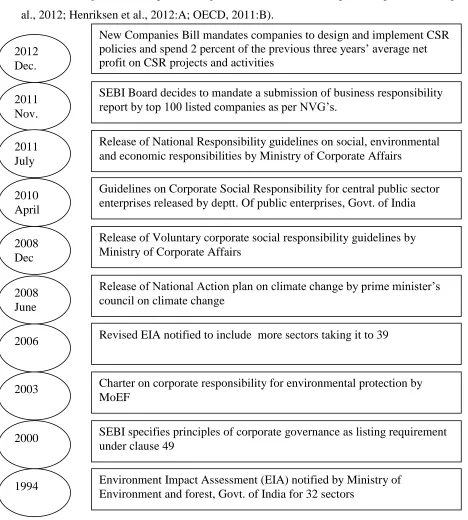
makers in sustainable business, as well as shaping the generic Business Model. (Refer figure 1
for policy and legislative initiatives in India regarding sustainability business practices).
The Function of Policy and Policy Makers in ‘Sustainable’ Business
'Sustainable development' means development that meets the needs of the present without
compromising the ability of the future generations to meet their own needs. (Agarwal, 2005).
The OECD (2009) explicitly states, “Like general innovation, eco-innovation needs government
interventions that set the right framework conditions and provide enough support for successful
research and business development” (pp. 182). It is only through such support that green growth
can be achieved and SBM frameworks can be further developed, as “innovation benefits from
having stable and predictable policy signals” (OECD, 2011). (Bisgaard et al., 2012)
More specifically, policy makers must be in a position to assess whether new sustainable
innovations are to be left to the market or whether policies are needed to support them, and in
that case, what these policies should look like. The reason for policy creation and intervention
with the emerging innovations can be due to market failure in the case of a commercialization,
which in turn can lead to under-investments in eco-innovation, green growth and development of
SBM. (Bisgaard et al., 2012; Henriksen et al., 2012:A, FORA, 2009, OECD, 2011:B). However,
policy makers are not to interfere with the methods used by firms to reach their green targets.
Instead, they are there to set goals and allocate resources that can be used by organizations in
their pursuit of green transition. More than this, constant monitoring and evaluation of any
implemented policies to assure their effectiveness and efficiency, while gaining benefits from
In an increasingly globalised society, the challenge becomes even greater for policy makers, as
national policies can rarely stand alone, but instead will have to intertwine with policies in other
nations and regions, and implement regulations that are as widespread as possible. (Bisgaard et
[image:4.612.51.519.142.662.2]al., 2012; Henriksen et al., 2012:A; OECD, 2011:B).
Figure 1: Policy and Legislative Initiatives in India
Environment Impact Assessment (EIA) notified by Ministry of Environment and forest, Govt. of India for 32 sectors
New Companies Bill mandates companies to design and implement CSR policies and spend 2 percent of the previous three years‟ average net profit on CSR projects and activities
SEBI Board decides to mandate a submission of business responsibility report by top 100 listed companies as per NVG‟s.
Release of National Responsibility guidelines on social, environmental and economic responsibilities by Ministry of Corporate Affairs
Guidelines on Corporate Social Responsibility for central public sector enterprises released by deptt. Of public enterprises, Govt. of India
Release of Voluntary corporate social responsibility guidelines by Ministry of Corporate Affairs
Release of National Action plan on climate change by prime minister‟s council on climate change
SEBI specifies principles of corporate governance as listing requirement under clause 49
Revised EIA notified to include more sectors taking it to 39
Charter on corporate responsibility for environmental protection by MoEF
2012 Dec.
2011 Nov.
2011 July
1994 2010 April
2008 Dec
2008 June
2006
2003
Source: GIZ, 2012
POLICY ENVIRONMENT – INFORMATION TECHNOLOGY
The Government of India visualized the importance of electronics and information technology
(IT) and its critical role in the economic growth of the country, and as a result, established the
Department of Electronics (DOE) in June, 1970 and the Electronics Commission in February,
1991. The objectives of the Department were to review the field of electronics with regards to
research, development and industrial operations, to formulate policy in the field of electronics
and IT and to direct implementation of all measures, both promotional and regulatory, to attain
self-reliance.
In 1975, the Government of India strategically decided to take effective steps for the
development of information systems and utilization of information resources, and also for
introducing computer-based decision support system in government ministries and departments
to facilitate planning and programme implementation to further the growth of economic and
social development (Informatics-led development). In view of its relevance for all round
socio-economic growth, and also to get benefit of the emerging digital economy, the Central
Government has created a new Ministry of Information Technology (MIT) in 1999 by merging
the DOE, National Informatics Centre (NIC) and Electronics and Software Export Promotion
Council.
The 1970s saw the Policies of self-reliance and promotion of an indigenous IT industry in India.
The idea that import of technology could accelerate national development in the field of
electronics and computer, had gained support in the Policies/Statements of the Central
Government announced between 1978 to1984. Many State/Central Electronics Corporations
were established in 1970s and 1980s to develop electronics industry in the states. Various policy
announcements like the Import Policy (1983), Computer Policy (1984), Electronic Policy (1985),
and Software Policy (1986) laid the foundations for the liberalized growth of IT industry in the
country. It was recognized that IT would become strategically as important to the Indian
Committee (1997) constituted by the Department of Administrative Reforms recommended
2-3% of the budget outlay for IT applications in Government Departments.
The National Conference on Informatics for Sustainable Agricultural Development (ISDA) 1995
recommended 3-6% of IT applications in the agricultural sector. National Task Force on
Information Technology and Software Development (1998) of the Central Government has
suggested a plan of action to make India IT super power in the World.
WIPRO
[image:6.612.22.583.274.499.2]1940 1950 1960 1970 1980 1990 2000 2010
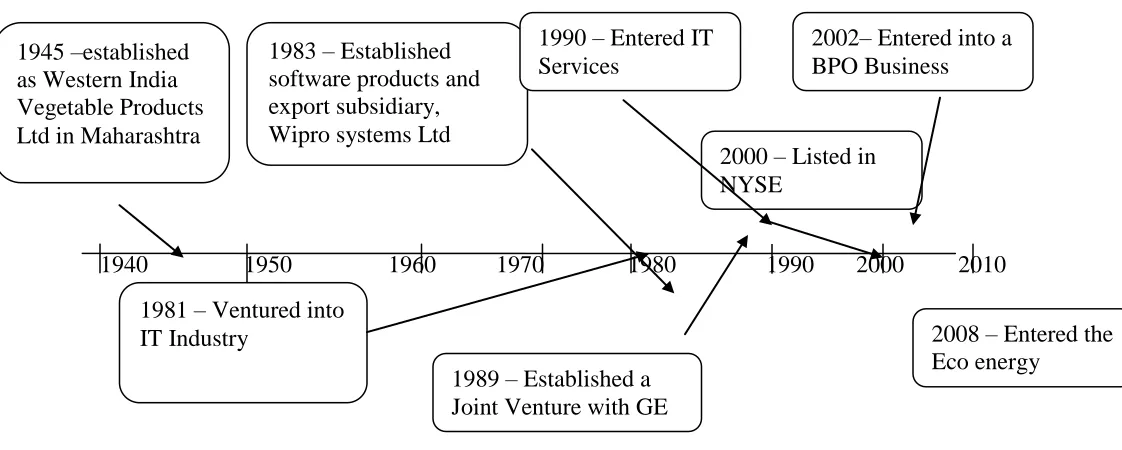
Figure 2: Time Line: Wipro About Wipro
Wipro Ltd., the flagship company of the Azim H Premji group was incorporated in the year
1945. The company started off originally as a manufacturer of vegetable ghee/vanaspati, refined
edible oils etc. Gradually the company has diversified into various other businesses. Today
Wipro provides comprehensive IT solutions and services, including systems integration,
Information Systems outsourcing, package implementation, software application development
and maintenance, and research and development services to corporations globally. 1945 –established
as Western India Vegetable Products Ltd in Maharashtra
1983 – Established software products and export subsidiary, Wipro systems Ltd
1981 – Ventured into IT Industry
1990 – Entered IT Services
1989 – Established a Joint Venture with GE
2000 – Listed in NYSE
2002– Entered into a BPO Business
2008 – Entered the Eco energy
In the Indian market, Wipro is a leader in providing IT solutions and services for the corporate
segment in India offering system integration, network integration, software solutions and IT
services. Wipro also has profitable presence in niche market segments of consumer products and
lighting. In the Asia Pacific and Middle East markets, Wipro provides IT solutions and services
for global corporations. Wipro's ADSs are listed on the New York Stock Exchange, and its
equity shares are listed in India on the Stock Exchange - Mumbai, and the National Stock
Exchange, among others. Wipro is the leading strategic IT partner for companies across India,
the Middle East and Asia-Pacific - offering integrated IT solutions.
Different divisions of the company:
Wipro Technologies - Wipro Technologies is the global IT services business division of Wipro
Limited. With over 20 offices around the world, Wipro Technologies is the No.1 provider of
integrated business, technology and process solutions on a global delivery platform.
Wipro Infotech- Wipro Infotech is the leading strategic IT partner for companies across India, the
Middle East and Asia-Pacific - offering integrated IT solutions. We plan, deploy, sustain and
maintain your IT lifecycle through our total outsourcing, consulting services, business solutions
and professional services.
Wipro Consumer Care and Lighting- Wipro Consumer Care and Lighting, a business unit of
Wipro Limited, has a profitable presence in the branded retail market of toilet soaps, hair care
soaps, baby care products and lighting products. It is also a leader in institutional lighting in
specified segments like software, pharma and retail.
Wipro Infrastructure Engineering - Wipro Infrastructure Engineering was Wipro Limited‟s first
diversification in 1975, which addressed the hydraulic equipment requirements of mobile
original equipment manufacturers in India. Over the past 25 years, the Wipro Infrastructure
Engineering business unit has become a leader in the Hydraulic Cylinders and Truck Tipping
Systems markets in India, and intends growing its business to serve the global manufacturing
Wipro GE Medical Systems - Wipro GE Medical Systems is a joint venture between Wipro and
General Electric Company. As a part of GE Medical Systems South Asia, it caters to customer
and patient needs with a commitment to uncompromising quality. Wipro GE is Indias largest
exporter of medical systems, with unmatched distribution and service reach in South Asia. Wipro
GE pioneered the manufacture of Ultrasound and Computed Tomography systems in India and is
a supplier for all GE Medical Systems products and services in South Asia.
Phase Period Business model Corporate Strategy Policy framework Sustainability attributes Phase 1
1945 – 70
Establishment of Wipro and focus
on FMCG
Sector
Concentration strategy – vertical
as well as
horizontal
Govt. policy
conducive for
Indian businesses
Demand driven
model, local
capital
Phase 2
1970 – 90
Diversification into technology domain
Greenfield venture
IBM left Indian IT sector
Demand driven
model, local
capital Phase
3
1990 – 00 Business expansion Expansion strategy Liberalization of Indian Economy
Demand driven
model, local
capital Phase
4
2000 onwards
Factory Model Large-scale
outsourced management servicing multiple
geographical or
business divisions
Information Technology Act,
2000 (and
subsequent amendments)
Demand driven
model, local
[image:8.612.68.547.224.493.2]capital, Sustainability reporting, Stakeholders concern
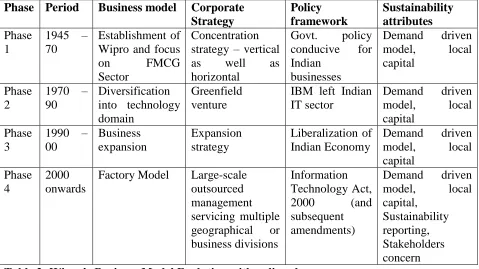
Table 2: Wipro’s Business Model Evolution with policy changes Evolution of Wipro Buisness Model
Phase 1: Establishment of Wipro and focus on FMCG Sector
When Wipro ltd had been taken over by Mr. Azim Premji, he analyzed the economic
environment and found the opportunities for the expansion and diversification in various
industries. Even when it was under his father‟s administration he took that into a consumer
market segment, where he had seen an opportunity to tap the consumer goods market, which was
opportunity seen by them was the boom of infrastructure industry in mid – 1970‟s. The growth
of country has its one of the bases as infrastructure development which should be in both private
and government sectors. They foresee it in a better way and decided to enter in to a market where
they could achieve the top level, which was engineering and manufacturing of hydraulic and
pneumatic cylinders. This provides solutions by hydraulic and pneumatic cylinders, truck tipping
systems for the trucks and heavy industry machines and for army tanks and vehicles.
The sustainability components present during this phase were – Demand driven and Local
capital. Since Wipro is a private company, therefore, it is involved in lot of research and
development and introduction of innovative products in market. At the same time, it is also
involved in local sustainability initiatives like community development, environment protection,
shareholders engagement etc. Wipro also keeps local shareholders. Two of its major shareholders
are LIC of India and Land T Infrastructure pvt. Ltd.
Phase 2: Diversification into technology domain
At that time Indian economy was state-controlled and the state remained hostile to the software
industry through the 1970s. Import tariffs were high and software was not considered as a
separate industry, so that exporters were considered as ineligible for bank loans. In 1977, after
IBM left Indian IT sector, Wipro entered into the market. It started developing its own
computers. Within a couple of years, Wipro Ltd. started selling finished products. It licensed
technology from Sentinel Computers in U.S. Wipro is also the manufacturer of India's first mini
computers.
Government policy towards IT Sector changed in 1984. The Government has played a vital role
in the development of the India Software Industry. In 1986, the Indian government announced a
new software policy which was designed to serve as a catalyst for the software industry. This
was followed in 1988 with the World Market Policy and the establishment of the Software
Technology Parks of India (STP) scheme. Package of reduced import tariffs on hardware and
software (reduced to 60%). Government started giving Package of reduced import tariffs on
eligible for bank finance. This encouraged our Indian domestic players like Infosys, Wipro and
TCS to concentrate in software industry very actively. The trend of growth rate of Indias
economy demonstrates an upward trend. During the period of 1960 to 1980 the economy saw a
growth rate of 3.5% due to the roles of major industries in India GDP. In the years from1980 to
1990 the growth rate showed a marked improvement of 5.4%.
The sustainability attributes remains same in this phase, which are, demand driven model and
local capital.
Phase 3: Business Expansion
When the liberalization took place, India‟s Information technology had a huge advantage over it.
Then onwards the boom started and the big players like Wipro started being stable enough to
survive in the industry. Liberalization gave them the opportunity to go global and to get their
investment to expand their businesses in various sub sectors like BPO and KPO and consulting.
Those companies were already into the industry, quickly utilized the opportunity, others were
struggling to come up.
The sustainability attributes remains same in this phase also, which are, demand driven model
and local capital.
Phase 4: Factory Model
The start of 21st century till 2008 the economic conditions were really good for this industry.
The time line shows the consistent innovativeness of Wipro ltd throughout its journey. Wipro ltd
was very quick to react for governmental or legal environmental changes. Those immediate
responses helped it to build and grow its businesses to extreme level in several industries, in
which they achieved and continuing in top players list.
One of the prime examples of Wipro‟s success in thought leadership was the rollout of the Factory Model. The „Factory Model‟ had evolved from Wipro‟s Innovation council and was
quality improvements are driven through standardization of processes. It was based on the
principles of the Toyota production system and "lean" manufacturing. Wipro‟s Factory Model
brought together the governance, architectural expertise, and delivery capability and aimed to
accelerate development and management within a large corporate application development
environment by using principles of componentization, much like assembly in a factory. The
Factory Model was most suitable when Wipro undertook program management and large-scale
outsourced management of application development, especially where Wipro serviced multiple
geographical or business divisions of the same client. It was founded on a common demand
management process, centralized architecture and engineering services, core processes of
software development driven through enterprise-wide standards, and a framework of a shared
development, testing and deployment environment.
The sustainability attributes during this phase were demand driven model, local capital,
sustainability reporting and stakeholders concern. Wipro started sustainability reporting from
2007 and since then every year it comes up with the sustainability report. Wipro is also top 100
BSE/NSE listed company and therefore, it is made compulsory recently in 2013 by the SEBI to
produce sustainability report. In its sustainability report itself Wipro has shown how the
company is environmentally, economically and socially responsible and is giving due concern to
its shareholders and other stakeholders.
INFOSYS
1980 1985 1990 1995 2000 2005 2010
1981 - Led by N Murthy, 7 people started a small company in pune with US$ 250
1983 – With the MICO engagement Infosys moved
1987 – Opened its first international sales office in Boston
1992 – Infosys went public
1989 – Infosys touched the US $ 100 million mark and was listed on the NASDAQ
Fig 3: Timeline Infosys . About Infosys
Infosys was started in Pune, India, in 1981 by Narayana Murthy, along with seven software
professionals who were earlier working for Patni Computers. The total capital that the founders
put together was just 10,000 Indian Rupees. From the beginning, the company relied on foreign
projects. In 1983, Infosys developed its first onsite project in Databasics Corporation, US.
Infosys, initially provided onsite service to its global clients. This being an expensive
proposition, the company decided to complete projects at its Indian offshore development
centers and then implement them at the clients' places. This was also a challenge as there was
no service provider at the clients' locations, causing a deterrent to the progress of projects.
Besides, miscommunication added to the delay of project completion. To serve its clients
effectively and in time, Infosys decided to open proximity centers close to the clients' locations.
In the late 1990s, due to stiff competition from IBM, Wipro and TCS, Infosys decided to adopt
the Global Delivery Model (GDM).
Infosys found that IBM, Accenture, TCS and Wipro had also adapted GDM. Industry observers
felt that GDM was a standardized IT model but had no competitive advantage. To combat
competition and to differentiate itself from other Global IT giants, Infosys started working on
GDM 2.0 and called it the "Collaborative Distributed Delivery Model" (CDDM).
To implement the new GDM, Infosys had to set up more offshore development centers around
the globe. To succeed in its efforts Infosys decided to acquire companies around the globe.
According to Mr Murthy (CEO, Infosys), the term „offshore‟ somehow assumes that the work is
entirely done in India. Infosys‟s vision is sourcing capital from where it is cheapest, sourcing
talent from where it is best available, producing where it is most cost effective and selling where
While the GDM makes use of talent and infrastructure-including on-shore, near-shore and
off-shore locations in various parts of the world, the collaborative model involve distribution of
various aspects of a project based on the competencies of each center, thereby improving and
speeding the delivery process.
Phase Period Business model
Corporate Strategy
Policy framework Sustainability attributes
Phase 1
1980 – 90 Onsite delivery model Horizontal growth Self-reliant macroeconomic development policy
with heavy
emphasis on import substitution
Demand driven
model, local capital, shareholders
concern
Phase 2
1990 – 00
Global Delivery Model
Growth (concentric) -
Vertical as
well as
horizontal
Liberalization of
Indian Economy
Demand driven
model, local capital, shareholders concern Phase 3 2000 onwards Collaborative Distributed Delivery Model Growth (concentric) –
vertical as
well as
horizontal
New economic
policy, Information
Technology Act,
2000 (and
subsequent amendments)
Demand driven
model, local capital, shareholders concern, sustainability reporting, stakeholders concern
Table 3: Infosys business model evolution with policy changes Evolution of Infosys Business Model
Phase 1: Onsite Delivery Model
In the 1980‟s the company was established by N. R. Narayana Murthy and six engineers in Pune,
India with initial capital of US $ 250. The socialist economy prevailed at that time; the country
was not opened for private investment. However, there were preparations for opening up of
economy. N R Narayan Murthy acknowledges that several private banks refused to fund the
setting up of Infosys, and it was the Public Sector financial institution that came forward and
local entrepreneurs in the initial stages of a high technology industry.
With these as the humble beginnings, the Indian IT industry witnessed the Indian
Government policies becoming more favorable in late 1980s, representative industry
associations getting formed (one of which eventually became NASSCOM) and the IT training
and education level gradually becoming strong enough for creating a full-fledged industry.
In 1983, Infosys developed its first onsite project in Databasics Corporation, US. Infosys sent a
team of engineers to the client's place to develop the required software for the project; the
hardware was provided by the client. Till the completion of the project, these professionals
worked in interaction with Databasics and after completion, supported the company in the
maintenance of the developed projects as and when required.
The sustainability attributes during this phase were demand driven model, local capital and
shareholders concern. Since Infosys is a private company it gives prime importance to market
forces. Thus market demand decides what is to be produced and in what quantity it is to be
produced. Infosys, being and Indian company, keeps local shareholders and invests in local
sustainability activities.
Phase 2: Introduction of Global Delivery Model
In the early 1990‟s India‟s rapid deregulation and the rise of internet opened the door for global delivery model. During the 1990‟s with revenue growing rapidly, Infosys could easily have
focused on preservation. But the Murthy was intent on challenging the biggest companies in the
IT service Industry, including IBM and Accenture. Policy reforms in 1991 allowed foreign
investments which enabled significant growth and development in IT industry. From just
programming and documentation work, India started implementation, R&D, out sourcing and
diversified itself to hidden depths of IT industry in order to become a global hub for software and
IT enabled services. The Infosys most demanding clients were frustrated by having to work
simultaneously with multiple services firms, each lacking full accountability. The company
hypothetical company would provide a management consulting team that would redesign
operations and write specifications for new IT systems. That same company would then develop,
test, install and maintain the new hardware and software. This implied a dramatical industry
transformation. If multiple clients move towards end-to-end services, former partners would
become rivals. The industry would have room for only handful of large players. Infosys intended
to be one among them and to use its mastery over Global Delivery Model to outperform rivals.
By selectively forgetting the past and focusing on future, Infosys was able to grow 25 fold. In
2000, it touches revenues of US$ 200 million.
The global delivery model combines onsite, offsite onshore and offshore resources. Its objective
is to distribute and manage engagements and resources across multiple global locations, thereby
allowing the service provider to better respond to client requirements from around the globe. The
sustainability attributes in this phase were same as previous phase (phase II) – demand driven,
local capital and shareholders concern.
Phase 3: Collaborative Distributed delivery model
Infosys has continuously focused on the Global Delivery Model in order to update and include
all the upcoming changes in the IT industry that are successful for any organization for its long
term growth and stability. In the process, Infosys has played close attention to – strategy making,
accountability and organization design. The information Technology Act, 2000 by Indian
government acts as a frame work to address legal issues and security concerns related to
computer crimes and IT protection and thus helped the companies like Infosys to consolidate
their Business. The global delivery model till early 2000 meant delivering the work out of India
for client location. The model is now evolving to include other low cost locations across the
world. To combat competition and to differentiate itself from other Global IT giants, Infosys
started working on GDM 2.0 and called it the "Collaborative Distributed Delivery Model"
(CDDM). To implement the new GDM, Infosys had to set up more offshore development
centers around the globe. To succeed in its efforts Infosys decided to acquire companies around
The sustainability attributes during this phase were demand driven model, local capital,
shareholders concern, sustainability reporting and stakeholders concern. Infosys started
sustainability reporting from 2006-07 and since then it has produced six sustainability reports.
Infosys is also top 100 BSE/NSE listed company and therefore, it is made compulsory recently in
2013 by the SEBI to produce sustainability report. In its sustainability report itself Infosys has
shown how the company is environmentally, economically and socially responsible and is giving
due concern to its shareholders and other stakeholders.
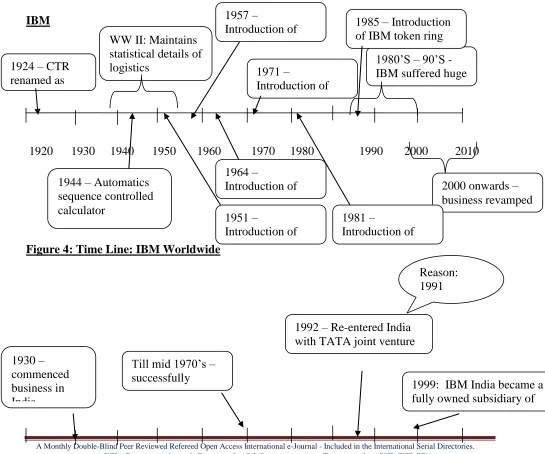
IBM
[image:16.612.46.591.264.718.2]1920 1930 1940 1950 1960 1970 1980 1990 2000 2010
Figure 4: Time Line: IBM Worldwide
1980‟S – 90‟S - IBM suffered huge loss
1985 – Introduction of IBM token ring LAN
1957 –
Introduction of FORTRAN WW II: Maintains
statistical details of
logistics 1971 –
Introduction of floppy discs 1924 – CTR
renamed as IBM
2000 onwards – business revamped 1964 –
Introduction of system/ 360 1944 – Automatics
sequence controlled calculator
1951 –
Introduction of IBM 701
1981 –
Introduction of IBM PC
Reason: 1991
Liberalizatio n
1992 – Re-entered India with TATA joint venture
Till mid 1970‟s – successfully operated 1930 –
commenced business in India
1920 1930 1940 1950 1960 1970 1980 1990 2000 2010
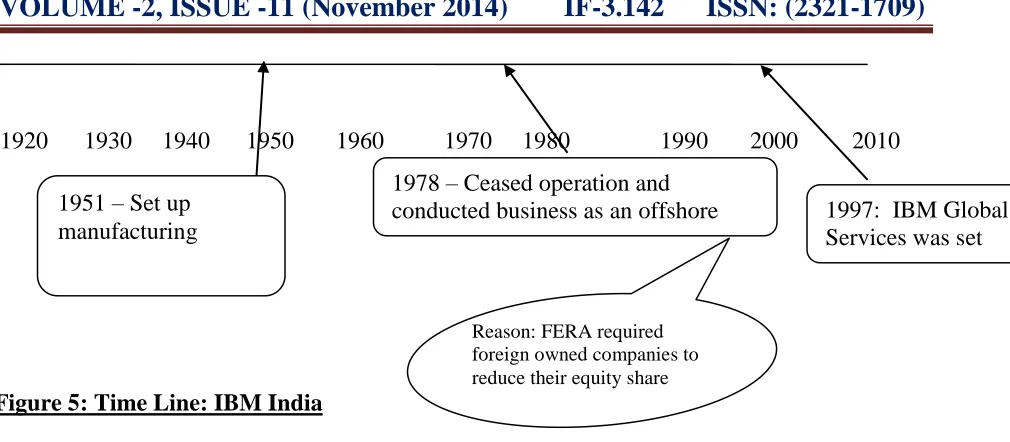
Figure 5: Time Line: IBM India About IBM
IBM commenced business in India in the 1930s and set up manufacturing there in 1951. The
business operated successfully until the mid-1970s. During 60‟s and 70‟s, India was motivated
to try to develop self-sufficiency in computers and electronics largely by national security
concerns related to border conflicts with China and Pakistan. The government created an
Electronics Committee which devised a strategy for achieving self-sufficiency in electronics
within ten years by "leapfrogging" ahead to absorb the most advanced products and technologies
available. The goal was eventually to achieve indigenization of technology, whereby India would
move away from dependence on foreign technology and produce its own. This approach not only
responded to the perceived security risks, but also fit the ideology of self-sufficiency which
drove much of India's post-independence political and economic agenda.
The main vehicle chosen to gain access to advanced computer technologies was negotiation
with multinationals, primarily IBM, which dominated the computer market in India (from
1960-1972, IBM accounted for over 70% of all computers installed in India). From 1966 to 1968, the
Indian government tried to get IBM to share equity with local capital in its Indian operations.
IBM said it would leave India before agreeing to equity sharing, and the government let the
matter drop.
In an attempt to satisfy the government's interest in developing domestic production, both IBM 1978 – Ceased operation and
conducted business as an offshore entity
1997: IBM Global Services was set up
1951 – Set up manufacturing
and British-owned ICL began to refurbish used computers in Indian plants and sell or lease
them to Indian customers. IBM felt that India should evolve technologically from one level of
sophistication to the next. However, a 1966 report by the government‟s Electronics Committee
stated that such step-by-step technological evolution should be avoided and that India should
leap ahead to the latest technologies. But at this point, the government was unable to impose its
will on IBM.
The government's inability to effectively regulate the MNCs was due partly to institutional
weaknesses in the agencies assigned the task. In 1966, responsibility for implementing the
Electronics Committee Report strategies had been given to the Department of Defense Supplies,
with monitoring by a new agency, the Electronics Committee of India. However, the committee
lacked support staff and had no authority to compel action by other agencies.
Negotiations with IBM went on through 1976 and 1977, but before they took place, two
important developments occurred. In 1975, U.S. computer maker Burroughs entered into a joint
venture with Tata Consultancy Services to export software and printers from SEEPZ. This
meant the government had two MNCs (ICL and Burroughs) in the country on its own terms,
which probably encouraged the government to take a hard line toward IBM.
Also in 1975, the Indian cabinet approved a proposal to set up the state-owned Computer
Maintenance Corporation (CMC) with a legal monopoly on the maintenance of all foreign
computer systems in the country. This reduced the advantage IBM had with users as a result of
its superior service capabilities. Now users would have to depend on CMC no matter whose
system they purchased.
With its bargaining position substantially enhanced, the government continued to demand that
IBM dilute its equity to 40% for all Indian operations. IBM responded with a proposal to share
equity in its non-computer operations, meet export goals, and fund an Indian science center and
an electronics testing facility. The government refused. After two years of negotiations, IBM
decided it could not back down on the equity issue and in 1978 it quit India altogether but still
Office.
India was liberalized in 1991, relaxing FDI norms. IBM re-entered the Indian shores in 1992
with a Tata joint-venture, named Tata Information Systems Ltd. Its business interest in India was
still focused on product sales. In 1997, IBM Global Services was set up. India Research Lab was
set up in the IIT Delhi campus in 1998. In 1999, IBM bought out Tata's stake in the company and
IBM India became a fully owned subsidiary of IBM Corporation.
Phase Period Business model
Corporate Strategy
Policy framework Sustainability attributes
Phase 1
1930 – 70
Onsite –
Onshore Business Model
Concentration
strategy –
vertical as well as horizontal
Govt. policy
conducive for
MNC‟s
Market driven model
Phase 2
1970 – 85
Offshore Business Model
Retrenchment – divestment
FERA required
foreign companies
to reduce their
equity ownership
to 26%.
Market driven model
Phase 3
1985 – 00
Hybrid Business Model
Joint venture – horizontal
growth
Liberalization of Indian Economy
Market driven model, shareholders concern Phase 4 2000 onwards Global Delivery Model Concentration
strategy –
vertical as well as horizontal
Information
Technology Act,
2000 (and
subsequent amendments)
Market driven model, shareholders
concern, sustainability reporting,
stakeholders concern.
Table5: IBM’s Business Model evolution with policy changes
Evolution of IBM’s Component Business Model with respect to Government policy
Phase 1: Onsite – Onshore Business Model
IBM commenced business in India in the 1930s and set up manufacturing there in 1951. The
business operated successfully until the mid-1970s. IBM dominated the computer market in
India, from 1960-1972, IBM accounted for over 70% of all computers installed in India. In 70‟s,
responded with a proposal to share equity in its non-computer operations, meet export goals, and
fund an Indian science center and an electronics testing facility. The government refused. After
two years of negotiations, IBM decided it could not back down on the equity issue and in 1978 it
quit India.
The sustainability attribute during this phase was market driven model. Since sustainability
issues had not gained momentum during that time private companies were more involved in
making profit and market forces decides what and how of production.
Phase 2: Offshore Business Model (1970 – 85)
During 70‟s and early 80‟s, Government emphasize on self-reliant macroeconomic development
policy with heavy emphasis on import substitution. India was motivated to try to develop
self-sufficiency in computers and electronics largely by national security concerns related to border
conflicts with China and Pakistan. The government created an Electronics Committee which
devised a strategy for achieving self-sufficiency in electronics. The goal was eventually to
achieve indigenization of technology, whereby India would move away from dependence on
foreign technology and produce its own. Private or strategic partnership was not allowed at that
time. IBM at that time, commenced business as an offshore entity through a small Liaison Office
as India‟s Foreign Exchange Regulation Act (FERA) required foreign owned companies to
reduce their equity ownership to (in IBM‟s case) 26%. Since IBM was working through offshore
business model. The physical presence of the company in country was lacking. It was supplying
the products and services according to the demand in market. Again, Market driven model was
the only sustainability attribute during this phase.
Phase 3: Hybrid Business Model (1985 – 00)
In 1985, waves of economic reforms started and finally in 1991 Indian economy liberalized.
Therefore, companies started operation by strategically partnering with other companies and
focusing more on process optimization rather business unit optimization. In early 1990s the
Finance Ministry made concerted attempts to consciously give thrust t o software exports
of entry barriers against foreign companies (b) removal of restrictions on foreign technology
transfers (c) participation of the private sector in policy making (d) provisions to finance
software development through equity and venture capital (e) measures to make available
faster and cheaper data communication facilities and (f) reduction and rationalization of
taxes, duties, tariffs.
IBM re-entered the Indian shores in 1992 with a Tata joint-venture, named Tata Information
Systems Ltd. Its business interest in India was still focused on product sales. IBM followed
Hybrid Model whereby it takes advantage of onsite and offshore services to deliver results to
clients at reduced costs. In 1997, IBM Global Services was set up. India Research Lab was set up
in the IIT Delhi campus in 1998.
The sustainability attributes during this phase were market driven model and shareholders
concern. IBM entered India during this phase, therefore, the shareholders of the business were
receiving due care and concern by the company.
Phase 4: Global Delivery Model (2000 onwards)
With more relaxation in norms and focus on expanding exports, the firms started networking
their operation industry wide, focus shifted from process optimization to enterprise optimization.
In 1999, IBM bought out Tata's stake in the company and IBM India became a fully owned
subsidiary of IBM Corporation. IBM India has established itself as one of the leaders in the
Indian IT Industry and continues to transform itself to align with global markets and geographies
to grow this leadership position. With the globalization and removal of restrictions, IBM moved
towards Global Delivery Model whereby it combines onsite, offsite onshore and offshore
resources. The objective is to distribute and manage engagements and resources across multiple
global locations, thereby allowing the service provider to better respond to client requirements
from around the globe. If disaster strikes any of the vendor's locations, it can immediately shift
work to other locations so that there is no interruption in business processes. Information
Technology Act, 2000 and subsequent amendments has provided additional focus on Information
presence in over 200 cities and towns across the country - either directly or through its strong
business partner network.
IBM started producing Sustainability report since 2002 which depicts its environment, social and
economic responsibility. The important sustainability attributes during this phase are – market
driven model, shareholders concern, stakeholders concern and sustainability reporting.
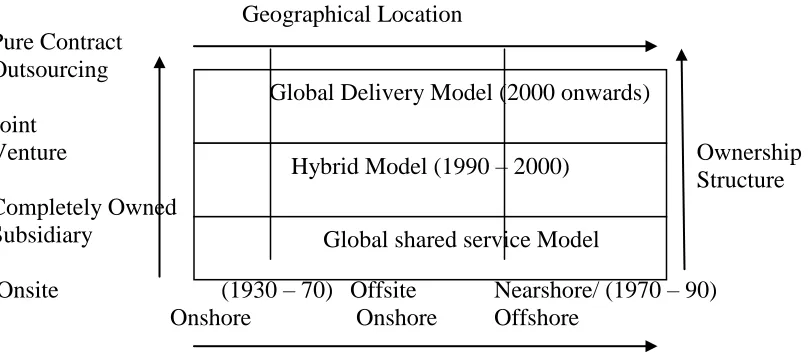
Geographical Location Pure Contract
Outsourcing
Joint
Venture Ownership
Structure Completely Owned
Subsidiary
Onsite (1930 – 70) Offsite Nearshore/ (1970 – 90)
[image:22.612.77.481.215.392.2]Onshore Onshore Offshore
Figure 6: Business Model Evolution at IBM Conclusion
Although the story of the Indian IT industry is a story of private initiative, Government policies
have played important role in shaping the information technology sector. The industry has grown
more than 30 percent annually throughout the last two decades. Recognizing the growth potential
of IT industry, the government in the 1980‟s took key policy actions to open up the sector.
Further policy reforms enacted since late 1990‟s have facilitated development of
telecommunications and other infrastructure required for offshore work. A policy change in 1998
that effectively ended a monopoly on internet service provider (ISP) gateways, allowed india‟s
private sector to offer needed bandwidth to the growing industry. Global Delivery Model (2000 onwards)
Hybrid Model (1990 – 2000)