International Research Journal of Management and Commerce
Vol. 4, Issue 3, March 2016 Impact Factor- 5.564 ISSN: (2348-9766)
© Associated Asia Research Foundation (AARF)
Website: www.aarf.asia Email : [email protected] , [email protected]
CSR ASA KEY STRATEGY TO OPTIMIZE BUSINESS PERFORMANCE OVER THE LONGER-RUN: AN EXPLORATORY FACTOR ANALYSIS
Doman GNOUFOUGOU
Université de Kara, TOGO
ABSTRACT
It is universally accepted that the only way to achieve long-term firm’s value while being a
responsible corporate citizen is to incorporate economic, ethical, social and environmental
codes of conduct into corporate strategy. Thus, this article has tried to explain how
implementing social welfare perspective in strategy management can optimize firm’s value over
the longer run. It has attempted to answer why it is important for organizations to implement
CSR practices in their strategies and to optimize corporate image, corporate reputation,
corporate financial growth and shareholder satisfaction over the longer run. The article has
employed descriptive statistics and Exploratory Factor Analysis (EFA) using Kaiser
–Mayer-Olkin (KMO) and Bartlett’s test of sphericit for data analysis using the SPSS. The
results of our research, along the line with the findings from the conceptual model confirmed
that there is a strong relationship between CSR and Business performance
Key words: CSR, Strategy, business performance, Exploratory Factor Analysis (EFA)
1. Introduction
welfare and recognize the need and importance of taking into consideration the concepts such as
ethical, social, moral, equity, social responsibility. However, corporations that contravene societal expectations harm, or even destroy its image, reputation and value among networked stakeholders. Therefore it is universally accepted that the only way to achieve long-term shareholder value while being a responsible corporate citizen is to incorporate economic, ethical, social and environmental codes of conduct into corporate strategy. While, there has always been a debate on the magnitude to which company directors and managers should consider social and environmental factors in commercial decision making, an approach to decision making that routinely encompasses these factors may be described as corporate social responsibility. By implementing CSR‟s culture, employee morale will be high and the owners earn goodwill and
respect from one and all. The youngsters will follow good examples to improve the living conditions of the public. And business is expected to create market, generate employment and produce a sufficient surplus to sustain its activities and perk up its competitiveness. Thus, every firm is so dependent on its rich heritage of governance practices that it can neither survive nor grow without full social acceptance and approval of all the constituents of social environment, obligations and responsibilities.
To shed some light on this uncertainty, the present article will be inclined to an approach centered on the topic: “CSR as a key strategy to optimize business performance over the
longer-run: An exploratory factors analysis”. It is attempted to address the gap by investigating the measurability of the effect of Corporate Social Responsibility on Business Performance. It is
sorted out how CSR‟s implementing contributed to a positive image of the company, contributed to enhance corporate reputation and to increase financial performance and stakeholder‟s satisfaction.
1.1 Research objectives
To examine the relationship between CSR and corporate image
To analyze the relationship between CSR and corporate reputation.
To determine the significance of CSR and Financial performance.
To understand the dependency of CSR expenditure on stakeholders satisfaction.
1.2 Research hypothesis
For the above purposes, this study tested four hypotheses that relate the link between corporate social responsibility (CSR) to business performance. These hypotheses are:
Ho1- Adoption of CSR positively influences the corporate image
Ho2- Adoption of CSR positively has a significant effect on corporate reputation
Ho3- Adoption of CSR would have a positive effect on their financial performance.
Ho4- Adoption of CSR would have a positive related to stakeholders Satisfaction.
2. Literature Review
2.1 Corporate Social Responsibility (CSR)
The phrase Corporate Social Responsibility (CSR) was coined in 1953 by H R Bowen (who is known as the father of corporate social responsibility) with the publication of Bowen's 'Social
Responsibility of Businessmen', which posed the question „what responsibilities to society can
business people are reasonably expected to assume?‟ (Bowen, 1953). In 1960s, Carroll extended
the definition, suggesting that beyond, legal obligations companies had certain responsibilities to
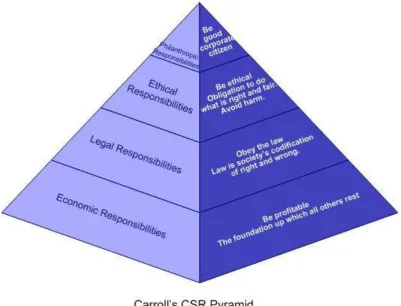
society. According to the definition of Carroll (1991), CSR mainly consists of four
Figure 1: Four responsibilities of Carroll
CSR has been defined much more in terms of a philanthropic model and has been viewed as a comprehensive set of policies, practices and programs that are integrated into business operations, supply chains, and decision-making processes throughout the company –wherever the company does business – and includes responsibility for current and past actions as well as future impacts. As time passed, the concept of CSR has undergone changes tremendously. In modern era of
In earlier times this concept has not received much support, but presently it is taken seriously by
wide sections of society. The concept of CSR came to the forefront in the late 90s and early 2000s due to gain prominence.
In present times, many corporations are undertaking diverse social activities to satisfy different types of stakeholders. Most of the corporations focus on community development activities like education, health, rural development; human resource development; environmental protection
activities; energy conservation activities; following codes of business ethics; child and labor welfare practices; support of local businesses or charities; providing equal opportunities to all; etc. Some of the benefits of being socially responsible include:
Enhanced company and brand image
By applying the concept of CSR, companies are capable of positioning themselves in the mind of consumer and in developing their brand image because today consumer gives preference to the companies that think about consumer and society.
Easier to attract and retain employees
Once a company becomes successful in positioning itself in market and develops its image as a good and established company, it becomes easy for it to attract and retain employees because today employee would like to serve the company that has good brand image.
Increased market share
When a company has good brand image, talented and dedicated employees, it can easily capture the market and its market share will increased continuously.
Easier to attract investors
Any investor who wants to invest in company can look mainly two aspects: one is company‟s image and another is its market share, and the company who follows the concept of CSR will definitely have the both aspects. So it becomes easy to attract investors.
2.2 Business Performance
Business performance was traditionally a topic that leaders of large companies paid a good deal of attention to, because it gives vital information about the state of the company, its success, development and future outlook. While the term “success” describes the positive effective overall turnout of a company´s activities, the term business performance in itself is a neutral descriptive concept for the effectiveness and the efficiency of the company´s actions in general or of certain parts or processes of the company in particular. Business performance can be characterized by attributes, for example “well” or “poor”, depending on the expectations of the individual analyzing the data he or she has chosen to examine in order to gain insight into the state the company is in at a given moment. Business Performance is of key interest for the top
management of a company. If Business Performance is weak, managers need to intervene in order to return to the path of growth. Especially in a market in which competition is increasing and globalization demands for better competitive, business leaders need to pay close attention to business performance.
Various dimensions or factors of business performance have been examined globally to explain the direct causal link between corporate social responsibility (CSR) and business performance. These factors are: corporate image, corporate reputation, financial growth, employees and stakeholders satisfaction
Corporate image
Image is an identity and is defined as reputation. Corporate image as described by Bennett and
Rentschler (2003) is an identity of a corporation that is related to value judgment, develops over a longer time span, on its consistency, dependability and credibility. A company‟s image or identity can affect its consistency and effectiveness in reaching its internal employees.
Corporate reputation
Reputation is the true reflection of a company‟s value, strategies and culture. Marken (2002) described reputation as “quality product and service, innovative capability, long term investment plan, attraction ability, retention of talent and quality management control.” Marken (2004) has
reputation as described by Fombrun (1996) is based on a set of collectively held beliefs about a company‟s ability and willingness to satisfy the interests of various stakeholders. Bromley (2002)
and Sandberg (2002) viewed reputation as a socially shared impression and a consensus about how firm will behave in any given situation.
Financial performance
Financial performance is any of many different mathematical measures to evaluate how well a company is using its resources to make a profit. It is a subjective measure of how well a firm can use assets from its primary mode of business and generate revenues. In this concept, the level of performance of a business over a specified period of time, expressed in terms of overall profits and losses during that time. Besides, evaluating the financial performance of a business allows
decision-makers to judge the results of business strategies and activities in objective monetary terms
Stakeholders satisfaction
Stakeholders are any group or any individual who can influence or can be influenced during reaching the aims of the company. Regarding their interest or share in companies, they can demand the right to be informed, consulted and to participate in making decisions. They are the people who play the roles of sponsors, clients, managers, performers, regulators and anyone else who might impact or be impacted by projects. If project management is well performed, and the stakeholders play their roles well, the stakeholders will be satisfied.
2.3 Concept of strategy
According to military science, strategy is the science and art of a general to win at war. It is an ancient technique of fighting with enemies in different terrains, territories or areas. Any technique to win a war requires planning. “Strategy,” wrote von Clausewitz (1982, p. 4), “makes the plans for the separate campaigns and regulates the combats to be fought in each.” Similar military definitions of strategy date as far back as Sun Tzu‟s The Art of War and the Greek
adoption of a course of action and the allocation of the resources necessary for carrying out these goals.” Glueck (1980) define strategy as, “A unified, comprehensive, and integrated plan
designed to assume that the basic objectives of the enterprise are achieved.” Thus we can say that strategy is long-term which requires establishing specific goals, formulation of a plan, and commitment of resources to achieve sustainable competitive advantage and superior performance.
2.4 The causal link between corporate social responsibility (CSR) and Business
performance
Some companies have already implemented and integrate new CSR strategies linked with business performance. If it is virtually impossible to subtract out the influence of CSR on
business performance, it is possible to determine and measure changes in business performance indicators factors (corporate image, corporate reputation, financial growth and stakeholder satisfaction levels) due to investments in Corporate Social Responsibility. Thus, an approach to decision making that routinely encompasses these factors may be described as corporate social responsibility. Decision makers have started to believe and consider that expenditure on corporate social responsibility can contribute to the financial performance of a company. This approach, which has been described as the „enlightened shareholder approach‟, suggests that
corporate decision-makers must consider a range of social and environmental matters if they are to maximize long-term financial returns.
Moreover, the good image of a firm leads to sustaining a superior business performance over the
time. Firm possessing good reputation in CSR can boost internal employee morale and commitment within the firm and also is in position to recruit better employees which may enhance its productivity along with lowering costs thereby improving its financial growth.
The firm which involves into CSR activities:
maximizes it competitive advantage,
improves it market positioning through strengthening corporate culture and social welfare
creates corporate reputation in the mindset of customer and its brand value is always high,
influences on market price of share,
gets easily trade credits for the short term financing of the firms
Corporations believe that being socially responsible or investing in the socially responsible activities are a kind of reinvestment that could create value, brand loyalty and positive impact in the mindset of the workforce and also encourage staff loyalty and commitment and could impact the business performance like corporate image, corporate reputation, financial growth and stakeholder satisfaction levels.
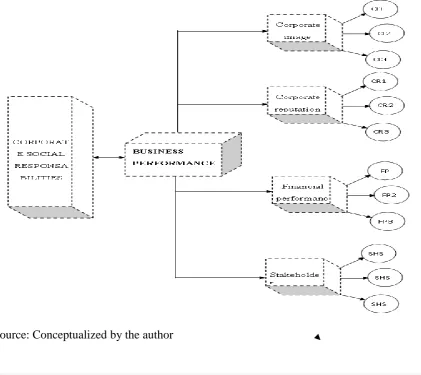
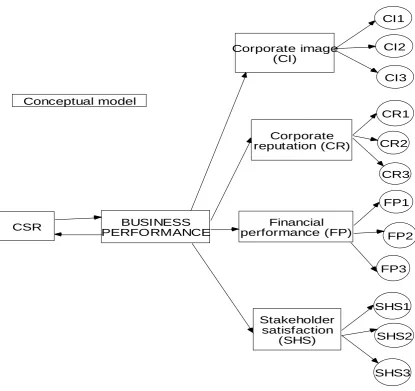
The model that is explained the causal link between corporate social responsibility (CSR) and
[image:9.612.85.507.322.697.2]Business performance is conceptualized in figure 2 below. Figure 2: Conceptual model
3. Research Methodology
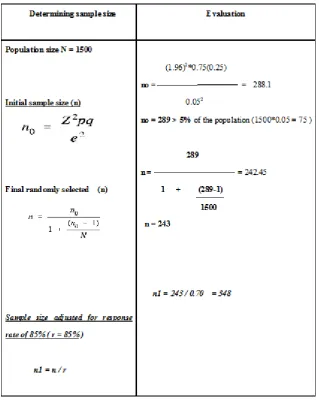
This research methodology describes the procedures for determining sample size for categorical data using Alain Bouchard as cited by SABITI Fred (2004: 46), Cochran‟s (1977) and Naresh Malhotra et al. (2007 : p. 283) formulas. It uses purposive sampling method, which is a convenience sampling method and a non-probability sample, to satisfy certain criteria and to
[image:10.612.145.465.256.657.2]select its respondents. Based on a margin of error of 5% (e = p - .= ± 0.05 ) at a 95% confidence level (CL) , the z value associate with the CL is Z = 1.96 for a proportion available value of 75% ( P= 0.75). Then, the sample size for categorical data is presented as follow: Table 1: Determining sample size for categorical data
Therefore, for a population of 1500, the required sample size is 289. However, since this sample size exceeds 5% of the population (1500*.05=84), Cochran‟s (1977) correction formula should be used to calculate the final sample size (called the finite population correction) and the final randomly selected including an error marge is 243. (n = 243). Assuming a response rate of 70 % (r= 0.70), a minimum drawn sample size (n1) should be used to send out the survey questionnaire to 348 people and to require a minimum sample size 243.
Data was collected through questionnaires distributed to different respondents including customers, employees, decisions makers, stakeholders and research scholars.
To measure the effect of CSR on business performance, a survey questionnaire was designed for primary data collection. It was focused on two demographical variables (such as gender and age)
and was consisted of 12 questions across the four dimensions of business performance (corporate image, corporate reputation, financial performance, stakeholder satisfaction levels) that related to CSR. A five point Likert scale from “strongly disagree” to “strongly agree” was used in the collection of data as scale and numerical code for questions.
Following tables which give detail of different structure of questionnaire and detail of demographical variables respondents are addressed:
Table3: Respondents Demographics
Table 3 shows respondents‟ profile for the study. Most of respondent were male (58.70%) who
are: between 20-35 years old (42.77 %), between 35-45years old (29.50%) and above 45 years old (27.73 %)
[image:13.612.80.496.202.593.2]As mentioned above, this study employed questionnaire items from the existing literature and developed the conceptualize model.
Figure 3: the conceptualize model
Corporate image (CI) Corporate reputation (CR) Financial performance (FP) Stakeholder satisfaction (SHS) BUSINESS PERFORMANCE CSR CR2 CR3 FP1 FP2 FP3 SHS1 SHS2 CR1 CI3 CI2 CI1 SHS3 Conceptual model
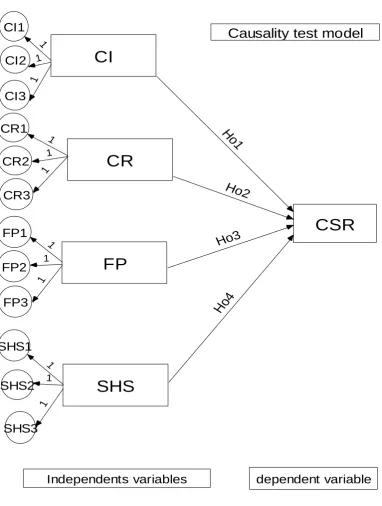
This conceptualize model involves a causality testanalysis with a series of regression analyses to
[image:14.612.105.488.125.632.2]test the hypothesis model.
Figure 4 : Causality test model
CI
CR
FP
SHS
CSR
CI1 CI2 CI3 CR1 CR2 CR3 FP1 FP2 FP3 SHS1 SHS2 SHS3 1 1 1 1 1 1 1 1 1 1 1 1 Ho3 H o1 Ho2 Ho4Independents variables dependent variable
Causality test model
Source: Conceptualized by the author
for reliability using Cronbach‟s alpha. Then, factors are then interpreted in order to present the
[image:15.612.119.461.220.503.2]best explanation for the variables influenced by that factor. Cronbach‟s alpha shown in Table 4 was used to assess the internal consistency reliability for each of the five variables. All the constructs in the survey questionnaires were analyzed to validate their reliability. Higher scores indicate more reliability for the measurements. All the constructs had acceptable scores. Since these constructs are proposed for the current study, further analysis in future research could be addressed.
Table 4 : Internal consistency reliability statistics of the study
Source: Developed by the author
The results of the test indicated that the data collected from the respondents were very much reliable because all the Cronbach‟s alpha evaluated is acceptable scores (over 0.7).
4. Data Analysis and Interpretation
In factor analysis, Kaiser –Mayer-Olkin (KMO ) and Bartlett‟s test of sphericity were applied
before Principal Component Factor (PCF) analysis. And before carrying out the factor analysis, the data should have to be checked for its appropriateness of use (Kline, 1998).
In descriptive statistics analysis, the mean value of all the variables and the correlation matrix and the causality test are used to measure how CSR implementation strategies and business performance indicators factors are related.
4.1 Exploratory Factor Analysis (EFA)
As mentioned above, before carrying out the factor analysis, the data should have to be checked for its appropriateness of use (Kline, 1998). To check the appropriateness of use
[image:16.612.79.503.317.592.2]Source: Developed by the author
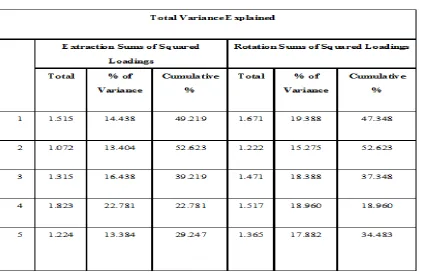
The Exploratory Factor Analysis (EFA) that is carried out consisted of four dimensions which are (corporate image, corporate reputation, financial performance, stakeholder satisfaction levels). Then, the results of factor analysis are given in Table 5. Otherwise, all sections show that, KMO statistics values are (0.845, 0.757, and 0.733 and 0.799) were all greater than 0.5. The Bartlett‟s tests of sphericity were found to be all significant at 0.000 and be all less than 0.05. It was considered strong, suitable and acceptable to conduct Principal Component Analysis (PCA). A principal component method with a promax rotation method was used to carry out the exploratory factor analysis (EFA). The number of factors was determined by cut off eigen values.
In this EFA, Eigen values (2.97, 2.21, 1.67and 1.37) were all greater than 1(Eigen values >1) for all the sections.
Based on the results of Rotated Components Matrix, best combination of variables from each section was identified. It is to be noted that variables having low factor loading from cut off value, were also included in the combination which show greater significance in representing the section. In our case the cut off Eigen values all the sections are (2.97, 2.21, 1.67and 1.37) >1 which proved that the combination is excellent and acceptable.
hypotheses are confirmed.
[image:21.612.120.491.105.573.2]4.2 Descriptive Statistics Analysis (DSA)
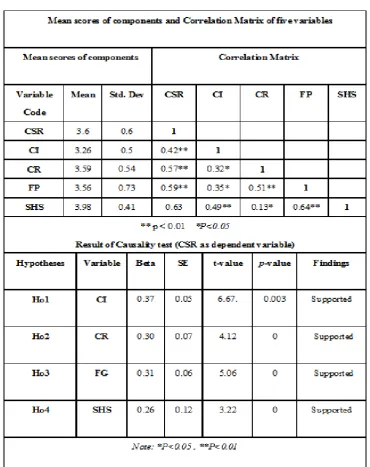
Table 6: Descriptive Statistics Analysis (DSA)
Source: Developed by the author
In this Descriptive Statistics Analysis (DSA) three tests are used to measure and confirmed how
As shown in (Table 6) the mean standard deviations and correlations were analyzed for each of
the five variables (corporate image, corporate reputation, financial performance, stakeholder satisfaction level and CSR). For the 5-likert point Scales the mean value of all the variables is greater than 3 and the standard deviations ranged from 0.41 to 0.73.
As mentioned above, there are 10 relationships found among the variables. First of all, CI, CR, FP and SHS are positively and significant correlated with CSR (r = 0.42, r = 0.57, r =0.59 and r = 0.63, p < 0.01, respectively). Secondly, the correlations between CR, FP and SHS were (r = 0.32, r = 0.35 , p < 0.01 respectively and r = 0.49, p < 0.05) positive significant correlation with CI. Furthermore, both FP and SHS were positively correlated with role CR (r = 0.51, r = 0.51 p < 0.01 and r =0.13, p < 0.05). Finally SHS was positively related with FP (r = 0.64, p <
0.01). The correlation matrix constructed to from the data obtained to know the impact of CSR on Business performance indicators variables (CI, CR, FP, SHS) and the coefficient of correlation were less than 0.7. Therefore, none of the variables was dropped as no multi- collineraity was observed. In an identity matrix, all the diagonal terms are 1 and all off diagonal terms are 0.
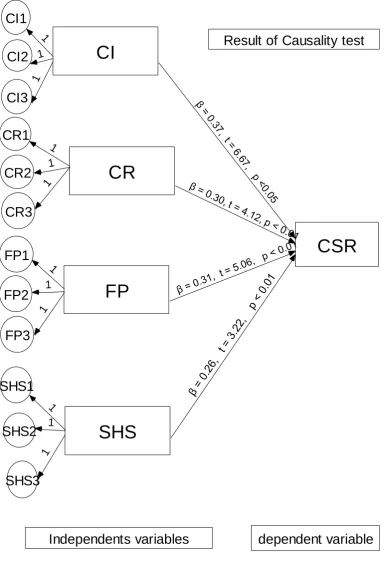
The regression analyses were conducted to determine the relationship between the variables. As shown in the result of causality test in Table 6 and in figure 5, the four predictor variables (i.e., CI, CR, FP and SHS) contribute to CSR. An examination of results in (Table 4) indicated that CI, CR, FP and SHS are positively and significantly related to CSR (β = 0.37, t = 6.67, p <0.05 ; β = 0.30, t = 4.12, p < 0.01; β = 0.31, t = 5.06, p < 0.01; β = 0.26, t = 3.22, p < 0.01) .
Figure 5: Result of causality test
CI
CR
FP
SHS
CSR
CI1
CI2
CI3
CR1
CR2
CR3
FP1
FP2
FP3
SHS1
SHS2
SHS3
1 1 1 1 1 1 1 1 1 1 1 1Independents variables
dependent variable
β = 0
.37 , t = 6
.67 , p <
0.05
β = 0
.30, t = 4.1 2, p <
0.01
β = 0.31
, t = 5.0
6, p < 0.01
β = 0.26,
t = 3.22,
p < 0.
01
Result of Causality test
Source: Developed by the author
for this present research consider small, so the findings of the present study not able to be
generalized. Thus, this study use a causal test to explain the effect of CSR on BP. The future research sample has to be larger and a longitudinal research should conduct to get more valid results.
5. Conclusion
Today's business environment is more complex than earlier and it is expected that firms should regard the relationship with stakeholders at the strategic level to create value for shareholders and stakeholders. Similarly transparency and compliance support firms to win their stakeholders. This proves that CSR may positively influence relationships with their stakeholder who enhances
business performance through creation of corporate reputation like social contribution in education, health, sports, the environment, and other purposes. Every organization must follow the minimum expectations of environmental care and employee welfare and recognize the need and importance of taking into consideration the concepts such as ethical, social, moral, equity, social responsibility. However, corporations that contravene societal expectations, harm or even destroy its image, reputation and value among networked stakeholders. This article has tried to explain how implementing social welfare perspective in strategy management can optimize firm‟s value over the longer run. It has attempted to answer why it is important for organizations
to implement CSR practices in their strategies and to optimize corporate image, corporate reputation, corporate financial performance and shareholder satisfaction over the longer run.
The results of our research, along the line with the findings from previous studies confirm that there is a strong relationship between CSR and Business performance (i.e. Corporate image, corporate reputation, financial performance and stakeholders satisfaction). So by implementing CSR‟s culture, the employee‟s morale will be high and the owners earn and respect from one and
all. The youngsters will follow good examples to improve the living conditions of the public.
6. References
influences, employee commitment and organizational performance‟, African Journal of Business
Management, vol. 4, no. 12, pp. 2796- 2801.
Bedi, HS 2009, „Financial Performance and Social Responsibility: Indian Scenario‟, Working
Paper, viewed 29 December 2010, < http://ssrn.com/abstract=1496291>.
Bhattacharyya, SS 2008, „Development of a CSR-Strategy-Framework‟, Proceedings of the
conference CRRC, 7-9 September, Queen's University Belfast
Blackburn, V, Doran, M and Shrader, C 1994, „Investigating the Dimensions of Social Responsibility and the Consequences for Corporate Financial Performance‟, Journal of
Managerial Issues, vol 6, no. 2, pp 195-218.
Carroll, AB 1999, „Corporate social responsibility: Evolution of a definitional construct‟,
Business and Society, vol. 38, no. 3, pp. 268–295.
Cramer J, Jonker J & van der Heijden, A 2004, „Making Sense of Corporate Social
Responsibility‟, Journal of Business Cochran, W. G. (1977). Sampling techniques (3rd ed.).New
York: John Wiley & Sons. Ethics, vol. 55, no. 2, pp. 215-22
Donald, M. N. (1967). Implications of non-response for the interpretation of mail questionnaire data. Public Opinion Quarterly, 24(1), 99-114
Gupta & Saxena 2006, „Corporate Social Responsibility in Indian Service Organisations: An
Empirical Study‟, Proceedings of the International Conference on „CSR-Agendas for Asia‟, ICCSR, 13-14 April 2006, in Kuala Lumpur, Malaysia. 30.
Johnson, P. O. (1959). Development of the sample survey as a scientific methodology. Journal of Experiential Education, 27, 167-176
Malhotra, N. (2007). Marketing research: A state-of-the-art review, International Marketing Review, Vol. 13 Iss: 5, pp.7 – 43
Miller, D. E., & Kunce, J. T. (1973). Prediction and statistical overkill revisited. Measurement and Evaluation in Guidance, 6(3), 157-163.
Olaru, M., G. Stoleriu, et al. (2011). "Social Responsibility Concerns of SMEs in Romania, from
the perspective of the requirements of the EFQM European Excellence Model." Amfiteatru Economic XIII(29): p. 56-71.
Salkind, N. J. (1997). Exploring research (3rd ed.). Upper Saddle River, NJ: Prentice Hall.
Serban, V. and M. Ghenta (2009). Excellence Sustainability. Using the European business excellence EFQMModel for a sustainable development of the organization. Proceedings of the 2nd International Conference of Ecological Performance in a competitive economy (PEEC), Bucharest, Romania.
Smith, M. F. 1983. Sampling Considerations in Evaluating Cooperative Extension Programs. Florida Cooperative Extension Service Bulletin PE-1. Institute of Food and Agricultural Sciences.
University of Florida
The new version of EFQM fundamental concepts and its main changes are described in detail in Kaufmann, M. and V. Serban (2010). The New EFQM 2010 Model for Business Excellence and its fundamental concepts in light of the economic crises. Future of Europe Conference, Bucharest.
Werder, K. P. (2008). The effect of doing good: An experimental analysis of the influence of corporate social responsibility initiatives on beliefs, attitudes, and behavioral intention. International Journal of Strategic Communication, 2(2), 115-135.
Wunsch, D. (1986). Survey research: Determining sample size and representative response. Business Education Forum, 40(5), 31-34.
7.Appendix
To assess the effect of Corporate Social Responsibility on Business performance Questionnaires focusing on characteristically demographics variables
Sex: Male Female
Age: 20 - 35 35 - 45 Above 4 5
Questionnaires evaluating Perspective of business performance indicators variables on
CSR
Rate the statement: 1-Strongly Disagree 2-Disagree 3-Neutral 4-Agree 5-Strongly Agree
Corporate Image (CI) and CSR evaluating perspective
CI 1
Being socially responsible is like a source of opportunity and innovation for strengthening
Corporate Image
1 2 3 4 5
CI 2 The good image of a firm leads to sustaining a superior CSR over the time
1 2 3 4 5
CI 3 Firms involving in more social contribution leads to
improve corporate image and maximize competitive advantage
1 2 3 4 5
Corporate Reputation (CR) and CSR evaluating perspective
CR 1 Socially responsible firm creates corporate
reputation in the mindset of customer
1 2 3 4 5
CR 2 A firm which involves into CSR activities always enhances highly its brand value
CR 3 A Firm has to spend more amount of funds in CSR to ensure customer loyalty and its reputation
1 2 3 4 5
Financial Growth and CSR evaluating perspective
FG 1 Firm which contributes more in CSR gets easily trade credits for the short term financing of the firms
1 2 3 4 5
FG 2 Participation in the socially responsible activities may
impact the financial growth of business
1 2 3 4 5
FG 3 Investing in socially responsible activities is a kind of reinvestment
1 2 3 4 5
Stakeholder satisfaction levels (SHS L) and CSR evaluating perspective
ESSL 1 Being Socially responsible firm has influence on
ESSL
1 2 3 4 5
ESSL 2 A socially responsible firm distributes dividend in
expected time period to the shareholder
1 2 3 4 5
ESSL 3 Firms have to formulate and implement CSR activities for attaining ESSL