Citation:
Moore, D (2007) Making e-learning less didactic. Assessment, Teaching & Learning Journal, 1 (1). ISSN 1756-8781
Link to Leeds Beckett Repository record: http://eprints.leedsbeckett.ac.uk/1037/
Document Version: Article
The aim of the Leeds Beckett Repository is to provide open access to our research, as required by funder policies and permitted by publishers and copyright law.
The Leeds Beckett repository holds a wide range of publications, each of which has been checked for copyright and the relevant embargo period has been applied by the Research Services team.
We operate on a standard take-down policy. If you are the author or publisher of an output and you would like it removed from the repository, please contact us and we will investigate on a case-by-case basis.
Making elearning less didactic
David Moore
Introduction
Clearly, elearning is contributing significantly to current higher education; at Leeds Met, for example, elearning features large in the Leeds Met ALT strategy: ‘… we will offer enhanced facilities to support elearning on and offsite …’. Equally clearly, elearning does seem to offer many advantages. For example students may learn at their own pace and convenience, remotely from the university campus if necessary.
A possible danger with elearning, however, is that the educational interactions may become unduly didactic (Moore 2000). Computerbased learning systems, that is, tend to adopt what Freire (2000) calls the ‘banking concept of education’ – students are (partially) empty vessels into which suitable knowledge is
deposited. This concern is very real today; the use, for example, of multiple choice quizzes within webCT exemplifies the banking concept: there is a single right answer to each question, the aim is to get students to learn the right answers. Whilst this approach may be valid in some domains, its approach is limited in attempts to encourage critical thinking and reflection, vital components of HE.
I argue that there are two possible approaches to addressing this problem of untoward didacticism. One is to allow multiple participants in the learning interactions, so that learners are able to use the environment to communicate with each other and their tutors. A different approach is to have the computer itself be a participant in the learning interaction. For this to avoid the concern about undue didacticism, the computer must be capable of engaging the student in suitable educational dialogue. We have been researching each of these
approaches within Innovation North, and my aim in this paper is to outline our work in each.
Collaborative learning via elearning
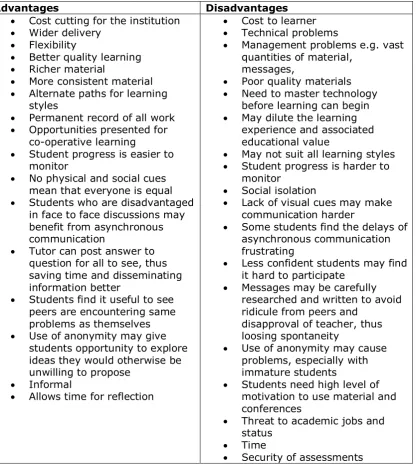
This approach involves giving students the opportunity to have openended discussions with each other and their tutors, via computer communications technology. In principle therefore students may engage in tutorialtype
Advantages Disadvantages
· Cost cutting for the institution
· Wider delivery
· Flexibility
· Better quality learning
· Richer material
· More consistent material
· Alternate paths for learning styles
· Permanent record of all work
· Opportunities presented for cooperative learning
· Student progress is easier to monitor
· No physical and social cues mean that everyone is equal
· Students who are disadvantaged in face to face discussions may benefit from asynchronous communication
· Tutor can post answer to question for all to see, thus saving time and disseminating information better
· Students find it useful to see peers are encountering same problems as themselves
· Use of anonymity may give students opportunity to explore ideas they would otherwise be unwilling to propose
· Informal
· Allows time for reflection
· Cost to learner
· Technical problems
· Management problems e.g. vast quantities of material,
messages,
· Poor quality materials
· Need to master technology before learning can begin
· May dilute the learning experience and associated educational value
· May not suit all learning styles
· Student progress is harder to monitor
· Social isolation
· Lack of visual cues may make communication harder
· Some students find the delays of asynchronous communication frustrating
· Less confident students may find it hard to participate
· Messages may be carefully researched and written to avoid ridicule from peers and
disapproval of teacher, thus loosing spontaneity
· Use of anonymity may cause problems, especially with immature students
· Students need high level of motivation to use material and conferences
· Threat to academic jobs and status
· Time
[image:3.595.97.516.71.540.2]· Security of assessments
It would clearly be a concern were this to be the case at Leeds Met, and research into this is therefore worth pursuing.
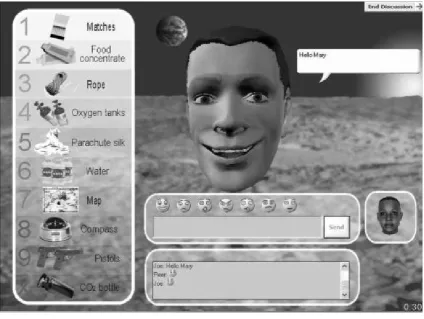
Related work in INN involves collaborative virtual environments (CVE). A CVE is a distributed computerbased virtual space, in which people can meet and interact with others, via their avatars (Moore et al 2005). An avatar is a
[image:4.595.90.515.222.541.2]representation of the user’s identity within the computer environment (Gerhard, 2003). An INN colleague, Marc Fabri, is investigating how emotionally expressive avatars might enhance the experience of collaborating users. Fabri is conducting experiments using the system depicted in figure 1 below.
Figure 1: Interface of the Virtual Messenger tool
Early results look promising (Fabri and Moore, 2005). Whether this would translate into educationally valuable distance learning experiences, is another open empirical question.
Computational Dialectics
The approach here is to enable the computer itself to engage students in suitable educational dialogue. In our research we are concentrating on one of the
computational prerequisites, a suitable model of dialogue. We are adopting an approach known as ‘computational dialectics’. Dialectics is building systems of dialogue rules aimed at generating “good” dialogue. Computational dialectics is the use of such systems within a computer system. The essential aim of computational dialectics is to find or create dialogue models which are:
·computationally tractable
·usable by the target user population
What has any of this to do with elearning? The idea is that the dialectical model will give a shared model of dialogue between student and machine, and thus allow open educational dialogue to occur. In INN, our former research student, Tommy Yuan, has built a system that allows rudimentary debate between student and computer (Yuan et. al. 2003). Such approaches are very crude currently, in that for example since the computer cannot understand English, debate
participants are restricted to selecting from preset propositions. Getting over such problems will be a complex technical challenge, involving artificial
intelligence and computational linguistics. Nevertheless, it is an exciting possibility for the future, and already elearning systems using computational dialectics are showing promising results (e.g. Ravenscroft and Pilkington, 2000).
Summary and further work
I have tried to outline research in INN into two possible approaches to making e learning nondidactic: CSCL and computational dialectics. Each area raises interesting possibilities for further research. In the case of CSCL, there are important empirical questions concerning its practical use in HE. In the case of computational dialectics important technical issues are raised. A further
interesting question concerns how these approaches might be used together. An attractive possibility is that the dialectical model provides a regulatory framework for interactions within CSCL. Colleagues in INN are pursuing funding to enable exploration of this idea, which we envisage as a virtual café used by students for collaborative learning and debate.
In all this the challenges are decidedly nontrivial, but the potential educational gains are great.
References
CunninghamAtkins, H. (2004) The influence of learning styles on the effective use of textbased computer conferencing. PhD thesis, Leeds Metropolitan University.
Fabri, M. and Moore, D (2005) ‘The use of emotionally expressive avatars in Collaborative Virtual Environments’, Proceedings of the Joint Symposium on Virtual Social Agents, 1215 April 2005, pp. 8894, University of Hertfordshire.
Freire, P. (2000) Pedagogy of the oppressed (20 th anniversary edition) Continuum International Publishing, New York, USA.
Gerhard M (2003) A hybrid avatar/agent model for educational collaborative virtual environments. PhD thesis, Leeds Metropolitan University.
Moore D, Cheng Y, McGrath P, Powell N J (2005) ‘Collaborative virtual environment technology for people with autism’. Focus on Autism and Other Developmental Disorders 20, 231243.
Ravenscroft, A. and Pilkington, R. (2000). ‘Investigate by Design: Dialogue Models to Support Reasoning and Conceptual Change’. International Journal of Artificial Intelligence in Education, 11: 237298.