Citation:
Sharpe, S and Richards, L (2008) Web development on a stick. Assessment, Teaching & Learning Journal, 3. 7 - 15. ISSN 1756-8781
Link to Leeds Beckett Repository record: http://eprints.leedsbeckett.ac.uk/1089/
Document Version: Article
The aim of the Leeds Beckett Repository is to provide open access to our research, as required by funder policies and permitted by publishers and copyright law.
The Leeds Beckett repository holds a wide range of publications, each of which has been checked for copyright and the relevant embargo period has been applied by the Research Services team.
Web development on a stick
Simon Sharpe and Louise Richards
Introduction
Leeds Metropolitan University is one of the largest universities in the UK, with over 52,000 students and 3,500 staff. The University also forms the hub of a regional university network, which involves 14 partner further education colleges, with over 300,000 students between them.
The Information and Communication Technology (ICT) awards available in the Faculty of Innovation North (INN) include Computing, Interactive Multimedia, Animation, Entertainment Technology and Games Design. Currently students enrolled on computing awards can take web development modules at all levels of study, although the intention in the Faculty is to widen the participation next year in these modules to all awards.
In the 2006/7 academic year approximately 300 students studied basic web development at level 1, with around 100 students taking the more specialist web modules at level 2 and 3. At Masters Level, a new MSc in Web Application Development has been introduced and enrolled its first cohort this year.
While the web development courses have proved popular for a number of years now, there are drivers for change to improve the educational experience of our students and contribute to the success of the University in general. This means taking a regular fresh look at learning
resources, content and delivery.
Drivers for change
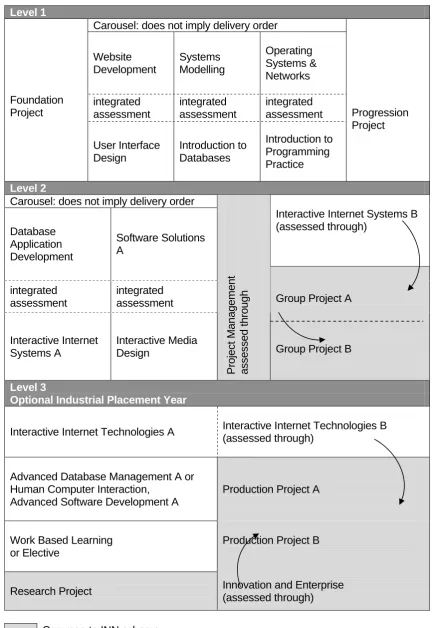
Changing delivery patterns
Figure 1: Business Computing – Internet Systems
Level 1
Carousel: does not imply delivery order
Website Development Systems Modelling Operating Systems & Networks integrated assessment integrated assessment integrated assessment Foundation Project User Interface Design Introduction to Databases Introduction to Programming Practice Progression Project Level 2
Carousel: does not imply delivery order
Interactive Internet Systems B (assessed through) Database Application Development Software Solutions A integrated assessment integrated assessment Interactive Internet Systems A Interactive Media Design Proje c t Ma n age me nt asses s ed t h roug h
Group Project A
Group Project B
Level 3
Optional Industrial Placement Year
Interactive Internet Technologies A Interactive Internet Technologies B (assessed through)
Advanced Database Management A or Human Computer Interaction,
Advanced Software Development A
At level 2 there is a similar block structure during the first semester, culminating in an extended team project during the second semester. At level 3, students study four semester-long
modules, with a final team-based project in the second semester, with supplemental learning delivered via learning objects (Shen et al, 2004). At Masters Level students receive a mixture of tutor-supported sessions combined with a distance learning approach supported via the X-Stream e-learning environment.
This focused, compact delivery is aimed at increasing retention rates and improving student performance (Milton and Halpern, 1993) However, the increased commonality and blocking has led to a greater need for more flexible learning, and more efficient use of learning resources.
University Assessment, Learning and Teaching Strategy
The introduction of the Leeds Met Assessment, Learning and Teaching strategyhas also been a significant driver for change. The strategy supports widening participation and encourages the accommodation of differing learning styles and environments.
Specific targets that the web development modules would need to incorporate include:
• Extending e-learning and computer-aided assessment
• Maximising the formative feedback available to students
• Adopting a receptive approach to non-standard delivery patterns, and innovative approaches to teaching and learning
• Promoting work-related learning and employability
• Exploring the wider use of re-usable learning objects.
Retention and progression rates
In the highly competitive UK higher education market, courses with poor retention and progression rates cannot be supported. The reasons for poor engagement are manifold and well documented (Wishart, 2005), but often relate to stimulating student interest, engagement and developing an effective assessment and feedback strategy (Connolly and Murphy, 2005). A key driver for change therefore was to achieve these pedagogic principles through the development of stimulating learning objects, engaging assessment activities and learning spaces buzzing with activity and enthusiasm.
Increased project work
Team-based project work at all levels has played an increasingly important role over the past two years, as team-working is recognised as being beneficial to learning (Kearsley and
Shneiderman, 1999). Project-based learning approaches emphasise the importance of realistic and relevant contexts(Nunes and McPherson, 2006), combined with flexible learning
opportunities.
Web 2.0
Finally, the connected world is changing fast. New technologies associated with Web 2.0 are emerging and information is commonly being accessed from devices other than PC-based browsers. Students are excited and motivated by these developments (Evangelos et al, 2006), hence the importance of incorporating these technologies into the curriculum.
Implementing changes
Versatile learning object and development tools
A key factor in encouraging engagement is the provision of a convenient web hosting and development environment. While the Faculty offers hosting facilities, these are available only on campus and many students also wish to work elsewhere. A very useful solution to this issue is to bundle web technologies together in an environment which is easy to install and use. These bundled solutions are open source and available from organisations such as Apachefriends (XAMPP) and easyPHP. The bundles typically consist of an Apache server, the PHP language and MySQL database. With the PHPAcademy and XAMPP on a USB memory stick, students have a completely portable environment which they can plug into any PC or laptop, and continue to work on their web applications or exercises.
Effective use of e-learning platform
All web development modules are hosted on the WebCT e-learning platform, where students can find a range of other supportive learning resources, for example, discussion boards, links to allow browsing of the best student websites and a method for cohort-wide announcements. WebCT also provides an efficient process for securely uploading student assessments. It is used to give private feedback and marks to students, which complements the face to face feedback in class time.
Stimulating assessment
To address the issue of assessment, students are required to construct individual websites that utilise the skills learned at that level. They implement unique sites that meet a specified set of criteria, but which are based on any context of their choosing. This not only removes much potential for plagiarism, but also fosters enthusiasm and ownership of the site created. An early assessment ‘milestone’ focuses the students and provides staff with useful feedback regarding engagement and progress. Grading is via student demonstration of the site. This is fast and efficient, and immediate feedback can be given to the student. Marks and feedback are also entered on to WebCT where they can be accessed privately by the students. At level 3, students complete ‘Evaluation and Reflection Templates’ where they concisely demonstrate critical analysis of design and implementation issues.
Evaluation
Learning resources
The web learning resources and the hosting and development tools have now been
Interest stimulated Staff responsiveness
Useful module information Acquire skills
Quality of teaching Module relationship
Learning activities Plan learning
Support materials Repetition avoided
Assessments Think critically
[image:6.595.71.512.84.218.2]Feedback available Recommend course
Table 1: Criteria used in student feedback form
In addition there are two open questions at the end of the module survey where students are asked to list anything they particularly liked about the module or thought needed improving.
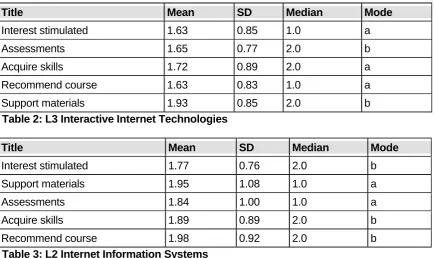
For all web development modules student responses have been consistently good and particularly high for ‘Interest stimulated’, ‘Assessments’, ‘Acquire skills’ and ‘Recommend course’. Some example statistics are given in tables 2 and 3 from the level 3 Interactive Internet Technologies module and level 2 Internet Information Systems module. For each criterion, the highest possible rating is 1 and the lowest is 5, and so the statistics indicate that these modules are highly regarded by the students.
Title Mean SD Median Mode
Interest stimulated 1.63 0.85 1.0 a
Assessments 1.65 0.77 2.0 b
Acquire skills 1.72 0.89 2.0 a
Recommend course 1.63 0.83 1.0 a
[image:6.595.70.505.362.620.2]Support materials 1.93 0.85 2.0 b
Table 2: L3 Interactive Internet Technologies
Title Mean SD Median Mode
Interest stimulated 1.77 0.76 2.0 b
Support materials 1.95 1.08 1.0 a
Assessments 1.84 1.00 1.0 a
Acquire skills 1.89 0.89 2.0 b
Recommend course 1.98 0.92 2.0 b
Table 3: L2 Internet Information Systems
In addition there have been some very positive qualitative comments relating to these modules. For example, several students commented on the usefulness of the PHPAcademy learning object and development tools. Example comments include:
“A lot of time given to do website, good help on WebCT and the PHPAcademy. I learned a lot.” “PHPAcademy was good”
The approach to assessment has proved popular with both staff and students alike. It has proved efficient to mark and yet has been judged fair by students in terms of effort and the opportunity they have to demonstrate their work. Students also found the assessment both stimulating and interesting. They appreciated the regular formative feedback that was available in the labs and the early milestone. In addition they appreciated the open-ended nature of the assessment which allowed them to demonstrate their ability, innovation and creativity. Many took the opportunity to extend the basic requirements to include facilities for mobile devices, RSS (Really Simple Syndication) feeds and SMS (Short Message Service), as well as developing sophisticated user interfaces using CSS (Cascading Style Sheets) and Flash. Students soon developed a real sense of ownership over their work and the peer dynamics of group work added greater motivation with students endeavouring to out-do each other in terms of the sophisticated functionality they could develop. Example comments include:
“It’s possible to be creative on the assignment” “Content and assessment were gr8”
“The ability to be creative”
“Assessment allowed a real world problem to be tackled”
“Learning PHP, the ability to flex my creative muscles in creating a website. None/few limitations on website content”
“The module has been effective in encouraging me to plan my own studies. The work for the assignment was a lot of fun!!!’
The workshop approach also fostered a creative and supportive environment which again attracted favourable comments such as:
“Providing workshops was good as it meant you had flexible access to labs and teachers” “In the whole year and a half that I have been at this university, I must say that this is the best module undertaken. I think the two 3 hour drop-in workshops are a very good idea”
Other general comments include:
“I thoroughly enjoyed this module...learned lots and has provided me with good foundation to build on”
“It was an enjoyable and stimulating module” “By far the best module on the course”
“I just liked the module in general. It was good when I felt I had learnt something and put it to use. I felt a sense of achievement when stuff worked”
“It was an enjoyable and stimulating module”
“I liked everything about this module, it was by far the most interesting module for me, I enjoyed it very much”
• Dickory Dock - www.dickory-dock.com/index.html
• Ultimate Paintball - www.ultimatepaintball.co.uk/
In addition many of the Internet Systems students are in high demand by their peers for the final-year projects which often involve web development work
External interest
There has been increased external interest in the web-related courses being run within the Faculty. For example, links are currently being established with Orange, the mobile
communications company, who have a significant presence in Leeds. They are particularly interested in the PHP training provided and the mobile web resources currently being
developed. Orange are keen to become partners as they feel some courses would be useful for the professional development of their employees. Other local organisations have also expressed an interest in sending their employees on either short courses or to take some modules of a Masters level programme.
Further work
The changing nature of web technology and curriculum will mean that the PHPAcademy learning object and development tools will require frequent updating. Current upgrades are primarily focused on advanced PHP concepts and mobile technologies.
Faculty members are studying towards Zend Certification. This will extend our training provision, allowing us to offer PHP/Zend certified courses.
It is also planned to develop a tool to facilitate the installation, customisation and targeting of the PHPAcademy learning object. This should further enhance the flexibility and versatility of the resource.
The current links with external organisations will also be expanded, thereby enhancing the synergy between curriculum development and the needs of business.
Conclusion
There have been many drivers for change as the University and the Faculty of INN strive for excellence in key areas such as student retention and progression. This has resulted in changing delivery patterns, a greater need for commonality and an increasing emphasis on team-based project work. In addition the web-related courses need to keep pace with rapid technological changes. This has necessitated a more flexible and versatile approach to learning tools and resources.
The PHPAcademy learning object which has been developed allows simple customisation for use on a variety of courses, and can be used independently by students outside of module teaching for project work or distance learning. Open source web hosting and development tools such as XAMPP were introduced, which provide the independence and versatility students require.
E-learning environments such as WebCT provided an invaluable platform to access learning resources and to facilitate support and assessment.
Stimulating, work-related assessments proved popular and gave students a great sense of ownership and pride in their work. Demonstrations and reflective evaluations proved effective for both staff and students alike.
have improved. Several current students are already working as part-time web developers and their skills are in demand from both their peers and employers.
Simon Sharpe (Connectivity and Interactive Systems, Innovation North) and Louise Richards (Regional University Network, Innovation North)
References
Apache Friends http://www.apachefriends.org/en/index.html [Accessed April 2007]
Connolly, C. and Murphy, E. (2005) Retention initiatives for ICT based courses. Frontiers in Education. Proceedings 35th Annual Conference, pp. S2C - 10-13.
EasyPhP http://www.easyphp.org/ [Accessed April 2007]
Evangelos, S., Miltiadis, L. and Athanasios, T. (2006) Adaptive mobile web services facilitate communication and learning internet technologies. IEEE Transactions on Education 49(2): 208-215.
Leeds Metropolitan University http://www.leedsmet.ac.uk/ALTre-source/alt_strategy.htm [Accessed April 2007]
Kearsley, G. and Shneiderman, B. (1999) Engagement Theory: A framework for technology-based teaching and learning.
http://www.home.sprynet.com/~gkearsley/engage.htm [Accessed April 2007]
Milton, C.J. and Halpern, D.F. (1993) The million dollar question: Can an intensive learning experience help lowest quartile students… Journal of Instructional Psychology 20(1): 29.
Nunes, M. and McPherson, M. (2006) Learning support in online constructivist environments in information systems. ITALICS May 2006 Vol 5(2).
Shen, R., Shen, L. and Fan, X. (2004) e-Learning Content Management Based on Learning Objects. Lecture Notes in Computer Science. Berlin/Heidelberg: Springer.