ASSESSING COMMUNICATION COMPETENCY OF WORKING
MANAGERS: AN EMPIRICAL STUDY
Anand Bhardwaj
Assistant Professor, KIIT College of Engineering, Gurugram (Haryana)
ABSTRACT
Purpose- Objective of this research paper is to assess communication competency of Working
Managers.
Research Methodology- 273 Respondents were selected by using random sampling method from
various parts of Delhi-NCR. Structured questionnaire was designed to assess communication
competency of working managers. Statistical tools like mean, t-test, F-test (ANOVA) are used to
analyze data with the help of SPSS.
Findings: Results show that, communication competency of working managers differ
significantly for demographic variables like gender, work experience, position in the
organization etc. Male managers possess better communication competencies as compare to
female managers. Managers working at managerial positions are better in communication
competency than managers at supervisory level.
Implications- It is clear that working managers in Delhi-NCR are not very much competent in
communication competency. Organizations should focus on developing soft skills, more efficient
training and development programs etc. in order to improve communication skills of their
employees.
Keywords: Managerial Competencies, Communication Competency, Assessing.
International Research Journal of Management and Commerce
ISSN: (2348-9766) Impact Factor- 5.564, Volume 5, Issue 1, January 2018
Website- www.aarf.asia, Email : [email protected] , [email protected]
INTRODUCTION AND REVIEW OF LITERATURE
Human resource is the most important resource for an organization. Effective and efficient managers are vital for any organization‟s success, regardless of its nature and size. To be an efficient and successful manager one needs several competencies that enable him to perform proficiently at different managerial positions (Bhardwaj and Punia, 2013). Competencies may be defined as the set of knowledge, skills, behaviors, and attitudes that a person needs to be efficient and successful in his job.
According to Hellriegel et. al. (2005), Managerial competencies are “a set of knowledge, skills, behaviors, and attitudes that a person needs to be effective in a wide range of positions and various types of organizations.” They also recommended that to be a successful manager one
needs to develop six core managerial competencies namely: Communication Competency, Planning and Administration Competency, Teamwork Competency, Strategic Action Competency, Global Awareness Competency, and Self-Management Competency. Current study primarily focuses Communication Competency of Working managers.
Communication is the most important element in human relationships. It is the fundamental need of all human beings. Effective communication is necessary to build organizations and societies at large. In simple words, communication means transfer of information along with understanding. According to Hellriegel et al. (2005) the term communication competency refers to “the effective transfer and exchange of information that leads to understanding between oneself and others.” Schultz et al. (2003) contends that
communication is an activity that takes up most of the time of both managers and non-managers. Kelly (2000) advocates that organizational communication is the process of exchanging information between two or more people with the target of either motivating them or influencing their behavior. Communication competency is essential for effective managerial performance because managers need to direct other people in order to get the work done.
Communication competency is the most fundamental of managerial competencies. It has the following sub-dimensions:
Formal Communication
Negotiation
Shirazi and Mortazavi (2009) in their study found that responsiveness, effective communication, team building, proactiveness, negotiation, and decisiveness are the main characteristics of an effective manager. The study of Rao (2007) identified that Job knowledge, hard work, effective communication skills, team skills, calmness are the main skills of good managers. In their study, Abraham et. al. (2001) identified six most critical competencies that are leadership skills, communication skills, customer focus, result orientation, problem solver, and team leader to be an effective manager.
Organizations should assess competencies of their managers and find out the skill gaps. Since the competencies are behavioral, these can be developed (Boyatzis, 2009).
RESEARCH METHODOLOGY
The research methodology designed and followed in the current study has been discussed under the following sub-heads:
Objectives of the Study
The main objective of this paper is to assess the communication competency of working managers. The specific sub-objectives of the study are as following:
1. To assess communication competency of working managers.
2. To suggest workable guidelines for improving the communication of working managers. Hypothesis of the Study
1. There is no significant difference across various age groups of working managers for the communication competency.
2. There is no significant difference between working managers of different gender for the communication competency.
3. There is no significant difference across various experienced groups of working managers for the communication competency.
5. There is no significant difference between working managers having different positions in organisations for the communication competency.
Research Design
Since the current study is related to assessment of the communication competency of working managers, so exploratory cum descriptive research design has been used in the current study.
Sampling Design and data collection
In the current study, random sampling method is used to collect data from 273 working managers across various parts of Delhi-NCR.
Data Analysis and Interpretation
[image:4.612.70.549.366.558.2]Statistical tools like mean, t-test, F-test (ANOVA) were applied on the data using SPSS. Test of significance has been used to check the significance of hypothesis assumed.
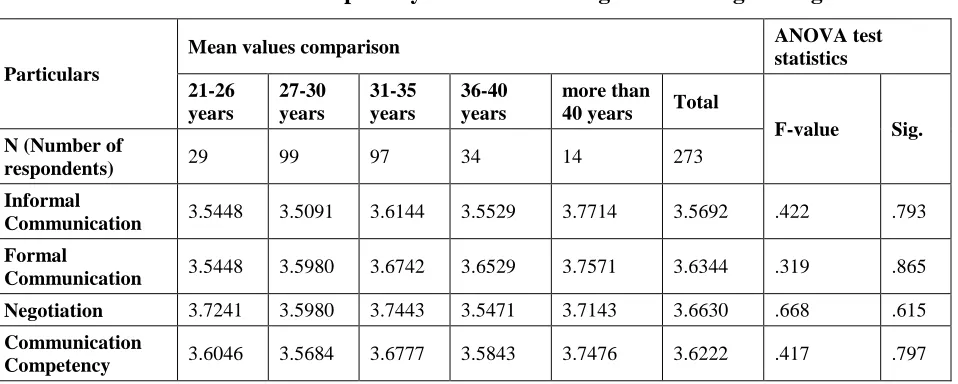
Table 1: Communication Competency on the basis of Age of Working Managers
Particulars
Mean values comparison ANOVA test
statistics
21-26 years
27-30 years
31-35 years
36-40 years
more than
40 years Total
F-value Sig.
N (Number of
respondents) 29 99 97 34 14 273
Informal
Communication 3.5448 3.5091 3.6144 3.5529 3.7714 3.5692 .422 .793
Formal
Communication 3.5448 3.5980 3.6742 3.6529 3.7571 3.6344 .319 .865
Negotiation 3.7241 3.5980 3.7443 3.5471 3.7143 3.6630 .668 .615
Communication
Competency 3.6046 3.5684 3.6777 3.5843 3.7476 3.6222 .417 .797
Source: Primary data
Table 1 examines the association between age and communication competency of working managers. Communication competency has three sub-dimensions „informal communication‟, „formal communication‟, and „negotiation‟. Comparison of mean values across
with the age of respondents, which means that working managers of different age groups possess similar level of communication competency.
[image:5.612.66.550.210.329.2]F-statistics also indicates that competency level of working managers does not have a significant difference among different age groups. This difference is also not significant for all the sub-dimensions of communication competency. So the table 1 reveals that age does not contribute any significant variation in communication competency levels of working managers of different age groups.
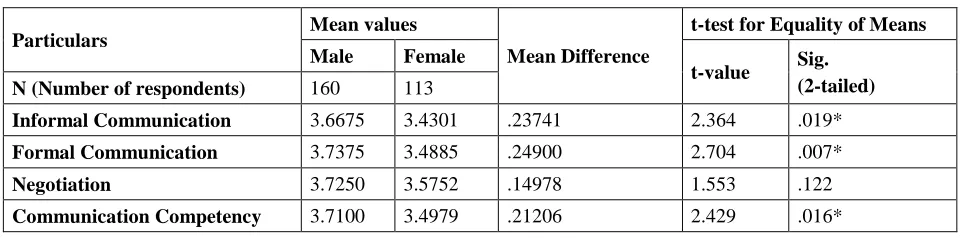
Table 2: Communication Competency on the basis of Gender of Working Managers
Particulars Mean values
Mean Difference
t-test for Equality of Means
Male Female
t-value Sig. (2-tailed)
N (Number of respondents) 160 113
Informal Communication 3.6675 3.4301 .23741 2.364 .019*
Formal Communication 3.7375 3.4885 .24900 2.704 .007*
Negotiation 3.7250 3.5752 .14978 1.553 .122
Communication Competency 3.7100 3.4979 .21206 2.429 .016*
Source: Primary data
*significant at .05 level of significance
Table 2 depicts that whether gender brings any significant variation in competency level of working managers for communication competency and its sub-dimensions. Comparison of mean values between male and female working managers indicates that competency level of male and female working managers for „negotiation‟ dimension does not vary so much, which
mean that working managers of both genders possess similar level of negotiation skills. For the remaining two dimensions „informal communication‟ and „formal communication‟ and for
overall communication competency male and female working manager possess different level of competency. Comparison of mean values also indicates that male working managers are more competent in communication competency than female working managers.
The t-statistics also indicates that competency level of working managers does not have a significant difference between male and female working managers for „negotiation‟ dimension. This difference is significant for „informal communication‟ and „formal communication‟
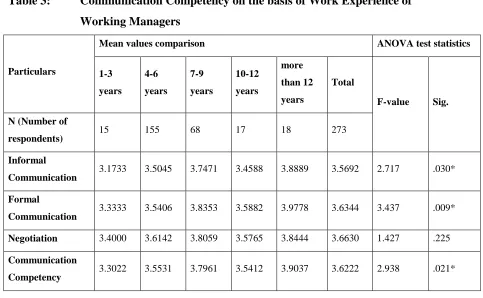
Table 3 gauges the communication competency level of working managers across various experience groups. Comparison of mean values across different experience groups indicates that competency level of working managers vary for the dimensions „informal communication‟ and „formal communication‟, which means that working managers having different levels of experience possess different level of competency for these dimensions. For „negotiation‟
[image:6.612.64.547.235.533.2]dimension, all the working managers irrespective of their level of experience possess similar level of skills. Communication competency varies with different experience level possessed by working managers. Working managers with more experience are more competent in communication than lesser experienced working managers
Table 3: Communication Competency on the basis of Work Experience of Working Managers
Particulars
Mean values comparison ANOVA test statistics
1-3
years
4-6
years
7-9
years
10-12
years
more
than 12
years
Total
F-value Sig.
N (Number of
respondents) 15 155 68 17 18 273
Informal
Communication 3.1733 3.5045 3.7471 3.4588 3.8889 3.5692 2.717 .030*
Formal
Communication 3.3333 3.5406 3.8353 3.5882 3.9778 3.6344 3.437 .009*
Negotiation 3.4000 3.6142 3.8059 3.5765 3.8444 3.6630 1.427 .225
Communication
Competency 3.3022 3.5531 3.7961 3.5412 3.9037 3.6222 2.938 .021*
Source: Primary data
*significant at .05 level of significance
experience contributes a significant variation in competency levels of working managers for communication competency.
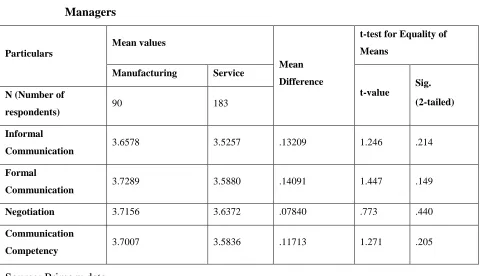
[image:7.612.67.547.271.547.2]Table 4 indicates that whether serving sector of working managers brings any significant variation in competency level of working managers for communication competency and its sub-dimensions. Comparison of mean values between manufacturing and service sector working managers indicates that competency level does not vary for all the dimensions of communication competency, which means that service sector of the working managers does not produce variation in level of communication competency. The t-statistics also depicts that competency level of working managers does not have a significant difference between manufacturing and service sector working managers for communication competency.
Table 4: Communication Competency on the basis of Serving Sector of Working Managers
Particulars
Mean values
Mean
Difference
t-test for Equality of
Means
Manufacturing Service
t-value
Sig.
(2-tailed) N (Number of
respondents) 90 183
Informal
Communication
3.6578 3.5257 .13209 1.246 .214
Formal
Communication 3.7289 3.5880 .14091 1.447 .149
Negotiation 3.7156 3.6372 .07840 .773 .440
Communication
Competency 3.7007 3.5836 .11713 1.271 .205
[image:7.612.68.544.600.695.2]Source: Primary data
Table 5: Communication Competency on the basis of Position of Working Managers in the Organization
Particulars
Mean values
Mean Difference
t-test for Equality of
Means
Managerial Supervisory
t-value
respondents)
Informal
Communication 3.6146 3.3852 .22943 1.840 .067
Formal Communication 3.7032 3.3556 .34764 3.065 .002*
Negotiation 3.7233 3.4185 .30477 2.575 .011*
Communication
Competency
3.6804 3.3864 .29395 2.731 .007*
Source: Primary data
*significant at .05 level of significance
The table 5 shows that whether position of the working managers brings any significant variation in competency level of working managers for communication competency and its sub-dimensions. Mean values comparison between managerial and supervisory working managers indicates that competency level of managerial and supervisory working managers does not vary for „informal communication‟ dimension, which means that working managers having different position possess similar level of informal communication. For the remaining dimensions „formal communication‟ and „negotiation‟ and for overall communication competency managerial and
supervisory working managers possess different level of communication competency. Comparison of mean values also indicates that working managers at managerial position are more competent than working managers at supervisory position for „formal communication‟ and „negotiation‟ and for overall communication competency.
The t-statistics further indicates that competency level of working managers does not have a significant difference between managerial and supervisory working managers for „informal communication‟ dimension. This difference is significant for „formal communication‟ and „negotiation‟ and for overall communication competency. So the table 5 depicts that
variation in position of the working managers at organization contributes significant variation in communication competency levels of working managers.
CONCLUSIONS AND DISCUSSION
experience. Male managers are more competent than female managers and there is a significant difference between male and female managers on the basis of Gender. Managers working at managerial positions are superior in communication competency than their counterparts working as supervisors. Managers working in manufacturing and service sectors possess similar level of planning and administration competency. It can be seen from the results that Working managers are at the above average level of planning and administration competency.
MANAGERIAL IMPLICATIONS
Communication competency is the most fundamental of managerial competencies. One need to be proficient in these skills is order to be an effective and efficient manager. But from the findings it is quite obvious that Working managers in Delhi-NCR are not very competent in communication competency, which indicates some limitation with the current education system and training and development programs provided by the organizations to their employees. It focuses more on increasing the productivity of the employees. Organizations should focus on developing more soft skill development programs, mentoring, coaching, training sessions etc. in order to improve communication competency of their employees. Managers must emphasize on developing soft skills, formal and informal communication as well as negotiation skills so that they can become more valuable asset for the organizations.
REFERENCES
Abraham, S.E., Kams, L.A., Shaw, K. and Mena, M.A. (2001), “Managerial competencies and the managerial performance appraisal process”, Journal of Management Development,
Vol. 20, No 10, pp. 842-852.
Bhardwaj, Anand and Punia, B.K.(2013), “Managerial Competencies and their influence on
Managerial Performance- A Literature Review”, International Journal of Advance Research in Management and Social Sciences, Volume 2, Issue 5, pp 70-84.
Boyatzis, R.E., (2009), “Competencies as a behavioral approach to emotional intelligence”, Journal of Management Development, Vol. 28, No. 9, pp. 749-770.
Kelly, D. (2000). Using vision to improve organizational communication. Leadership & Organisation Developmental Journal, 21(2), 92-101.
Rao, T.V. (2007), “Global leadership and managerial competencies of Indian managers” W.P
.No.2007-06-05, Research and Publications, IIMA, India.
Schultz, H., Bagraim, J., Potgieter, T., Viedge, C., & Werner, A., (2003). Organisational Behaviour: A Contemporary South African Perspective. Pretoria: Van Schaik.
Shirazi Ali and Mortazvi Saeed (2009), “Effective management performance a competency
based perspective”, International Review of Business Research Papers, Vol. 5, No. 1, pp. 1-10.