Environmental Awareness among D.Ed., B.Ed. and M.Ed. students.
Dr. Kompal Wadhawan Principal, Universal College of Education
Mohali
ABSTRACT Environment includes all living and non living components. It is the sum of all conditions
and influences that affect the development and life of organism. During the last three decades,
environment has been a subject of concern for the whole of humanity. The main objective of the
study is to compare the environmental awareness among D.Ed, B.Ed and M.Ed students. Sample
of the study was 210 students of D.Ed, B.Ed and M.Ed classes. The survey method of research
was used. Environmental Awareness Ability (EAAM) inventory by Dr. Parveen Kumar Jha was
used to find out the difference between mean scores of Experimental and control groups.
KEYWORDS: Environment, Humanity, Awareness, Development
Introduction:
Environment includes all living and non living components. It is the sum of all conditions and influences that affect the development and life of organism. During the last three decades, environment has been a subject of concern for the whole of humanity.
The concept of environment can be understood as the totality of all components surroundings the man. The environment pollution panel of the U.S., President’s Science Advisory Committee (1965) referred to the environment as “The sum of all social, biological, physical and chemical factors which compose the surroundings of “Man”. Each component of these surrounding
constitutes a resources on which man depends with a views of promoting human welfare. Unlike all others forms of life, man is capable of exerting great influence upon the environment which in turn affects almost all the life Process and form of organism. The environmental awareness is increasing day by day. The protection of the environment is necessary for sustaining the
International Research Journal of Human Resources and Social Sciences ISSN(O): (2349-4085) ISSN(P): (2394-4218) Impact Factor- 5.414, Volume 4, Issue 6, June 2017 Website- www.aarf.asia, Email : [email protected] , [email protected]
economic and social progress of country. This awareness was reflected at the earth summit in Rio-de-Janeiro in June, 1992 and the second earth summit recently held in Johannesburg. The first each summit at Rio adopted a global action plan called „Agenda 21‟ which aimed at integrating environmental imperatives with development aspiration.
The relationship between environment and humankind is indeed deep and has been recognized from the Vedic period further more, non-violence towards both animate and inanimate components of biosphere has been ingrained as a guiding principle in the Indian Psyche. Therefore, awareness and education of environment is the paramount concern of all the citizens of society. Environment protection starts by crying awareness among the people so that it becomes part of their lifestyle. The key to achieving this goal lies in environmental education and its related programmes. The objective of environmental education includes awareness, knowledge, attitudes, skills and participation of people in protecting the Environment.
The Hon‟ble Supreme Court on Environmental Education directed that through medium
of education, an awareness of the environment and its protection should be taught as a
compulsory subject. Because of Supreme Court‟s directive there has been a change in school syllabus. As a result an impact has already been noticed on students‟ level of awareness about
environment and their willingness to take action to arrest environmental degradation. The term „Environmental Awareness‟ has a broad connotation. Environment has become the concern of all
the academicians, intellectuals, scientists, policy makers and government across the continents. By realizing the due importance of environment, H.P. Govt. incorporated environmental education in the school curriculum. In a sense, it is an integrating discipline bringing together learning in physical and social sciences, mathematics and languages. The objectives of environment education is to create a awareness of the environment and problems surroundings; building a basic knowledge and valves and attitude with environment to develop skills and objectives to identity; evaluate environmental problems and to find solution though education programs to sensitize and create a sense of urgency and responsibility towards environment and to ensure appropriate action to maintain the quality of environment. To meet the objectives, environmental education in schools will include infusion of environmental education a separate time and space for instructions in environmental education, at the middle level, training of teachers, for its effective implementation. On the other hand environmental awareness means to
environment and its allied problems. The importance of environmental awareness cannot be over emphasis. We must understand that to improve the environment is to improve the quality of life. This study highly demands the environmental awareness towards environmental conservation. How we can protect our environment from pollution? These studies also focus the pupil-teachers awareness ability regarding what are the main courses of pollution. The present scenario measures the social aspect of pupil teachers that how soil pollution, water pollution, air pollution, noise pollution could be checked up and consumes the environment. Therefore the research study will be focused on the Environmental Awareness among D.Ed., B.Ed. and M.Ed. students who are studying in various educational institutions.
Statement of the Problem:
Environmental Awareness among D.Ed., B.Ed. and M.Ed. students.
Operational Term to be Used Environmental Awareness:
Environment literally means surrounding and everything that affect an organism during its lifetime is collectively known as its environment.
Environmental Awareness is an awareness and subsequent desire to preserve natural resources and the environment. It includes all the physical and biological surrounding and their interactions. Environmental studies provide an approach towards understanding the environment of our planet and the impact of human life upon the environment. Thus environment is actually global in nature, it is a multidisciplinary subject including physics, geology, geography, history, economics, physiology, biotechnology, remote sensing, geophysics, soil science and hydrology etc.
Objectives of the Study:
1. To study and compare of Environmental Awareness between Students of D.Ed. and B.Ed. 2. To study and compare of Environmental Awareness between Students of B.Ed. and
M.Ed.
HYPOTHESIS OF THE STUDY:
1. There is no significant difference of Environmental Awareness between Students of
D.Ed. and B.Ed.
2. There is no significant difference of Environmental Awareness between Students of
B.Ed. and M.Ed.
3. There is no significant difference of Environmental Awareness between Students of M.Ed. and D.Ed.
Delimitation of Study:
1. The present study was delimited to Kurukshetra District in Haryana State only.
2. It was further delimited to students studying in D.Ed., B.Ed. and M.Ed. courses only. 3. The sample was delimited to 210 students of D.Ed.(70), B.Ed.(70) and M.Ed. (70)
courses.
Research Method: The survey method of research was used to define problem and definite objective and data collection.
SAMPLE:
Sample for Study is 210 students, 70 Students from each course.
Sampling technique:-
Stratified Random Sampling Method was used for selection of sample from
population of the study.
TOOLS OF THE STUDY:
(a) Environmental Awareness Ability Measure (EAAM) Inventory was used for collection of
data which was prepared and standardised by Dr. Parveen Kumar Jha,
descriptive statistics such as Mean and Standard Deviation. The t-ratio was used to find out the difference between mean scores of experimental and control groups.
INTERPRETATION AND ANALYSIS OF DATA
[image:5.612.83.529.163.334.2] [image:5.612.82.532.425.595.2]H0=1 There is no significant difference of Environmental Awareness between Students of D.Ed. and B.Ed.
Table No.-T.1
Related data Shows the Mean, S.D. of Environmental Awareness between Students of D.Ed. and B.Ed.
Type of Groups
(N) (Mean) (S.D.) (CR-Value) Level of significance
0.05 0.01
D.Ed Students
70 38.03 6.76
0.743
No Significant
No Significant B.Ed Students
70 37.20 6.43
(df=N1+N2-2=70+70-2=138)
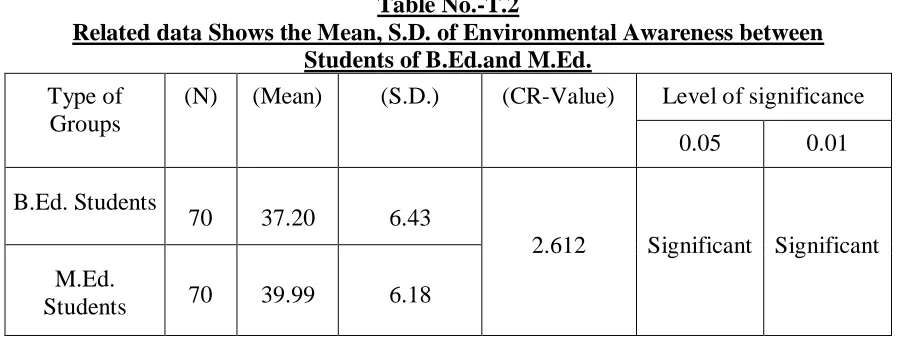
H0=2 There is no significant difference of Environmental Awareness between Students of B.Ed and M.Ed.
Table No.-T.2
Related data Shows the Mean, S.D. of Environmental Awareness between Students of B.Ed.and M.Ed.
Type of Groups
(N) (Mean) (S.D.) (CR-Value) Level of significance
0.05 0.01
B.Ed. Students
70 37.20 6.43
2.612 Significant Significant M.Ed.
Students 70 39.99 6.18
(df=N1+N2-2=70+70-2=138)
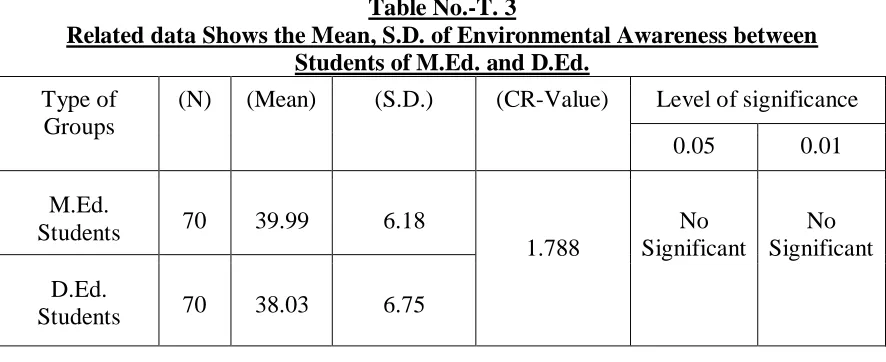
Table No.-T. 3
Related data Shows the Mean, S.D. of Environmental Awareness between Students of M.Ed. and D.Ed.
Type of Groups
(N) (Mean) (S.D.) (CR-Value) Level of significance
0.05 0.01
M.Ed.
Students 70 39.99 6.18
1.788
No Significant
No Significant D.Ed.
Students 70 38.03 6.75
(df=N1+N2-2=70+70-2=138)
Findings :
H0
1=
There is no significant difference of Environmental Awareness between Students of D.Ed.and B.Ed
, have resulted that
the calculated C.R. value of Environmental Awareness in bothgroups is 0.743. The table value of C.R. at the level of significance 0.01 & 0.05 for the degree of freedom 138 are 2.58 & 1.97 respectively, which is more than its calculated value at both levels of significance (i.e. 0.01 & 0.05). This is perusal that the null hypothesis has been accepted. There is no significant difference of Environmental Awareness between Students of D.Ed. and B.Ed.
H0=2 There is no significant difference of Environmental Awareness between Students of B.Ed
and M.Ed.,
have resulted that
the calculated C.R. value of Environmental Awareness in bothgroups is 2.612. The table value of C.R. at the level of significance 0.01 & 0.05 for the degree of freedom 138 are 2.58 & 1.97 respectively, which is less than its calculated value at both levels of
significance (i.e. 0.01 & 0.05). This is perusal that the null hypothesis has been rejected. There is a significant difference of Environmental Awareness between Students of B.Ed. and M.Ed. Students of M.Ed. Class have more Environmental Awareness in comparison to Students of B.Ed. Class.
H0=3 There is no significant difference of Environmental Awareness between Students of M.Ed.
freedom 138 are 2.58 & 1.97 respectively, which is more than its calculated value at both levels of significance (i.e. 0.01 & 0.05). This is perusal that the null hypothesis has been accepted. There is no significant difference of Environmental Awareness between Students of M.Ed. and D.Ed.
References
1. Asthana, D.K. and Asthana, M. (2006), Environmental Studies, New Delhi, S.Chand & Company Ltd.
2. Cherif,A.(2010), Journal of Environmental Education, ERIG Document Reproduction Service No. EJ 54546, ERIC Data Base.
3. Pardhan, G.C. (1995), Environmental awareness among Teacher Trainees.University News Monday, Oct.,1995, Vol. 2, PP-10