ARJUN K. GUPTA AND SARALEES NADARAJAH
Received 5 December 2005; Revised 4 May 2006; Accepted 7 May 2006
Three new distributions on the unit interval [0, 1] are introduced which generalize the standard beta distribution. These distributions involve the Bessel function. Expression is derived for their shapes, particular cases, and thenth moments. Estimation by the method of maximum likelihood and Bayes estimation are discussed. Finally, an application to consumer price indices is illustrated to show that the proposed distributions are better models to economic data than one based on the standard beta distribution.
Copyright © 2006 Hindawi Publishing Corporation. All rights reserved.
1. Introduction
Beta distributions are very versatile and a variety of uncertainties can be usefully modeled by them. Many of the finite range distributions encountered in practice can be easily transformed into the standard distribution. In reliability and life testing experiments, many times the data are modeled by finite range distributions, see, for example, [2].
A random variableXis said to have the standard beta distribution with parametersν andμif its probability density function (pdf) is
f(x)=xν−1(1−x)μ−1
B(ν,μ) (1.1)
for 0< x <1,ν>0, andμ >0, where
B(a,b)=
1
0t
a−1(1−t)b−1dt (1.2)
denotes the beta function. Many generalizations of (1.1) involving algebraic, exponential, and hypergeometric functions have been proposed in the literature. Some of these are (see [6, Chapter 25] and [5] for comprehensive accounts)
Hindawi Publishing Corporation
International Journal of Mathematics and Mathematical Sciences Volume 2006, Article ID 16156, Pages1–14
(i) the four-parameter generalization given by
f(x)= 1
(d−c)B(a,b)
x−c
d−c
a−1
1−x−c
d−c
b−1
(1.3)
forc≤x≤d,a >0, andb >0 (see [7, Section 3.2] for a reparameterization of
this);
(ii) the McDonald and Richards [9,13] beta distribution given by
f(x)= pxap−1
1−(x/q)pb−1
qapB(a,b) (1.4)
for 0≤x≤q,a >0,b >0,p >0, andq >0;
(iii) the Libby and Novick [8] beta distribution given by
f(x)= λaxa−1(1−x)b−1
B(a,b)1−(1−λ)xa+b (1.5)
for 0≤x≤1,a >0,b >0, andλ >0;
(iv) the McDonald and Xu [10] beta distribution given by
f(x)= pxap−1
1−(1−c)(x/q)pb−1
qapB(a,b)1 +c(x/q)pa+b (1.6)
for 0≤xp≤qp/(1−c), wherea >0,b >0, 0≤c≤1,p >0, andq >0; (v) the Gauss hypergeometric distribution given by
f(x)=xa−1(1−x)b−1
(1 +zx)γ B(a,b)2F1(γ,a;a+b;−z) (1.7)
for 0< x <1,a >0,b >0, and−∞< γ <∞(Armero and Bayarri [1]), where
2F1(a,b;c;x)=
∞
k=0
(a)k(b)k (c)k
xk
denotes the Gauss hypergeometric function, where (f)k = f(f + 1)···(f + k−1) denotes the ascending factorial;
(vi) confluent hypergeometric distribution given by
f(x)=xa−1(1−x)b−1exp(−γx)
B(a,b)1F1(a;a+b;−γ)
(1.9)
for 0< x <1,a >0,b >0, and−∞< γ <∞(Gordy [3]), where
1F1(a;b;x)=
∞
k=0 (a)k (b)k
xk
k! (1.10)
is the confluent hypergeometric function.
In this paper, we introduce the first generalizations of (1.1) involving the Bessel function. We refer to them as the beta Bessel (BB) distributions. We propose three BB distributions in all.
For each of the three BB distributions, we derive various particular cases, an expres-sion for thenth moment as well as estimation procedures by the method of maximum likelihood and Bayes method (Sections 2to4). We also present an application of the proposed models to consumer price indices (Section 5). The calculations involve several special functions, including the modified Bessel function of the first kind defined by
Im(x)= x
m √
π2mΓ(m+ 1/2)
1
−1
1−t2 m−1/2exp(xt)dt, (1.11)
the2F2hypergeometric function defined by
2F2(a,b;c,d;x)=
∞
k=0
(a)k(b)k (c)k(d)k
xk
k!, (1.12)
and the2F3hypergeometric function defined by
2F3(a,b;c,d,e;x)=
∞
k=0
(a)k(b)k (c)k(d)k(e)k
xk
k!, (1.13)
2. BB distribution I
The first generalization of (1.1) is given by the pdf
f(x)=Cxα−1(1−x)β−1Iν(cx) (2.1)
for 0< x <1,ν>0,α >0,β >0, andc≥0, whereCdenotes the normalizing constant. Application of [12, equation (2.15.2.1)] shows that one can determineCas
1
C=
cνΓ(α+ν)Γ(β) 2νΓ(α+β+ν)Γ(ν+ 1)2F3
α+ν
2 ,
α+ν+ 1
2 ;ν+ 1,
α+ν+β
2 ,
α+ν+β+ 1
2 ; c2 4 . (2.2)
The standard beta pdf (1.1) arises as the particular case of (2.1) forc=0 andν=0. Sev-eral other particular cases of (2.1) can be obtained using special properties ofIν(·). Note
that
I3/2(x)=
2 π
xcosh(x)−sinh(x)
x3/2 ,
I5/2(x)=
2 π
x2+ 3 sinh(x)−3xcosh(x)
x5/2 ,
I7/2(x)=
2 π
xx2+ 15 cosh(x)−32x2+ 5 sinh(x)
x7/2 ,
I9/2(x)=
2 π
x4+ 45x2+ 105 sinh(x)−5x2x2+ 21 cosh(x)
x9/2 .
(2.3)
More generally, ifν−1/2≥1 is an integer, then
Iν(x)=√2√xπexp
πi 2
1
2−ν
× sinh πx 2 1
2−ν
−x
×
[(2|ν|−1)/4]
k=0
|ν|+ 2k−1/2 ! (2k)!|ν| −2k−1/2 !(2x)2k
+ cosh
πx 2
1
2−ν
−x
[(2|ν|−3)/4]
k=0
|ν|+ 2k+ 1/2 !(2x)−2k−1 (2k+ 1)!|ν| −2k−3/2 !
.
2
1.5
1
0.5
0 0.2 0.4 0.6 0.8 1 w
[image:5.468.129.339.69.297.2]Empirical pdf Fitted beta pdf (1) Fitted BB pdf (11)
Figure 2.1. The empirical and fitted densities for the consumer price indices of the United States and the United Kingdom (X=consumer price index of the United States andY=consumer price index of the United Kingdom).
Thus, several particular forms of (2.1) can be obtained for half-integer values ofν. For example, ifν=3/2, then (2.1) reduces to
f(x)=C
2 πc3xα−
5/2(1−x)β−1cxcosh(cx)−sinh(cx). (2.5)
Ifν=5/2, then (2.1) reduces to
f(x)=C
2 πc5xα
−7/2(1−x)β−1I
ν(cx)c2x2+ 3 sinh(cx)−3cxcosh(cx). (2.6)
The modes of (2.1) are the solutions of
α−1
x −
β−1
x +
cIν−1(cx)
Iν(cx) =
ν
c. (2.7)
There could be more than one mode (see Figures2.1and2.2). Thenth moment of (2.1) can be written as
EXn =C
1
0x
n+α−1(1−x)β−1I
3.5
3
2.5
2
1.5
1
0.5
0
0 0.2 0.4 0.6 0.8 1 w
[image:6.468.129.340.69.298.2]Empirical pdf Fitted beta pdf (1) Fitted BB pdf (11)
Figure 2.2. The empirical and fitted densities for the consumer price indices of the United States and Germany (X=consumer price index of the United States andY=consumer price index of Germany).
and an application of [12, equation (2.15.2.1)] shows that (2.8) reduces to
EXn = CcνΓ(n+α+ν)Γ(β)
2νΓ(n+α+β+ν)Γ(ν+ 1)
×2F3
n+α+ν
2 ,
n+α+ν+ 1
2 ;ν+ 1,
n+α+ν+β
2 ,
n+α+ν+β+ 1
2 ;
c2 4
. (2.9)
For a random samplew1,...,wn, the maximum-likelihood estimators (MLEs) of the four parameters in (2.1) are the solutions of
n
i=1
Inwi= −n C
∂C
∂α,
n
i=1
In1−wi = −Cn∂C∂β,
n
i=1 wiIν−1
cwi
Iνcwi =
nν
c −
n C
∂C ∂c, n
i=1
∂Iνcwi /∂ν
Iνcwi = −
n C
∂C ∂ν.
Assuming (2.1) as the prior, the Bayes estimate of the binomial parameter, sayp, is
Ep|x
=CcνΓ(x+ 1 +α+ν)Γ(n−x+β) 2νΓ(n+ 1 +α+β+ν)Γ(ν+ 1)
×2F3
1 +x+α+ν
2 ,
x+α+ν
2 + 1;ν+ 1,
n+ 1 +α+β+ν
2 ,
n+α+β+ν
2 + 1;
c2 4
, (2.11)
wherenis the number of trials andxis the number of successes.
3. BB distribution II
The second generalization of (1.1) is given by the pdf
f(x)=Cxα−1(1−x)β−1exp(cx)I
ν(cx) (3.1)
for 0< x <1,ν>0,α >0,β >0, andc≥0, whereCdenotes the normalizing constant. Application of [12, equation (2.15.4.1)] shows that one can determineCas
1
C=
cνΓ(α+ν)Γ(β) 2νΓ(α+β+ν)Γ(ν+ 1)2F2
ν+1
2,α+ν; 2ν+ 1,α+β+ν; 2c
. (3.2)
The standard beta pdf (1.1) arises as the particular case of (3.1) for c=0 andν=0. Further particular cases of (3.1) can be obtained using (2.4). The modes of (3.1) are the solutions of
α−1
x −
β−1
x +
cIν−1(cx)
Iν(cx) =
ν
c−c. (3.3)
There could be more than one mode (see Figures2.1and2.2). Thenth moment of (3.1) can be written as
EXn =C
1
0x
n+α−1(1−x)β−1exp(cx)I
ν(cx)dx (3.4)
and an application of [12, equation (2.15.4.1)] shows that the above reduces to
EXn = CcνΓ(n+α+ν)Γ(β)
2νΓ(n+α+β+ν)Γ(ν+ 1)2F2
ν+1
2,n+α+ν; 2ν+ 1,n+α+β+ν; 2c
For a random samplew1,...,wn, the MLEs of the four parameters in (3.1) are the solu-tions of
n
i=1
Inwi= −Cn∂C∂α,
n
i=1
In1−wi = −n C
∂C
∂β,
n
i=1
wiIν−1cwi
Iνcwi +
n
i=1
wi=nν
c −
n C
∂C
∂c,
n
i=1
∂Iνcwi /∂ν
Iνcwi = −
n C
∂C ∂ν.
(3.6)
Assuming (3.1) as the prior, the Bayes estimate of the binomial parameter, sayp, is
Ep|x =CcνΓ(1 +x+α+ν)Γ(n−x+β)
2νΓ(n+ 1 +α+β+ν)Γ(ν+ 1)
×2F2
ν+1
2, 1 +x+α+ν; 2ν+ 1,n+ 1 +α+β+ν; 2c
,
(3.7)
wherenis the number of trials andxis the number of successes.
4. BB distribution III
The third and final generalization of (1.1) is given by the pdf
f(x)=Cxα−1(1−x)β−1exp(−cx)Iν(cx) (4.1)
for 0< x <1,ν>0,α >0,β >0, andc≥0, whereCdenotes the normalizing constant. Application of [12, equation (2.15.4.1)] shows that one can determineCas
1
C=
cνΓ(α+ν)Γ(β) 2νΓ(α+β+ν)Γ(ν+ 1)2F2
ν+1
2,α+ν; 2ν+ 1,α+β+ν;−2c
. (4.2)
The standard beta pdf (1.1) arises as the particular case of (4.1) for c=0 andν=0. Further particular cases of (4.1) can be obtained using (2.4). The modes of (4.1) are the solutions of
α−1
x −
β−1
x +
cIν−1(cx)
Iν(cx) =
ν
There could be more than one mode (see Figures2.1and2.2). Thenth moment of (4.1) can be written as
EXn =C
1
0x
n+α−1(1−x)β−1exp(−cx)I
ν(cx)dx (4.4)
and an application of [12, equation (2.15.4.1)] shows that the above reduces to
EXn = CcνΓ(n+α+ν)Γ(β)
2νΓ(n+α+β+ν)Γ(ν+ 1)2F2
ν+1
2,n+α+ν; 2ν+ 1,n+α+β+ν;−2c
. (4.5)
For a random samplew1,...,wn, the MLEs of the four parameters in (4.1) are the solu-tions of
n
i=1
Inwi= −Cn∂C∂α,
n
i=1
In1−wi = −n C
∂C
∂β,
n
i=1 wiIν−1
cwi
Iνcwi −
n
i=1
wi=ncν−Cn∂C∂c, n
i=1
∂Iνcwi /∂ν
Iνcwi = −
n C
∂C ∂ν.
(4.6)
Assuming (4.1) as the prior, the Bayes estimate of the binomial parameter, sayp, is
Ep|x =CcνΓ(1 +x+α+ν)Γ(n−x+β)
2νΓ(n+ 1 +α+β+ν)Γ(ν+ 1)
×2F2
ν+1
2, 1 +x+α+ν; 2ν+ 1,n+ 1 +α+β+ν;−2c
,
(4.7)
wherenis the number of trials andxis the number of successes.
5. Application
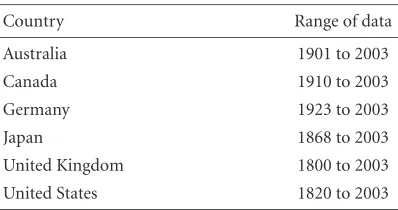
We now illustrate an application of the proposed beta distributions to consumer price index data. We collected the data on this index for the six countries: United States, United Kingdom, Japan, Canada, Germany, and Australia. The data were extracted from the web-sitehttp://www.globalfindata.com/(go to “Sample Data” under “Database” and then look under “Consumer Price Indices” for the closing value of the index) and the range of data for each country is shown inTable 5.1.
Table 5.1. Countries and years of data.
Country Range of data
Australia 1901 to 2003
Canada 1910 to 2003
Germany 1923 to 2003
Japan 1868 to 2003
United Kingdom 1800 to 2003
United States 1820 to 2003
two distributions were fitted by the method of maximum likelihood. The MLEs of the two parameters in (1.1) are obtained by solving the equations
n
i=1
Inwi=nΨ(α)−nΨ(α+β),
n
i=1
In1−wi =nΨ(β)−nΨ(α+β),
(5.1)
whereΨ(x)=dInΓ(x)/dxis the digamma function. The MLEs of (α,β,c) in (4.1) withν fixed asν=1 are obtained by solving (4.6).
The results of the fits were remarkable. In each fit, the maximized log-likelihood for (4.1) turned up significantly higher than that for the standard beta model. Here, we give details for just two of the 15 data sets.
(i) For the (United States, United Kingdom) data set shown inTable A.1of the ap-pendix the fitted estimates wereα=1.392,β=1.230 with logL=5.145 for the standard beta model (1.1); andα=0.820,β= −3.180,c=1.571 with logL= 7.647 for the BB III model (4.1). The corresponding fitted densities superim-posed with the empirical density are shown inFigure 2.1(the empirical density computed using the hist command in theRsoftware package).
(ii) For the (United States, Germany) data set shown inTable A.2of the appendix the fitted estimates wereα=0.914,β=1.130 with logL=1.494 for the standard beta model (1.1); andα=1.405,β=2.370,c=7.828×10⁻⁶with logL=5.198 for the BB III model (4.1). The corresponding fitted densities superimposed with the empirical density are shown inFigure 2.2(the empirical density computed using the hist command in theRsoftware package).
So, we can conclude at least in this situation that the beta Bessel models are better than the one based on the standard beta distribution.
Appendix
Table A.1. Consumer price index data for the United States and the United Kingdom for the years 1820–2003.
Year US CPI UK CPI Year US CPI UK CPI Year US CPI UK CPI
1820 6.2 4.9 1882 7.7 4.1 1944 17.8 7.4
1821 5.9 4.3 1883 7.5 4.3 1945 18.2 7.5
1822 6.1 3.7 1884 7.3 3.9 1946 21.5 7.5
1823 5.8 4.0 1885 7.2 3.7 1947 23.4 7.8
1824 5.5 4.3 1886 7.2 3.4 1948 24.1 8.1
1825 5.6 5.0 1887 7.3 3.4 1949 23.6 8.4
1826 5.3 4.8 1888 7.3 3.4 1950 25.0 8.6
1827 5.5 4.5 1889 7.3 3.4 1951 26.5 9.6
1828 5.5 4.3 1890 7.3 3.4 1952 26.7 10.2
1829 5.6 4.3 1891 7.3 3.6 1953 26.9 10.4
1830 5.2 4.1 1892 7.3 3.6 1954 26.7 10.8
1831 5.4 4.5 1893 7.3 3.3 1955 26.8 11.3
1832 5.5 4.2 1894 7.1 3.5 1956 27.6 11.7
1833 5.6 3.9 1895 7.0 3.5 1957 28.4 12.2
1834 4.9 3.6 1896 7.0 3.4 1958 28.9 12.4
1835 5.7 3.7 1897 7.0 3.5 1959 29.4 12.4
1836 6.5 4.1 1898 7.1 3.5 1960 29.8 12.6
1837 6.9 4.2 1899 7.3 3.4 1961 30.0 13.2
1838 6.8 4.2 1900 7.4 3.4 1962 30.4 13.5
1839 6.8 4.5 1901 7.6 3.3 1963 30.9 13.8
1840 5.7 4.6 1902 7.8 3.3 1964 31.2 14.5
1841 5.7 4.5 1903 7.8 3.4 1965 31.8 15.1
1842 5.3 4.2 1904 7.9 3.4 1966 32.9 15.7
1843 4.9 3.7 1905 8.1 3.4 1967 33.9 16.1
1844 5.0 3.7 1906 8.5 3.4 1968 35.5 17.0
1845 5.2 3.9 1907 8.8 3.5 1969 37.7 17.8
1846 5.6 4.0 1908 8.8 3.4 1970 39.8 19.2
1847 5.6 4.5 1909 9.3 3.5 1971 41.1 20.9
1848 4.9 4.0 1910 9.3 3.5 1972 42.5 22.5
Table A.1. Continued.
Year US CPI UK CPI Year US CPI UK CPI Year US CPI UK CPI
1850 4.9 3.5 1912 9.8 3.7 1974 51.9 29.6
1851 5.7 3.5 1913 10.0 3.8 1975 55.5 37.0
1852 5.7 3.5 1914 10.1 4.1 1976 58.2 42.6
1853 6.1 4.1 1915 10.3 5.0 1977 62.1 47.8
1854 6.1 4.6 1916 11.6 6.1 1978 67.7 51.8
1855 6.4 4.6 1917 13.7 6.8 1979 76.7 60.7
1856 6.5 4.5 1918 16.5 8.1 1980 86.3 69.9
1857 6.7 4.6 1919 18.9 8.3 1981 94.0 78.3
1858 6.6 4.3 1920 19.4 9.8 1982 97.6 82.5
1859 6.0 4.4 1921 17.3 7.1 1983 101.3 86.9
1860 5.8 4.7 1922 16.9 6.6 1984 105.3 90.9
1861 6.0 4.7 1923 17.3 6.5 1985 109.3 96.0
1862 6.6 4.6 1924 17.3 6.6 1986 110.5 99.6
1863 7.5 4.1 1925 17.9 6.4 1987 115.4 103.3
1864 9.1 4.3 1926 17.7 6.4 1988 120.5 110.3
1865 9.8 4.5 1927 17.3 6.2 1989 126.1 118.8
1866 9.9 4.7 1928 17.1 6.1 1990 133.8 129.9
1867 9.8 4.8 1929 17.2 6.1 1991 137.9 135.7
1868 9.4 4.6 1930 16.1 5.6 1992 141.9 139.2
1869 9.1 4.5 1931 14.6 5.4 1993 145.8 141.9
1870 8.7 4.5 1932 13.1 5.2 1994 149.7 146.0
1871 8.5 4.8 1933 13.2 5.2 1995 153.5 150.7
1872 8.6 5.0 1934 13.4 5.3 1996 158.6 154.4
1873 8.4 5.2 1935 13.8 5.4 1997 161.3 160.0
1874 8.4 5.1 1936 14.0 5.6 1998 163.9 164.4
1875 8.0 4.7 1937 14.4 5.9 1999 168.3 167.3
1876 7.7 4.9 1938 14.0 5.7 2000 174.0 172.2
1877 7.3 4.8 1939 14.0 6.4 2001 176.7 173.4
1878 6.8 4.6 1940 14.1 7.2 2002 180.9 178.5
1879 7.3 4.4 1941 15.5 7.4 2003 184.3 183.5
1880 7.5 4.2 1942 16.9 7.3 — — —
Table A.2. Consumer price index data for the United States and Germany for the years 1923–2003.
Year US CPI DE CPI Year US CPI DE CPI Year US CPI DE CPI
1923 17.3 17.8326 1950 25 22.8529 1977 62.1 55.7936
1924 17.3 17.2442 1951 26.5 25.7652 1978 67.7 57.1635 1925 17.9 17.9829 1952 26.7 26.9921 1979 76.7 60.2769 1926 17.7 18.3777 1953 26.9 26.2559 1980 86.3 63.5772
1927 17.3 19.2692 1954 26.7 26.9921 1981 94 67.8739
1928 17.1 19.4475 1955 26.8 27.3546 1982 97.6 70.9873 1929 17.2 19.4348 1956 27.6 27.8025 1983 101.3 72.8554 1930 16.1 18.0339 1957 28.4 28.3949 1984 105.3 74.2876 1931 14.6 16.6584 1958 28.9 28.7063 1985 109.3 75.5953 1932 13.1 15.0537 1959 29.4 29.3289 1986 110.5 74.7858 1933 13.2 15.3593 1960 29.8 29.5781 1987 115.4 75.533 1934 13.4 15.5631 1961 30 30.3875 1988 120.5 76.7784 1935 13.8 15.7159 1962 30.4 31.2593 1989 126.1 79.2839 1936 14 15.8306 1963 30.9 32.3179 1990 133.8 81.4561 1937 14.4 15.8894 1964 31.2 33.0029 1991 137.9 84.1
1938 14 15.9679 1965 31.8 34.3105 1992 141.9 86.9
1939 14 16.1052 1966 32.9 35.3069 1993 145.8 90.6
1940 14.1 16.6545 1967 33.9 35.4936 1994 149.7 92.9 1941 15.5 16.9487 1968 35.5 36.3032 1995 153.5 94.3 1942 16.9 17.3018 1969 37.7 37.0504 1996 158.6 95.7 1943 17.4 17.6353 1970 39.8 38.5448 1997 161.3 97.6
1944 17.8 17.9688 1971 41.1 40.662 1998 163.9 98
1945 18.2 18.8093 1972 42.5 43.2774 1999 168.3 99.1
1946 21.5 20.745 1973 46.2 46.6399 2000 174 101.2
1947 23.4 21.318 1974 51.9 49.3175 2001 176.7 102.8 1948 24.1 25.4258 1975 55.5 51.995 2002 180.9 104 1949 23.6 23.6096 1976 58.2 53.9254 2003 184.3 105.1
Acknowledgments
The authors would like to thank the Editor-in-Chief and the two referees for carefully reading the paper and for their great help in improving the paper.
References
[1] C. Armero and M. J. Bayarri, Prior assessments for prediction in queues, The Statistician 43 (1994), 139–153.
[2] R. E. Barlow and F. Proschan, Statistical Theory of Reliability and Life Testing: Probability Models, Holt, Rinehart and Winston, New York, 1975.
[4] I. S. Gradshteyn and I. M. Ryzhik, Table of Integrals, Series, and Products, 6th ed., Academic Press, California, 2000.
[5] A. K. Gupta and S. Nadarajah, Handbook of Beta Distribution and Its Applications, Statistics: Textbooks and Monographs, vol. 174, Marcel Dekker, New York, 2004.
[6] N. L. Johnson, S. Kotz, and N. Balakrishnan, Continuous Univariate Distributions. Vol. 2, 2nd ed., Wiley Series in Probability and Mathematical Statistics: Applied Probability and Statistics, John Wiley & Sons, New York, 1995.
[7] Z. A. Karian and E. J. Dudewicz, Fitting Statistical Distributions. The Generalized Lambda Distri-bution and Generalized Bootstrap Methods, CRC Press, Florida, 2000.
[8] D. L. Libby and M. R. Novick, Multivariate generalized beta-distributions with applications to utility assessment, Journal of Educational Statistics 7 (1982), no. 4, 271–294.
[9] J. B. McDonald and D. O. Richards, Model selection: some generalized distributions, Communi-cations in Statistics. Theory and Methods 16 (1987), no. 4, 1049–1074.
[10] J. B. McDonald and Y. J. Xu, A generalization of the beta distribution with applications, Journal of Econometrics 66 (1995), no. 1-2, 133–152.
[11] A. P. Prudnikov, Yu. A. Brychkov, and O. I. Marichev, Integrals and Series. Vol. 1. Elementary Functions, Gordon & Breach Science, New York, 1986.
[12] , Integrals and Series. Vol. 2. Special Functions, Gordon & Breach Science, New York, 1986.
[13] D. O. Richards and J. B. McDonald, A general methodology for determining distributional forms with applications in reliability, Journal of Statistical Planning and Inference 16 (1987), no. 3, 365–376.
Arjun K. Gupta: Department of Mathematics and Statistics, Bowling Green State University, Bowling Green, OH 43403, USA
E-mail address:[email protected]
Saralees Nadarajah: School of Mathematics, University of Manchester, Oxford Road, Manchester M13 9PL, UK