GE-International Journal of Engineering Research
Vol. 4, Issue 1, Jan 2016 IF- 4.007 ISSN: (2321-1717)© Associated Asia Research Foundation (AARF) Publication
Website: www.aarf.asiaEmail : [email protected] , [email protected]
SOLID WASTE STABILISATION WITH PHOSPHOGYPSUM IN
ADDITION TO FLYASH
Jani H.J.
Analytical Research Laboratory, Bharuch Enviro Infrastructure Ltd.,
Plot No. 9701-9716, GIDC, Ankleshwar, Bharuch District, Gujarat, India.
ABSTRACT
Since ancient times, a number of stabilization methods are used to improve the properties of the
solid waste. Various studies were carried out on expansive grounds after stabilization with
additives such as cement, lime, cement kiln dust, rice etc., which showed promising results.
Now-a-days easily available industrial by-products are used for the enrichment of solid waste
properties. In the present study, the effects of stabilizing agents such as Phosphogypsum (PG)
and fly ash (FA) have been studied for improving strength in varying percentages. This article
He describes a study to verify the improvements of land ownership with phosphor gypsum in
various percentages(That is, 2, 4 and 6%) with the fixed quantity of fly ash (5%). The unconfined
compression test (UCC) and the microstructure analysis the plot with different percentages of
additives were determined separately after curing the samples for 3 days and 7 days. Strength of
stabilized solid waste is increased with increased amount of stabilizer and care periods.
Keywords— Solid waste, Fly ash, Stabilization, Phosphogypsum
I. INTRODUCTION
compression, can cause serious damage to the civil engineering structures and can lead to very serious economic losses and environmental risks. Thus, these solid wastes must be treated before starting the operation of construction to get desired properties. This has led to the development of the solid waste stabilization techniques. Since the nature and properties of natural solid waste vary widely, a stabilization technique has adequate to be adopted for a particular situation after having considered the solid waste properties. The chemical technique is common ground, stabilization approach, producing a better solid waste quality with greater strength and durability than the mechanical and physical techniques. In many countries of the world, it is to stabilize solid waste especially if you have done the natural resources available locally / industry is available. The use of Phosphogypsum (PG) fly ash(FA) in solid waste stabilization can lead to the construction at low cost and Can provide a means of low environmental impact of their offer Distribution and technical characteristics of the land to improve.
Phosphogypsum is a by-product of the wet process Production of phosphoric acid (phosphates of ammonium
Fertilizer) per share of sulphuric acid on the rocks Phosphates. Ash is one of the residues Generated during the Combustion of Coal powder from the combustion chamber is transported by the exhaust gases. The fly ash is used principal elements, as a stabilizer considering its potentials as construction Pozzolan. In this work, the Study to investigate the force and the microstructure of the clay joined Tata with unconfined Compressive strength test and scanning electron microscope (SEM).
II. LITERATURE REVIEW
the basis of the CBR and UCS tests, the optimum amount of FA and RHA were found to be respectively 12% and 9%. Studies on background solid waste treated with rice husk and lime showed an increase CBR strength and value with increased curing time [3]. The investigations were carried out on the microstructure and strength lime and cement stabilized clays which show that the development of resistance concerns the micro structural changes, increase in hardening time and the admixture content [4]. The micro structural changes in clay cement-stabilized can improve force which can be explained with reference to influential factors, namely, cement content, water content of clay, fly ash content and hardening time [5]. The compressive strength was not confined used as a practical indicator to investigate the force development.
III . OWNERSHIP ' OF THE MATERIALS AND METHODS
Table-1
GEOTECHNICALPROPERTIESOFVIRGINSOLID WASTESAMPLES
Property Value
Solid waste -S1 Solid waste -S2
Specific Gravity 2.42 2.65
Grain size
distribution
Sand,% 2.00 2
Clay,% 28 32
Silt,% 70 67
Liquid Limit,(%) 81.2 71
Plastic Limit,(%) 42 36
Plasticity Index, (%) 40.3 38
Solid waste classification CH CH
Shrinkage Limit,(%) 7.74 5.2
Free Swell Index,% 124 104
Maximum Dry Density,g/cc 1.4 1.52
Optimum moisture content,% 24.63 19.62
Unconfined compressive strength, kPa 72 114
Table-2
CHEMICALCOMPOSITIONOFSOLID WASTESAMPLES, PHOSPHOGYPSUM
ANDFLYASH
Name of the
chemical Symbol
% by weight
Solid waste
-S1
Solid waste
-S2 PG FA
Insolubleresidue IR 82.94 63.30 4.92 39.30
Loss onignition LOI 12 16.25 16.5 2.74
Sulphurtrioxide SO3 0.12 0.22 44.56 4.21
Silica SiO2 52.36 55.84 3.80 35.20
Calciumoxide CaO 3.54 1.17 32.27 19.20
Magnesiumoxide MgO 0.73 0.60 --- 1.73
Alumina Al2O3 13.79 15.77 --- 27.40
IV . SAMPLE PREPARATION AND TEST METHODS
For Unconfined compressive strength test, samples of 38in diameter and 76 mm height mm were prepared for compaction the samples at their optimal moisture content and maximum dry density to maintain the same dry density and water content using mold division. For virgin solid waste testing was performed immediately after sample preparation. For solid waste treated with phosphogypsum and fly ash samples prepared they were placed in polythene covering which have been treated with covering them with wet jute bags. Samples prepared for UCS test were cured for 3 and 7 days and at the end of each hardening period, the samples were tested until fracture. All samples were tested at a speed of axial deformation of 1.2 mm for minute second IS: 2720- (Part X).
V. DISCUSSION OF TEST RESULTS
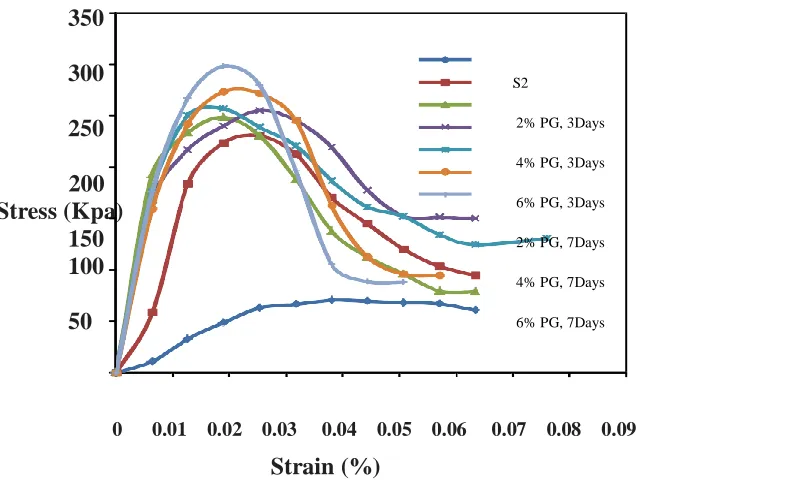
To study the effect of fly ash and various percentages of phosphogypsum on land S1 and S2, tests were UCS performed on solid waste samples prepared in their MDD reached in the test of compaction, after the period of maturation of 3:07days. Stress - deformation behaviour of untreated and treated solid waste samples S1 and S2 for different periods of aging are presented in Fig.1 and 2 respectively.
300
250
200
150
Stress (Kpa)
100
50
0 0.01 0.02 0.03 0.04 0.05 0.06 0.07
Strain (%)
S1
2% PG, 3Days
4% PG, 3Days
6% PG, 3Days
2% PG, 7Days
4% PG, 7Days
Fig. 1. Comparison of stress-strain behaviour of treated and untreated solid waste S1 with
different percentages of stabilizer (Fly Ash: 5%+PG %).
350
300
250
200 Stress (Kpa)
150 100
50
0 0.01 0.02 0.03 0.04 0.05 0.06 0.07 0.08 0.09
Strain (%)
Fig. 2. Comparison of stress-strain behaviour of the solid waste treated and untreated S2with different percentages of stabilizer ( fly ash : 5 % PG + % )From the test results it can be observed that there is a increased stress with the addition of fly ash and various percentages of phosphogypsum for both land and S2 . S1This trend was observed for both the curing period studied .From Fig .1, it can be observed that stress is increase rapidly and reached the peak at a particular strain for treated ground. For the solid waste is not treated , the peak voltage is reached at0.044 % deformation , while for the treated solid waste sample the peak stress was observed in less deformation of the 0.031 % and 0.025 % for periods of care of 3 and 7 days . The same behaviour was observed for S2 terrain that can be observed in Fig.2 .the increase value for UCS treated solid waste is compared ground untreated S1 and S2 and ' increase in the values of UCS various conditions studied are shown in table 3 - .
S2
2% PG, 3Days
4% PG, 3Days
6% PG, 3Days
2% PG, 7Days
4% PG, 7Days
[image:6.612.74.473.117.363.2]A Monthly Double-Blind Peer Reviewed Refereed Open Access International e-Journal - Included in the International Serial Directories.
[image:7.612.79.515.119.275.2]GE-International Journal of Engineering Research (GE-IJER) ISSN: (2321-1717)
TABLE –3
COMPARISONBETWEENPEAKUCSOFTREATEDSOLID WASTEAND
UNTREATEDSOLID WASTE
Solid waste + % PG+ %FA
UCS Value (kPa)
SampleS1 SampleS2
3days 7days 3days 7days
Solid waste + 0% PG+0%FA 75.41 112
Solid waste + 2% PG+5%FA 204.9 224.9 240.6 268.1
Solid waste + 4% PG+5%FA 216.3 239.0 259.5 285.4
Solid waste + 6% PG+5%FA 223.5 266.5 266.5 292.1
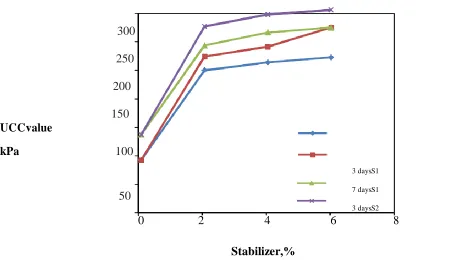
The increase of the minimum UCS value was 1.72 times that of untreated solid waste to the stabilizer (FA: 5% + PG2%)Besides = 2%, seasoning period = 3 days in solid waste S1 but for the solid waste 2the increase is 2.25 times that of untreated solid waste. The UCS value increases linearly with increasing stabilizer content and was independent of the type of solid waste, S1 and S2 (Fig.3.)
300
250
200
150
UCCvalue
kPa 100
50
0 2 4 6 8
Stabilizer,%
Fig. 3. Change in value UCS with the addition of a stabilizer on solid waste S1and S2 (FA: 5%) 3 daysS1
7 daysS1
3 daysS2
[image:7.612.72.533.395.658.2]VI. ANALYSIS MICROSTRUCTURAL
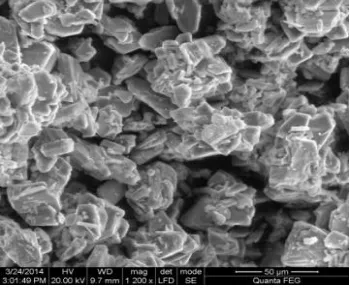
[image:8.612.94.269.184.329.2] [image:8.612.92.271.392.546.2]The technique scanning electron microscope was It employed using a microscope FEI Quanta 200 FEG qualitatively identify developments in micro structure matrix solid waste, fly ash, phosphogypsum and treated solid waste specimens. Fig. 4:05 shows micro structure stabilizers (eg. phosphogypsum and fly ash) and solid waste (Eg. Virgin solid waste and treated solid waste). (A) Phosphogypsum (b) fly ash
Fig. 4. SEM picture of stabilizers
(a) Phosphogypsum (b) Fly ash
Fig. 4. SEM photos of stabilizers
(a) SEM photos of virgin solid wasteS2 (b) SEM photo of treated sampleS2
[image:8.612.390.562.408.547.2](6% PG & 5%FA)
Fig. 5. SEM photos of treated and untreated solid waste sampleS2
Fig. 5. SEM picture of solid waste samples treated and untreated S2It can be observed from Fig. 4 and 5, the samples studied through SEM have very different micro structures. When fly ash and phosphogypsum are in contact with the water, pozzolanic reaction between fly ash and gypsum begins. Due to these pozzolanic reactions occurring during vulcanization period, the strength of solid waste treated with FA and PG is greatly improved.
VII. CONCLUSION
Based on experimental investigations conducted and the analysis of test results, the following conclusions are drawn. Strength of stabilized solid wastes increased with increasing amount of phosphogypsum in addition to the fly ash content of 5%.The aging of the mixture is a measure of how government the chemical reaction of stabilizers is depended on it. So you canconclude that the resistance increases with increase in the period of curing. Unconfined compressive strength of the treated solid wastes was superior to that of untreated solid wastes. The minimum increase is01.72 and 2.25 times for the solid waste S1 and S2 of adding 5% fly ash and 2 % phosphogypsum in a seasoning of 3 days. The addition of the combination of PG with FA stabilizer brands solid waste mixes durable, low cost and effective for solid waste stabilization.
Acknowledgement:
I am thankful to Analytical Research Laboratory which is MoEF, NABL, ISO Certified laboratory to provide all infrastructure and support.
REFERENCES
[1]. Satyanarayana PVV, Rama Rao and R. Krishna Rao CV (2004).The use of lime fly ash stabilized expansive solid waste in roads and levees. Conference Proceedings Indian Geotechnical, Warangal (India).465-467.
[2]. LaxmikantYadu, Rajesh Kumar Tripathi and Dharamveer Singh(2011), "Comparison of fly ash and rice husk ash stabilized black Cotton solid waste ", International Journal of Earth Sciences and Engineering,Volume 04, pp. 42-45.
[4]. Katsutada Onitsuka, ChirdchaninModmoltin and Masakazu Kouno(2001), "Survey on the microstructure and strength of lime and Cement Stabilized Ariake Clay ", reports the Faculty of Science and Engineering, Saga University, Vol.30, No.1.
[5]. Sukun Horpibulsuk, Runglawan Rachan, Avirut Chinkulkijniwat, Yuttana Raksachon and APICHAT Sudeepong (2010), "Analysis of strength development in cement-stabilized salty clay from Micro structural considerations, "Construction and building materials, Vol. 24, pp 2011-2012.
[6]. IS: 1498-1970 ", classification and identification of solid wastes administrations Engineering purposes ", Bureau of Indian Standards, New Delhi.
[7]. IS: 2720 (Part I) - 1983 "Test methods for solid waste - Preparation of Dry Solid waste sample for various tests, "the Bureau of Indian Standards, New Delhi.
[8]. IS: 2720 (Part III) - 1987 "Testing Methods for Solid waste– Determination specific weight ", Bureau of Indian Standards, New Delhi.
[9]. IS: 2720 (Part V) - 1985 Test method for solid waste: Determination liquid limit and plastic limit, the Bureau of Indian Standards, New Delhi.
[10]. IS: 2720 (Part VI) - 1972 Test method for solid waste: Determination factors of withdrawal, the Bureau of Indian Standards, New Delhi.
[11]. IS: 2720 (Part VII) - 1987 "Testing Methods for Solid waste– Determination Water relation Content-density dry compaction Light "Bureau of Indian Standards, New Delhi.
[12]. IS: 2720 (Part X) - 1973 "Testing Methods for Solid waste– Determination of Unconfined Compressive Strength ", Bureau of Indian Standards, New Delhi.