Citation:
Woratschek, H and Horbel, C and Popp, B (2014) Value co-creation in sport manage-ment. European Sport Management Quarterly, 14 (1). 1 - 5. ISSN 1618-4742 DOI: https://doi.org/10.1080/16184742.2013.866302
Link to Leeds Beckett Repository record:
http://eprints.leedsbeckett.ac.uk/2683/
Document Version: Article
The aim of the Leeds Beckett Repository is to provide open access to our research, as required by funder policies and permitted by publishers and copyright law.
The Leeds Beckett repository holds a wide range of publications, each of which has been checked for copyright and the relevant embargo period has been applied by the Research Services team.
We operate on a standard take-down policy. If you are the author or publisher of an output and you would like it removed from the repository, please contact us and we will investigate on a case-by-case basis.
THE SPORT VALUE FRAMEWORK –
A NEW FUNDAMENTAL LOGIC FOR ANALYSES IN SPORT MANAGEMENT
Keywords:
sport value framework, value co-creation, service-dominant logic, sport management, sport
marketing
Authors:
Herbert Woratschek, Prof. Dr., University of Bayreuth, Department of Services Management,
Universitaetsstrasse 30, Bayreuth, Germany, 95447,
Tel. +49-921-55-3497, Fax +49-921-55-3496, [email protected]
Chris Horbel, Assoc. Prof. Dr., University of Southern Denmark,
Department of Environmental and Business Economics,
Niels Bohrs Vej 9, DK-6700 Esbjerg, Denmark,
Tel. +45-6550-4238, Fax +45-6550-1091, [email protected]
Bastian Popp, Dr., University of Bayreuth, Department of Services Management,
Universitaetsstrasse 30, Bayreuth, Germany, 95447,
The Sport Value Framework – A New Fundamental Logic for Analyses in Sport
Management
Research question:
Sports economic theory and management models have frequently been criticized for not
sufficiently explaining phenomena in sport management. This article addresses this gap by
proposing a conceptual framework that can be used to understand sport management
problems and derive appropriate strategies.
Research method:
The framework proposed in this conceptual article has been developed through a critical
review of existing literature on sport management and theoretical considerations based on the
service-dominant logic.
Results and findings:
The sport value framework provides ten foundational premises on value co-creation in sport
management and suggests three levels for its analysis. The main contribution is a new and
better theoretical basis for explaining phenomena in sport management compared with
traditional sport economic thinking. Moreover, the sport value framework provides guidance
in structuring research in sport management.
Practical implications:
The framework encourages researchers and practitioners to rethink their strategies by
1. Introduction
Sports economic theory and management models have frequently been criticized for
not sufficiently explaining phenomena that can be observed in sport management. To gain a
better understanding of real problems and enable the development of suitable strategies,
scholars call for a further development of theories and models used in sport management
(Chelladurai, 2013; Cunningham, 2013). In recent years, much of the discussion about the
suitability of existing theories and models has been related to the extent to which they can
explain collaboration between different parties. Sport management approaches have been
criticized because they cannot sufficiently explain partnerships between sport organisations
(Parent & Harvey, 2008). Some scholars doubt that competitive advantage in team sports can
be examined independently of each actor's competitive scope. For this reason, they propose a
framework for the development and analysis of competitive advantage in professional team
sports (Dolles & Söderman, 2013). Other researchers have realised that theories from general
management or economics, such as institutional theory, have not been well applied to the field
of sport management and are insufficiently integrated into existing models (Washington &
Patterson, 2011). We suggest that a better understanding of sport-specific phenomena and
more appropriate solutions to management problems require a new perspective on sport
markets.
As an answer to the increasingly apparent limitations of traditional marketing and
management approaches, Vargo and Lusch (2004) have suggested such a new perspective for
general marketing. It has become known as ‘service-dominant logic’ (SDL). In the following,
the traditional approaches were frequently referred to as ‘goods-dominant logic’ (GDL).
While we believe that a perspective similar to the one proposed by SDL could be applied to
gain a better understanding of sport management problems, we acknowledge that sport
(simultaneity of cooperation and competition) as a basic principle, the involvement of
volunteers in the creation of services, the importance of emotions, fans’ ultimate loyalty to
their favourite club, and the mixture of profit and non-profit organizations.
We propose a ‘sport value framework’ (SVF) that aims to enable a better
understanding of sport management phenomena and improve management decisions. This
framework is based on the fundamental ideas of SDL, but takes the characteristics of sport
markets into account. We call it the ‘sport value framework’ because it sees the notion of
value as one of the fundamental concepts of contemporary marketing and focuses on how
value is (co-) created in sports. We strongly believe that a new way of thinking about value
creation provides the basis for relevant future research in sport management. This is why we
have chosen “Value Co-creation in Sport Management” as the title of this special issue of
European Sport Management Quarterly.
In the following, we will contrast the two different perspectives on value creation
discussed in marketing research. We start with an overview of goods-dominant logic, the
traditional perspective of economic exchange, and we will show that conventional sport
management thought is in line with this perspective. With this overview, we intend to
demonstrate why the traditional perspective is not suitable for fully understanding the nature
of sport management. Next, we will introduce the general ideas of service-dominant logic,
which will serve as the basis for the development of the sport value framework. We will
conclude with some considerations about the implications of the sport value framework for
future research in sport management.
2. Goods-Dominant Logic
Economic theory and traditional management approaches generally see units of output
(goods) as the fundamental basis of economic exchange. In recent years, this conventional
2004). The term ‘logic’ is used to describe the way of thinking on which traditional theories
and models are based: goods, both products and/or services are the main reason why
economic exchange takes place. The GDL perspective suggests that firms create value by
producing and selling goods (products or services). Here, the term ‘producing’ is used in a
broader sense and is not only limited to manufacturing. This means that, in general, GDL can
include products, services and even complex services such as sport events.
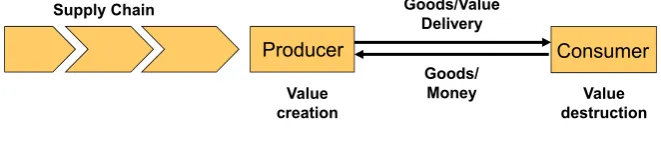
By integrating internal and external resources, value is attached to the units of output
during the production process. External resources are mainly provided by the firm's supply
chain (see Figure 1). Further, service marketing emphasises that customers often also provide
external resources that must be integrated to produce services (Fließ & Kleinaltenkamp, 2004;
Grönroos, 2000). In such instances, firms then use their abilities and competencies to combine
these input factors (internal and external resources) and turn them into goods (products and
services). Ideally, this production process is solely controlled by the firm and results in
homogeneous output. Because of their specific competencies, firms can produce goods that
contain higher value than the sum of their parts. This creates added value that makes goods
attractive to customers, and turns goods into objects of economic exchange (Penrose, 1959;
Prahalad & Hamel, 1990). Customers are the recipients of value; they consume it and thereby
destroy it. From a GDL perspective, value is typically understood as value-in-exchange that is
reflected in the price consumers pay (see Figure 1).
- Insert Figure 1 here -
3. Traditional Thinking about the Nature of Sport Management
In our view, most approaches to sport economics and in sport management are
grounded in GDL, as they interpret sport as something that is 'produced'. For example,
Sullivan (2004, p. 129) argues that satisfying “sport customer needs with sport products and
providing sport products or services to customers is the “nature of sport marketing” (Sullivan,
2004). Parks, Quarterman, and Thibault (2011) use three different models to describe the
sport industry, all of which interpret sports competition as a production process that is
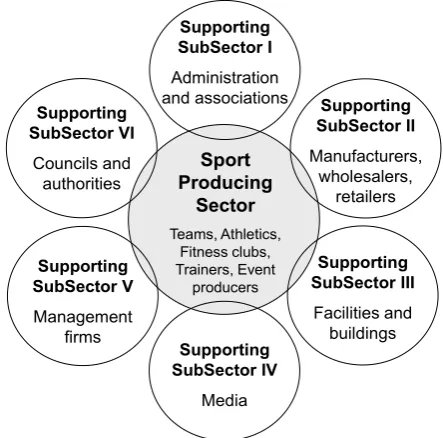
complemented to varying degrees by additional services. One of these models, the ‘sport
activity model’, which was initially proposed by Li, Hofacre, and Mahony (2001), divides the
sport sector into the sport-producing sector and supporting subsectors. Hence, the model sees
sport events as the 'core products' that are complemented by the products and services that
various supporting firms and organisations (see Figure 2) provide.
- Insert Figure 2 here -
The sport activity model acknowledges that, on its own, a single firm or organisation
cannot create sport events. Rather, they require the cooperation of several independent actors.
And yet the model remains grounded in GDL. Similar to concepts such as strategic alliances
or other forms of cooperation between firms in networks (Gulati, 1998; Sydow, 1992), the
sport activity model still focuses on the firm’s production process and the respective
outcomes. Many sport management approaches, which are based on economic theory and
characterize sport competition as a team production process, adopt a similar perspective
(Alchian & Demsetz, 1972; Borland, 2006; Frick, Prinz, & Winkelmann, 2003; Frick &
Simmons, 2008). By interpreting value creation as a production process, these models limit
sport consumers' role to that of buyers and consumers of, for example, 'event products'.
However, this does not mean that consumers have been entirely neglected. In fact,
there is extensive and substantial research on sport consumer behaviour (e.g., Funk, 2012;
Kahle & Close, 2010). Distinctive behaviours of sport consumers, such as basking in reflected
glory (BIRGing)’ (Cialdini et al., 1976) or ‘cutting off reflected failure (CORFing)’ (Snyder,
Lassegard, & Ford, 1986) have been the subject of extensive discussion, as has been sport
these behavioural variables have been used to segment sport consumers and develop fan
typologies (K. A. Hunt, Bristol, & Bashaw, 1999; James & Ross, 2004; Mahony, Madrigal, &
Howard, 2000; Stewart, Nicholson, & Smith, 2003; Tapp, 2004). For instance, Wann and
Branscombe (1990), described two very typical groups of sport consumers: die-hard and fair
weather fans. These two consumer segments are characterized by very different levels of fan
identification, one of the most important drivers of sport fan behaviour (Sutton, McDonald,
Milne, & Cimperman, 1997). Moreover, using either structural equation models (Bodet &
Bernache-Assollant, 2011; Gwinner & Swanson, 2003; Martínez Caro & Martínez García,
2007) or conjoint analysis and discrete choice models (Pedersen, Kiil, & Kjær, 2011;
Theysohn, 2006), empirical studies have analysed the effects of psychological variables such
as satisfaction and team identification on sport consumers’ buying behaviour and loyalty.
These examples of research demonstrate that many facets of sport consumer behaviour
have been studied in the past. However, previous research has not fully appreciated the role of
the customer in the value-creation process. Until now, there has been a widespread
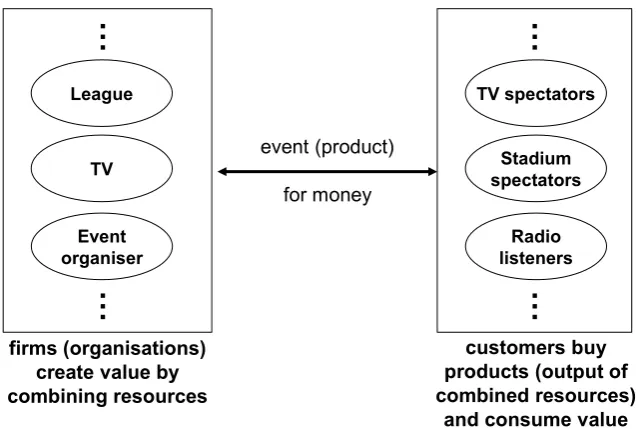
assumption in sport management and economics that value is created by several firms or
organizations (e. g. sport teams, league, media, event organiser, and others in the case of sport
events) that combine their resources. Customers (e. g. TV spectators, stadium spectators, radio
listeners) buy 'products' such as 'sport events' and consume the value that sport organizations
and firms provide. For example, Borland (2006) states that the ‘production’ of a sporting
competition requires four components: players, clubs, a sporting league, and stadium(s). “A
sporting contest consisting of these components, is available to be ‘consumed’ by spectators”
(Borland, 2006, p. 22). This statement represents the perspective of all of the
above-mentioned examples and illustrates the fundamental principle of exchange that underlies most
of the theories and models in sport management and sport economics to date: product (e.g. a
- Insert Figure 3 here -
But does this perspective truly grasp value creation and economic exchange processes
in sports? In other words, can the nature of sport management really be understood through
the lens of GDL?
We believe that many phenomena in sport management cannot be fully understood
from the GDL perspective. For example, firm networks not only 'produce' sport events on
their own. Other stakeholders at various stages before, during or after the event also
contribute to its value. Politicians, for example, often make a significant contribution before
the actual event takes place by making decisions about funding. Their presence during the
event can provide a particular meaning, and their opinion after the event can influence the
perception of others. Perhaps most importantly, it must be considered that fans, who are also
the customers, make an important contribution to sport events. This contribution often begins
long before the event when they start coming up with battle chants and songs, preparing
choreographies to be performed at the stadium or creating fan banners and posters. During the
event, fans of the home and the away teams can contribute to the atmosphere in both positive
and negative ways. Their participation in the value creation process continues after the sport
event when they celebrate victories or jointly come to terms with losses.
While current sport management literature already recognizes that fans contribute to
the atmosphere of sport events, it is necessary to emphasize that their participation in value
creation is essential. Value cannot be created solely by sport organizations and firms. Past
research has not sufficiently appreciated that sport organizations and firms create value jointly
with various customer groups (e.g. fans of home and away teams, VIP guests and other
spectator groups) and other stakeholders (e.g. politicians, journalists). Indeed, value is created
Clearly, many theories and models in sport management do not sufficiently consider
all actors involved in value creation, particularly the customer. Moreover, non-producing
value creation processes, such as problem solving and intermediating activities, are almost
entirely neglected (Stabell & Fjeldstad, 1998). And yet when it comes to sport leagues, for
instance, these kinds of activities are very important. It is hard to define what sport leagues
‘produce’, as their main activity is coordinating market partners to create a sport competition.
This activity is often referred to as the “production of a sporting competition” (Borland,
2006), but we consider this definition misleading. It neither reflects the core of what they
actually do, nor does it describe the 'nature of sport management' at all.
Stabell and Fjeldstad (1998) propose basic types of value creation activities that
translate into three different value configurations. With regard to this typology, sport leagues
mainly create value through intermediating activities, for instance by linking teams in a
competition. A ‘producing’ activity, such as transforming input into output, at best plays a
minor role. The alternative value configurations of Stabell and Fjeldstad (1998) are a first step
toward a better understanding of the nature of sport management. The typology demonstrates
that firms can fulfil market functions other than production. Despite this, it is still assumed
that firms create value and deliver it to customers. However, as already mentioned, fans
contribute considerably to the value created at sport events. For some fans, the competition
itself is not at all important (Koenigstorfer, Groeppel-Klein, & Schmitt, 2010). This is why a
second step is necessary to fully grasp the nature of value creation and economic exchange in
sport. We propose that the ideas provided by the service-dominant logic (SDL) (Vargo &
Lusch, 2004) could be useful in this regard. ‘Value co-creation’ is one of the central tenets of
SDL. It refers to joint value creation by firms, organizations and the customer. As various
actors are involved in value creation, sport organisations and firms do not have full control of
their contributions. As a result, firms and organizations can provide a platform for the value
co-creation of these actors. In the case of sport events, sport organizations and firms can
provide a platform which enables all types of stakeholders, including fans and other
spectators, to co-create value (Ferrand, Chappelet, & Séguin, 2012).
4. Service-Dominant Logic
The introduction of the service-dominant logic (SDL) by Vargo and Lusch (2004)
marked a turning point in thinking about economic exchange. It provided the broad
foundation of value creation that many researchers had been calling for in the previous
decades (Grönroos, 1994; Gummesson, 1995; S. D. Hunt & Morgan, 1995). In our view, SDL
provides insights that have the potential to enhance our understanding of sport management
problems. We thus build on it in our conceptual work.
SDL consistently contrasts the product- or output-centric view of GDL. A key
distinction between both mind-sets is the conceptualization of service. SDL defines the term
‘service’ (singular) as the application of competencies for the benefit of another party. In
contrast, 'services’ in the GDL sense of the term represent units of output (goods as products
and/or services). According to SDL, 'service’, is the basis of economic exchange, and this
means that economic exchange can be characterised as an exchange of service for service.
From the traditional GDL perspective, goods (products or services) are exchanged for money
(or other goods). While goods (products and services) in SDL are no longer regarded as the
basis of economic exchange, they remain significant. Products and services function as
service-delivery vehicles (operand resources) that have knowledge and skills embedded in
them. Hence, operant resources that can be used to act on other resources, such as knowledge,
competencies and skills, are most important for the creation of value (Vargo & Lusch, 2004).
Furthermore, the locus of value creation is no longer confined to the 'producer'.
stakeholders. All actors (e.g. firms, customers, non-profit organisations, government) actively
participate in the value co-creation process by integrating resources from (one or more)
service providers with their personal (e.g. knowledge, competencies and skills) and other
resources. According to SDL, value is always determined by the beneficiary, thus implying
that service providers can only offer value propositions as input for potential value creation.
Value co-creation requires the consumer to integrate the provider’s value proposition with his
or her own skills, as well as with public, market-facing and other resources. As a result, the
entire context of the integration of a firm’s offering leads to heterogeneous value creation and
perception referred to as “value-in-context” (Vargo, 2008).
For example, a mountain bike is a manufacturer's value proposition. Depending on
their personal (e.g. biking skills), public (e.g. availability and accessibility of mountain biking
trails) and other resources (e.g. geography of the region), customers may use the mountain
bike in very different ways (biking on trails vs. biking on streets vs. proudly presenting the
possession of a particular mountain bike brand to others, etc.) and determine very individual
value (Horbel, 2013). In the context of sport events, the organizer's value proposition is a
platform that can be used by various actors (organizations and individuals) to co-create value.
Moreover, value co-creation is a mutual and reciprocal process (i.e. service is exchanged for
service). Not only do firms offer their customers a value proposition that can be integrated
with other resources to create value, customers also do the same for the firms, though usually
indirectly through money (rights to future service) (Vargo, 2009). This is why Vargo and
Lusch (2011) have suggested using the term 'actor' for all entities involved in value
co-creation, emphasizing that the roles of firms and consumers are similar and that a distinction
between them is theoretically obsolete. Since no single actor possesses adequate resources for
value creation, resources (e.g. competencies, knowledge, and skills) are constantly provided
not limited to dyadic relationships between providers and beneficiaries (e.g., firms and
customers), as these central actors must also interact with others to co-create value. SDL thus
advocates a network-with-network model of value creation that enables the central provider
and beneficiary to integrate resources from actors connected with them (see Figure 4).
- Insert Figure 4 here -
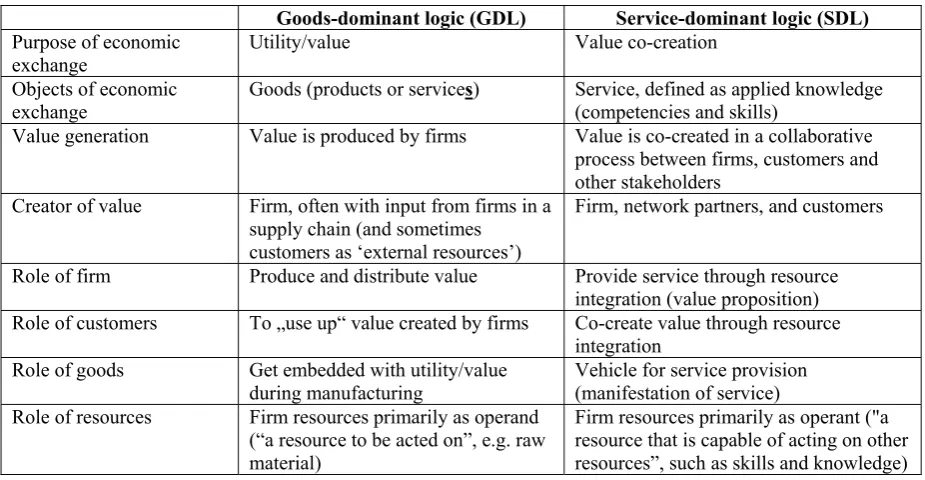
To sum up the basic ideas of SDL and to demonstrate why it can be understood as
another lens through which economic exchange can be viewed, Table 1 highlights the
fundamental differences between the GDL and SDL perspectives.
- Insert Table 1 here -
5. Developing a Sport Value Framework
The SDL briefly outlined above has received a great deal of attention among
academics and practitioners in past years, as it offers a unified understanding of economic
exchange and provides a comprehensive view of value creation. We believe that adopting the
SDL perspective can help advance research and practice in sport management. Based on the
foundations of SDL, we therefore aim to propose a sport value framework (SVF) that enables
a better understanding of sport management phenomena.
A conceptual framework for sport management needs to consider the field's unique
characteristics, for instance the mix of volunteers and professionals, coopetition, events sold
directly and via different media, and emotional customers. Besides addressing these
characteristics, we would like to use the SVF to illustrate the reasons why applying alternative
models of value creation will lead to better analyses, and hence, to more appropriate strategies
in sport management. While we will frequently use sports events as examples throughout the
development of the sport value framework, the SVF should nonetheless be understood as a
general framework for analysis in sport management. In the following, we will provide and
illustrate its usefulness for sport management. We will also discuss three different levels of
analysis of value co-creation. These levels differ with regard to the perspective of analysis and
the degree to which they cover the complexity of value co-creation.
It is generally accepted that sport management is inseparably linked with sporting
activities. The specific characteristics of sports, such as the uncertainty of outcomes, the role
of athletic display, the kinaesthetic nature of sporting activities, the visceral nature of many
types of sporting engagements (Hinch & Higham, 2005), and the extreme emotions involved
in sports (Biscaia, Correia, Rosado, Maroco, & Ross, 2012; Hanin, 2000), clearly distinguish
sport management from other management areas. Consequently, a framework for the analysis
of sport management should be based on this first foundational premise.
FP 1: Sporting activities are the core of sport management.
SDL defines service as the applied knowledge of the actors involved in value creation
and sees it as the basis of all economic exchange (Vargo & Lusch, 2004). One of the central
tenets of SDL, that service is exchanged for service, implies that products or services may still
be involved in economic exchange, but only in the function of appliances for service
provision. If seen through this lens, sport events can no longer be understood as products or
even services. In fact, event organisers can only make a value proposition to the other actors
(Vargo & Lusch, 2004). For sport events, this could be interpreted as providing a ‘platform’
for value co-creation. In such ‘service systems’ (Vargo, Maglio, & Akaka, 2008), the actors
depend on the resources of others to create value, meaning that fans integrate team
performance and teams integrate spectator-induced atmosphere. As a consequence,
service-for-service exchange and resource integration are essential if value is to be created. This is
expressed in the second foundational premise of the sport value framework.
In SDL, goods are seen as vehicles for service provision rather than the primary basis
of exchange (Vargo, 2009). Whether the goods are tangible or intangible is not important, as
applied knowledge is the reason why economic exchange exists. Products and services are
merely the manifestation of applied knowledge (service). Following this logic, sport goods
(products and services) are vehicles that convey the applied knowledge and skills of the actors
involved. They provide consumers with the opportunity to achieve higher-order benefits or
needs (e.g. emotions, meaning, and image). Hence, sport goods can be interpreted as
resources that can be integrated into value co-creation processes (e.g. sporting activities,
spectator sports). These considerations lead to the third foundational premise of the sport
value framework.
FP 3: Sport goods (products and services) are vehicles for service provision.
The first three premises include the basic assumptions underlying the SVF and
characterize the nature of exchange in sport markets. In the following, we aim to shed more
light on value co-creation with regard to the field of sports. We will split these considerations
into different levels of analysis starting with the individual actors up to the entire ecosystem
of value creation.
We suggest that the first and most basic level of analysis of value co-creation is the
‘intra-level’. At the intra-level, the analysis focuses on problems within a subject or within an
organization. These can include the motivations, attitudes or loyalty of consumers, or the
structure of (primary and secondary) activities within an organization.
In contrast to conventional views of value creation in sport management, and as noted
previously, value is not embedded in sport goods and services provided by firms and
organisations, but can only be derived from their use (Grönroos, 2000; Gummesson, 1998).
Interactions between actors (firms or organisations, customers, and other stakeholders) are
According to SDL, the role of each of these actors is to provide service through resource
integration (value proposition) (see Table 1). As mentioned earlier, in the case of sport events,
the value proposition of the event itself can be interpreted as a platform that fans, spectators,
and other actors can use as a means of providing their value propositions. For example, the
value proposition of fans and spectators is usually their contribution to stadium atmosphere
through singing, chanting and other activities. While sport organizations often welcome these
contributions, they can sometimes also be unwanted, for instance in the case of hooligans.
Nevertheless, these value propositions are always part of the value co-creation processes of
others (other spectators, journalists, etc.). Still, it must be emphasized that value propositions
can always serve only as potential input for the value creation of other actors, as value is
always determined by the beneficiary. This is expressed in the fourth foundational premise.
FP 4: Firms and customers can only offer value propositions.
Firms, organisations and customers have been well investigated in sport management
in the past, but mainly through a GDL lens. While these pieces of research are useful in some
regards, they must be re-considered from the SDL perspective. Although it is useful to
understand the activities and behaviours of single actors, from the SDL perspective it is
necessary to understand the entire ecosystem of value creation. Hence, we must be aware of
the limitations of results if research focuses only on firms or customers.
Besides the intra-level, past research in sport management has also often been done at
a micro-level and has examined, for instance, basic relationships between actors. Research has
included the investigation of team-fan relationships (dyad) or team-sponsor-fan relationships
(triad). However, SDL demands broader analyses that consider the entire network of actors
involved in value co-creation (meso-level).
The intra-level can be seen as the link to existing approaches in (sport) marketing and
the field of sport. As previously mentioned, there is both a wealth of research on the supply of
sport events (e.g. the sport activity model (Li et al., 2001)) as well as on sport consumers
(e.g., fan typologies (K. A. Hunt et al., 1999; James & Ross, 2004; Mahony et al., 2000;
Stewart et al., 2003; Tapp, 2004)). However, these approaches fall short of capturing the true
nature of sport management, as value co-creation cannot be solely analysed at an intra-level
that is limited to single actors. Rather, they need to be complemented by research at the
micro- and, in particular, at the meso-level. Nevertheless, we think that limiting research to
the intra- or micro-level can be useful in some instances, as this helps gain a profound
understanding of value co-creation processes from a particular actor’s perspective.
In sport management, the value creation processes of firms and organisations are
usually analysed using Porter’s value chain (1985). Stabell and Fjeldstad (1998) suggested
that, two other generic value configurations (value shop, value network) could be used to
better account for the nature of firms' value creation activities. These value configurations
have been derived from Thompson’s (1967) typology of firm functions, which classifies the
primary activities of firms and organisations into producing, problem-solving and
intermediating activities. As many sport organisations and firms do not primarily ‘produce’
(i.e. transform inputs into outputs), but rather solve the problems of their customers (e.g. ski
schools) or link various actors (e.g. sport events), more suitable value configuration models
(value shops, value networks) should be applied to analyse their value creation processes
(Stabell & Fjeldstad, 1998).
Although a marathon competition can be modelled as a value chain, the value network
configuration is more appropriate. In organising a marathon, the main activity is coordinating
all of the actors involved (i.e. the runners, media, sponsors, volunteers, spectators, etc.).
Likewise, a friendship match between two football teams can be modelled as team production
managing such a match. Organising the event would require coordinating the teams, service
providers in the stadium, fans, VIP guests, media, police, security staff, volunteers, medical
staff, and many other stakeholders. In this instance, the ‘value network’ is most suitable for
analysis, as the main purpose of sport event organisations is linking different partners to
create the event. Similarly, sport leagues do not ‘produce’ in a narrow sense. They do more
than merely turn input into output. Rather, their value proposition is providing a platform and
coordinating teams and other actors. By providing their platform, they also give others the
opportunity to use it as a means of offering their value proposition.
Sport activities and sport competitions are the core of sport management. To create
value, various actors must participate. As a consequence, the purpose of sport firms and
organisations frequently lies in linking these partners to one another: they create value
propositions mainly in the configuration of a value network. Their activities can be supported
by other sport firms or organisations that could focus on producing (value chain) or problem
solving (value shop). However, the value creation of these actors is not that different from that
of other industries. Firms producing and selling sporting shoes and sporting clothes can be
seen as quite similar to firms producing other types of footwear and clothing. The activities of
consultants in the field of sport do not differ much from those of consultants in other
industries.
While the value configurations suggested by Stabell and Fjeldstad (1998) are still
grounded in GDL because they assume that firms and organisations can actually create value,
their models could be interpreted as a means of analysing how organisations create value
propositions. If we restrict these models to this condition, they are useful, even from the SDL
perspective. As discussed earlier, the nature of sport management lies primarily in linking
best described with the value configuration of a value network rather than a value chain, as
has been done in most previous research.
FP 5: Sport firms create value propositions mainly in the configuration of a value
network.
If SDL is used as a lens through which we look at sport events, regarding them as
‘team products’ clearly fails. From the SDL perspective, the term ‘production’ in sport
management is misleading, as value cannot be created in a production process. Single actors
cannot create value at all, because value is always the result of a collaborative process
between various actors. Hence, if research is only focused on the value propositions of firms,
results are limited to the intra-level and the consequences for value co-creation cannot be fully
covered. In the following section, we will thus examine consumers’ value creation processes
before analysing value co-creation at the micro- and meso-levels.
At present, customers are mainly seen as ‘destroyers of value’ (Vargo et al., 2008),
and are mostly analysed individually (Chandler & Vargo, 2011). Similarly, research on sport
events, for example, usually limits the role of sport fans to the consumption of the events.
However, it has been shown that the interaction of customers within social groups also leads
to value. Research on the influence of reference groups (Bearden & Etzel, 1982), social
identity theory (Tajfel, 1974), network theory (Granovetter, 1973; Scott, 2000) or the concept
of many-to-many marketing known from the Nordic School (Gummesson, 2008), illustrate
that consumers cannot be interpreted as independent individuals. Especially at sport events,
consumers often act in a group and/or are influenced by other consumers. Fans and spectators
participate in an event and contribute to it by singing, chanting, acting emotionally and
creating a specific stadium atmosphere. Moreover, sport consumers co-create by contributing
to the reputation of a sport event, for instance by engaging in customer communities (van
Furthermore, the presence of other customers during consumption can influence the perceived
service quality, and hence, the perception of the value propositions (products, services)
(Raghunathan & Corfman, 2006; Ramanathan & McGill, 2007; Uhrich & Benkenstein, 2010).
Watching a football game in a small stadium with many free seats is probably a much
different experience than watching it in a sold-out arena. From these considerations, we derive
our sixth foundational premise.
FP 6: Sport customers co-create value primarily by integrating resources from their
social groups.
Doing research on sport consumers is important, as profound insights into their
behaviour are needed. However, it is necessary to be aware of the limitations of the results, as
such research only considers the intra- or micro-level. To fully grasp the foundations of SDL,
research on the interplay of actors (firms, customers and other stakeholders) in the entire
network of value creation is necessary. This proposition is substantiated by Ferrand,
Chappelet, and Séguin (2012) who argue that Olympic marketing is co-creation of value
through the contributions and interaction of all Olympic stakeholders. Each of these actors
creates both “value for itself and the Olympic brand” (Ferrand et al., 2012). For example,
sponsors create value by providing products and services to the Olympic Games, or by
communicating Olympic values in their advertising campaigns. But, they also use the
Olympic platform to present their own brand, products and services to consumers worldwide.
National Olympic committees (NOCs) build on the Olympic brand in their endeavours for
sport development and education, but are also responsible for protecting the Olympic brand.
The representation of the core values of the Olympic brand is also a key role of the athletes,
which in turn create value for themselves by using the Olympic Games as a platform to
market themselves. Broadcasters enable people around the world to participate in the
them a large audience, and hence, high advertising revenues. Not to forget, fans and
spectators are important actors in value co-creation by contributing to the special atmosphere
of the game, consuming the games on television or buying merchandise. They derive value by
feeling part of something unique and experiencing emotions. The various perspectives of
these and other stakeholders (e.g. IOC, organising committees, governments, professional
sport leagues) are captured in a framework which applies the logic of value co-creation within
the Olympic network (Ferrand et al., 2012). The seventh foundational premise of the SVF
emphasizes the collaborative nature of value creation when considered from the SDL
perspective.
FP 7: Value is always co-created by firms, customers and other stakeholders.
As a first step in this direction, relationships in sport management should be analysed
at a micro-level, meaning at the level of the relationships between actors in dyads and triads.
Three types of dyads between actors are important to understand as parts of the entire
ecosystem of value co-creation: relationships between actors on the supply side, relationships
between actors on the demand side, and relationships between actors on both the supply and
demand sides. Triads are the simplest form of relationship; they acknowledge that focal actors
(firm and customer) often need resources from other stakeholders to co-create value.
In sport management, value is mostly conceptualized as value-in-exchange
(manifested in the market price of a good), thus following the GDL perspective. However, as
previously outlined, value creation in sport management always requires the interaction of
different social actors, which leads to varying and individual outcomes. Value is not merely a
product of buying. Every actor has to integrate his/her own resources with the value
propositions of the other actors. As a result, the beneficiary always determines value
individually. For example, different visitors who experience the same sport event usually
visitors). Since value emerges from the actual use of the product or service, such as the
participation in a sport event, value is commonly referred to as “value-in-use”. This is
expressed in the eighth foundational premise of the sport value framework.
FP 8: Co-created value is always value-in-use.
Traditional models of value creation in sport management fall short of capturing the
true nature of value creation, since they solely focus on quantities or qualities of goods (Parks
et al., 2011; Stabell & Fjeldstad, 1998). For example, conjoint measurement analyses utility
(value) by only considering characteristics of goods (quality). The problem with this approach
is that it neglects the situation in which the consumption process takes place. For example, the
perceived value of new skis can vary considerably in the eyes of a single customer, depending
on a variety of factors such as weather conditions and whether the customer is skiing alone or
with friends.
Clearly, the value of the new skis always depends on the specific context in which
they are used. Chandler and Vargo (Chandler & Vargo, 2011, p. 40) define context as a ‘‘set
of unique actors with unique reciprocal links among them’’. Hence, the resources that can
potentially be integrated in the process of value co-creation depend on the specific context.
Consequently, value propositions can be more valuable in one context but less valuable in
another (Chandler & Vargo, 2011). The context dependence of value creation is
acknowledged in the ninth foundational premise.
FP 9: Co-created value is always value-in-context.
In the case of team sport events, value is always co-created by many different
stakeholders (e.g., league, teams, event organizer, catering providers, security staff,
volunteers, media, fans, etc.). Another example is skiing tourism, where the resources of
funiculars, sport producers, hotels, restaurants, skiing schools, etc. are integrated. Value
private, public, market-facing and other resources, which are provided through networks and
relationships. This network-with-network model of value creation (Vargo, Lusch, Horbel, &
Wieland, 2011) is captured in the tenth foundational premise of the sport value framework.
FP 10: The role of firms, customers and other stakeholders is to integrate the
resources of their specific networks to co-create value.
Value co-creation as a whole can only be captured if the entire context-specific
network is analysed. Analyses in which the whole value co-creation network is the object of
research are carried out at the meso-level. This level reflects the core idea of SDL. We do not
call it the macro-level, as this would refer to the entire economy. Even though an
all-encompassing perspective of value co-creation in sports must sometimes include actors from
politics, the government, and companies from other sectors, the SVF focuses on one particular
and distinctive part of the economy: the sport industry. However, while specific networks do
not include every actor in an economy, analyses cannot focus solely on sport organizations
and sport firms.
Figure 5 provides an overview of the SVF based on ten foundational premises. FP 1 to FP 3
express the nature of economic exchange. They are the basic assumptions that underlie the
sport value framework. FP 4 to FP 10 describe the nature of value co-creation in sport
industries, whereby the complexity of the analysed object increases, from individual actors,
(intra-level) dyads and triads of actors (micro-level), to the entire value co-creation system
(meso-level).
- Insert Figure 5 here -
The SVF aims to provide guidance for analysing this system. Such analyses can be
carried out at three different levels, depending on the matter at hand. The meso-level provides
a comprehensive view of the relationships in a specific sport industry. At the micro-level,
even more complex relationships between actors are analysed, but without full appreciation of
the entire value-creation network. At the intra-level, the analysis focuses on single actors
(organizations, individuals). This level is the link to most existing approaches in (sport)
marketing and management, where there is a rich body of research dedicated to an
understanding of the actors in the field of sport. However, for analyses of value co-creation at
the various levels, the interfaces with other levels must always be kept in mind and the
consequences and limitations of the results considered.
6. Conclusions and Further Research
Current sport economic thinking implies that firms create value by combining
resources and customers buy products and consume value. However, we demonstrate that
building on this GDL perspective in sport management is inappropriate, as it does not
sufficiently explain phenomena that can be observed in practice. For this reason, we suggest
abandoning the GDL perspective in sport management and developing the SVF, which
consists of ten foundational premises based on SDL. This new framework is better suited to
analysing value co-creation in sport management. However, we do not claim that the SVF
contradicts previous sport management literature. Rather, it enhances existing perspectives.
SVF can be applied to re-interpret existing literature, and it can be combined with new
approaches of value co-creation. This provides a full picture that promotes a deeper
understanding of the nature of sport management.
The SVF based on SDL aims to provide guidance in structuring the different pieces of
research in sport management. The fundamental premises can be used to
identify the perspective of a particular analysis,
analyse whether this perspective allows for an appropriate understanding of sport
determine the extent to which analysis goes beyond the inadequate perspective of
many traditional theories and models in sport management and economics.
According to the SVF, sport events should be regarded as platforms where different
actors (e.g. organizations, customers and other stakeholders) co-create value within a network.
We suggest analysing this network at three different levels:
the intra-level, which examines the role and behaviour of sport firms, customers and
other stakeholders,
the micro-level, which comprises the dyadic, triadic and somewhat more complex
relationships between sport firms and customers, and
the meso-level, or the entire network of actors involved in value co-creation on a
sport market and their relationships with one another.
Depending on the matter of interest, value creation should be analysed on one of these
levels. However, it is always necessary to take interfaces with other levels into account and
consider possible limitations and consequences.
In our view, applying the SVF and considering sport events as platforms for
co-creation will lead to new insights in sport management research and practice, as managing a
platform (value network) is different from managing a production process (value chain).
Therefore, researchers and practitioners should be open to breaking new ground and
developing new management approaches. And while the nature of these new approaches
cannot yet be fully anticipated, some of the emerging topics are clear: Managers must be
aware that they have limited control over their organizations' value creation, as they rely on
other actors (e.g. partners, consumers, fans, clubs, and media). Consequently, they must
develop strategies for value co-creation and collaborative brand building with other actors in
the network. However, the influence of customers, potential customers and especially
groups influence the value of a sport event? What is the impact of fan or brand communities
and anti-brand communities on value creation? If sport events are well connected to other
markets, shouldn’t we know more about brand alliances and branded communities in sport?
And what are the consequences of the answers to these questions for the evaluation of brand
values?
Moreover, recognizing that other customers are present on a platform and contribute to
value co-creation calls for the development of new approaches to utility measurement
(discrete choice models) or measurement of service quality. If services cannot solely be
provided by one firm or organization, traditional approaches to measuring service quality and
customer satisfaction (e.g., SERVQUAL , SERVPERF) that do not cover the contributions of
fans, spectators, or VIP guests to service quality are no longer suitable.
Although we cannot yet answer all these questions, we hope that we have successfully
demonstrated that thinking about sport management should change. Applying the SVF based
on SDL is an adventure, and we look forward to seeing to where it will take us in the next ten
years. If one thing is certain, it is that we will think differently about sport management in the
decade to come. We will no longer consider sport events as goods, but as platforms that actors
7. References
Alchian, A. A., & Demsetz, H. (1972). Production, information costs, and economic
organization. The American Economic Review, 62(5), 777-795.
Bearden, W., & Etzel, M. (1982). Reference Group Influence on Product and Brand Purchase
Decisions. Journal of Consumer Research, 9(2), 183-194.
Biscaia, R., Correia, A., Rosado, A., Maroco, J., & Ross, S. (2012). The effects of emotions
on football spectators' satisfaction and behavioural intentions. European Sport
Management Quarterly, 12(3), 227-242.
Bodet, G., & Bernache-Assollant, I. (2011). Consumer Loyalty in Sport Spectatorship
Services: The Relationships with Consumer Satisfaction and Team Identification.
Psychology & Marketing, 28(8), 781-802.
Borland, J. (2006). The production of professional team sports. In W. Andreff & S.
Szymanski (Eds.), Handbook on the Economics of Sport (pp. 22-26). Cheltenham:
Edward Elgar.
Chandler, J. D., & Vargo, S. L. (2011). Contextualization and value-in-context: How context
frames exchange. Marketing Theory, 11(1), 35-49.
Chelladurai, P. (2013). A personal journey in theorizing in sport management. Sport
management review, 16(1), 22-28.
Cialdini, R. B., Borden, R. J., Thorne, A., Walker, M. R., Freeman, S., & Sloan, L. R. (1976).
Basking in Reflected Glory - Three (Football) Field Studies. Journal of Personality
and Social Psychology, 34(3), 366-375.
Cunningham, G. B. (2013). Theory and theory development in sport management. Sport
management review, 16(1), 1-4.
Dolles, H., & Söderman, S. (2013). The network of value captures in football club
professional team sports. In S. Söderman & H. Dolles (Eds.), Handbook of Research
on Sport and Business. Cheltenham: Edward Elgar Publishing.
Ferrand, A., Chappelet, J.-L., & Séguin, B. (2012). Olympic Marketing. London: Routledge.
Fließ, S., & Kleinaltenkamp, M. (2004). Blueprinting the service company: Managing service
processes efficiently. Journal of Business Research, 57(4), 392-404.
Frick, B., Prinz, J., & Winkelmann, K. (2003). Pay inequalities and team performance:
empirical evidence from the North American major leagues. International Journal of
Manpower, 24(4), 472-488.
Frick, B., & Simmons, R. (2008). The impact of managerial quality on organizational
performance: evidence from German soccer. Managerial and Decision Economics,
29(7), 593-600.
Funk, D. (2012). Consumer Behaviour in Sport and Events. Marketing Action (2 ed.). Oxford:
Butterworth-Heinemann.
Granovetter, M. S. (1973). The Strength of Weak Ties. American Journal of Sociology, 78(6),
1360-1380.
Grönroos, C. (1994). From Marketing Mix to Relationship Marketing. Management Decision,
32(2), 4-20.
Grönroos, C. (2000). Service management and marketing: A Customer Relationship
Management Approach. West Sussex, UK: John Wiley & Sons.
Gulati, R. (1998). Alliances and Networks. Strategic Management Journal, 19(4), 293-317.
Gummesson, E. (1995). Relationship Marketing: Its Role in the Service Economy. In W. J.
Glynn & J. G. Barns (Eds.), Understanding Services Management (pp. 224-268). New
York: John Wiley.
Gummesson, E. (1998). Implementation requires a relationship marketing paradigm. Journal
Gummesson, E. (2008). Extending the service-dominant logic: from customer centricity to
balanced centricity. Journal of the Academy of Marketing Science, 36(1), 15-17.
Gwinner, K., & Swanson, S. R. (2003). A model of fan identification: antecedents and
sponsorship outcomes. Journal of Services Marketing, 17(3), 275-294.
Hanin, Y. L. (2000). Emotions in Sport. Champaign, IL: Human Kinetics.
Hinch, T., & Higham, J. (2005). Sport, Tourism and Authenticity. European Sport
Management Quarterly, 5(3), 243-256.
Horbel, C. (2013). Service-dominant logic and tourism management. Enriching each other.
Business Administration Review, 73(2), 131-142.
Hunt, K. A., Bristol, T., & Bashaw, R. E. (1999). A conceptual approach to classifying sports
fans. Journal of Services Marketing, 13(6), 439-452.
Hunt, S. D., & Morgan, R. M. (1995). The comparative advantage theory of competition. The
Journal of Marketing, 59(2), 1-15.
James, J. D., & Ross, S. D. (2004). Comparing sport consumer motivations across multiple
sports. Sport Marketing Quarterly, 13(1), 17-25.
Kahle, L. R., & Close, A. G. (2010). Consumer Behavior Knowledge for Effective Sports and
Event Marketing. New York: Routledge.
Koenigstorfer, J., Groeppel-Klein, A., & Schmitt, M. (2010). "You'll Never Walk Alone" -
How Loyal Are Soccer Fans to Their Clubs When They Are Struggling Against
Relegation? . Journal of Sport Management, 24(6), 649-675.
Li, M., Hofacre, S., & Mahony, D. (2001). Economics of Sport. Morgantown, WV: Fitness
Information Technology.
Mahony, D. F., Madrigal, R., & Howard, D. (2000). Using the psychological commitment to
team (PCT) scale to segment sport consumers based on loyalty. Sport Marketing
Martínez Caro, L., & Martínez García, J. A. (2007). Cognitive–affective model of consumer
satisfaction. An exploratory study within the framework of a sporting event. Journal
of Business Research, 60(2), 108-114.
Parent, M. M., & Harvey, J. (2008). Towards a Management Model for Sport and Physical
Activity Community-based Partnerships. European Sport Management Quarterly,
9(1), 23-45.
Park, C. W., & Mittal, B. (1985). A theory of involvement in consumer behavior: Problems
and issues. In J. N. Sheth (Ed.), Research in consumer behavior (Vol. 1, pp. 201-232).
Greenwich, CT: JAI Press.
Parks, J., Quarterman, J., & Thibault, L. (2011). Managing Sport in the 21st Century. In P.
Pedersen, J. Parks, J. Quarterman & L. Thibault (Eds.), Contemporary Sport
Management (4 ed., pp. 5-27). Champaign, IL: Human Kinetics.
Pedersen, L. B., Kiil, A., & Kjær, T. (2011). Soccer Attendees' Preferences for Facilities at
the Fionia Park Stadium: An Application of the Discrete Choice Experiment. Journal
of Sports Economics, 12(2), 179-199.
Penrose, E. T. (1959). The Theory of the Growth of the Firm. New York: Sharpe.
Porter, M. E. (1985). Competitive advantage. New York u.a.: Free Press.
Prahalad, C. K., & Hamel, G. (1990). The Core Competence of the Corporation. Harvard
Business Review, 68(3), 79-91.
Raghunathan, R., & Corfman, K. (2006). Is happiness shared doubled and sadness shared
halved? Social influence on enjoyment of hedonic experiences. Journal of Marketing
Research, 386-394.
Ramanathan, S., & McGill, A. L. (2007). Consuming with others: Social influences on
moment‐to‐moment and retrospective evaluations of an experience. Journal of
Scott, J. (2000). Social network analysis. London: Sage.
Snyder, C. R., Lassegard, M. A., & Ford, C. E. (1986). Distancing after group success and
failure: Basking in reflected glory and cutting off reflected failure. Journal of
Personality and Social Psychology, 51(2), 382-388.
Stabell, C. B., & Fjeldstad, O. D. (1998). Configuring value for competitive advantage: On
chains, shops, and networks. Strategic Management Journal, 19(5), 413-437.
Stewart, B., Nicholson, M., & Smith, A. (2003). Sport Consumer Typologies: A Critical
Review. Sport Marketing Quarterly, 12(4), 206-216.
Sullivan, M. (2004). Sport Marketing. In J. Beech & S. Chadwick (Eds.), The Business of
Sport Management (pp. 128-153). Harlow: Pearson Education.
Sutton, W. A., McDonald, M. A., Milne, G. R., & Cimperman, J. (1997). Creating and
Fostering Fan Identification in Professional Sports. Sport Marketing Quarterly, 6(1),
15-22.
Sydow, J. (1992). Strategische Netzwerke - Evolution und Organisation (Strategic Networks -
Evolution and Organisation). Wiesbaden: Gabler.
Tajfel, H. (1974). Social identity and intergroup behaviour. Social science information, 13(2),
65-93.
Tapp, A. (2004). The loyalty of football fans - We'll support you evermore? The Journal of
Database Marketing & Customer Strategy Management, 11(3), 225-246.
Theysohn, S. (2006). Willingness to pay for soccer reports on the internet. International
Journal of Sports Marketing and Sponsorship, 8(1), 16-33.
Thompson, J. D. (1967). Organizations in action: social science bases of administrative
Uhrich, S., & Benkenstein, M. (2010). Sport Stadium Atmosphere: Formative and Reflective
Indicators for Operationalizing the Construct. Journal of Sport Management, 24(2),
211-237.
van Doorn, J., Lemon, K. N., Mittal, V., Nass, S., Pick, D. n., Pirner, P., et al. (2010).
Customer Engagement Behavior: Theoretical Foundations and Research Directions.
Journal of Service Research, 13(3), 253-266.
Vargo, S. L. (2008). Customer Integration and Value Creation: Paradigmatic Traps and
Perspectives. Journal of Service Research, 11(2), 211-215.
Vargo, S. L. (2009). Toward a transcending conceptualization of relationship: a
service-dominant logic perspective. Journal of Business & Industrial Marketing, 24(5/6),
373-379.
Vargo, S. L., & Lusch, R. F. (2004). Evolving to a New Dominant Logic for Marketing.
Journal of Marketing, 68(1), 1-17.
Vargo, S. L., & Lusch, R. F. (2011). It's all B2B… and beyond: Toward a systems perspective
of the market. Industrial Marketing Management, 40(2), 181-187.
Vargo, S. L., Lusch, R. F., Horbel, C., & Wieland, H. (2011). Alternative Logics for
Service(s): From Hybrid Systems to Service Ecosytems. In D. Spath & W. Ganz
(Eds.), Taking the Pulse of Economic Development. Service Trends (pp. 123-135).
München: Hanser.
Vargo, S. L., Maglio, P. P., & Akaka, M. A. (2008). On value and value co-creation: A
service systems and service logic perspective. European Management Journal, 26(3),
145-152.
Wann, D. L., & Branscombe, N. R. (1990). Die-Hard and Fair Weather Fans: Effects of
Identification on BIRGing and CORFing Tendencies. Journal of Sports and Social
Washington, M., & Patterson, K. D. W. (2011). Hostile takeover or joint venture: Connections
between institutional theory and sport management research. Sport management
review, 14(1), 1-12.
Woratschek, H., & Schafmeister, G. (2005). New Business Models for the Value Analysis of
Sport Organisations. Wirtschaftswissenschaftliche Diskussionspapiere, Rechts- und
Wirtschaftswissenschaftliche Fakultät, Universität Bayreuth, Diskussionspapier 07-10.
Bayreuth.
Zaichkowsky, J. L. (1985). Measuring the Involvement Construct. Journal of Consumer
Table 1: Comparison of GDL and SDL (adapted from Vargo, Maglio, & Akaka, 2008, p. 148)
Goods-dominant logic (GDL) Service-dominant logic (SDL) Purpose of economic
exchange Utility/value Value co-creation
Objects of economic
exchange Goods (products or services) Service, defined as applied knowledge (competencies and skills) Value generation Value is produced by firms Value is co-created in a collaborative
process between firms, customers and other stakeholders
Creator of value Firm, often with input from firms in a supply chain (and sometimes
customers as ‘external resources’)
Firm, network partners, and customers
Role of firm Produce and distribute value Provide service through resource integration (value proposition) Role of customers To „use up“ value created by firms Co-create value through resource
integration Role of goods Get embedded with utility/value
during manufacturing Vehicle for service provision (manifestation of service) Role of resources Firm resources primarily as operand
(“a resource to be acted on”, e.g. raw material)
Figure 1: Goods-Dominant Logic (adapted from Vargo, 2009)
Producer Consumer
Goods/Value Delivery
Goods/ Money Value
creation
Value destruction Supply Chain
Goods are mainly
Figure 2: Sport Activity Model (adapted from Li et al., 2001)
Supporting SubSector I
Administration
and associations Supporting
SubSector II
Manufacturers, wholesalers,
retailers
Supporting SubSector III
Facilities and buildings
Supporting SubSector IV
Media
Supporting SubSector V
Management firms
Supporting SubSector VI
Councils and authorities
Sport Producing
Sector Teams, Athletics,
Fitness clubs, Trainers, Event
Figure 3: The State of Thought on the Nature of Sport Management
TV spectators
Stadium spectators
Radio listeners event (product)
for money
firms (organisations) create value by combining resources
customers buy products (output of combined resources)
and consume value
…
…
…
…
League
TV
Figure 4: Service-Dominant Logic (adapted from Vargo, 2009)
Firm Customer
Service (value proposition)
Service (e.g. money)
Resource integration Resource integration
Figure 5: Sport Value Framework
FP 1 Sporting activities are the core of sport management.
FP 2 Service is the fundamental basis of exchange in sport.
FP 3 Sport goods (products and services) are vehicles for service
provision.
FP 4 Firms and customers can only offer value propositions.
FP 5 Sport firms create value propositions mainly in the configuration of
a value network.
FP 6 Sport customers co-create value primarily by integrating resources from their social groups.
FP 7 Value is always co-created by firms, customers and other stakeholders.
FP 8 Co-created value is always value-in-use.
FP 9 Co-created value is always value-in-context.
FP 10 The role of firms, customers and other stakeholders is to integrate the resources of their specific networks to co-create value. Meso-Level
Micro-Level Intra-Level