EFFECT OF NORMAN CROWDER’S PROGRAMMED INSTRUCTION MODEL ON UNDERGRADUATES’ ACADEMIC ACHIEVEMENT IN DYNAMICS:
IMPLICATIONS FOR EFFECTIVE TEACHING AND LEARNING OF MATHEMATICS AND PHYSICS
Dr. Samuel Onyinyechi Nneji
Department of Science and Computer Education, Faculty of Education Enugu State University of Science and Technology (ESUT) Enugu
Dr. Rose Chigoziri Anamezie
Department of Science and Computer Education, Faculty of Education Enugu State University of Science and Technology (ESUT) Enugu
Abstract
This study investigated the Effects of Norman Crowder’s Programmed Instruction Model on Undergraduate Academic Achievement in Dynamics. The design was a pretest –posttest, nonequivalent control group, quasi-experimental design. Three research questions and three hypotheses guided the study. The study was conducted at Enugu state university of science and technology from where 32 undergraduates made up of 18 mathematics education and 14 physics education students all from science and computer education department were drawn and used as sample for the study. Dynamics Achievement Test (DAT) was used for data collection. DAT was developed by the researchers. It was made up of Thirty (30) multiple choice questions with four options each. DAT was validated by three research experts. Kuder-Richardson’s formula 20 (KR-20) was used to determine the reliability test (internal consistency). The reliability coefficient of .63 was obtained for DAT. Research Questions were answered using mean statistics and standard deviation. Test of hypotheses was done using analysis of covariance (ANCOVA) at .05 level of significance. Major findings of the study showed that mathematics education and physics education undergraduates taught dynamics with Norman Crowder’s programmed instruction model achieved higher than their counterparts taught the same topics with expository method also the subjects of the study did not differ significantly in their academic achievement based on their gender and area of specialization. It was recommended that Norman Crowder’s programmed instruction model be adopted by mathematics and physics lectures in tertiary institutions.
Keywords: Norman Crowder, Programmed Instruction Model, Academic Achievement, Dynamics, Effective, Teaching, Learning, Mathematics, Physics
International Research Journal of Human Resources and Social Sciences
ISSN(O): (2349-4085) ISSN(P): (2394-4218)
Impact Factor- 5.414, Volume 5, Issue 4, April 2018
Introduction
No doubt, one cannot talk of functional education without science. The role of science in the
achievement of Nigeria’s or any nation’s educational objectives and aspirations is, to say the
least most vital. Grant (2015) defined science as systematized knowledge in any field. Ricky
(2012) stated that science consists essentially of an attempt to understand the relations of
selected aspects of things and events in the real world, an attempt which should have both
intuitive and logical components, and which must be based on observation and tested by
further observation. Parchy (2013) defined science as the systematic study of man and his
environment based on the deductions and inferences which can be made, and the general laws
which can be formulated from reproducible observations and measurement of events within
the universe.
Furthermore, Omenka (2012) defined science as the study of nature. According to Harrison
science is an exploration of natural phenomenon. Science seeks to provide a consistent model
of the universe. It therefore, explains why and how things happen. Its task is to explain
natural events, processes or phenomena. It seeks to disclose universally valid, objective, and
verifiable relationships in order to make predictions, and understand causal relationships
systems in nature. This means that science is dynamic and scientific facts have predictive
power. It portrays a scientist as someone in constant investigation and whose field of
investigation is his natural world, he develops some curiosity as to the happenings around
him. In a bid to answer the questions that arise; he gains explanation of phenomena. Science
is therefore different from other forms of arm chair theorizing and philosophizing.
Tenty (2014) stated that good scientific skills and competences are great assets to students.
This is because science is a tool for developing critical and logical thinking that can facilitate
the learning of all other subject. It is also a tool for educating the mind. Science gives the
individual a fuller understanding of the world around him and this understanding can be
applied to solving our day to day problems. Vema (2015) described mathematics as the call
of sciences. Vema maintained that mathematics is closely related to all sciences but the closet
to mathematics among the core sciences (physics, chemistry and biology) is physics. Zachy
(2014) collaborated Samuleson’s view claiming that over 70% of physics content is
mathematics based. Romanus (2014) described the unity of mathematics and physics as
cordial and beneficial to science students. Mathematics and physics, according to Vema, do
matter in relation with practical human activities. One of the areas the unity of mathematics
and physics is illustrated is in the study of mechanics generally and dynamics in particular.
Dynamics is concerned with the study of forces and torques and their effects on motion. In
mathematics, dynamics is grouped among applied mathematics. In physics dynamics is
grouped under mechanics. Mathematics and physics students in tertiary institutions, be it
colleges of education, poly-technics, mono-technics or universities offer courses in dynamics
although the courses may differ in course codes and titles. Isaac Newton’s laws of motion
defined fundamental physical laws which govern dynamics. Dynamics generally involves a
study of how a physical system might develop or alter over time as well as the causes of those
changes. The study of dynamics falls into two categorizes namely linear and rotational.
Linear dynamics according to Wilson (2015) pertains to objects moving in a line and involves
such quantities as force, mass/inertia, displacement (in units of distance), velocity (distance
per unit time), acceleration (distance per unit of time squared) and momentum (mass times
unit of velocity).
Furthermore, Wilson explained that rotational dynamics pertains to objects that are rotating
or moving in a curved path and involves such quantities as torque, moment of
inertia/rotational inertia, angular displacement (in radians or less often, degrees), angular
velocity (radians per unit time), angular acceleration (radians per unit of time squared) and
angular momentum (moment of inertia times unit of angular velocity). From the foregoing, it
is the clear that good skills and competences in dynamics are veritable tools in the hands of
any science students. Unfortunately, research evidences such as Bucky (2015), Tragbala
(2015) and Presco (2016) reported that undergraduates do not perform satisfactorily in
dynamics.
The researchers cited above and a hand full of other research evidences consistently blamed
students’ poor academic achievement in dynamics on instructional method and other related
factors. Without fear of controversy, one can make bold to say that teaching methods or
instructional strategies are indispensible in the quest to elicit maximum and optimal
performances from learners. Hence, the search for effective and efficient instructional
strategy constitutes great percentage of research concerns among educators in general and
science educators in particular. This search has lead to various innovations and creativity in
the theory of instructional method. Some of the innovative teaching strategies recommended
oriented, problem solving, computer-aided instruction, delayed formalization, self-regulated
learning, concept mapping, discovery, cooperative learning and programmed instruction.
Programmed instruction according to Ricky (2012) is a method of presenting new subject
matters to students in a graded sequence of controlled steps. Learners work through the
programmed material by themselves at their own speed and after each step test their
comprehension by answering an examination question or filling in a diagram. The learners
are then immediately shown the correct answer or given additional information. Computers
and other types of teaching machines are often used to present the material, although books
may also be used. Tenty (2014) averred that programmed instruction consists of a network of
statements and tests, which direct the student to new statements depending on his pattern of
errors. It is based on a particular tool which is called teaching machine. There are various
origins and flavors of programmed instruction. The most important to subcategories are;
linear programs (in the skinner tradition) and branched programs (in the Crowder tradition).
This study is focused on branched programmed instruction as propounded by Norman
Crowder.
Branching Sequences/Branching Programming
The founder of Branching programming is Norman Crowder, hence it is also known as
Crowderian Model. It is based on conjuration theory of learning. It is a problem solving
approach. It is stimulus centered approach of learning. As the word branching means the
subdivision the stem or trunk. The same concept is applied in the branched programming
instruction style. The main concept (the trunk of the tree) is sub divided into smaller concepts
(the stems of the tree) and further again to other minute details of the topic. Norman Crowder
has given its definition as ―It is a programme which adapts to the needs of the students
without the medium of extrinsic device as a computer. It is called intrinsic because the learner
within himself makes the decision, to adapt the Learning to his/her needs. The rationale of
intrinsic programming postulates that the basic learning takes place during the student‘s
exposure to the new material on each page. In branching programme, the learning material is
divided into units of material called “frames‘. Much information, one or two paragraphs or
even a page, is provided in a frame.
Thus each frame is quite larger than that employed in linear programme. The learner goes
through the frame. After that he is required to respond to multiple choice questions associate
with the learning material of the frame. The learner moves forward if he answers correctly
but is diverted (branched) to one or more remedial frames if he does not. These frames
mistakes, and then return him to original frame. This cycle goes on till the learner passes
through the whole instructional material at his own pace. Each Content frame includes the
following: Repeating student response; Positive commotion; New information; Question and
Alternatives followed by page numbers, where the student should go next. Each Remedial
frame includes the following: Repeating student response; Negative commotion; Reasons
why he is wrong; Further explanation in simple language and Directions as to where the
student should go next.
Features of Branching programme
The features of branching programme include:
1) Material in a frame is larger; much information is presented at each step. A step may
consist of two or more paragraphs and sometimes a full page.
2) The method of student response is different than that of linear model; student has to make
choice out of several choices. Multiple-choice question are asked. Each response to the
question is keyed to different pages. If the learner selects correct response, his response is
confirmed and in case he selects wrong response, then he routed to material which explains as
to why he is wrong.
3) Crowder holds that teaching is communication and so he concentrates his attention upon
the improvement of communication.
4) Learner has freedom to choose his own path of action according to the background of
subject matter. The learner controls the exact sequence that he will follow.
5) The programmer has sample opportunity to exploit the literary style.
6) Student is more alert and concentrates on the subject matter more carefully.
7) Detection and concentration of errors is important. Crowder holds that making error is
basic to learning. He permits 20 percent errors in his model. In such a model the errors are
detected and then corrected. The learner knows why he is wrong. Crowder says that it is
impractical to eliminate errors in the process of learning the crucial and identifying feature of
branching model is the fact that the material presented to each student is continuously and
directly controlled by the learner‘s performance in answering questions.
8) Intrinsic programmed material when presented in a book form, the book is called
scrambled book because the pages do not follow in a normal sequence.
9) It is very useful to concept learning or where the material is given larger steps.
10) The role of active response is not central in intrinsic theory. Intrinsic programme less
As effective as Norman Crowder programmed instruction model may sound in enhancing
students’ academic achievement, research evidences have reported conflicting findings on its
efficacy with regard to mathematics and physics. While Bucky (2015) and Barley (2016)
found that this teaching model promoted students’ academic achievement. Grant (2015) and
Presco (2016) found the contrary. Also Zachy (2014) and Vema (2015) found that male
undergraduates achieved higher than their female counterparts in a programmed instruction
class while Omenka (2012) and Romanus (2014) reported that female undergraduates
outperformed their male counterparts when taught the same content with program instruction
model. This gap of no definitive conclusion justifies the need for more studies such as this
present work.
Statement of the Problem
The role of science in general and mathematics and physics in particular in achieving the
functional education required for the attainment of the Nigerian national objectives cannot be
over-emphasized. The unity of mathematics and physics has been described as mutual and
beneficial. One of the concepts studied both in mathematics and physics at tertiary education
levels is dynamics. Mathematics and physics educators have consistently portrayed dynamics
as a very important concept. The study of dynamics can equip the science undergraduates’
with basic competences and skills to excel even in other topics and courses. Regrettably,
undergraduates’ achievement in dynamics is yet to hit the satisfactory level. Research
evidences have consistently implicated teaching method as a major factor causing this
menace.
Of all the innovative instructional strategies, programmed instruction, especially Norman
Crowder’s model has been widely recommended, yet there is still no definitive conclusion as to its effect on students’ achievement in mathematics and physics. More worrisome, also is
the no definitive conclusion on the influence of Norman Crowder’s programmed instruction
model on academic achievement of male and female undergraduates. This study therefore
was a deliberate attempt to bridge the gap highlighted above.
Purpose of the Study
The purpose of this study was to investigate the Effects of Norman Crowder’s Programmed
Specifically, the study aimed at investigating the effects of Norman Crowder’s Programmed
Instruction Model on undergraduates;
I. Achievement in Dynamics
II. Achievement in Dynamics with regard to gender (male and female)
III. Achievement in Dynamics with regard to students’ area of specialization
(mathematics education and physics education).
Research Questions
The following research questions guided the study
1. What are the mean dynamics achievement scores of the students in both experimental (those taught with Norman Crowder’s Programmed Instruction Model) and control
(those taught with expository method) in pretest and posttest?
2. What are the mean dynamics achievement scores of male and female undergraduates
in the experiment?
3. What are the mean dynamics achievement scores of mathematics education and physics education students in the experiment?
Hypotheses
The following research hypotheses were tested at .05 level of significance
1. There is no significant difference between the mean dynamics achievement scores of students in the experimental and control groups.
2. There is no significant difference between the mean dynamics achievement scores of male and female students in the experiment.
3. There is no significant difference between the mean dynamics achievement scores of mathematics education and the physics education students in the experiment.
Methodology Research Design
The research design adopted in the conduct of this investigation was quasi-experimental
design. Specifically the design was a pretest –posttest, non-equivalent control group design.
This study was conducted at Enugu state university of science and technology from where 32
from science and computer education department were drawn and used as sample for the
study. The sample was also made up of 23 female and 9 male students.
Dynamics Achievement Test (DAT) was used for data collection. DAT was developed by the
researchers. It was made up of Thirty (30) multiple choice questions with four options each.
The DAT was drawn using table of specification to ensure adequate coverage of the content
areas covered in the study, hence the content validity. DAT was validated by three research
experts. After necessary corrections as directed by the experts, it was confirmed to be valid
and suitable for the study. Since the items of DAT are dichotomously scored,
Kuder-Richardson’s formula 20 (KR-20) was used to determine the reliability test (internal
consistency). The reliability coefficient of .63 was obtained for DAT.
Experimental Procedures
At the beginning of the experiment, DAT was administered to all the subjects of the study as
pretest. Thereafter, the treatment was administered for a period of five weeks. The
experimental group was taught the selected topics in dynamics using Norman Crowder’s
Programmed Instruction Model while the control group was taught the same topics using
expository method. At the expiration of the treatment period, the DAT was re-arranged and
administered to all the subjects as posttest. Research Questions were answered using mean
statistics and standard deviation. Test of hypotheses was done using analysis of covariance
(ANCOVA) at .05 level of significance.
Results
Research Question One
What are the mean dynamics achievement scores of the students in both experimental (those
taught with Norman Crowder’s Programmed Instruction Model) and control (those taught
with expository method) in pretest and posttest?
Table 1: Pretest and Posttest mean dynamics achievement scores of the experimental and control groups
Group n Pretest Mean Standard Deviation Posttest Mean Standard Deviation
Experimental 16 38.9 11.0 69.5 4.1
Control 16 40.0 11.1 44.2 8.8
From table 1, the pretest mean dynamics achievement score and standard deviation of the
experimental group were 38.9 and 11.0 respectively while those of the control group were
standard deviation were 69.5 and 4.1 respectively for experimental group while 44.2 and 8.8
were those of control group. Apparently both groups scored poorly in the pretest and the
standard deviations of 11.0 and 11.1 for both groups were high showing that there were more
extreme values; only a few scores clustered around the mean, therefore the mean scores for
both groups in the pretest were not very reliable.
However, in the posttest, experimental group achieved higher with a mean of 69.5 and lower
standard deviation of 4.1 unlike the control group which achieved lower with a mean of 44.2
and a higher standard deviation value of 8.8. Comparing with the pretest data, learning took
place in both groups but better in experimental group. Also the mean score for experimental
group was more reliable than that of control group as revealed by the standard deviation
values of both groups. There were more extreme scores in the control group.
Research Question Two
What are the mean dynamics achievement scores of male and female undergraduates in the
[image:9.595.67.539.367.515.2]experiment?
Table 2: Mean Achievement scores of male and female students in pretest and posttest.
Group N Pretest Posttest
Mean SD Mean SD
Male (Experimental) 5 39.1 10.8 67.8 5.5
Female
(Experimental)
11 38.0 10.9 68.2 4.0
Male (Control) 4 39.8 10.8 42.9 9.0
Female (Control) 12 39.9 11.0 43.4 8.2
From table 2 above the posttest mean score of the male (Experimental) was 67.8 while that of
female (Experimental) was 68.2. Similarly, the posttest mean score of the male (control) was
42.9 while that of female (Control) was 43.4. This result suggests that both experimental
groups (male and female) achieved equally and both control groups (male and female)
achieved equally.
Research Question Three
What are the mean dynamics achievement scores of mathematics education and physics
Table 3: Mean Achievement scores of mathematics education and physics education students in pretest and posttest.
Group N Pretest Posttest
Mean SD Mean SD
Mathematics (Experimental)
9 38.5 9.9 69.0 3.7
Physics
(Experimental)
7 39.0 11.1 68.9 3.9
Mathematics (Control)
9 40.2 11.0 43.6 8.1
Physics (Control) 7 38.4 10.2 44.0 8.9
From table 3 above the posttest mean score of the mathematics education (Experimental) was
69.0 while that of physics education (Experimental) was 68.9. Similarly, the posttest means
score of the mathematics education (control) was 43.6 while that of physics education
(Control) was 44.0. This result suggests that both experimental groups (mathematics and
physics students) as well as control groups (mathematics and physics) did not differ
significantly in their academic achievement in the study.
Hypothesis 1: There is no significant difference between the mean dynamics achievement scores of students in the experimental and control groups.
Hypothesis 2: There is no significant difference between the mean dynamics achievement scores of male and female students in the experiment.
[image:10.595.35.526.510.690.2]Hypothesis 3: There is no significant difference between the mean dynamics achievement scores of mathematics education and the physics education students in the experiment.
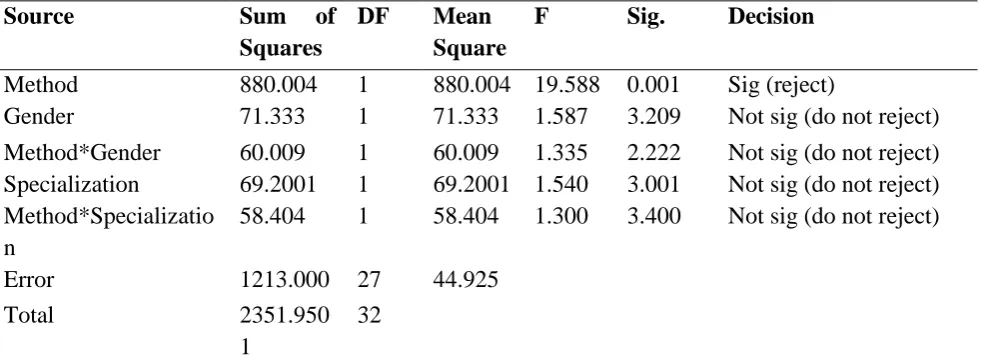
Table 4: ANCOVA analyses of the students’ mean mathematics achievement scores.
Source Sum of
Squares
DF Mean
Square
F Sig. Decision
Method Gender 880.004 71.333 1 1 880.004 71.333 19.588 1.587 0.001 3.209 Sig (reject)
Not sig (do not reject)
Method*Gender Specialization Method*Specializatio n 60.009 69.2001 58.404 1 1 1 60.009 69.2001 58.404 1.335 1.540 1.300 2.222 3.001 3.400
Not sig (do not reject) Not sig (do not reject) Not sig (do not reject)
Error 1213.000 27 44.925
Total 2351.950
1
32
From table 4, instructional method (programmed instruction/expository) as main effect gave
at .05 level of significance, the f value of 19.588 is significant. Therefore, hypothesis 1 is
rejected as stated. This indicates that there is a significant difference between the mean
achievement scores of the experimental and control groups in favour of the experimental
group who were taught dynamics with Norman Crowder’s programmed instruction model.
Students’ gender (male/female) as main effect gave an f value of 1.587 and this is significant
at 3.209. Since 3.209 is greater than .05, this means that at .05 level of significance, the f
value 1.587 is not significant. Therefore, hypothesis 2 is not rejected as stated. This indicates
that there is no significant difference between the mean dynamics achievement scores of male
and female students in the experiment. This result is further validated by the test for
interaction effect between method and gender which is not significant.
In the same vein, students’ area of specialization (mathematics education/physics education)
as main effect gave an f value of 1.540 and this is significant at 3.001. Since 3.001 is greater
than .05, this means that at .05 level of significance, the f value 1.540 is not significant.
Therefore, hypothesis 3 is not rejected as stated. This indicates that there is no significant
difference between the mean dynamics achievement scores of mathematics education and the
physics education students in the experiment.
Interaction effect between (method*specialization) proved insignificant. Hence, collaborating
this result.
Summary of findings
Findings made in this study can be summarized thus
1. Mathematics education and physics education undergraduates taught dynamics with Norman Crowder’s programmed instruction model achieved higher than their
counterparts taught the same topics with expository method.
2. Male and female mathematics education and physics education undergraduates with Norman Crowder’s programmed instruction model did not differ significantly in their
academic achievement.
3. Mathematics education and physics education students taught dynamics with Norman
Implications for Effective Teaching and Learning of Mathematics and Physics
The findings of this study have serious implications for effective teaching and learning of
mathematics and physics. Formost, the findings have shown that teaching methods or
methodology is very important in the educational system. According to Parchy (2013)
methodology is the analysis of the principles of methods, rules and postulates employed by a
discipline or the systematic study of methods that are, can be, or have been applied within a
discipline. Methodology, hence, includes a philosophically coherent collection of theories,
concepts or ideas as they relate to a particular discipline or field of inquiry. Obviously,
methodology refers to the rationale and the philosophical assumptions that underlie a
particular study relative to the scientific method. Grant (2015) defined methodology as the
study of the methods of teaching or the study and practice of various methods of teaching.
This implies that methodology is both the study of different methods and the systematic
means of presenting subject matter and learning experiences. Many of the methods of
teaching have their origins in the various theories of learning. The study of methodology
covers not only the philosophy of methods but also the influence of psychological principles
involved in learning.
Ricky (2012) posited that early attempts to develop a methodological foundation of
mathematics and physics attempted to vindicate them as disciplines free of error that did
justice to their arrogant and secular epithets as the most perfect of all sciences. Vincent
(2014) argued that if mathematics and physics are, as the Platonist tradition suggested, just an
entity out there waiting to be discovered, then it will be enough for schools to present the
curriculum instruction as a mere collection of facts, definitions and algorithms. In that
regard, teaching mathematics and physics would be like just transmitting an immutable body
of knowledge that students have to accept as a perennial fact without any reasoning.
However, if mathematics and physics are empirical activities, then learners are in the position
of constructing their own mathematics and physics knowledge regardless, of how different
their methodology may be from cannon of orthodox and classical science, (Nneji, 2017). This
later view forms the basis of this study.
From the findings of this study, mathematics and physics educators should bear in mind that
it is often possible for learner’s to learn the ‘how’ (that is procedures) mechanically without
understanding ‘why’ it works (that is conceptual knowledge). Procedures learnt this way are
often forgotten easily. Conceptual and procedural understanding actually helps each other.
Conceptual knowledge is important for the development of procedural fluency. While fluent
findings of this study show that Norman Crowder’s programmed instruction model can
facilitate both conceptual and procedural understanding when properly utilized.
To programmed instruction designers, the findings of this study and the conflicting results of
reviewed empirical studies imply that well designed programmed instruction models have the
potentials to promote students’ achievement in mathematics and physics. Hence, designers
should bear in mind that the arousal features of programmed instruction models need not
overshadow the intended lessons. The play and amusement features of programmed
instruction models should elicit both emotional and cognitive interest of learners. Seductive
details should be eliminated. Programmed instruction models should be designed as simple as
possible. Hence, with minimum computer literacy or proficiency, a mathematics and physics
teacher can use it to teach profitably.
Furthermore, the findings of this study imply that students taught mathematics and physics
with programmed instruction models can achieve very well regardless of their gender and
area of specialization. The findings of this study have serious implications to the student. This
is because the programmed instruction model, as a constructivist process, is a
student-centered model. In student-student-centered models, generally, the students are in charge. The teacher
offers minimal guides and allows the students to construct their own understanding by seeing
relationships between incoming information and their previous knowledge. Students thus,
determine their own knowledge based on their own way of processing information and
according to his or her own beliefs and attitudes towards learning. From the foregoing,
students taught mathematics and physic with programmed instruction model are expected to
develop skills for indepth analysis of any given problem. These skills will enable them think
reflectively, creatively and productively. Since programmed instruction model is
student-centered, it implies that if the process fails, students should bear commensurate blames.
Recommendations
Consequent upon the findings of this study, the following recommendations are made;
1. Norman Crowder’s Programmed Instruction Model should be used in teaching
mathematics and physics in tertiary institutions.
2. Mathematics and physics lecturers should be trained through intensive seminars, workshops and in-service trainings on the use of Norman Crowder’s Programmed
Conclusions
Based on the findings of this study, the following conclusions were made;
1. Norman Crowder’s Programmed Instruction Model enhances undergraduates’
achievement in mathematics and physics.
2. Norman Crowder’s Programmed Instruction Model affects male and female students’
achievement in dynamics equally.
3. Norman Crowder’s Programmed Instruction Model affects mathematics education
and physics education students’ achievement in dynamics equally.
References
Barley, P. (2016). Effect of Programmed Instruction Model on 5th grade pupils’ achievement in physics. http://www.African quarters.org/journal 5(2). 230- 241.
Retrieved 05/11/2015.
Bucky, P.N (2015). Validating High school basic sciences. Eds science journal (4),
502-516. www.edsjournal.com
Grant H. (2015) Efficacy of Programmed Instruction in promoting creative and
critical thinking among secondary school students. www.edu support.net/newsletter.
448010322/ ABSTRACT. Retrieved 08/05/2016.
Nneji, S.A. (2017). Effect of Delayed Formalization Strategy on Secondary School Students’
Achievement and Retention in Algebra in Enugu state. Benue State University
Journal of Education.
Omenka, A. M. (2012). Effect of Self Programmed Instruction on students’ achievement in
mathematics in Public and private secondary schools. www.mathscorner/tcl.com.
Retrieved 08/05/2016.
Parchy, W.J. (2013) Effects of Programmed Instruction on students’ achievement and
Learning in mathematics. Journal of Technology Education 14 (2) 101-222
http://www.scholar/ib.vt. edui/ ejour/ijev/1472/haynie/. html Retrieved 02/02/2015.
Presco, P.A. (2016) Effect of Programmed Instruction on students; achievement in
physics. www.artscorner/tcl.com. Retrieved 08/05/2016.
Ricky, S.K. (2012) Enhancing Achievement of students in physics through Programmed
Instruction. http://www.artscorner.prg.com./journal 12(1). 118-129. Retrieved
Romanus, J. B. (2014). The effect of Programmed Instruction. Journal of social sciences
Learning 23(1) 260 – 270. New York: Blackwell Publishing Ltd.
Tenty, P.Q. (2014) Percentage coverage of the stated behavioural objectives for basic
sciences in Eastern Canada. http://www.jer.infotex/vol6.com. Retrieved 6/8/15.
Tragbala, H. (2015) Efficacy of Programmed Instruction in promoting creative and
critical thinking among secondary school students. www.edu support.net/newsletter.
448010322/ ABSTRACT. Retrieved 08/05/2016.
Vema, A. M. (2015). Effect of Programmed Instruction on students’ achievement
in mathematics in Public and private secondary schools. www.mathscorner/tcl.com.
Retrieved 08/05/2016.
Vincent, W.J. (2014) Effects of Programmed Instruction on students’ achievement and
Learning in mathematics. Journal of Technology Education 14 (2) 101-222
http://www.scholar/ib.vt. edui/ ejour/ijev/1472/haynie/. html Retrieved 02/02/2015.
Wilson, P.N (2015). Validating High school basic sciences. Eds science journal 0(4),
502-516. www.edsjournal.com
Zachy, S.K. (2014) Enhancing Achievement of students in physics through Programmed
Instruction. http://www.artscorner.prg.com./journal 12(1) 118-129. Retrieved 04/05