DOI 10.3349/ymj.2008.49.6.909
Purpose: The reliability and validity of a Korean version of the Obsessive-Compulsive-Inventory-Revised (OCI-R) was examined in non-clinical student samples. Materials and Methods:The Korean version of OCI-R was administered to a total of 228 Korean college students. The Maudsley Obses-sive CompulObses-sive Inventory (MOCI), Beck's Depression In-ventory (BDI), and Beck's Anxiety InIn-ventory (BAI) were administered to 228 students.Results:The total and each of subscale of the Korean OCI-R demonstrated excellent internal consistency, good test-retest reliability, moderate convergent validity and good divergent validity. Conclusion: It was concluded that the Korean version of the OCI-R has strong psychometric properties as the original version.
Key Words:Korean Obsessive-Compulsive Inventory-Revised, reliability, validity
INTRODUCTION
Obsessive-compulsive disorder (OCD) is mani-fested by a diverse groups of symptoms that include intrusive thoughts, rituals, preoccupations and compulsions.1 The lifetime prevalence of OCD is
estimated at 2.5 percent in the general population,2
and 0.4 to 2.3 percent in Korean population.3The
causes of OCD are still unclear, but there is growing evidence that OCD has some neurobiological bases. In addition, familial, twin and segregation studies support the role of a genetic component in the etiology of OCD.4,5 The obsessions or
com-pulsions cause severe psychological and behavioral distress to patients which may result in impair-ments in social, occupational functioning and interpersonal relationships. Patients with OCD usually think their symptoms shameful, so they try not to expose their symptoms to others.6 Even
though patients with OCD are distressed with ob-sessions or compulsions which are time-consum-ing and significantly interfere with the person's normal routine, occupational functioning, usual social activities or relationships, they are seldom referred to hospital because their cognitive func-tions and judgments are preserved, thus making them appear normal. As patients with OCD are likely to be misdiagnosed or undiagnosed, it is important to properly screen patients and provide a correct diagnosis to provide them with proper treatment.
Proper tools are needed to make early and cor-rect diagnosis for OCD. Diagnostic tools involve clinical interview by clinician, behavior observa-tion (by self or others) and self-report quesobserva-tion- question-naires. Among these, self-report questionnaires are found to be the most economic and easiest to ad-minister, and there are many self-report question-naires developed and used in clinical practice and research fields. New questionnaires have recently been developed to overcome limitations of their predecessors, particulary their insufficient cover-age of all types of OCD symptoms. These include the Maudsley Obsessive compulsive Inventory,7
Padua Inventory,8 Vancouver Obsessive Compul-sive Inventory,9 Leyton Obsessional Inventory,10
and Obsessive-Compulsive Inventory.11 Each ques-tionnaire has several limitations. The MOCI, for example, has not been reported to be internally
Reliability and Validity of the Korean Version of
Obsessive-Compulsive Inventory - Revised in a Non-clinical Sample
Joon Suk Lim,1 Se Joo Kim,1,2 Woo Taek Jeon,1,2 Kyung Ryul Cha,1 Joon Hyung Park,2 and Chan-Hyung Kim1,2
1Department of Psychiatry and 2Institute of Behavioral Science in Medicine, Yonsei University College of Medicine, Seoul,
Korea.
Received December 13, 2007 Accepted June 4, 2008
consistent nor factorially distinct, and coverage of OCD symptoms other than washing and checking (e.g. hoarding, convert rituals) is limited. The MOCI is also not suitable for measuring changes with treatment, both because of its dichotomous response format and of several items referred to past and permanent events.12,13 For the PI, it has
been reported that several items were found to measure worry rather than obsessions, and it does not encompass certain categories of obsession and compulsions, including neutralizing and hoard-ing.14 The LOI is less applicable to clinical OCD than to subclinical symptoms, because it was developed for homemakers rather than OCD patients, and is insensitive to symptom reductions that are evident in other measures.15 The OCI
consists of 42 items grouped in 7 subscales (check-ing, wash(check-ing, obsess(check-ing, mental neutraliz(check-ing, order-ing, hoardorder-ing, and doubting), measured on two 5-point Likert scales of symptom frequency and associated distress. The OCI shows sound psycho-metric properties in both clinical11 and non-clinical
samples.16 However, since frequency and distress
scales of the questionnaire seemed to be redun-dant, and a revised and shortened version was developed in order to make the administration easier.
The Obsessive-Compulsive Inventory-Revised (OCI-R)17is a shortened version of the
Obsessive-Compulsive Inventory that measures OCD symp-toms. The OCI-R consists of 18 items and provides a total score and scores on six subscales: washing, checking, ordering, obsessing, hoarding, and neu-tralizing. The psychometric properties of the OCI-R showed good to excellent internal consis-tency, test-retest reliability and convergent validity in both clinical and nonclinical samples.17It showed
a good ability to discriminate between patients with OCD and other anxiety groups, with exceptions of its hoarding and ordering subscales. The following studies addressed the psychometric properties of the OCI-R in a student population.18 Six factors were confirmed in a factor analysis, and the OCI-R showed good convergent and divergent validity in one study.17The psychometric properties of Spanish
version of the OCI-R were also examined in a col-lege student sample.19 Confirmatory factor analysis
replicated the original six-factor structure, and the total and each of the subscales of the Spanish
OCI-R demonstrated moderate to good internal consistency and convergent validity and good divergent validity. Recently the Icelandic version of the OCI-R demonstrated strong psychometric properties in a student population.20
Individuals with OCD show a considerable a-mount of heterogeneity and diversity of symptom contents. In addition, diagnostic differentiation from other mental disorders is often difficult, and comorbidity with other mental disorders is high, in particular with major depression and other anxiety disorders.21 The divergent validity of the OCI-R with measures of other kinds of psycho-pathology needs further exploration, particularly in clinical samples. A poor divergent validity with measures of depression, anxiety and worry has been a substantial shortcoming of OCD measures, and has commonly been attributed to a true symp-tom overlap between sympsymp-toms of OCD, other anxiety disorders, and major depression.22Potential
symptom overlap between obsessions and patholo-gical worry has been reported.23,24 There was a
high correlation (r = 0.70) between the OCI-R total score and the Beck Depression Inventory25 total score in a mixed sample of patients with OCD and non-clinical controls. Foa et al. suggest that the high correlations between OCD and depression may reflect high levels of depression observed in OCD patients.17
The goal of this study was to provide Korean version of OCI-R and examine its psychometric properties and factor structure in a sample of col-lege students.
MATERIALS AND METHODS
Participants
measures 10 days later and they constituted for test-retest reliability.
Korean version of Obsessive-Compulsive Inventory-Revised (OCI-R-K)
As described above, the OCI-R17 is a 18-item
self-administered questionnaire that assess the distress associated with obsessions and compul-sions. There are 6 subscales, each with 3 items: washing, checking/doubting, obsessing, mental neutralizing, ordering and hoarding. The items are rated on a 5-point Likert scale between 0 and 4. The English version of the OCI-R was translated to Korean each by 2 residents at the Department of Psychiatry. We made a primary translated edi-tion of OCI-R by reviewing 2 of them. The primary translated edition of OCI-R was then back-trans-lated by an another Korean psychiatrist. The primary translated edition and back-translated edition of OCI-R were supervised by an another Korean psychiatrist who was fluent in English. Finally, the Korean version of OCI-R was com-pleted with supervision by Korean language pro-fessor.
Korean version of Maudsley Obsessive-Compul-sive Inventory: (MOCI-K26)
The Korean version26 of Maudsley Obsessive-Compulsive Inventory7 is a 30-item questionnaire
that assess the obsessive compulsive symptoms. It is composed of dichotomous response format, and scores ranged from 0 to 30. The subscales are cleaning, checking, doubting/conscientiousness and obsessional slowness. Korean version has shown to have good internal consistency, good test-retest reliability and good discriminant, and convergent validity.26
Korean version of Beck's Depression Inventory: (BDI-K27)
The BDI25 is a well-performing, 21 item,
self-report questionnaire designed to assess and evaluate the frequency of depressive symptoms over 1-week period. Score ranges from 0 to 64. The Korean version27of the BDI has demonstrated good reliability and validity in both non-clinical
and clinical samples. The internal consistency coefficient of the Korean version of BDI was 0.92.
Korean version of Beck's Anxiety Inventory: (BAI-K28)
The BAI29 is a well-performing, 21-item,
self-re-port questionnaire designed to assess and evaluate the frequency of anxiety symptoms over a 1 week period. Score ranges from 0 to 63. We admini-stered a Korean version28 of the BAI, and it
demonstrated good psychometric properties. The internal consistency coefficient of the Korean version of the BAI was 0.93, with test-retest relia-bility at r = 0.84.
Procedure
All participants were administered the ques-tionnaires in a group setting during a lecture period. A brief description of the purpose of the study was given, and written consent was obtain-ed. The self report questionnaires which contained OCI-R-K, MOCI-K, BDI-K and BAI-K were admi-nistered to 350 Korean college student partici-pants. From this pool of subjects, 228 participants (male = 143, female = 85) had usable data for the current study. All of them were administered the same self-report measures 10 days later. A subset of 122 participants (male = 72, female = 50) com-pleted a second administration of the question-naires and constituted the sample for test-retest reliability.
RESULTS
Data analysis
Socio-demographic and clinical characteristics of participants
Participants were college undergraduates com-posed of 143(62.3%) male and 85(37.3%) female students. The mean age was 22.5 ± 1.9. The mean education year was 15.1 ± 1.4. The total score of BDI-K and BAI-K were 5.8 ± 5.6 and 6.0 ± 6.6, res-pectively, which showed very low levels of depres-sive and anxiety symptoms.
Factor structure of the OCI-R-K scales
We conducted a confirmatory analysis using AMOS 5.0 in SPSS version 12.0. We evaluated the fit of our data to the original sis factor structure,17
using the maximum likelihood estimation method. To facilitate comparability, we considered the same fit indices used by Foa et al.17and Hajcak et al.18
The model had a significant 2[2(120) = 205.32, p
< 0.0001], a Goodness-of fit Index (GFI) of 0.91, a Comparative Fit Index (CFI) of 0.95, a square residual (RMR) of 0.05, and a root-mean-suare error of approximation (RMSEA) of 0.06. Considering criteria30 by Hu and Bentler (adequate
fit indices are GFI and CFI of 0.90 or greater, and RMR and RMSEA values of 0.06 or lower) our results indicated a good fit for the six-factor model, with values similar to those presented by Hajcak et al.18We also tested a one-factor model, and most indices suggested a poor fit as in Hajcak et al. (2(135) = 450.93,p< 0.0001; GFI = 0.805; CFI = 0.80; RMR = 0.08; RMSEA = 0.10).
Based on the above results, therefore we used
the original subscales developed by Foa et al.17in
all subsequent analysis.
Correlations among OCI-R-K scales
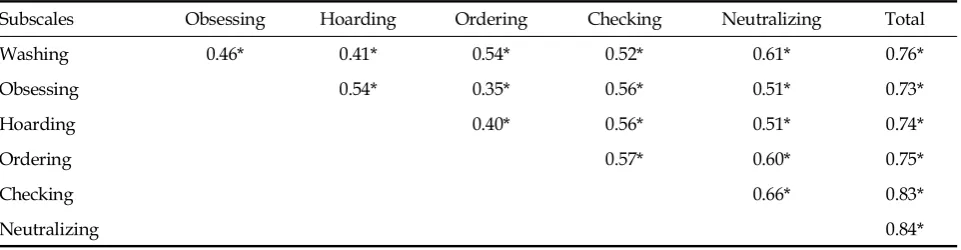
Cohen's criteria31 were used to evaluate the size of the correlations. Correlations > 0.50 were de-fined as "large", from 0.30 to 0.49 as "medium", and from 0.10 to 0.29 as "small". Correlations between each of the subscales and the total scale for the OCI-R-K were found to be large (ranging between 0.73 and 0.84), but inter-correlations among the subscales were medium to large (ranging between 0.35 and 0.66) (Table 1).
Internal consistency and gender differences
Cronbach'sα was calculated and used to assess the internal consistency of the OCI-R-K total and subscale scores. Table 2 shows means, standard deviation and p value for the total OCI-R-K and each of its subscales. Internal consistency for the full scale of the OCI-R was excellent (α= 0.90) and was acceptable for all of the subscales α= 0.70 -0.79). As in previous studies of both the OCI-R17,18
and the OCI,11 the neutralizing subscale had the
lowest alpha, which in our study was same as ob-sessing subscale in our study. In terms of gender differences, men scored significantly higher than women on the obsessing subscale (3.10 ± 2.55 vs. 1.95 ± 2.68; p= 0.00) subscale.
[image:4.595.59.540.583.708.2]The obsessing subscale consists of 3 items: "I find it difficult to control my own thoughts.", "I am upset by unpleasant thoughts that come into my
Table 1. Correlations among OCI-R-K Subscales
Subscales Obsessing Hoarding Ordering Checking Neutralizing Total
Washing 0.46* 0.41* 0.54* 0.52* 0.61* 0.76*
Obsessing 0.54* 0.35* 0.56* 0.51* 0.73*
Hoarding 0.40* 0.56* 0.51* 0.74*
Ordering 0.57* 0.60* 0.75*
Checking 0.66* 0.83*
Neutralizing 0.84*
mind against my will.", "I frequently get nasty thoughts and have difficulty in getting rid of them." Among these 3 items, there was no signifi-cant difference between men and women except the "nasty thoughts" (item 18), where men scored 4 times significantly higher than women (1.05 ± 0.97 vs. 0.27 ± 0.56; p= 0.01).
Test-retest reliability
To assess test-retest reliability between the admi-nistrations, Pearson's r was calculated. Our results
for the OCI-R total score (0.81) were higher than those of Hajcak et al.18 and Fullana et al.19 (0.70
and 0.67) after one month interval. The OCI-R-K subscale scores were somewhat smaller, but higher than 0.62, showing good test-retest reliability.
Convergent validity: OCI-R-K total and subscales
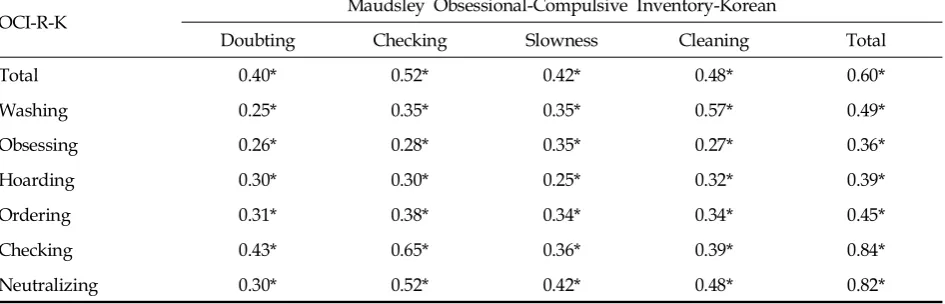
[image:5.595.66.537.134.295.2]OCI-R-K total and subscale score were cor-related with scores on the MOCI-K to assess its convergent validity (Table 3). The OCI-R-K total score showed large correlation with the MOCI-K Table 2. Means, Standard Deviations and Internal Consistency (Cronbach's ) for the OCI-R-K Total Scale andα
Subscales, for the Whole Sample and by Gender
OCI-R-K Group α p value
Males Females Total
Total 16.99 ± 11.31 16.41 ± 12.05 16.78 ± 11.57 0.90 0.72
Washing 1.73 ± 1.96 2.02 ± 2.65 1.84 ± 2.24 0.74 0.34
Obsessing 3.10 ± 2.55 1.99 ± 1.95 2.68 ± 2.41 0.70 0.00
Hoarding 3.27 ± 2.48 3.74 ± 3.03 3.44 ± 2.70 0.75 0.20
Ordering 3.70 ± 2.88 3.55 ± 2.75 3.64 ± 2.82 0.79 0.71
Checking 2.92 ± 2.48 2.69 ± 2.60 2.83 ± 2.52 0.74 0.52
Neutralizing 2.29 ± 2.24 2.41 ± 2.79 2.33 ± 2.46 0.70 0.71
OCI-R-K, Obsessive-Compulsive Inventory-Revised-Korean. The values shown are mean ± SD.
Thep value were determined by independent-samples t test, level 5%.
Table 3. Convergent Validity of the OCI-R-K
OCI-R-K Maudsley Obsessional-Compulsive Inventory-Korean
Doubting Checking Slowness Cleaning Total
Total 0.40* 0.52* 0.42* 0.48* 0.60*
Washing 0.25* 0.35* 0.35* 0.57* 0.49*
Obsessing 0.26* 0.28* 0.35* 0.27* 0.36*
Hoarding 0.30* 0.30* 0.25* 0.32* 0.39*
Ordering 0.31* 0.38* 0.34* 0.34* 0.45*
Checking 0.43* 0.65* 0.36* 0.39* 0.84*
Neutralizing 0.30* 0.52* 0.42* 0.48* 0.82*
[image:5.595.63.536.377.529.2]total score (r = 0.60, p< 0.01), indicating good con-vertgent validity. The washing and checking subscales of the OCI-R-K correlated better with the corresponding cleaning and checking scales of the MOCI-K, respectively, than with other non-corresponding subscales, indicating adequate con-vergent validity.
Divergent validity: OCI-R-K total and subscales
The correlation between the total and subscale scores of OCI-R-K, BDI-K and BAI-K scores were small to medium except the obsessing subscale of OCI-R-K, suggesting adequate discriminant vali-dity of the OCI-R-K (Table 4). It was very similar to previous studies by Hajcak et al.18and Fullana
et al.,19 showed that had the highest correlations
with the BDI-K. There is a well-known potential symptom overlap between obsessions and patholo-gical worry.23,24 Furthermore, Foa et al.17 found a
high correlation (r = 0.70) between the OCI-R and Beck Depression Inventory, as mentioned above. The highest correlation between obsessing subscale of OCI-R-K and BDI-K can be explaned by the relationship between depressive rumination and obsession.18
DISCUSSION
The psychometric properties of newly
develop-ed Korean version of the OCI-R were investigatdevelop-ed in a college student population. Our factor-analytic findings confirmed the original176-factor structure.
For the total and subscales of the OCI-R-K scale, excellent internal consistency was found, which was higher than for the original vergion of the OCI-R previously employed by Foa et al.17 and
Hajcak et al.18 The neutralizing and obsessing
subscale had the lowest alphas, in agreement with previous studies. The test-retest reliability of the Korean version of the OCI-R scale was higher than those by Hajcak et al.18 and Fullana et al.19 The convergent validity of the Korean version of the total and subscales scores of the OCI-R scale was moderate compared with MOCI-K scale, with moderate divergent validity as well. The washing and checking subscales of the OCI-R-K correlated better with the corresponding cleaning and check-ing scales of the MOCI-K, respectively, than with other non-corresponding subscales, indicating ad-equate convergent validity. The divergent validity of the Korean version of OCI-R scale was adequate and similar to previous studies.13,14
Differences among genders were slight, with men scoring higher than women on the obsessing subscale, because of higher rates of endorsement of item 18("I frequently get nasty thoughts and have difficulty in getting rid of them"). On this item, men scored about 4 times higher than women. Fullana et al.19reported that men reported significantly higher subscale scores than women on the hoarding and checking subscales, which was not found in our results. The gender difference shown in the OCI-R subscales may be due to cul-tural differences. It is highly possible that Korean men suffer more from recurrent sexual thoughts than women. However, Koreans are strongly influ-enced by Confucianism for a long time, therefore it may be more reasonable to except that tattoos in sexual expression by Korean women affect the result.
[image:6.595.58.281.123.265.2]There were several limitations in this study. First, the subjects were highly educated and their average age was in early 20s, therefore, it is difficult to state that the subjects represent gene-ral population. Therefore, more studies with various groups should be replicated. Second, subjects of Korean version of OCI-R constituted a non-clinical sample. To ascertain its ability to Table 4. Divergent Validity of the OCI-R-K
OCI-R-K BDI-K BAI-K
Total 0.40 0.43
Washing 0.22 0.27
Obsessing 0.59 0.55
Hoarding 0.37 0.37
Ordering 0.13* 0.17
Checking 0.33 0.37
Neutralizing 0.22 0.26
OCI-R-K, Obsessive-Compulsive Inventory-Revised-Korean; BDI-K, Beck's depression inventory-Korean; BAI-K, Beck's anxiety inventory-Korean.
discriminate OCD from other types of anxiety and depression, the psychometric properties of the Korean OCI-R need to be further examined in clinical samples.
In summary, the Korean version of the OCI-R seems to retain the sound psychometric properties of its original version. Further research is needed, nevertheless, it appears to be an excellent instru-ment for assessinstru-ment of obsessive compulsive sym-ptoms in a Korean population.
REFERENCES
1. American Psychiatric Association. Diagnostic and stati-stical manual of mental disorders: DSM-IV. 4th ed. Washington DC: American Psychiatric Press; 2000. 2. Karno M, Golding JM, Sorenson SB, Burnam MA. The
epidemiology of obsessive compulsive disorder in five US communities. Arch Gen Psychiatry 1988;45:1094-9. 3. Lee CK. A nationwide epidemiological study of mental disorders in Korea. Psychiatry Clin Neurosci 1998;52 (Suppl):S268-S74.
4. Kim SJ, Kim CH. The genetic studies of obsessive-com-pulsive disorder and its future directions. Yonsei Med J 2006;47:443-54.
5. Kim SJ, Kim YS, Kim CH, Lee HS. Lack of association between polymorphisms of the dopamine receptor D4 and dopamine transporter genes and personality traits in a Korean population. Yonsei Med J 2006;47:787-92. 6. Thomsen PH. Obsessive-compulsive disorder: pharma-cological treatment. Eur Child Adolesc Psychiatry 2000; 9:76-84.
7. Sanavio E, Vidotto G. The Components of the Maudsley Obsessional-Compulsive Questionnaire. Behav Res Ther 1985;23:659-62.
8. Sanavio E. Obsessions and compulsions: the Padua Inventory. Behav Res Ther 1988;26:169-77.
9. Thordarson DS, Radomsky AS, Rachman S, Shafran R, Sawchuk CN, Ralph Hakstian A. The Vancouver Obsessional Compulsive Inventory (VOCI). Behav Res Ther 2004;42:1289-314.
10. Cooper J. The Leyton obsessional inventory. Psychol Med 1970;1:48-64.
11. Foa EB, Kozak MJ, Salkovskis PM, Coles ME, Amir N. The validation of a new obsessive-compulsive disorder scale: the obsessive-compulsive inventory. Psychol Assess 1998;10:206-14.
12. Emmelkamp PM, Kraaijkamp HJ, van den Hout MA. Assessment of obsessive-compulsive disorder. Behav Modif 1999;23:269-79.
13. Taylor S, Thordarson DS, Söchting I. Obsessive-com-pulsive disorder. In: Antony MM, Barlow DH, editors. Handbook of assessment and treatment planning for psychological disorders. New York: The Guilfore Press; 2004. p.182-214.
14. Freeston MH, Ladouceur R, Rhéaume J, Letarte H, Gagnon F, Thibodeau N. Self report of obsessions and worry. Behav Res Ther 1994;32:29-36.
15. Stanley MA, Prather RC, Beck JG, Brown TC, Wagner Stanley, Davis ML. Psychometric analyses of the Leyton Obsessional Inventory in patients with obses-sive-compulsive and other anxiety disorders. Psychol Assess 1993;5:187-92.
16. Wu KD, Watson D. Further investigation of the Obses-sive-Compulsive Inventory: psychometric analysis in two non-clinical samples. J Anxiety Disord 2003;17:305-19.
17. Foa EB, Huppert JD, Leiberg S, Langner R, Kichic R, Hajcak G, et al. The Obsessive-compulsive Inventory: development and validation of a short version. Psychol Assess 2002;14:485-95.
18. Hajcak G, Huppert JD, Simons RF, Foa EB. Psychometric properties of the OCI-R in a college sample. Behav Res Ther 2004;42:115-23.
19. Fullana MA, Tortella-Feliu M, Caseras X, Andión O, Torrubia R, Mataix-Cols D. Psychometric properties of the Spanish version of the Obsessive-compulsive Inventory-revised in a non-clinical sample. J Anxiety Disord 2005;19:893-903.
20. Smári J, Olason DT, Eypórsdóttir A, Frölunde MB. Psychometric properties of the Obsessive Compulsive Inventory-Revised among Icelandic college students. Scand J Psychol 2007;48:127-33.
21. Brown TA, Campbell LA, Lehman CL, Grisham JR, Mancill RB. Current and lifetime comorbidity of the DSM-IV anxiety and mood disorders in a large clinical sample. J Abnorm Psychol 2001;110:585-99.
22. Taylor S. Assessment of obsessive-compulsive disorder. In: Swinson RP, Antony MM, Rachman S, Richter MA, editors. Obsessive-Compulsive disorder: theory, re-search, and treatment. New York: The Guilford Press; 1998. p.229-57.
23. Abramowitz JS, Foa EB. Worries and obsessions in in-dividuals with obsessive-compulsive disorder with and without comorbid generalized anxiety disorder. Behav Res Ther 1998;36:695-700.
24. Holaway RM, Heimberg RG, Coles ME. A comparison of intolerance of uncertainty in analogue obsessive-compulsive disorder and generalized anxiety disorder. J Anxiety Disord 2006;20:158-74.
25. Beck AT, Steer RA. Internal consistencies of the original and revised Beck Depression Inventory. J Clin Psychol 1984;40:1365-7.
26. Min BB, Won HT. Reliability and Validity of the Korean translations of Maudsley Obsessional-Compul-sive Inventory and Padua Inventory. Korean J Clin Psychol 1999;18:163-82.
27. Lee YH, Song JY. A Study of the reliability and the Validity of the BDI, SDS, and MMPI-D Scales. Korean J Clin Psychol 1991;10:98-118.
for measuring clinical anxiety: Psychometric properties. J Consult Clin Psychol 1988;56:893-7.
30. Hu LT, Bentler PM. Cutoff criteria for fit indexes in co-variance structure analysis: conventional criteria versus
new alternatives. Struct Equation Model 1999;6:1-55. 31. Cohen J. Statistical power analysis for the behavioral