Citation:
Thomson, S (2015) Building a conversational framework for e-learning to support the future
imple-mentation of learning technologies. In: Smart Learning – teaching and learning with smartphones
and tablets in post compulsory education. MELSIG & Sheffield Hallam University, 86 - 90 (298).
ISBN 1843873834, 978-1843873839
Link to Leeds Beckett Repository record:
http://eprints.leedsbeckett.ac.uk/1475/
Document Version:
Book Section
Creative Commons: Attribution-Noncommercial-No Derivative Works 3.0
The aim of the Leeds Beckett Repository is to provide open access to our research, as required by
funder policies and permitted by publishers and copyright law.
The Leeds Beckett repository holds a wide range of publications, each of which has been
checked for copyright and the relevant embargo period has been applied by the Research Services
team.
We operate on a standard take-down policy.
If you are the author or publisher of an output
and you would like it removed from the repository, please
contact us
and we will investigate on a
case-by-case basis.
framework for e-learning to
support the future
implementation of learning
technologies
Simon Thomson
Let’s start this piece with a quote which aligns with my thinking and was a catalyst for some of the ideas I am about to pour out below.
Transformation is more about the human and
organizational aspects of teaching and learning than it is about the use of technology – Laurillard (2007, p. xvi)
This is fundamental in positioning our approach to technology in learning and teaching, yet it is often lost in the big strategic rollout of technologies and the “minimum expectations” documents which subsequently follow. To start with we need to think a bit differently about what we currently do with technology enhanced learning activity. I am suggesting that we begin by stopping some current practices that we may have:
STOP insisting that everyone who teaches uses technology
Teaching has been around much longer than technology, and learning has successfully taken place without technology so why do we often insist that “everyone” must use technology as part of their teaching?
Smart Learning 87
STOP creating hoops for people to jump through
If your institution has a “minimum expectations” document, for the VLE or equivalent, then within that will likely be a series of requirements (hoops).
The intention of these documents is supposedly good - it’s to make everyone use the technology (see previous paragraph). However in reality it’s not a measure of quality - it’s a measure of compliance.
STOP running workshops run by TEL champions.
This may seem a bit harsh because TEL champions and Learning Technologists are doing a fantastic job, but the reality is that academic colleagues expect them to be good. What is more effective is when people who have made the move from lacking digital confidence to achieving increased digital ability show what they have done. The best evangelists are the converted congregation, not the preacher.
Smart decisions
Therefore when planning to use smart devices in learning & teaching we should refrain from any of the three activities I identified above. Instead the focus of activity should be on the conversation, not on the device(s). Using smart devices in an effective way means making smart decisions and that does not include insisting on their use, creating hoops or running all workshops where the experts demonstrate the potential.
So before you think about buying your smart devices, start by talking about the “why”. Using the 4E Framework (see http://4e.digis.im) is one way in which you might wish to approach those conversations. The basis of the framework is to establish a rationale and ownership model where it is needed. The conversations should be framed around four core questions:
1. What can smart devices enable us to do (that we couldn’t do without them)?
3. How can smart devices enrich our learning experiences (such as add a global dimension to the learning)?
4. How can smart devices empower learners and teachers (giving them choices, such as different locations to teach & learn)? Through these conversations we should seek to establish a clear rationale for using smart devices, but also identify clear potential positive impact. The framework is not hierarchical, there is no requirement for everyone to be empowered and the conversations are best undertaken with mixed staff and student groups.
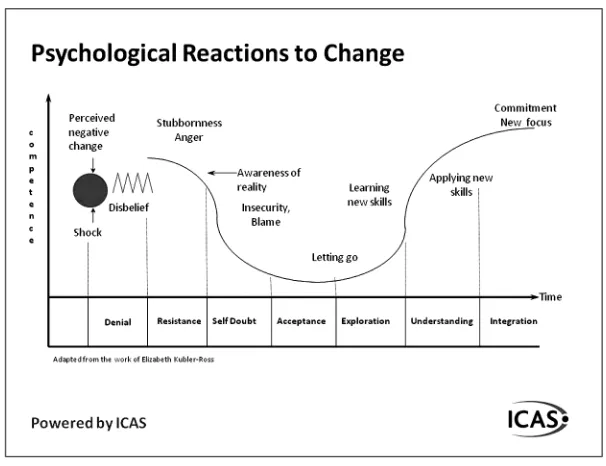
This process can help to alleviate some of the fears associated with technology change or technology implementation. I had long recognised the physiological barriers associated with “change” specifically pertaining to technology related change. I was particularly drawn to the adapted work of Kubler-Ross and the 5 Stages of Grief model (2005).
I began to explore the 5 Stages to aspects of my own work in supporting colleagues to use technology in learning and teaching to enhance the student (and staff) experience. In using the model I mapped the 5 Stages against the typical journey I saw staff undertaking with regards to Technology Enhanced Learning (TEL).
5 Stages of Grief (with TEL comments in brackets)
1. Denial – This isn’t happening to me. (Oh no not something else to learn).
2. Anger – Who’s to blame for this? Why me? (Who made the decision to get this?)
3. Bargaining – If I can live till my daughter’s wedding …. (Why can't we just stick with...)
4. Depression – I am too sad to do anything. (I'm too busy to even think about it.)
5. Acceptance – I’m at peace with what is coming. (Actually it looks ok, might give it a go.)
Smart Learning 89
Figure 1. Image Source: http://agilesutra.wordpress.com/2011/11/09/willpower-to-change-is-an-exhaustive-resource/ (with original © accredited to
http://www.icas.co.za/)
Conclusion
The value of smart device use in learning and teaching is now being explored more widely, partly through publications such as this, but also in the wider context of mobile device use. However, there are also studies (e.g. Kuznekoff & Titsworth, 2013) and reports which highlight the potential pitfalls associated with such devices if we do not have effective conversations around their purpose and value.
It is the conversations (or lack of) prior to the implementation of smart device initiatives that will see them succeed or fail, not the technology.
References
Jeffries, D. (2013). Is technology and the internet reducing pupils' attention spans? Teacher Network Teacher's blog, Monday 11 March 2013, The Guardian online. Online at:
Kuznekoff, J.H. and Titsworth, S. (2013). The impact of mobile phone usage on student learning. Communication Education, (62)3, 233-252.
Kübler-Ross, E. (2005). On grief and grieving: finding the meaning of grief through the Five Stages of Loss. London: Simon & Schuster Ltd.
Laurillard, D. (2007). Introduction. In: H. Beetham and R. Sharpe, eds., “Rethinking pedagogy for a Digital Age: designing for 21st century learning. New York: Routledge
This chapter is released with a Creative Commons licence
You may share this work for non-commercial purposes only provided you give attribution to the copyright owner, contributing authors and the publisher. You do not have permission to publish a commercial version of this work.
When referring to the chapters and other contributions in this text you are required to acknowledge the respective authors according to common academic practice.
It appears in:
Middleton, A., ed. (2015). Smart learning: Teaching and
learning with smartphones and tablets in post compulsory
education. Media-Enhanced Learning Special Interest Group
and Sheffield Hallam University.
You can download the whole book from: http://melsig.shu.ac.uk/?page_id=503