A Parallel Hyper-heuristic
Approach for the Two-dimensional
Rectangular Strip-packing Problem
Istvan Borgulya
Faculty of Business and Economics, University of Pecs, Hungary
In this paper, we present a parallel hyper-heuristic approach for two-dimensional rectangular strip-packing problems(2DSP). This is an island model with a special master-slave structure, and in all the islands we run a memetic algorithm-based hyper-heuristic (HH). The basic technique of this HH is a memory-based evolution-ary technique, the “extended virtual loser” (EVL). The memory-based technique memorises the past events, e.g., past successes of the evolutionary process or bad values of the variables; thus, we can influence the operations of the evolutionary algorithms using this memory. The EVL technique learns the bad values of the variables based on the worst solutions of the population and computes probabilities to control the mutation steps. With the help of the EVL technique, we can use a mutation-omitting recombination operator and obtain a learning mechanism for the selection of heuristics. In the HH, the selection of the low-level heuristics is modified with mutations based on the EVL technique using a local search. The island model achieved good performance. The test instances show that the proposed algorithm is efficient for the rectangular strip-packing problem.
Keywords: rectangular strip-packing, hyper-heuristic, memetic algorithm, memory-based technique, island model
1. Introduction
In the 2DSP, we have a set of n rectangular items with wi widths and hi heights, where
i=1,2, . . . ,n. The goal is to pack all the items without overlap into a strip of width W such that the height of the packing is minimised. The packing problem can be specified with orienta-tion and guillotine constraints. We will regard the 2DSP variant with a fixed orientation and without a guillotine cut.
The 2DSP belongs to cutting and packing prob-lems that have several industrial applications,
such as garment manufacturing, sheet metal cutting, furniture making, and shoe manufac-turing, and also applications in logistics. The 2DSP is NP-hard (Garey and Johnson 1979). Many exact, heuristic and meta-heuristic algo-rithms have been published to solve it. Usually, a combination of different heuristics can give better solutions than a single heuristics. It is a complex task to determine the best algorithm including the operators and heuristics to use. In this planning process the HHs can help. A HH is a search method that works in the heuristic space(using only limited information from the problem solution space)selecting or generating good heuristics and then applying them to solve the problem. In the last decade, HH methods were also used for the solution of the 2DSP.
mechanism for the selection of heuristics in a HH(Borgulya 2006, 2008).
For the HH we use a memetic algorithm(MA); Mas are hybrid evolutionary algorithms (EA)
incorporating a local search (LS) process. In this MA-based HH, we apply a mixture of three placement heuristics which are modifications of earlier placement heuristics and use place-ment strategies and improving procedures that are different from the earlier ones. The HH uses a set of mutation heuristics and a set of LSs for the solution. Selection of the mutation, LS and placement heuristics are modified with the mutations based on the EVL technique using a local search. For better results, we also use parallel computing. We apply an island model
(Borgulya 2010), and in all the islands, we run the MA-based HH. To the best of our know-ledge, this model is the first to present parallel HH for the 2DSP.
Thus, our contribution is a new parallel HH al-gorithm for the 2DSP. The key features of this contribution are the following:
• We propose a parallel MA-based HH for 2DSP. This is an island model, and the HH uses EVL-based mutations and local search to control the application of the heuristics and select other heuristics.
• We propose three placement heuristics which are modifications of the BF and BL heuris-tics. All new heuristics use placement strate-gies and improving procedures that are dif-ferent from the earlier ones.
• Our algorithm is efficient for the rectangular strip-packing problem.
The rest of this paper is organised as follows. Section 2 gives a summary of the methods of the 2DSP and the methods of HHs. Section 3 gives a description of the island model used. Section 4 presents the new MA-based hyper-heuristic for the 2DSP, gives a description of the EVL technique, as well as of the operations and characteristics of the algorithm; and it also gives examples for the individuals and opera-tors. Section 5 presents the low-level heuristics used. The computational results are reported in Section 6, and the conclusions are summarised in Section 7.
2. Related Works
2.1. Exact, Heuristic and Meta-heuristic Methods for 2DSP
We find exact, heuristic and meta-heuristic gorithms to solve the 2DSP. The first exact al-gorithm was a linear programming approach
(Gilmore and Gomory 1961). Tree search-based algorithms were published for the guil-lotine and non-guilguil-lotine versions(Christofides and Whitlock 1997). Some authors used vari-ants of the branch and bound technique (e.g., Martello et al. 2003; Arahori et al. 2013; Bo-schetti and Monatelli 2010). We can use these methods to solve only small 2DSP instances within a reasonable time.
Heuristic algorithms can find the solutions quickly, but do not guarantee to provide the global optimum. The most important heuris-tic group, constructive heurisheuris-tics, use various strategies for the packing of the items. An im-portant point is how they choose the next item for placement. They can choose the next item from a fixed sequence of the items or, dynami-cally, from the sequence for placement. A fixed ordered sequence is used for the best known placement heuristic: the “bottom up, left jus-tified”(BL) heuristic(Baker et al. 1980). BL first sorts the items according to their areas and then starts with each item from the top-right corner. Then, it slides the item as far as pos-sible to the lowest location and then, as far as possible to the left of the strip. There are more improved versions of BL(e.g., Hopper and Tur-ton 2001). The “best fit”(BF)heuristic(Burke et al. 2004)dynamically chooses the items. BF repeats two operations until all items are placed; it searches for an available space as low as pos-sible and then places the item that fits the space best. An improved version of BF is the “bidi-rectional best-fit” heuristic(¨Ozcan et al. 2013). Additional heuristics are the squeaky wheel op-timisation(Burke et al. 2011), the shacking pro-cedure(Wauters et al. 2013)and a combination of constructive heuristics with other methods, e.g., BF and simulated annealing (Burke et al. 2004).
simulated annealing(SA), the tabu search(TS)
and the genetic algorithm (GA) (e.g., Jakobs 1996; Faina 1999; Burke et al. 2011; Thomas and Chaudhari 2014). The methods with best results are usually hybrid methods that can use combinations of meta-heuristics, LSs, place-ment heuristics or improving procedures (e.g., Jakobs 1996; Yang et al. 2013; Wei et al. 2011; Iori et al. 2003). Some heuristics use other solutions for the improvement. The reactive GRASP (Alvarez-Valdes et al. 2008) involves a constructive phase and a subsequent iterative improvement phase.
2.2. Hyper-heuristic Methods
The HH is “a search method or learning mech-anism for selecting or generating heuristics to solve computational search problems”(Burke et al. 2013). The HH works in the heuristic space selecting or generating good heuristics and ap-plies them to solve the problem. It uses only limited information from the problem solution space. If the HH selects heuristics, it selects one or more heuristics from a low-level heuristic set in every step of the HH algorithm. The low-level heuristics are usually mutation operators, local search procedures, and other constructive heuristics. If the HH generates heuristics, it uses genetic programming (GP) to build new heuristics.
The HH selects or generates heuristics; in both cases, we can use constructive and improvement techniques. The constructive techniques con-struct the solution step-by-step, with low-level heuristics; the improvement techniques change only small parts of the solution. Selection meth-ods differ between the two techniques. Con-structive techniques use various methods to se-lect appropriate heuristics, e.g., EAs, TSs, and classification systems. The selection mecha-nism in the improvement techniques is divided into two parts: a heuristic selection method and a move acceptance criterion. The heuristic se-lection method can select heuristics randomly or it can select heuristics using a learning mecha-nism. The move acceptance criterion, which is based on the result, accepts or rejects the new solution.
Most HHs work with one solution(single-point search). However, there are a few HHs that work with multiple solutions(population). These
are generally improvement techniques and are built based on GA, ACO, or PSO, for example,
(detailed descriptions of the HH methods are available in Burke et al. 2013).
In the following, we describe three HHs for the 2DSP:
• Garrido and Riff (2007) developed a con-structive, GA-based HH. Individuals of a population are sequences of low-level heuris-tics. The low-level heuristic set is four place-ment heuristics, and the individuals are se-quences of these low-level heuristics with ordering, rotation and repeating information. In a generation, it uses roulette wheel selec-tion, one-point crossover and three mutation operators to generate descendants. It con-structs multiple solutions in every generation and it accepts the descendants (the descen-dants constitute a new population).
• The HH of Burke et al.(2010)is a GA with an improvement technique and works with a population of the solutions together with the information about the heuristics. The low-level heuristic set includes three place-ment heuristics with four placeplace-ment strate-gies. The individuals are permutations of items; a set of candidate heuristics, together with probabilistic information, is attached to each item of the individual. For every item, the algorithm uses roulette-wheel se-lection to choose a heuristic from the candi-date set in the packing process. The GA ap-plies crossover and mutation operations on the permutation of items to generate descen-dants, and a learning mechanism updates the probabilities of applying heuristics and/or modifies the candidate heuristic set accord-ing to the result of the descendant. The algo-rithm accepts the descendants (the descen-dants constitute a new population).
from previous packing solutions, which al-low the evolved heuristics to iteratively cor-rect the mistakes made in previous place-ment decisions. Based on this statistics, the GP calculates the average penalty of the item, which indicates the difficulty of plac-ing. In each placement step, the heuristic will calculate the score for each combina-tion of items, allocacombina-tion and slot (together with the penalty), and the combination with the highest score will be applied for the next placement. The algorithm accepts the new heuristics(they constitute a new popu-lation).
2.3. Parallel Methods
Parallel processing is a useful tool for reducing runtimes and improving the quality of meta-heuristics. In most applications of parallel pro-cessing, the parallel meta-heuristics are imple-mented using a master–slave or an island model. For cutting and packing problems, there are also parallel solutions. For instance, for bin pack-ing, circles packpack-ing, and 2D cutting problems, we find parallel processing beneficial. There are also a few parallel HHs for timetabling and scheduling(Rattadilok et al. 2005)and for real parameter optimisation(Biazzini et al. 2009).
3. The Island Model
The island model(Borgulya 2010)uses a master-slave structure with a centralised scheme in which slave processors execute the evolutionary process and periodically send their best partial results to a master process. The master process stores partial results in a common migration set
(MS) and then randomly chooses individuals from the MS, one after another for every slave and sends them to the slaves.
The island model can work withnpparallel pro-cessors (e.g., 2, 4, 8 or 16), and the given EA runs on every parallel processor. The parallel process will be controlled with the frequ and
mignumb parameters. Let EPi be the
evolu-tionary process on the ith slave processor with Pi population. frequ determines the
communi-cation frequency; after frequ iterations, every slave sends migrating individuals into the MS.
Every EPi sends the mignumb number of
in-dividuals to the MS, and these select the best individuals for migration. The master process randomly selectsmignumbindividuals fromMS for every EPi, and each population Pi obtains
these individuals fromMS(The master process selects the individuals forPi randomly, except
for the earlier migrant individuals fromPi).
Ev-eryEPi replaces the worst individuals with the
incoming ones inPi.
We simulated the island model in one proces-sor and did not examine the parallel environ-ment characteristics in a network. To determine the cost, we computed only the running time, which also includes the communication time. Naturally, we considered all parallel processes as only one process time, which belonged to the longest process.
In our parallel HH approach (PMAHH), the MA-based HH(MAHH)runs as an evolution-ary process in this island model.
4. Our Hyper-heuristic Algorithm
4.1. The EVL Technique
Our MAHH uses the EVL technique in differ-ent mutation operations. Mutation operators of MAHH select another low-level mutation heuristic, another low-level local search heuris-tic and other placement heurisheuris-tics in a few po-sitions of the placement heuristics list. Among the low-level mutation heuristics for the solu-tion, there are also two heuristics that use mu-tation based on the EVL(see Sections 4.2 and 5.3).
The principle of the EVL is as follows(Borgulya 2006). Let us consider a generic EA, and sup-pose that the individual has l variables, each havingkdiscrete values. Notice that the ECM
(explicit collective memory) is a k×l matrix that stores and learns the relative frequencies of different values of the variables. This matrix is updated throughout the evolution procedure, using some of the worst performing individuals. LetECMijgenbe the collected relative frequency of the ith values on the jth position (variable)
until thegenth generation. We can update the elements of the ECM matrix
whereΔECMijis a relative frequency of theith
value on the positionjbased on the worse indi-viduals of the genth generation and α denotes some relaxation factor(e.g.,α =0.2). We up-date ECM periodically, every knth generation
(e.g., kn = 10). The computation ofΔECMij
goes on as follows:
• we take 20% of the worst individuals from the population;
• we count how many times the ith value oc-curs on position j in the worst individuals
(i=1,2, . . . ,k;j=1,2, . . . ,l)
• we divide theΔECM matrix by the number of worst individuals.
We use the ECM matrix to estimate the proba-bility of the mutation. Let X be an individual, and letzbe the value of thejth variable in indi-vidualX(Xj=z). To determine the probability
of mutating thejth variable in individualX, we use the formula
prj=1−
ECMzjgen
k
i=1ECM
gen ij
−aj
where aj is the following: if B is one of the
best individuals, thenif z=Bjthen aj =1else
aj =0.
4.2. The Memetic Algorithm-based Hyper-heuristic
Our MAHH uses an improvement technique and works with a population. The individual has two parts: a permutation ofnitems and a set of the low-level heuristics used. We acquired a new solution by applying these low-level heuristics from an earlier individual. We define muta-tion operamuta-tions and LS for the heuristics part of the individual. Mutation is based on the EVL technique; thus, in the algorithm, there is no separated learning mechanism.
MAHH is a steady-state MA-based HH. It uses a two-stage algorithm structure to speed up con-vergence and to produce higher-quality results. The first stage is a quick “preparatory” stage that is designated to improve the quality of the initial population. The second stage is a steady-state MA that searches for better solutions.
For certain tasks, the algorithm might ”get stuck” at one of the local optima. To enable escape to-ward a potential global optimum, the algorithm generates new, additional individuals. A new individual is also a descendant and can help to improve capability and speed of the algorithm to find the global optimum. Thus, in the second stage, new descendants are periodically inserted in the population until the maximum size of the population is reached.
Algorithm 1 shows the main steps of MAHH and Figure 1 shows how it works. Parameters of the algorithm are the following:
tmax– the maximum size of the population. t– the size of the population in the first stage. itt – the number of generations in the first stage
kn– the algorithm is controlled in everyknth generation.
timeend– the limit of the running time. tp– parameter of truncation selection. gp, rp – parameters of the condition of the Restartprocedure.
LSn, LSmax, rep, prun1, prun2– parameters of the low-level local search heuristics. Hn– parameter of the LSH local search. Imax – parameter of the placement heuris-tics.
The operations and the characteristics are as fol-lows:
Input. The algorithm reads the instance and the values of the parameters (these are described and given in the parameter selection section). Individuals. Every individual of population P is a pair of the permutation of thenitems and a set of heuristicsIj = (Sj,Hj)j = 1,2, . . . ,|P|,
whereSjis the permutation of the items andHj
is the list of the low-level heuristics used. In the list, we distinguish three groups: mutation heuristics, local search heuristics and placement heuristics. The Hj list of heuristics is (MSj,
LSj, PLj1, PLj2,. . .,PLjn), where MSj is a
mu-tation heuristic on the permumu-tation,LSj is a
lo-cal search heuristic on the permutation and the PLj1, PLj2, . . . ,PLjn heuristics are the
place-ment heuristics; there is one placeplace-ment heuris-tic attached to every position of the permutation
(see Section 5).
Algorithm 1.The main steps of MAHH
Input:the instance, the values of the parameters. Initialize the individuals,the ECMs matrices.
/* First stage */
Doitttimes
Generate a descendant randomly.
Accept descendant according to the move acceptance criteria. In everyknth generation update ECMs.Filter.
od.
/* Second stage */
Repeat Dokntimes
Select a parent.
Mutations of the low level heuristics. Apply the low level heuristics. LS on the low level heuristics.
Accept descendant according to the move acceptance criteria.
od
If(t<tmax)then t=t+1fi
Apply LS procedures on the last descendant.
Accept descendant according to the move acceptance criteria. Apply LS procedures on the best individual.
Accept individual according to the move acceptance criteria. Update ECMs.Filter, Restart.
untilrunning time>timeend
end
items of the permutation are ordered using vari-ous criteria(decreasing order: by height, height and width, perimeter, area and by width and height)and theHjsets are generated randomly.
Other individuals are generated randomly. Fitness function. The fitness function is defined on the permutation and it is the height of the packed items on the strip.
Selection operator. MAHH selects individualIj
based on truncation selection. In this selection, only the besttppercentage of the population is considered a potential parent.
Mutation operators. MAHH applies appropri-ate mutations for the three groups of the heuris-tics inHj. All mutations use the EVL technique
with different ECMMS, ECMLS and ECMPL matrices:
• Mutation of MSj. The ECMMS is a 4×1
column matrix; every mutation heuristic has a row in the matrix. The mutation opera-tor selects another heuristic with the highest prj probability. The algorithm applies the
mutations with 0.5 probabilities.
• Mutation of LSj. The ECMLS is a 7 ×1
column matrix; every local search heuristic has a row in ECMLS. The mutation operator selects another local search with the highest prj probability. The algorithm applies the
mutations with 0.5 probabilities.
• Mutation of the list of the placement heuris-tics. The ECMPL is a 3×nmatrix. Every placement heuristic has a row, and every po-sition on the list has a column in ECMPL. The mutation operator first chooses a ran-dom i position on the list of the placement heuristics. Next, it chooses another heuristic for this position with the highest pri
proba-bility. (MAHH applies this mutation opera-tor twice in a sequential manner). The algo-rithm applies the mutations with 0.5 proba-bilities.
se-quence improves the result, it will be the new sequence of the placement heuristics in the indi-vidual. The generated sequences are the follow-ing: withphprobability, LSH takes the HP1 on every position; otherwise, the HP2 or HP3 are taken with equal probabilities. Nine sequences are generated with the followingphvalues: 0.1, 0.2. . .0.9. Construction of the nine sequences
is repeated five times. In the second step, LSH modifies the sequence of the placement tics. At a random position, it changes the heuris-tic randomly to a different one. If the applica-tion of the sequence improves the result, the modified sequence will be the new sequence of the placement heuristics in the individual. This modification is repeatedHntimes.
Filter, Restart. To speed up the convergence, the algorithm uses Filter and Restart proce-dures. The Filter procedure filters and deletes the weak individuals which are members of the neighbourhood of a better individual ( individ-uals Ik and Ij are neighbours if the Hamming
distancedH (S
k,Sj)< 3). If the fittest solution
did not change in the last gp generations, the Restartprocedure deletes the weakest solutions
(rpproportion of the population).
Move acceptance criterion. The move accep-tance criterion is a special variant of the crowd-ing technique and it helps separate the local and global optima. This crowding technique com-pares the descendant with the former solutions
(or the parent) based on similarities in the Sj
permutations. In the first stage, the descendant may replace (is accepted) the most similar of the former solutions if the descendant is better
(similarity is based on the Hamming distance); in the second stage, the descendant may replace
(is accepted)the parent if the descendant is bet-ter. If the descendant is an additional individual or if there are fewer individuals than the size of the population (after Restart or Filter pro-cedures), a new descendant is unconditionally inserted (is accepted)into the population until the population size is reached.
Stopping criterion. The algorithm is terminated if the running time limit is reached.
4.3. Example
The following example demonstrates the in-dividuals and how MAHH works. Let there be 5 items (n = 5). Among the low-level heuristics we distinguish three groups: muta-tion heuristics, local search heuristics and place-ment heuristics groups. Let’s take four muta-tion heuristics, seven local search procedures and three placement heuristics. We identify the items and the low-level heuristics in every group with sets of serial numbers. The individual is composed of 4 parts: permutation of items, se-rial number of the mutation, sese-rial number of the LS and a sequence of serial numbers of the placement heuristics. Permutation and se-quence of the placement heuristics jointly con-stitute the solution.
Let’s take a random individual(1, 3, 5, 2, 4, 1, 3, 1, 2, 1, 3, 3), the 1, 3, 5, 2, 4 is the permuta-tion, and from the low-level heuristics we have
the 1st mutation heuristic, the 3rd local search heuristic and the sequence 1st, 2nd, 1st, 3rd, 3rd of the placement heuristics.
Let us see the applications of the mutations of MAHH, of the low-level heuristics and of the local search procedure of MAHH.
a) Let us suppose that the mutations of MAHH arrived to the following modifications of the serial numbers: the 3rd mutation, the 1st lo-cal search and on the 2nd and 3rd positions of the sequence the new serial numbers are 1st and 2nd. The descendant is thus the fol-lowing: (1, 3, 5, 2, 4, 3, 1, 1, 1, 2, 3, 3)
(modifications are shown in bold).
b) Let’s now demonstrate application of the low-level heuristics: Application of the 3rd mutation: let us suppose the mutation is a random insert operation and the item from the 5th position will be inserted to the 2nd position. The descendant is thus the follow-ing: (1,4, 3, 5, 2, 3, 1, 1, 1, 2, 3, 3).
Application of the 1st local search: let us suppose that it analyses the swaps in the per-mutation. After every swap it computes the new value of the fitness and if the result is better, it accepts the swap. Let us suppose the two swaps improved the fitness: between the 2nd-4th and 3rd-5th positions. The new descendant is thus the following: (1,5,2,4,
3, 3, 1, 1, 1, 2, 3, 3).
Application of the placement heuristics. This is the computation of the fitness. One after the other, the placement heuristics place the next not-yet-placed item, or a dynamically selected not-yet-placed item from the per-mutation part of the individual.
c) LSH is a local search procedure of MAHH. It modifies multiple times the sequence of placement heuristics. For example, the out-come may be the following after the applica-tion of the LSH on the last descendant: (1, 5, 2, 4, 3, 3, 1, 2, 2, 2,1, 3). LSH computes a new value of the fitness and if the result is better, it accepts the modification.
5. Low-level Heuristics for the 2DSP in MAHH
5.1. The Placement Heuristics
For the 2DSP, we use three different placement heuristics. The first is a modified version of the BL heuristic; the second and third ones are modified versions of the BF heuristic. The most important modification of the heuristics is that they use a local search procedure after every item, and the procedure attempts to improve the placement with a block of multiple items. We call these heuristics HP1, HP2 and HP3. HP1 first applies the BL heuristic and then at-tempts to improve the result with a local search procedure. The BL places the next not-yet-placed item from the solution part of the indi-vidual. If the width of the packed item is smaller than the width of the space, HP1 applies the lo-cal search ImpLS, which works in two steps. First, it searches other items to be packed into the empty part of the space. These items are the next not-yet-packed items with maximum imax. In the second step,ImpLS builds blocks combining one, two or three items from the se-lected items and chooses the block that fits in the empty part of the space and has the largest width. If ImpLS finds a block, HP1 places the block into the space. (In the block, the items can be different, unlike in the reactive GRASP method Alvarez-Valdes et al. 2008).
HP2 first applies the BF heuristic and then at-tempts to improve the result in two different ways with the ImpLSlocal search. The BF dy-namically selects a not-yet-placed item and fits the item into the lowest available space. If the lowest available space is too narrow to place a remaining item into it, the space is raised to the level of the lower space adjacent to it, and the two spaces are merged. Next, BF begins again. If the placing was successful and the width of
the packed item is smaller than the width of the space, HP2 applies theImpLSlocal search. First, HP2 applies theImpLSfor the full space. IfImpLSbuilds a block with a larger width than the fitted item found, the block replaces the item in the space. If there is no appropriate block, HP2 (similarly to HP1) applies the ImpLS on the empty part of the space. If ImpLS finds a block, HP2 places the block into the space. HP3 is a modified version of HP2, in which the BF is replaced with a modified, score-based version of BF. The idea of the score-based BF was motivated by the IDBS method(Wei et al. 2011). In the IDBS, the placing heuristic uses several strategies, and one of the strategies as-signs fitness values to some important(space, fit item)pairs. The IDBS may choose the(space, fit item) pair with the highest fitness value to place. In the score-based BF, we assign scores to some special types of spaces without the items. The score reflects the importance of the spaces, and our BF variant searches for a fit item for the space that has the highest score value. Thus, the score is 4 if the space is at the left or the right edge and lies deeper than the neighbour-ing space; 3 if the space lies deeper than its neighbours and the neighbouring spaces lie at the same height; 2 if the space lies deeper than its neighbours and the neighbours lie at differ-ent heights; 1 if the space is located in middle of three steps; and 0 if the space is located at the lowest available space.
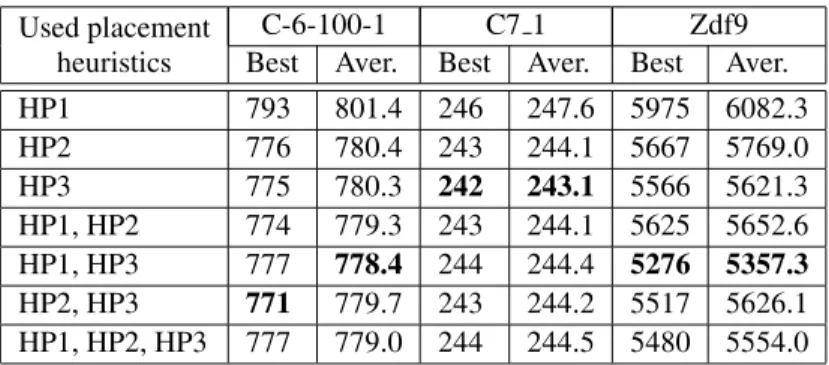
It is important to determine the efficiency of the HP1, HP2 and HP3 heuristics. First we anal-ysed the importance of the ImpLSlocal search and used the heuristics withoutImpLSas well. Our conclusion is that theImpLS can improve the results in general and gives better than av-erage results. Next we compared the heuris-tics separately and some combinations of the
Used placement C-6-100-1 C7 1 Zdf9
heuristics Best Aver. Best Aver. Best Aver.
HP1 793 801.4 246 247.6 5975 6082.3
HP2 776 780.4 243 244.1 5667 5769.0
HP3 775 780.3 242 243.1 5566 5621.3
HP1, HP2 774 779.3 243 244.1 5625 5652.6 HP1, HP3 777 778.4 244 244.4 5276 5357.3
HP2, HP3 771 779.7 243 244.2 5517 5626.1 HP1, HP2, HP3 777 779.0 244 244.5 5480 5554.0
heuristics in MAHH. Table 1 shows a compar-ison with the help of the C 6 100 1, C7 1 and Zdf9 instances (the best results for every in-stances are shown in bold). Among the HP1, HP2, and HP3 heuristics, the HP3 has the best results. The combination of two or three heuris-tics gives better result in general than the sim-ple heuristics. Although the results of HP1 are weaker than the results of HP2 and HP3, their combination with HP1 improves the quality of the results. Thus, in the MAHH algorithm, we use the three (HP1, HP2, and HP3) heuristics together.
5.2. The Local Search Heuristics
To compile the set of appropriate LS procedures for the algorithm, we use seven LS procedures. A local search version takes every pair of the values of the permutation, attempts to apply a move on the pair and computes the new value of the fitness function. If the application of the move improves the result, the procedure ac-cepts the move. The moves in the procedures are swap, insert, or inversion.
The low-level heuristics are the following: LS1 is a search with a swap move; LS2 is a search with an insert move; LS3 is a search with an inversion move; LS4 is LS1 followed by LS2; LS5 is LS1 followed by LS3; LS6 is LS2 fol-lowed by LS3; and LS7 is LS1 folfol-lowed by LS3 and then by LS4. We attempted to achieve shorter running times with all local searches. Thus, every local search uses only a few ran-dom parts of the permutation for the move. The number of parts is controlled by the LSn pa-rameter, and the length of each part is at most LSmaxelements. If a local search improves the results, it can be repeated. The rep parame-ter controls the repetition of local searches. If rep=1, then MAHH can repeat the local search. There are two parametersprun1andprun2that control the applications of the local searches in the algorithm. If prun1=1, then MAHH can apply the local searches on every descendant. If prun2=1, the algorithm can apply the local searches on the last descendant in every knth generation.
5.3. The Mutation Heuristics
The algorithm uses one of four mutation heuris-tics for theSjpermutations. The low-level
muta-tion heuristics are the following: a swap based on the EVL technique, an insert based on the EVL technique, a random swap, and a random insert move.
The first and second mutation heuristics use a common ECM matrix, named ECMS. The ECMS is an n × n matrix. Every item has a row, and every position of the Sj
pertion has a column in the matrix. If the muta-tion is based on the EVL method, the mutamuta-tion heuristic first chooses a random k position in the permutation and then chooses another item for this position with the highest prk
probabil-ity based on the ECMS; it searches the position of the new item in Sj and swaps the values of
the positions or inserts the new item in
posi-tion k. MAHH examines randomly only min
(n, 50)rows of the ECMS matrix to search for the highestprkprobability.
6. Computation Experiments
The PMAHH algorithm was implemented in C++. It was executed on an iMAC with an Intel Core i5 2.5 GHz processor with 4 GB of RAM, running the Mac OS X 10.9.2 operating system.
We tested our algorithm with the benchmark instances that are used generally in publica-tions. The zero-waste instances comprise the first group, and their optimal solutions are known. The second group includes non-zero-waste in-stances, the optimal solutions of which involve some wasted regions.
The zero-waste instances are the following:
• C (Hopper and Turton 2001) with 21 in-stances, the number of input rectangles rang-ing from 16 to 197.
• N(Burke et al. 2004)with 13 instances, the number of input rectangles ranging from 10 to 3152. We also used the set(N12), without
the N13 instance.
• RB(Ramesh Babu and Ramesh Babu 1999)
• NT (Hopper 2000) with 70 instances, the number of input rectangles ranging from 17 to 199.
• CX (Pinto and Oliveira 2005) with 7 in-stances, the number of input rectangles rang-ing from 50 to 15 000.
The non-zero-waste instances are:
• NP(Nice1,. . ., Path5) (Wang and Valenzela 2001)with 12 instances, the number of input rectangles ranging from 25 to 1000.
• NPT(Nice1t,. . ., Path5t) (Wang and Valen-zela 2001)with 60 instances, the number of input rectangles ranging from 1000 to 5000.
• ZDF(Leung et al. 2011). We use only the first 13 instances (ZDF13), the number of
input rectangles ranging from 580 to 15 096.
• 2sp (cgcut1, . . ., gcut1, . . ., ngcut1, . . ., beng1, . . ., beng10) (Beasley 1985, 1985a; Christofides and Hadjiconstantinou 1995; Bengtsson 1982)with 38 instances, the num-ber of input rectangles ranging from 7 to 200.
• BWMV(Berkey and Wang 1987; Martello et al. 2003)with 500 instances, the number of input rectangles ranging from 20 to 100.
6.1. Parameter Selection
While studying some of the more complex prob-lems of the benchmark sets, we analysed the process of MAHH to determine how the param-eter values affect the convergence, the discov-ery of the global optimum and the speed of the calculation. Thus, we analysed the population size (t and tmax parameter), the frequency of checks (kn parameter), the generation in the first stage (itt parameter), the parameters of the Restart procedures (gp and rp) and of the truncation selection (tp). Summarising the re-sults of the analysis, we found the following: t =5, tmax=30,itt=5, kn=5, gp=300,rp=0.7 andtp=0.1, and we accepted that the published methods allowed a duration of 60 CPU seconds for each test problem.
In the second part of the parameter selection, we analysed the LS procedures, which are the most time consuming part of the algorithm. As the number of dimensions increases, their run-ning times increase rapidly. Thus, the values of
LSp, LSmax, Hn, imax, repand the parameters
prun1 and prun2 are important. We searched
the parameter values at different values of n. The result is the following:
• 20≤ n ≤100, we use the planned LS with
repetition. The parameter values: LSp=30, LSmax=50, Hn=30, imax=100, rep=1, prun1=1andprun2=1.
• 100<n≤200, we narrow the use of the LSs for the last descendant and the best individ-ual with repetition. The parameter values: LSp=30, LSmax=50, Hn=30, imax=100, rep=1, prun1=0andprun2=1.
• 200<n<500, the above values of the param-eters except: LSp=3.
• 500≤n<2000, the above values of the pa-rameters, but the local searches run without repetition(rep=0).
• 2000≤ n ≤4000, we use only the local
search for the best individual without repe-tition. LSp=2, LSmax=50, Hn=30, imax= 100, rep=0, prun1=0andprun2=0.
• 4000<n≤8000, we use only the local search for the best individual without repetition. LSp=2, LSmax=10, Hn=10, imax=50, rep=
0, prun1=0andprun2=0.
• 8000<n≤15100, we use only the local search for the best individual without repetition. LSp=1, LSmax=5, Hn=0, imax=10, rep=0, prun1=0andprun2=0.
Based on these results, we can give the initial values of the parameters of the LSs. For exam-ple, ifn=300, the values of the LS parameters are the following: LSp=3, LSmax=50, Hn=30, imax=100, rep=1, prun1=0andprun2=1. In the third part of the parameter selection, we used the parameters of MAHH in the island model and searched appropriate parameter val-ues for the island model. Experimenting with settingfrequandmignumbwe found that using
frequ =kn and mignumb =1 yielded the
6.2. Comparative Results
PMAHH was run 10 times on each test instance, and we provide the best and the average results for every instance as % gap, which is the per-centage gap to the lower bound(LB), namely, % gap = 100 *(obtained solution - LB)/LB. LB is the optimal height for the zero-waste prob-lem. For the non-zero-waste problem, LB is as described by Leung et al.(2011).
We show the summary of our results compared with some published results. The first com-parison shows the best result of two place-ment heuristics, namely the BF (Burke et al. 2004) and BBFM (¨Ozcan et al. 2013) place-ment heuristics, and the results of the following five HHs: the PMAHH, the GA of Garrido and Riff (2007) (R GA), the GA of Burke et al.
(2010) (B GA), the GP of Burke et al.(2010a)
(B GP) and the GP of Nguyen et al. (2012) (N GP). The second comparison is based on the best-published results in the papers of Wei et al. (2011)and Yang et al.(2013), where the running times were 60 CPU seconds for each test problem. From these papers, we chose four methods: the reactive GRASP(Alvarez-Valdes et al. 2008), the ISA (Leung et al. 2011), the SRA (Yang et al. 2013) and the IDBS (Wei et al. 2011).
In Tables 2-4, we show the comparisons. In Ta-ble 2, we find the average best results (% gap)
of the placement heuristics and HHs. The re-sults were available only for the C, N, N12, RB
and NP test sets. For C, the result of PMAHH is approximately twofold better than the second best result of R GA. For N and N12, the result of
PMAHH is approximately twofold better, and for NP, the result is approximately 75% better than the second best results of N GP. We can conclude that for the C, N, N12and NP test sets,
our approach outperforms the BF and BBFM placement heuristics and the four HHs.
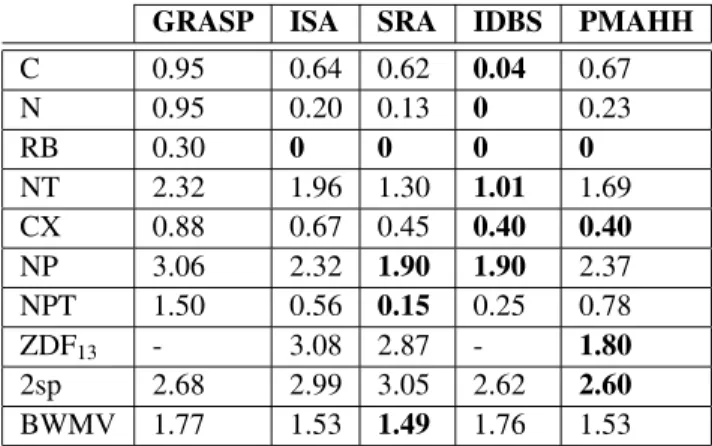
Table 3 shows the average results, and Table 4 shows the best results of GRASP, ISA, SRA, PMAHH and IDBS. For the zero-waste test sets
(C, N, RB, NT and CX), the IDBS is the best method based on the best and the average re-sults. For the RB test set, only the GRASP did not find the optimal result.
GRASP ISA SRA IDBS PMAHH
C 0.95 0.76 0.69 0.12 0.81
N 0.95 0.41 0.23 0 0.40
RB 0.30 0 0 0 0
NT 2.32 2.24 1.60 1.54 2.23
CX 0.88 0.88 0.52 0.43 0.50
NP 3.06 2.52 2.00 2.10 2.62
NPT 1.50 0.56 0.15 0.35 0.89
ZDF13 - 4.00 2.94 - 2.50
2sp 2.68 3.02 3.07 3.01 2.63
BWMV 1.77 1.70 1.63 2.00 1.70
Table 3.Average results(% gap)of the methods(with 60 CPU seconds).
GRASP ISA SRA IDBS PMAHH
C 0.95 0.64 0.62 0.04 0.67
N 0.95 0.20 0.13 0 0.23
RB 0.30 0 0 0 0
NT 2.32 1.96 1.30 1.01 1.69
CX 0.88 0.67 0.45 0.40 0.40
NP 3.06 2.32 1.90 1.90 2.37
NPT 1.50 0.56 0.15 0.25 0.78
ZDF13 - 3.08 2.87 - 1.80
2sp 2.68 2.99 3.05 2.62 2.60
BWMV 1.77 1.53 1.49 1.76 1.53
Table 4.Average best results(% gap)of the methods
(with 60 CPU seconds).
BF BBFM R GA B GA B GP N GP PMAHH
(60 sec) (60 sec)
C 5.70 2.32 1.39 - 10.50 1.70 0.67
N12 4.32 1.48 - 4.76 3.50 0.58 0.24
N 4.05 1.37 - - - 0.53 0.23
RB 6.66 0 - - - - 0
NP 6.43 5.18 - - - 3.19 2.37
For the CX test set, PMAHH is also the best method based on the best results and the sec-ond of the five methods based on the average results. Based on the best and average results of the NT test sets, PMAHH ranks third of the five methods, and based on its results for the C and N test sets, it is the fourth of the five methods. However, for the C test set, the best results of ISA, SRA and PMAHH are very similar and for the C, N and NT test sets, the average results of PMAHH and ISA are very similar.
For the non-zero-waste test sets, there is not a best method for every test set. For the NP, NPT and BWMV test sets, the SRA is the best method based on the best and average results, and for the ZDF13and 2sp test sets, the PMAHH is the
best method based on the best and the average results. For the BWMV sets, the PMAHH and ISA are the second best methods, and for the NP and NPT test sets, the PMAHH is ranked fourth based on the best and the average results(in the three tables, the best results for every test set are shown in bold).
We can conclude that our algorithm is effi-cient for the rectangular strip-packing problem; PMAHH is the best methods(or equally good) in case of four test sets and the second best method in case of the largest BWMV test set. Based on the test results, it is better than reac-tive GRASP, and PMAHH belongs to the group of ISA, SRA and IDBS.
7. Conclusions
In this paper, we present a parallel memetic algorithm-based hyper-heuristic for the 2DSP. In our algorithm, the individuals are ( solu-tion, low-level heuristics)pairs. The algorithm organises the choice of the low-level heuris-tics with an improving technique that uses the memory-based EVL technique. The algorithm uses three placement heuristics that are mod-ified versions of the BL and BF placement heuristics and uses improving local searches when placing an item. Our algorithm is effi-cient for the rectangular strip-packing problem; based on the test results, it belongs to the group of ISA, SRA and IDBS methods. For four test sets, it exhibited the best results.
In the future, we plan to extend our algorithm to solve other types of strip-packing problems.
Our plan is to develop a hyper-heuristic frame-work based on the memetic algorithm-based hyper-heuristic.
References
[1] R. ALVAREZ-VALDES, F. PARRENO˜ , J. M. TAMARIT,
Reactive GRASP for the strip packing problem.
Computers & Operations Research35, 1065–1083, 2008.
[2] Y. ARAHORI, T. IMAMICHI, H. NAGAMOCHI, An ex-act strip packing algorithm based on canonical forms.Computers & Operations Research,39(12), 2991–3011, 2013.
[3] B. S. BAKER, E. G. COFFMAN, R. L. RIVEST, Or-thogonal packing in two dimensions.SIAM Journal on Computing9, 846–55, 1980.
[4] J. E. BEASLEY, Algorithms for unconstrained two-dimensional guillotine cutting.The Journal of the Operational Research Society36, 297–306, 1985.
[5] J. E. BEASLEY, An exact two-dimensional
non-guillotine cutting tree search procedure.Operations Research33, 49–64, 1985.
[6] B. E. BENGTSSON, Packing rectangular pieces –
a heuristic approach. The Computer Journal 25, 253–7, 1982.
[7] J. O. BERKEY, P. Y. WANG, Two-dimensional finite
bin-packing algorithms.The Journal of the Opera-tional Research Society38, 423–429, 1987.
[8] M. BIAZZINI, B. BANHELYI, A. MONTRESOR, M. JE -LASITY, Distributed hyper-heuristics for real
param-eter optimization.Genetic and Evolutionary Com-putation Conference, (F. ROTHLAUF, ED.). ACM:
New York, NY, 1339–1346, 2009.
[9] I. BORGULYA, An Evolutionary Algorithm for the Biobjective QAP. Computational Intelligence, The-ory and Applications “Advances in Soft Computing”
(B. REUSCH,ED.), Springer series, 577–586, 2006. [10] I. BORGULYA, An Algorithm for the Capacitated
Vehicle Routing Problem with Route Balancing.
Central European Journal of Operations Research,
16(4), 331–344, 2008.
[11] I. BORGULYA, An Island Model for the No-Wait Flow Shop Scheduling Problem.PPSN XI. Krakow, Springer, LNCS 6239, 280–289, 2010.
[12] M. A. BOSCHETTI, L. MONATELLI, An Exact
Algo-rithm for the Two-Dimensional Strip Packing Prob-lem.Operations research58, 1774–1791, 2010.
[13] E. K. BURKE, M. GENDREAU, M. HYDE, G.
KENDALL, G. OCHOA, E. ¨OZCAN, R. QU,
[14] E. K. BURKE, Q. GUO, G. KENDALL, A
Hyper-Heuristic Approach to Strip Packing Problems. In
PPSN XI. Krakow, LNCS 6238, 465–474, 2010.
[15] E. K. BURKE, M. HYDE, G. KENDALL, A Genetic
Programming Hyper-Heuristic Approach for Evolv-ing 2-D Strip PackEvolv-ing Heuristics.IEEE Transactions on Evolutionary Computation, 14(6), 942–958, 2010.
[16] E. K. BURKE, G. KENDALL, G. WHITWELL, A new
placement heuristic for the orthogonal stock-cutting problem.Operations Research52, 655–71, 2004.
[17] E. K. BURKE, M. HYDE, G. KENDALL, A Squeaky
Wheel Optimization Methodology for Two Di-mensional Strip Packing.Computers & Operations Research,38(7), 1035–1044, 2011.
[18] N. CHRISTOFIDES, E. HADJICONSTANTINOU, An
ex-act algorithm for orthogonal 2-D cutting problems using guillotine cuts.European Journal of Opera-tional Research83, 21–38, 1995.
[19] N. CHRISTOFIDES, C. WHITLOCK, An algorithm for
two-dimensional cutting problems.Operations Re-search25, 30–44, 1997.
[20] L. FAINA, An application of simulated annealing
to the cutting stock problem.European Journal of Operational Research,114(3), 542–556, 1999.
[21] M. R. GAREY, D. S. JOHNSON, Computers and
intractability: a guide to the theory of NP-completeness. New York: Freeman, 1979.
[22] P. GARRIDO, M. C. RIFF, An Evolutionary
Hy-perheuristic to Solve Strip-Packing Problems H. IDEAL.(YIN ET AL. ED.), LNCS 4881, 406–415,
2007.
[23] P. GILMORE, R. GOMORY, A linear programming
approach to the cutting stock problem.Operations Research9, 849–859, 1961.
[24] E. HOPPER, Two-dimensional packing utilising
evo-lutionary algorithms and other meta-heuristic meth-ods. Ph.D. thesis, Cardi University, 2000.
[25] E. HOPPER, C. H. TURTON, An empirical
investi-gation of metaheuristic and heuristic algorithms for a 2D packing problem. European Journal of Operational Research128, 34–57, 2001.
[26] M. IORI, S. MARTELLO, M. MONACI, Metaheuristic
algorithms for the strip packing problem.: Opti-mization and Industry: New Frontiers.(P. PARDA -LOS, V. KOROTKICH, ED.), Kluwer Pub. 159–179,
2003.
[27] S. JAKOBS, On genetic algorithms for the
pack-ing of polygons.European Journal of Operational Research 88, 165–181, 1996.
[28] S. C. H. LEUNG, D. ZHANG, K. M. SIM, A two-stage
intelligent search algorithm for the two-dimensional strip packing problem.European Journal of Opera-tional Research,215(1), 57–69, 2011.
[29] S. MARTELLO, M. MONACI, D. VIGO, An exact
ap-proach to the strip packing problem. INFORMS Journal on Computing,15(3), 310–319, 2003.
[30] S. NGUYEN, M. ZHANG, M. JOHNSON, K. C. TAN,
Automatic Discovery of Optimization Search Heuristics for Two Dimensional Strip Packing Us-ing Genetic ProgrammUs-ing. SEAL(L. T. BUI ET AL.
EDS.), LNCS 7673, 341–350, 2012.
[31] E. ¨OZCAN, Z. KAI, H. DRAKE, Bidirectional best-fit heuristic considering compound placement for two dimensional orthogonal rectangular strip packing.
Expert Systems with Applications40, 4035–4043, 2013.
[32] E. PINTO, J. F. OLIVEIRA, Algorithm based on graphs
for the non-guillotinable two-dimensional packing problem.Second ESICUP Meeting, Southampton, 2005.
[33] A. RAMESH BABU, N. RAMESH BABU, Effective
nesting of rectangular parts in multiple rectangular sheets using genetic and heuristic algorithms. In-ternational Journal of Production Research,37(7), 1625–43, 1999.
[34] P. RATTADILOK, A. GAW, R. S. K. KWAN, Distributed
choice function hyper-heuristics for timetabling and scheduling. The Practice and Theory of Automated Timetabling V: Selected Papers from the 5th Inter-national Conference on the Practice and Theory of Automated Timetabling(E. K. BURKE, M. TRICK, EDS), LNCS 3616, Springer: Berlin, 51–70, 2005. [35] J. THOMAS, N. S. CHAUDHARI, A new
metaheuris-tic genemetaheuris-tic-based placement algorithm for 2D strip packing.J Ind Eng Int, 10–47, 2014.
[36] C. L. VALENZELA, P. Y. WANG, Heuristics for large
strip packing problems with guillotine patterns: an empirical study.Proceedings of the 4th Metaheuris-tics International Conference. University of Porto, Porto, Portugal, 417–421, 2001.
[37] P. Y. WANG, C. L. VALENZELA, Data set genera-tion for rectangular placement problems.European Journal of Operational Research 134, 378–391, 2001.
[38] T. WAUTERS, J. VERSTICHEL, V. BERGHE, An
effec-tive shaking procedure for 2D and 3D strip packing problems.Computers & Operations Research 40, 2662–2669, 2013.
[39] L. WEI, W. C. OON, W. ZHU, A. LIM, A skyline
heuristic for the 2D rectangular packing and strip packing problems.European Journal of Operational Research,215(2), 337–46, 2011.
[40] S. YANG, S. HAN, W. YE, A simple randomized
Received:May, 2014
Revised:September, 2014
Accepted: October, 2014
Contact address:
Istv´an Borgulya University of P´ecs Faculty of Business and Economics R´ak´oczi ´ut 80. H-7621 P´ecs Hungary e-mail:[email protected]