doi: 10.17700/jai.2015.6.4.209 56 Siné M , Haezebrouck T.P , Emonet E: API - AGRO: An Open Data and Open API platform to promote interoperability standards for Farm Services and Ag Web Applications
Hungarian Association of Agricultural Informatics
European Federation for Information Technology in Agriculture, Food and the Environment
Journal of Agricultural Informatics. 2015 Vol. 6, No. 4 journal.magisz.org
API - AGRO: An Open Data and Open API platform to promote interoperability
standards for Farm Services and Ag Web Applications
Siné M1, Haezebrouck T.P2, Emonet E3
I N F O Received Accepted Available on-line Responsible Editor:
Keywords:
Interoperability, API, Data Exchanges, Open Data, Farm Management Information Services
A B S T R A C T
In accordance to National Program of Agricultural and Rural Development objectives, the project API-AGRO has been selected to improve interoperability and data exchange between agricultural stakeholders. This project is a non-contradictive new oncoming about the previous projects working on agricultural data exchanges trying to standardizing data format to insure exchange. Based on Application Programming Interfaces (APIs), this emerging digital distribution channel enables data sharing with clear rules of use.
APIs can provide a hook for partners or third party developers to access data and services to build applications or to offer new services for different Farm Management Information Systems. In the French Ecophyto program, we observed that centralizing data from many different FMIS has shown its limits; all FMIS have their own standards, constraints and goals. This has led to the creation of a new FMIS to receive all the data collected from the farms national networks. In this context, APIs seem to be an innovative solution to expand data exchanges and promote open-innovation. Thus, we made the assumption that pooling data sets produced by different partners, or web services provided by API, will facilitate the design of the new FMIS.
We also believe that APIs could boost innovation in the agricultural ecosystem by integrating new players (start-up, for example) promoting co-development of disruptive web applications for e-agriculture.
So we designed the API-AGRO platform from an agronomic references inventory existing in each program’s partner. The platform offers unified access to a data set in open or private mode and a set of Open or Private-APIs (reserved for specific partners or clients) This paper will present the main functionalities of the full platform. We will focus on user interfaces with the visualization and the data extraction tools and on the API console designed for developers.
1.
Introduction
French agricultural technical institutes are research and development institutions created by and for farmers. Their role is to develop and disseminate techniques, information and services to help farmers and their partners adapt to changing markets and remain competitive internationally. As part of their strategy to develop and disseminate services on the Internet (Decision Support Systems, dissemination of information, etc.), these institutes, under the auspices of ACTA, wished to assess the advantage of setting up a common API (Application Programming Interface) platform. The main aim of the platform is, via new channels of dissemination by the web, make a catalogue of data available as well as calculation functions produced by the institutes' researchers and engineers. This approach is comparable to those of the major economic players who strive to strengthen their presence on the web by developing more and more APIs. But the originality of the institutes' project lies in associating several partners who
doi: 10.17700/jai.2015.6.4.209 57 Siné M , Haezebrouck T.P , Emonet E: API - AGRO: An Open Data and Open API platform to promote interoperability standards for Farm Services and Ag Web Applications
provide data around a single platform thus covering the needs of the entire vegetable and animal farming industry.
A consortium of institutional partners around ACTA and ARVALIS - Institut du végétal was thus formed to have the API-AGRO project approved by the Ministry of Agriculture in 2013. Initially, this project focused on providing reference systems to populate the information system developed by INRA National Institute of Agronomic Research) as part of a national network for acquiring and disseminating agronomic references. This network consists of reference, experimentation and demonstration farms under the Ecophyto ministerial programme (Butault et al. 2010). To feed a national database, the interoperability with several existing Farm Management Information Systems (FMIS) soon proved necessary to avoid operators re-entering information. Calculations of technical and economic performance indicators, to measure the efficiency of the network's farm cultivation systems, should also be developed and shared. To resolve these two problems, the pooling of APIs providing multi-channel reference systems produced by the reference institutes appeared obvious.
But beyond the Ecophyto use case, could setting up such a platform not initiate new levers, for API providers, to expand the distribution of their services on the web, develop partnerships, reach new customers and improve their productivity? In addition to the concepts, is this platform strategy applicable to research institutes applied in the field of agriculture?
This article aims to explain how setting up a data and API platform on the web is strategic for suppliers of agricultural knowledge keen to increase their capacity for innovation. It also presents the advantages of such a platform for disseminating reference systems in Open Data and Open APIs to develop new services on the web and explains how a consortium of French institutes formed to address this subject and develop a type of Open Innovation.
2.
The challenges of a platform of Open Data and Open API
2.1. Open Innovation
doi: 10.17700/jai.2015.6.4.209 58 Siné M , Haezebrouck T.P , Emonet E: API - AGRO: An Open Data and Open API platform to promote interoperability standards for Farm Services and Ag Web Applications
the recent concept of Extended Enterprise in detail. It can be defined as a set of organisations, including suppliers, distributors, buyers and customers, each involved both upstream and downstream of the company's production process, working together to build value. What characterizes this organisation model is that it is flexible and adaptable because it promotes the sharing of knowledge to improve the capacity to innovate. One of the main principles of such a strategy is to outsource the development of new products to external innovators and involve customers, suppliers and partners in the design at an early stage. The sharing of knowledge and common reference systems is also an essential rule for this type of process. These are the foundations of crowdsourcing, which uses creativity, intelligence and expertise from a large number of people, by subcontracting, to perform certain tasks traditionally performed by an employee or a contractor. In other words, crowdsourcing means opening up to outsourcing and therefore contributing to expanding the company. Simula and Vuori (2012), envisaged that this model more well-known in the open-source or open-innovation environment could apply to businesses whose economic model is Business-to-Business (B2B). Their article takes stock of the opportunities for interaction between various groups of contributors with the goal being to gather new ideas, feedback, or solutions to improve the quality of their products and services.
Open innovation can only exist if there is a genuine determination to open-source. In an increasingly digital world, open-sourcing at least part of a company's data, takes this direction.
2.2. Open Data and APIs
Open Data is a movement that consists of making available all the data in an accessible format, both for humans and machines, with a licence allowing everyone to access, use, develop and share (Sunlight Foundation 2010). In France, this resulted in an action by the French government to set up a national portal, in late 2011. It combines open data from public and semi-public organisations. It is also open to private contributions, although their share is still relatively minor. This portal promotes the re-use of data by individuals or companies which on the contrary may be relatively large.
In the agricultural sector, the open data initiative by the Global Open Data for Agriculture and Nutrition is an example. This initiative promotes the advantages of Open Data in the agricultural world: greater decision-making efficiency by taking the various factors into account more effectively, innovations that everyone can take advantage of and to improve transparency in the entire agricultural ecosystem (Godan 2015).
One of the conditions for these data to be classified 'open', is that they must be usable by machines; making these data available for one or more APIs is a possible solution to meet this condition.
An API enables two programs to exchange data (Guillaud 2011). The first uses the API provided by the second to benefit from its services and data. The API defines a common language between the two programs. All of the web's major players now offer their services via their web API. Instead of remaining closed, these players decided to open to be able to offer accessible development terms and benefit millions of web developers. The API describes functions and methods to access certain properties of certain sites such as Facebook, Twitter which offer it. These programming interfaces help a developer to interact with the system. There are different types of interfaces. Some only allow questioning (you can look for information), others allow information to be entered (for example, you can 'write' the status to a person on his/her Facebook wall). The description of the API, is based on HTTP requests and XML or JSON, to use a very simple language to read and question them.
In practice, there are two types of APIs.
1. Public APIs: These APIs are open to everyone. Various levels of services can be offered and use restrictions are often imposed. They distribute general services, useful for everyone. Large Web companies inject part of their revenue in this type of API (Facebook, Twitter, and Amazon).
doi: 10.17700/jai.2015.6.4.209 59 Siné M , Haezebrouck T.P , Emonet E: API - AGRO: An Open Data and Open API platform to promote interoperability standards for Farm Services and Ag Web Applications
The book "API, A strategy Guide" (Jacobson 2011) recounts that private and public APIs are differentiated by the contract concept. Private APIs are subject to an agreement between the two parties (supplier and developer) certified by a contract. Public APIs only provide operating conditions ensuring compliance with the supplier's rights.
API management platforms provide a supplier with a set of services to manage all the constraints related to publishing an API. They act somewhat like a portal filtering communications between the API and the applications designed by the external developers. According to Maler and Hammond (2013) managing an open API externally requires adding certain features that are specific to it because it targets a diversity of external partners. Setting up a portal for developers, making available a key and approval system is essential, as is measuring traffic and setting up means of payment. Finally, API access control and protection should take into account the constraints related to an extended enterprise environment. From this point of view, a 'zero trust' level security strategy has to be set up and all potential API clients considered as external and potentially dangerous. This is why API management platforms are useful.
Thus, the Web is no longer just a vast source of information: it is now a "programmable" platform (Babcock 2011). Companies and service providers can offer an enhanced APIs capable of deploying company services more quickly and efficiently. An API management platform will be useful to orchestrate internal and external APIs and create access for new composite applications able to create new business applications and services.
More and more organisations are investing in Web API in order to reach new customers or invest in new distribution channels (Van Huizen 2012). A well-implemented API program can be used to build the foundations of a new ecosystem of economic partners and independent developers lending their imagination and efforts.
2.3. Potential for the French agricultural ecosystem
According to a survey on APIs conducted in 2013 (Sine 2013), with several French agricultural organisations (technical institutes, FMIS software publishers, chambers of agriculture, etc.), it appears that for 2/3 of them, in the case of joint web application development projects, the API-based interfacing strategy was the preferred method. In addition, more than half of the respondents said that they would implement the APIs themselves in the future or that they already had them. So, an initial circle of twelve partners, technical institutes around ACTA and ARVALIS - Institut du végétal, are committed to the API-AGRO project.
The API-AGRO project focuses on 4 areas of work: 1. Compiling an inventory of useful agronomic references to develop applications and that can be made available, 2. Developing and uploading an API management and data distribution platform, 3. Establishing licences to make the distribution of these reference systems transparent to the largest number of users, 4. Setting a consortium to govern this platform.
The rest of the article focuses on presenting the results of the second phase of this project, namely an overview of the features offered by the API-AGRO platform.
3.
Presentation of the platform API-AGRO
The API-AGRO platform is based on the tool of a French start-up, OpenDataSoft, which has developed a product distributed in SaaS (Software as a Service) format. This type of product has enabled the rapid deployment of a tool appropriate for storage and performance needs requiring the flexibility of the cloud to absorb any change in needs.
doi: 10.17700/jai.2015.6.4.209 60 Siné M , Haezebrouck T.P , Emonet E: API - AGRO: An Open Data and Open API platform to promote interoperability standards for Farm Services and Ag Web Applications
The home page lists all the datasets and services registered on the API-AGRO platform (Figure 1). Several sorting functionalities or a search field help find agronomic references containing one or more key words or matching a specific theme. The datasets and services implemented by a specific data provider can be found. A filter can also be used on the type of references: datasets can be displayed in the form of maps, charts or accessible only through an API.
Figure 1. Overview of the API-AGRO platform catalogue
These search functions are made possible due to a precise characterisation of each reference posted on the platform by means of a number of metadata. These metadata are based on the DCAT vocabulary (Maali 2014) designed to facilitate interoperability between the various data catalogues on the web. It is also useful to include one or more documents related to the reference that can help to understand the dataset (description of codes or abbreviations used in the document) or description of the calculation method used to find the result.
When the reference is a set of data, multiple tabs are available to explore it and view it in different formats (Figure 2).
doi: 10.17700/jai.2015.6.4.209 61 Siné M , Haezebrouck T.P , Emonet E: API - AGRO: An Open Data and Open API platform to promote interoperability standards for Farm Services and Ag Web Applications
The "spreadsheet" interface provides a clear understanding of the data content. The content can be filtered to explore only the rows in the dataset that interest us. The 'Analysis' part enables graphics and advanced diagrams to be produced. If the dataset contains a geographical field (geometric form or point), a map can be viewed. Information can also be geo-coded from geographical indications. It is possible to export (embed) the dataset value (spreadsheet, chart, or map) in a web page, dashboard or any other web content (newsletter, blog post, etc.).
One of the main objectives of this platform is to promote the distribution of datasets and services, as well as facilitate their reuse in applications. Access to data or calculation functions through an API is at the centre of the solution. The platform offers minimal access by API to references, and wherever possible, to download the dataset or part of the dataset of interest in suitable formats for the user. In the case of Nitrate Areas, the dataset contains geographical information which can be exported in Shapefile and GeoJSON formats (file formats used by GIS4 software) or exported in spreadsheet formats CSV5 or
EXCEL or even JSON6 format.
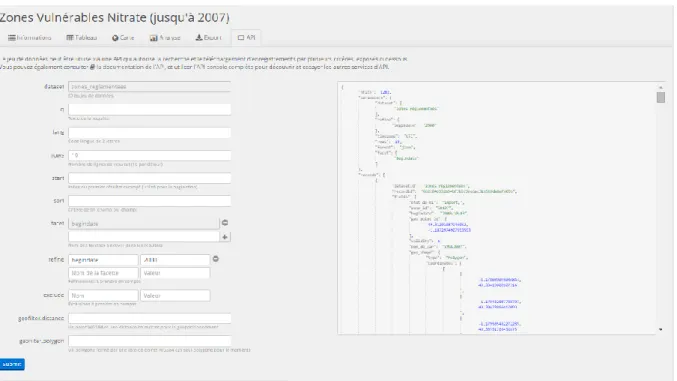
In order to promote the most up-to-date data possible, the user can access the data in real time using the platform's API (Figure 3). A Human Machine Interface (HMI) associated with a console window allows queries to be made and the results to be viewed immediately. This user interface is complementary to the API documentation. It enables easier and faster appropriation for developers. For each query a URL is generated and takes into account the configuration so as to be used directly in an application.
Figure 3. API console HMI
To protect access, the platform provides quite a precise definition of rights to give the rules and permissions to a user, or a group of several users.
4 Geographic Information Systems 5 Coma Separated Value
doi: 10.17700/jai.2015.6.4.209 62 Siné M , Haezebrouck T.P , Emonet E: API - AGRO: An Open Data and Open API platform to promote interoperability standards for Farm Services and Ag Web Applications
In the case of a dataset, rules management for example, only gives access to restricted views of a dataset. Similarly, in the case of an API, the methods with which users will have access can be defined based on their profile.
4.
Discussion
The preliminary study of the API-AGRO (Sine 2013) project helped prioritise a number of points of vigilance in order to set up an API management platform. Our attention focused on two aspects: firstly, protecting the API and secondly, service quality in terms of availability. These two points clearly refer to Service Level Agreement (SLA) expectations. This explains the choice of a contract solution with a service provider to ensure, with its SaaS offer, scalable, protected and user-friendly access conditions according to the rate of use. Furthermore, the choice of a "turnkey" API platform and data management solution enabled the API-AGRO platform to be implemented very swiftly.
Considerable work upstream was nevertheless carried out to identify the needs of the project's partners on the one hand and on the other hand the first API and data deposits rapidly made available. This inventory has helped compile an initial catalogue of agronomic datasets and services that had to be qualified and documented using a standard so as to define a list of metadata. This work also allowed the sharing knowledge about the field of APIs, Open Data and to support change by limiting the resistance and promoting the cohesion of a group by trying to involve each partner as much as possible. The principles of agile methods are applied to project management.
All this work has, although the API-AGRO project is still only in its infancy, resulted in a very rapid appropriation of the platform by the partners, just weeks after its deployment. The functionalities desired by the partners have not yet been implemented, but the expected basic functions are already operational. The choice of an "off-the-shelf" solution and not a specific development enabled an initial version of platform to be deployed that encourages the project partners to distribute references, connect APIs and very easily promote them for their internal and external needs by means of the display interfaces (graphs and maps). The recurrent integration of other features, such as the ability to monetise access to certain APIs, is planned.
Platform and open innovation
doi: 10.17700/jai.2015.6.4.209 63 Siné M , Haezebrouck T.P , Emonet E: API - AGRO: An Open Data and Open API platform to promote interoperability standards for Farm Services and Ag Web Applications
5.
Conclusion and Prospects
Even if initially, the API-AGRO project was built to meet the needs of interoperability in order to promote the development of an information system for a national network of farms, it was designed to go further. The project's partners, who are mostly knowledge-providing technical institutes, by uniting around an Open Data and Open API platform, are beginning to see the opportunities in open-sourcing a part of their data and to allow third parties to interface to their APIs.
The simple pooling of a part of their reference systems will enable them to co-develop and foster innovation due to external players who can build new tools, useful to farmers, based on their data which may then become standards. It is very likely that they themselves will be the first users of the APIs that they will upload to distribute content on various digital media (web, mobile phones, etc.) and develop their app.
The choice of a "turnkey" platform that meets the institutes' requirements and proves to offer a range of advanced viewing tools has meant it was able to go on-line very quickly, and will gradually grow in content and functionality.
This API-AGRO platform probably represents a strategic area of development which goes beyond the purely technological aspects. It is an open innovation tool, promoting the creation of value, at the service of an increasingly digital agriculture.
References
Babcock, C 2011, Easy-to-use APIs Key to Business Growth, in Information Week, vol. 1313, pp. 14. Butault, JP, Dedryver, CA, Gary, C, Guichard, L & Jacquet, F 2010, Synthèse du rapport d’étude Ecophyto R&D : quelles voies pour réduire l’usage des pesticides. Available from:
<http://inra.dam.front.pad.brainsonic.com/ressources/afile/224976-51d3e-resource-ecophyto-r-d-8-pages.html>. [8 June 2015].
CEFRIO 2013, L’innovation dans l’entreprise numérique : résultat d’une étude menée auprès des grandes entreprises française, in Indice de l’innovation par les TIC, Ed. CEFRIO, Montréal.
Chesbrough, H 2006, Open Innovation: Researching a New Paradigm, Oxfort University Press, New York. Filieri, R & Alguezaui, S 2012, Extending the enterprise for improved innovation, in The Journal of Business Strategy, vol. 33, n°3, pp. 40-47. doi: 10.1108/02756661211224997
Fountas, S, Sorensen, CG, Tsiropoulos, Z, Cavalaris, C, Liakos, V & Gemtos, T 2015, Farm machinery management information system. in Computers and Electronics in Agriculture, vol. 110, pp. 131-138. doi: 10.1016/j.compag.2014.11.011
Godan 2015, How can we improve agriculture, good and nutrition with open data, Open Data Institute. Available from <http://theodi.org/how-improve-agriculture-food-nutrition-open-data>. [8 June 2015].
Guillaud, H 2011, Comprendre les interfaces de programmation, Available from:
<http://www.internetactu.net/2011/06/24/comprendre-les-interfaces-de-programmation>. [25 June 2011]. Jacobson, D, Brail, G & Woods, D 2011, APIs, A strategy guide, O’Reilly, Sebastopol.
Kaloxylos, A, Eigenmann, R, Teye, F, Politopoulou, Z, Wolfert, S, Shrank, C & Kormentzas, G 2012, Farm management systems and the Future Internet era, in Computers and electronics in agriculture, vol. 89, pp.
130-144. doi: 10.1016/j.compag.2012.09.002
(Maali, F, DERI, NUI Galway, ERICKSON, J, Tetherless World Constellation (RPI) 2014, Data Catalog Vocabulary (DCAT). Available from <http://www.w3.org/TR/2014/REC-vocab-dcat-20140116/>. [8 June 2015].
Maler, E & Hammond, JS 2013, The Forrester WaveTM: API Management Platforms. Forrester.
doi: 10.17700/jai.2015.6.4.209 64 Siné M , Haezebrouck T.P , Emonet E: API - AGRO: An Open Data and Open API platform to promote interoperability standards for Farm Services and Ag Web Applications
Sine, M 2013, Quels sont les enjeux des interfaces de programmation web (API) pour les Instituts de Recherche Appliquée dans le domaine agricole, Professional thesis, Ecole de Management des Systèmes d’Information (EMSI) de Grenoble.
Sunlight Foundation 2010, Ten Principles for Opening Up Government Information. Available from: <http://sunlightfoundation.com/policy/documents/ten-open-data-principles/>. [8 June 2015]
Schumpeter, J.A, 1934, The theory of Economic Development, Cambride: Harvard University Press, MA. Van Huizen, G 2012, Extend the Enterprise with Public Web APIs, GARTNER.