107
AN ASSESSMENT OF FOREST FRUITS FROM ARAD COUNTY
ENESCU RALUCA1, DINCĂ LUCIAN1
1 ``Marin Dracea`` National Institute for Research and Development in Forestry, Brasov; E-mail:
Keywords: NWFP, Arad County, raspberry, hazelnuts.
ABSTRACT
Non-wood forest products had and still have an extremely important role in the life of local communities. Romania has a very varied relief so that the assortment of species and types of forests are also varied. The present study focused on Arad County where the most important categories of non-wood products were identified. In this case, they belong to the forest fruit category. As such, eight forest fruits were selected and were then hierarchized based on 19 criteria. The general conclusion was that the most important forest fruits from Arad County are hawthorn, raspberry and forest hazelnut.
INTRODUCTION
During the last decades, the importance of accessory products (NWFPs) for local communities, income and local economy has increased significantly, as they are appreciated and renowned in adopted policies and research domains (Shackleton et al., 2011). Discussions regarding the definition of
these products are sometimes
contradictory, as it is more easy to define what they are not (Neumann and Hirsch, 2000). The most intuitive and used definition is the ones elaborated by De Beer and McDermott (1989): biological material, other than the wood harvested from the forest for human usage. The products used by humans such as branches or bark can be included in this category of product accessories. FAO (Food and Agriculture Organization of United Nation) defines these products as ``goods of biological origin other than wood derived from forests, other wooded land and trees outside forests``(www.fao.org), excluding as such the products that contain wood and naming them NWFPs -Non-wood forest products.
The notion of NWFPs can be characterized by four factors: scale,
ecosystem value, forests, and
domestication (Shackleton et al., 2011). NWFPs are usually collected by locals or small merchants at a small scale. Processing NWFPs at an industrial scale and trading them can lead to a decrease of the local community’s dependence on these resources.
108 that grow on meadows can also be included in this NTFP category.
Cultivated accessory products are most of the time excluded from the NTFPs category, as humans control this process (Shackleton et al., 2011). However, in some cases, certain species can grow in forests and are necessary to local communities even though humans influence them. Agro-forest systems are rich in biodiversity and can contain numerous plant species (Aguilar-Støen et al., 2009; Sahoo, 2009). Furthermore, the debates can be extended if these products can be local or invasive. The NFTP definition is complex and diverse due to the different situations regarding the origin environment of these products.
Regarding the non-wood products from Arad County, a number of mentions are necessary about the forest fund from this area. As such, the total surface of Arad’s forest fund is of 211470 ha (www.insse.ro), from which 101.672 ha is forest fund managed by Arad Forest Directory through its ten forest districts (www.rosilva.ro). Broad-leaved species (European Beech, oaks, other species) represent 94% of the forest fund’s surface
(www.rosilva.ro). Annually, Romsilva Forest National Administration capitalizes approximately 3000 tons of forest fruits and 500 tons of medicinal plants. Edible mushrooms are also directly capitalized through submitting harvesting rights based on a transfer price (www.rosilva.ro).
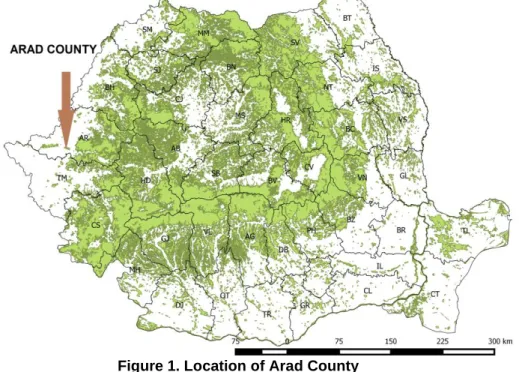
The aim of this study was to highlight the potential of non-wood forests products from Arad County. Arad County is located in the western part of Romania and is a border county (Figure 1). The total area of this county is of 7754 km2
(www.wikipedia.ro), meaning that the forest fund represents approximately 27% of its surface, namely over one quarter of its surface is forest. The most important fruits harvested from Arad’s forests are: forest hazelnuts, juniper, raspberry, wild strawberry, bitter cherries, hawthorn, black cranberry. The raspberry production from the harvesting months (July-September) is of 70-200 kg/ha (Vasile et al., 2016). For example, Maramures Forest Directorate has harvested an annual quantity of 119,9 t/an during 2005-2013 (Enescu et al., 2017). Another county in which raspberry is an important non-wood products is Prahova (Enescu et al., 2018a).
109 In its neighboring North County (Bihor) that has the same forest percentage as Arad, other studies have shown other non-wood forest products as the most important ones, namely: truffles (Tuber sp.), Boletus sp., Tilia flowers, dog-rose fruits (Rosa canina L.), black elder flowers (Sambucus nigra L.), bear’s garlic (Allium ursinum L.), pheasant (Phasianus colchicus L.) and hare (Lepus europaeus Pallas) (Timiș-Gânsac et al., 2018). In its neighboring
South County (Timiș), only one non-wood product is common (hawthorn), while the other products are: penny bun (Boletus spp.), milkcaps (Lactarius spp.), linden flowers (Tilia spp.), European blackberry (Rubus fruticosus L.), St John’s wort (Hypericum perforatum L.), European hare (Lepus europaeus Pallas) and grey partridge (Perdix perdix L.) (Enescu et al., 2018b).
MATERIALS AND METHODS
The forest fruits that were taken into consideration for the present study from Arad County were selected based on consulting forest management plans and then using an Analytic Hierarchy Process (AHP). This method was developed by Th. Saaty and is a multi-criteria decision analysis (Saaty, 2008). As such, in order to establish the value of the selected forest fruits, 19 criteria were selected, namely: harvesting period, portfolio of derived products, harvested quantity by one worker in 8 hours, harvesting cost, knowledge for recognition, knowledge for harvesting, tools
needed for harvesting, complexity of harvesting process, distribution range, market potential, the price of raw product, the price of the derived product, transport from the harvesting point to the storage center, perishability, “celebrity” of the product on the market, market demand, biotic threats, abiotic threats and development of the process of harvesting. The Expert Choice Desktop software package v. 11.5.1683 was used in order to analyze the fruit’s value after they were organized based on the 19 established criteria.
RESULTS AND DISCUSSION
The Analytic Hierarchy Process (AHP) was used for the eight categories of forest fruits (Corylus avellana, Juniperus sp., Rubus idaeus, Fragaria vesca, Fagus sp., Prunus avium, Crataegus monogyna, Ribes nigrum), by taking into account the 19 criteria mentioned above (Table 1).
As it can be seen in Table 1, the highest market’s request (criterion 14) is for wild strawberry, followed by raspberry. This criterion is well connected with the previous one regarding the product’s potential on the market (criterion 13). These two fruits also have the highest degree of perishability (criterion 12). In addition,
amongst all the studied fruits, these two are also the most popular on the market (criterion 15) and the easiest to recognize (criterion 8). It is possible that their “popularity” is closely connected to the fact that they are so easy to identify. Following the same principles, criterion 17 and 18 (regarding the derived products’ price and portfolio of products) place the same two fruits in the top.
110
AHP alternative ranking (Arad)
Table 1 Criterion Berries Co rylus av ell ana Jun iperus sp. Ru b u s idaeus F ragar ia ve sc a F agu s sp. P ru n u s av ium C rataegu s mo n o g yna Rib es n igrum
1 2 3 4 5 6 7 8
1 Harvesting period 6 5 3 1 7 2 8 4
2 Harvested quantity / worker /
8 hours 8 6 2 1 3 7 5 4
3 Harvesting cost 7 5 2 1 4 3 8 6
4 Knowledge for harvesting 7 5 2 3 4 1 8 6
5 Tools needed for harvesting 7 6 2 1 4 5 8 3
6 Complexity of harvesting
process 7 6 2 1 4 5 8 3
7 Development of harvesting
process 8 4 5 2 1 7 6 3
8 Knowledge for recognition 4 8 2 1 5 3 6 7
9 Distribution range 5 4 3 2 7 6 8 1
10 Biotic threats 3 1 8 7 2 6 4 5
11 Abiotic threats 4 1 7 6 2 8 3 5
12 Perishability 3 2 8 7 1 6 4 5
13 Market potential 6 2 7 8 1 4 5 3
14 Market demand 6 2 7 8 1 4 5 3
15 “Celebrity” of the product on
market 6 2 7 8 1 4 5 3
16 The price of raw product 5 2 7 6 1 8 3 4
17 The price of the derived
products 5 2 7 8 1 6 4 3
18 Portfolio of derived products 4 2 8 7 1 6 5 3
19 Transport (harvesting -
storage center) 4 5 8 7 1 6 3 2
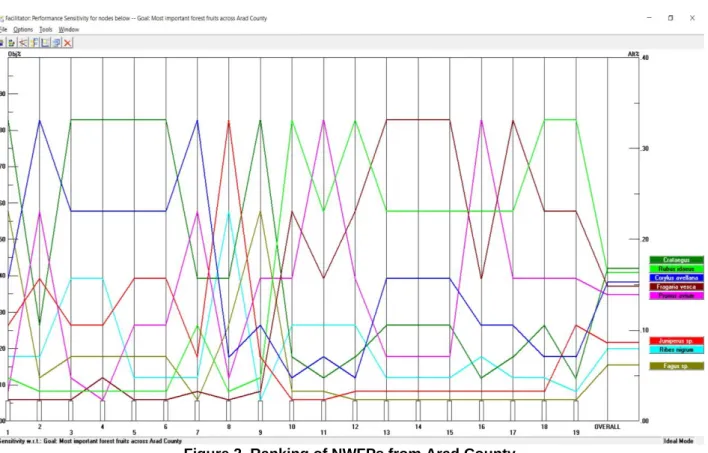
According to the Analytic Hierarchy Process, based on the above graphic, it can be observed that the most important forest fruits from this county are hawthorn (Craeugus monogyna), followed by raspberry (Rubus idaeus), and forest hazelnut (Corylus avelana). In another county (Cluj), hawthorn was also identified as a non-wood product but has occupied the last place (Enescu et al., 2018c). The last place from Arad County is occupied by beech mast (common beech fruits), while the next to last is reserved for black cranberry (Ribes nigrum). Even though wild strawberry was in the top area, the general hierarchy places them on the forth place. Bitter cherries occupy only the fifth place
even though the analysis displayed that they have the highest price for the raw matter. The surface occupied by bird cherry at a national level was of 7600 ha in 1994 (Dinca and Dinca, 2003). In Gorj County, raspberry, wild strawberry, black cranberry and hawthorn were also selected as forest fruits but the top three was occupied by sea buckthorn, edible chestnuts and blue berry (Vechiu et al., 2018).
111 2008). Other products derived from these fruits are tea, tincture, juice or different dry or solid extracts. They have a cardio stimulant effect and contain active biologic substances such as flavonoids and
glycosides (Bernatonienė et al., 2008). World Health Organization recommends hawthorn extracts as sedative, diuretic, anti-inflammatory and cardio tonic (Simirgiotis, 2013).
Figure 2. Ranking of NWFPs from Arad County
Raspberry is considered among the
most valuable shrubs that generates forest fruits (Beldeanu, 2008). Raspberries are an important source of diverse bioactive compounds such as phenol, anthocyanin, organic acids, minerals and antioxidants (Tosun et al., 2009). In addition, it can be prepared under numerous forms: juices, sorbet syrups, ice cream, marmalade, comfiture, stew, dehydrated fruits or even as alcoholic drinks (wine, liquor) (Beldeanu, 2008).
Forest hazelnuts contain a high
quantity of proteins, glucide, starch, mineral substances, provitamin A, vitamins B1, B2, and B6. They have a high nutritive
value and are very appreciated as pastry and confectionery products (Beldeanu, 2008). Their effects must not be forgotten in diseases such as anemia, tuberculosis, gravel, diabetes or taenia (Beldeanu, 2008).
CONCLUSIONS
The most important non-wood products from Arad County are forest fruits. Amongst them, the most popular ones are: forest hazelnut, juniper, raspberry, wild strawberry, bitter cherries, hawthorn and black cranberry. By making a hierarchy based on 19 criteria and by taking into
112 the most easy to recognize. The last place was occupied by common beech fruits.
REFERENCES
1. Aguilar-Støen, M., Moe, S. R., Camargo-Ricalde, S. L., 2009. Home gardens sustain crop diversity and improve farm resilience in Candelaria Loxicha, Oaxaca, Mexico. Human Ecology, 37(1), p. 55-77.
2. Assessment, M.E., 2005. Ecosystems and human well-being, vol. 5. Washington, DC, Island press.
3. Belcher, B.M., Vantomme, P., 2003.
What isn't an NTFP?. The International
Forestry Review, 5(2), p.161-168.
4. Beldeanu, E., 2008. Produse forestiere. Editura Universitatii Transilvania din Brasov, 331 p.
5. Bernatonienė, J., Masteikova, R.,
Majienė, D., Savickas, A., Kėvelaitis, E., Bernatonienė, R., ... Pečiūra, R., 2008.
Free radical-scavenging activities of
Crataegus monogyna extracts. Medicina, 44(9), p. 706-712.
6. De Beer, J. H., McDermott, M. J., 1989. The economic value of non-timber forest products in Southeast Asia: with emphasis on Indonesia, Malaysia and Thailand. Netherlands Committee for IUCN, Amsterdam, Netherlands, 175 pp.
7. Dincă, L., Dincă, M., 2003. Considerations regarding the valuable broadleaved species in Romania, Analele ICAS, 46(1), p. 315-320.
8. Enescu, C.M., Dincă, L., Vasile, D, 2017a. Importance of non-wood forest
products for Maramureș County. Revista
de Silvicultură și Cinegetică 40, p. 92-97. 9. Enescu, C.M, Dincă, L., Crișan, V, 2018b. The most important non-wood forest products from Prahova County, Revista Pădurilor, 1, p. 45-51.
10. Enescu, C.M., Dincă, L., Cântar, I, 2018c. Which are the most common non-wood forest products in Timis County?, Research Journal of Agricultural Science 50(1), p. 51-56.
11. Enescu, R.E., Vechiu, E., Vasile, D.,
2018. Non-wood forest products from Cluj county. Research Journal of Agriculture Science, 50 (1), p. 121-126.
12. Neumann, R. P., Hirsch, E., 2000. Commercialisation of non-timber forest products: review and analysis of research. Cifor. Indonesia, 173 p.
13. Saaty, T.L., 2008. Decision making with the analytic hierarchy process. International Journal of Services Sciences 1(1), p. 83-98.
14. Sahoo, U.K., 2009. Traditional home gardens and livelihood security in North-East India. Journal of Food, Agriculture and Environment, 7, p. 665–670.
15. Simirgiotis, M., 2013. Antioxidant capacity and HPLC-DAD-MS profiling of Chilean Peumo (Cryptocarya alba) fruits and comparison with German Peumo (Crataegus monogyna) from Southern Chile. Molecules, 18(2), p. 2061-2080. 16. Shackleton, C., Shackleton, S. and Shanley, P., 2011. Building a holistic picture: an integrative analysis of current and future prospects for non-timber forest products in a changing world. In Non-timber forest products in the global context. Springer, Berlin, Heidelberg.
17. Timiș-Gânsac, V., Enescu C.M.,
Dincă, L., Oneț, A., 2018. The management of non-wood forest products in Bihor county. Natural Resources and Soustainable Development, 8(1), p. 27-34. 18. Tosun, M., Ercisli, S., Karlidag, H., Sengul, M., 2009. Characterization of red raspberry (Rubus idaeus L.) genotypes for their physicochemical properties. Journal of Food Science, 74(7), p. C575-C579.
19. Vasile, D., Dincă, L., Voiculescu, I., 2016. Wild berries collected in 2016 from national forest fund managed by RNP
Romsilva. Revista de Silvicultură și
113 20. Vechiu, E., Dincă, L., Enescu, C.M., 2018. Care sunt cele mai importanta fructe de pădure din județul Gorj? Revista de Silvicultură și Cinegetică 42, p. 89-93. 21. www.fao.org