Journal of Agriculture and Rural Development in the Tropics and Subtropics Volume 110, No. 1, 2009, pages 9–22
How Do “Renewable Products” Impact Biodiversity and
Ecosystem Services – The Example of Natural Rubber in China
M. Cotter∗1,K. Martin1andJ. Sauerborn1
Abstract
This paper aims to present the implications brought by the expansion of “renewable products” plantation systems in the tropics with cultivation of rubber (Hevea brasilien-sis) as a main focus. Throughout South East Asia, natural forest is being replaced by rubber or oil palm (Elaeis guineensis) plantations, with severe consequences for the local flora and fauna. Main aspects of this review are: i) The provision of an overview over renewable resources in general and rubber in particular, with eco-physiological and agro-nomical information concerning rubber cultivation. ii) The effect of rubber plantations on biodiversity and species composition under different rubber farming approaches. In addition we debate the possible influences of such large scale land cover transformations on ecosystem services. iii) The conversion of natural forests into rubber plantations releases considerable amounts of carbon dioxide into the atmosphere. We estimated these values for different land cover types in southern China and assessed the carbon sequestration potential of local rubber plantations.
Keywords: biodiversity, renewable products, rubber, ecosystem services, carbon seques-tration, ecophysiology
1 Introduction
Ever since, mankind has been dependent on natural resources. From the timber used to build houses to the materials for clothing or the construction of tools, most of these were renewable products obtained from the direct environment. These days, with fossil fuels and minerals to be on the decline, the large scale use of renewable resources is given an increasing degree of importance for a fast-growing human population. The natural forests of the humid tropics are particularly rich in flora and fauna forming several hotspots of biodiversity. In South East Asia’s forests, deforestation rates are highest, mainly because of an increasing agricultural expansion in order to meet the economic and nutritional needs of a growing population. Two of the main contributors are rubber and oil palm plantations. The bulk of rubber plantations in the Greater
∗corresponding author: [email protected]
Mekong Subregion replace primary and secondary natural forest, threatening the unique wildlife and disturbing ecosystem services.
In this article, we highlight the possible impacts of large scale use of renewable products with the example of rubber cultivation in South East Asia, especially in southern China. Of particular interest are the implications of the replacement of tropical rainforest by rubber plantations concerning biodiversity, ecosystem services and carbon sequestration potential.
2 Renewable Products
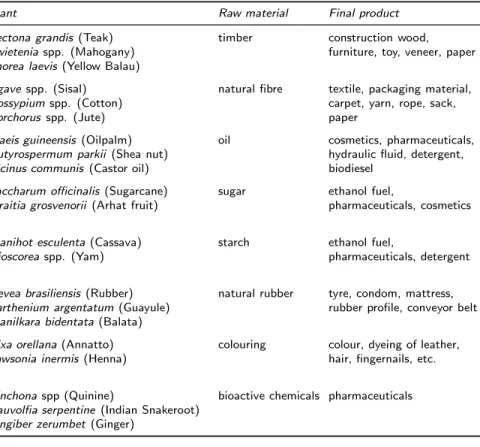
The world demand for renewable resources is constantly growing because of an increas-ing need by a risincreas-ing human population. Renewable resources are defined as materials produced by living organisms (plants, animals, microbes) used for purposes other than food and feed. Such materials include timber, natural fibre, oil and grease, sugar, starch, natural rubber, colorants, pharmaceuticals, and others containing special substances like resin, tannin, wax and/or natural protective compounds against pests and diseases (Tab. 1).
Table 1: Selected tropical plants for industrial and energetic use
Plant Raw material Final product
Tectona grandis (Teak)
Swieteniaspp. (Mahogany)
Shorea laevis(Yellow Balau)
timber construction wood, furniture, toy, veneer, paper
Agavespp. (Sisal)
Gossypiumspp. (Cotton)
Corchorusspp. (Jute)
natural fibre textile, packaging material, carpet, yarn, rope, sack, paper
Elaeis guineensis (Oilpalm)
Butyrospermum parkii (Shea nut)
Ricinus communis(Castor oil)
oil cosmetics, pharmaceuticals, hydraulic fluid, detergent, biodiesel
Saccharum officinalis(Sugarcane)
Siraitia grosvenorii(Arhat fruit)
sugar ethanol fuel,
pharmaceuticals, cosmetics
Manihot esculenta(Cassava)
Dioscoreaspp. (Yam)
starch ethanol fuel,
pharmaceuticals, detergent
Hevea brasiliensis(Rubber)
Parthenium argentatum(Guayule)
Manilkara bidentata(Balata)
natural rubber tyre, condom, mattress, rubber profile, conveyor belt
Bixa orellana(Annatto)
Lawsonia inermis(Henna)
colouring colour, dyeing of leather, hair, fingernails, etc.
Cinchonaspp (Quinine)
Rauvolfia serpentine(Indian Snakeroot)
Zingiber zerumbet(Ginger)
The cultivation of these renewable resources can contribute substantially to the improve-ment of a local and regional economic situation but it can also result in biodiversity loss and environmental degradation.
3 Natural rubber as a renewable resource
Natural rubber extracted from the treeHevea brasiliensis (Willd. Ex A. Juss.) Muell. Arg. distinguishes itself from all other raw materials, for it is elastic and at the same time reversible and hence inimitable. To gain rubber the bark of the rubber tree is cut so as to collect the latex, a milky sap from the latex vessels localised in the inner bark. Latex is an emulsion that contains e.g. water, proteins, resins, tannins, and rubber in varying quantities. The Mayas called the tree “Caa-o-chu”, that means “weeping tree” (Tab 2).
Table 2: Characteristics of the rubber tree
Name: natural rubber
scientific name: Hevea brasiliensis(Willd. Ex A. Juss.) Muell. Arg.
family: Euphorbiaceae
habitus: tree (may reach heights of more than 20 m within a forest)
fertilisation: mainly allogamy by small insects such as midges and thrips, autogamy occurs to various degrees
centre of origin: Amazon basin in South America
natural range: humid tropics
propagation: vegetative
first harvest: 5 – 7 years after planting
economic life span: about 30 years
production unit: plantation / family farming
predominant constituent harvested: latex, timber
actual yield of dry rubber: ∼3 – 4.5 kg tree−1year−1
potential yield of dry rubber: about 8.5 kg tree−1year−1(Onget al., 1994) major disease: South American leaf blight of rubber (Microcyclus ulei
(Henn.) Arx
4 Ecophysiology of Natural Rubber
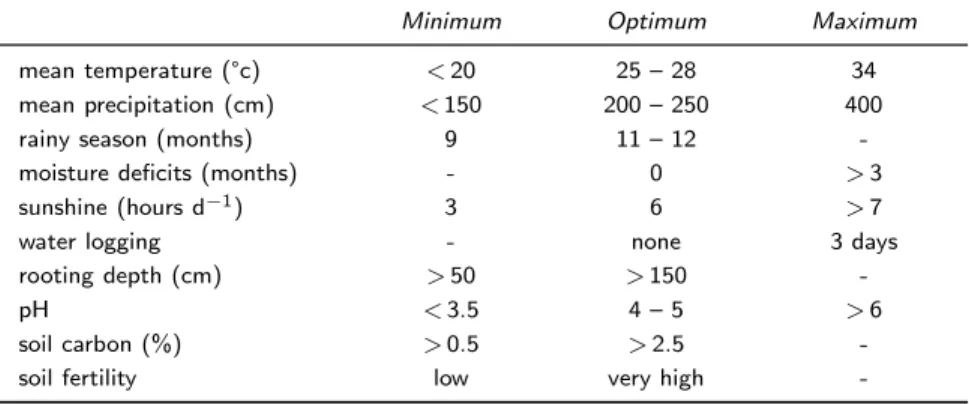
Hevea brasiliensis is a tropical tree. It grows best at temperatures of 20 – 28°C with a well distributed annual precipitation of 180 – 200 cm. Traditionally, H. brasiliensis has been cropped in the equatorial zone between 10°N and 10°S. Urged by a growing world demand rubber has now spread successfully to the latitudes 23°N (China) and 21°S (Brazil) and is cultivated up to 1200 m above sea level (Tab. 3).
Table 3: Characteristics for suitable cultivation of Hevea brasiliensis
Minimum Optimum Maximum
mean temperature (°c) <20 25 – 28 34 mean precipitation (cm) <150 200 – 250 400
rainy season (months) 9 11 – 12
-moisture deficits (months) - 0 >3
sunshine (hours d−1) 3 6 >7
water logging - none 3 days
rooting depth (cm) >50 >150
-pH <3.5 4 – 5 >6
soil carbon (%) >0.5 >2.5
-soil fertility low very high
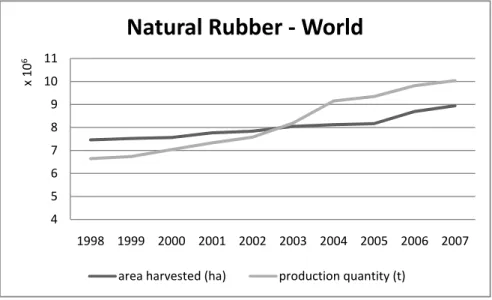
-Today, natural rubber provides about 40% of the world rubber demand and is used in the manufacture of over 40,000 products (Ray, 2004). Synthetic rubber, invented at
the beginning of the 20thcentury, covers about 60 % of the current consumption. The world production of natural rubber is constantly growing from about 2 million tons in the 1960s to more than 10 million tons in 2007 (FAOSTAT, 2008) (Fig. 1).
In its centre of origin, the Amazon basin, H. brasiliensis is consistently endangered by the fungus Microcyclus ulei (South American leaf blight of rubber). The pathogen so far inhibits plantation growth of rubber trees in South America (Lieberei, 2007).
Beneficiaries of this situation are located in South East Asia where the fungus has not spread to date. Thailand, Indonesia and Malaysia are the main rubber producers followed by Viet Nam and China (FAOSTAT, 2008) (Tab. 4).
Table 4: Major natural rubber producers of the world (data of 2007)
Country Area harvested (1000 ha) Yield (t ha−1) Production quantity (1000 t)
China 475 1.1 545
Indonesia 3175 0.8 2540
Malaysia 1400 0.9 1270
Thailand 1763 1.7 3122
Figure 1: Natural Rubber – World (Source: FAOSTAT, 2008)
4 5 6 7 8 9 10 11
1998 1999 2000 2001 2002 2003 2004 2005 2006 2007
x1
0
6
Natural Rubber - World
area harvested (ha) production quantity (t)
Microcyclus ulei remains the Achilles’ heel of natural rubber production. Not only that its introduction to South East Asia would cause an economic loss to the producers but it would precipitate a crisis within the many industries (medical, transportation, defence, etc.) which are dependent on natural rubber in the manufacturing of their commodities. Rubber production systems and the conservation of natural biodiversity Natural forest vegetation in the humid tropics is dwindling in an alarming rate, and the loss of biodiver-sity due to the decline of such habitats is a well-known fact. The level of deforestation in SE-Asia is the highest among tropical areas (Sodhiet al., 2004). The major reason
for this is the increasing agricultural expansion, especially due to oil palm and rubber cultivation.
The expansion of rubber plantations in SE-Asia largely takes place by the reduction of primary and secondary natural forest areas. The loss of natural forests is especially serious in the major rubber production areas of Asia, because they are located within the so called Indo-Burma hotspot, one of the 34 global biodiversity hotspots identified by Conservation International(2007). This region largely corresponds with the
Lower Mekong catchment area and also includes parts of southern and western Yunnan as well as southern Chinese offshore islands such as Hainan.
The replacement of any type of forest by a rubber monoculture results in a reduction of natural tree species diversity to zero, because the rubber tree is not even native to that region. Many studies also confirm significant reductions of fauna in plantations compared to natural forest. For example,DanielsenandHeegaard(1995) found that
importance to conservation. In the plantations, only 5-10% of the primary-forest bird species were recorded. Primates, squirrels and tree-shrews disappeared except for one species. Similarly,Pehet al.(2005) found reductions in primary-forest species of more
than 70% in such habitat types in Malaysia.
There are two approaches to reduce biodiversity losses in rubber and other types of monoculture plantations. The first is the diversification in terms of plant species rich-ness and vegetation structure of the plantation itself, and the other is the preservation of landscape diversity, specifically the maintenance of natural forest patches within plan-tation areas.
Diversification of rubber plantations is realized in a variety of cropping systems. From southern Yunnan (China), Wu et al. (2001) classified the existing rubber plantations
into four types. These are
(a) monoculture rubber, representing the most common type,
(b) temporarily intercropped rubber plantations, with annual crops (e.g. upland rice, corn pineapple, passionflower) established between young rubber trees before canopy closing,
(c) rubber plantations of multiple species and layers of shrubs and perennial herbaceous plants such as tea, coffee, cardamom and vanilla, and
(d) mixed rubber plantations based on the principles of traditional home garden systems with perennial plants including tea, coffee, fruit trees bamboo and bananas, which are mainly established in aging rubber plantations.
In this sequence, there is an increase in structural as well as plant diversity, but most or all of these plant species do not represent natural forest species. Although no studies on faunal diversity have been conducted in these types of plantations, it can be expected that it is still very low and do not support significant numbers in forest species. In terms of plant species diversity and structure, such polyculture systems are probably similar to the mixed-rural landscapes in Malaysia, consisting of agricultural land, oil palm, rubber and fruit tree stands (Pehet al., 2005).
More complex and more diversified is the so-called “jungle rubber”, “rubber garden” or “rubber agroforest” system of Indonesia, specifically Sumatra and Kalimantan. It can be defined as a balanced, diversified system derived from swidden cultivation, in which man-made forests with a high concentration of rubber trees replace fallows. Most of the income comes from rubber, complemented with temporary food and cash crops during the early years (Gouyonet al., 1993). In its structure, they resemble secondary forest
with wild species tolerated by the farmer.
Beukemaet al.(2007) compared plant and bird diversity of the Indonesian jungle rubber
species diversity in an impoverished landscape increasingly dominated by monoculture plantations. From a more specific study on terrestrial pteridophytes (ferns and fern allies) in jungle rubber and primary forest,Beukemaandvan Noordwijk(2004) conclude
that jungle rubber systems can play a role in conservation of part of the primary rain forest species, especially in areas where primary forest has already disappeared. Of economic reasons, however, the most common type of rubber cultivation is the monoculture system. In such landscapes, natural biodiversity can only be conserved in remaining plots of natural vegetation, which should be preserved as reservation areas. Several aspects of this approach needed to be considered for practical implementations (Debinskiet al., 2001):
(a) The frequency and spatial distribution of habitat fragments and patches determines species distribution patterns.
(b) Species populations may be separated on patches of their habitat within a landscape of less suitable habitat, and
(c) Species dispersal patterns may interact with patch size and patch context to de-termine species distributions within and among patches (“patch context” describes the habitat type adjacent to a patch)
Derived from this, a concept for measuring landscape structure has been developed, named “landscape connectivity” (Merriam, 1991). It describes the degree to which
the landscape facilitates or impedes movement of species populations among habitat or resource patches. An important question related to this is whether the size and structure of the landscape matrix acts as a corridor or barrier between patches.
All these points also apply to forest patches within monoculture rubber plantations. However, no study dealing with matrix effects on species movements in such landscapes has been conducted so far. Specifically, there is no information on the arthropod diversity of rubber plantations in comparison to forests. In order to develop species conservation concepts in rubber dominated landscapes, research needs to address this question. 5 Ecosystem Services
Ranging from the provision of clean drinking water to the pollination of fruit crops, mankind is deriving benefits from a wide array of processes and interactions that take place in our environment. These services are vital to the functioning of our ecosystems, and vital to the livelihood of men, as they provide not only the basis for human life, but also additional attendances like food and health security or cultural and spiritual values. The total amount of these services can only be estimated, but cautious predictions state a yearly value of 33 trillion (1012) US$(Costanzaet al., 1997;Eamuset al., 2005).
values, knowledge system, spiritual and religious values. (4) Supporting services com-prise soil formation and retention, provision of habitat, primary production, water and nutrient cycling (Millennium Ecosystem Assessment, 2005).
Ecosystem goods and services are in danger as the human impact on the environment is constantly increasing (IPCC, 2007). Deforestation and the increase of agricultural
areas, water pollution and rising fresh water demand, degradation and unsustainable use have put many ecosystems on the brink of collapse.
6 Impacts of rubber cultivation on ecosystem services
In South-East Asia large areas of natural vegetation with their plentiful diversity of flora and fauna have been put under great pressure from the establishment of plantations. Rubber is playing a great role in this process, as the anticipated revenues are appealing to farmers and policy makers alike. In China’s Yunnan province, more than 11% of the total area is covered with rubber (Liet al., 2007), but there are townships where rubber
cultivation contributes to more than 45% of the land cover (Huet al., 2007). For one of
these townships, Menglun,Huet al.(2007) estimated the value of ecosystem services
provided. According to this report covering land use change over a period of 18 years, the total value of ecosystem services dropped by US$11.4 million (28%). The services most affected were nutrient cycling, erosion control and climate regulation. The biodiversity service of “habitat/refugia” had not been covered, but considering the detrimental effect of monoculture plantation systems on species richness and the corresponding ecosystem services, the total value of ecosystem services for the research area can be expected to be even lower than reported.
This effect seems to be alleviated by the fact that the townships gross domestic product increased, leading to a ratio of 1:1.39 for increase in GDP to loss of ecosystem services in US$(Huet al., 2007).
7 Deforestation due to rubber expansion
The increasing demand for natural rubber products has lead to a wide spread replacement of natural forest vegetation with rubber. Liet al.(2007) states that, between 1976 and
2003, tropical seasonal rain forest in Yunnan was reduced by 67%, mainly due to the planting of rubber. Lowland rain forests are the most affected forest types due to the climatic needs of the rubber tree. But also mountain rainforests and other forest communities of higher elevations are seriously under pressure, as agricultural production shifts into these regions.
According to the recommendations given by the International Panel of Climate Change (Houghton et al., 1997) as used byGermerandSauerborn(2007), we assessed
the potential amounts of carbon and carbon dioxide emission that are expected when preparing land for the conversion into rubber plantations.
Again, the data from the Yunnan Institute of Forest Inventory and Planning Li et al.
below to above ground biomass, we used a BGB to AGB ratio of 1:1.13 as given by the
Houghtonet al.(1997).
For the emission of CO2 during decomposition, we assume that after 30 years under humid subtropical conditions, all cleared biomass, above and below ground, will be decomposed. Houghtonet al.(1997) suggests a vegetation independent forest carbon
stock estimate of 50% of the biomass. Carbon (12 g/mol) will mostly be released as carbon dioxide (44 g/mol). One ton of cut forest biomass would release 0.5 t of carbon through decomposition, resulting in the emission of 1.8 tCO2.
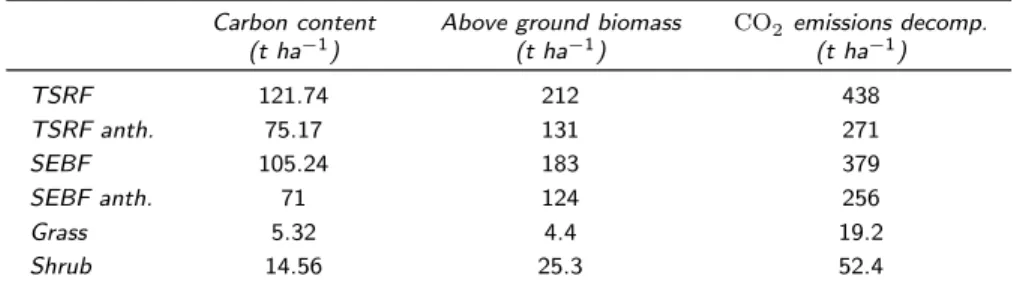
As an example, the average carbon content of one hectare of undisturbed tropical sea-sonal rainforest in Yunnan was reported to be 121.74 t, which is an estimated 243.5 t of biomass, assuming a forest stock carbon content of 50% (Houghtonet al., 1997).
The complete decomposition of this amount would lead to the emission of (243.5 t× 1.8) = 438.3 tCO2.
Table 5: Emission ofCO2equivalents by forest clearing.
Carbon content (t ha−1)
Above ground biomass
(t ha−1) CO2
emissions decomp. (t ha−1)
TSRF 121.74 212 438
TSRF anth. 75.17 131 271
SEBF 105.24 183 379
SEBF anth. 71 124 256
Grass 5.32 4.4 19.2
Shrub 14.56 25.3 52.4
TSRF: tropical seasonal rainforest; SEBF: subtropical evergreen broadleaf forest (57% of Yunnan forests); TSRF anth., SEBF anth. both with strong anthropogenic influences (e.g. selective logging); Grass: grassland,Shrub: shrubland. Carbon content values fromLiet al. (2008), other values calculated following IPCC guidelines.
8 Carbon sequestration potential of rubber
Properly managed rubber plantations that are supplied with sufficient amounts of fer-tilizer have a high potential to act as a continuous sink for atmospheric carbon dioxide (Chenget al., 2007). This is mainly due to their high sequestration rates and the fact
that there is a constant export out of the production system by means of tapping.
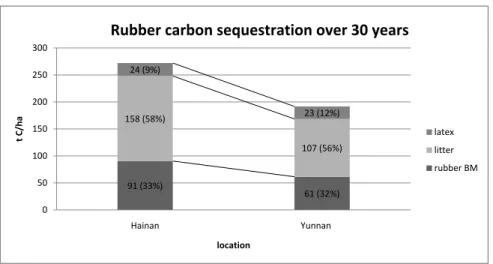
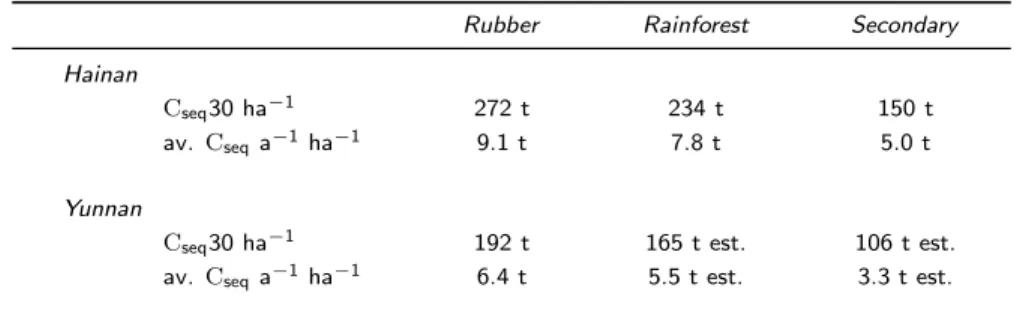
Chenget al.(2007) reported a 30 years lifetime carbon sequestration of 272 tCha-1
in rubber plantations on the island of Hainan. Comparing this to the sequestration rates of rain forests and secondary forests on Hainan, 234 and 150 t Cha-1over the same period, the high productivity of a rubber plantation becomes discernable. Nevertheless, more than 57% of the sequestrated carbon ends up in easily decomposed litter. This decomposition process returns considerable amounts of carbon back to the atmosphere, up to fifty percent of the total carbon content in the first year (AndersonandSwift,
Based on the equation used by Cheng et al.(2007), we were able to derive carbon
sequestration values for rubber plantations (CR) in Yunnan province, China’s second biggest rubber producer. We can calculateCRas:
CR=CBi+CLa+CLi,
with the carbon content of biomass (CBi), carbon content of latex yieldCLa, and the carbon content of litter (CLi).
Data from the Yunnan Institute of Forest Inventory and Planning published byLiet al.
(2008) were used to obtain information about local forest biomass and its carbon content (CBi= 61.48 tCha-1for rubber plantations below 800m).
The amount of sequestrated carbon that is removed from the field during latex tapping was estimated by multiplying average values of latex carbon content by latex yield per hectare (FAOSTAT, 2008) by the economic lifetime of a rubber plantation in years
(CLa). Due to suboptimal climate conditions rubber tapping in Yunnan usually begins seven years after establishment of the plantation, in comparison to an average of five years reported for Hainan. This results in a slightly lower average economic lifetime. In order to estimate the amount of litter produced over 30 years we proportionally adjusted the values for Hainan litter biomass per hectare to the lower total biomass of Yunnan rubber plantations (CLi).
Based on these calculations, the estimated carbon sequestration during a 30 years life-time for rubber plantations below 800m elevation in Yunnan province is 192 tCha-1, which consists of an estimated litter mass of 107 tCha-1and a latex output of 23 tC ha-1.
Figure 2: Total carbon sequestration by rubber over 30 years per hectare. Total values are divided into latex production, litter production and rubber biomass (non-litter)
91 (33%)
61 (32%) 158 (58%)
107 (56%) 24 (9%)
23 (12%)
0 50 100 150 200 250 300
Hainan Yunnan
t C/ha
location
Rubber carbon sequestration over 30 years
These estimates do not consider the soils potential to release and sequestrate carbon under different management regimes. In this context, the dynamics of carbon cycling regarding the substantial amounts of litter produced by rubber plantations should be put to further investigation, as these results could lead to a clearer picture of the overall carbon sequestration potential of rubber.
9 CO2 balance in plantation establishment
During its lifetime of 30 years, a rubber plantation in Yunnan province can sequester an estimated 192 t of carbon or 703 t CO2 per hectare (based on an atomic weight ratio of 1:3.66). Plantations in Hainan province can be expected to achieve about 272 t of Csequestration, mostly due to their higher biomass and litter production. These values are, as stated above, comparable to the 30 years sequestration potential of Hainan rainforests.
When comparing these vegetation types concerning theirCO2balance, one decisive fact has to be considered. Rubber plantations are man-made ecosystems which replace local floral communities entirely. In most cases, this is done by clearing the forest for the plantation establishment.
Based on our estimates, if one hectare of relatively undisturbed tropical seasonal rain-forest in Yunnan province is cleared, this process releases about 438 t ofCO2 into the atmosphere. A fully grown rubber plantation on the same spot would need around 20 years to re-sequester this amount ofCO2 . Although after several decades a net gain in carbon fixation could be achieved, the loss in biodiversity and ecosystem resources would be persistent.
Table 6: Carbon sequestration over 30 years and annually
Rubber Rainforest Secondary
Hainan
Cseq30 ha−1 272 t 234 t 150 t
av.Cseqa−1ha−1 9.1 t 7.8 t 5.0 t
Yunnan
Cseq30 ha−1 192 t 165 t est. 106 t est. av.Cseqa−1ha−1 6.4 t 5.5 t est. 3.3 t est.
10 Rubber and grassland rehabilitation
In order to find more sustainable locations for the establishment of rubber plantations, disturbed ecosystems like degraded grassland and abandoned fallows from swidden agri-culture could be used. These land uses are rather scarce in the elevation levels that are suitable for rubber plantation in Yunnan province, but nevertheless it is a promising concept for other regions nearby. All throughout the tropics and subtropics, the trans-formation of agricultural areas to grassland ecosystems is a common problem. These areas are often dominated by very competitive grass species that effectively prevent nat-ural succession into secondary woodlands and forests. The conversion of these land use types into rubber plantations would not only increase the farmers’ welfare but also se-cure important ecosystem services that grassland and fallows have difficulties to provide (Liet al., 2008). In addition, the establishment of plantations on these degraded areas
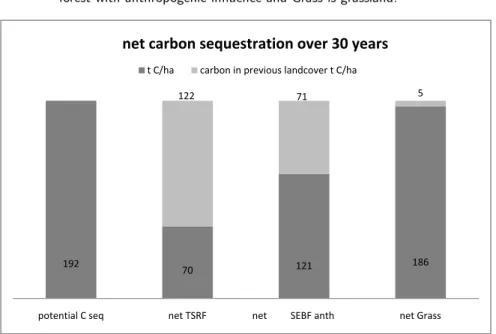
would emit decisively less carbon dioxide than the conversion of forests. CO2 release into the atmosphere during land preparation is estimated to amount to about 110 t ha-1 for shrubland in Yunnan, and 19 t ha-1 for grassland, in comparison to the 438 t ha-1 for Yunnan seasonal rainforest. Compared to the values reported above, this would lead to a faster and significantly higher net gain inCO2 sequestration by rubber plantations when used to rehabilitate grassland. Similar results have been published for oil palm plantations (GermerandSauerborn, 2007).
Figure 3: Carbon sequestration by rubber grown below 800 masl. over a period of 30 years in Yunnan province, compared to net carbon sequestration considering the release ofCO2 during plantation establishment. Cseq. is the estimated carbon sequestration potential of rubber (above); previous land cover: TSRF is tropical seasonal rainforest, SEBF anth is subtropical evergreen broadleaf forest with anthropogenic influence and Grass is grassland.
192
70 121 186
122 71 5
potential C seq net TSRF net SEBF anth net Grass
net carbon sequestration over 30 years
References
Anderson, J. M.andSwift, M. J.; Decomposition in tropical forests; in: Tropical
rain forest: ecology and management, edited bySutton, S. L.,Whitmore, T. C.
andChadwick, A. C.; 287–309; Blackwell, Oxford, UK; 1983.
Beukema, H.,Danielsen, F.,Vincent, G.,Hardiwinoto, S.andvan Andel, J.; Plant and bird diversity in rubber agroforests in the lowlands of Sumatra,
Indone-sia;Agroforestry Systems; 70:217–242; 2007.
Beukema, H. and van Noordwijk, M.; Terrestrial pteridophytes as indicators of
a forest-like environment in rubber production systems in the lowlands of Jambi, Sumatra;Agriculture, Ecosys. Environ.; 104:63–73; 2004.
Cheng, C.,Wang, R. and Jiang, J.; Variation of soil fertility and carbon
seques-tration by planting Hevea brasiliensis in Hainan Island, China; J. Environm. Sci.; 19(3):348–352; 2007.
Conservation International; Biodiversity Hotspots - Indo-Burma; 2007; URL
http://www.biodiversityhotspots.org/xp/hotspots/indo burma/.
Costanza, R.,D’Arge, R.andde Groot, R.; The value of the world’s ecosystem
services and natural capital;Nature; 387:253–260; 1997.
Danielsen, F.andHeegaard, M.; Impact of logging and plantation development on
species diversity – a case study from Sumatra; in: Management of tropical forests: towards an integrated perspective, edited bySandbukt, O.; 73–92; Centre for
De-velopment and the Environment, University of Oslo, Norway; 1995.
Debinski, D. M.,Ray, C.andSaveraid, E. H.; Species conservation and the scale
of the landscape mosaic: do scales of movement and patch size affect diversity?; Biodiv. Conserv.; 98:179–190; 2001.
Eamus, D.,Macinnis-Ng, C. M. O.,Hose, G. C.,Zeppel, M. J. B.,Taylor, D. T.and Murray, B. R.; Ecosystem services: an ecophysiological examination;
Austr. J. Bot.; 53(1):1–19; 2005.
FAOSTAT; 2008; URLhttp://faostat.fao.org/site/567/default.aspx. Germer, J. and Sauerborn, J.; Estimation of the impact of oil palm plantation
establishment on greenhouse gas balance; Environment, Development and Sustain-ability; 10(6):697–716; 2007.
Gouyon, A., de Foresta, H. and Levang, P.; Does ‘jungle rubber’ deserve its
name? An analysis of rubber agroforestry systems in southeast Sumatra;Agroforestry Systems; 22(3):181–206; 1993.
Houghton, J. T., Meira Filho, L. G., Lim, B., Treanton, K.,
Mamaty, I., Bonduki, Y., Griggs, D. J. and Callender, B. A.,
(Eds.) Revised 1996 IPCC Guidelines for National Greenhouse Gas In-ventories - Workbook (Volume 2); IPCC-NGGIP/OECD/IEA; 1997; URL
http://www.ipcc-nggip.iges.or.jp/public/gl/invs5.html.
Hu, H.,Liu, W.andCao, M.; Impact of land use and land cover change on ecosystem
IPCC; Technical summary; in: Climate change 2007 – The physical science basis;
Cambridge University Press, Cambridge UK, and New York, USA; 2007.
Li, H.,Aide, T. M.,Ma, Y.,Liu, W.andCao, M.; Demand for rubber is causing
the loss of high diversity rain forest in SW China; Biodiv. Conserv.; 16:1731–1745; 2007.
Li, H., Ma, Y., Aide, T. M. and Liu, W.; Past, present and future land-use in
Xishuangbanna, China and the implications for carbon dynamics;For. Ecol. Manag.; 255:16–24; 2008.
Lieberei, R.; South American leaf blight of the rubber tree (Heveaspp.): New steps
in plant domestication using physiological features and molecular markers;Annals of Botany; 100:1125–1142; 2007.
Merriam, G.; Corridors and connectivity: animal populations in heterogenous
environ-ments; in: Nature conservation 2: The role of corridors, edited bySaunders, D. A.
and Hobbs, R. J.; 133–142; Surrey Beatty & Sons, Chipping Norton, Australia;
1991.
Millennium Ecosystem Assessment;Ecosystems and human well-being: Synthesis;
Island Press, Washington D.C., USA; 2005.
Ong, S. H., Ramli, O.,Othman, H., Mesahuling, B.and Naimah, I.; Rubber
breeding progress and strategies to meet the future needs of the plantation industry; in: Management of enhanced profitability in plantations; 53–70; Incorporated Society of Planters, Kuala Lumpur, Malaysia; 1994.
Peh, K. S., De Jong, J., Sodhi, N. S., Lim, S. L. and Yap, C. A.; Lowland
rainforest avifauna and human disturbance: persistence of primary forest birds in selectively logged forests and mixed-rural habitats of southern Peninsular Malaysia; Biol. Conserv.; 123:489–505; 2005.
Ray, D. T.; Natural Rubber; in: Encyclopedia of Plant and Crop Science; 778–780;
Marcel Dekker Inc. NY, USA; 2004.
Sodhi, N. S., Koh, L. P., Brooke, B. W. and Ng, P. K.; South East Asian
biodiversity: an impeding disaster;Trends Ecol. Evol.; 19:654–660; 2004.
Wu, Z. L.,Liu, H. M.andLiu, L. Y.; Rubber cultivation and sustainable development