Lucrări ştiinŃifice Zootehnie şi Biotehnologii, vol. 41(1) (2008) Timişoara
EFFECTS OF BARLEY PROCESSING ON THE
BIO-PRODUCTIVE INDICES IN FATTENING WEANED LAMBS
EFECTUL PROCES
Ă
RII ORZULUI ASUPRA INDICILOR
BIOPRODUCTIVI LA TINERETUL OVIN SUPUS
ÎNGR
ĂŞĂ
RII
VOIA S. *, BOGDAN GH*, DRINCEANU D. *, PADEANU I. *, COŞIER VIORICA**, HRINCĂ GH ***
* Faculty of Animal Sciences and Biotechnologies, Timişoara, România ** Faculty of Animal Sciences and Biotechnologies, Cluj, România
*** S.C.D.O. PopăuŃi, Botoşani, România
The objective of our researcheswas to observe the nutritive and productive effect of the ratio, offered at discretion, composed of alfalfa hay and barley under the following presentation forms: whole grains, roughly ground (4mm) with and without addition of yeast, strain Yea-Sacc1026, to lambs submitted for fattening. The experiment lasted 54 days, the biological material was represented by Turcana lambs, grouped in three lots (n=12). Growth performances were significant bigger (p< 0.04) for the final body weight, total weight gain and average daily gain, but the specific intake was decreased with 0.49 UNC in lambs that consumed ground barley prior to those that consumed whole barley grains. The addition of Saccharomyces cerevisiae, strain Yea-Sacc1026 in the ground barley at 4 mm has a more productive and evident effect (p<0.02) regarding final body weight, total weight and average daily weigh compared to the lambs fed with whole barley grains, with a specific intake lower with 0.89 UNC.
Key words: lamb, fattening, nutrition, barley, yeast
Introduction
Materials and Methods
Our researches were performed at the Didactic Station Timisoara in Turcana weaned lambs, 98 day old, proceeded from simple births.
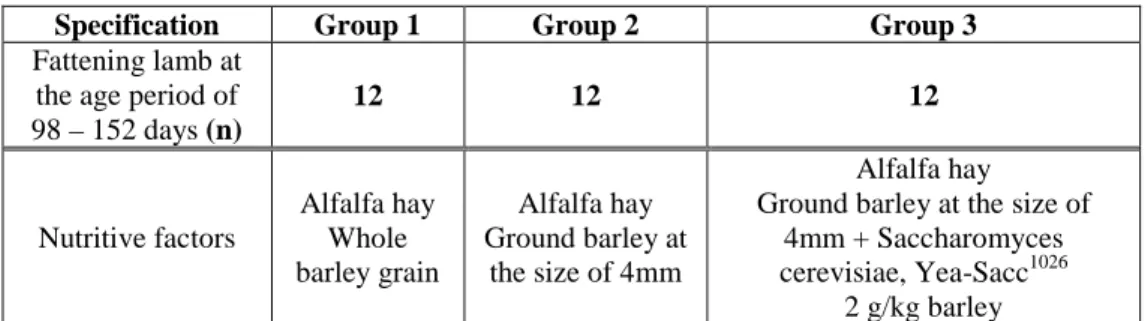
At the beginning of the experimental period, the lambs was randomly divided into three groups, each group was made of 12 lambs, according to the experiment organization program presented in table 1.The lambs groups were maintained in shelter, under the same environmental conditions.
- Group 1 (control) was feed at discretion with alfalfa hay and whole barley grains. - Group 2 was feed with the same diet, but barley was grounded into 4 mm particles.
- Group 3 had the same feed ratio like group 2, but the grounded barley was added with Saccharomyces cerevisiae, strain Yea-Sacc1026, in amount of 2 g/kg forage (2 ‰).
Table 1 Experiment organization program
Specification Group 1 Group 2 Group 3
Fattening lamb at the age period of 98 – 152 days (n)
12 12 12
Nutritive factors
Alfalfa hay Whole barley grain
Alfalfa hay Ground barley at
the size of 4mm
Alfalfa hay Ground barley at the size of
4mm + Saccharomyces cerevisiae, Yea-Sacc1026
2 g/kg barley
Lamb groups were constituted, two weeks, before the experiment beginning. An accommodation period was necessary for lambs so that they could accustom to the new conditions of maintenance and feed.
The forage intake/group was registered daily using a scale with an accuracy of 0.1 kg. Body weight evolution was established through weighing each lamb at the age of 98 days (at the beginning of the experimental period) and at 152 days (at the end of the experimental period). The results achieved, biostatistically processed, were compared between them with the help of the “Mann Whitney” test.
Results and Discussions
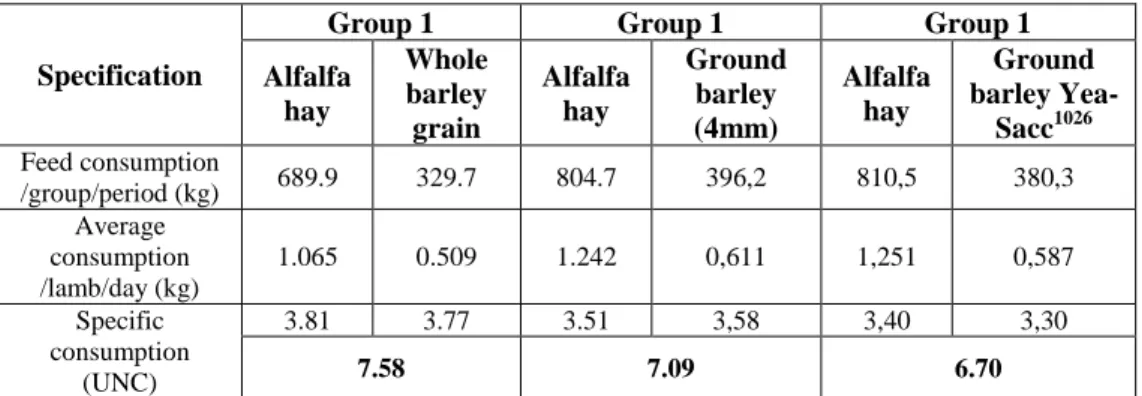
If we analyze the average values of intake/lamb/day, then we may observe that lambs in group 3 eat daily more hay with 186 g, respectively with 9 g compared to the lambs in groups 1 and 2. The biggest barley intake was observed in group 2 with a daily intake of 102 g, respectively 24 g more than the lambs in groups 1 and 3.
The barley processed through grinding at 4 mm particles, offered to group 2, leads to the decrease of the specific intake with 0.49 UNC/kg body weight compared to group 1. The addition of the yeast Saccharomyces cerevisiae, strain Yea-Sacc1026 in a proportion of 2 ‰ in the barley ground at 4 mm leads to the achievement of a specific intake lower with 0.88 UNC, respectively with 0.39 UNC compared to group 1, respectively group 2. So, by grinding barley into 4 mm particles and by adding Saccharomyces cerevisiae, the conversion of the dry feed offered in groups 2 and 3 is higher, leading to the achievement of lower specific intakes.
Table 2 Nutritional index realized by fattening lambs in the experimental period
Specification
Group 1 Group 1 Group 1
Alfalfa hay
Whole barley grain
Alfalfa hay
Ground barley (4mm)
Alfalfa hay
Ground barley
Yea-Sacc1026
Feed consumption
/group/period (kg) 689.9 329.7 804.7 396,2 810,5 380,3 Average
consumption /lamb/day (kg)
1.065 0.509 1.242 0,611 1,251 0,587
Specific consumption
(UNC)
3.81 3.77 3.51 3,58 3,40 3,30
7.58 7.09 6.70
In the analysis of data presented in table 3, we may notice that there are not significant differences between group 1 and 2 (p>0.05) regarding initial body weight (21.80 kg, respectively 21.74 kg), but the differences are significant (p<0.04) regarding final body weight (30.85 kg, respectively 33.20 kg), total weight (9.05 kg, respectively 11.46 kg) and average daily weight (168 g, respectively 212 g).
Table 3
Productive index realized by fattening lambs from group 1 and 2 in the experimental period
Specification
Group 1 Whole barley grains
Group 2 Ground barley
(4mm) Differences L
1-L2
Mann- Whitney
TEST
n X ±Sx cv% n X ±Sx cv%
Initial body
weight (kg) 12 21.80±0.64 10.16 12 21.74±0.57 9.05 0.06
0.95 ns Final body
weigh (kg) 12 30.85±0.75 8.44 12 33.20±0.78 8.11 -2.35
* 0.04
s
Total weigh
gain (kg) 12 9.05±0.16 5.95 12 11.46±0.23 7.07 -2.41
* 0.00003
s
Average
daily gain (g) 12 168±2.88 6.47 11 212±4.33 7.06 -44
* 0.00003
s
Table 4
Productive index realized by fattening lambs from group 1 and 3 in the experimental period
Specification
Group 1 Whole barley grains
Group 3 Ground barley +
Yea-Sacc1026 Differences L
1-L3
Mann- Whitney
TEST
n X ±Sx cv% n X ±Sx cv%
Initial body
weight (kg) 12 21.80±0.64 10.16 12 21.63±0,58 2.01 0.17 0.77 ns Final body
weigh (kg) 12 30.85±0.75 8.44 12 33.53±0,78 2.71 - 2.68
* 0.02
s
Total weigh
gain (kg) 12 9.05±0.16 5.95 12 11.91±0,25 0.88 - 2.86
* 0.00003
s
Average
daily gain (g) 12 168±2.88 6.47 11 221±4,71 16.29 - 53
* 0.00003
Conclusions
- In the lambs feed with 4 mm ground barley, the differences are significantly bigger (p<0.04), with 2.41 kg, respectively 44 g for the total body weight and average daily weight, compared to the lambs feed with whole barley grains, and the specific intake is lower with 6.46%.
- In the lambs feed with 4 mm ground barley added with Saccharomyces cerevisiae strain Yea-Sacc1026, the differences are significantly bigger (p<0.02) with 2.86 kg, respectively 53 g regarding the total body weight and average daily weight, compared to the lambs feed with whole barley grains, and the specific intake is lower with 11.61%.
Bibliography
1. Drînceanu D. (1994) - AlimentaŃia animalelor, Timişoara, Editura Euroart. 2. Pădeanu I. (2002 ) - ProducŃiile ovinelor şi caprinelor, Timişoara, Editura Mirton,.