ORIGINAL RESEARCH ARTICLE
Feasibility of a Ketamine Anesthesia Package in Support of
Obstetric and Gynecologic Procedures in Kenya When No
Anesthetist is Available
DOI: 10.29063/ajrh2019/v23i1.4
Charles O. Masaki
1,2, Jennifer Makin
1,3, Sebastian Suarez
1*, Gabriella Wuyke
1,4, Ayla N.
Senay
1,5, Daniela Suarez-Rebling
1, Javan Imbamba
4, Jackton Juma
4, Moytrayee Guha
1,4and
Thomas F. Burke
1,2,4,6Division of Global Health and Human Rights, Department of Emergency Medicine, Massachusetts General Hospital, Boston, MA, USA1; Harvard T.H. Chan School of Public Health, Boston, MA, USA2; SUNY Upstate Medical School, Department of Obstetrics and Gynecology, Syracuse, NY3; African Institute for Health Transformation at Sagam Community Hospital, Luanda, Kenya4; Albany Medical College, Albany, NY, USA5; Harvard Medical School, Boston, MA, USA6
*For Correspondence: Email: [email protected]; Phone: +1 857-294-3848
Abstract
The objective was to assess the feasibility and safety of the ‗Every Second Matters for Emergency and Essential Surgery – Ketamine‘ (ESM-Ketamine) package in support of obstetric and gynecologic emergency and essential surgery when no anesthetist is available. A consecutive case series was conducted in twelve hospitals across five severely resource-limited counties in Kenya. 530 women underwent obstetric or gynecological operative procedures supported by non-anesthetist clinicians using the ESM-Ketamine package between November 1, 2013 and September 30, 2017.Main outcomes included reasons for ESM-Ketamine activations and ketamine-related adverse events. There were two (0.4%) prolonged (>30 seconds) oxygen desaturations below 92%. Brief oxygen desaturations (<30 seconds) below 92% occurred in 15 (2.8%) cases and 113 (21.3%) were administered diazepam to treat hallucinations or agitation. There were no ketamine-related deaths or injuries. The ESM-Ketamine package appears feasible and safe for use in support of obstetric and gynecologic surgeries when no anesthetist is available. (Afr J Reprod Health 2019; 23[1]: 37-45).
Keywords: Obstetrics, Gynecology, Anesthesia, Ketamine, low-resource settings
Résumé
L‘objectif était d‘évaluer la faisabilité et la sécurité du paquet «Chaque seconde compte pour la chirurgie urgente et essentielle – L‘ensemble Kétamine» (CSC-Kétamine) à l‘appui de l‘urgence obstétricale et gynécologique et de la chirurgie essentielle en l‘absence de l‘anesthésiste. Une série de cas consécutifs a été menée dans douze hôpitaux du Kenya, dans cinq comtés aux ressources limitées. Entre le 1er novembre 2013 et le 30 septembre 2017, 530 femmes ont subi une intervention chirurgicale gynécologique ou obstétricale soutenue par des cliniciens non anesthésistes, à l'aide du progiciel CSC-Kétamine. Les principaux résultats comprenaient les raisons des activations de la Kétamine et des événements indésirables liés à la kétamine. Deux (0,4%) désaturations prolongées en oxygène (> 30 secondes) étaient inférieures à 92%. Des désaturations brèves en oxygène (<30 secondes) inférieures à 92% sont survenues dans 15 cas (2,8%) et 113 (21,3%) ont reçu du diazépam pour traiter des hallucinations ou une agitation. Il n'y a eu aucun décès ou blessure lié à la kétamine. Le progiciel CSC-Kétamine semble utilisable et sans danger pour les chirurgies obstétricales et gynécologiques lorsqu'aucun anesthésiste n'est disponible. (Afr J Reprod Health 2019; 23[1]: 37-45).
Introduction
Approximately five billion people world-wide do not have access to emergency and essential surgery in a timely fashion1-3. Lack of safe and affordable anesthesia services is a primary barrier1. In resource scarce settings, anesthesia services are often unavailable despite functional operating theatres, adequate surgical equipment and staff capable of performing and supporting surgical procedures4,5.
Kenya‘s northern and eastern counties are chronically severely stressed due to poverty, drought, food insecurity, violence and large populations of Somali and South Sudanese refugees6. In these settings, lack of anesthesia services is often a critical barrier to life-saving and life-improving surgical procedures7,8. In 2017, the
World Federation of Societies of
Anaesthesiologists (WFSA) reported that Kenya has 0.44 anesthetists per 100,000 population overall9. However, since anesthetists are unevenly distributed throughout the country, large regions have poor or no coverage of anesthesia services10. Most hospitals in the northern and eastern regions do not have adequate access to anesthesia services. Lack of access to obstetric and gynecologic operative procedures, especially cesarean sections, is associated with adverse maternal and newborn health7,11,12. While the World Health Organization (WHO) recommends that optimal cesarean section rates should be about 19%, the rates are less than 1% across several regions of Kenya4,13. For example, the scarcity of anesthesia services in Mandera County, located in northern Kenya, contributes to a cesarean section rate near zero percent and a maternal mortality ratio (3,795 maternal deaths per 100,000 live births) among the worst in the world14. This statistic demonstrates the disproportionate impact across the country, where the average maternal mortality is estimated as 488 maternal deaths per 100,000 live births4.
To address the anesthesia gap within these low resource regions of Kenya, our team previously designed the ‗Every Second Matters for Emergency and Essential Surgery – Ketamine‘
(ESM-Ketamine) package15. The ESM-Ketamine package is an evidence-based protocol on which non-anesthetist providers are trained to support emergency and essential operative procedures when no anesthetist is available. Ketamine is an ultra-low-cost analgesic, amnesic, and anesthetic dissociative drug that has been used safely worldwide for more than 50 years16. Ketamine is especially attractive for use in resource-scarce settings because it is inexpensive, readily available, preserves cardiorespiratory functions, has a wide safety margin, and does not require anesthesia machines16-18. However, the use of ketamine in resource-limited settings has not been integrated into health systems in an organized fashion15. The objective of this study was to assess the feasibility and safety of the ESM-Ketamine package in support of obstetric and gynecologic operative procedures in severely resource-scarce settings in Kenya, when no anesthetist was available.
Methods
Health Directors from five severely resource-limited counties in Kenya (Siaya, Homa Bay, Garissa, Mandera, and Wajir) were invited to participate in implementation of the ESM-Ketamine package. The five counties included in this study are home to approximately 5 million people. In these regions, poor access to basic healthcare, including anesthesia services, means that women‘s reproductive health needs are often not met14,19.
ESM-Ketamine training, including clinical officers, medical officers (doctors), and nurses.
ESM-Ketamine training took place at the African Institute for Health Transformation (AIHT) at Sagam Community Hospital, Luanda, Kenya. The ESM-Ketamine package consists of an intensive competency-based 5-day training program, a defined ESM-Ketamine kit, wall charts and pocket checklists15. Training on ESM-Ketamine was led by Kenyan master trainer anesthetists and clinical officers. The training included hands-on participation during obstetric and gynecological surgical cases performed in the operating theatre, as well as didactics on ketamine pharmacology, patient monitoring, documentation, and basic adult and newborn airway management. The American Academy of Pediatrics‘ Helping Babies Breathe program was also included.
After the ESM-Ketamine providers transitioned to their home facility, one of them was
selected ESM-Ketamine Champion.
Ketamine Champions oversaw other ESM-Ketamine providers and record keeping for each Ketamine case at their facility. ESM-Ketamine champions provided weekly reports on cases completed. Adverse events triggered immediate reporting to the AIHT research team and the principal investigator. The AIHT-based research team conducted unannounced monthly visits at each facility to collect data cards and compare them with medical records.
The ESM-Ketamine clinical pathway was activated in support of emergency or essential operative procedures in four circumstances: if an anesthetist was unavailable; if patient transfer would potentially have resulted in untoward consequences; if an anesthetist would previously not have been called; or if the patient refused care because they could not afford an anesthetist. Once activated, ESM-Ketamine providers performed a standardized pre-operative evaluation as well as defined pre-induction tasks. These included vital signs assessment, initiation of intravenous access, pre-oxygenation, and placement of pulse oximetry and blood pressure monitoring devices. Induction of anesthesia was performed with racemic
ketamine administered over 30-60 seconds (Figure 1). Hallucinations and/or agitation were managed with diazepam, nausea with promethazine, hypersalivation with atropine, and hypertension in pregnant women with hydralazine. Patients were recovered until their mental status was back to baseline.
All women who underwent obstetric or gynecological procedures supported by ESM-Ketamine between November 1, 2013 and September 30, 2017 were enrolled. Training and non-training cases were included in the analysis. No cases were excluded. Data were collected prospectively using program-specific data collection cards for every operative procedure supported by ESM-Ketamine (Figure 2). Safety was determined by monitoring adverse events, and closely following outcomes through the time of hospitalization and post-operative visits. Adverse events (AEs) were defined as hallucinations and/or agitation treated with diazepam and brief periods (less than 30 seconds) of oxygen desaturation below 92%. Serious adverse events (serious AEs) were defined as deaths or injuries potentially related to ESM-Ketamine and any prolonged periods (more than 30 seconds) of oxygen desaturation below 92%. Data collected included reasons for ESM-Ketamine activation, patient demographics, medical history, pre-operative diagnoses, procedure(s) performed, medications administered, oxygen saturation levels, AEs, and intra- and post-operative complications.
The database was constructed using Excel 2015 (Microsoft, Redmond, WA, USA). Standard descriptive statistical analyses were conducted using RStudio version 1.0.153 (RStudio, Inc, Boston, MA, USA). Normality was assessed using the Shapiro-Wilk test. Ethical approval was obtained from the Partners Healthcare Institutional Review Board (Boston, MA, USA) (Ref: 2014P002197) and the Maseno University School of Medicine Ethical Review Committee (Maseno, Kenya) (Ref: MUERC/00101/14). Informed
consent was not required from patients beyond their usual operative and anesthesia
Figure 1: ESM- Ketamine Pocket Checklist (front and back)
Results
County Health Directors from Siaya, Homa Bay, Garissa, Mandera, and Wajir Counties in Kenya selected twelve facilities in which to implement the ESM-Ketamine package. Forty-three providers were trained on the ESM-Ketamine Package between November 4, 2013 and September 30, 2017, the ESM-Ketamine package was used to support 1 244 emergency and essential operative procedures, of which 530 (42.6%) were obstetric or gynecologic in nature.
The median age and weight were 29 years (IQR 22-30 years) and 63 kg (IQR 56 - 71.12 kg) respectively. Among the 530 operative procedures, 141 (26.6%) were training cases while the remaining 389 (72.3%) were operative procedures supported by an ESM-Ketamine provider without
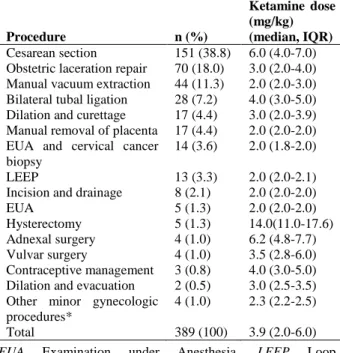
the presence of an anesthetist or ESM-Ketamine instructor (Table 1).
Figure 2: ESM-Ketamine data collection card
Table 1: Non-training operative procedures supported by the ESM- Ketamine package
Procedure n (%)
Ketamine dose (mg/kg) (median, IQR)
Cesarean section 151 (38.8) 6.0 (4.0-7.0) Obstetric laceration repair 70 (18.0) 3.0 (2.0-4.0) Manual vacuum extraction 44 (11.3) 2.0 (2.0-3.0) Bilateral tubal ligation 28 (7.2) 4.0 (3.0-5.0) Dilation and curettage 17 (4.4) 3.0 (2.0-3.9) Manual removal of placenta 17 (4.4) 2.0 (2.0-2.0) EUA and cervical cancer
biopsy
14 (3.6) 2.0 (1.8-2.0)
LEEP 13 (3.3) 2.0 (2.0-2.1) Incision and drainage 8 (2.1) 2.0 (2.0-2.0) EUA 5 (1.3) 2.0 (2.0-2.0) Hysterectomy 5 (1.3) 14.0(11.0-17.6) Adnexal surgery 4 (1.0) 6.2 (4.8-7.7) Vulvar surgery 4 (1.0) 3.5 (2.8-6.0) Contraceptive management 3 (0.8) 4.0 (3.0-5.0) Dilation and evacuation 2 (0.5) 3.0 (2.5-3.5) Other minor gynecologic
procedures*
4 (1.0) 2.3 (2.2-2.5)
Total 389 (100) 3.9 (2.0-6.0)
EUA Examination under Anesthesia, LEEP Loop Electrosurgical Excision Procedure
* Procedures include EUA following defilement, hymen cruciate incision, and LEEP complication
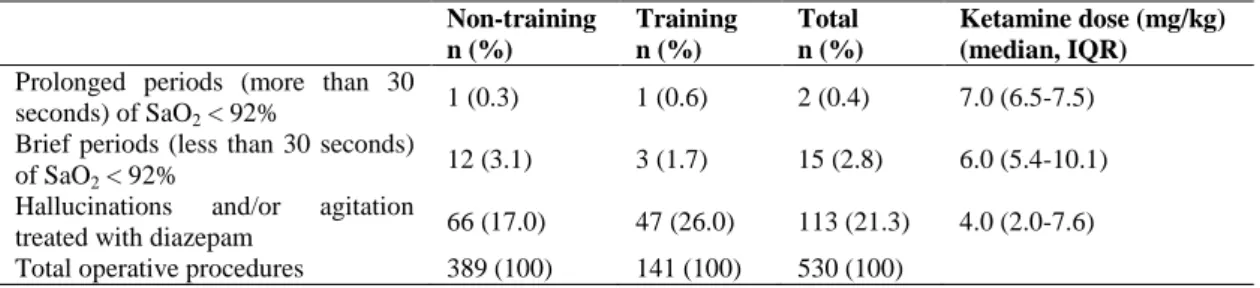
Table 2: Adverse events among training and non-training obstetric and gynecologic cases
Non-training n (%)
Training n (%)
Total n (%)
Ketamine dose (mg/kg) (median, IQR)
Prolonged periods (more than 30 seconds) of SaO2 < 92%
1 (0.3) 1 (0.6) 2 (0.4) 7.0 (6.5-7.5) Brief periods (less than 30 seconds)
of SaO2 < 92%
12 (3.1) 3 (1.7) 15 (2.8) 6.0 (5.4-10.1) Hallucinations and/or agitation
treated with diazepam 66 (17.0) 47 (26.0) 113 (21.3) 4.0 (2.0-7.6) Total operative procedures 389 (100) 141 (100) 530 (100)
SaO2 Oxygen saturation
113 (21.3%). Additional administered medications included atropine (n=68, 12.8%), promethazine (n=10, 1.9%), and hydralazine (n=7, 1.3%). Of the 530 cases, three (0.6%) women died from causes unrelated to ketamine. Two died from advanced cervical cancer within 30 days of ESM-Ketamine supported biopsies, and one woman died six hours after ESM-Ketamine supported surgery for a ruptured uterus, after late referral from another facility that could not access an anesthetist.
Discussion
This series of surgical cases supported by the ESM-Ketamine package adds to the mounting evidence that trained ESM-Ketamine providers may safely support emergency and essential obstetric and gynecologic operative procedures in severely resource-limited settings when no anesthetist is available. Although ketamine has been used as a general anesthetic worldwide for over 50 years16,20-22, its use in support of operations by non- anesthetists in severely resource limited settings is not well reported. The low incidence of serious AEs suggests that ESM-Ketamine may serve as an alternative to no care when anesthetists are not available in severely resource-constrained settings.
The incidence of AEs in this series was like other reports of ketamine use16,18,21,23,24. Among the 530 women that underwent obstetric and gynecologic operative procedures supported by ESM-Ketamine, only two (0.4%) experienced a serious AE. The ESM-Ketamine providers were able to readily address the AEs and serious AEs and all women recovered uneventfully. No women
died or were injured from the use of ESM-Ketamine. Therefore, the ESM-Ketamine package may serve as a safe alternative to support emergency and essential surgeries in the absence of anesthesia services. Given that standard anesthesia services are scarce in many severely low resource settings; this study suggests that the benefit of the ESM-Ketamine package – saving and improving the lives of women and pregnant mothers – may at times outweigh the potential for harm.
The ESM-Ketamine package provided a life-saving alternative for pregnant women when no anesthetist was available. This package allowed surgeons to perform 151 (38.8%) cesarean sections in regions where they would not have been able to do so previously. Therefore, this package may help decrease maternal and infant mortality in resource limited settings, where women and children die from lack of access to anesthesia services7,8. Among this case series, two (cesarean sections and laparotomy) of the three Bellwether Procedures described by the 2015 Lancet Commission on Global Surgery1 were supported by ESM-Ketamine. The Bellwether Procedures are considered a proxy for surgical systems that can provide a broad range of necessary emergency and essential surgeries in surrounding communities1. It therefore follows that the ESM-Ketamine package may be helpful in support of a wide range of surgical procedures in severely resource-constrained settings.
unexpected use of the ESM-Ketamine pathway emerged in an entirely organic fashion, led by the ESM-Ketamine providers themselves. This use subsequently allowed for improved compassionate and quality care and led the authors to revise the clinical pathway and allow for more modest dosing (see procedural sedation section in Figure 1) in support of painful yet minor operative procedures. The use of the ESM-Ketamine package in support of minor painful procedures may provide an opportunity to increase access to compassionate care across a wide range of cases. More evidence is needed to better understand the benefit-harm ratio regarding use of the ESM-Ketamine package in support of minor procedures.
Twenty (5.1%) women that were deemed to need life-improving surgery refused the procedure due to the required up-front charges of the anesthetist. These women only consented to surgery when support from ESM-Ketamine was offered. The ESM-Ketamine package provided an alternative for women willing to suffer the consequences of no care due to cost. The authors are aware that the option of ESM-Ketamine for the extreme poor is potentially a slippery slope and may have unintended consequences. Further studies should seek to define the patient populations and clinical conditions where the harm-benefit equations are favorable.
The main strength of this study is the moderate size of the data set of 530 cases. Since the distribution half-life of ketamine is short (10 minutes in adults)25, follow-up through the first postoperative visit should have captured most adverse events. Nonetheless, the authors recognize that 530 operative cases may have been too few to capture rare events. Moreover, since the ESM-Ketamine program is intensively monitored, quality of care may be higher than usual due to careful oversight.
The ESM-Ketamine package is in no way designed to replace anesthetists. Every person deserves the basic right of access to high quality surgical care when needed. This absolutely means a fully trained surgical team, including a well-trained anesthetist. However, anesthetists are often not available in the most severely
resource-constrained settings world-wide. Across many poor regions, in the absence of anesthesia services, unnecessary death and disability is the only recourse for so very many. To only allow quality anesthesia services in these settings when no anesthetist is available is sentencing people to unnecessary deaths and disability. With the emergence of ESM-Ketamine, women no longer need to lose their lives or become permanently disabled across large stretches of our planet, when no reasonable alternatives are available. In addition, to promote the responsible and diligent use of ketamine, national guidelines could be created to regulate its use only to healthcare facilities that have the necessary infrastructure and capacity, such as the availability of oxygen and oxygen saturation monitoring devices. The ESM-Ketamine training is constantly improving to ensure provider competency and promote safe implementation of the ESM-Ketamine package, which includes consistent data collection and monitoring of adverse events.
Conclusion
The ESM-Ketamine package appears feasible and safe for use in support of emergency and essential obstetric and gynecologic operative procedures in extremely resource-limited settings when no anesthetist is available. Future studies will need to further evaluate the safety profile of the ESM-Ketamine package while additionally exploring domains such as policy, liability, political will, integration into health systems, and potential roles in compassionate and quality care.
Acknowledgements
was prepared by the listed authors and does not necessarily reflect the views of the funding partners. The funding sources had no role in the collection, analysis, or interpretation of the data or in manuscript preparation.
Contribution of Authors
As principal investigator, TFB made substantial contributions to the concept development, study design, and interpretation of data. COM, JM, and SS contributed to data analysis interpretation of data. COM, JM, SS, and TFB drafted the initial version of this manuscript and revised it based on input from other co-authors. GW, ANS, DSR, JI, JJ, and MG contributed to data acquisition and manuscript editing. All authors approved the final version of this manuscript and agree to be accountable for all aspects of the work.
References
1. Meara JG, Leather AJ, Hagander L, Alkire BC, Alonso N, Ameh EA, Bickler SW, Conteh L, Dare AJ, Davies J, Merisier ED, El-Halabi S, Farmer PE, Gawande A, Gillies R, Greenberg SL, Grimes CE, Gruen RL, Ismail EA, Kamara TB, Lavy C, Lundeg G, Mkandawire NC, Raykar NP, Riesel JN, Rodas E, Rose J, Roy N, Shrime MG, Sullivan R, Verguet S, Watters D, Weiser TG, Wilson IH, Yamey G and Yip W. Global Surgery 2030: evidence and solutions for achieving health, welfare, and economic development. Lancet 2015;386(9993):569-624.
2. Anderson RE, Ahn R, Nelson BD, Chavez J, de Redon E and Burke T. Defining the anesthesia gap for reproductive health procedures in resource-limited settings. Int J Gynaecol Obstet 2014;127(3):229-33. 3. McQueen KA. Anesthesia and the global burden of
surgical disease. Int Anesthesiol Clin 2010;48(2):91-107.
4. Kenya National Bureau of Statistics (KNBS) and ICF Macro (2010). Kenya Demographic and Health Survey 2008-09. Nairobi, Kenya: KNBS and ICF Macro, 2010.
5. Burke TF, Hines R, Ahn R, Walters M, Young D, Anderson RE, Tom SM, Clark R, Obita W and Nelson BD. Emergency and urgent care capacity in a resource-limited setting: an assessment of health facilities in western Kenya. BMJ Open 2014;4(9):e006132.
6. Drummond J and Crawford N. Humanitarian crises, emergency preparedness and response: the role of
business and the private sector, Kenya case study. London, UK: Humanitarian Policy Group, Overseas Development Institute, 2014.
7. Ahamadani FA, Louis H, Ugwi P, Hines R, Pomerleau M, Ahn R, Burke TF and Nelson, BD. Perinatal health care in a conflict-affected setting: evaluation of health-care services and newborn outcomes at a regional medical centre in Iraq. East Mediterr Health J 2015;20(12):789-95.
8. Busza J and Lush L. Planning reproductive health in conflict: a conceptual framework. Soc Sci Med 1999;49(2):155-71.
9. Kempthorne P, Morriss WW, Mellin-Olsen J and Gore- Booth J. The WFSA Global Anesthesia Workforce Survey. Anesth Analg 2017;125(3):981-90. 10. African Institute for Health Transformation (AIHT).
ESM-Ketamine and ESM-UBT Inception Meeting. Mandera and Garissa County Engagement - Field Report, September 26, 2016.
11. Bosmans M, Nasser D, Khammash U, Claeys P and Temmerman M. Palestinian women's sexual and reproductive health rights in a longstanding humanitarian crisis. Reprod Health Matters 2008;16(31):103-11.
12. Alkire BC, Vincent JR, Burns CT, Metzler IS, Farmer PE and Meara JG. Obstructed labor and caesarean delivery: the cost and benefit of surgical intervention. PLoS One 2012;7(4):e34595. 13. Molina G, Weiser TG, Lipsitz SR, Esquivel MM, Uribe-
Leitz T, Azad T, Shah N, Semrau K, Berry WR, Gawande AA and Haynes AB. Relationship Between Cesarean Delivery Rate and Maternal and Neonatal Mortality. Jama 2015;314(21):2263-70. 14. United Nations Population Fund (UNFPA) Kenya.
Counties with the Highest Burden of Maternal Mortality United Nations Population Fund [Internet], 2014. Available from: http://kenya.unfpa.org/en/news/counties-highest-burden-maternal-mortality.
15. Burke TF, Suarez S, Sessler DI, Senay A, Yusufali T, Masaki C, Guha M, Rogo D, Jani P, Nelson BD and Rogo K. Safety and Feasibility of a Ketamine Package to Support Emergency and Essential Surgery in Kenya when No Anesthetist is Available: An Analysis of 1216 Consecutive Operative Procedures. World J Surg 2017;41(12):2990-2997 16. Green SM, Clem KJ and Rothrock SR. Ketamine Safety
Profile in the Developing World: Survey of Practitioners. Acad Emerg Med 1996;3(6):598-604. 17. Bisanzo M, Nichols K, Hammerstedt H, Dreifuss B,
Nelson SW, Chamberlain S, Kyomugisha F, Noble A, Arthur A and Thomas S. Nurse-administered ketamine sedation in an emergency department in rural Uganda. Ann Emerg Med 2012;59(4):268-75. 18. Guldner GT, Petinaux B, Clemens P, Foster S and
review for military health care providers. Mil Med 2006;171(6):484-90.
19. Population Dynamics, Environment, and Sustainable Development in Siaya County. Washington, DC: Population Action International - Healthy Families Healthy Planet, 2013.
20. Craven R. Ketamine. Anaesthesia 2007;62(Suppl 1):48- 53.
21. Burke TF, Nelson BD, Kandler T, Altawil Z, Rogo K, Imbamba J, Odenyo S, Pinder L, Lozo S, Guha M and Eckardt MJ. Evaluation of a ketamine-based anesthesia package for use in emergency cesarean delivery or emergency laparotomy when no anesthetist is available. Int J Gynaecol Obstet 2016;135(3):295-98.
22. Dich-Nielsen J and Holasek J. Ketamine as induction agent for caesarean section. Acta Anaesthesiol
Scand 1982;26(2):139-42.
23. Schwartz KR, Fredricks K, Al Tawil Z, Kandler T, Odenyo SA, Imbamba J, Nelson BD and Burke TF. An innovative safe anesthesia and analgesia package for emergency pediatric procedures and surgeries when no anesthetist is available. Int J Emerg Med 2016;9(1):16.
24. Green SM, Roback MG, Krauss B, Brown L, McGlone RG, Agrawal D, McKee M, Weiss M, Pitetti RD, Hostetler MA, Wathen JE, Treston G, Garcia Pena BM, Gerber AC and Losek JD. Predictors of emesis and recovery agitation with emergency department ketamine sedation: an individual-patient data meta-analysis of 8,282 children. Ann Emerg Med 2009;54(2):171-80.e1-4.