Original Research Article
Evaluation of acute physiology and chronic health evaluation
(APACHE) II in predicting ICU mortality among critically ill
Sariga J. Theresa
1*, Fathima Latheef
2INTRODUCTION
Intensive care also known as critical care is a multidisciplinary and inter professional specialty, dedicated to patients who need intense support for failing organ systems, constant monitoring and round the clock nursing care. Critical illness is different from other illness as it is often unexpected, sudden and a life-threatening condition which requires a high level of treatment especially in the initial phase of management of patients admitted to the intensive care units (ICUs).1,2 It is indeed
associated with long term impact on functional status and their quality of life. The primary goal of an ICU is to save the life of critically ill patients by detecting and treating
their functional derangements, thereby decreasing the in-hospital mortality rate. Siddiqui S reported in his article that traditionally the modern intensive care unit has the highest mortality compared to any other sections of a hospital. The average ICU mortality rate reported in the United States (US) ranges from 8% to 19% or about 500,000 deaths annually.3
The (Society of Critical Care Medicine (SCCM 2017)) also reported that multi organ failure has a mortality rate of up to 15-28%, with 61% of new onset renal failure, 20-50% severe respiratory failure and sepsis being the second leading cause death with a mortality rate of up to 45%. The overall average mortality rate of patients
ABSTRACT
Background: Clinical assessment of the severity of illness among critically ill patients is an essential component to predict the mortality and morbidity in intensive care units. Scoring systems estimate the prognosis and help in clinical decision making thus enhance the quality of care in Intensive care units.
Methods: A descriptive study including 122 patients admitted to medical intensive care unit was performed from January 2017-March 2017 in Southern Kerala. APACHE II score for the first 24 hours of admission to the intensive care unit was calculated. SPSS 20 was applied for statistical analysis, and clinical parameters were investigated with descriptive statistics.
Results: The actual ICU mortality rate (9%) was less than the predicted mortality rate (43.6%) obtained using the APACHE II. Majority of patients 98(80%) had APACHE score >15. There was a statistically significant correlation observed between age and predicted mortality score of critically ill (r=.434 p=0.01).
Conclusions: APACHE II scoring system has been successful in predicting the mortality of critically ill. Healthcare professionals should therefore incorporate the disease severity measuring tools in their clinical practice to prioritize and optimize the care rendered in critical care units.
Keywords: APACHE II scoring system, Intensive care unit, Mortality
1Department of Nursing, Pushpagiri College of Nursing, Thiruvalla, Kerala, India
2Department of Nursing, Gangothri Academy of Nursing Education, Bangalore, Karnataka, India
Received: 06 November 2017
Accepted: 13 November 2017
*Correspondence: Mrs. Sariga J. Theresa,
E-mail: [email protected]
Copyright: © the author(s), publisher and licensee Medip Academy. This is an open-access article distributed under the terms of the Creative Commons Attribution Non-Commercial License, which permits unrestricted non-commercial use, distribution, and reproduction in any medium, provided the original work is properly cited.
admitted to adult ICUs’ ranges between 10%-29%.4
David K Samson et.al conducted a cohort study at Central Kerala revealed that mortality rate was 16.7% (15) patients out of 90, of which 3(20%) suffered from cerebro vascular accident (CVA).5
Mortality rate in ICUs’ depends on severity of the disease and deterioration in health condition of critically ill patients. The factors that have shown to increase the in-hospital mortality rates are increasing age, severity of illness, certain pre-existing medical conditions such as (eg. Malignancy, Immune suppressive and renal replacement therapy). Assessment of medical treatment outcome was first addressed as an issue by Florence nightingale in 1863.6 Initially the outcome prediction of
critically ill patients was based on judgments made by the clinician’s but today the rapid development of ICUs, demand quantitative assessment and evaluation of the outcomes in order to enhance evidence based practices. The original outcome prediction scores were developed more than 25 years ago to provide an indication of risk of death among ICU patients.7 Since then many ICU scoring
systems were developed though only a minority of them are been used. Therefore, prognostication is an important part of management of any critically ill patients.
Multiple scoring systems are available for assessment and prognosticate the severity of illness in critical care units.8
The scoring systems quantify the severity of critically ill on the basis of anatomical, physiological and biochemical variables and classify the patient in a specific risk group. Hence scoring systems are been developed and it is vital to implement them in ICUs to improve quality and standardization of patient care.
Acute Physiology and Chronic Health Evaluation II (APACHE II) is a severity score and mortality estimation tool developed from a large sample of ICU patients in the US by Knaus et al in 1985.9 The critical care severity
scores are calculated from the data obtained on the first day of ICU admission e.g. APACHE, SAPS (Simplified Acute Physiology Score), and Mortality Probability Model (MPM). The Scoring system consists of two parts: a severity score which is a number (generally higher the score more is the severity of the condition) and a calculated probability of mortality.9,10 In addition to
clinical observation and advance treatments in health care, healthcare professionals need to realize and utilize scoring systems in their day today practice.11
However, in all ICUs, the aim of the nurses is to provide high level of comprehensive care to the patients. Studies have also postulated that some patients who doesn’t require special care and mostly are in need of continuous monitoring of vital signs and nursing care are also been admitted to ICUs. Decision making in intensive care units is an art and ability to work in emergency and urgent situation. Hence nurses need to identify and prioritize the conditions based on critical ill patient’s physiological and
guides the nurses to evaluate patients’ physiological stability.
Thus, the combination of effective process of care and appropriate scoring models increases the likelihood that each patient gets the right intervention at appropriate time; which ultimately reduce the hospital mortality and length of stay. Based on these evidence the investigator felt the need to determine the predicted mortality rate of patients admitted to ICU using APACHE II and to correlate the mortality with selected baseline variables.
METHODS
A descriptive design was used in the study to assess the in hospital mortality percentage and to correlate the mortality with selected variables. A total of 122 patients were recruited from Medical Intensive Care Unit (MICU) for a period of three months from January 2017-March 2017 in Southern Kerala. The samples were recruited using purposive sampling technique. The Acute Physiology and Chronic Health Evaluation (APACHE II) is a severity of disease classification system which includes 12 physiological measurements. APACHE II score was obtained within the first 24 hours of admission to ICU.
The observation checklist consists of two sections: the first section included age, gender, length of hospital stays and admitting diagnosis. The second section included the APACHE II score which is a combination of 12 physiological parameters. APACHE II was calculated on the day of admission to MICU using an online calculator. An integer score from 0-71 is then computed based on their physiological measurements.
Higher score implies a more severe disease and higher risk of death. The predicted mortality rate was calculated on the basis of this score. Patients who had been hospitalized for more than 24 hours and received with brain death to MICU were excluded. Patients less than 19 years, having ICU stay of less than 24 hours or re-transferred to ICU from other floors and ICU of the same hospital where also excluded. The results were analyzed using SPSS 20. Frequency, percentage and Pearson correlation were calculated.
RESULTS
Table 1: Frequency and percentage distribution of patients based on age, gender, length of ICU stay
(n=122).
Variables Frequency(f) %
Age (years)
Late adolescence (19-24) 07 6
Early adulthood (25-34) 04 3
Middle adulthood (35-60) 34 28
Late adulthood (60-75) 55 45
Very old age (>75) 22 18
Gender
Male 81 66
Female 41 34
Length of stay (days)
1-2 57 47
3-4 31 26
5-6 20 16
7-8 07 6
9-10 03 2
>10 04 3
Nearly half of the study participants (65) had APACHE score ranged between 15-24 with the predicted ICU
mortality of 25%-40%. Ten patients had APACHE score >30 with a predicted mortality of 75% and above (Table 2). Figure 1 represents the patients distributed based on admitting diagnosis. A total of twenty-three (19%) of patients were admitted to MICU with Chronic Kidney Disease (CKD) followed by 14(11.4%) Cerebro Vascular Accident (CVA), eleven (9%) Chronic Obstructive Pulmonary Disease (COPD) and 11(9%) Upper Gastrointestinal Bleed. One patient (0.8%) had Pulmonary Tuberculosis, 2 (1.6%) Sepsis and Poisoning were less during the last three months.
Table 2: Frequency and percentage distribution of critically ill patients based on predicted mortality
score (n=122).
Variable Frequency (f) %
APACHE II score/predicted mortality
10-14 (15%) 24 20
15-19 (25%) 34 28
20-24 (40%) 31 25
25-29 (55%) 23 19
30-34 (75%) 5 4
>34 (85%) 5 4
Figure 1: Frequency distribution of diagnosis of patients admitted to ICU.
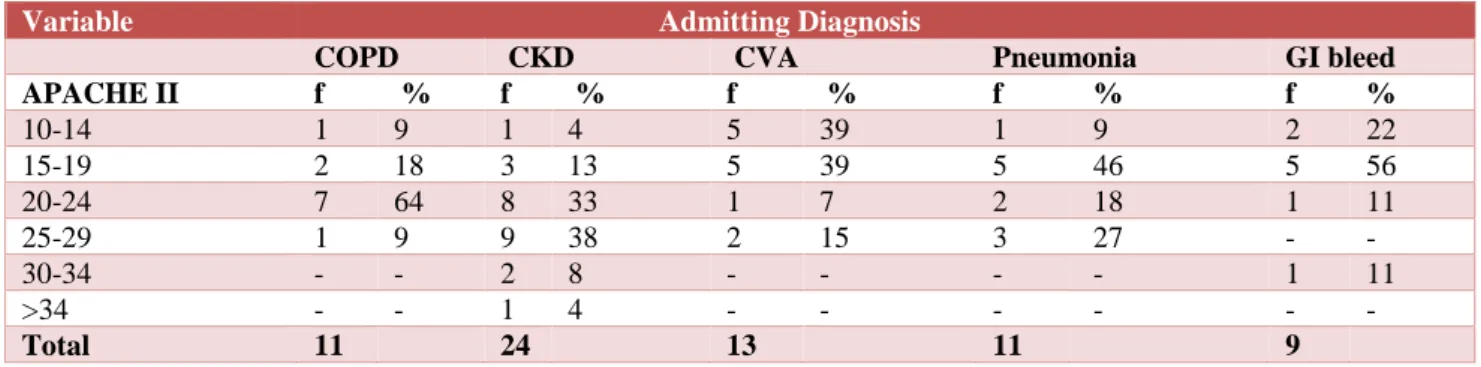
Table 3: Frequency and percentage distribution of APACHE SCORE II with admitting diagnosis of critically ill patient’s (n = 68).
Variable Admitting Diagnosis
COPD CKD CVA Pneumonia GI bleed
APACHE II f % f % f % f % f %
10-14 1 9 1 4 5 39 1 9 2 22
15-19 2 18 3 13 5 39 5 46 5 56
20-24 7 64 8 33 1 7 2 18 1 11
25-29 1 9 9 38 2 15 3 27 - -
30-34 - - 2 8 - - - - 1 11
>34 - - 1 4 - - - - - -
Total 11 24 13 11 9
9%
4.1% 19%
9% 9%
11.4%
2.5% 1.6% 1.6% 1.6% 1.6% 3.3% 3.3% 4.1% 4.9%
1.6% 1.6% 1.6% 0.8% 8.2%
0 2 4 6 8 10 12 14 16 18 20
Diagnosis of patients admitted to MICU
Nine (38%) patients with CKD had an APACHE score ranged between 25-29 with a predicted mortality of 55%. Seven (64%) COPD patients ranged between 20-24 with 40% of predicted mortality. Other participants had an APACHE score ranged between 15-19 with predicted mortality of 25% CVA 5(39%), Pneumonia 5(46%) and GI bleed 5 (56%) respectively (Table 3).
Table 4: Correlation between age of critically ill patients with predicted mortality score (n=122).
Variable Predicted mortality rate
Age r p
0.434** 0.01
** Correlation is significant at the 0.01 level
Table 5: Correlation between length of ICU stay of critically ill patients with predicted mortality score
(n=122).
Variable Predicted mortality rate
Length of ICU stay
r p
-0.068 0.458
Table 4 revealed that there was a statistically significant positive correlation between age of the patients (r= 0.434** p at 0.01 level) with predicted mortality score.
DISCUSSION
The disparity between demands and available healthcare resources is a universal problem and ICU is an area where this disparity exists up to the maximum, especially in developing countries like India.13,14 A critically ill is a
person at imminent risk of loss of life and who needs medical treatment in ICU for more than 5 days. At present there are various scoring systems available to predict the outcome of critically ill patients. Although all lack 100% of accuracy still it plays a vital role to audit the performance outcome of ICU and clinical research.14
The APACHE II scoring system has been successfully used for predicting the ICU mortality rate in the west by Knaus et.al, Wagner et al (1983), Jordan et.al, Purdie et.al, Marks et al (1991), Brown et al, Van Le et al. However, these trials were from developed countries were the medical facilities are to the optimal level.15
In the present study the participant were with an average age of 61 years (SD±16.9). More of the patients were in late adulthood 55(45%), and 22(18%) belongs to very old age. Samir Desai et.al from Shree Krishna Hospital, Karamsad also reported to had a mean age of 47.52 years which was slightly lower than other studies.8
Chronological age is a well-documented risk factors for death from acute illness, that is independent of the severity of diseases.16 Thus age of critically ill patients
may have an impact on the severity score. According to literature over 50% of patients in most ICUs are older
60(49%) participants were above 65 yrs. Although age is a main variable of almost all scoring systems, it may not be a parameter for ICU admission. Rather the comorbidity and the disease condition which requires continuous monitoring predicts the outcome of critically ill patients.
In our study most of the participants were males 81 (66%) and females were 41 (34%). Gupta et.al from India also reported that males were significantly more (p< 0.01) than females.16
In the present study there is no statistically significant difference in mortality compared to gender in ICUs. Mahmood et.al from a retrospective review of data among 261,255 consecutive patients admitted to adult ICUs in US reported that ICU mortality was 7.2% for men and 7.9% for women. Women less than 50 years of age had lower ICU mortality compared to men while 50 years of age or older women had no significant difference compared with men.18
Mortality of critically ill is based on their severity of illness coupled with co-morbidities. The present study had an average ICU stay as 3.7days (SD± 2.9) with patients 57(47%) for 1-2 days. Others participants of the study thirty one (26%) were admitted for 3-4 days, 20(16%) had 5-6 days and it was reported that only 4(3%) of patients were in the ICU for more than 10 days. The overall mean ICU stay for our patients was less than that reported in other studies from Brazil (9.4 days) and USA (5 days).14,17 Presumably this could be because
majority of patients had medical conditions which was not in an advanced nature.
In contrary a prospective study conducted among 393 patients from a tertiary institute, New Delhi had an average ICU stay of 11.3 days. Overall studies from abroad and India reported to have ICU length of stay between 3-11 days.20-22 Therefore the main goal of the
health system should focus on cost reduction by decreasing the length of stay both in ICU and hospital by providing a system of patient centered quality care.
Breslowi published the results obtained from the US ICU program 2008 database which revealed that gastro intestinal bleeding (1.7%) and sepsis (1.4%) were the most common ICU admission diagnosis.19 The findings
from the present study reported twenty three (19%) patients had CKD followed by COPD 11(9%), CVA 14(11.4%), Pneumonia and Gastrointestinal bleed were equally distributed11(9%).The patients with pulmonary tuberculosis , sepsis, poisoning 4(3.3%) were less during the three months period.
The present study had a mean APACHE II score of 20.7 (SD ± 6.4) which was slightly higher than the studies from Singapore, Israel and India.14 Moreover this range is
comparable to that from other studies reported from other areas of the world. A multi center observational point prevalence study (INDICAPS) conducted in India had patients with moderate severity of illness as evidenced by APACHE II of 17.4(SD±9.2).20 This signifies that there is
a need for improvements in the organization and delivery of critical care in Indian ICUs. APACHE score is declared the “gold standard” for the evaluation of intensive care and is one of the most commonly used scoring system in intensive care unit around the world. In the present study the average predicted ICU mortality rate was 43.61 %. Abdulbaset Saleh et.al form Egypt also reported that mortality rate among critically ill patients diagnosed with acute respiratory distress syndrome was 27.3%.23 Costa et.al found a mortality rate of 28.5%
among patients in intensive care units.24-26
The MICU were the study was done had an actual mortality of eleven (9%) patients from January 2017 to March 2017 which was comparatively lesser than reported from a study conducted in Kerala which had a mortality rate of 16.7%(15 patients ) died in intensive care unit during one month period.4 The deaths reported
in this study had their APACHE II score and mortality rate as cancer tongue 36(85%), CVA 29(67.2%), sepsis 24(49.7%) and 35(83%), gastrointestinal bleed 30(70.3%), hemolysis 38(88.4%), cancer liver 31(73%) and bronchial asthma 29( 67.2%) respectively.
Naved SA et al (2011) found that out of 253 patients thirty-nine patients had APACHE II score in high category 31-40. This revealed that there might be more chances of death in case of high APACHE II score (p=0.001).27 However patients with chronic disease as
reported have a higher risk of hospital mortality. Thus, it is evident from the present study that as the APACHE score increases the predicted mortality rate also increase. Majority of patients 98 (80%) in this study had APACHE score>15, which predicate that patients admitted to MICU were seriously ill and had physiological derangements. However, the predicted mortality did not correlate with actual mortality of patients admitted to MICU.
A similar conclusion was drawn from an Indian study conducted in LRS Institute of Tuberculosis and Respiratory Diseases, New Delhi, that observed and predicted mortality increased with 5-point APACHE score, but did not correlate for patients with any compatible groups. Studies from abroad showed that APACHE scores is useful in predicting the mortality, but prediction is not same among all patients.17
The present study revealed that APACHE II was capable of stratifying patients according to the severity of illness
in relation to predicted mortality. However, this may not be accurate which compared to other studies.
Thus, considering the dissimilarity which exist among the critically ill admitted to ICUs each intensive care units need to have a mortality prediction system model to validate the patient and to verify with the standard rates. The ability to survive an acute illness can be judged based on the age, gender, comorbidities and the chronic state health disease status. In the present study a statistically significant positive correlation was observed between age of critically ill patients with predicted mortality score (r= .434 p= 0.01).
In contrast a study conducted in Dr. SN Medical College, Jodhpur among 100 surgical patients revealed that there was no apparent correlation between age, gender and mortality. Even in elderly patients the response to surgery and treatment was not different from young patients. This is in contrast to the general belief that advanced chronological age is associated with poor recovery from acute illness. However, there is a decrease in physiological functions of major organ systems as the age advances which may affect the severity of the outcome.27
It is also observed from the present study that there was no apparent correlation between gender and mortality. There was an inverse correlation between length of stay in ICU and predicted mortality rate (r=-.068, p<0.458). This observation is similar to another study which reported as insignificant but an inverse correlation (r=0.084, p<0.183) was observed between APACHE II score and length of ICU stay.28
Despite the rise is APACHE score and the predicted mortality rate in the present study observed among critically ill, the predicted mortality had a positive correlation only with age. Limitations of the present study were that the APACHE was calculated only during the admission. Updated version of APACHE III or IV was not used. APACHE scoring can be calculated on the other days of the ICU stay which would predict the worsening or improvement of the patient’s outcome.
CONCLUSION
standards and minimize the gaps and bring them closer to the standard values.
Funding: No funding sources Conflict of interest: None declared
Ethical approval: The study was approved by the institutional ethics committee
REFERENCES
1. Capuzzo M, Volta CA, Tassinati T, Moreno PR, Valentine A, Guid ET. Hospital mortality of adults admitted to intensive care units in hospitals with and without intermediate care units.Critical Care. 2014; 18:551.
2. Azoulay E, Alberti C, Legendre I, Brussianc B, Gall JR, For European Sepsis Group. Post ICU mortality in critically ill infected patients; an international study. Intensive Care Med 2005;31:56-63.
3. Siddiqui S. Mortality profile across our intensive care units: A 5-year data base report from a Singapore restructured hospital. Indian journal Critical Care Med. 2015;19(12):726-7.
4. Society of Critical Care Medicine. Fact sheet:critical care statistics. 2017. available at http://www.scccm.org/communication/pages/critical care stats.aspx. Acesssed 15 September 2017. 5. Samson DK, Bagatheesh S, Vinayan DC, Da ID,
Verghese AC. Study on admission profile and outcome in medical intensive care unit in Central Kerala. Available at: www.sooperarticles.com. 6. Vincent JL, and Moreno R. Clinical review. scoring
system in the critical ill, Critical Care. 2010;14:207. 7. Rapsang AG and Shyam DC. Scoring systems in
intensive care unit A compendium. Ind J Critic Care Med. 2014;18(4):220-8.
8. Desai S, and Lakhani JD. Utility of SOFA and APACHE II Score in Sepsis in Rural Set up MICU. Journal of the Association of physicians of India. 2013;61:608-11.
9. Jamal Q, Rahman AS, Muhammad A, Siddiqui MA, Riaz M, Ansari M and Saleemullah. Apache II scoring as an index of severity in Organ phosphorus Poisoning. J Clin Toxicol. 2014;7:354.
10. Bouch CD, and Thompson JP. Severity Scoring System in the critically ill. Continuing Education in Anaesthesia. Critical Care Pain J. 2008;8(5):181-5. 11. Johnsons S and Saranya AVR, Comparison of
different scoring systems used in intensive care unit. J Pulm Repair Med. 2015;5:276.
12. Asadzandi M, Taghizade K, Karati, Tardrisi SD, Ebadi A. Estimation of the mortality rate using the APACHE II standard disease severity scoring system in intensive care unit patients, Iranian Journal of Critical Care Nursing. 2012;4(4):209-14. 13. Varghese YE, Kalaiselvan K, Renuka MS,
Arunkumar AS. Comparison of acute physiology and chronic health evaluation (APACHE) II and acute physiology and chronic health
system in a multidisciplinary ICU. J Anaesthesiol Clin Pharmacol. 2017;33(2):248-58.
14. Sekulic AD, Trpkovic SV, Pavlovic AP, Olivera M, Marinkonic, Aleksandra N et al. Scoring systems in assessing survival of critically III ICU. Patients Med SciMonit. 2015;21:2621-9.
15. Parajuli BD, Shrestha S, Pradhan, Ametya R. Comparison of acute physiology and chronic health evaluation II and acute physiology and chronic health evaluation IV to predict ICU mortality. Indian J Crit Care Med. 2015;19(2):87-91.
16. Knaus, WA, Draper, EA, Wagner, DP, Zimmerman JE. APACHE II, a severity of disease classification system. Crit Care Med. 1985;13(10):818-29. 17. Gupta R, Arora VK. Performance evaluation of
APACHE II score for an Indian patient with respiratory problems. Indian J Med Res. 2004;119:273-82.
18. Abdi M, Tofighi S, Kalhori AB, Ebadi B, Basirat, Feyzi E. The Quality Assessment of Performance in Intensive Care Units according to APACHE II Score. Int J Travel Med Glob Health. 2015; 3(3):125-9.
19. Breslow JM, and Badawi O. Severity Scoring in the critically in (Part 1 –interpretation and accuracy of outcome prediction scoring systems). Chest. 2012; 141(1):245-52.
20. Divatia JV, Amin PR, Ramakrishnan N, Kapadia FN, Jodi S, Sahu S et al. The intensive care case mix and practice pattern study. Indian J Crit Care Med. 2016;20(4):216-55.
21. Juillar J, Blanco J, Anon JM. The Alien Study: Incidence And Outcome Of Acute Respiratory Distress Syndrome In The Era Of Lung Protective Ventilation. Intensive Care Med. 2011;37(12):1932-41.
22. Esteban A, Vivar F, Muriel A, Ferguson ND, Penuelas O, Abraira V et al. Evolution of mortality over time in patients receiving mechanical ventilation. Am J Respire Crit Care Med. 2013;188(2):220-30.
23. Wang CV, Calfee CS, Paul DW. One year mortality and predictors of death among hospital survivors of acute respiratory distress syndrome. Intensive Care Med. 2014;40-388.
24. Saleh A, Ahmed M, Sultan I, Lateif A. Comparision of the mortality prediction of different ICU soring systems (APACHE II and III, SAPS II and SOFA) in a single–center ICU sub population with acute respiratory distress syndrome. Egy ptian Journal of Chest Diseases and Tuberculosis. 2015;64.843-8. 25. Chiavone PA, Sens YA. Evaluation of Apache II
system among intensive care patients at a teaching hospital. Sao Paulo Med J. 2003;(2):53-7.
an intensive care unit. J Coll Physicians Surg Pak. 2011;21(1):4-8.
28. Singh R, Meena R, Khokad M. A prospective study of outcome of acute physiology and chronic health evaluation II score in critically ill surgical patients. Adv Hum Biol. 2017;7(2):61-4