The Design and Implementation of
SPARK, a Toolkit for Implementing
Domain-Speci
fi
c Languages
John Aycock
Department of Computer Science, University of Calgary, Alberta, Canada
SPARK is a toolkit for implementing domain-specific languages in Python. It is somewhat unusual in that its intended audience includes users who do not necessarily have a background in compilation; this choice impacts both the design and implementation of SPARK. We introduce SPARK in this paper and discuss major issues that have arisen in its design and ongoing development.
Keywords: compiler tools, domain-specific languages, software design
1. Introduction
SPARK, the Scanning, Parsing, And Rewriting Toolkit, is a toolkit which assists in the im-plementation of domain-specific languages in Python. First unveiled in 1998, SPARK is now on its sixth release. In that time, SPARK has been used by ourselves and others to implement a number of domain-specific languages; a se-lection of these projects are listed below.
Compiling Guide 23], a web programming
language
Bytecode decompilation GUI building
Linux1kernel configuration system 26
]
Interfacing with IRAF (astronomical
soft-ware) 33]
Fortran interface description 9]
Early on, we decided to target SPARK to a spe-cific group of users, a somewhat unusual choice in that it included users without a background in compilation. In the remainder of this paper we introduce SPARK, then discuss our design choices in more detail and how they have influ-enced SPARK’s implementation.
2. SPARK2
We begin with a simple model of a compiler having only four phases, as shown in Figure 1: 1. Scanning, or lexical analysis, breaks the
in-put stream into a list of tokens and their at-tributes(if any).
2. Parsing, or syntax analysis, resulting in the construction of an abstract syntax tree(AST).
In this section, we use a typical expression grammar as our running example:
Fig. 1.Compiler model. Note the absence of feedback edges.
1Linux is a trademark of Linus Torvalds.
2A very early version of the work in this section appeared in 2
expr ::= expr + term expr ::= term
term ::= term * factor term ::= factor factor ::= number
3. Semantic analysis, performed by traversing the AST one or more times.
4. Evaluation, which may directly interpret the program, or output code in C or assembly which would implement the input program. Evaluation may be implemented by another traversal of the AST, or by matching patterns in the AST.
Each phase performs a well-defined task, and passes a data structure on to the next phase; Grune et al. 15]refer to this as a “broad
com-piler.” Note that information only flows one way, and that each phase runs to completion be-fore the next one starts. This is in contrast to oft-used techniques based on a symbiosis between scanning and parsing, where several phases may be working concurrently, and a later phase may send some feedback to modify the operation of an earlier phase.
Certainly not all domain-specific language com-pilers will fit this model, but it is extremely clean and elegant for those that do. The main function of the compiler, for instance, distills into three lines of Python code which reflect the compiler’s structure:
f = open(filename)
evaluate(semantic(parse(scan(f)))) f.close()
How are these phases implemented using SPARK? A common theme throughout SPARK is that the user should have to do as little work as possible. For each phase, SPARK supplies a
Phase Class
Lexical analysis GenericScanner Syntax analysis GenericParser Syntax analysis GenericASTBuilder Semantic analysis GenericASTTraversal
Evaluation GenericASTTraversal
Evaluation GenericASTMatcher
Table 1.SPARK classes, by functionality. Some classes are potentially useful for more than one phase.
class which performs most of the work; these are summarized in Table 1. The user’s job is simply to create subclasses which customize SPARK’s base classes.
2.1. Lexical Analysis
A user creates a scanner by creating a subclass of GenericScanner, SPARK’s generic scanner class. In this subclass, the user specifies the regular expressions that the scanner should look for, and actions(consisting of arbitrary Python
code)to be performed based on the type of
to-ken found.
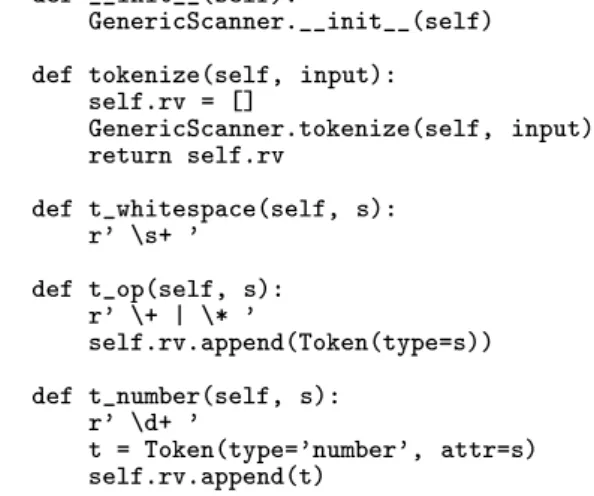
Below is a simple scanner to tokenize expres-sions for our running example. The parameter to the action routines is a string containing the part of the input that was matched by the regular expression.
class SimpleScanner(GenericScanner): def __init__(self):
GenericScanner.__init__(self)
def tokenize(self, input): self.rv = ]
GenericScanner.tokenize(self, input) return self.rv
def t_whitespace(self, s): r' \s+ '
def t_op(self, s): r' \+ | \* '
self.rv.append(Token(type=s))
def t_number(self, s): r' \d+ '
t = Token(type='number', attr=s) self.rv.append(t)
A few words about the syntax and semantics of Python are in order. This code defines the class SimpleScanner, a subclass of
Generic-Scanner. All methods have an explicitself
pa-rameter; init is the class’ constructor, and it is responsible for invoking its superclass’s constructor if necessary. Methods may option-ally begin with a documentation string which is ignored by Python’s interpreter but, unlike a regular comment, is retained and accessible at run-time. For example, the documentation string for thet numbermethod isr'nd+', where
the prefix “r” denotes a “raw” string in which backslash characters are not treated as escape sequences. A method which is empty(save for
an optional documentation string)has no effect
Object instantiation uses the same syntax as function calls; in the above code,Tokenobjects are being created. Both object instantiation and function invocation can make use of “keyword arguments,” which permit actual and formal pa-rameters to be associated by name rather than by their position in the argument list. Above,
type=spassessto thetypeparameter. Finally,
]denotes the empty list.
Returning to the scanner itself, each method whose name begins with “t ” is an action; the regular expression for the action is placed in the method’s documentation string. (The
rea-son for this unusual design, using reflection, is explained in Section 3.2.1.)
When the tokenized method is called, a list of
Tokeninstances is returned, one for each
oper-ator and number found. The code for theToken class is omitted; it is a simple container class with a type and an optional attribute. White space is skipped by SimpleScanner, since its action code does nothing. Any unrecognized characters in the input are matched by a default pattern, declared in the action
GenericScan-ner.t default. This default method can of
course be overridden in a subclass.
Scanners made with GenericScanner are exten-sible, meaning that new tokens may be recog-nized simply by subclassing. To extend
Sim-pleScannerto recognize floating-point number
tokens is easy:
class FloatScanner(SimpleScanner): def __init__(self):
SimpleScanner.__init__(self)
def t_float(self, s): r' \d+ \. \d+ '
t = Token(type='float', attr=s) self.rv.append(t)
How are these classes used? Typically, all that is needed is to read in the input program, and pass it to an instance of the scanner:
def scan(f):
input = f.read()
scanner = FloatScanner() return scanner.tokenize(input)
Here, the entire input is read at once with the read method. Once the scanner is done, its result is sent to the parser for syntax analysis.
2.2. Syntax Analysis
The outward appearance of GenericParser, our generic parser class, is similar to that of Gener-icScanner.
A user starts by creating a subclass of Gener-icParser, containing special methods which are named with the prefix “p ”. These special meth-ods encode grammar rules in their documenta-tion strings; when a grammar rule is recognized by GenericParser, the rule’s associated “action” code in the method is executed.
The expression parser subclass is shown below. Here, the actions are building the AST for the input program from the bottom up. ASTis also a simple container class; each instance ofAST corresponds to a node in the tree, with a node type and possibly child nodes. The grammar’s start symbol is passed to the constructor. In the code, ExprParser’s constructor assigns a de-fault value to its start symbol argument so that it may be changed later by a subclass.
class ExprParser(GenericParser): def __init__(self, start='expr'):
GenericParser.__init__(self, start)
def p_expr_1(self, args): ' expr ::= expr + term '
return AST(type=args 1], left=args 0], right=args 2])
def p_expr_2(self, args): ' expr ::= term ' return args 0]
def p_term_1(self, args): ' term ::= term * factor '
return AST(type=args 1], left=args 0], right=args 2])
def p_term_2(self, args): ' term ::= factor ' return args 0]
def p_factor_1(self, args): ' factor ::= number ' return AST(type=args 0])
def p_factor_2(self, args): ' factor ::= float ' return AST(type=args 0])
The “args” passed in to the actions are based on a similar idea used by Yacc 18, 22]. Each
The index intoargscorresponds to the position of the symbol in the rule’s right-hand side. In the running example, the call to p expr 1 has
len(args) == 3: args0] is expr’s attribute,
the left subtree of + in the AST; args1] is +’s attribute, the token+; args2]is term’s at-tribute, the right subtree of+in the AST. The routine to use this subclass is straightfor-ward:
def parse(tokens): parser = ExprParser() return parser.parse(tokens)
Although omitted for brevity, ExprParser can be subclassed to add grammar rules and ac-tions, the same way that SimpleScanner was subclassed.
GenericParser allows a user to specify ambigu-ous grammars. For practical purposes, this means that GenericParser must be able to choose between multiple derivations of an input. Cur-rently, SPARK relies upon the user to make this choice at parse time by invoking an ambiguity-resolution method when necessary. More elab-orate mechanisms are known, such as disam-biguating rules 1]and filters 19].
Writing actions to build ASTs for large lan-guages can be tedious. An alternative is to use the GenericASTBuilder class instead of GenericParser, which automatically constructs the tree:
class AnotherExprParser(GenericASTBuilder): def __init__(self, AST, start='expr'):
GenericASTBuilder.__init__(self, AST, start)
def p_expr_1(self, args): ' expr ::= expr + term ' def p_expr_2(self, args):
' expr ::= term '
def p_term_1(self, args): ' term ::= term * factor ' def p_term_2(self, args):
' term ::= factor '
def p_factor_1(self, args): ' factor ::= number ' def p_factor_2(self, args):
' factor ::= float '
(There is a more abbreviated way to express
this code which we omit.) The constructor is
passed the AST class, so GenericASTBuilder knows how to instantiate AST nodes.
By default, GenericASTBuilder constructs a
concrete syntax tree which faithfully reflects the structure of the grammar. Depending on the node type being built, one of two methods in-side GenericASTBuilder is invoked to construct the node: terminalornonterminal. The user may override these with methods which shape a more compact AST rather than a concrete syn-tax tree.
After syntax analysis is complete, the parser has produced an AST, and verified that the input program adheres to the grammar rules. Next, the input’s meaning must be checked by the se-mantic analyzer.
2.3. Semantic Analysis
Semantic analysis is performed by traversing the AST. Rather than spread code to traverse an AST all over the compiler, we have a single base class, GenericASTTraversal, which knows how to walk the tree. Subclasses of Generic-ASTTraversal supply methods which get called depending on what type of node is encountered. To determine which method to invoke, Generi-cASTTraversal will first look for a method with the same name as the node type (augmented
by the prefix “n”), then will fall back on an
optional default method if no more specific method is found. This design is a combination of the Reflection 7] and Default Visitor 25]
design patterns.
Of course, GenericASTTraversal can supply many different traversal algorithms. We have found three useful: preorder, postorder, and a pre/postorder combination. (The latter allows
methods to be called both on entry to, and exit from, a node.)
For example, say that we want to forbid the mix-ing of floatmix-ing-point and integer numbers in our expressions, raising an exception if such mixing occurs:
class TypeCheck(GenericASTTraversal): def __init__(self, ast):
GenericASTTraversal.__init__(self, ast) self.postorder()
def n_number(self, node): node.exprType = 'number' def n_float(self, node):
node.exprType = 'float'
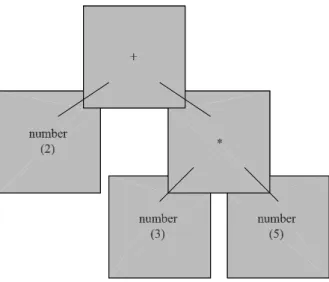
Fig. 2.Pattern covering of AST for2 + 3 * 5.
# this handles + and * nodes leftType = node.left.exprType rightType = node.right.exprType if leftType != rightType:
raise 'Type error.' node.exprType = leftType
After this phase, we have an annotated AST for an input program that is lexically, syntactically, and semantically correct — but that does noth-ing. The final phase, evaluation, remedies this.
2.4. Evaluation
As already mentioned, the evaluation phase can traverse the AST and implement the input pro-gram, either directly through interpretation, or indirectly by generating code for a given target language.
Our expressions, for instance, can be easily interpreted using GenericASTTraversal. For the sake of variety, we use SPARK’s Generi-cASTMatcher class below. With GenericAS-TMatcher, patterns to look for in the AST are specified in a linearized tree notation, which looks remarkably like grammar rules. Gener-icASTMatcher determines a way to cover the AST with these patterns, then executes actions associated with the chosen patterns.
class Interpreter(GenericASTMatcher): def __init__(self, ast):
GenericASTMatcher.__init__(self, 'V', ast) self.match()
print ast.value
def p_number(self, node):
' V ::= number '
node.value = int(node.attr) def p_float(self, node):
' V ::= float '
node.value = float(node.attr)
def p_add(self, node): ' V ::= + ( V V ) '
node.value = node.left.value + node.right.value def p_multiply(self, node):
' V ::= * ( V V ) '
node.value = node.left.value * node.right.value
The AST covering is shown in Figure 2. In the above code,intandfloatare built-in functions which convert strings to integers and floating-point numbers, respectively.
The patterns specified may be arbitrarily com-plex, so long as all the nodes specified in the pattern are adjacent in the AST. To match both +and*nodes, for instance, this method could be added:
def p_addmul(self, node): ' V ::= + ( V * ( V V ) ) ' node.value = node.left.value + \
node.right.left.value * \ node.right.right.value
3. Experience with the Design and Implementation of SPARK
3.1. Remember Your Audience
The advice “remember your audience” is dis-pensed unabashedly to speakers, writers, and web page designers. It is equally applicable to software designers. In the case of SPARK, we made two base assumptions about SPARK’s users.
First, we assume that our users are program-mers, who do not necessarily possess a back-ground in compiler construction. Unlike most compiler toolkits, we deliberately hide details that are traditionally foisted onto users. The best example of this is the fact that SPARK’s parser has no restrictions on the input grammar; a user need not understand parsing theory in order to use it. We have also adopted the com-pilation model discussed in Section 2 to target this class of users, because this provides a sin-gle template with which users can structure their compilers. (Expert users may of course abuse
SPARK’s classes in whatever manner they see fit.)
Second, SPARK users are thought to be occa-sional users. Very few people — ourselves in-cluded — design and implement domain-specific languages on a daily basis. SPARK is thus de-signed not just for ease of use, but for ease of occasional use. In particular, we have at-tempted to reduce the cognitive load associ-ated with using SPARK by providing minimal interfaces to SPARK’s classes, requiring very little of user-supplied token and AST classes, and in some cases by deliberately omitting fea-tures that could be otherwise implemented by users. Other restrictions have been avoided for the same reasons: there is no “compiler build” phase for users to worry about, making each of SPARK’s classes software components which may be inserted freely into an implementation. SPARK could be seen as a “lightweight” tool, compared to other compiler construction toolk-its such as Eli 13], Gentle 29], and
Cock-tail 14]. SPARK supports a simple compilation
model, is highly coupled to its host language, and does not require installation and use of a large suite of tools.
Obviously, some of these design guidelines ben-efit both groups of users, such as SPARK’s close relationship with its host language, Python.
3.2. Co-evolution and Integration
SPARK has been integrated very tightly into Python. This reduces the (re)learning curve
for users already familiar with Python, which is consistent with our design goals. At the same time, it makes SPARK’s design vulnerable to the ever-increasing pace of Python’s evolution, a problem which will eventually impact user code. Python-specific integration also limits the portability of SPARK to languages which do not possess the same features. In particular, the ability to easily associate string attributes with methods such that they may be reflectively examined is important to both the implementa-tion and “feel” of SPARK. We are looking at C# as another possible target because of its attribute support 24].
Unfortunately, there were few other alterna-tives to tight integration. Having SPARK spec-ifications in a separate file, or embedded in Python programs surrounded by special delim-iters, would have violated our design constraints by necessitating a compiler-build or preprocess-ing phase, and decreaspreprocess-ing the ease of occasional use. However, it would have permitted SPARK to be better isolated from changes in the host language.
There are other tradeoffs too. We look at these in terms of two key areas where SPARK is tightly coupled with Python: documentation strings and regular expressions.
3.2.1. Documentation Strings
SPARK’s classes rely upon it to extract needed information at run-time and to associate this in-formation with a particular method.
When SPARK was first conceived, there were few(if any)Python packages using docstrings
in this manner. Since that time, a number have arisen, resulting in the potential for semantic conflicts between packages; it is even rumored that some users write documentation in doc-strings.
Recent releases of Python have included sup-port for function attributes, which are meant to alleviate these collisions by allowing arbi-trary attributes to be attached to methods. From SPARK’s perspective, there are several draw-backs: existing user code would need to be changed; assignments to function attributes are statements that must be executed, unlike the declarative nature of docstrings; a new source of typographically-induced bugs is introduced
(because attribute names can be mistyped);
func-tion attributes are considerably less integrated and elegant.
Whether function attributes will become the dominant way of handling meta-information in Python remains to be seen. Here, the fate of SPARK is out of our hands as a result of the tight integration with Python.
3.2.2. Regular Expresssions
In contrast, we had hoped for certain fates to be out of our hands in the area of regular expres-sions. Rationalizing that Python users would understand regular expressions, being an im-portant feature of Python,3 we decided that it
would be best to have users specify tokens using Python regular expression notation as opposed to some other formalism. Implementation of SPARK’s scanner then becomes trivial, a mat-ter of concatenating the user’s regular expres-sions together as alternatives of a single, large regular expression; throughout this section, we call this the “single” regular expression, and the ones specified by the user “component” regular expressions. As a side effect of this imple-mentation, we automatically benefit from any
speedups and other enhancements, such as Uni-code support, made to Python’s regular expres-sion code.
There were some concessions to be made. Py-thon’s regular expression engine, and hence SPARK’s scanner class, is restricted to using strings as input; the entire input file must be read into a string prior to being tokenized. This is not a terrible burden for many domain-specific lan-guage applications, but severely limits SPARK’s usefulness for, say, processing large XML files. Another issue lay with the semantics of Python regular expressions. Python follows other script-ing languages like Perl and Tcl in supplyscript-ing “first-then-longest” semantics for regular ex-pressions.4 This means that the first match for a regular expression will be taken, not neces-sarily the longest match, contrary to what users might expect from a scanner. As SPARK users do not even see the single regular expression that SPARK constructs on their behalf, first-then-longest semantics are especially troubling because the user will not know which of their component regular expressions appeared first. At first glance, one might think that SPARK could use the static position of the user’s reg-ular expressions in their source code to order the single regular expression. One would be wrong. Internally, Python compiles methods, and stores method names into a hashed data structure; all information about method order-ing is lost. SPARK offers three workarounds to this problem: a user’s component regular ex-pression is never broken apart, so a user may combine and order conflicting alternatives in one component regular expression; component regular expressions in a subclass are placed be-fore those of a superclass in SPARK’s single regular expression; users may define a default method whose component regular expression is placed after all those in the default method’s class.
We have found that SPARK has not gained as much from speedups to Python’s regular ex-pression engine as anticipated. The first-then-longest semantics are implemented by a linear search through the alternatives. As SPARK’s single regular expression is atypical in that it tends to be very long with many alternatives,
we suffer a corresponding performance penalty. In one case, a handwritten scanner interpreted by the Python interpreter was 3.1 times faster than the corresponding SPARK scanner, even though Python’s regular expression engine is implemented in C!
3.3. The Price of Generality and Code Reuse
Other performance problems have haunted SPA-RK, also due to design decisions. As men-tioned, there are no restrictions on the input grammar to SPARK’s parser. Any context-free grammar, even an ambiguous one, may be supplied by the user. To parse with these grammars, we use Earley’s general parsing al-gorithm 10, 11].
Using general parsing algorithms is a somewhat unusual choice in that they tend to have more overhead than more specialized algorithms like the LALR(1)algorithm used in Yacc 18, 22].
Such a choice is not completely unprecedented, however; generalized LR parsing, another gen-eral parsing algorithm, is used in the ASF+SDF
toolkit 31]. SPARK incorporates Earley’s
algo-rithm rather than generalized LR parsing, pri-marily because no precomputation is required for Earley’s algorithm.5 Earley’s algorithm
suf-fers from two major problems, from SPARK’s perspective: the performance problem and the delayed action problem.
Addressing the performance problem is a mat-ter of ongoing research. We have made Ear-ley’s algorithm run in time comparable to that of much more specialized algorithms, by gen-erating code to parse a specific grammar and creating a directly-executable Earley parser 4].
This is not suitable for inclusion in SPARK, unfortunately, due to the large amounts of pre-computation required. More promisingly, we have devised a new type of automaton tailored for fast Earley parsing, the states of which can be unobtrusively constructed as needed 3, 5].
We are currently incorporating this automaton into SPARK. Preliminary results show that use of our new automaton in SPARK can result in a 40% speed increase.
The delayed action problem refers to the fact that general parsing algorithms, in general, must read and verify their entire input first 16].
As a consequence of this, the user’s seman-tic actions associated with grammar rules may not be executed until after the input is recog-nized. Even simple semantic actions, such as inserting names into symbol tables, must be deferred. While we have looked at ways to remedy this problem 3], SPARK tries to
mini-mize the impact of the delayed action problem through facilities for automatically construct-ing parse trees, somethconstruct-ing semantic actions are commonly used for.
Besides automatically constructing parse trees, the generality of Earley’s algorithm lends it-self to use for tree-pattern matching, by which SPARK users can implement the evaluation phase of a compiler. This is known as Gra-ham/Glanville code generation 12], and use of
Earley’s parsing algorithm in a Graham/
Glan-ville code generator is known to correct prob-lems with the technique 8]. The interpreter
from Section 2.4, for example, would corre-spond to the grammar:
V ::= ) V V ( + V ::= ) V V ( *
V ::= ) ) V V ( * V ( + V ::= number
V ::= float
The AST in Figure 2 would be linearized to) )
number number ( * number ( +, with
paren-theses inserted to delineate the AST’s structure. Conflicting matches show up as ambiguities during parsing, and are handled using Gene-ricParser’s ambiguity resolution mechanism.
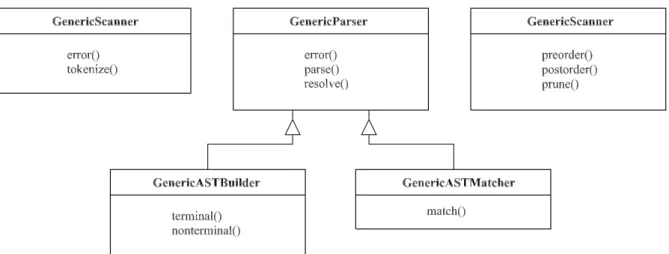
There is a great dependency in SPARK on the implementation of Earley’s algorithm in Gene-ricParser, as it is re-used for various purposes. Figure 3 shows the class structure of the user-visible classes of SPARK, along with their key methods. Our experience is that this serves to amplify the performance problem, and this is why we have devoted much effort towards solv-ing that problem.
5Although implementations of generalized LR parsing which compute information on the fly are possible 17
], they are more
Fig. 3.SPARK’s class structure.
3.4. Serendipity, Schr¨odinger, and Speed
Our criterion that user-supplied tokens should have a minimal interface led us to an accidental discovery. SPARK’s parser assumes that to-kens are objects and, while parsing, compares them to the names of terminal symbols using Python’s == operator. This in turn causes the token’s user-supplied cmp method to be in-voked to perform the comparison. In this way SPARK never needs to know how or where the token’s type is stored — the user need only to supply the one “comparison method” in their token class.
An odd question arose: what if the user’s com-parison method lied? When asked by the parser, what if a token claimed to not only have its token type, but other token types as well? The result is what we call a Schr¨odinger token, which has some very useful applications, as well as pro-viding a means of avoiding the delayed action problem. A more complete discussion6appears
in 6]; we summarize the ideas here.
For simplicity, consider processing a file which contains key/value pairs. The problem is that
the type of tokens may be context-sensitive, be-cause the name of a key may appear as a value:
foo 123 bar 456 baz foo
Ideally, we would like users to be able to write a grammar which accurately reflects the struc-ture of this small domain-specific language, as
shown in Figure 4. In this grammar,foo,bar, baz, andvalueare all distinct token types, and therein lies the problem. Recall that SPARK’s scanner is finished operation by the time the parser starts; the scanner does not have access to context information from the parser to deter-mine whenfoois a key and when it is avalue.
pairs ::= pairs pair pairs ::= pair pair ::= foo value pair ::= bar value pair ::= baz value
Fig. 4.An ideal grammar for key/value pairs.
By making a one-line change to their cmp method, the problem is easily solved. The to-ken — foo in this case — can claim to be
both token types, effectively giving the token a superposition of types. Earley’s parsing al-gorithm essentially simulates nondeterminism, and can handle a token that appears to have more than one type; the conflict is automati-cally resolved once enough context information has been seen. The user does not need to make any modifications to the grammar whatsoever, unlike other techniques to solve the problem of context-dependent tokens.
Analogy can be established between these to-kens with a superposition of types and Schr¨o-dinger’s Cat, which was in a superposition of “alive” and “dead” states 28]. The general
parser acts as the observer which resolves the actual type of the “Schr¨odinger token.”
6Including a full discussion of other approaches, such as scannerless parsing 27, 32
Unfortunately, the performance problem rears its ugly head again. We can make SPARK’s parser run 30% faster by knowing an exact type for tokens, rather than having to query each token’s cmp method repeatedly. In recent releases of SPARK we have done this, but the utility of Schr¨odinger’s tokens is so great that we have taken pains to ensure that they are still supported in SPARK.
3.5. Run-time Limitations
While we gained a great deal of portability across platforms and ease of implementation working in Python, there were also some things we lost by working in an interpreted scripting language. All of these tended to play out at SPARK’s run-time. It was, for example, ex-tremely difficult to gauge the effect of a po-tential optimization to SPARK until such time as it was actually implemented. A number of times, the overhead required for Python to exe-cute the “optimized” code negated any speedup that would have been obtained.
The design decision to eschew a compiler build phase and make SPARK reflectively gather in-formation from user classes at run-time has been effective from the user standpoint, but has also severely limited what we can do in terms of precomputation. Computation done by SPARK can only be done at run-time, when speed is al-ready critical; we must search for effective yet computationally lightweight improvements.
4. Future Directions
Some future work on SPARK is mundane but necessary, such as writing more user documen-tation. It would also be interesting to evaluate ease-of-use from an experimental, rather than an anecdotal, perspective. Other future direc-tions, once important, have been abandoned. Initially, we envisioned that SPARK’s parsing engine could be replaced with another, using a more efficient parsing algorithm 2]; however,
the general parsing algorithm has proven itself so simple to use that its replacement is no longer being considered.
Improvements to the pattern matcher are likely. Currently, “sparse” patterns cannot be specified
without giving patterns to match the entire AST. Removing this limitation would permit use of pattern matching for selective tree rewriting and possibly for some tree-based optimizations. The scanner should also see replacement. Re-lying on Python’s regular expression engine has unfortunately proven to be a disaster from the performance point of view. Finally, a facility for performing static verification of SPARK speci-fications would be useful to trap some common user errors.
One obvious direction, which we arenot con-sidering at this time, is the use of attribute gram-mars 20]. While this would alleviate the need
for the user to order AST traversals for seman-tic checking, it would also impose an additional barrier to use by SPARK’s intended audience. We hold the somewhat controversial view that the key to wider acceptance is less formalism, not more.
5. Conclusion
SPARK has been used to implement a num-ber of domain-specific languages in Python. Targeting the toolkit to occasional users and programmers without a compiler construction background has had profound effects in both the design and implementation of SPARK. Like most designs, a series of tradeoffs is in-volved. Tight integration with Python lowers the learning curve, but leaves SPARK at the mercy of ongoing Python development; re-use of regular expression and parsing engines im-pacts performance; avoiding a compiler build phase pushes all computation work to run-time. Nevertheless, we are pleased with the result and plan to bring SPARK’s ideas to a wider audi-ence.
Acknowledgments
References
1] A. V. AHO, S. C. JOHNSON,ANDJ. D. ULLMAN,
De-terministic parsing of ambiguous grammars. Com-munications of the ACM, 18(2):441–452, August
1975.
2] J. AYCOCK, Compiling little languages in Python.
In Proceedings of the 7th International Python Conference, pages 69–77, 1998.
3] J. AYCOCK, Practical Earley Parsing and the
SPARK Toolkit. PhD thesis, University of Victoria, 2001.
4] J. AYCOCK ANDN. HORSPOOL, Directly-executable
Earley parsing. InProceedings of the 10th Interna-tional Conference on Compiler Construction, pages 229–243, 2001.
5] J. AYCOCK ANDR. N. HORSPOOL, Practical Earley
parsing. Submitted for publication.
6] J. AYCOCK ANDR. N. HORSPOOL, Schr¨odinger’s
token. Software — Practice and Experience, 31(8):803–814, 2001.
7] F. BUSCHMANN, R. MEUNIER, H. ROHNERT, P. SOM
-MERLAD,ANDM. STAL, Pattern-Oriented Software
Architecture: A System of Patterns. Wiley, 1996.
8] T. W. CHRISTOPHER, P. J. HATCHER, AND R. C.
KUKUK, Using dynamic programming to
gener-ate optimized code in a Graham-Glanville style code generator. In Proceedings of the SIGPLAN ’84 Symposium on Compiler Construction, pages 25–36, 1984.
9] P. F. DUBOIS, Pyfort Reference Manual. Lawrence
Livermore National Laboratory, sixth edition, 2000.
10] J. EARLEY, An Efficient Context-Free Parsing
Al-gorithm. PhD thesis, Carnegie-Mellon University, August 1968.
11] J. EARLEY, An efficient context-free parsing
algo-rithm.Communications of the ACM, 13(2):94–102,
February 1970.
12] R. S. GLANVILLE AND S. L. GRAHAM, A new
method for compiler code generation. In 5th An-nual ACM Symposium on Principles of Program-ming Languages, pages 231–240, 1978.
13] R. W. GRAY, V. P. HEURING, S. P. LEVI, A. M.
SLOANE, AND W. M. WAITE, Eli: A complete, flexible compiler construction system. Communi-cations of the ACM, 35(2):121–131, February 1992.
14] J. GROSCH ANDH. EMMELMANN, A tool box for
compiler construction. Technical Report 20, GMD, January 1990.
15] D. GRUNE, H. E. BAL, C. J. H. JACOBS,ANDK. G.
LANGENDOEN, Modern Compiler Design. Wiley,
2000.
16] D. GRUNE AND C. J. H. JACOBS, Parsing
Tech-niques: A Practical Guide. Ellis Horwood, 1990.
17] J. HEERING, P. KLINT,ANDJ. REKERS, Incremental
generation of parsers. In Proceedings of the SIG-PLAN ’89 Conference on Programming Language Design and Implementation, pages 179–191, 1989.
18] S. C. JOHNSON, YACC — yet another compiler.
UNIX Programmer’s Manual, 7th Edition, 2B, 1978.
19] P. KLINT ANDE. VISSER, Using filters for the
disam-biguation of context-free grammars. InProceedings of the ASMICS Workshop on Parsing Theory, pages 1–20, 1994.
20] D. E. KNUTH, Semantics of context-free languages.
Mathematical Systems Theory, 2(2):127–145, 1968.
Errata in21].
21] D. E. KNUTH, Semantics of context-free
lan-guages: Correction.Mathematical Systems Theory, 5(1):95–96, 1971.
22] J. R. LEVINE, T. MASON,ANDD. BROWN, Lex &
Yacc. O’Reilly & Associates, second edition, 1992.
23] M. R. LEVY, Web programming in Guide.Software
— Practice and Experience, 28(11):1581–1603,
1998.
24] Microsoft Corporation,C# Language Specification,
version 0.28, 2001.
25] M. E. NORDBERGIII, Variations on the visitor
pat-tern. In Collected Papers from the PLoP ’96 and EuroPLoP ’96 Conferences. Washington University, 1997. Technical Report WUCS-97-07.
26] E. S. RAYMOND, The CML2 language: Python
im-plementation of a constraint-based interactive con-figurator. In Proceedings of the 9th International Python Conference, pages 135–142, 2001.
27] D. J. SALOMON ANDG. V. CORMACK, Scannerless
NSLR(1) parsing of programming languages. In
Proceedings of the SIGPLAN ’89 Conference on Programming Language Design and Implementa-tion, pages 170–178, 1989.
28] E. SCHRODINGER¨ , Die gegenw¨artige situation in
der quantenmechanik. Die Naturwissenschaften, 23:807–812,823–828,844–849, 1935. Translation in Trimmer30].
29] F. W. SCHROER¨ , The GENTLE Compiler
Construc-tion System. R. Oldenbourg Verlag, 1997.
30] J. D. TRIMMER, The present situation in
quan-tum mechanics: a translation of Schr¨odinger’s “cat paradox” paper. Proceedings of the American Philosophical Society, 124(5):323–338, 1980.
31] A.VANDEURSEN, Introducing ASF+SDF using the
λ-calculus as example. In Executable Language Definitions. PhD thesis, University of Amsterdam, 1994.
32] E. VISSER, Scannerless generalized-LR parsing.
33] R. L. WHITE ANDP. GREENFIELD, Using Python to
modernize astronomical software. In Proceedings of the 8th International Python Conference, pages 103–109, 2000.
Received:July, 2001
Revised:October, 2001
Accepted:November, 2001
Contact address:
John Aycock Department of Computer Science University of Calgary 2500 University Drive N.W. Calgary, Alberta, Canada T2N 1N4 e-mail:[email protected] a
JOHNAYCOCKreceived a B.Sc.(1993)from the University of Calgary,
and a M.Sc.(1998)and Ph.D.(2001)from the University of Victoria,