Lucrări ştiinţifice Zootehnie şi Biotehnologii, vol. 42 (1) (2009), Timişoara
MICROBIAL HYDROLASES IMMOBILIZED ON POROUS
MATRICES
HIDROLAZE MICROBIENE IMOBILIZATE PE MATRICI
POROASE
MONICA DRAGOMIRESCU1, T. VINTILǍ1, GABRIELA PREDA2
1Faculty of Animal Sciences and Biotechnologies, Timişoara, România,
2Faculty of Chemistry-Biology-Geography, Timişoara, România
Starch degrading enzymes are used as feed additives to increase the digestibility of corn meal based diet in livestock and poultry. To be efficient, these enzymes have to present a good activity and stability. Immobilization by physical bonding of enzymes on a porous support is a simple and efficient method to preserve enzyme molecules in an active form and retain their activity for a period of time.
The aim of this study was to stabilize an enzymatic preparation with amylase activity produced by a native strain of Bacillus amyloliquefaciens in submerged culture. The immobilization technique used was physical bonding on a porous ceramic support. The enzymatic preparation with amylase activity was used in immobilization in a liophylized form. By using the same method we immobilized also a purified Aspergillus niger amylase. For both enzymes, the optimal temperature and pH of the native and immobilized enzymes did not vary significantly. At temperature and pH values lower than the optimum, the relative activities have been higher for the immobilized Bacillus amyloliquefaciens enzyme compared to the native one. The immobilization has led to an enzymatic compound with stability at pH 3 and 37°C and in time higher than that of the free one.
Keywords: feed enzymes,amylase, Bacillus amyloliquefaciens, Aspergillus niger,
stabilization, physical bonding.
Introduction
Enzymes act very specificly and mediate digestion processes in livestock and poultry. This has generated a real interest in obtaining exogenous enzymes as feed additives in order to improve animal productivity.
The aim of this study was to find a simple and efficient method, with reduse cost, to stabilize a microbial enzymatic preparation with amylase activity, with yields as high as possible, in order to obtain insoluble enzymatic preparations with high enzymatic activity, with potential applications as additives in the animal food.
Materials and Methods
Soluble poatatoes starch, maltose, Folin-Ciocalteus phenol reagent and bovine serum albumin (BSA) were purchased from Merck, 3,5-dinitrosalicylic acid (DNS) was obtained from Fluka. Ceramics and all the other chemicals were obtained from local suppliers or were commercially available reagent grade products and were used without further purification. Amylase produced by
Aspergillus niger was obtained from Novo. The Bacillus amyloliquefaciens DSM 7 strain was purchased from DSMZ Germany.
Microbial cells of Bacillus amyloliquefaciens were cultured under aerobic conditions (rotary shaker, 175 rpm), for 24 hours, at 37ºC, in Erlenmeyer flasks containing 50 mL mineral medium (corn meal 0.05%, KH2PO4 0.25%, tryptone 0.6%, Na2HPO4 0.25%, NaCl 0.1%, (NH4)2SO4 0.2%, MgSO4, 0.005%, CaCl2 0.0075% and water (sterilized for 15 min. at 120˚C)). A 5% (V/V) inoculum was used. The purity, pH and amylase activity were monitored continuously. The enzymatic preparation with amylase activity was liophylized from fermentation medium for 24 hours, at -56ºC and 26 mTorr (iLShin Europe Dry Freezer).
A buffered enzymatic solution (containing 50 amylase units from A. niger
amylase and lyophilized enzymatic preparation with amylase activity produced by
B.amyloliquefaciens, respectively in 0.1 M citric acid – 0.2 M Na2HPO4 buffer, pH 4,6) was stirred with the ceramic support (1 g) for two hours and than filtered, washed with 7 mL distilled water and 3.5 mL acetone, dried at 4ºC over night and than assayed.
The effect of temperature and pH on the activity of native and immobilized enzymes was investigated by DNS assay and measuring the glucose concentration in the medium at various temperature (22-85ºC) and in the presence of 0.1 M citric acid – 0.2 M Na2HPO4 buffer ranged from 3 to 8 respectively, at room temperature.
Stability test – the immobilized enzymes (300 mg immobilized amylase from
A. niger and B. amyloliquefaciens, respectively) in 0.1 M citric acid – 0.2 M Na2HPO4 buffer, pH 3.0 (5 mL) were incubated at 37ºC for one hour. Samples were withdrawn at every 10 minutes and amylase activity was assayed.
Results and Discussion
Both a purified Aspergillus niger amylase (amylase activity 6400 U/mL, protein content 326.69 mg/mL) and a liophylized enzymatic preparation with amylase activity produced by a native strain of Bacillus amyloliquefaciens
(amylase activity 232 U/g, protein content 3.38 mg/g) were imobilized by physical adsorption on inorganic ceramic support.
Table 1. Protein content and amylase activity of the free and immobilized enzyme
Enzyme
Protein content mgBSA·mL-1
mgBSA·g-1
Amylase activity
μmol·min-1·mL-1
μmol·min-1·g-1
Immobilization yielda
%
A. niger amylase freeb 326.69 6400 -
immobilizedc 4.42 8.94 34.76
B. amyloliquefaciens amylase
freeb 3.38 232 -
immobilizedc 4.85 16.92 38.52
aimmobilization yield = Af·100/Ai, were Ai is initial total amylase activity and Af is total amylase activity of the immobilized enzyme, bliquid, csolid
The highest enzyme activity and the best immobilization yield were found for the liophylized B. amyloliquefaciens amylase (16.92 μmol·min-1·g-1, 38.52% immobilization yield). It was noticed that the concentration of the enzyme exposed per support mass unit (ceramic) during immobilization was the same for both of the enzymes (Table 1).
The influence of pH and temperature on the free and immobilized enzyme was studied in order to find the effect of ceramic support on the enzymes activity in the hydrolysis of starch.
a b
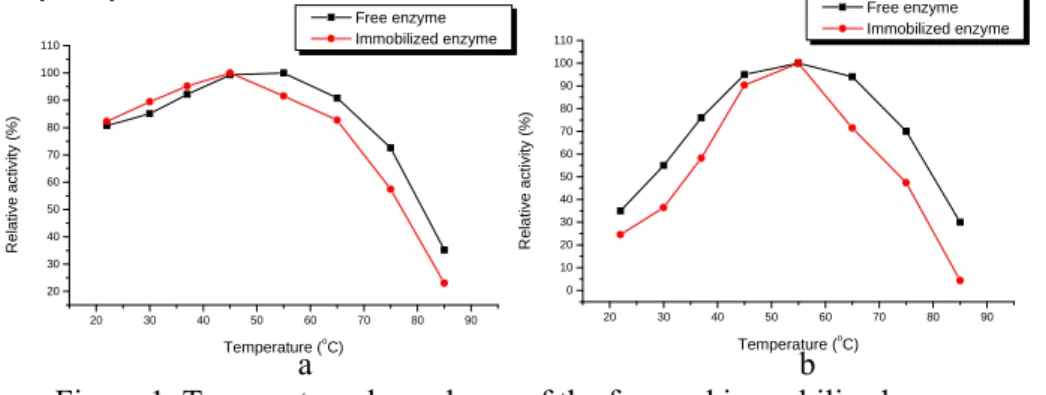
Figure 1. Temperature dependence of the free and immobilized enzyme (a - B. amyloliquefaciens amylase, b - A. niger amylase)
The optimum temperatures of the free and immobilized B. amyloliquefaciens
amylase were 55ºC and 45ºC, respectively (Figure 1). For temperatures lower than the optimum, the relative activity of the immobilized enzyme is greater than in the
20 30 40 50 60 70 80 90
20 30 40 50 60 70 80 90 100 110 Free enzyme Immobilized enzyme R e lativ e activ ity (%)
Temperature (o C)
20 30 40 50 60 70 80 90
0 10 20 30 40 50 60 70 80 90 100 110 Free enzyme Immobilized enzyme R e la tiv e ac tiv ity (%)
temperature of the free and immobilized enzyme was 55 ºC. The physical bonded enzyme activity is slightly reduced in the temperature domain lower and higher than the optimum.
The free B. amyloliquefaciens enzymatic preparation had the optimum pH domain being 4.6-7.0. At pH 3, the immobilized amylase had a higher activity then the free enzyme, the relative activity being more than 15% from the maximum (Figure 2). For the pH values higher than the optimum it has an almost identical evolution with the native one.
The optimum pH of A. niger amylase was 4.6. After immobilization a shift of optimum pH was observed. In the pH range 5-7 the activity of the physical bonded enzyme was higher than that of the native form (Figure 2).
a b
Figure 2. pH dependence of free and immobilized enzyme activity (a-B. amyloliquefaciens amylase, b-A. niger amylase)
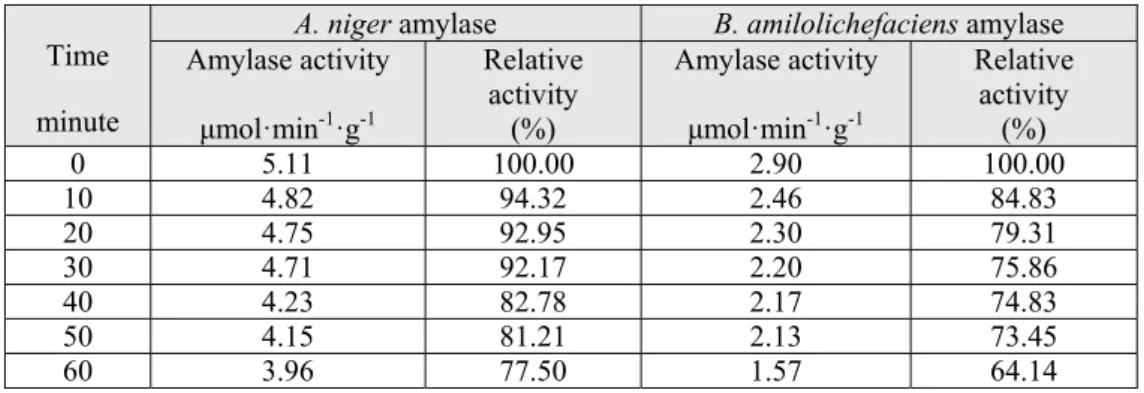
To be used in animal feeding as efficient forage additives, the enzymes have to be stable in the physiological conditions from the proximal segment of the intestine tract in the mammal’s organism. The immobilized enzymatic preparations were tested “in vitro”. The stability for one hour at 37ºC and pH 3 was studied (Table 2).
Table 2. Stability of the immobilized enzymatic preparation at pH 3.0 and 37ºC
Time
minute
A. niger amylase B. amilolichefaciens amylase
Amylase activity
μmol·min-1·g-1
Relative activity
(%)
Amylase activity
μmol·min-1·g-1
Relative activity
(%)
0 5.11 100.00 2.90 100.00
10 4.82 94.32 2.46 84.83
20 4.75 92.95 2.30 79.31
30 4.71 92.17 2.20 75.86
40 4.23 82.78 2.17 74.83
50 4.15 81.21 2.13 73.45
60 3.96 77.50 1.57 64.14
3 4 5 6 7 8
0 20 40 60 80 100 Free enzyme Immobilized enzyme R e la tiv e a c ti v ity ( % ) pH
3 4 5 6 7 8
After one hour, the relative activity of the immobilized A. niger amylase on ceramic support was 77.5%. The B. amyloliquefaciens amylase immobilized by physical bonding on ceramic support after one hour of contact with the pH 3 medium exhibited more than 64 % of the initial activity.
Both B. amyloliquefaciens and A. niger amylases, adsorbed on ceramic support, had a good stability in time. After 2 months at 4 ºC, more than 40% of the initial activity was preserved.
Conclusions
Two microbial amylases, a purified Aspergillus niger amylase and a liophylized Bacillus amyloliquefaciens amylase were imobilized by physical adsorption on ceramic support. For both enzymes the immobilization yields were almost 40%.
The exogenous immobilized microbial enzymatic preparations with amylase activity can act on available substrates at low pH in stomach and can be used as feed additives. They are stable for a time sufficiently long to act in proximal segment of digestive tract.
Acknowledgement: This work was supported by PN II-IDEI project, contract number 426/01.10.2007.
References
1. Tricarico, J.M., Johnston, J.D., Dawson, K.A., 2008, Dietary supplementation of ruminal diets with Aspergillus oryzae α-amylase, Animal Feed Science and Technology, 145, 136-150
2. Onderci, M., Sahin, N., Cikim, G., Aydin, A., Ozercan, I., Aydin, S., 2006, Efficacy of Supplementation of α-Amylase-Producing Bacterial Culture on the performance, Nutrient use, and Gut Morphology of Broiler Chicken Fed a Corn-Based Diet, Poultry Science, 85 (3), 505-510
3. Sumner, J. B., Graham, V. A., 1921, Dinitrosalicylic acid: a reagent for the estimation of sugar in normal and diabetic urine, J. Biol.Chem., 47(1), 5 - 9.
4. ***, BDH Enzyme Catalog, 1981