© 2019 by University of Niš, Serbia | Creative Commons License: CC BY-NC-ND
UDC: (159.953.5+378.147):811.111 https://doi.org/10.22190/JTESAP1903385K
THE ESP LECTURERS’ SELF-DEVELOPMENT COMPETENCE
IN HIGHER EDUCATIONAL CONTEXT
Marianna Kniazian, Olena Khromchenko
Odesa I. I. Mechnikov National University, Ukraine E-Mail: [email protected]; E-Mail: [email protected]
Abstract.The article is devoted to the problem of preparing of future ESP teachers in the
context of higher education. Taking into account the necessity of solving the problem of acquiring not only purely theoretical and applied linguistic knowledge, but also knowledge from a certain professional area (for example, medicine, pharmacy, economics, law, engineering), the role of the formation of self-development competence as a means of expanding and deepening of vocational training gained at the university is presented. Self-development competence of the ESP teacher is the ability to evaluate one’s professional achievements, to choose the ways of optimizing personal level of intelligence aimed at self-improvement, to practically embody personality changes, control efficiency, adjust the conditions for self-change. The crucial components of this process are: self-analysis of knowledge, skills and know-hows, that can ensure full inclusion of the individual into professional and pedagogical activity at its highest innovative-creative level; designing ways of their development; selection and realization of corresponding receptions in all spheres of vital functions of the ESP teacher as a carrier and creator of humanistic values in society; self-control and self-correction. Self-development competence provides individuals with a promising opportunity to resolve problems characterized by increasing complexity, gradually expand their professionally important knowledge, master new creative opportunities.
Key words: competency-based approach, self-development competence, ESP teacher, self-improvement, self-correction
1. INTRODUCTION
In today‟s fast-paced, globalized world, in which the need for international partnerships between enterprises, organizations, individuals, is becoming ever more relevant, proficiency in professional English is a priority factor for effectiveness of any individual‟s activity. The effectiveness of ESP training largely depends on professionalism, knowledge, and pedagogical skills of the teachers of higher educational institutions, both technical and humanistic. Comprehending such a problem of modern education as “How are ESP lecturers educated for this line of work and where?”, we can make the assumption that one of the effective theoretical bases for the training of teachers of this type is a competency-based approach. In this regard, Anna Stefanowicz-Kocoł and Monika Pociask rightly insist that “we are on the way to the development of teaching / learning process in order to enable students to find their place in the demanding world of labor market and feel competent and respectful” (p. 263).
It should be emphasized that recently, scientists have been paying special attention to the formation of such competencies of future specialists in various fields as communicative (Corrizzato & Goracci, 2013; Kubacheva, 2014; Veselinova, 2016; Vukićević-Đorđević, 2018), social (Stefanowicz-Kocoł & Pociask, 2017), cultural (Bakić-Mirić, 2013), intercultural (Stefanowicz-Kocoł & Đorđević, 2017), intercultural communicative (Janulevičiene & Rackevičiene, 2015), ICT competence (Dobrova, 2017) and others.
But if we are talking about the professional training of the ESP teacher, then it involves not only mastering the competencies mentioned above, but also the subject area of a certain profession (economics, engineering, medicine, pharmacy and so on). Danica Piršl and Nadežda Stojković pay special attention to the issue touched upon, emphasizing that “... future practitioners find themselves in a job position that requires knowledge of specialized discourse regarding teaching it” (2018: 79). Thus, the formation of the special professional knowledge of ESP teachers in the process of their preparation in the higher education system remains relevant today. Given that the training of ESP teachers is carried out at the philological faculties, their mastery of narrowly specialized knowledge in, for example, medicine, pharmacy, engineering, law, economics and so on, can be carried out mainly in the process of self-education. We theorize that the future ESP teachers need to build self-development competence that would provide them with the ability to expand their knowledge (primarily from a specific specialized professional field), as well as master components of other competencies.
2. METHODS
The objective of the article is to reveal the role of the competency-based approach as a theoretical foundation for the training of ESP teachers, to analyze the features of the competency of self-development of ESP teachers in the context of higher education, to reveal the methods of formation of this competency. To achieve this objective, such methods as analysis of theoretical sources, systematization, classification, generalization of scientists‟ positions (Aguilar; 2018; Bakić-Mirić, 2013; Corrizzato & Goracci, 2013; Dobrova, 2017; Janulevičiene & Rackevičiene, 2015; Kubacheva, 2014; Maiier, 2017; Nor Yazi Hj Khamis et al, 2014; Stefanowicz-Kocoł & Đorđević, 2017; Venkatraman & Prema, 2013; Veselinova, 2017) on the competencies that ESP teachers should gain, and first of all, on the self-development competence were made use of. ESP teacher training programs (Profil, 2017, 2018) for higher education institutions were also investigated. To diagnose the formation of this competence expert assessment and self-assessment (Fedorova, 2017) were exploited, as well as qualitative and quantitative analysis of the data obtained.
3. COMPETENCE APPROACH AS A THEORETICAL BASIS FOR THE STUDY OF THE PROBLEM
(Nor Yazi Hj Khamis et al, 2014), the formation of their methodological competence (Maiier, 2017), written communication skills (Mancho-Barés & Arnó-Macià, 2017), the mastery of which will facilitate effective teaching of ESP. Particular attention is paid to the formation of critical thinking (Piršl, Popovska, Stojković, 2017) and the development of critical thinking skills through self-evaluation (Janulevičienė & Kavaliauskienė, 2012).
The comparative analysis of the above scientific viewpoints indicates that the competencies of an ESP teacher, in general, are reflected by their most important components: gnostic, which involves the possession of a certain set of knowledge, actualized in a specific professional activity; information-projective, which is manifested in the ability to accumulate, process and implement knowledge necessary for a successful professional activity; procedural, containing the ability to practically implement one‟s plan, idea, project, implementation of copyright technologies for solving professional problems, complete self-embodiment in the product of one‟s labor; establishing positive social interaction in the team; personal, focused on the mastery of socially appropriate norms, values and motives.
Thus, the competencies of an ESP teacher include active social interaction of a person with other members of a multicultural society, positive communication with them, quick search for and processing of information, implementation of innovations, effective solution of problems of varying complexity and more. In addition, the analysis of scientific sources indicates the need for constant and complete development of all competencies acquired by students in the higher education system: “the process of educating has not finished for those young people who, while building up their professional know-how, also need to develop a set of soft skills necessary to put the expertise into practice” (p. 259) (Stefanowicz-Kocoł & Pociask, 2017), which especially enhances the role of self-development competence in the professional work of the ESP teacher.
4. RESEARCH RESULTS
As a result of the study of the scientific viewpoints (Aguilar, M. 2018; Dobrova, T. E. 2017: Kubacheva, K. I. 2014; Stefanowicz-Kocoł A., Đorđević, D. 2017) the essence of the self-development competence of ESP teachers was clarified, those components that make up its structure were characterized, effective methods for the formation of this competence were determined.
4.1. ESP teacher self-competence
4.2. Essence of ESP teachers’ Self-Competence
The competence of the ESP teacher‟s self-development is the ability to evaluate one‟s professional achievements, choose the means of optimizing personal opportunities for self-improvement, practically embody changes in one‟s personality, control one‟s own performance, and adjust the conditions for self-change. Thus, the necessary components of this process are: self-disclosure of knowledge, skills and know-hows for pedagogical activities for teaching ESP at its highest innovative-creative level; design of means and selection of tools for the development of the mentioned knowledge, skills and know-hows; the implementation of this toolkit in all spheres of life of an ESP teacher as a carrier and creator of humanistic values in society; self-control and self-correction.
To do this, an ESP teacher needs to have information on the following: what theoretical knowledge from the professional field, which is the subject of ESP, he or she should expand; what applied linguistic knowledge of the English language should be deepened; what practical experience of other ESP teachers should be studied by him or her for effective self-development; what tools of self-development are applicable under the specific conditions of professional activity; what methods of self-diagnosis (self-knowledge, self-understanding, self-observation, self-analysis, self-esteem, self-control, self-characterization) are appropriate to choose for effective self-assessment of knowledge, skills and personality traits that a teacher should develop in order to optimize their professional activity, make each lesson interesting and useful for effective professional development of their pupils and students.
This also implies requirements for specific practical skills, without which self-development is not possible, namely: to identify problems that impede self-improvement, to adjust them; to study positive experience of their colleagues; use techniques of self-education, develop an individual model of self-development. The competence of self-development is related to solving problems associated with teaching ESP, and lay foundation for self-realization of one‟s creative pedagogical potential.
4.3. ESP teacher self-development competency building areas
work with the aim of introducing new information technologies for ESP training; preparing and conducting classes of various types; the organization of student research groups to solve scientific problems, the management of student research; partnership participation in the work of foreign research centers on linguodidactics, centers for the transfer of innovative methods of teaching foreign languages; dissemination of knowledge about modern teaching methods of ESP through independent preparation of papers to be submitted to both domestic and foreign journals; the formation of personal qualities that determine the progress of ESP teacher‟s self-development: perseverance in achieving the goal of professional and research activities; ability for creative interaction in a multinational team; tolerance; responsibility; independence; hard work; discipline; organization of their self-development activities: creating a strategy, program and selecting the best methods of self-development; diagnosing its effectiveness and making timely corrections in case of failures.
4.4. An empirical experiment to build ESP teachers’ self-development competence
To find out the level of self-development competence formation among students - future ESP teachers, testing was carried out, which involved expert assessment and self-assessment by students of their level of formation of this competency, taking into account the main program results of training at the Department of Romance-Germanic Philology at Odessa I. I. Mechnikov National University, Ukraine.
4.4.1. Data collection
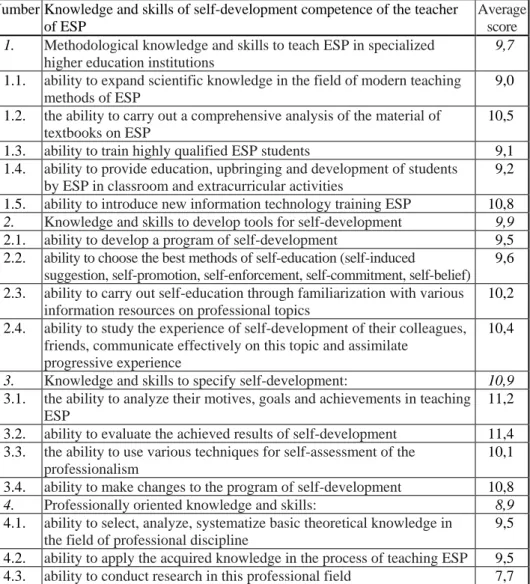
The proposed test contained questions that were grouped in the following way: methodological knowledge and skills to teach ESP in specialized higher educational institutions; knowledge and skills to develop tools for self-development; knowledge and skills to delineate the dynamics of their own self-development as ESP teachers; professionally oriented knowledge and skills. We have chosen a rating scale of 12 points (Palchevskyi, 2007), in which points from 1 to 3 reflect the lack of knowledge and skills, from 4 to 6 - a low level of formation of assessed knowledge and skills, from 7 to 9 - sufficient, from 10 to 12 - high. The expert assessment was attended by 29 students of the distance learning form of the Department of English Philology Odessa I. I. Mechnikov National University. For each student, 3 experts (teachers of the English language) and self-evaluating data were obtained. The average score was calculated, after which the indicator was figured (Table 1).
We would like to note that students who took part in testing have little experience in teaching ESP in various specialized universities.
Table 1 Generalized results of testing the self-development competence of students
Number Knowledge and skills of self-development competence of the teacher of ESP
Average score
1. Methodological knowledge and skills to teach ESP in specialized higher education institutions
9,7
1.1. ability to expand scientific knowledge in the field of modern teaching methods of ESP
9,0
1.2. the ability to carry out a comprehensive analysis of the material of textbooks on ESP
10,5
1.3. ability to train highly qualified ESP students 9,1 1.4. ability to provide education, upbringing and development of students
by ESP in classroom and extracurricular activities
9,2
1.5. ability to introduce new information technology training ESP 10,8
2. Knowledge and skills to develop tools for self-development 9,9
2.1. ability to develop a program of self-development 9,5 2.2. ability to choose the best methods of self-education (self-induced
suggestion, self-promotion, self-enforcement, self-commitment, self-belief) 9,6
2.3. ability to carry out self-education through familiarization with various information resources on professional topics
10,2
2.4. ability to study the experience of self-development of their colleagues, friends, communicate effectively on this topic and assimilate
progressive experience
10,4
3. Knowledge and skills to specify self-development: 10,9
3.1. the ability to analyze their motives, goals and achievements in teaching ESP
11,2
3.2. ability to evaluate the achieved results of self-development 11,4 3.3. the ability to use various techniques for self-assessment of the
professionalism
10,1
3.4. ability to make changes to the program of self-development 10,8
4. Professionally oriented knowledge and skills: 8,9
4.1. ability to select, analyze, systematize basic theoretical knowledge in the field of professional discipline
9,5
4.2. ability to apply the acquired knowledge in the process of teaching ESP 9,5 4.3. ability to conduct research in this professional field 7,7
At the same time, methodological knowledge and skills to teach ESP in specialized higher educational institutions was rated rather low (average score - 9.7), due to the lack of wide experience in these universities. For example, the lowest score was received by students for their ability to expand scientific knowledge in the field of modern teaching methods ESP (9.0), which confirms the need for more active involvement of future ESP teachers in research activities in this direction. The lack of sufficient internships in technical universities also explains the low score for the formation of the ability to train ESP students with high qualifications (9.1).
field depending on the university‟s specialization was evaluated on average by 7.7. The ability to select, analyze, systematize basic theoretical knowledge in the field of professional discipline, as well as the ability to apply this knowledge in practical pedagogical activity were rated at 9.5 points.
The data obtained confirm the need for the implementation of specially designed tasks to build the self-development competence of future ESP teachers.
4.4.2. Forming experiment
Based on the above-mentioned areas of formation of the competence of self-development of ESP teachers, we have elaborated a system of research tasks for future ESP teachers aimed at mastering components of this competence. This system of research assignments was implemented in the course of the discipline Methods of foreign language teaching in higher school. Here are examples of some tasks: biographical analytical essay (students analyze interesting facts about the biography of famous ESP teachers, their impact on the modern generation of teachers, on student‟s personality); essay „Why I strive for professional self-growth‟ (undergraduates outline the priorities of their professional life which determine the direction of their continuous development); elaboration of the program “Self-guided improvement in life” (students determine the stages of self-development in accordance with their needs and goals within the short and long term, select the optimal techniques for its successful implementation); mutual assessment of students (students estimate the results of personal development of methodological and professional knowledge and skills, as well as knowledge and skills to analyze levels of self-growth). The above examples of research assignments allow orienting ESP teachers towards understanding goals of self-development, elaborating an appropriate program, selecting most effective tools, systematic self-assessment and self-correction.
5. CONCLUSION
REFERENCES
Aguilar, M. 2018. “Integrating intercultural competence is ESP and EMI: from theory to practice”. ESP Today. Vol. 6(1): 25-43.
Bakić-Mirić, N. 2013. “The importance of teaching cultural competence in Serbian medical schools – a conceptual framework”. The Journal of Teaching English for Specific and Academic Purposes. Vol. 1, No 1: 45-52.
Corrizzato, S., Goracci, G. 2013. “English for nursing: the importance of developing communicative competences”. The Journal of Teaching English for Specific and Academic Purposes. Vol. 1, No 2: 177-184.
Dobrova, T. E. 2017. “Forming ICT competences of international relations students”. The Journal of Teaching English for Specific and Academic Purposes. Vol. 5, No 3: 483-488. Fedorova, N. 2017. “Pro pedahohichnu ekspertyzu”. Osvita ta rozvytok obdarovanoi
osobystosti. No 4(59): 14-22.
Janulevičienė, V., Kavaliauskienė, G. 2012. “The development of critical thinking skills through self-evaluation in a tertiary ESP course”. Socialinių mokslų studijos: mokslo
darbai. 4(4): 1357-1370.
Janulevičiene, V., Rackevičiene, S. 2015. “Legal terminology acquisition as an integral part of intercultural communicative competence development”. Journal of Language and Literature. No 6(1): 96-102.
Kubacheva, K. I. 2014. “Basic principles in the formation of communicative competence of medicine specialists”. The Journal of Teaching English for Specific and Academic Purposes. Vol. 2, No 1: 141-142.
Maiier, N. 2017. “The methodological training of future university teachers to implement intercultural foreign language education: the competency-based approach”. Advanced Education. Issue 8: 4-9.
Mancho-Barés, G., Arnó-Macià, E. 2017. “EMI lecturers training programmes and academic literacies: a critical insight from ESP”. ESP Today. Vol. 5(2): 266-290.
Maslow, A. H. Motivation and personality. New York: Addison – Wesley Educational Publishers, Inc., 1987.
Nor Yazi Hj Khamis, Supyan Hussin, Nor Fariza Mohd Nor. 2014. “Competencies of English for Academic Purposes Educators at Engineering Universities: A Conceptual Framework”. World Applied Sciences Journal. 30 (Innovation Challenges in Multidiciplinary Research & Practice): 62-69.
Palchevskyi, S. Pedahohika. Kyiv: Karavela. 2007. https://westudents.com.ua/glavy/49724-
kriter-otsnyuvannya-navchalnih-dosyagnen-uchnv-za-12-bal-noyu-sistemoyu-otsnyuvannya-.html
Piršl, D., Popovska, S., Stojković N. 2017. “Critical thinking, strategic learning and metacognition in ESP”. The Journal of Teaching English for Specific and Academic Purposes. Vol. 5, No 3.
Profil osvitno-naukovoi prohramy. 2017. “Filolohiia. Hermanski movy ta literatury (pereklad
vkliuchno), persha-anhliiska”. Uzhhorodskyi natsionalnyi universytet. https://www. uzhnu.edu.ua/uk/infocentre/get/15586
Stojković, N., Piršl, D. 2018.”The need to redetermine the position of ESP educational setting of higher education in Serbis”. Zbornik radova Filozofskog fakulteta u Prištini. Vol. 48, Issue 3: 79-87.
Stefanowicz-Kocoł A., Đorđević, D. 2017. “Intercultural competence of ESP students”. The Journal of Teaching English for Specific and Academic Purposes. Vol. 5, No 2
Stefanowicz-Kocoł, A., Pociask, M. 2017. “Improving social competences of nursing students in ESP classes”. The Journal of Teaching English for Specific and Academic Purposes. Vol. 5, No 2.
Venkatraman, G., Prema, P. 2013. “Identification and Validation of ESP Teacher Competencies: A Research Design”. English Language Teaching. Vol. 6, No 2: 27-31. Veselinova, A. 2017. “Designing final tasks and acquiring the communicative competence
with the task-oriented approach in the business English classroom”. The Journal of Teaching English for Specific and Academic Purposes. Vol. 4, No 3.
Vukićević-Đorđević, L. 2018. “Evolving learning paradigms: affordances and constraints”.