UDC (061.7:371.684):811.111
UNLOCKING POTENTIAL:
TOOLS FOR SUPPORTING ACADEMIC COMMUNICATION
Boryana Kostova, Galina ShamoninaDepartment of Foreign Language Teaching, Varna Free University, Bulgaria E-Mail: [email protected], [email protected]
Abstract. Set against the backdrop of the intensive internationalization of higher education, this paper outlines some of the challenges that academics face today. The paper also describes the rationale behind and the process of familiarizing scholars with the genre specificity of academic presentations. Finally, it focuses on a recently published handbook of academic communication that will empower its users with the skills and language for effective interaction in an academic setting.
Key words: academic communication, academic presentation, learning tool, genre analysis
All great speakers were bad speakers at first.
Ralph Waldo Emerson
1.INTRODUCTION
There is a growing interest among academics nowadays for participating in international programmes or teaching via the medium of another language either at home or at a partner university abroad. This interest is accompanied by an ever growing need for competencies not just in one‟s own specialization but also in the complex area of communication. Much to non-linguists‟ surprise, sometimes, proficiency in a foreign language, in general, is not enough for success, especially when we refer to lecturing, presenting or public speaking at large in a foreign language.
Building on the genre-based approach (Swales, 2004) and analysis of the intricacies of human communication (Adler, et. al., 2006) this article illustrates some tools for analysis and improvement of presentation performance in an academic setting. It attempts to describe a new approach to the acquisition and usage of academic language and conventions free from unduly anxiety and apprehension. The main focus of the paper is on the functionality of a self-study book in three languages designed for lecturers in a broad range of disciplines.
2.FRAMING THE STUDY:THE NEED TO IMPROVE PRESENTATION PERFORMANCE INA FOREIGN LANGUAGE IN A BULGARIAN EAPSETTING
apprehensive of the idea to provide instruction both in their mother tongue and in English or another foreign language. Lecturing and presenting in a foreign language does require some extra effort. For some public speaking as such in a foreign language can be a nerve-wracking experience. For others the major ordeal comes from the clash between the desire for perfection and the doubt which linguistic and rhetorical devices would be suitable to convey meaning to a diverse audience or create greater impact.
Except for these psychological factors there is a more practical rationale. Many university lecturers in Bulgaria come from a generation which lacked the privilege to be immersed in the Western academic culture but they are experienced in the Eastern academic conventions. This makes them well aware of the fact that academic cultures vary tremendously in terms of rules and conventions and they might not feel at ease when being outside their native one. Also, university lecturers are conscious of their disadvantaged position as native speakers of a small language. As more and more of them wish to publish their findings in international journals, it becomes obvious that there is a great inequality in academic performance in relation to discursive norms of languages different from English (Flowerdew, 2013: 301).
This situation underpins the need to improve academics‟ language and techniques for giving oral presentations in a foreign language and to strengthen their presence on the international academic field. Even if their individual priorities or levels of internationally relevant experience for academic and professional communication may differ, there is a necessity to find a tool to deepen their understanding of international requirements and discourse practices, as well as to refine complex sets of skills.
3.GENRE ANALYSIS AND UNDERSTANDING COMMUNICATION IN A FOREIGN LANGUAGE
One of the ways to intervene into the above mentioned problematic situation is to introduce explicitly the theoretical framework of the genre of oral presentations. Why is genre important to the context of our study? Genre is referred to as „a class of communicative events with some shared communicative purposes (Swales, 1990: 58)‟. All texts are products of communicative events aimed at specific audiences and intended to achieve particular purposes. Analyzing genres enables learners to gain insights into the ways in which academic communities share knowledge and research. Genre-based approach encourages learners to remember with ease some fixed patterns and formulae for their writing and speaking. If these are considered as prototypes, they can allow for individual variation depending on the context.
Despite the spontaneity and the conversational aspect, the oral presentation should have a basic speech structure consisting of an „introduction with an attention-getter and preview, body, consisting of three to five main points, and a conclusion, made up of a review and final remarks‟ (Adler, et. al., 2006: 354). Although this structure may sound redundant to speakers of Slavonic languages (including Bulgarian), the research on listening and on the structures and strategies of human memory (Adler, et. al., 2006: 116-126) demonstrates that „receivers forget much of what they hear. The clear, repetitive nature of the basic speech structure reduces the potential for memory loss, because audiences have a tendency to listen more carefully during the beginning and ending of a speech.‟ (Adler, et. al., 2006: 374)
Research into the principles and practice of organizing information has shown that a presenter should follow a few principles and be able to organize the presentation‟s points into a logical order, build an effective outline, use transitions between ideas and discourse markers between the parts of the presentation, make use of the rule of parallel writing. Presenter‟s ability to choose appropriate visual aids and refer to them, building a specific cohesion between the text and the visual aid, is another requirement for a successful presentation.
4.ILLUSTRATION OF AN EFFECTIVE TOOL
In order to create a context to analyze the genre moves in academic presentations, to gain insight into presentations as a type of communication and ultimately to help scholars develop ‘a useful range of linguistic and rhetorical proficiencies within their disciplinary
cultures’ (Swales, 2004: 56) we designed one important measure. This took the form of a handbook, which includes linguistic and rhetorical frameworks needed for successful performance in an academic setting. The title of the handbook is Key to Success: the Language of Academic Communication (Шамонина, Костова, 2013). Its purpose is to provide not only textual support for scholars such as recurrent phrases, but also models, patterns, formulae to manage academic communication. These are already familiar to scholars. However, what scholars need is to be more aware of the international standards and comply with them in their own texts. Interestingly, the handbook is devised in three languages, Bulgarian, English and Russian, and is intended for lecturers in a broad range of disciplines from humanities to engineering. The focus is on these three particular languages as they represent the most frequent linguistic setting for the scholars in Bulgaria. They are seen as a way for scholars to become part of the global discourse community.
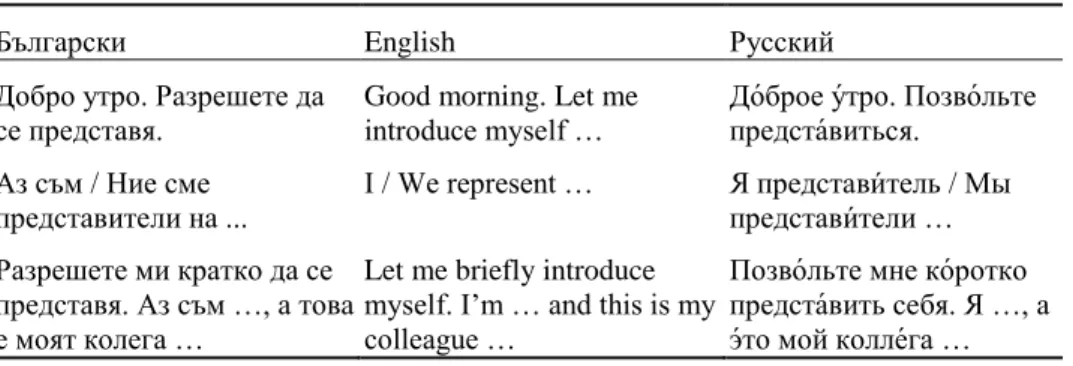
Chapter Five opens with the phrases used in the general introduction of a presentation:
Table 1 General introduction
Български English Русский
Добро утро. Разрешете да се представя.
Good morning. Let me
introduce myself … До брое у тро. озво льте предста виться. Аз съм / Ние сме
представители на ... I / We represent … представи тель / ы представи тели … Разрешете ми кратко да се
представя. Аз съм …, а това е моят колега …
Let me briefly introduce myself. I‟m … and this is my colleague …
озво льте мне ко ротко предста вить себя. …, а э то мой колле га …
The next stage is expressing gratitude for the invitation to speak:
Table 2 Gratitude for invitation
Български English Русский
За мен е голяма чест да
говоря пред вас днес. It‟s a great honour to be able to speak here today ...
Для меня больша я честь выступа ть пе ред ва ми сего дня.
Радвам се, че имам възможността да говоря пред Вас.
I‟m glad to have the chance to speak here.
рад, что у меня есть возмо жность вы ступить пе ред ва ми.
Stage three is the actual opening of the oral presentation. It is extremely important although it occupies a very small part of the presentation. However, listeners form their impression of the speaker at this early stage. Therefore alternative openings could be very appropriate.
Table 3 Opening
Български English Русский
В следващите десет минути бих искал да изложа причините за ...
For the next ten minutes or so, I‟d like to give you some of the reasons why …
В сле дующие де сять мину т я хоте л бы изложи ть причи ны …
В презентацията си ще се
спра на ... In my talk, I‟m going to focus on … В презента ции я остановлю сь на … оята цел днес е да ... My purpose / objective today
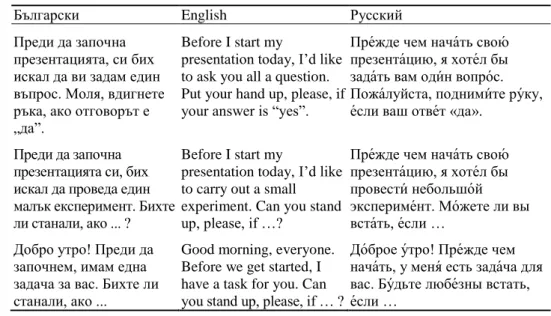
Table 4 Alternative ways to open an oral presentation
Български English Русский
реди да започна презентацията, си бих искал да ви задам един въпрос. оля, вдигнете ръка, ако отговорът е „да”.
Before I start my
presentation today, I‟d like to ask you all a question. Put your hand up, please, if your answer is “yes”.
ре жде чем нача ть свою презента цию, я хоте л бы зада ть вам оди н вопро с. ожа луйста, подними те ру ку, е сли ваш отве т «да».
реди да започна презентацията си, бих искал да проведа един малък експеримент. Бихте ли станали, ако ... ?
Before I start my
presentation today, I‟d like to carry out a small experiment. Can you stand up, please, if …?
ре жде чем нача ть свою презента цию, я хоте л бы провести небольшо й экспериме нт. о жете ли вы вста ть, е сли …
Добро утро! реди да започнем, имам една задача за вас. Бихте ли станали, ако ...
Good morning, everyone. Before we get started, I have a task for you. Can you stand up, please, if … ?
До брое у тро! ре жде чем нача ть, у меня есть зада ча для вас. Бу дьте любе зны встать, е сли …
Obviously the opening has several functions: to capture the audience‟s attention, to set the mood and tone of the speech, to demonstrate the importance of the topic. It will almost always give the listeners an idea of the upcoming main points. The overview of the presentation includes the main themes and subthemes of a presentation connected with linking words. It must be delivered with deliberate pauses at the right places in order to create maximum impact and get the audience‟s attention. The overview can be introduced in the following way:
Table 5 Overview
Български English Русский
Ще започна с обзор на последните ни проекти, след това ще ви дам данни за ... и ще завърша с бъдещите планове.
I‟ll begin with an overview of our latest projects, then I‟ll brief you on ... and I‟ll finish off with an outlook on the future plans.
начну с обзо ра на ших после дних прое ктов, пото м я приведу да нные о … и зако нчу пла нами на бу дущее.
Разделил съм
презентацията на три основни части. Бих искал да започна с ..., след това ... и накрая ...
I‟ve divided my presentation into three main parts.
I would like to begin / start with … and then … and lastly … раздели л свою презента цию на три основны е ча сти. Ще разгледам следните
три области.
I‟ll be covering the following three main areas.
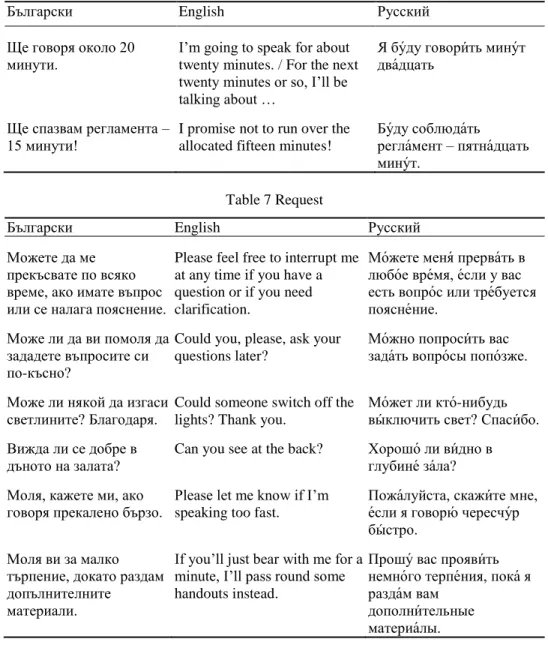
The introductory part also includes three short stages which are not central to the main topic of the presentation but focus on important procedural issues, requests to the audience and distribution of handouts.
Table 6 Procedure
Български English Русский
Ще говоря около 20
минути. I‟m going to speak for about twenty minutes. / For the next twenty minutes or so, I‟ll be talking about …
бу ду говори ть мину т два дцать
Ще спазвам регламента – 15 минути!
I promise not to run over the allocated fifteen minutes!
Бу ду соблюда ть регла мент – пятна дцать мину т.
Table 7 Request
Български English Русский
ожете да ме прекъсвате по всяко време, ако имате въпрос или се налага пояснение.
Please feel free to interrupt me at any time if you have a question or if you need clarification.
о жете меня прерва ть в любо е вре мя, е сли у вас есть вопро с или тре буется поясне ние.
оже ли да ви помоля да зададете въпросите си по-късно?
Could you, please, ask your
questions later? о жно попроси ть вас зада ть вопро сы попо зже.
оже ли някой да изгаси светлините? Благодаря.
Could someone switch off the lights? Thank you.
о жет ли кто -нибудь вы ключить свет? паси бо. Вижда ли се добре в
дъното на залата?
Can you see at the back? орошо ли ви дно в глубине за ла? оля, кажете ми, ако
говоря прекалено бързо. Please let me know if I‟m speaking too fast. ожа луйста, скажи те мне, е сли я говорю чересчу р бы стро.
оля ви за малко търпение, докато раздам допълнителните
материали.
If you‟ll just bear with me for a minute, I‟ll pass round some handouts instead.
рошу вас прояви ть немно го терпе ния, пока я разда м вам
Table 8 Handouts
Български English Русский
Ще раздам копия на слайдовете, за да си водите бележки по време на презентацията.
I‟ll pass round copies of my slides so you can make notes as you go through the presentation.
разда м экземпля ры сла йдов, что бы вы могли вести заме тки / составля ть конспе кт в хо де
презента ции. Няма нужда да си водите
бележки, тъй като ще раздадем брошура с презентацията.
You don‟t need to take notes as we‟ll be handing our
presentation booklet.
Не на до составля ть конспе кт, так как мы дади м вам брошю ру с презента цией.
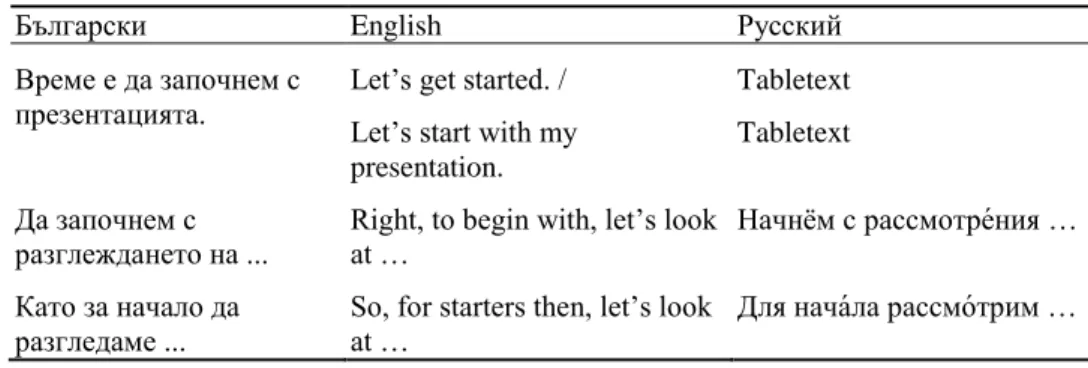
The main body of a presentation covers the lead-in stage and the transitions from one point to another making use of discourse and sequential markers to connect ideas. They are important because they let the audience know that something new is coming or there will be a change of direction. There is a frequent use of the suggestion form of the verb which helps to build more of a connection between the speaker and the audience; it suggests to the audience that they are part of the presentation, not just passive recipients.
Table 9 Lead-in
Български English Русский
Време е да започнем с
презентацията. Let‟s get started. / Let‟s start with my
presentation.
Tabletext
Tabletext
Да започнем с
разглеждането на ... Right, to begin with, let‟s look at … Начнѐм с рассмотре ния … Като за начало да
разгледаме ... So, for starters then, let‟s look at … Для нача ла рассмо трим …
Table 10 Transition
Български English Русский
Бих искал да премина към следващата част на презентацията, която е ...
Now, I‟d like to move on to the next part of my presentation, which is …
хоте л бы перейти к сле дующей ча сти презента ции, кото рая представля ет собо й … Това ни отвежда към
следващата точка: ...
This leads us to my next point:
… то приво дит нас к сле дующему вопро су: ... лед като разгледахме
..., да се спрем на ...
Now that we have looked at …
The main body of a presentation reveals clearly the multimodal nature of the genre of academic presentations. There is a complex interplay between text and visuals. These graphic devices are used to illustrate or support ideas as research on human cognition has shown that the more sensory routes we use to process data, the more likely we are to recall that data later on. However, visuals should be introduced with care and in such a way as to help focus the audience‟s attention not distract it from the main information
Table 11 Referring to visual aids
Български English Русский
Графиката ясно показва ...
This graph clearly shows … Гра фика я сно пока зывает … Както виждате, колоната
отляво / отдясно показва ...
As you can see, the column on
the left / right shows … Как ви дите, сто лбик сле ва / спра ва пока зывает …
Тази таблица ни дава представа за ...
This table provides an
overview of … та табли ца даѐт нам представле ние о …
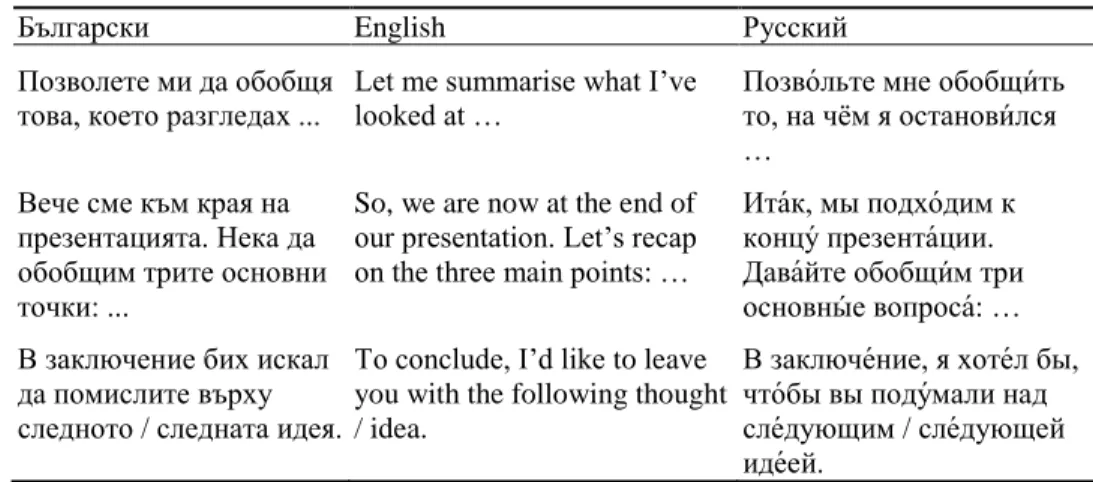
The final stage of a presentation is the conclusion which is an especially important part. The reason is that the audience members have a tendency to listen carefully to this final part and consider what is said as important. Because of this, the conclusion has three essential functions: to review the thesis (by repeating or paraphrasing it), to review the main points and to provide a memorable final remark or summary of the presentation.
Table 12 Conclusion
Български English Русский
озволете ми да обобщя
това, което разгледах ... Let me summarise what I‟ve looked at … озво льте мне обобщи ть то, на чѐм я останови лся …
Вече сме към края на презентацията. Нека да обобщим трите основни точки: ...
So, we are now at the end of our presentation. Let‟s recap on the three main points: …
та к, мы подхо дим к концу презента ции. Дава йте обобщи м три основны е вопроса : … В заключение бих искал
да помислите върху следното / следната идея.
To conclude, I‟d like to leave you with the following thought / idea.
The closing remarks are the very last stage of a presentation. They signal to the audience that the presentation is going to stop. The presenter may thank the audience for their attention, ask them if they liked the talk and invite questions.
Table 13 Closing remarks
Български English Русский
Надявам се, че сте харесали презентацията ми. Ако някой има въпроси, ще се постарая да им отговоря.
I hope you‟ve enjoyed my presentation today. If anyone has any questions, I‟ll do my best to answer them.
наде юсь, вам
понра вилась презента ция. Е сли у вас есть вопро сы, я постара юсь отве тить.
Благодаря за вниманието.
Thank you for your attention. /
Thanks very much for your attention. /
Thank you for listening.
паси бо за внима ние.
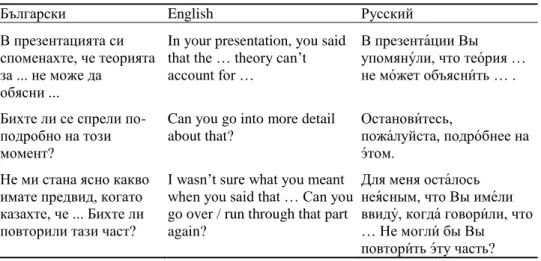
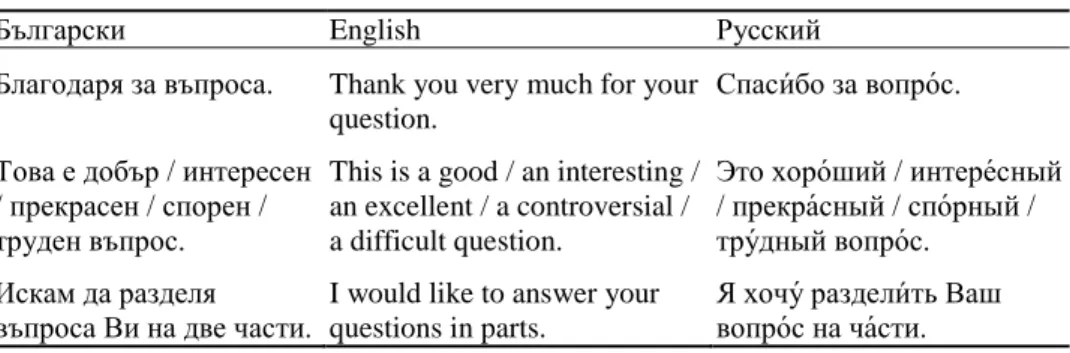
Another important stage of a presentation is dealing with questions and answers. It is a common practice for presenters to invite questions in the final part of the presentation. However, there are different reasons why questions are asked, e.g., because we didn‟t understand; because something the speaker said made us think of a related point; because we want to have a more detailed explanation, etc. Thеsе refer to three question types. Although not absolutely necessary to do so, people do not start asking the question by directly referencing something that the speaker actually said. The question is often prefaced with an explicit question marker. When answering questions the presenter should preface each question with acknowledgement to suit each question type.
Table 14 Questions
Български English Русский
В презентацията си споменахте, че теорията за ... не може да
обясни ...
Бихте ли се спрели по-подробно на този момент?
In your presentation, you said that the … theory can‟t account for …
Can you go into more detail about that?
В презента ции Вы упомяну ли, что тео рия … не мо жет объясни ть … .
станови тесь,
пожа луйста, подро бнее на э том.
Не ми стана ясно какво имате предвид, когато казахте, че ... Бихте ли повторили тази част?
I wasn‟t sure what you meant when you said that … Can you go over / run through that part again?
Table 15 Dealing with answers
Български English Русский
Благодаря за въпроса. Thank you very much for your
question. паси бо за вопро с.
Това е добър / интересен / прекрасен / спорен / труден въпрос.
This is a good / an interesting / an excellent / a controversial / a difficult question.
то хоро ший / интере сный / прекра сный / спо рный / тру дный вопро с.
скам да разделя въпроса Ви на две части.
I would like to answer your questions in parts.
хочу раздели ть Ваш вопро с на ча сти.
The above mentioned illustrations clearly show that Chapter Five of Key to Success:
the Language of Academic Communication makes readers aware of the main stages of an
oral presentation, provides key phrases and formulae, introduces specific linguistic devices to create more impact. By following these stages or „genre moves‟, using the phrases and paying attention to variety in language usage academics would be able to produce their own effective presentations.
The remaining six chapters of the handbook are organized along the same lines. They cover such topics as first contact by formal letters, e-mails and telephone conversations, the scientific conference and discussion session, and scholarly writing viewing them as a set of genre moves. The handbook also includes a glossary of culture specific academic terminology and a set of appendices. It can be considered as a practical guide in the field of EAP and a tool to promote the policy of inclusion in the international scientific exchange of research and ideas.
5. CONCLUSION
REFERENCES
Adler, R. & Rodman, G. Understanding Human Communication. 9th edn. Oxford, New York: OUP. 2006.
Alexander, O., & Argent, S. & Spencer, J. EAP Essentials. A teacher’s guide to
principles and practice. Reading: Garnet Publishing Ltd. 2008.
Charles, M. English for Academic Purposes. In B. Paltridge & S. Starfield (Eds.), The Handbook of English for Specific Purposes 1 (2013): 137-153.
Connor, U. & Rozycki, W. ESP and Intercultural Rhetoric. In B. Paltridge & S. Starfield (Eds.), The Handbook of English for Specific Purposes 1 (2013): 427 - 443.
Flowerdew, J. English for Research Publication Purposes. In B. Paltridge & S. Starfield (Eds.), The Handbook of English for Specific Purposes 1 (2013): 310 - 321.
Simpson-Vlach, R. & Ellis, N. An academic formulas list: New methods in phraseology research. Applied Linguistics 31(2010): 487 - 512.
Swales, J. Genre Analysis. Cambridge: Cambridge University Press. 1990.
Swales, J. Research Genres: Exploration and Analysis. Cambridge: Cambridge University Press. 2004.
Paltridge, B. Genre and English for Specific Purposes. In B. Paltridge & S. Starfield (Eds.), The Handbook of English for Specific Purposes 1 (2013): 348 - 366.
авродиева, ., Й. Тишева. Академичната комуникация. К „ Е АРШ”. офия. 2010.